Psalms 10:9

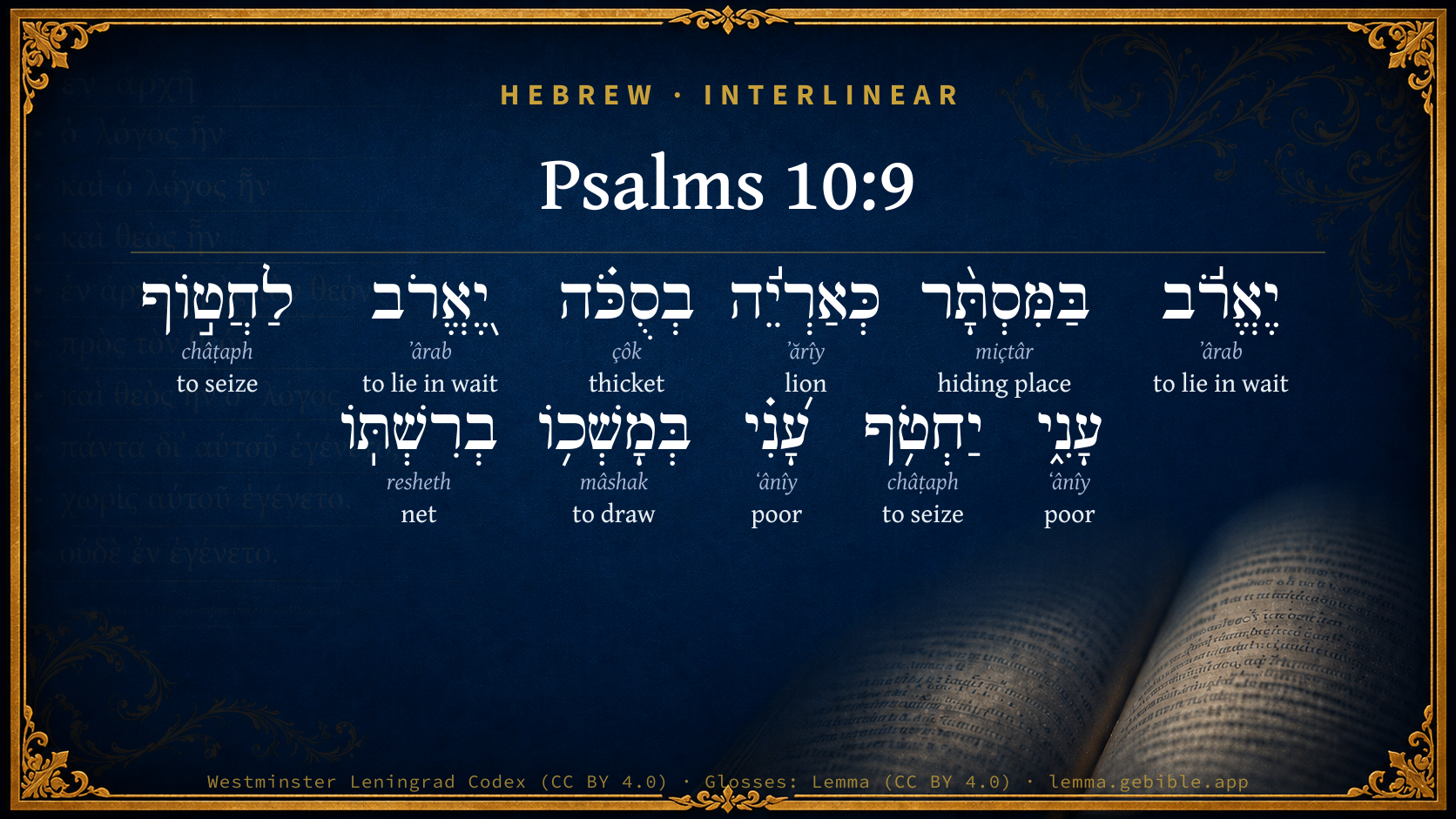
Hebrew (Westminster Leningrad Codex) Psalms 10:9 appears in the Hebrew Old Testament. The text above is from the Westminster Leningrad Codex. Each word links to its Strong’s number, a concise gloss, and parsing drawn from the Open Scriptures Hebrew Bible morphology. Click any word for its full Brown-Driver-Briggs (BDB) entry.
Download image
Cite this verse

Psalms 10:9 (World English Bible). Public Domain. Lemma interlinear Bible study tool, https://lemma.gebible.app/v/psalms/10/9.

Show BibTeX & RIS
BibTeX
RIS
English Translation
He lurks in secret as a lion in his ambush. He lies in wait to catch the helpless. He catches the helpless, when he draws him in his net.
World English Bible · Public Domain
Highlights
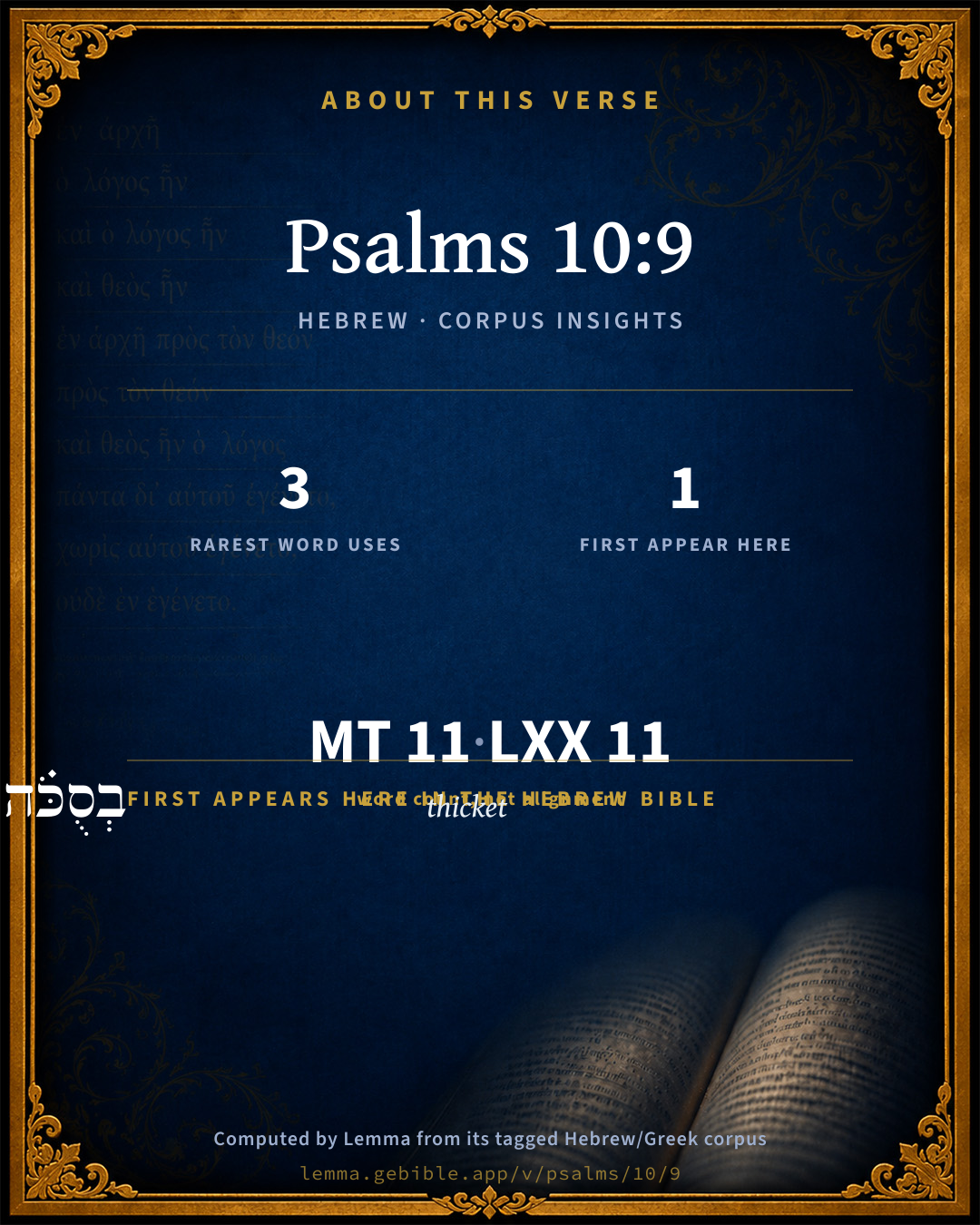
  • 1 first appearance in the Hebrew Bible
Full analysis ↓
Download a study sheet

One document with this verse’s original text, its word-by-word gloss line, the meaning frame, cross-references with their text, attributed commentary, and full source and license credits — printable, and it pastes into notes with its structure intact.

This verse Autodidact and up

Study sheet (.html) Plain text (.txt)

A passage Seminary Student

Up to 50 verses in one chapter. A passage sheet keeps up to 6 commentary sources and 12 cross-references per verse, in the order this page ranks them, and says so on the sheet whenever that leaves anything out. Ask for a single verse and you get the Autodidact verse sheet above.

Everything on this page stays free to read, with no account — the sheet is a download of what is already on screen, not access to it.

Want to remove ads? Support Godless Engineer
Compare translations 3

The same verse in 3 English versions, stacked beneath the original-language interlinear above. Click any original word for its lexicon entry.

Each is an independent rendering of the whole verse — the interlinear is not word-aligned to these translations.

Highlighted words mark where these versions differ — a whole-verse word diff, not a word-by-word alignment.

  • World English Bible Public Domain
    He lurks in secret as a lion in his ambush. He lies in wait to catch the helpless. He catches the helpless, when he draws him in his net.
  • King James Version Public Domain
    He lieth in wait secretly as a lion in his den: he lieth in wait to catch the poor: he doth catch the poor, when he draweth him into his net.
  • unfoldingWord Literal Text CC BY-SA 4.0
    He ambushes in a secret place like a lion in cover; he ambushes to seize the afflicted. He seizes the afflicted by pulling in his net.

unfoldingWord Literal Text — © unfoldingWord, licensed CC BY-SA 4.0. Word-aligned USFM3 via Door43 (git.door43.org/unfoldingWord/en_ult).

Versions to compare (up to 4)

3 of 4 selected

Show all 17 translations

Every available English version of this verse, each an independent rendering of the whole verse.

  • World English Bible Public Domain
    He lurks in secret as a lion in his ambush. He lies in wait to catch the helpless. He catches the helpless, when he draws him in his net.
  • Berean Standard Bible Public Domain
    He lies in wait like a lion in a thicket; he lurks to seize the oppressed; he catches the lowly in his net.
  • Majority Standard Bible Public Domain
    He lies in wait like a lion in a thicket; he lurks to seize the oppressed; he catches the lowly in his net.
  • King James Version Public Domain
    He lieth in wait secretly as a lion in his den: he lieth in wait to catch the poor: he doth catch the poor, when he draweth him into his net.
  • American Standard Version (1901) Public Domain
    He lurketh in secret as a lion in his covert; He lieth in wait to catch the poor: He doth catch the poor, when he draweth him in his net.
  • Revised Version (1885) Public Domain
    He lurketh in the covert as a lion in his den: he lieth in wait to catch the poor: he doth catch the poor, when he draweth him in his net.
  • Geneva Bible (1599) Public Domain
    He lyeth in waite secretly, euen as a lyon in his denne: he lyeth in waite to spoyle the poore: he doeth spoyle the poore, when he draweth him into his net.
  • Young's Literal Translation Public Domain
    He lieth in wait in a secret place, as a lion in a covert. He lieth in wait to catch the poor, He catcheth the poor, drawing him into his net.
  • Literal Standard Version CC BY-SA 4.0
    He lies in wait in a secret place, as a lion in a covert. He lies in wait to catch the poor, || He catches the poor, drawing him into his net.
  • Unlocked Literal Bible CC BY-SA 4.0
    He lurks in secret like a lion in the thicket; he lies in wait to catch the oppressed. He catches the oppressed when he pulls in his net.
  • unfoldingWord Literal Text CC BY-SA 4.0
    He ambushes in a secret place like a lion in cover; he ambushes to seize the afflicted. He seizes the afflicted by pulling in his net.
  • Darby Bible Public Domain
    He lieth in wait secretly, like a lion in his thicket; he lieth in wait to catch the afflicted: he doth catch the afflicted, drawing him into his net.
  • World Messianic Bible Public Domain
    He lurks in secret as a lion in his ambush. He lies in wait to catch the helpless. He catches the helpless when he draws him in his net.
  • Webster's Bible Public Domain
    He lieth in wait secretly as a lion in his den: he lieth in wait to catch the poor: he doth catch the poor, when he draweth him into his net.
  • Free Bible Version CC BY-SA 4.0
    They lie in ambush like a lion ready to attack, ready to leap out from their hiding place to seize their victim. They capture the helpless, throwing a net over them.
  • Bible in Basic English Public Domain
    He keeps himself in a secret place like a lion in his hole, waiting to put his hands on the poor man, and pulling him into his net.
  • JPS Tanakh (1917) Public Domain
    He lieth in wait in a secret place as a lion in his lair, he lieth in wait to catch the poor; he doth catch the poor, when he draweth him up in his net.

Literal Standard Version (2020), Covenant Press — licensed CC BY-SA 4.0. Text via the HelloAO Bible API (eBible.org). Unlocked Literal Bible (unfoldingWord) — licensed CC BY-SA 4.0. Text via the HelloAO Bible API (eBible.org). unfoldingWord Literal Text — © unfoldingWord, licensed CC BY-SA 4.0. Word-aligned USFM3 via Door43 (git.door43.org/unfoldingWord/en_ult). Free Bible Version, Dr. Jonathan Gallagher — licensed CC BY-SA 4.0. Text via the HelloAO Bible API (eBible.org).

Word by word

More ways to search: Search by grammar → Find every occurrence → Compare this word →

Practice this passage: Drill this verse → Learn its vocabulary →

לַחֲט֣וֹף
châṭaph
H2414
“to seize”
Preposition + Verb, Qal, Infinitive Construct
Part of Speech
Preposition + Verb
Stem
Qal
Form
Infinitive Construct
Full BDB Definition

Origin: a primitive root

TWOT: 642

(Qal) to catch, seize
  1. יֶאֱרֹ֬ב ʼârab H693 “to lie in wait” Verb, Qal, Imperfect, 3rd Person, Masculine, Singular
  2. בַּמִּסְתָּ֨ר miçtâr H4565 “in/at the · hiding place” Preposition, Determined + Noun, Common, Masculine, Singular, Absolute
  3. כְּאַרְיֵ֬ה ʼărîy H738 “like/as · lion” Preposition + Noun, Common, Masculine, Singular, Absolute
  4. בְסֻכֹּ֗ה çôk H5520 “in/at · thicket · his” Preposition + Noun, Common, Masculine, Singular, Construct + Suffix, Personal, 3rd Person, Masculine, Singular
  5. יֶ֭אֱרֹב ʼârab H693 “to lie in wait” Verb, Qal, Imperfect, 3rd Person, Masculine, Singular
  6. עָנִ֑י ʻânîy H6041 “poor” Adjective, Adjective, Masculine, Singular, Absolute
  7. יַחְטֹ֥ף châṭaph H2414 “to seize” Verb, Qal, Imperfect, 3rd Person, Masculine, Singular
  8. עָ֝נִ֗י ʻânîy H6041 “poor” Adjective, Adjective, Masculine, Singular, Absolute
  9. בְּמָשְׁכ֥וֹ mâshak H4900 “in/at · to draw · him” Preposition + Verb, Qal, Infinitive Construct + Suffix, Personal, 3rd Person, Masculine, Singular
  10. בְרִשְׁתּֽוֹ resheth H7568 “in/at · net · his” Preposition + Noun, Common, Feminine, Singular, Construct + Suffix, Personal, 3rd Person, Masculine, Singular

About this verse

These counts appear in no published source. They are computed here, from the morphology-tagged text and Lemma’s own curated glosses. What Lemma adds →

11
words
8
distinct lemmas
Wisdom
section

Notable vocabulary

The rarest word here is לַחֲט֣וֹף to seize H2414 — appearing just 3 times in the whole Hebrew Bible.

First appearance in Scripture

This word makes its first canonical appearance in the Hebrew Bible here:

  • בְסֻכֹּ֗ה thicket H5520

Shared distinctive vocabulary

לַחֲט֣וֹף to seize H2414 occurs in 2 verses of the Hebrew Bible. Also found in:

Grammatical profile

  • 5 verbs
  • 4 nouns
  • 2 adjectives

Verb forms

  • יֶאֱרֹ֬ב Qal · Imperfect
  • יֶ֭אֱרֹב Qal · Imperfect
  • לַחֲט֣וֹף Qal · Infinitive Construct
  • יַחְטֹ֥ף Qal · Imperfect
  • בְּמָשְׁכ֥וֹ Qal · Infinitive Construct

Repetition

Words recur within this verse — often emphatic in Hebrew:

  • יֶאֱרֹ֬ב to lie in wait H693 ×2
  • לַחֲט֣וֹף to seize H2414 ×2
  • עָנִ֑י poor H6041 ×2

Hebrew & Septuagint length

In English translation the verse runs 29 words from the Hebrew and 15 from the Septuagint (LXX English) — closely comparable.

A rough comparison of the two English renderings, which tokenize alike — not a word-level alignment.

Word counts can differ between the Hebrew and the Greek without any difference in meaning — e.g. the Hebrew direct-object marker אֵת has no separate Greek word, and Greek often adds the article ὁ.

In the original languages it is 11 Hebrew tokens and 11 Greek tokens — but the two are counted differently (Hebrew bundles its prefixes and suffixes into one token; the Greek is in lemma form), so that isn’t a like-for-like length.

Cross-references

26

Topical passages linked to Psalms 10:9 in the Treasury of Scripture Knowledge — connected by theme and wording, ordered by reader-vote popularity; previews shown in the World English Bible.

  • Psalms 17:12 He is like a lion that is greedy of his prey, As it were a young lion lurking in secret places.
  • Psalms 59:3 For, behold, they lie in wait for my soul. The mighty gather themselves together against me, Not for my disobedience, nor for my sin, Yahweh.
  • Micah 7:2 The godly man has perished out of the earth, And there is no one upright among men. They all lie in wait for blood; Every man hunts his brother with a net.
  • Psalms 35:10 All my bones shall say, "Yahweh, who is like you, Who delivers the poor from him who is too strong for him, Yes, the poor and the needy from him who robs him?"
  • Job 5:15–16 But he saves from the sword of their mouth, Even the needy from the hand of the mighty.
  • Psalms 12:5 "Because of the oppression of the weak and because of the groaning of the needy, I will now arise," says Yahweh; "I will set him in safety from those who malign him."
  • Psalms 140:5 The proud have hidden a snare for me, They have spread the cords of a net by the path. They have set traps for me. Selah.
  • Proverbs 14:31 He who oppresses the poor shows contempt for his Maker, But he who is kind to the needy honors him.
  • Proverbs 22:16 Whoever oppresses the poor for his own increase and whoever gives to the rich, Both come to poverty.
  • Proverbs 28:15 As a roaring lion or a charging bear, So is a wicked ruler over helpless people.
  • Isaiah 3:15 What do you mean that you crush my people, And grind the face of the poor?" says the Lord, Yahweh of Hosts.
  • Isaiah 32:7 The instruments of the churl are evil: he devises wicked devices to destroy the humble with lying words, even when the needy speaks right.
  • Lamentations 3:10 He is to me as a bear lying in wait, as a lion in secret places.
  • Ezekiel 22:29 The people of the land have used oppression, and exercised robbery; yes, they have vexed the poor and needy, and have oppressed the foreigner wrongfully.
  • Amos 2:6–7 Thus says Yahweh: "For three transgressions of Israel, yes, for four, I will not turn away its punishment; Because they have sold the righteous for silver, And the needy for a pair of shoes;
  • Amos 3:4 Will a lion roar in the thicket, When he has no prey? Does a young lion cry out of his den, If he has caught nothing?
  • Amos 5:11–12 Forasmuch therefore as you trample on the poor, And take taxes from him of wheat: You have built houses of hewn stone, But you will not dwell in them. You have planted pleasant vineyards, But you shall not drink their wine.
  • Nahum 2:11–12 Where is the den of the lions, and the feeding-place of the young lions, where the lion and the lioness walked, the lion's cubs, and no one made them afraid?
  • Habakkuk 3:14 You pierced the heads of his warriors with their own spears. They came as a whirlwind to scatter me, Gloating as if to devour the wretched in secret.
  • Zechariah 11:3 A voice of the wailing of the shepherds! For their glory is destroyed: a voice of the roaring of young lions! For the pride of the Jordan is ruined.
  • John 10:12 He who is a hired hand, and not a shepherd, who doesn't own the sheep, sees the wolf coming, leaves the sheep, and flees. The wolf snatches the sheep, and scatters them.
  • Psalms 37:14 The wicked have drawn out the sword, and have bent their bow, To cast down the poor and needy, To kill those who are upright in the way.
  • Jeremiah 5:26 For among my people are found wicked men: they watch, as fowlers lie in wait; they set a trap, they catch men.
  • Ezekiel 19:3–6 She brought up one of her cubs: he became a young lion, and he learned to catch the prey; he devoured men.
  • Habakkuk 1:15 He takes up all of them with the hook. He catches them in his net, and gathers them in his dragnet. Therefore he rejoices and is glad.
  • Acts 23:21 Therefore don't yield to them, for more than forty men lie in wait for him, who have bound themselves under a curse neither to eat nor to drink until they have killed him. Now they are ready, looking for the promise from you."

Cross-references courtesy of OpenBible.info (CC BY 4.0).

Hebrew and Greek witnesses Masoretic Hebrew ↔ Greek Septuagint

The same verse in the two great witnesses to the Old Testament, shown verse-for-verse.

You’re reading Greek Psalm 9 (Hebrew Psalm 10). The Septuagint counts the superscription, so verse numbers can differ from the Hebrew — chapter-level alignment, not verse-by-verse. Numbering follows Rahlfs.

These are two independent witnesses, not word-aligned to each other, and the Septuagint is shown in lemma (dictionary) form.

Hebrew Psalms 10:9 Masoretic · Westminster Leningrad Codex

יֶאֱרֹ֬ב בַּמִּסְתָּ֨ר כְּאַרְיֵ֬ה בְסֻכֹּ֗ה יֶ֭אֱרֹב לַחֲט֣וֹף עָנִ֑י יַחְטֹ֥ף עָ֝נִ֗י בְּמָשְׁכ֥וֹ בְרִשְׁתּֽוֹ

He lurks in secret as a lion in his ambush. He lies in wait to catch the helpless. He catches the helpless, when he draws him in his net.

World English Bible · Public Domain

Greek LXX Greek Psalm 9:9 Septuagint · lemma form

καί αὐτός κρίνω ὁ οἰκέω ἐν δικαιοσύνη κρίνω λαός ἐν εὐθύτης

The Lord also is become a refuge for the poor, a seasonable help, in affliction.

LXX2012 (modern English Septuagint) · Public Domain

Hebrew: Westminster Leningrad Codex (CC BY 4.0). Greek: Septuagint (public domain); English from LXX2012 (modern English Septuagint) (Public Domain). How the Septuagint differs from the Hebrew →

Commentary

Notes on Psalms 10:9 from classic Christian and Jewish commentators (each source and its license shown beneath its notes). The classic Christian expositions comment on the surrounding passage and are grouped to its opening verse, so a note may address several verses; the Jewish commentaries on the Tanakh (Rashi and others) are per-verse, so they appear only where the commentator wrote on this verse.

Lemma curates 59 commentaries, every one of them public domain or Creative Commons licensed, each selected and text-cleaned for this edition rather than reprinted as found. About our sources →

Trapp's Complete Commentary

John Trapp

Psa 10:9 He lieth in wait secretly as a lion in his den: he lieth in wait to catch the poor: he doth catch the poor, when he draweth him into his net.

Ver. 9. He lieth in wait secretly as a lion in his den] See Job 38:40, {See Trapp on "Job 38:40"}

When he draweth him into his net] That is, into his bonds, debts, mortgages, saith Chrysostom. When a poor man is once gotten into these nets, wicked oppressors do not only rob but ravish them; coining their money upon poor men’s skins, and wringing the sponges of poor people into their own purses. David compareth them to cannibals, Psa 14:4, to greedy lions here. Another saith they are like the fish polypus, that lying in wait for other fishes upon the rock, assimilateth to the rock and taketh them in his net, which he hath naturally behind his head, and can spread at his pleasure, before they find themselves in danger (Sir Richard Berkley’s Summum Bonum).

John Trapp, A Commentary or Exposition upon All the Books of the Old and New Testament (1647–1656) — public domain. Text from a community e-Sword module.

John Calvin's Commentaries

In the next verse, he sets forth their cruelty in a light still more aggravated, by another comparison, saying, that they thirst for their prey like lions in their dens Now, it is a step higher in wickedness to equal in cruelty wild beasts than to make havoc after the manner of robbers. It is worthy of remark, that he always joins deceits and snares with violence, in order the better to show how miserable the children of God would be, unless they were succoured by help from heaven. There is also added another similitude, which expresses more clearly how craft in catching victims is mingled with cruelty. They catch them, says he but it is by drawing them into their net By these words he means, that they not only rush upon them with open force and violence, but that, at the same time also, they spread their nets in order to deceive.

John Calvin's Commentaries (1540-1563) — public domain. Text from the Calvin Translation Society English edition (1840s-50s) via the Christian Classics Ethereal Library (ccel.org). Calvin's coverage is partial (roughly two-thirds of the Bible); uncommented books and verses are honest gaps, never fabricated. The 19th-century editor's footnotes and remarks are omitted so the notes are faithfully Calvin's own voice.

Ellicott's Commentary for English Readers

(9) Lieth in wait.—A confusion of metaphor. The wicked is first, the lion watching for his prey, and then the hunter snaring animals. “Poor,” here—better, afflicted (see Psa_9:12). Translate, in his hiding-place he lurks, as a lion in his lair, lurks to seize a sufferer, seizes a sufferer, drawing him into his net.

A Bible Commentary for English Readers, edited by Charles John Ellicott (1878–1897) — public domain. Text from a community e-Sword module.

The Cambridge Bible for Schools and Colleges

gen. ed. J. J. S. Perowne

9. Render:

He lieth in ambush in the secret place as a lion in his lair;

He lieth in ambush to catch the poor:

He catcheth the poor, dragging him off with his net.

The wicked man is now described as a lion, lurking in his lair in the forest till his prey comes near. In the third clause the figure is changed for that of a hunter: probably the victim is dragged off to be sold for a slave.

The Cambridge Bible for Schools and Colleges (gen. ed. J. J. S. Perowne; Cambridge University Press, 1878–1918) — public domain. Text from a community e-Sword module.

John Gill's Exposition

He lieth in wait secretly as a lion,.... The first beast in Rev 13:2; is said to have a mouth like a lion, and the second beast in Psa 10:11; spake like a dragon; and both design one and the same, antichrist, in his twofold capacity, civil and ecclesiastical; this metaphor of the lion lying in wait secretly for his prey denotes the insidious methods used by antichrist to destroy the faithful witnesses of Christ; who lies like a lion

in his den, in the temple of God, now become a den of thieves;

he lieth in wait to catch the poor: to snatch and carry them away captive as his prey; see Rev 13:10;

he doth catch the poor when he draweth him into his net; this metaphor is taken from fowlers, who spread nets, into which they allure and draw the birds and catch them. The allurements, snares, and nets, which antichrist lays to catch the poor saints and people of God in, are the riches and honours of this world, great pretensions to holiness, devotion; and religion, and many lying signs and wonders.

John Gill's Exposition of the Whole Bible (1746–1763) — public domain (CC PDM 1.0). Text via the HelloAO Bible API.

Albert Barnes' Notes on the Bible

He lieth in wait secretly - Margin, in the secret places. See the note at Psa 10:8. The object here is merely to illustrate the thought in the previous verse, by an allusion to a lion and a hunter.

As a lion in his den - As a lion crouches down in his den, ready to spring upon his prey. That is, the lion is concealed, but is on the look out, and when his prey passes near his den, he suddenly springs upon it and secures it. So it is with the wicked man. He carefully lays his plans. He conceals his purposes. He is himself hidden, or his plans are all hidden. Suddenly he springs upon his victim, who is taken by surprise and has no power of defense or escape. The purpose here is not so much to describe the wicked man as a literal robber, as to compare the conduct of the wicked with that of a robber - one who, like a lion or a hunter, lies concealed until his victim is seen. This will describe the conduct of a large class of people - men who secretly lay plans of seduction, villany, and fraud, and who spring suddenly upon their victims when there is no hope of escape.

He lieth in wait to catch the poor - The helpless and defenseless.

He doth catch the poor, when he draweth him into his net - As a hunter does the wild beast. Here the same thought is presented under a new image - that of a hunter. He lays his snare, gin, or pit-fall, and when the animal is allured into it, he springs the net suddenly on him, or the animal sinks into the pit, and is secured. See the note at Psa 7:15; the note at Psa 9:15.

Albert Barnes' Notes on the Bible (1834–1885) — public domain. Text from a community e-Sword/MySword module.

Matthew Poole's English Annotations

As a lion in his den, where he lurks and waits for prey.

He doth catch, or snatch, or seize upon, to wit, with violence, and to devour or destroy him.

When he draweth him; or, by drawing him; or, after he hath drawn him. He layeth snares for him, and when he takes him, tears him in pieces.

Matthew Poole's English Annotations on the Holy Bible (1683–1685) — public domain. Text from a community e-Sword/MySword module.

The Treasury of David

Charles H. Spurgeon

Ver. 9. The picture becomes blacker, for here is the cunning of the lion, and of the huntsman, as well as the stealthiness of the robber. Surely there are some men who come up to the very letter of this description. With watching, perversion, slander, whispering, and false swearing, they ruin the character of the righteous, and murder the innocent; or, with legal quibbles, mortgages, bonds, writs, and the like, they catch the poor, and draw them into a net. Chrysostom was peculiarly severe upon this last phase of cruelty, but assuredly not more so than was richly merited. Take care, brethren, for there are other traps besides these. Hungry lions are crouching in every den, and fowlers spread their nets in every field. Quarles well pictures our danger in those memorable lines,

"The close pursuers busy hands do plant Snares in thy substance; snares attend thy wants;

Snares in thy credit; snares in thy disgrace; Snares in thy high estate; snares in thy base; Snares tuck thy bed; and snares surround thy board; Snares watch thy thoughts; and snares attack thy word; "

"Snares in thy quiet; snares in thy commotion; Snares in thy diet; snares in thy devotion; Snares lurk in thy resolves; snares in thy doubt; Snares lie within thy heart; and snares without; Snares are above thy head, and snares beneath; Snares in thy sickness; snares are in thy death."

"O Lord! keep thy servants, and defend us from all our enemies!"

Ver. 9. He doth catch the poor. The poor man is the beast they hunt, who must rise early, rest late, eat the bread of sorrow, sit with many a hungry meal, perhaps his children crying for food, while all the fruit of his pains is served into Nimrod's table. Complain of this while you will, yet, as the orator said of Verres, pecuniosus nescit damnari. Indeed, a money man may not be damnified, but he may be damned. For this is a crying sin, and the wakened ears of the Lord will hear it, neither shall his provoked hands forbear it. Si tacuerint pauperes loquentur lapides. If the poor should hold their peace, the very stones would speak. The fines, rackings, enclosures, oppressions, vexations, will cry to God for vengeance. "The stone will cry out of the wall, and the beam out of the timber shall answer it." Hab 2:11. You see the beasts they hunt. Not foxes, not wolves, nor boars, bulls, nor tigers. It is a certain observation, no beast hunts its own kind to devour it. Now, if these should prosecute wolves, foxes, &c., they should then hunt their own kind; for they are these themselves, or rather worse than these, because here homo homini lupus. But though they are men they hunt, and by nature of the same kind, they are not so by quality, for they are lambs they persecute. In them there is blood, and flesh, and fleece to be had; and therefore on these do they gorge themselves. In them there is weak armour of defence against their cruelties; therefore over these they may domineer. I will speak it boldly: there is not a mighty Nimrod in this land that dares hunt his equal; but over his inferior lamb he insults like a young Nero. Let him be graced by high ones, and he must not be saluted under twelve score off. In the country he proves a termagant; his very scowl is a prodigy, and breeds an earthquake. He would be a Caesar, and tax all. It is well if he prove not a cannibal! Only Macro salutes Sejanus so long as he is in Tiberius's favour; cast him from that pinnacle, and the dog is ready to devour him. Thomas Adams.

Ver. 9. He draweth him into his net. "They hunt with a net." Mic 7:2. They have their politic gins to catch men; gaudy wares and dark shops (and would you have them love the light that live by darkness, as many shopkeepers?) draw and tole customers in, where the crafty leeches can soon feel their pulses: if they must buy they shall pay for their necessity. And though they plead, We compel none to buy our ware, caveat emptor; yet with fine voluble phrases, damnable protestations, they will cast a mist of error before an eye of simple truth, and with cunning devices hunt them in. So some among us have feathered their nests, not by open violence, but politic circumvention. They have sought the golden fleece, not by Jason's merit, but by Medea's subtlety, by Medea's sorcery. If I should intend to discover these hunter's plots, and to deal punctually with them, I should afford you more matter than you would afford me time. But I limit myself and answer all their plans with Augustine. Their tricks may hold in jure fori, but not in jure poli in the common pleas of earth, not before the king's bench in heaven. Thomas Adams.

Ver. 9. Oppression turns princes into roaring lions, and judges into ravening wolves. It is an unnatural sin, against the light of nature. No creatures do oppress them of their own kind. Look upon the birds of prey, as upon eagles, vultures, hawks, and you shall never find them preying upon their own kind. Look upon the beasts of the forest, as upon the lion, the tiger, the wolf, the bear, and you shall ever find them favourable to their own kind; and yet men unnaturally prey upon one another, like the fish in the sea, the great swallowing up the small. Thomas Brooks.

Ver. 9. The ferocity, craftiness, strength, and activity of Satan.

Ver. 9. (last clause). The Satanic fisherman, his art, diligence, success, etc.

Charles H. Spurgeon's The Treasury of David (1869–1885) — public domain. Psalms only. Text from a community e-Sword/MySword module.

Whedon's Commentary on the Bible

Daniel D. Whedon

9. Secretly as a lion—The figure is now borrowed from the habits of beasts of prey, the most perfect for secrecy, wariness, deceit, and cruelty.

In his den—Rather, in his covert, or covered place, where he watches for prey.

Draweth him into his net—The figure changes to the method of the hunter in catching wild animals.

Daniel D. Whedon (gen. ed.), Commentary on the Old and New Testaments (1874–1909) — public domain. Text from a community e-Sword module.

The Pulpit Commentary

He lieth in wait secretly as a lion in his den; or, he lurks in the covert as a lion in his lair (Kay) a very striking image! He lieth in wait (or, lurks) to catch the poor: he doth catch the poor, when he draweth him into his net; rather, by drawing him into his net. The mode of capture is intended.

The Pulpit Commentary (1880–1919), ed. H.D.M. Spence-Jones & Joseph S. Exell — public domain. Text from a community e-Sword module.

Keil & Delitzsch

C. F. Keil & F. Delitzsch

The picture of the רשׁע, who is become as it were a beast of prey, is now worked out further. The lustrum of the lion is called סך Jer 25:38, or סכּה Job 38:40 : a thicket, from סכך, which means both to interweave and to plait over = to cover (without any connection with שׂך a thorn, Arab. shôk, a thistle). The figure of the lion is reversed in the second line, the עני himself being compared to the beast of prey and the רשׁע to a hunter who drives him into the pit-fall and when he has fallen in hastens to drag him away (משׁך, as in Psa 28:3; Job 24:22) in, or by means of (Hos 11:4, Job 41:1), his net, in which he has become entangled.

Keil & Delitzsch — Biblical Commentary on the Old Testament (1861–1891) — public domain (CC PDM 1.0). Text via the HelloAO Bible API. (Old Testament only.)

J. A. Alexander on Psalms

Joseph Addison Alexander

9. He will lurk in, the hiding-place as a lion in his den; he will lurk (or lie in wait) to catch the sufferer; he will catch the sufferer by drawing him into his net, or in drawing him (towards him) with his net. That the preceding verse contains a simile, and not a description of the enemy as an actual robber, is here rendered evident by the. addition of two new comparisons, applied to the same object. In the first clause he is compared to a lion, in the second to a hunter. See above, on Psa 7:16 (15), Psa 10:16 (15), and below, on Psa 35:7, Psa 57:7 (6). The force of the futures is the same as in the foregoing verse.—His den, his shelter, covert, hiding-place. The Hebrew word is commonly applied to any temporary shed or booth, composed of leaves and branches. He lies in wait to seize the prey, and he succeeds, he accomplishes his purpose. A third possible construction of the last clause is, in his drawing (i.e. when he draws) his net. The whole verse, with the one before it, represents the wicked as employing craft no less than force for the destruction of the righteous.

Joseph Addison Alexander, The Psalms Translated and Explained (1850) — public domain. Text from a community e-Sword module.

Radak

Rabbi David Kimhi (Radak)

He lieth in ambush in the secret place as a lion in his den: He lieth in ambush to catch the poor: He catcheth the poor, when he draweth him in his net. – He likens him to a lion as he crouches in his den and lieth in wait to catch the passer-by or one near at hand, so that they will not (be able to) guard themselves against him and flee from him when they see him; and when he sees the prey he catcheth (it). And (the word) “catching” here means “seizing quickly,” for the wicked sits in ambush in the secret place. Afterwards he compares him with a fowler who spreads his net and stands at a distance from it so that the bird may not be aware of him, and the cords of the net are in his hand, and when the bird falls into the net he closes the net with the cords in his hand and the bird is taken. So is the way of the wicked. Sometimes he will not be in ambush, but will stand at a distance from the roads, so that men may not beware of him; and then when he sees the poor and the helpless he rushes upon them. Or he stations some members of his band on the roads without any weapons, while he himself is with the armed men some distance off. Then as defenceless people pass these give them a signal and they come; and they (the decoys) are to them as the net to the fowler. He tells of yet another way the wicked adopts, and this is what he says:

Radak on the Tanakh — English translations: “Sefaria Community Translation” (CC0 1.0 (public-domain dedication)); “Eliyahu Munk, HaChut Hameshulash” (CC BY 4.0); “Rabbi Mike Feuer, Jerusalem Anthology” (CC BY 4.0); and “R. David Kimhi on the first book of Psalms, Translated by R.G. Finch, London, 1919” (public domain). Text via Sefaria.

Lesson kit

Teaching starters — assembled from the data on this page, not authored interpretation. Every prompt links to the verse data it draws on. Edit before teaching.

Psalms, in the Wisdom, opens this verse with 11 words (8 distinct Hebrew lemmas). Its most distinctive word is châṭaph (“to seize”). A historical commentator’s framing appears above. Read the whole chapter for the surrounding context.

Discussion questions

  1. How does “to seize” (châṭaph) shape what this verse is saying?
  2. The word “thicket” first appears here in Scripture. What is being introduced at this debut?
  3. Judges 21:21 shares the word «to seize» with this verse. How do the two illuminate each other?
  4. “to lie in wait” occurs 2× in this one verse. What is the effect of the repetition?
  5. The translations on this page render this verse differently — a whole-verse word diff, not a word-by-word alignment. What might account for the different wordings?
  6. The verb «יֶאֱרֹ֬ב» is Qal Imperfect. How does its form color the action?
  7. Reading how Trapp's Complete Commentary and John Calvin's Commentaries read this verse, where do the two commentators agree and where do they part?

Things to notice

Reading settings

Reading text

Shown beneath each verse's original-language words.

Old Testament
Old Testament edition

Read the OT as the Masoretic Hebrew (MT) or the Greek Septuagint (LXX).

English shown for the Greek Septuagint (in the Hebrew ↔ Greek comparison).

Comparing translations? Open the Compare panel on any verse page to stack up to four side by side.