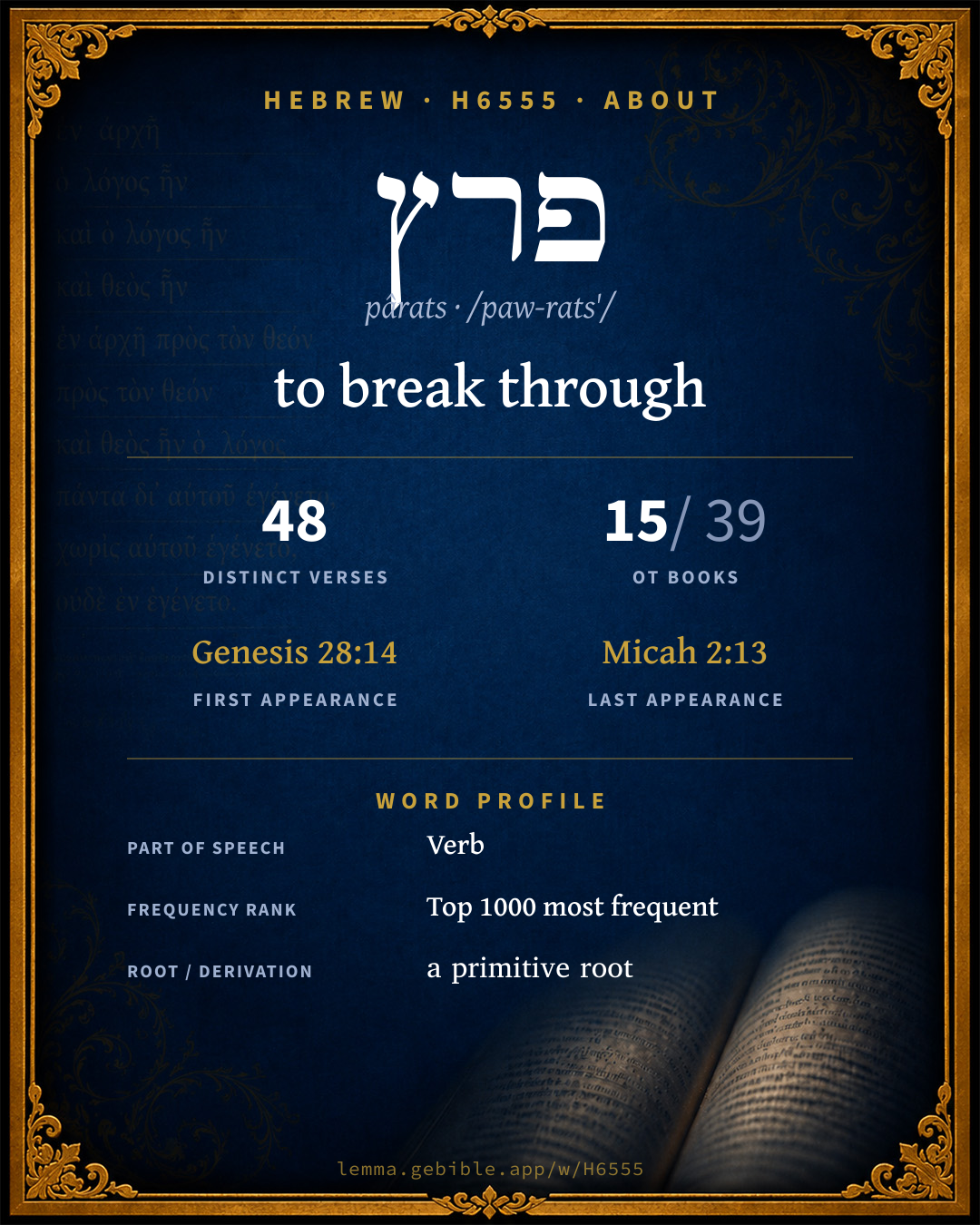
פָּרַץ
to break through
‘to break through’ is one of 4 main senses fuller range ↓
Full lexicon entry — Brown-Driver-Briggs (BDB)
From Brown-Driver-Briggs (BDB)
Where this word appears
See every Qal verb in the Hebrew Bible →
Grammar key — what these labels mean
Part of speech
- Verb
- An action or state-of-being word.
Stem
- Qal
- The basic, simple active stem — the plain form of the verb (“he wrote”).
- Pual
- The passive counterpart of the Piel.
- Hithpael
- The reflexive or reciprocal stem (the subject acts on itself).
- Niphal
- Usually the simple passive or reflexive of the Qal (“he was written”).
Form
- Sequential Imperfect
- An imperfect with prefixed waw — the standard past-narrative form (waw-consecutive imperfect).
- Perfect
- A completed action or state — Hebrew marks aspect (completeness) more than strict tense (“he wrote”).
- Imperfect
- An incomplete, ongoing, or future action (“he will / would write”).
- Infinitive Construct
- A bound verbal noun, frequently with prepositions (“to write / in writing”).
- Sequential Perfect
- A perfect with prefixed waw continuing a preceding imperfect or command (waw-consecutive perfect).
- Participle Active
- A verbal adjective expressing ongoing or characteristic action (“writing / one who writes”).
- Participle Passive
- A verbal adjective expressing action received (“written”).
- Infinitive Absolute
- An unbound verbal noun, often intensifying or standing in for a finite verb.
- Cohortative
- A first-person volitional form expressing wish or resolve (“let me / let us write”).
State
- Absolute
- The independent form of a noun, not bound to a following word.
Person
- 3rd Person
- The one spoken about (“he / she / it / they”).
- 2nd Person
- The one addressed (“you”).
- 1st Person
- The speaker (“I / we”).
Gender
- Masculine
- Grammatically masculine.
- Common
- Either gender — not distinguished for this form.
- Feminine
- Grammatically feminine.
Number
- Singular
- One.
- Plural
- More than one (in Hebrew, generally three or more).
Grammatical forms 21 distinct
- Verb, Qal, Sequential Imperfect, 3rd Person, Masculine, Singular 9 times (18%)
- Verb, Qal, Perfect, 3rd Person, Masculine, Singular 8 times (16%)
- Verb, Qal, Perfect, 3rd Person, Common, Plural 4 times (8%)
- Verb, Qal, Imperfect, 3rd Person, Masculine, Singular 4 times (8%)
- Verb, Qal, Perfect, 2nd Person, Masculine, Singular 4 times (8%)
- Verb, Qal, Imperfect, 3rd Person, Masculine, Plural 2 times (4%)
- Verb, Qal, Infinitive Construct 2 times (4%)
- Verb, Qal, Participle Active, Masculine, Singular, Absolute 2 times (4%)
+13 more forms (15 occurrences)
Parsed forms decoded from the imported morphology (morphhb / Westminster Leningrad Codex — WLC text public domain, morphhb tagging CC BY 4.0), counted across 50 parsed occurrences — not distinct verses.
Every verse where H6555 appears — 48 distinct verses across 15 books. Click any verse to open its interlinear word-by-word view. Verse text shown in the World English Bible for context — . Each verse’s Hebrew form is shown with its reference; the English is not keyword-highlighted, since the data carries no word-level English alignment. Use “Compare translations” on any verse to read it across multiple English versions. This concordance covers the Hebrew Bible; Septuagint (Greek Old Testament) occurrences are not indexed here.
Genesis 4 verses
- Genesis 28:14 וּ/פָרַצְתָּ֛ conj + Qal wpf 2ms Your seed will be as the dust of the earth, and you will spread abroad to the west, and to the east, and to the north, and to the south. In you and in your seed will all the families of the earth be blessed.
- Genesis 30:30 וַ/יִּפְרֹ֣ץ conj + Qal wimpf 3ms For it was little which you had before I came, and it has increased to a multitude. Yahweh has blessed you wherever I turned. Now when will I provide for my own house also?"
- Genesis 30:43 וַ/יִּפְרֹ֥ץ conj + Qal wimpf 3ms The man increased exceedingly, and had large flocks, maid-servants and men-servants, and camels and donkeys.
- Genesis 38:29 פָּרַ֖צְתָּ Qal pf 2ms It happened, as he drew back his hand, that behold, his brother came out, and she said, "Why have you made a breach for yourself?" Therefore his name was called Perez.
Exodus 3 verses
- Exodus 1:12 יִפְרֹ֑ץ Qal impf 3ms But the more they afflicted them, the more they multiplied and the more they spread out. They were grieved because of the children of Israel.
- Exodus 19:22 יִפְרֹ֥ץ Qal impf 3ms Let the priests also, who come near to Yahweh, sanctify themselves, lest Yahweh break forth on them."
- Exodus 19:24 יִפְרָץ Qal impf 3ms Yahweh said to him, "Go down and you shall bring Aaron up with you, but don't let the priests and the people break through to come up to Yahweh, lest he break forth on them."
1 Samuel 3 verses
- 1 Samuel 3:1 נִפְרָֽץ Niphal ptcp.act ms The child Samuel ministered to Yahweh before Eli. The word of Yahweh was precious in those days; there was no frequent vision.
- 1 Samuel 25:10 הַ/מִּתְפָּ֣רְצִ֔ים ptcl def.art + Hithpael ptcp.act mp Nabal answered David's servants, and said, Who is David? and who is the son of Jesse? there are many servants now-a-days who break away every man from his master.
- 1 Samuel 28:23 וַ/יִּפְרְצוּ conj + Qal wimpf 3mp But he refused, and said, I will not eat. But his servants, together with the woman, constrained him; and he listened to their voice. So he arose from the earth, and sat on the bed.
2 Samuel 4 verses
- 2 Samuel 5:20 פָּרַ֨ץ Qal pf 3ms David came to Baal Perazim, and David struck them there; and he said, Yahweh has broken my enemies before me, like the breach of waters. Therefore he called the name of that place Baal Perazim.
- 2 Samuel 6:8 פָּרַ֧ץ Qal pf 3ms David was displeased, because Yahweh had broken forth on Uzzah; and he called that place Perez Uzzah, to this day.
- 2 Samuel 13:25 וַ/יִּפְרָץ conj + Qal wimpf 3ms The king said to Absalom, No, my son, let us not all go, lest we be burdensome to you. He pressed him: however he would not go, but blessed him.
- 2 Samuel 13:27 וַ/יִּפְרָץ conj + Qal wimpf 3ms But Absalom pressed him, and he let Amnon and all the king's sons go with him.
2 Kings 2 verses
- 2 Kings 5:23 וַ/יִּפְרָץ conj + Qal wimpf 3ms Naaman said, Be pleased to take two talents. He urged him, and bound two talents of silver in two bags, with two changes of clothing, and laid them on two of his servants; and they bore them before him.
- 2 Kings 14:13 וַ/יִּפְרֹץ֩ conj + Qal wimpf 3ms Jehoash king of Israel took Amaziah king of Judah, the son of Jehoash the son of Ahaziah, at Beth-shemesh, and came to Jerusalem, and broke down the wall of Jerusalem from the gate of Ephraim to the corner gate, four hundred cubits.
1 Chronicles 5 verses
- 1 Chronicles 4:38 פָּרְצ֖וּ Qal pf 3cp these mentioned by name were princes in their families: and their fathers' houses increased greatly.
- 1 Chronicles 13:2 נִפְרְצָה֙ Qal coh 1cp David said to all the assembly of Israel, If it seem good to you, and if it be of Yahweh our God, let us send abroad everywhere to our brothers who are left in all the land of Israel, with whom the priests and Levites are in their cities that have suburbs, that they may gather themselves to us;
- 1 Chronicles 13:11 פָרַ֧ץ Qal pf 3ms David was displeased, because Yahweh had broken forth on Uzza; and he called that place Perez Uzza, to this day.
- 1 Chronicles 14:11 פָּרַ֨ץ Qal pf 3ms So they came up to Baal Perazim, and David struck them there; and David said, God has broken my enemies by my hand, like the breach of waters. Therefore they called the name of that place Baal Perazim.
- 1 Chronicles 15:13 פָּרַ֨ץ Qal pf 3ms For because you didn't carry it at the first, Yahweh our God made a breach on us, because we didn't seek him according to the ordinance.
2 Chronicles 7 verses
- 2 Chronicles 11:23 וַ/יִּפְרֹ֨ץ conj + Qal wimpf 3ms He dealt wisely, and dispersed of all his sons throughout all the lands of Judah and Benjamin, to every fortified city: and he gave them food in abundance. He sought [for them] many wives.
- 2 Chronicles 20:37 פָּרַ֤ץ Qal pf 3ms Then Eliezer the son of Dodavahu of Mareshah prophesied against Jehoshaphat, saying, Because you have joined yourself with Ahaziah, Yahweh has destroyed your works. The ships were broken, so that they were not able to go to Tarshish.
- 2 Chronicles 24:7 פָרְצ֖וּ Qal pf 3cp For the sons of Athaliah, that wicked woman, had broken up the house of God; and also all the dedicated things of the house of Yahweh did they bestow on the Baals.
- 2 Chronicles 25:23 וַ/יִּפְרֹ֞ץ conj + Qal wimpf 3ms Joash king of Israel took Amaziah king of Judah, the son of Joash the son of Jehoahaz, at Beth-shemesh, and brought him to Jerusalem, and broke down the wall of Jerusalem from the gate of Ephraim to the corner gate, four hundred cubits.
- 2 Chronicles 26:6 וַ/יִּפְרֹ֞ץ conj + Qal wimpf 3ms He went forth and warred against the Philistines, and broke down the wall of Gath, and the wall of Jabneh, and the wall of Ashdod; and he built cities in [the country of] Ashdod, and among the Philistines.
- 2 Chronicles 31:5 וְ/כִ/פְרֹ֣ץ conj + prep + Qal inf.cs As soon as the commandment came abroad, the children of Israel gave in abundance the first fruits of grain, new wine, and oil, and honey, and of all the increase of the field; and the tithe of all things brought they in abundantly.
- 2 Chronicles 32:5 הַ/פְּרוּצָ֜ה ptcl def.art + Qal ptcp.pass fs He took courage, and built up all the wall that was broken down, and raised [it] up to the towers, and the other wall outside, and strengthened Millo [in] the city of David, and made weapons and shields in abundance.
Nehemiah 4 verses
- Nehemiah 1:3 מְפֹרָ֔צֶת Pual ptcp.pass fs They said to me, The remnant who are left of the captivity there in the province are in great affliction and reproach: the wall of Jerusalem also is broken down, and the gates of it are burned with fire.
- Nehemiah 2:13 ה/מפרוצים פְּרוּצִ֔ים ptcl def.art + Pual ptcp.pass mp Qal ptcp.pass mp I went out by night by the valley gate, even toward the jackal's well, and to the dung gate, and viewed the walls of Jerusalem, which were broken down, and the gates of it were consumed with fire.
- Nehemiah 4:3 וּ/פָרַ֖ץ conj + Qal wpf 3ms Now Tobiah the Ammonite was by him, and he said, Even that which they are building, if a fox go up, he shall break down their stone wall.
- Nehemiah 4:7 הַ/פְּרֻצִ֖ים ptcl def.art + Qal ptcp.pass mp But it happened that when Sanballat, Tobiah, the Arabians, the Ammonites, and the Ashdodites heard that the repairing of the walls of Jerusalem went forward, [and] that the breaches began to be stopped, then they were very angry;
Job 3 verses
- Job 1:10 פָּרַ֥ץ Qal pf 3ms Haven't you made a hedge around him, and around his house, and around all that he has, on every side? You have blessed the work of his hands, and his substance is increased in the land.
- Job 16:14 יִפְרְצֵ֣/נִי Qal impf 3ms + sfx pers 1cs He breaks me with breach on breach. He runs on me like a giant.
- Job 28:4 פָּ֤רַץ Qal pf 3ms He breaks open a shaft away from where people live. They are forgotten by the foot. They hang far from men, they swing back and forth.
Psalms 4 verses
- Psalms 60:1 פְרַצְתָּ֑/נוּ Qal pf 2ms + sfx pers 1cp God, you have rejected us. You have broken us down. You have been angry. Restore us, again.
- Psalms 80:12 פָּרַ֣צְתָּ Qal pf 2ms Why have you broken down its walls, So that all those who pass by the way pluck it?
- Psalms 89:40 פָּרַ֥צְתָּ Qal pf 2ms You have broken down all his hedges. You have brought his strongholds to ruin.
- Psalms 106:29 וַ/תִּפְרָץ conj + Qal wimpf 3fs Thus they provoked him to anger with their deeds. The plague broke in on them.
Proverbs 2 verses
Ecclesiastes 2 verses
Isaiah 2 verses
- Isaiah 5:5 פָּרֹ֥ץ Qal inf.abs Now I will tell you what I will do to my vineyard. I will take away its hedge, and it will be eaten up. I will break down its wall of it, and it will be trampled down.
- Isaiah 54:3 תִּפְרֹ֑צִי Qal impf 2fs For you shall spread aboard on the right hand and on the left; and your seed shall possess the nations, and make the desolate cities to be inhabited.
Hosea 2 verses
- Hosea 4:2 פָּרָ֕צוּ Qal pf 3cp There is cursing, lying, murder, stealing, and committing adultery; They break boundaries, and bloodshed causes bloodshed.
- Hosea 4:10 יִפְרֹ֑צוּ Qal impf 3mp They will eat, and not have enough. They will play the prostitute, and will not increase; Because they have abandoned giving to Yahweh.
Micah 1 verse
About this entry
At a glance — auto-summarized from this page’s data, not written by a person. Every figure links to its source below. This summary describes the numbers; it doesn’t interpret them.
“to break through” is the headline sense of the Hebrew verb פרץ (pârats). Carrying more than one sense, it rewards its full sense range. The Hebrew Bible uses it across 48 verses — moderately common. First canonically at Genesis 28:14, it enters the text early. It shares a root with מפרץ, פריץ and פרץ. The sections below give every sense, occurrence, and version rendering.
Gloss history
Strong's 1890 vs modern scholarship
About this word
Strong's H6555 catalogs a Hebrew word from the Hebrew Old Testament.
These counts are not copied from any lexicon or concordance. They are computed here, from the morphology-tagged Hebrew Old Testament. What Lemma adds →
- 48
- distinct verses
- The word appears in 48 distinct verses.
- 15 / 39
- OT books
- The word appears in 15 of 39 Old Testament books.
- #739
- by frequency
- Top 1000 most frequent Hebrew words (rank 739 of 8,640 Hebrew words by occurrence).
View all 48 occurrences in the concordance →
Most concentrated in
- 2 Chronicles 7 verses 15%
- 1 Chronicles 5 verses 10%
- Genesis 4 verses 8%
By section of the Old Testament
By traditional corpus
Conventional, traditional groupings — biblical authorship is debated, so this is a traditional corpus grouping, not an authorship claim. Each share is this word’s portion of its verses in that division of the Hebrew canon. Each figure is a share of the word’s 48 distinct verses.
- Writings (Ketuvim) 27 verses · 56%
- Prophets (Nevi'im) 14 verses · 29%
- Torah (Pentateuch) 7 verses · 15%
How translations render this word
Counts come from each version’s own published word-to-Strong’s tagging or interlinear alignment — an approximate guide to how each version renders this word, not a word-level alignment the data otherwise carries. Because each total is that version’s own tagged count, the per-version totals vary from one another and need not match the appearance or distinct-verse counts above. These counts may also differ from a printed concordance because Lemma counts each distinctly tagged rendering and does not collapse phrase taggings into a single head-word total. This is a fixed set of word-tagged versions (KJV, ASV, BSB, ULT) and does not change with the reading translation you choose elsewhere. Each version’s license is shown beside its name below (and on Sources).
- King James Version: Brake down 3×, Break down 2×, Had made 2×
- American Standard Version: Brake down 3×, Forth 2×, Hath broken 2×
- Berean Standard Bible: Broke down 2×, Had burst forth 2×, Has burst out 2×
- unfoldingWord Literal Text: Broke through 3×, Broke out 2×, But 2×
King James Version Public Domain
Renders H6555 across 49 tagged occurrences — most commonly:
Plus 38 renderings that appear only once — usually multi-word phrases or single function words the recovered tagging swept in, not distinct renderings.
American Standard Version Public Domain
Renders H6555 across 50 tagged occurrences — most commonly:
Plus 37 renderings that appear only once — usually multi-word phrases or single function words the recovered tagging swept in, not distinct renderings.
Berean Standard Bible Public Domain
Renders H6555 across 49 tagged occurrences — most commonly:
Plus 41 renderings that appear only once — usually multi-word phrases or single function words the recovered tagging swept in, not distinct renderings.
unfoldingWord Literal Text CC BY-SA 4.0
Renders H6555 across 56 tagged occurrences — most commonly:
Plus 41 renderings that appear only once — usually multi-word phrases or single function words the recovered tagging swept in, not distinct renderings.
10 senses and sub-senses in the full BDB
What do BDB’s symbols mean?
BDB uses these scholarly abbreviations:
| Symbol | Meaning |
|---|---|
| 𝔊 | the Septuagint (the ancient Greek translation, LXX) |
| 𝔙 | the Vulgate (the Latin translation) |
| 𝔖 | the Syriac version (the Peshitta) |
| 𝔗 | the Targum (the Aramaic translation) |
| ψ | the Psalms |
| √ | root (the underlying root or stem) |
| ‖ | parallel passage (a synonymous or contrasted parallel) |
| † | the dagger: every passage where the word occurs is cited |
The 10 senses and sub-senses the full Brown-Driver-Briggs lexicon distinguishes for this word, in lexicon order (not ranked by frequency), with BDB’s own verbatim wording and sub-sense lettering. Shown in Hebrew script with BDB’s own scholarly abbreviations. The condensed entry is in the Lexicon Entry tab. See also the Forms in the corpus table below.
- 1. break or burst out, from womb Gn 38:29 (J; c. acc. cogn.); from enclosure Mi 2:13. e.g. Genesis 38:29
- 2. break through, down (from without), c. acc. גָּדֵר Is 5:5 ψ 80:13; 89:41; Ec 10:8; חוֹמָה Ne 3:35; 2 Ch 26:6, cf. pt. pass. Ne 2:13; 2 Ch 32:5; c. בְּחוֹמָה = make a breach in 2 K 14:13 = 2 Ch 25:23; עִיר פְּרוּצָה Pr 25:28; abs., opp. בָּנָה Ec 3:3; הַפֹּרֵץ Mi 2:13; הַפְּרוּצִים Ne 4:1 the part broken down. e.g. Isaiah 5:5
- 3. break into, c. acc. בֵּית י׳ 2 Ch 24:7. e.g. 2 Chronicles 24:7
- 4. break open, a mining shaft Jb 28:4. e.g. Job 28:4
- 5. break up, break in pieces, c. acc. מַעֲשֶׂיךָ 2 Ch 20:37 (‖ וַיִּשָּֽׁבְרוּ אֳנִיּוֹת). e.g. 2 Chronicles 20:37
- 6. break out (violently) upon, of י׳ in sudden judgment, c. acc. pers. 2 S 5:20 = 1 Ch 14:11, ψ 60:3; c. ב pers. Ex 19:22, 24 (J), 1 Ch 15:13, so of plague ψ 106:29; of י׳, c. acc. cogn. פֶּרֶץ + ב pers. 2 S 6:8 = 1 Ch 13:11; c. acc. cogn. + sf. Jb 16:14. e.g. 2 Samuel 5:20
- 7. use violence, abs. Ho 4:2. e.g. Hosea 4:2
- 8. break over [limits], increase, וַיִּפְרֹץ לָרֹב Gn 30:30 (J), 1 Ch 4:38; + ה loc. Gn 28:14 (J); abs. 30:43 (J), Ex 1:12 (J; + רָבָה), Ho 4:10 Is 54:3, פָּרַץ בָּאָרֶץ Jb 1:10. e.g. Genesis 30:30
- 9. burst open, intrans., of wine-vats Pr 3:10 (c. acc. mat. תִּירוֹשׁ). e.g. Proverbs 3:10
- 10. spread, i.e. become known, of הַדָּבָר 2 Ch 31:5.—1 Ch 13:2 is prob. corrupt, v. Kau, who (after SS) conj. נֶחֱרָצָה; פ׳ in 2 Ch 11:23 is appar. distribute (c. מִן partit.), but dubious.—1 S 28:23; 2 S 13:25; 27; 2 K 5:23 v. פצר.Niph. Pt. אֵין חָזוֹן נִפְרָ֑ץ 1 S 3:1 no vision spread abroad (i.e. general, or frequent, cf. Qal 10; ‖ דְּבַר י׳ הָיָה יָקָר), but text dubious.Pu. Pt. f. מְפרָ֑צֶת Ne 1:3 broken down.Hithp. Pt. pl. הַמִּתְפָּֽרְצִים 1 S 25:10 slaves who break away, each from (מִפְּנֵי) his master. e.g. 2 Chronicles 31:5
Senses from the full Brown-Driver-Briggs lexicon (Brown, Driver, Briggs; Oxford 1906 — public domain), digitized via Sefaria, supplemented by the OpenScriptures HebrewLexicon (CC BY 4.0). Full attribution on Sources.
Word origin
† I. פָּרַץ vb. break through (NH id.; J.Aram. פְּרַץ id.; perhaps Assyrian parâṣu (v. DlHWB); Arabic فَرَصَ cut, slit, also hit);—Qal Pf. 3 ms. פָּרַץ 2 S 5:20 +; 2 ms. sf. פְּרַצְתָּנוּ ψ 60:3, etc.; Impf. 3 ms. יִפְרֹץ Ex 1:12; 19:22, יִפְרָץ־ v 24, וַיִּפְרֹץ Gn 30:30 +, etc.; Inf. abs. פָּרֹץ Is 5:5; cstr. פְּרֹץ 2 Ch 31:5, פְּרוֹץ Ec 3:3; Pt. act. פֹּרֵץ Mi 2:13; Ec 10:8; pass. fs. פְּרוּצָה 2 Ch 32:5; Pr 25:28; mpl. פְּרֻצִים Ne 4:1, + הֵם פְּרוּצִים 2:13 Qr (> Kt המפרוצים);—break through:
— Brown-Driver-Briggs (Oxford 1906, public domain), digitized via Sefaria, supplemented by the OpenScriptures HebrewLexicon (CC BY 4.0). See Sources.
Origin: a primitive root
Jastrow Dictionary
A second Hebrew/Aramaic lexicon for comparison, covering Aramaic and post-biblical (Talmudic, Targumic, Midrashic) usage that the biblical-Hebrew BDB does not. Matched by lemma rather than by Strong’s number, so a lemma may carry more than one Jastrow headword (shown separately below), and the entries cover usage well beyond the Bible.
פָּרַץ
- (b. h.)
- 1. to break through, make a breach, invade. Pes. 56ᵃ פּוֹרְצִין פרצות וכ׳ made breaches in the fences of their gardens &c.; (Tosef. ib. II (III), 21 פותחין גינותיהם וכ׳); Men. 71ᵃ. Ber. 63ᵃ כבר גדרת … יכול לִפְרוֹץ having once fenced in, thou canst not tear down, i.e. having once approved, you cannot now find fault. Y. Snh. I, 19ᶜ top, v. פּוּץ. Gen. R. s. 85 (ref. to Gen. XXXVIII, 29) כל הפּוֹרְצִים ממך וכ׳ all conquerors shall rise from thee (Judah). Yalk. Mic. 551 פָּרַצְתִּי גדרו של עולם מפני יעקב I broke down the fence of the world (reversed the natural order of things) for the sake of Jacob (making his cattle extremely fecund); ולע"ל אני פורץ אותו לבניו and in the days to come I shall do so to his children. B. Kam. 60ᵇ מלך פּוֹרֵץ … דרך the king may break through fences to pave a way for his army. Koh. R. to IX, 11 (ref. to Job I, 10) פ׳ גדרו של עולם וכ׳ his cattle reversed the order of things &c. Y. Ab. Zar. II, 41ᵃ top לא פָרַצְתָּ גדירן וכ׳ thou hast not torn down the fence of the scholars (not transgressed their law); Gen. R. s. 79, v. גָּדֵיר. Lev. R. s. 26, v. גֶּדֶר I; a. fr.—Part. pass. פָּרוּץ; f. פְּרוּצָה; pl. פְּרוּצִים, פְּרוּצִין; פְּרוּצוֹת. Kil. IV, 4 העומד מרובה על הפ׳ the unimpaired portion of the fence is larger than the ruined part, v. עָמַד II. Y. Sabb. X, 12ᶜ top קופה פ׳ a bin which has been broken into (some of the contents of which has been taken); a. fr.—[Peah VII, 1 בצד הפרוצה Y. ed., v. פִּרְצָה.] e.g. Genesis 38:29
- 2. (sub. גדר) to be lawless, unrestrained, dissolute. Y. Keth. I, 25ᵃ bot. שלא יִפְרְצוּ … בזימה in order that the daughters of Israel be not made heedless of chaste conduct (v. infra); a. e.—Part. pass. as ab. dissolute, bold. Ib. מפני פ׳ אחד because there might be one dissolute man (who may go to the expense of marriage for the sake of his gratification, with the intention of charging his bride with faithlessness afterwards). Cant. R. to IV, 12 לא נמצא בהן אחד פ׳ בעיוה not one of them was of immoral conduct; Lev. R. s. 32 פְּרוּץ ערוה. Gitt. 46ᵃ שלא יהו בנות … פ׳ וכ׳ that the daughters of Israel may not be loose in moral conduct or in vows (v. supra). Gen. R. s. 70 (ref. to Gen. XXIX, 21) אפי׳ אדם פ׳ אינו וכ׳ even the most shameless man would not use such language. Sot. 7ᵃ אבל פ׳ but if they are known to be of dissolute habits, opp. כשרין. Keth. 2ᵇ, sq. משום פ׳ on account of loose women, opp. צנועות; a. fr. e.g. Genesis 29:21
- 3. to spread, increase. Sabb. 13ᵃ; Tosef. ib. I, 14 עד היכן פָּרְצָה טהרה וכ׳ how far the observance of levitical cleanness has spread in Israel!; a. e.
- 1. to be broken through, torn down. Tosef. Kil. III, 3 מחיצת הכרם שנִפְרְצָה if the partition of a vineyard has come down; גדרה ונ׳ if he repaired it, and it came down again. Erub. IX, 2 חצר גדולה שנפרצה לקטנה if the partition between a large court and a smaller one has been broken into. Yalk. Ez. 352 a good shepherd שנ׳ גדר צאנו the fold of whose flock was broken into; (Ruth R. introd. שנפלה). גדר Tanḥ. Bal. 13 ראה שישראל נִפְרָצִים שם he (Balak) saw that the Israelites would be broken into (sustain a great loss) there; Num. R. s. 20 שיש פרצים (corr. acc.). Ab. d’R. N. ch. V ונִפְרְצוּ וכ׳, v. פִּרְצָה; a. fr.
- 2. to be unrestrained, dissolute. Tanḥ. Vayera 9 לפי שנפרצו מעשיהם בזנות because their doings were unrestrained in matters of sexual morality; a. e.
- 3. to be spread, increased. Gen. R. s. 73 (ref. to Gen. XXX, 43) נִפְרְצָה לו פרצה מעין וכ׳ an (abnormal) increase of wealth was granted to him similar to that expected in the days to come (v. Yalk. Mic. l. c.); Yalk. Gen. 130; Yalk. Koh. 989; a. e. e.g. Genesis 30:43
- 4. to be broken off, severed. Succ. III, 1 נפרצו עליו if its leaves are severed (and only kept together by a band), v. פָּרַד.
- (denom. of פָּרִיץ) to be defiant. Tosef. Macc. V (IV), 13 אפי׳ עומד ומַפְרִיץ וכ׳ even if he stands up defiantly (saying, he did not mind more lashes), you dare not add &c.
- to become dissolute, be unrestrained, licentious. Y. Sabb. III, 6ᵃ bot. שלא תִתְפָּרֵץ that she may not assume immoral habits; ib. שלא יִתְפָּרְצוּ that people may not be unrestrained; Y. Bets. II, 61ᶜ
פְּרַץ
- 1. to break through, open &c. Targ. II Kings XIV, 13. Targ. II Esth. III, 8; a. e.—[Targ. Prov. XXV, 28 תריצה Var. ed. Lag., corrected by Bxt. פריצה, read תריעא.]
- 2. to be reckless, sport. Taan. 24ᵇ הוו קא פַרְצֵי בריפתא were recklessly sporting with bread (throwing pieces of bread to one another).
פֶּרֶץ
- m. (b. h.), v. פִּרְצָה
A Dictionary of the Targumim, the Talmud Babli and Yerushalmi, and the Midrashic Literature (Marcus Jastrow; London, Luzac, 1903) — Public Domain. Digitized via Sefaria. Digitized via Sefaria. Full attribution on Sources.
Forms in the corpus
The 45 distinct written forms H6555 takes in the Hebrew Bible, most frequent first — each parse links to that stem’s occurrences in the concordance. Hebrew forms include their vowel points and cantillation, so a single lemma takes many written forms.
Same root — word family
Other BDB entries built from the same root as H6555, grouped by Strong’s listed origin. These share a root / origin per the lexicon — not necessarily a shared meaning. Each links to that word’s own entry.
Derived from this word
Compare all same-root words → They share a root, not necessarily a meaning.
Septuagint verse parallels
This word appears in 43 verses that also exist in the Greek Old Testament (Septuagint), out of the 48 Hebrew verses it occurs in. You can read those verses in Greek by switching the Old Testament edition to the Septuagint.
Read these verses in the Septuagint
- Genesis 28:14
- Exodus 1:12
- 1 Samuel 3:1
- 2 Samuel 5:20
- 2 Kings 5:23
- 1 Chronicles 4:38
- 2 Chronicles 11:23
- Job 1:10
- Psalms 60:1
- Proverbs 3:10
- Ecclesiastes 3:3
- Isaiah 5:5
This is a verse-level parallel only — the same verses exist in both the Hebrew and Greek Old Testaments. No word-level Hebrew↔Greek correspondence is claimed: the data carries no such alignment, so no Greek word is shown as this Hebrew word’s translation. Coverage is not total — the Septuagint omits the deuterocanon and renumbers the Psalms, so some Hebrew verses have no direct Greek parallel.