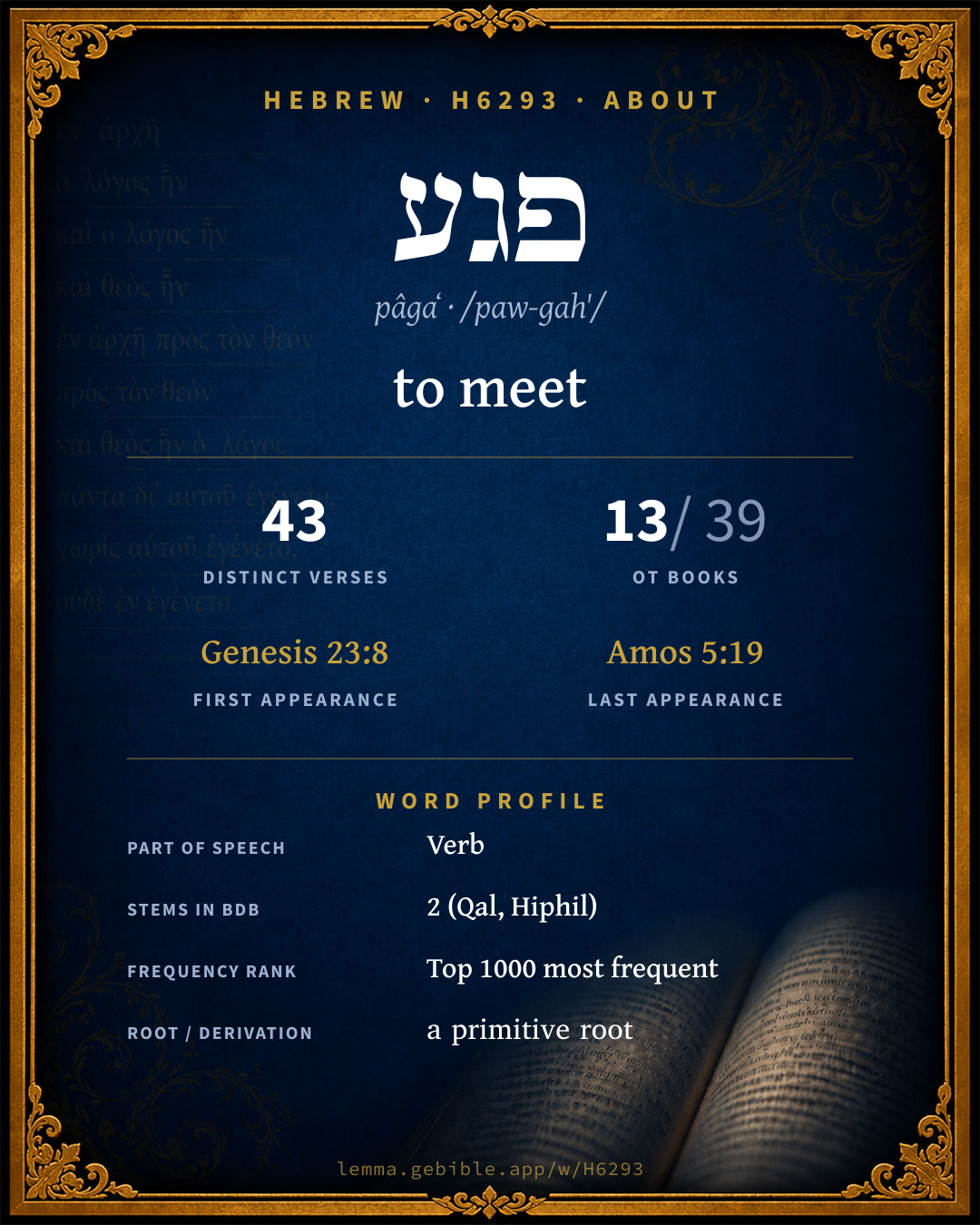
פָּגַע
to meet
‘to meet’ is one of 11 main senses fuller range ↓
Full lexicon entry — Brown-Driver-Briggs (BDB)
From Brown-Driver-Briggs (BDB)
Where this word appears
See every Qal verb in the Hebrew Bible →
Grammar key — what these labels mean
Part of speech
- Verb
- An action or state-of-being word.
Stem
- Qal
- The basic, simple active stem — the plain form of the verb (“he wrote”). Here: ‘meet’
- Hiphil
- The causative active stem (“he caused / brought about”). Here: ‘cause to light upon’
Form
- Perfect
- A completed action or state — Hebrew marks aspect (completeness) more than strict tense (“he wrote”).
- Sequential Imperfect
- An imperfect with prefixed waw — the standard past-narrative form (waw-consecutive imperfect).
- Imperative
- A direct command (“write!”).
- Imperfect
- An incomplete, ongoing, or future action (“he will / would write”).
- Infinitive Construct
- A bound verbal noun, frequently with prepositions (“to write / in writing”).
- Sequential Perfect
- A perfect with prefixed waw continuing a preceding imperfect or command (waw-consecutive perfect).
- Participle Active
- A verbal adjective expressing ongoing or characteristic action (“writing / one who writes”).
- Jussive
- A third- or second-person volitional form expressing wish or command (“let him write”).
State
- Absolute
- The independent form of a noun, not bound to a following word.
Person
- 3rd Person
- The one spoken about (“he / she / it / they”).
- 2nd Person
- The one addressed (“you”).
- 1st Person
- The speaker (“I / we”).
Gender
- Masculine
- Grammatically masculine.
- Common
- Either gender — not distinguished for this form.
- Feminine
- Grammatically feminine.
Number
- Singular
- One.
- Plural
- More than one (in Hebrew, generally three or more).
Grammatical forms 23 distinct
- Verb, Qal, Perfect, 3rd Person, Masculine, Singular 8 times (17%)
- Verb, Qal, Sequential Imperfect, 3rd Person, Masculine, Singular 5 times (11%)
- Verb, Qal, Imperative, 2nd Person, Masculine, Singular 5 times (11%)
- Verb, Qal, Imperfect, 3rd Person, Masculine, Plural 4 times (9%)
- Verb, Qal, Infinitive Construct 3 times (7%)
- Verb, Qal, Sequential Imperfect, 3rd Person, Masculine, Plural 2 times (4%)
- Verb, Qal, Sequential Perfect, 3rd Person, Masculine, Singular 2 times (4%)
- Verb, Hiphil, Participle Active, Masculine, Singular, Absolute 2 times (4%)
+15 more forms (15 occurrences)
Parsed forms decoded from the imported morphology (morphhb / Westminster Leningrad Codex — WLC text public domain, morphhb tagging CC BY 4.0), counted across 46 parsed occurrences — not distinct verses.
Every verse where H6293 appears — 43 distinct verses across 13 books. Click any verse to open its interlinear word-by-word view. Verse text shown in the World English Bible for context — . Each verse’s Hebrew form is shown with its reference; the English is not keyword-highlighted, since the data carries no word-level English alignment. Use “Compare translations” on any verse to read it across multiple English versions. This concordance covers the Hebrew Bible; Septuagint (Greek Old Testament) occurrences are not indexed here.
Genesis 3 verses
- Genesis 23:8 וּ/פִגְעוּ conj + Qal impv 2mp He talked with them, saying, "If it be your mind that I should bury my dead out of my sight, hear me, and entreat for me to Ephron the son of Zohar,
- Genesis 28:11 וַ/יִּפְגַּ֨ע conj + Qal wimpf 3ms He came to a certain place, and stayed there all night, because the sun had set. He took one of the stones of the place, and put it under his head, and lay down in that place to sleep.
- Genesis 32:1 וַ/יִּפְגְּעוּ conj + Qal wimpf 3mp Jacob went on his way, and the angels of God met him.
Exodus 3 verses
- Exodus 5:3 יִפְגָּעֵ֔/נוּ Qal impf 3ms + sfx pers 1cp They said, "The God of the Hebrews has met with us. Please let us go three days' journey into the wilderness, and sacrifice to Yahweh, our God, lest he fall on us with pestilence, or with the sword."
- Exodus 5:20 וַֽ/יִּפְגְּעוּ֙ conj + Qal wimpf 3mp They met Moses and Aaron, who stood in the way, as they came forth from Pharaoh:
- Exodus 23:4 תִפְגַּ֞ע Qal impf 2ms "If you meet your enemy's ox or his donkey going astray, you shall surely bring it back to him again.
Numbers 2 verses
- Numbers 35:19 בְּ/פִגְע/וֹ prep + Qal inf.cs + sfx pers 3ms The avenger of blood shall himself put the murderer to death: when he meets him, he shall put him to death.
- Numbers 35:21 בְּ/פִגְע/וֹ prep + Qal inf.cs + sfx pers 3ms or in enmity struck him with his hand, so that he died; he who struck him shall surely be put to death; he is a murderer: the avenger of blood shall put the murderer to death, when he meets him.
Joshua 8 verses
- Joshua 2:16 יִפְגְּע֥וּ Qal impf 3mp She said to them, Get you to the mountain, lest the pursuers light on you; and hide yourselves there three days, until the pursuers be returned: and afterward may you go your way.
- Joshua 16:7 וּ/פָגַע֙ conj + Qal wpf 3ms and it went down from Janoah to Ataroth, and to Naarah, and reached to Jericho, and went out at the Jordan.
- Joshua 17:10 יִפְגְּע֣וּ/ן Qal impf 3mp + sfx n southward it was Ephraim's, and northward it was Manasseh's, and the sea was his border; and they reached to Asher on the north, and to Issachar on the east.
- Joshua 19:11 וּ/פָגַ֣ע וּ/פָגַע֙ conj + Qal pf 3ms conj + Qal pf 3ms and their border went up westward, even to Maralah, and reached to Dabbesheth; and it reached to the brook that is before Jokneam;
- Joshua 19:22 וּ/פָגַע֩ conj + Qal pf 3ms and the border reached to Tabor, and Shahazumah, and Beth-shemesh; and the goings out of their border were at the Jordan: sixteen cities with their villages.
- Joshua 19:26 וּ/פָגַ֤ע conj + Qal pf 3ms and Allammelech, and Amad, and Mishal; and it reached to Carmel westward, and to Shihorlibnath;
- Joshua 19:27 וּ/פָגַ֣ע conj + Qal pf 3ms and it turned toward the sunrise to Beth Dagon, and reached to Zebulun, and to the valley of Iphtah El northward to Beth Emek and Neiel; and it went out to Cabul on the left hand,
- Joshua 19:34 וּ/פָגַ֨ע פָּגַ֣ע conj + Qal pf 3ms Qal pf 3ms and the border turned westward to Aznoth Tabor, and went out from there to Hukkok; and it reached to Zebulun on the south, and reached to Asher on the west, and to Judah at the Jordan toward the sunrise.
Judges 3 verses
- Judges 8:21 וּ/פְגַע conj + Qal impv 2ms Then Zebah and Zalmunna said, Rise you, and fall on us; for as the man is, so is his strength. Gideon arose, and killed Zebah and Zalmunna, and took the crescents that were on their camels' necks.
- Judges 15:12 תִּפְגְּע֥וּ/ן Qal impf 2mp + sfx n They said to him, We have come down to bind you, that we may deliver you into the hand of the Philistines. Samson said to them, Swear to me that you will not fall on me yourselves.
- Judges 18:25 יִפְגְּע֣וּ Qal impf 3mp The children of Dan said to him, "Don't let your voice be heard among us, lest angry fellows fall on you, and you lose your life, with the lives of your household."
Ruth 2 verses
- Ruth 1:16 תִּפְגְּעִי Qal juss 2fs Ruth said, "Don't entreat me to leave you, and to return from following after you, for where you go, I will go; and where you lodge, I will lodge; your people shall be my people, and your God my God;
- Ruth 2:22 יִפְגְּעוּ Qal impf 3mp Naomi said to Ruth her daughter-in-law, It is good, my daughter, that you go out with his maidens, and that they not meet you in any other field.
1 Samuel 3 verses
- 1 Samuel 10:5 וּ/פָגַעְתָּ֞ conj + Qal wpf 2ms After that you shall come to the hill of God, where is the garrison of the Philistines: and it shall happen, when you are come there to the city, that you shall meet a band of prophets coming down from the high place with a psaltery, and a tambourine, and a pipe, and a harp, before them; and they will be prophesying:
- 1 Samuel 22:17 לִ/פְגֹ֖עַ prep + Qal inf.cs The king said to the guard who stood about him, Turn, and kill the priests of Yahweh; because their hand also is with David, and because they knew that he fled, and didn't disclose it to me. But the servants of the king wouldn't put forth their hand to fall on the priests of Yahweh.
- 1 Samuel 22:18 וּ/פְגַ֖ע וַ/יִּפְגַּע conj + Qal impv 2ms conj + Qal wimpf 3ms The king said to Doeg, Turn you, and fall on the priests. Doeg the Edomite turned, and he fell on the priests, and he killed on that day eighty-five persons who wore a linen ephod.
2 Samuel 1 verse
1 Kings 6 verses
- 1 Kings 2:25 וַ/יִּפְגַּע conj + Qal wimpf 3ms King Solomon sent by Benaiah the son of Jehoiada; and he fell on him, so that he died.
- 1 Kings 2:29 פְּגַע Qal impv 2ms It was told king Solomon, Joab is fled to the Tent of Yahweh, and, behold, he is by the altar. Then Solomon sent Benaiah the son of Jehoiada, saying, Go, fall on him.
- 1 Kings 2:31 וּ/פְגַע conj + Qal impv 2ms The king said to him, Do as he has said, and fall on him, and bury him; that you may take away the blood, which Joab shed without cause, from me and from my father's house.
- 1 Kings 2:32 פָּגַ֣ע Qal pf 3ms Yahweh will return his blood on his own head, because he fell on two men more righteous and better than he, and killed them with the sword, and my father David didn't know it, [to wit], Abner the son of Ner, captain of the host of Israel, and Amasa the son of Jether, captain of the host of Judah.
- 1 Kings 2:34 וַ/יִּפְגַּע conj + Qal wimpf 3ms Then Benaiah the son of Jehoiada went up, and fell on him, and killed him; and he was buried in his own house in the wilderness.
- 1 Kings 2:46 וַ/יִּפְגַּע conj + Qal wimpf 3ms So the king commanded Benaiah the son of Jehoiada; and he went out, and fell on him, so that he died. The kingdom was established in the hand of Solomon.
Job 2 verses
Isaiah 5 verses
- Isaiah 47:3 אֶפְגַּ֖ע Qal impf 1cs Your nakedness shall be uncovered, yes, your shame shall be seen: I will take vengeance, and will spare no man.
- Isaiah 53:6 הִפְגִּ֣יעַ Hiphil pf 3ms All we like sheep have gone astray; everyone has turned to his own way; and Yahweh has laid on him the iniquity of us all.
- Isaiah 53:12 יַפְגִּֽיעַ Hiphil impf 3ms Therefore will I divide him a portion with the great, and he shall divide the spoil with the strong; because he poured out his soul to death, and was numbered with the transgressors: yet he bore the sin of many, and made intercession for the transgressors.
- Isaiah 59:16 מַפְגִּ֑יעַ Hiphil ptcp.act ms He saw that there was no man, and wondered that there was no intercessor: therefore his own arm brought salvation to him; and his righteousness, it upheld him.
- Isaiah 64:5 פָּגַ֤עְתָּ Qal pf 2ms You meet him who rejoices and works righteousness, those who remember you in your ways: behold, you were angry, and we sinned: in them [have we been] of long time; and shall we be saved?
Jeremiah 4 verses
- Jeremiah 7:16 תִּפְגַּע Qal juss 2ms Therefore don't you pray for this people, neither lift up a cry nor prayer for them, neither make intercession to me; for I will not hear you.
- Jeremiah 15:11 הִפְגַּ֣עְתִּֽי Hiphil pf 1cs Yahweh said, Most assuredly I will strengthen you for good; most assuredly I will cause the enemy to make supplication to you in the time of evil and in the time of affliction.
- Jeremiah 27:18 יִפְגְּעוּ Qal juss 3mp But if they be prophets, and if the word of Yahweh be with them, let them now make intercession to Yahweh of Hosts, that the vessels which are left in the house of Yahweh, and in the house of the king of Judah, and at Jerusalem, don't go to Babylon.
- Jeremiah 36:25 הִפְגִּ֣עוּ Hiphil pf 3cp Moreover Elnathan and Delaiah and Gemariah had made intercession to the king that he would not burn the scroll; but he would not hear them.
Amos 1 verse
About this entry
At a glance — auto-summarized from this page’s data, not written by a person. Every figure links to its source below. This summary describes the numbers; it doesn’t interpret them.
At its core, פגע (pâgaʻ) means “to meet.” Translators differ — “reacheth” in the King James Version, then “met” (unfoldingWord Literal Text), as the renderings breakdown shows. It turns up in 43 verses across 13 books, a moderately common footprint. It first appears in Genesis 23:8. The verb spans 2 stems, from Qal to Hiphil. Dig into 43-verse concordance and the renderings breakdown below.
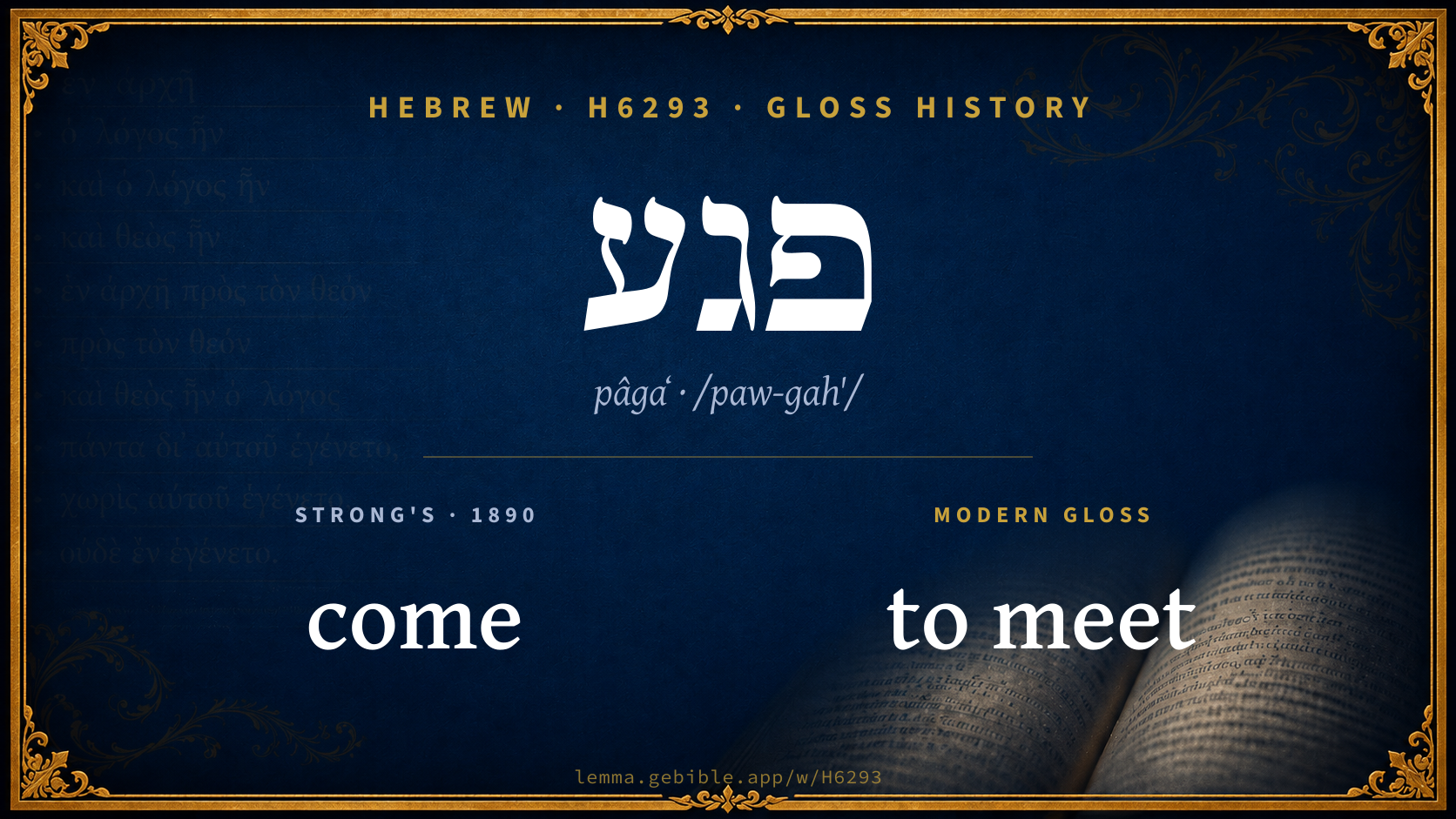
Gloss history
Strong's 1890 vs modern scholarship
About this word
Strong's H6293 catalogs a Hebrew word from the Hebrew Old Testament.
These counts are not copied from any lexicon or concordance. They are computed here, from the morphology-tagged Hebrew Old Testament. What Lemma adds →
- 43
- distinct verses
- The word appears in 43 distinct verses.
- 13 / 39
- OT books
- The word appears in 13 of 39 Old Testament books.
- #796
- by frequency
- Top 1000 most frequent Hebrew words (rank 796 of 8,640 Hebrew words by occurrence).
View all 43 occurrences in the concordance →
By section of the Old Testament
By traditional corpus
Conventional, traditional groupings — biblical authorship is debated, so this is a traditional corpus grouping, not an authorship claim. Each share is this word’s portion of its verses in that division of the Hebrew canon. Each figure is a share of the word’s 43 distinct verses.
- Prophets (Nevi'im) 31 verses · 72%
- Torah (Pentateuch) 8 verses · 19%
- Writings (Ketuvim) 4 verses · 9%
How translations render this word
Counts come from each version’s own published word-to-Strong’s tagging or interlinear alignment — an approximate guide to how each version renders this word, not a word-level alignment the data otherwise carries. Because each total is that version’s own tagged count, the per-version totals vary from one another and need not match the appearance or distinct-verse counts above. These counts may also differ from a printed concordance because Lemma counts each distinctly tagged rendering and does not collapse phrase taggings into a single head-word total. This is a fixed set of word-tagged versions (KJV, ASV, BSB, ULT) and does not change with the reading translation you choose elsewhere. Each version’s license is shown beside its name below (and on Sources).
- King James Version: Reacheth 5×, Fall 4×, Fell 3×
- American Standard Version: Reached 8×, Fall 4×, He fell 3×
- Berean Standard Bible: Reached 3×, He struck down 2×, Intercede 2×
- unfoldingWord Literal Text: Met 9×, Attack 5×, And 3×
King James Version Public Domain
Renders H6293 across 46 tagged occurrences — most commonly:
Plus 22 renderings that appear only once — usually multi-word phrases or single function words the recovered tagging swept in, not distinct renderings.
American Standard Version Public Domain
Renders H6293 across 46 tagged occurrences — most commonly:
Plus 27 renderings that appear only once — usually multi-word phrases or single function words the recovered tagging swept in, not distinct renderings.
Berean Standard Bible Public Domain
Renders H6293 across 45 tagged occurrences — most commonly:
Plus 30 renderings that appear only once — usually multi-word phrases or single function words the recovered tagging swept in, not distinct renderings. Not rendered by a distinct English word in 1 further occurrence.
unfoldingWord Literal Text CC BY-SA 4.0
Renders H6293 across 56 tagged occurrences — most commonly:
Plus 21 renderings that appear only once — usually multi-word phrases or single function words the recovered tagging swept in, not distinct renderings.
10 senses and sub-senses in the full BDB
Hebrew verbs can shift meaning by stem (binyan): Qal is the basic action, Niphal is often passive or reflexive, Piel often intensifies or makes it factitive, and Hiphil is typically causative. The senses below are grouped under the stem BDB assigns to each.
What do BDB’s symbols mean?
BDB uses these scholarly abbreviations:
| Symbol | Meaning |
|---|---|
| 𝔊 | the Septuagint (the ancient Greek translation, LXX) |
| 𝔙 | the Vulgate (the Latin translation) |
| 𝔖 | the Syriac version (the Peshitta) |
| 𝔗 | the Targum (the Aramaic translation) |
| ψ | the Psalms |
| √ | root (the underlying root or stem) |
| ‖ | parallel passage (a synonymous or contrasted parallel) |
| † | the dagger: every passage where the word occurs is cited |
The 10 senses and sub-senses the full Brown-Driver-Briggs lexicon distinguishes for this word, in lexicon order (not ranked by frequency), with BDB’s own verbatim wording and sub-sense lettering. Shown in Hebrew script with BDB’s own scholarly abbreviations. The condensed entry is in the Lexicon Entry tab. See also the Forms in the corpus table below.
Qal
- Pf. 3 ms. פ׳ 1 K 2:32 +, sf. וּפְגָעוֹ consec. Am 5:19, etc.; Impf. 3 ms. וַיִּפְגַּע Gn 28:11 +; 1 pl. נְפְגַּע Jb 21:15, etc.; Imv. ms. פְּגַע Ju 8:21 +; mpl. פִּגְעוּ Gn 23:8; Inf. cstr. לִפִגֹּעַ 1 S 22:17, sf. פִּגְעוֹ Nu 35:19, 21;— e.g. 1 Kings 2:32
- 1. meet, light upon, c. acc. pers. 1 S 10:5 Ex 5:20 (J), c. sf. pers. Am 5:19; פ׳ שׁוֹר Ex 23:4; c. ב pers. Gn 32:2 (E), Nu 35:19, 21 (P); c. ב loc. Gn 28:11 (E). e.g. 1 Samuel 10:5
- 2. meet, with kindness, c. acc. pers. Is 64:4 (subj. י׳), so 47:3 according to Ew De Di al.; CheHpt. אֶפְרַע (reading, with Du, אמר for אָדָם). e.g. Isaiah 64:4
- 3. encounter with hostility, fall upon c. ב pers. Jos 2:16 (JE), Ju 8:21; 15:12; 18:25 1 S 22:17, 18(×2) 2 S 1:15 1 K 2:25, 29, 31, 32, 34, 46 Ru 2:22; of God, c. acc. (sf.), + ב instr. Ex 5:3. e.g. Joshua 2:16
- 4. encounter with request, entreat, c. ב pers. Je 7:16 Jb 21:15, sq. cl. Je 27:18 Ru 1:16, + ל pers. on whose behalf Gn 23:8. e.g. Jeremiah 7:16
- 5. strike, touch, of boundary, c. ב loc. Jos 16:7; 19:11, 22, 26, 27, 34(×2), cf. 17:10; c. אֶל loc. 19:11. e.g. Joshua 16:7
Hiphil
- 1. cause to light upon, Pf. 3 ms. הִפְגִּיעַ c. acc. rei + ב pers. Is 53:6. e.g. Isaiah 53:6
- 2. cause one (acc.) to entreat 1 s. הִפְגַּעְתִּי (ב pers.) Je 15:11 (otherwise Gie; Co del. v. as gloss). e.g. Jeremiah 15:11
- 3. make entreaty, 3 pl. הִפְגִּעוּ Je 36:25 c. ב pers.; more gen. interpose, Impf. 3 ms. יַפְגִּיעַ Is 53:12, c. ל pers. in whose behalf; Pt. מַפְגִּיעַ 59:16 one interposing. e.g. Jeremiah 36:25
- 4. make attack, only Pt. Jb 36:32 assailant, but Ol Bu Du al. מִפְגָּע mark. e.g. Job 36:32
Senses from the full Brown-Driver-Briggs lexicon (Brown, Driver, Briggs; Oxford 1906 — public domain), digitized via Sefaria, supplemented by the OpenScriptures HebrewLexicon (CC BY 4.0). Full attribution on Sources.
Word origin
vb. meet, encounter, reach (NH id.; Aramaic פְּגַע, ܦܓܰܥ; poss. akin to Arabic فَجَأَ, فَجِىَٔ happen to, light upon; فَجَعَ is pain, afflict);—
— Brown-Driver-Briggs (Oxford 1906, public domain), digitized via Sefaria, supplemented by the OpenScriptures HebrewLexicon (CC BY 4.0). See Sources.
Origin: a primitive root
Jastrow Dictionary
A second Hebrew/Aramaic lexicon for comparison, covering Aramaic and post-biblical (Talmudic, Targumic, Midrashic) usage that the biblical-Hebrew BDB does not. Matched by lemma rather than by Strong’s number, so a lemma may carry more than one Jastrow headword (shown separately below), and the entries cover usage well beyond the Bible.
פָּגַע
- (b. h.)
- 1. to strike against, come in contact with, meet; (in a hostile sense) to attack, strike. Tanḥ. Vayishl. 4 כיון שפ׳ בעשו when he met Esau. Gen. R. s. 75 פ׳ בלובשי ברזל he met those clad in iron armor. Succ. 52ᵇ, a. e. אם פ׳ בך מנוול זה, v. נָוַול. Y. Kidd. III, 64ᵈ bot. ולמה לא פָּגַעְתָּה בו (not ביה) why didst thou not connect thyself with him? Num. R. s. 5 כדי שלא תִפְגַּע בכולם מדת הדין וכ׳ (not יפגע) in order that divine justice might not strike all of them, he took half of his name (the letter ה) &c. Ex. R. s. 5, end בקשה … לִפְגּוֹעַ במשה divine justice wanted to strike Moses. Koh. R. to IX, 11 עת היא שפּוֹגַעַת באדם וכ׳ (not האדם), v. עִרְעֵר III.
- 2. to beseech, entreat. Gen. R. s. 68 (ref. to Gen. XXVIII, 11) וַיִּפְגַּע במקום … מפני מה וכ׳ ‘and he entreated the Lord’ … why is the Lord surnamed maḳom? (v. מָקוֹם). Ib. מהו ויפגע במקום צלי וכ׳ what does vayifgʿa bammaḳom mean? He prayed on the site of the Temple; a. e.—Part. pass. פָּגוּעַ; pl. פְּגוּעִין stricken, afflicted (with insanity). Y. Sabb. VI, 8ᵇ top, v. פֶּגַע. e.g. Genesis 28:11
- to be stricken; to suffer. Ib. משנ׳ after one has been stricken; Y. Erub. X, 26ᶜ bot. Ḥag. 14ᵇ; Tosef. ib. II, 3 הציץ ונ׳ he looked (into the divine secrets, v. פַּרְדֵּס) and became demented; Y. ib. II, 77ᵇ top. Sabb. 13ᵇ אין שוטה נ׳ a maniac cannot be stricken with dementia (one overladen with sorrows becomes indifferent to new afflictions); a. e.
- 1. to cause suffering, afflict, v. מַפְגִּיעַ.
- 2. to suffer. Koh. R. l. c. עת … והוא מַפְגִּיעַ time strikes man …, and he suffers, v. עִרְעֵר III.
- 3. to entreat. Ib. פעמים שאדם מפגיע וכ׳ at times man prays and is answered &c.
פְּגַע I
- 1. to meet. Targ. Prov. XVII, 12 (h. text פגוש). Ib. XXIX, 13 (Var. פגיחו); a. e.—Gen. R. s. 36, beg. פ׳ ביה שידא וכ׳ the demon Sh’madon met him; Yalk. ib. 61; Lev. R. s. 5 פ׳ ליה וכ׳ (corr. acc.). B. Kam. 99ᵇ פַּגְעוּ ביה … גברא R. K. and R. A. met that man. Ber. 58ᵇ. Y. Kidd. III, 64ᵈ bot. יאות עביד דלא פ׳ ביה he did right not to connect himself with that man. Ib. top דלא תִפְגַּע בהון, v. פְּסוּלָא I; a. fr.
- 2. to plague. Gen. R. s. 58; Yalk. ib. 102 פַּגְעוּנֵיה, v. סְרַס.
- to intercede, pray. Targ. Esth. IV, 14.
- to happen. Y. Ber. II, 5ᶜ bot. ומִתְפְּגַע ביה and it happened to him (he died).
פֶּגַע
- preced.) contact, accident, (evil) occurence; affliction, plague. Ber. 17ᵃ ותצילני מפ׳ רע and save me from meeting with evil; a. e.—Pl. פְּגָעִים, פְּגָעִין evil spirits. Shebu. 15ᵇ (expl. בשיר, Mish. ib. II, 2) the song of thanksgiving (Ps. XXX) ושיר של פ׳ וכ׳ and the song referring to evil spirits (Ps. XCI, 1—9), and some call it song of n’gaʿim (plagues, with ref. to ונגע, ib. 10); Y. Erub. X, 26ᶜ bot. אומרין היו שיר של פ׳ וכ׳ they used to recite the ‘song of demons’ in Jerusalem (in the Temple, when one was threatened with insanity); Y. Sabb. VI, 8ᵇ top שיר פגועין, the song for the stricken. Midr. Till. to Ps. XCI שיר של פ׳ היה אומר משה וכ׳ Moses recited the ninety-first psalm on ascending the heavens, when he said &c. e.g. Psalms 91:1
פְּגַע II
- 1. evil occurrence, plague. Targ. I Kings V, 18.—Pl. פְּגָעִין. Ruth R. to I, 16 (ref. to אל תפגעי ib., as if it were תִּפָּגְעִי) לא תחטא עלי לא תסבין פ׳ מני (not פגעיך) do not commit a sin through me, do not suffer afflictions on my account (by dissuading me from embracing the Jewish faith).
- 2. pl. evil spirits. Targ. II Esth. I, 2.
A Dictionary of the Targumim, the Talmud Babli and Yerushalmi, and the Midrashic Literature (Marcus Jastrow; London, Luzac, 1903) — Public Domain. Digitized via Sefaria. Digitized via Sefaria. Full attribution on Sources.
Forms in the corpus
The 36 distinct written forms H6293 takes in the Hebrew Bible, most frequent first — each parse links to that stem’s occurrences in the concordance. Hebrew forms include their vowel points and cantillation, so a single lemma takes many written forms.
Same root — word family
Other BDB entries built from the same root as H6293, grouped by Strong’s listed origin. These share a root / origin per the lexicon — not necessarily a shared meaning. Each links to that word’s own entry.
Derived from this word
Compare all same-root words → They share a root, not necessarily a meaning.
Septuagint verse parallels
This word appears in 43 verses that also exist in the Greek Old Testament (Septuagint), out of the 43 Hebrew verses it occurs in. You can read those verses in Greek by switching the Old Testament edition to the Septuagint.
Read these verses in the Septuagint
- Genesis 23:8
- Exodus 5:3
- Numbers 35:19
- Joshua 2:16
- Judges 8:21
- Ruth 1:16
- 1 Samuel 10:5
- 2 Samuel 1:15
- 1 Kings 2:25
- Job 21:15
- Isaiah 47:3
- Jeremiah 7:16
This is a verse-level parallel only — the same verses exist in both the Hebrew and Greek Old Testaments. No word-level Hebrew↔Greek correspondence is claimed: the data carries no such alignment, so no Greek word is shown as this Hebrew word’s translation. Coverage is not total — the Septuagint omits the deuterocanon and renumbers the Psalms, so some Hebrew verses have no direct Greek parallel.