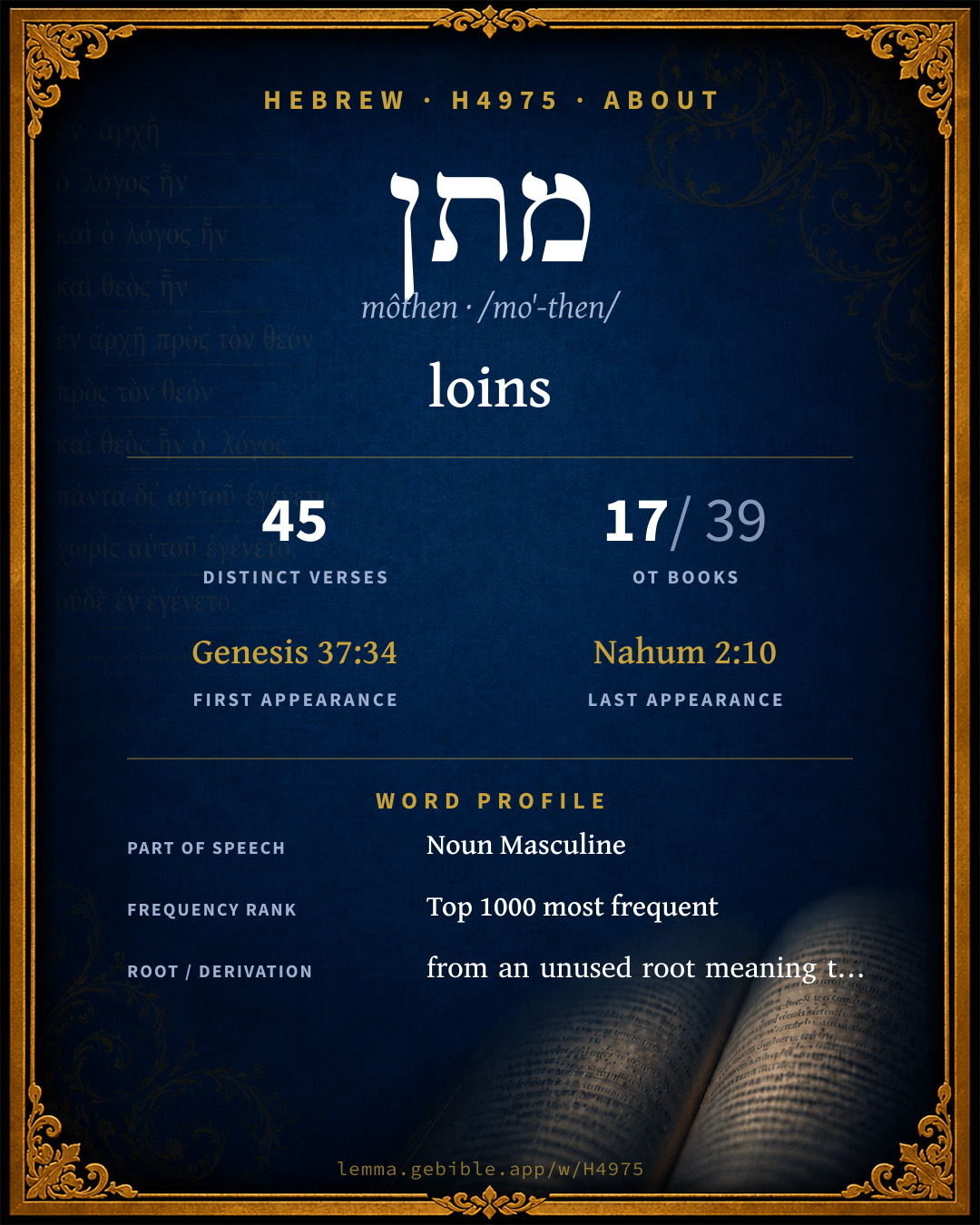
מׇתְנַ֫יִם
loins
‘loins’ is one of 2 main senses fuller range ↓
Full lexicon entry — Brown-Driver-Briggs (BDB)
From Brown-Driver-Briggs (BDB)
Where this word appears
See every Construct-state word in the Hebrew Bible →
Grammar key — what these labels mean
Part of speech
- Noun
- A naming word — a person, place, thing, or idea.
Noun type
- Common
- A common noun — a general class of person, place, or thing (“king,” “city,” “water”), not a specific name.
State
- Absolute
- The independent form of a noun, not bound to a following word.
- Construct
- A noun bound to a following noun in a possessive / “of” relationship (the construct chain).
Gender
- Masculine
- Grammatically masculine.
Number
- Dual
- Exactly two — for natural pairs and some measures of time.
Grammatical forms
- Noun, Common, Masculine, Dual, Construct 37 times (79%)
- Noun, Common, Masculine, Dual, Absolute 10 times (21%)
Parsed forms decoded from the imported morphology (morphhb / Westminster Leningrad Codex — WLC text public domain, morphhb tagging CC BY 4.0), counted across 47 parsed occurrences — not distinct verses.
Every verse where H4975 appears — 45 distinct verses across 17 books. Click any verse to open its interlinear word-by-word view. Verse text shown in the World English Bible for context — . Each verse’s Hebrew form is shown with its reference; the English is not keyword-highlighted, since the data carries no word-level English alignment. Use “Compare translations” on any verse to read it across multiple English versions. This concordance covers the Hebrew Bible; Septuagint (Greek Old Testament) occurrences are not indexed here.
Genesis 1 verse
Exodus 2 verses
- Exodus 12:11 מָתְנֵי/כֶ֣ם n c md cs + sfx pers 2mp This is how you shall eat it: with your loins girded, your shoes on your feet, and your staff in your hand; and you shall eat it in haste: it is Yahweh's Passover.
- Exodus 28:42 מִ/מָּתְנַ֥יִם prep + n c md You shall make them linen breeches to cover the flesh of their nakedness; from the loins even to the thighs they shall reach:
Deuteronomy 1 verse
2 Samuel 1 verse
1 Kings 5 verses
- 1 Kings 2:5 בְּ/מָתְנָ֔י/ו prep + n c md cs + sfx pers 3ms Moreover you know also what Joab the son of Zeruiah did to me, even what he did to the two captains of the hosts of Israel, to Abner the son of Ner, and to Amasa the son of Jether, whom he killed, and shed the blood of war in peace, and put the blood of war on his sash that was about his loins, and in his shoes that were on his feet.
- 1 Kings 12:10 מִ/מָּתְנֵ֥י prep + n c md cs The young men who had grown up with him spoke to him, saying, Thus shall you tell this people who spoke to you, saying, Your father made our yoke heavy, but make you it lighter to us; thus shall you speak to them, My little finger is thicker than my father's loins.
- 1 Kings 18:46 מָתְנָ֑י/ו n c md cs + sfx pers 3ms and the hand of Yahweh was on Elijah; and he girded up his loins, and ran before Ahab to the entrance of Jezreel.
- 1 Kings 20:31 בְּ/מָתְנֵ֜י/נוּ prep + n c md cs + sfx pers 1cp His servants said to him, See now, we have heard that the kings of the house of Israel are merciful kings: let us, we pray you, put sackcloth on our loins, and ropes on our heads, and go out to the king of Israel: peradventure he will save your life.
- 1 Kings 20:32 בְּ/מָתְנֵי/הֶ֜ם prep + n c md cs + sfx pers 3mp So they girded sackcloth on their loins, and [put] ropes on their heads, and came to the king of Israel, and said, Your servant Ben Hadad says, please let me live. He said, Is he yet alive? he is my brother.
2 Kings 3 verses
- 2 Kings 1:8 בְּ/מָתְנָ֑י/ו prep + n c md cs + sfx pers 3ms They answered him, He was a hairy man, and girt with a belt of leather about his loins. He said, It is Elijah the Tishbite.
- 2 Kings 4:29 מָתְנֶ֗י/ךָ n c md cs + sfx pers 2ms Then he said to Gehazi, Gird up your loins, and take my staff in your hand, and go your way: if you meet any man, Don't greet him; and if anyone greets you, don't answer him again: and lay my staff on the face of the child.
- 2 Kings 9:1 מָתְנֶ֗י/ךָ n c md cs + sfx pers 2ms Elisha the prophet called one of the sons of the prophets, and said to him, Gird up your loins, and take this vial of oil in your hand, and go to Ramoth-gilead.
2 Chronicles 1 verse
Nehemiah 1 verse
Job 2 verses
Psalms 2 verses
Proverbs 2 verses
Isaiah 4 verses
- Isaiah 11:5 מָתְנָ֑י/ו n c md cs + sfx pers 3ms Righteousness shall be the belt of his waist, and faithfulness the belt of his loins.
- Isaiah 20:2 מָתְנֶ֔י/ךָ n c md cs + sfx pers 2ms at that time Yahweh spoke by Isaiah the son of Amoz, saying, Go, and loose the sackcloth from off your loins, and put your shoe from off your foot. He did so, walking naked and barefoot.
- Isaiah 21:3 מָתְנַ/י֙ n c md cs + sfx pers 1cs Therefore are my loins filled with anguish; pangs have taken hold on me, as the pangs of a woman in travail: I am pained so that I can't hear; I am dismayed so that I can't see.
- Isaiah 45:1 וּ/מָתְנֵ֥י conj + n c md cs Thus says Yahweh to his anointed, to Cyrus, whose right hand I have held, to subdue nations before him, and I will loose the loins of kings; to open the doors before him, and the gates shall not be shut:
Jeremiah 6 verses
- Jeremiah 1:17 מָתְנֶ֔י/ךָ n c md cs + sfx pers 2ms You therefore gird up your loins, and arise, and speak to them all that I command you: don't be dismayed at them, lest I dismay you before them.
- Jeremiah 13:1 מָתְנֶ֑י/ךָ n c md cs + sfx pers 2ms Thus says Yahweh to me, Go, and buy you a linen belt, and put it on your loins, and don't put it in water.
- Jeremiah 13:2 מָתְנָֽ/י n c md cs + sfx pers 1cs So I bought a belt according to the word of Yahweh, and put it on my loins.
- Jeremiah 13:4 מָתְנֶ֑י/ךָ n c md cs + sfx pers 2ms Take the belt that you have bought, which is on your loins, and arise, go to the Euphrates, and hide it there in a cleft of the rock.
- Jeremiah 13:11 מָתְנֵי n c md cs For as the belt cleaves to the loins of a man, so have I caused to cleave to me the whole house of Israel and the whole house of Judah, says Yahweh; that they may be to me for a people, and for a name, and for a praise, and for a glory: but they would not hear.
- Jeremiah 48:37 מָתְנַ֖יִם n c md For every head is bald, and every beard clipped: on all the hands are cuttings, and on the loins sackcloth.
Ezekiel 10 verses
- Ezekiel 1:27 מָתְנָ֖י/ו מָתְנָי/ו֙ n c md cs + sfx pers 3ms n c md cs + sfx pers 3ms I saw as it were glowing metal, as the appearance of fire within it round about, from the appearance of his loins and upward; and from the appearance of his loins and downward I saw as it were the appearance of fire, and there was brightness round about him.
- Ezekiel 8:2 מָתְנָ֛י/ו וּ/מִ/מָּתְנָ֣י/ו n c md cs + sfx pers 3ms conj + prep + n c md cs + sfx pers 3ms Then I saw, and, behold, a likeness as the appearance of fire; from the appearance of his loins and downward, fire; and from his loins and upward, as the appearance of brightness, as it were glowing metal.
- Ezekiel 9:2 בְּ/מָתְנָ֑י/ו prep + n c md cs + sfx pers 3ms Behold, six men came from the way of the upper gate, which lies toward the north, every man with his slaughter weapon in his hand; and one man in the midst of them clothed in linen, with a writer's inkhorn by his side. They went in, and stood beside the brazen altar.
- Ezekiel 9:3 בְּ/מָתְנָֽי/ו prep + n c md cs + sfx pers 3ms The glory of the God of Israel was gone up from the cherub, whereupon it was, to the threshold of the house: and he called to the man clothed in linen, who had the writer's inkhorn by his side.
- Ezekiel 9:11 בְּ/מָתְנָ֔י/ו prep + n c md cs + sfx pers 3ms Behold, the man clothed in linen, who had the inkhorn by his side, reported the matter, saying, I have done as you have commanded me.
- Ezekiel 21:6 מָתְנַ֨יִם֙ n c md Sigh therefore, you son of man; with the breaking of your loins and with bitterness shall you sigh before their eyes.
- Ezekiel 23:15 בְּ/מָתְנֵי/הֶ֗ם prep + n c md cs + sfx pers 3mp girded with girdles on their loins, with flowing turbans on their heads, all of them princes to look on, after the likeness of the Babylonians in Chaldea, the land of their birth.
- Ezekiel 29:7 מָתְנָֽיִם n c md When they took hold of you by your hand, you did break, and did tear all their shoulders; and when they leaned on you, you broke, and mad all their loins to be at a stand.
- Ezekiel 44:18 מָתְנֵי/הֶ֑ם n c md cs + sfx pers 3mp They shall have linen tires on their heads, and shall have linen breeches on their loins; they shall not gird themselves with [anything that causes] sweat.
- Ezekiel 47:4 מָתְנָֽיִם n c md Again he measured one thousand, and caused me to pass through the waters, waters that were to the knees. Again he measured one thousand, and caused me to pass through [the waters], waters that were to the loins.
Daniel 1 verse
Amos 1 verse
Nahum 2 verses
- Nahum 2:1 מָתְנַ֔יִם n c md He who dashes in pieces has come up against you. Keep the fortress! Watch the way! Strengthen your loins! Fortify your power mightily!
- Nahum 2:10 מָתְנַ֔יִם n c md She is empty, void, and waste. The heart melts, the knees knock together, their bodies and faces have grown pale.
About this entry
At a glance — auto-summarized from this page’s data, not written by a person. Every figure links to its source below. This summary describes the numbers; it doesn’t interpret them.
מתן (môthen) is a Hebrew noun most often rendered “loins.” Translators differ — “loins” in the King James Version, then “waist” (Berean Standard Bible), as the renderings breakdown shows. It turns up in 45 verses across 17 books, a moderately common footprint. It first appears in Genesis 37:34. It is not a single-sense word — see its full sense range. For the data behind this summary, explore the sense tree and the renderings breakdown below.
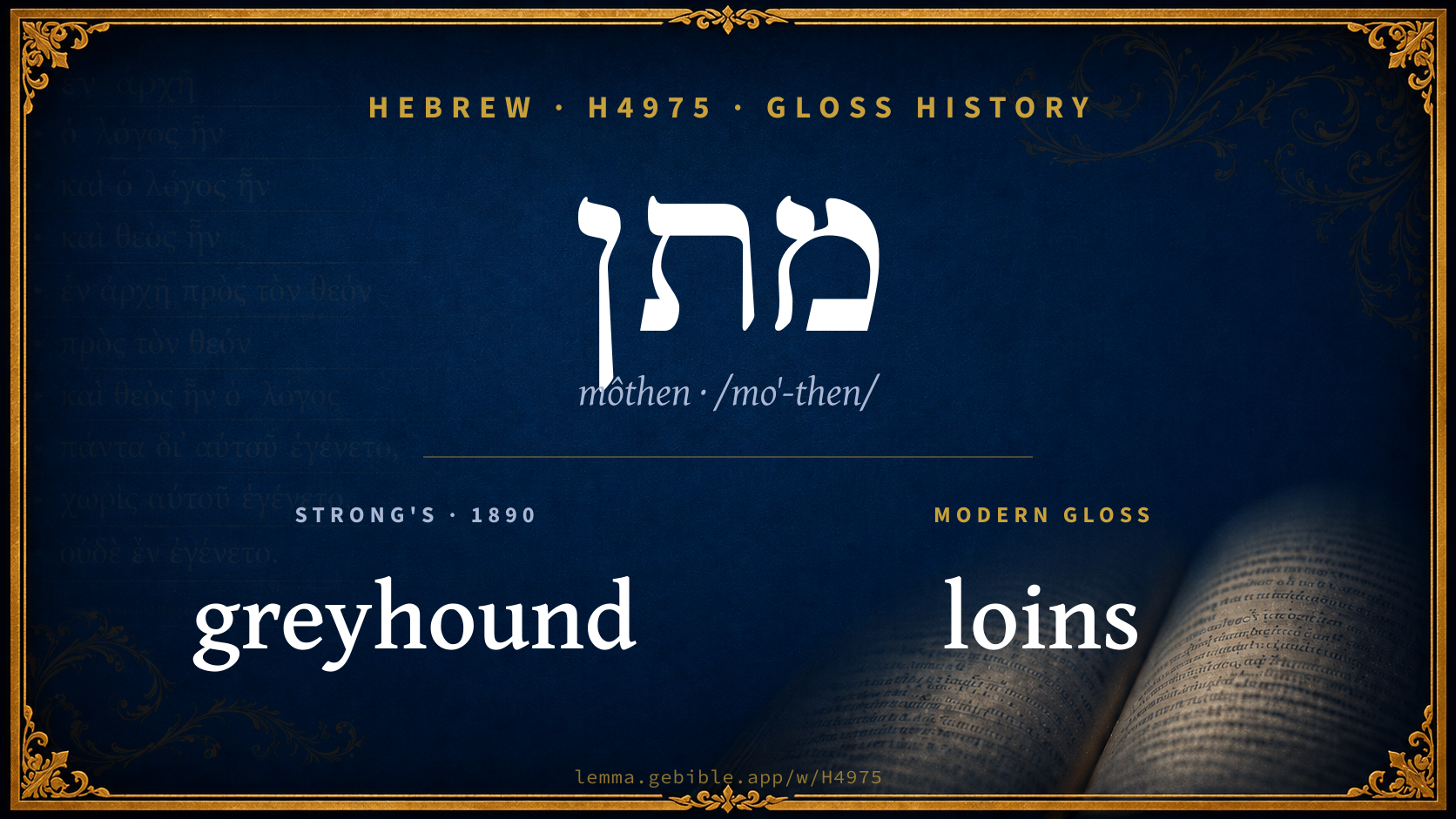
Gloss history
Strong's 1890 vs modern scholarship
About this word
Strong's H4975 catalogs a Hebrew word from the Hebrew Old Testament.
These counts are not copied from any lexicon or concordance. They are computed here, from the morphology-tagged Hebrew Old Testament. What Lemma adds →
- 45
- distinct verses
- The word appears in 45 distinct verses.
- 17 / 39
- OT books
- The word appears in 17 of 39 Old Testament books.
- #783
- by frequency
- Top 1000 most frequent Hebrew words (rank 783 of 8,640 Hebrew words by occurrence).
View all 45 occurrences in the concordance →
By section of the Old Testament
By traditional corpus
Conventional, traditional groupings — biblical authorship is debated, so this is a traditional corpus grouping, not an authorship claim. Each share is this word’s portion of its verses in that division of the Hebrew canon. Each figure is a share of the word’s 45 distinct verses.
- Prophets (Nevi'im) 32 verses · 71%
- Writings (Ketuvim) 9 verses · 20%
- Torah (Pentateuch) 4 verses · 9%
How translations render this word
Counts come from each version’s own published word-to-Strong’s tagging or interlinear alignment — an approximate guide to how each version renders this word, not a word-level alignment the data otherwise carries. Because each total is that version’s own tagged count, the per-version totals vary from one another and need not match the appearance or distinct-verse counts above. These counts may also differ from a printed concordance because Lemma counts each distinctly tagged rendering and does not collapse phrase taggings into a single head-word total. This is a fixed set of word-tagged versions (KJV, ASV, BSB, ULT) and does not change with the reading translation you choose elsewhere. Each version’s license is shown beside its name below (and on Sources).
- King James Version: Loins 29×, Side 4×
- American Standard Version: Loins 23×, Side 4×, 's loins 2×
- Berean Standard Bible: Waist 9×, Around his waist 4×, Side 4×
- unfoldingWord Literal Text: Loins 19×, Hips 5×, Waist 5×
King James Version Public Domain
Renders H4975 across 47 tagged occurrences — most commonly:
Plus 14 renderings that appear only once — usually multi-word phrases or single function words the recovered tagging swept in, not distinct renderings.
American Standard Version Public Domain
Renders H4975 across 46 tagged occurrences — most commonly:
Plus 17 renderings that appear only once — usually multi-word phrases or single function words the recovered tagging swept in, not distinct renderings.
Berean Standard Bible Public Domain
Renders H4975 across 39 tagged occurrences — most commonly:
Plus 11 renderings that appear only once — usually multi-word phrases or single function words the recovered tagging swept in, not distinct renderings. Not rendered by a distinct English word in 8 further occurrences.
unfoldingWord Literal Text CC BY-SA 4.0
Renders H4975 across 48 tagged occurrences — most commonly:
Plus 9 renderings that appear only once — usually multi-word phrases or single function words the recovered tagging swept in, not distinct renderings.
9 senses and sub-senses in the full BDB
What do BDB’s symbols mean?
BDB uses these scholarly abbreviations:
| Symbol | Meaning |
|---|---|
| 𝔊 | the Septuagint (the ancient Greek translation, LXX) |
| 𝔙 | the Vulgate (the Latin translation) |
| 𝔖 | the Syriac version (the Peshitta) |
| 𝔗 | the Targum (the Aramaic translation) |
| ψ | the Psalms |
| √ | root (the underlying root or stem) |
| ‖ | parallel passage (a synonymous or contrasted parallel) |
| † | the dagger: every passage where the word occurs is cited |
The 9 senses and sub-senses the full Brown-Driver-Briggs lexicon distinguishes for this word, in lexicon order (not ranked by frequency), with BDB’s own verbatim wording and sub-sense lettering. Shown in Hebrew script with BDB’s own scholarly abbreviations. The condensed entry is in the Lexicon Entry tab. See also the Forms in the corpus table below.
- 1.
- a. place of wearing girdle 1 K 2:5 2 K 1:8 Je 13:1, 2, 4, 11 Ez 23:15; fig. Is 11:5 righteousness shall be the girdle of his loins. e.g. 1 Kings 2:5
- b. hence place of things attached to girdle:—sword girded on (חגר על, אסר) 2 S 20:8 Ne 4:12; opp., וּמָתְנֵי מְלָכִים אֲפַתֵּחַ Is 45:1 and the loins of kings I will loosen, i.e. will disarm them (י׳ before Cyrus; cf. Che); ink-horn Ez 9:2, 3, 11. e.g. 2 Samuel 20:8
- c. girding up loins = make ready for action, וַיְשַׁנֵּס מָתְנָיו 1 K 18:46; more often חָגַר מ׳ 2 K 4:29; 9:1 Ex 12:11 (P), Dn 10:5; אָזַר מ׳ Je 1:17. e.g. 1 Kings 18:46
- d. זַרְזִיר מ׳ Pr 30:31 that which is girt in the loins, i.e. prob. either a greyhound Ew Bö De (contracted, as if by a belt), or a war-horse, charger, Bö Ges Hi Str Wild (with a saddle); cf. also זרזיר, p. 267 supr.; text perhaps corrupt (Wild). e.g. Proverbs 30:31
- e. girded with sackcloth (in mourning) Gn 37:34 (J), Am 8:10 Is 20:2 1 K 20:31, 32 Je 48:37. e.g. Genesis 37:34
- f. linen breeches of priests were to extend מִמָּתְנַיִם וְעַד יְרֵכַיִם Ex 28:42 (P); to be עַל־מָת׳ Ez 44:18; loins of slaves are girt with waistcloth, cf. Jb 12:18 (v. also אֵזוֹר). e.g. Exodus 28:42
- g. in gen. of the middle of the body, מֵי מָת׳ Ez 47:4 (i.e. water reaching to the loins); so of the appearance of י׳ in Ezek.’s visions Ez 1:27(×2); 8:2(×2). e.g. Ezekiel 47:4
- 2.
- a. loins as seat of strength, Dt 33:11 1 K 12:10 = 2 Ch 10:10; חַזֵּק מָתְנַיִם Na 2:2 (‖ אַמֵּץ כֹּחַ); כֹּחוֹ בְּמָתְנָיו Jb 40:16 (of hippopotamus); in combin. with 1 a (fig.) חָֽגְרָה בְּעוֹז מ׳ Pr 31:17 she girdeth her loins with strength, she puts on energy with her girdle; cf. also בְּשִׁבְרוֹן מ׳ Ez 21:11 sigh with breaking of loins, i.e. in entire collapse of strength; so וּמ׳ תָּמִיד הַמְעַ֑ד ψ 69:24 and make their loins continually to shake, make them totter; cf. Ez 29:7 (where read וְהִמְעַדְתָּ for וְהַעֲמַדְתָּ, v. מָעַד). e.g. Deuteronomy 33:11
- b. as seat of keenest pain, due to grief or dread Na 2:11 Is 21:3 (as in travail); so prob. also ψ 66:11 (cf. Bae; and v. מוּעָקָה sub עוק). e.g. Nahum 2:11
Senses from the full Brown-Driver-Briggs lexicon (Brown, Driver, Briggs; Oxford 1906 — public domain), digitized via Sefaria, supplemented by the OpenScriptures HebrewLexicon (CC BY 4.0). Full attribution on Sources.
Word origin
n.m.du. loins (Arabic مَتْنٌ back, مَتْنَتَانِ the two sides of the back, etc.; Syriac ܡܰܬ̈ܢܳܬܳܐ );—abs. מ׳ Dt 33:11 + 7 times, מָתְנָ֑יִם Ez 29:7; 47:4; cstr. מָתְנֵי Je 13:11 + 3 times; sf. מָתְנַי Is 21:3, מָתְנָ֑י Je 13:2; מָתְנֵיהֶם 1 K 20:32 + 4 times, etc.;—loins:
— Brown-Driver-Briggs (Oxford 1906, public domain), digitized via Sefaria, supplemented by the OpenScriptures HebrewLexicon (CC BY 4.0). See Sources.
Origin: from an unused root meaning to be slender
Jastrow Dictionary
A second Hebrew/Aramaic lexicon for comparison, covering Aramaic and post-biblical (Talmudic, Targumic, Midrashic) usage that the biblical-Hebrew BDB does not. Matched by lemma rather than by Strong’s number, so a lemma may carry more than one Jastrow headword (shown separately below), and the entries cover usage well beyond the Bible.
מָתַן
- [to stretch,] (cmp. ארך) to be long, slow; to wait; esp. (of fruits taken off the tree) to lie over for complete ripening. Toh. IX, 5 שיִמְתּוֹנוּ שיהו וכ׳ that they (the olives) may lie over so that they be easy to crush; ib. שימתונו שימלחם that they may lie over until they be ripe for salting; Tosef. ib. X, 10 שיַמְתִּינֵם ושימלחם (Hif.) to let them lie over &c.
- 1. (neut. verb) (neut. verb) to last, remain fresh, keep. Makhsh. VI, 2 בשביל שיַמְתִּינוּ (Maim. in comment. ed. Dehr. שימתונו) that they may remain fresh (Maim.). Sabb. XXIII, 5 (of a corpse) בשביל שיַמְתִּין (Ar. שיִמָּתֵן, Nif.) that it may be preserved.
- 2. to keep, to let (fruits) lie over. Tosef. Makhsh. l. c., v. supra.
- 3. to wait, tarry, postpone. Ḥull. II, 4. Ib. 47ᵇ הַמְתִּינִי לו עד וכ׳ postpone his circumcision until &c. Y. Pes. X, 37ᵈ אילו נַמְתִּין וכ׳ (not ממתין) if we were to wait (with the recital of the exodus) until &c. Gen. R. s. 18 (play on יתבששו, Gen. II, 25) לא הִמְתִּינוּ בשלותן וכ׳ they did not remain in their happiness for six hours; a. fr. e.g. Genesis 2:25
- 4. to be slow, patient. Ab. d’R. N. ch. I שיהא אדם מַמְתִּין בדבריו ואל יהא מקפיד על דבריו that man should be slow and patient in giving his opinion, and not angrily insist on his words.
מְתַן
- , to cause delay, to let wait. Targ. Job XXXII, 4 (h. text חִכָּה).—Part. pass. מְתִין waiting, detained, fr. which מְתִין, מְתֵין to wait for, hope; to be slow. Targ. Lam. II, 16. Targ. Esth. II, 12. Targ. Ps. LVI, 7. Ib. CXXX, 5 מְתֵינִית Ms. (ed. אַמְתִּינֵית Af.); a. e.—Yeb. 63ᵃ מְתוֹן נסיב וכ׳ be slow in taking a wife, opp. קפוץ.—V. מְתִין.
- to tarry, remain; to wait. Targ. Y. I Gen. II, 25 (v. Gen. R. s. 18, quot. in preced.). Ib. XXXI, 28 לא אַמְתַּנְתַּנִי thou didst not wait for me (give me an opportunity, h. text נטשתני). Targ. I Chr. IV, 18; a. fr.—Yeb. 91ᵇ איבעי לה לאַמְתּוּנֵי she ought to have waited.
מָתַן ²
- = מָאתָן, v. מְאָה. Targ. O. Num. XVI, 2; 17 ed. Berl.
מַתָּן
- giving, gift.—מַתּן תורה giving of the Law, revelation at Mount Sinai. Ber. 58ᵃ bot. Gen. R. s. 34; a. fr.—מ׳ שכר reward. Ab. II, 16; a. fr.—מ׳ דמים sprinkling or smearing the blood (on the altar &c.). R. Hash. 28ᵇ; a. fr.—Zeb. VIII, 10 מַתַּן ארבע במ׳ ארבע blood requiring four applications mixed with &c.; R. Hash. l. c.; Y. Erub. X, end, 26ᵈ; Bab. Erub. 100ᵃ. Ib. מ׳ ארבע במ׳ אחת (Zeb. l. c. במתנה) blood requiring four applications mixed with blood requiring one application; a. fr.—מַשָּׂא ומַ׳, v. מַשָּׂא.
A Dictionary of the Targumim, the Talmud Babli and Yerushalmi, and the Midrashic Literature (Marcus Jastrow; London, Luzac, 1903) — Public Domain. Digitized via Sefaria. Digitized via Sefaria. Full attribution on Sources.
Forms in the corpus
The 34 distinct written forms H4975 takes in the Hebrew Bible, most frequent first — each parse links to that state’s occurrences in the concordance. Hebrew forms include their vowel points and cantillation, so a single lemma takes many written forms.
Same root — word family
Other BDB entries built from the same root as H4975, grouped by Strong’s listed origin. These share a root / origin per the lexicon — not necessarily a shared meaning. Each links to that word’s own entry.
Derived from this word
Compare all same-root words → They share a root, not necessarily a meaning.
Septuagint verse parallels
This word appears in 39 verses that also exist in the Greek Old Testament (Septuagint), out of the 45 Hebrew verses it occurs in. You can read those verses in Greek by switching the Old Testament edition to the Septuagint.
Read these verses in the Septuagint
- Genesis 37:34
- Exodus 12:11
- Deuteronomy 33:11
- 2 Samuel 20:8
- 1 Kings 2:5
- 2 Kings 1:8
- 2 Chronicles 10:10
- Job 12:18
- Proverbs 30:31
- Isaiah 11:5
- Jeremiah 1:17
- Ezekiel 1:27
This is a verse-level parallel only — the same verses exist in both the Hebrew and Greek Old Testaments. No word-level Hebrew↔Greek correspondence is claimed: the data carries no such alignment, so no Greek word is shown as this Hebrew word’s translation. Coverage is not total — the Septuagint omits the deuterocanon and renumbers the Psalms, so some Hebrew verses have no direct Greek parallel.