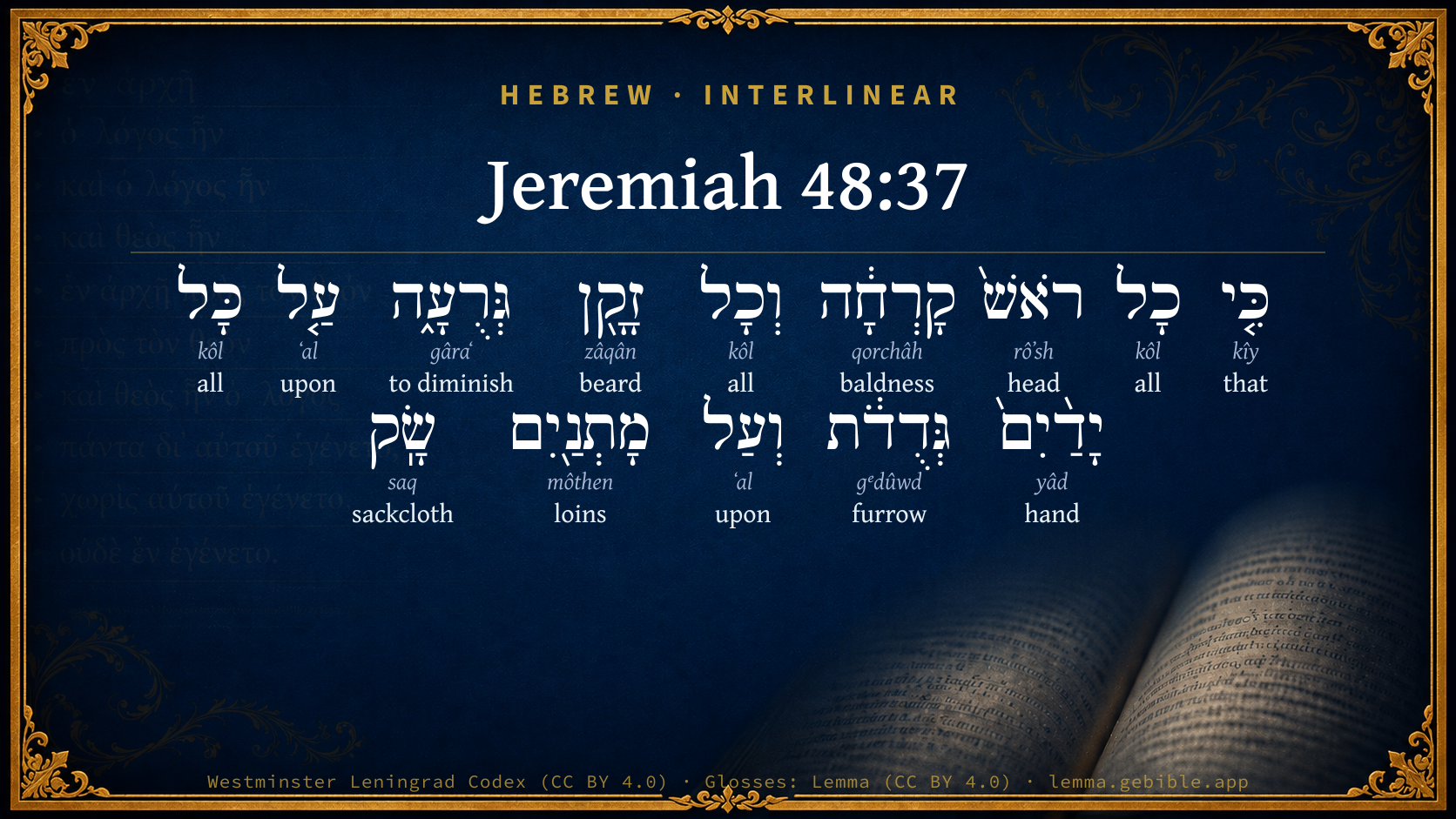
Jeremiah 48:37

Hebrew (Westminster Leningrad Codex) Jeremiah 48:37 appears in the Hebrew Old Testament. The text above is from the Westminster Leningrad Codex. Each word links to its Strong’s number, a concise gloss, and parsing drawn from the Open Scriptures Hebrew Bible morphology. Click any word for its full Brown-Driver-Briggs (BDB) entry.
Download image
Cite this verse

Jeremiah 48:37 (World English Bible). Public Domain. Lemma interlinear Bible study tool, https://lemma.gebible.app/v/jeremiah/48/37.

Show BibTeX & RIS
BibTeX
RIS
English Translation
For every head is bald, and every beard clipped: on all the hands are cuttings, and on the loins sackcloth.
World English Bible · Public Domain
Highlights
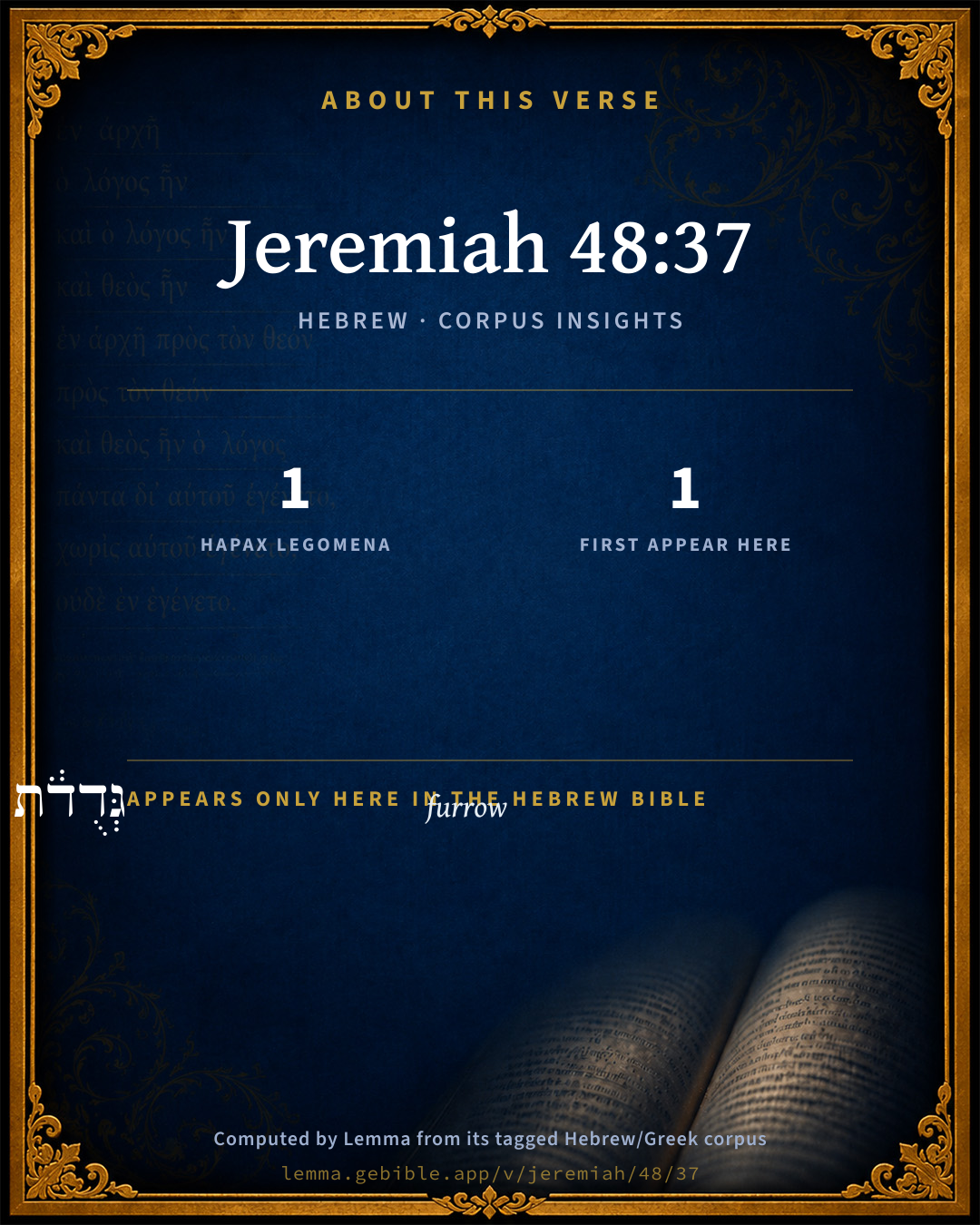
  • 1 hapax legomenon — only here in the Hebrew Bible
  • 1 first appearance in the Hebrew Bible
Full analysis ↓
Download a study sheet

One document with this verse’s original text, its word-by-word gloss line, the meaning frame, cross-references with their text, attributed commentary, and full source and license credits — printable, and it pastes into notes with its structure intact.

This verse Autodidact and up

Study sheet (.html) Plain text (.txt)

A passage Seminary Student

Up to 50 verses in one chapter. A passage sheet keeps up to 6 commentary sources and 12 cross-references per verse, in the order this page ranks them, and says so on the sheet whenever that leaves anything out. Ask for a single verse and you get the Autodidact verse sheet above.

Everything on this page stays free to read, with no account — the sheet is a download of what is already on screen, not access to it.

Want to remove ads? Support Godless Engineer
Compare translations 3

The same verse in 3 English versions, stacked beneath the original-language interlinear above. Click any original word for its lexicon entry.

Each is an independent rendering of the whole verse — the interlinear is not word-aligned to these translations.

Highlighted words mark where these versions differ — a whole-verse word diff, not a word-by-word alignment.

  • World English Bible Public Domain
    For every head is bald, and every beard clipped: on all the hands are cuttings, and on the loins sackcloth.
  • King James Version Public Domain
    For every head shall be bald, and every beard clipped: upon all the hands shall be cuttings, and upon the loins sackcloth.
  • unfoldingWord Literal Text CC BY-SA 4.0
    For every head is bald and every beard shaved. Incisions are on every hand, and sackcloth is around their waists.

unfoldingWord Literal Text — © unfoldingWord, licensed CC BY-SA 4.0. Word-aligned USFM3 via Door43 (git.door43.org/unfoldingWord/en_ult).

Versions to compare (up to 4)

3 of 4 selected

Show all 18 translations

Every available English version of this verse, each an independent rendering of the whole verse.

  • World English Bible Public Domain
    For every head is bald, and every beard clipped: on all the hands are cuttings, and on the loins sackcloth.
  • Berean Standard Bible Public Domain
    For every head is shaved and every beard is clipped; on every hand is a gash, and around every waist is sackcloth.
  • Majority Standard Bible Public Domain
    For every head is shaved and every beard is clipped; on every hand is a gash, and around every waist is sackcloth.
  • King James Version Public Domain
    For every head shall be bald, and every beard clipped: upon all the hands shall be cuttings, and upon the loins sackcloth.
  • American Standard Version (1901) Public Domain
    For every head is bald, and every beard clipped: upon all the hands are cuttings, and upon the loins sackcloth.
  • Revised Version (1885) Public Domain
    For every head is bald, and every beard clipped: upon all the hands are cuttings, and upon the loins sackcloth.
  • Geneva Bible (1599) Public Domain
    For euery head shalbe balde, and euery beard plucked: vpon all the handes shall be cuttings, and vpon the loynes sackecloth.
  • Douay-Rheims (1899) Public Domain
    For every head shall be bald, and every beard shall be shaven: all hands shall be tied together, and upon every back there shall be haircloth.
  • Young's Literal Translation Public Domain
    For every head `is' bald, and every beard diminished, On all hands cuttings, and on the loins -- sackcloth.
  • Literal Standard Version CC BY-SA 4.0
    For every head [is] bald, and every beard diminished, || On all hands—cuttings, and on the loins—sackcloth.
  • Unlocked Literal Bible CC BY-SA 4.0
    For every head is bald and every beard shaved. Incisions are on every hand, and sackcloth is around their waists.
  • unfoldingWord Literal Text CC BY-SA 4.0
    For every head is bald and every beard shaved. Incisions are on every hand, and sackcloth is around their waists.
  • Darby Bible Public Domain
    For every head is bald, and every beard clipped; upon all the hands are cuttings, and upon the loins sackcloth.
  • World Messianic Bible Public Domain
    For every head is bald, and every beard clipped. There are cuttings on all the hands, and sackcloth on the waist.
  • Webster's Bible Public Domain
    For every head shall be bald, and every beard clipped: upon all the hands shall be cuttings, and upon the loins sackcloth.
  • Free Bible Version CC BY-SA 4.0
    As signs of their mourning, every head is shaved, every beard is trimmed, every hand has a gash, and every waist is wearing sackcloth.
  • Bible in Basic English Public Domain
    For everywhere the hair of the head and the hair of the face is cut off: on every hand there are wounds, and haircloth on every body.
  • JPS Tanakh (1917) Public Domain
    For every head is bald, and every beard clipped; upon all the hands are cuttings, and upon the loins sackcloth.

Literal Standard Version (2020), Covenant Press — licensed CC BY-SA 4.0. Text via the HelloAO Bible API (eBible.org). Unlocked Literal Bible (unfoldingWord) — licensed CC BY-SA 4.0. Text via the HelloAO Bible API (eBible.org). unfoldingWord Literal Text — © unfoldingWord, licensed CC BY-SA 4.0. Word-aligned USFM3 via Door43 (git.door43.org/unfoldingWord/en_ult). Free Bible Version, Dr. Jonathan Gallagher — licensed CC BY-SA 4.0. Text via the HelloAO Bible API (eBible.org).

Word by word

More ways to search: Search by grammar → Find every occurrence → Compare this word →

Practice this passage: Drill this verse → Learn its vocabulary →

גְּדֻדֹ֔ת
gᵉdûwd
H1417
“furrows”
Noun, Common, Feminine, Plural, Absolute
Part of Speech
Noun
Type
Common
Gender
Feminine
Number
Plural
State
Absolute
Full BDB Definition

Origin: from H1413

TWOT: 313b

something cut, furrow, cutting - a furrow - cuttings (as a sign of mourning)
  1. כִּ֤י kîy H3588 “that” Conjunction
  2. כָל kôl H3605 “all of” Noun, Common, Masculine, Singular, Construct
  3. רֹאשׁ֙ rôʼsh H7218 “head” Noun, Common, Masculine, Singular, Absolute
  4. קָרְחָ֔ה qorchâh H7144 “baldness” Noun, Common, Feminine, Singular, Absolute
  5. וְכָל kôl H3605 “and · all of” Conjunction + Noun, Common, Masculine, Singular, Construct
  6. זָקָ֖ן zâqân H2206 “beard” Noun, Common, Both, Singular, Absolute
  7. גְּרֻעָ֑ה gâraʻ H1639 “diminished” Verb, Qal, Participle Passive, Feminine, Singular, Absolute
  8. עַ֤ל ʻal H5921 “upon” Preposition
  9. כָּל kôl H3605 “all of” Noun, Common, Masculine, Singular, Construct
  10. יָדַ֨יִם֙ yâd H3027 “hands” Noun, Common, Both, Dual, Absolute
  11. וְעַל ʻal H5921 “and · upon” Conjunction + Preposition
  12. מָתְנַ֖יִם môthen H4975 “loins” Noun, Common, Masculine, Dual, Absolute
  13. שָֽׂק saq H8242 “sackcloth” Noun, Common, Masculine, Singular, Absolute

About this verse

These counts appear in no published source. They are computed here, from the morphology-tagged text and Lemma’s own curated glosses. What Lemma adds →

14
words
11
distinct lemmas
Prophets
section

Notable vocabulary

1 hapax legomenon — a word that appears only here in the entire Hebrew Bible:

  • גְּדֻדֹ֔ת furrow H1417

First appearance in Scripture

This word makes its first canonical appearance in the Hebrew Bible here:

  • גְּדֻדֹ֔ת furrow H1417

Shared distinctive vocabulary

קָרְחָ֔ה baldness H7144 occurs in 11 verses of the Hebrew Bible. Also found in:

Grammatical profile

  • 1 verb
  • 10 nouns
  • 2 prepositions
  • 1 conjunction

Verb forms

  • גְּרֻעָ֑ה Qal · Participle Passive

Repetition

Words recur within this verse — often emphatic in Hebrew:

Cross-references

19

Topical passages linked to Jeremiah 48:37 in the Treasury of Scripture Knowledge — connected by theme and wording, ordered by reader-vote popularity; previews shown in the World English Bible.

  • Genesis 37:34 Jacob tore his clothes, and put sackcloth on his loins, and mourned for his son many days.
  • Isaiah 15:2–3 They are gone up to Bayith, and to Dibon, to the high places, to weep: Moab wails over Nebo, and over Medeba; on all their heads is baldness, every beard is cut off.
  • Jeremiah 41:5 that there came men from Shechem, from Shiloh, and from Samaria, even eighty men, having their beards shaved and their clothes torn, and having cut themselves, with meal-offerings and frankincense in their hand, to bring them to the house of Yahweh.
  • Jeremiah 47:5 Baldness is come on Gaza; Ashkelon is brought to nothing, the remnant of their valley: how long will you cut yourself?
  • Isaiah 20:2 at that time Yahweh spoke by Isaiah the son of Amoz, saying, Go, and loose the sackcloth from off your loins, and put your shoe from off your foot. He did so, walking naked and barefoot.
  • Jeremiah 16:6 Both great and small shall die in this land; they shall not be buried, neither shall men lament for them, nor cut themselves, nor make themselves bald for them;
  • Genesis 37:29 Reuben returned to the pit; and saw that Joseph wasn't in the pit; and he tore his clothes.
  • Leviticus 19:28 "'You shall not make any cuttings in your flesh for the dead, nor tattoo any marks on you. I am Yahweh.
  • 1 Kings 18:28 They cried aloud, and cut themselves after their manner with knives and lances, until the blood gushed out on them.
  • 1 Kings 21:27 It happened, when Ahab heard those words, that he tore his clothes, and put sackcloth on his flesh, and fasted, and lay in sackcloth, and went softly.
  • 2 Kings 6:30 It happened, when the king heard the words of the woman, that he tore his clothes (now he was passing by on the wall); and the people looked, and, behold, he had sackcloth within on his flesh.
  • Isaiah 3:24 It shall happen that instead of sweet spices, there shall be rottenness; Instead of a belt, a rope; Instead of well set hair, baldness; Instead of a robe, a girding of sackcloth; And branding instead of beauty.
  • Isaiah 37:1 It happened, when king Hezekiah heard it, that he tore his clothes, and covered himself with sackcloth, and went into the house of Yahweh.
  • Ezekiel 7:18 They shall also gird themselves with sackcloth, and horror shall cover them; and shame shall be on all faces, and baldness on all their heads.
  • Ezekiel 27:31 and they shall make themselves bald for you, and gird them with sackcloth, and they shall weep for you in bitterness of soul with bitter mourning.
  • Amos 8:10 I will turn your feasts into mourning, And all your songs into lamentation; And I will make you wear sackcloth on all your bodies, And baldness on every head. I will make it like the mourning for an only son, And the end of it like a bitter day.
  • Micah 1:16 Shave your heads, And cut off your hair for the children of your delight. Enlarge your baldness like the vulture; For they have gone into captivity from you!
  • Mark 5:5 Always, night and day, in the tombs and in the mountains, he was crying out, and cutting himself with stones.
  • Revelation 11:3 I will give power to my two witnesses, and they will prophesy one thousand two hundred sixty days, clothed in sackcloth."

Cross-references courtesy of OpenBible.info (CC BY 4.0).

Hebrew and Greek witnesses Masoretic Hebrew ↔ Greek Septuagint

The same verse in the two great witnesses to the Old Testament, shown verse-for-verse.

These are two independent witnesses, not word-aligned to each other, and the Septuagint is shown in lemma (dictionary) form.

Hebrew Jeremiah 48:37 Masoretic · Westminster Leningrad Codex

כִּ֤י כָל רֹאשׁ֙ קָרְחָ֔ה וְכָל זָקָ֖ן גְּרֻעָ֑ה עַ֤ל כָּל יָדַ֨יִם֙ גְּדֻדֹ֔ת וְעַל מָתְנַ֖יִם שָֽׂק

For every head is bald, and every beard clipped: on all the hands are cuttings, and on the loins sackcloth.

World English Bible · Public Domain

Greek LXX Structure differs

In the Septuagint, Jeremiah is about an eighth shorter than the Hebrew and arranges its material differently — the Oracles Against the Nations (Hebrew chapters 46–51) appear in the middle of the Greek book, after 25:13. Because the chapter and verse boundaries do not line up, a verse-for-verse comparison with the Hebrew is not shown.

A verse-for-verse comparison isn’t shown here because the chapters and verses don’t line up. Switch to the LXX edition with the MT / LXX toggle above to read the Greek directly.

Hebrew: Westminster Leningrad Codex (CC BY 4.0). Greek: Septuagint (public domain); English from a public-domain English Septuagint. How the Septuagint differs from the Hebrew →

Targum (Aramaic paraphrase)

1

The Targum is the ancient Jewish Aramaic paraphrase of the Hebrew Scriptures — an interpretive translation, not the Hebrew text itself. Onkelos (literal) and Pseudo-Jonathan (expansive) render the Torah, and Jonathan the Prophets. Coverage is partial: where no permissively-licensed English translation exists for a verse, only the Aramaic is shown. This is verse-level text, not a word-by-word alignment to the Hebrew.

  1. Targum Jonathan Prophets (Joshua–Malachi)
    אֲרֵי כָּל סְעַר רֵישׁ נְתַר וְכָל דְקַן גִלוּחַ עַל כָּל סִיעַן מִתְהַמְמִין וְעַל חַרְצִין סָק:

    (no public-domain English translation for this verse)

    Targum Jonathan — Aramaic: “Mikraot Gedolot” (public domain). English: “Sefaria Community Translation” (CC0 1.0 (public-domain dedication)); “London "Chaldee Paraphrase," 1871” (public domain). Text via Sefaria.

Commentary

Notes on Jeremiah 48:37 from classic Christian and Jewish commentators (each source and its license shown beneath its notes). The classic Christian expositions comment on the surrounding passage and are grouped to its opening verse, so a note may address several verses; the Jewish commentaries on the Tanakh (Rashi and others) are per-verse, so they appear only where the commentator wrote on this verse.

Lemma curates 59 commentaries, every one of them public domain or Creative Commons licensed, each selected and text-cleaned for this edition rather than reprinted as found. About our sources →

Trapp's Complete Commentary

John Trapp

Jer 48:37 For every head [shall be] bald, and every beard clipped: upon all the hands [shall be] cuttings, and upon the loins sackcloth.

Ver. 37. For every head shall be bald.] This was the doings among the Easterlings, in times of mourning.

John Trapp, A Commentary or Exposition upon All the Books of the Old and New Testament (1647–1656) — public domain. Text from a community e-Sword module.

Geneva Bible (1599)

Geneva Bible translators

Or, shaven.

Geneva Bible (1599) marginal notes — public domain. Text via Bolls.life.

Jamieson, Fausset & Brown

Robert Jamieson, A. R. Fausset & David Brown

(See on Jer 47:5; Isa 15:2-3).

upon all . . . hands--that is, arms, in which such cuttings used to be made in token of grief (compare Zac 13:6).

Jamieson, Fausset & Brown — Commentary Critical and Explanatory on the Whole Bible (1871) — public domain (CC PDM 1.0). Text via the HelloAO Bible API.

Adam Clarke's Commentary

Verse 37. For every head shall be bald] These, as we have seen before, were signs of the deepest distress and desolation.

Adam Clarke's Commentary on the Bible (1810–1826) — public domain. Text from a community e-Sword/MySword module.

John Calvin's Commentaries

The Prophet describes at large a very great mourning. They were wont in great sorrow to pull off their hair, to shave their beard, and to put on sackcloth, or to gird it round their loins, and also to cut their hands with a knife or with their nails. As these things were signs of grief; Jeremiah puts them all together, in order to show that the calamity of Moab would not be common, but what would cause to the whole people extreme lamentation. They shall make bald, he says, their heads, their beard they shall pull off, or shave; for the word, to diminish, may signify either. Then he adds, the incisions in the hands; they shall tear their faces and their hands with their nails, or as some say, with a knife or a razor. As to sackcloth, it was also a sign of mourning. It is indeed certain that it was formerly the practice for men, as though it was innate in human nature, in great calamities to spread ashes on the head and to put on sackloth. But he has added other excesses which are not very congenial to nature, for it is not agreeable to humanity to pull off the beard, to make bald the head, or to tear the hands and the face with the nails. These things show excesses, suitable neither to men nor to women, — not to women on the ground of modesty, nor to men on the ground of manliness and strength of mind.

But mankind never control themselves, and whether they mourn or rejoice, they are ever led away to excesses, observing no moderation. There was also another evil connected with sackcloth and ashes; for when it was God’s design to lead men by these symbols to humble themselves, to consider their sins and to flee to his mercy, they were diverted to another end, even that he who mourned might appear miserable to others, and make a display of his weeping and tears. In short, besides excess, there was also this common evil, even hypocrisy. For men ever turn aside to what is vain, and dissemble in all things. But in this place there is no reason to dispute about mourning, for the Prophet means only that the Moabites would become most miserable, exhibiting all the symptoms of sorrow. It follows —

John Calvin's Commentaries (1540-1563) — public domain. Text from the Calvin Translation Society English edition (1840s-50s) via the Christian Classics Ethereal Library (ccel.org). Calvin's coverage is partial (roughly two-thirds of the Bible); uncommented books and verses are honest gaps, never fabricated. The 19th-century editor's footnotes and remarks are omitted so the notes are faithfully Calvin's own voice.

The Cambridge Bible for Schools and Colleges

gen. ed. J. J. S. Perowne

37. All shall have the usual indications of mourning. See on ch. Jer_16:6.

37, 38. Cp. Isa_15:2 f. From “for I have broken” (Jer_48:38) to “upon Moab” (Jer_48:44) is either wholly or in a large part the work of a supplementer.

The Cambridge Bible for Schools and Colleges (gen. ed. J. J. S. Perowne; Cambridge University Press, 1878–1918) — public domain. Text from a community e-Sword module.

John Gill's Exposition

There shall be lamentation generally,.... Or, "all of it is mourning" (n); the whole country of Moab is in mourning; or all is full of mourning; all persons, places, and things, express nothing but mourning; go where you will, it is to be seen:

upon all the house tops of Moab, and in the streets thereof; the mourning, as it was general, it was public; it was seen by all, and everywhere; See Gill on Isa 15:3;

for I have broken Moab like a vessel wherein is no pleasure, saith the Lord; as an earthen vessel, which the potter does not like, and which is useless and unprofitable to any, and which he takes and dashes into pieces; into a thousand shivers, as the word (o) here signifies, and can never be put together again; or as a filthy unclean vessel a man cannot bear in his sight: Moab is by the Lord called his wash pot, Psa 60:8. The Moabites were vessels of wrath, fitted for destruction by their own this; and now the time of it was come.

(n) "totus luctus (est) vel omnia luctus (sunt)", Schmidt; "totus erit planctus", Junius & Tremellius; "per omnia erit planctus", Piscator. (o) "totalis confractio praedicitur", Schmidt.

John Gill's Exposition of the Whole Bible (1746–1763) — public domain (CC PDM 1.0). Text via the HelloAO Bible API.

Albert Barnes' Notes on the Bible

Cuttings - Compare Jer 16:6, and marginal references.

Albert Barnes' Notes on the Bible (1834–1885) — public domain. Text from a community e-Sword/MySword module.

Haydock's Catholic Bible Commentary

Shaven, or "clipt," (Protestants; Haydock) as in mourning. --- Tied. Hebrew, "cut," chap. xvi. 6. (Calmet) --- Such signs of mourning were usual in those countries. The Romans let their hair grow. (Cicero, pro Sestio.) (Worthington)

George Leo Haydock (1774–1849), Haydock's Catholic Family Bible and Commentary, 1859 edition — public domain. Excludes Psalms (Douay-Rheims chapter numbering differs from Protestant) and Deuterocanonical books (Catholic canon only).

Matthew Poole's English Annotations

These phrases are expounded in the beginning of the following verse, There shall be lamentation generally upon all the house-tops of Moab. Shaving of the hair, and clipping the beards, and cutting themselves, were rites and ceremonies of mourning used by these heathens.

Matthew Poole's English Annotations on the Holy Bible (1683–1685) — public domain. Text from a community e-Sword/MySword module.

Whedon's Commentary on the Bible

Daniel D. Whedon

37. Head… bald,… beard clipped, upon… the hands… cuttings, and upon the loins sackcloth, are signs of abject grief and desolation.

Daniel D. Whedon (gen. ed.), Commentary on the Old and New Testaments (1874–1909) — public domain. Text from a community e-Sword module.

The Pulpit Commentary

Vers. 37, 38 (first part). Based on Isa_15:2 (latter part), Isa_15:3 (first part). On the primitive Arabic, Egyptian, and Hebrew custom of cutting off the hair, see on Jer_16:6, and comp. Herod., 2:36. Clipped. The difference from the word in Isaiah is so slight that it may easily have arisen from a copyist. The meaning is virtually the same. Cuttings. So of Philistia; (Jer_47:5) see on Jer_16:6.

The Pulpit Commentary (1880–1919), ed. H.D.M. Spence-Jones & Joseph S. Exell — public domain. Text from a community e-Sword module.

Rashi

Rabbi Shlomo Yitzchaki (Rashi)

scratches Heb. גדדת.

Rashi on the Tanakh — English translations: “The Judaica Press complete Tanach with Rashi, translated by A. J. Rosenberg” (CC BY 4.0); “Pentateuch with Rashi's commentary by M. Rosenbaum and A.M. Silbermann, 1929-1934” (public domain); “The Metsudah Tanach series, Lakewood, N.J” (CC BY 4.0); and “The Book of Joshua, Metsudah Publications, 1997” (CC BY 4.0). Text via Sefaria.

Lesson kit

Teaching starters — assembled from the data on this page, not authored interpretation. Every prompt links to the verse data it draws on. Edit before teaching.

Jeremiah, in the Prophets, opens this verse with 14 words (11 distinct Hebrew lemmas). Its most distinctive word is gᵉdûwd (“furrow”). A historical commentator’s framing appears above. Read the whole chapter for the surrounding context.

Discussion questions

  1. What does “furrow” (gᵉdûwd) contribute to the verse as a whole?
  2. 1 word here appears nowhere else in the Hebrew Bible. Why might the author reach for such rare wording?
  3. This is the first place “furrow” appears in Scripture (first appears here). What does its debut here establish?
  4. How does Leviticus 21:5, which shares the word «baldness», read alongside this verse?
  5. What does the repetition of “all” (3× in this one verse) do in this verse?
  6. These translations render this verse differently. What is at stake in choosing one wording over another?
  7. «גְּרֻעָ֑ה» is a Qal Participle Passive verb. How does that grammatical form shape the action described?
  8. Compare how Trapp's Complete Commentary and Geneva Bible (1599) read this verse. Where do they agree or differ?

Things to notice

  • 1 word in this verse appears nowhere else in the Hebrew Bible.
  • 1 word makes its first canonical appearance in Scripture here.
  • These translations choose different wording for 12 words in this verse.
  • “all” occurs 3× in this single verse.
  • 11 distinct Hebrew lemmas span 14 words in this verse.

Reading settings

Reading text

Shown beneath each verse's original-language words.

Old Testament
Old Testament edition

Read the OT as the Masoretic Hebrew (MT) or the Greek Septuagint (LXX).

English shown for the Greek Septuagint (in the Hebrew ↔ Greek comparison).

Comparing translations? Open the Compare panel on any verse page to stack up to four side by side.