
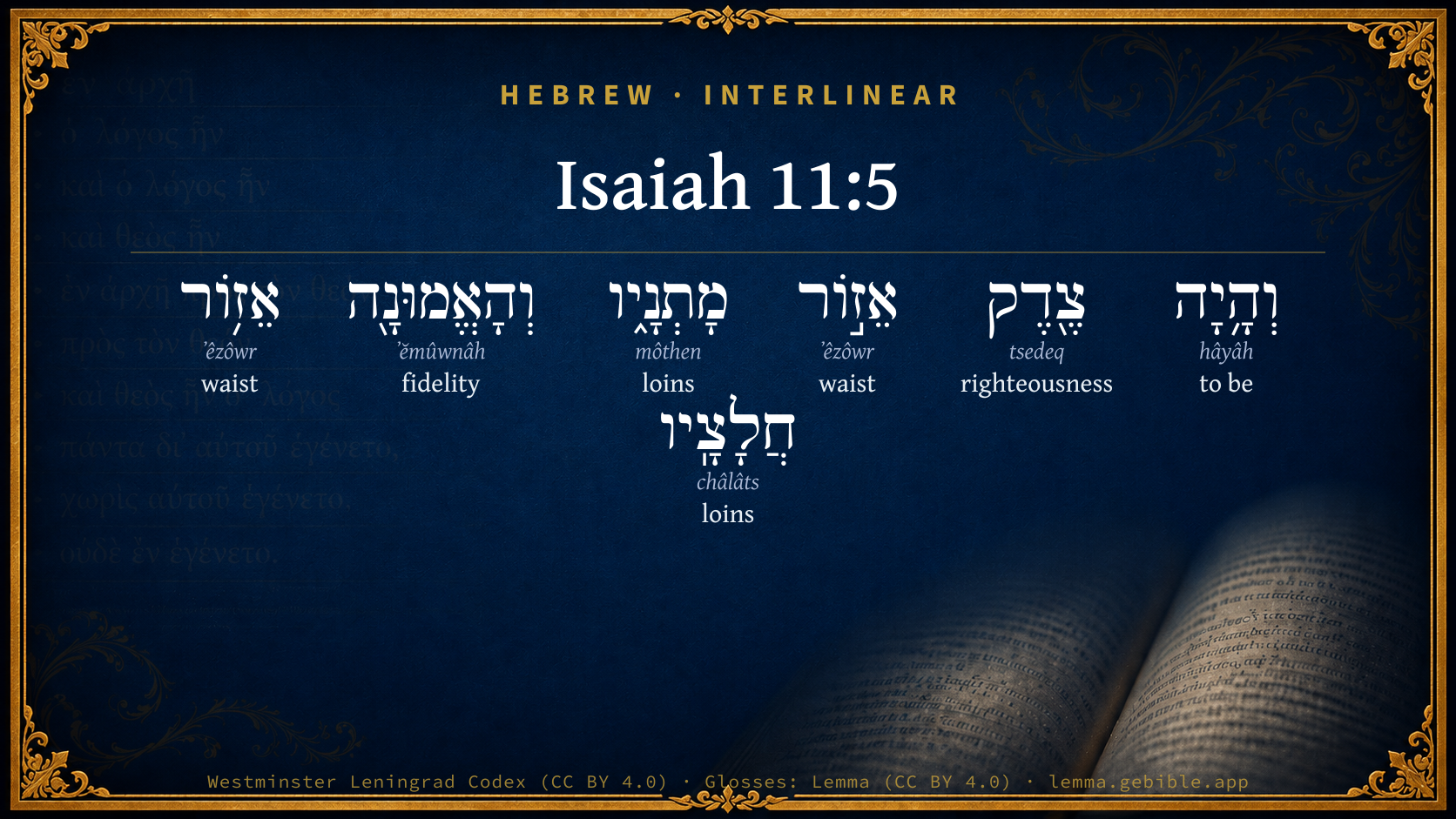
Isaiah 11:5

Hebrew (Westminster Leningrad Codex) Isaiah 11:5 appears in the Hebrew Old Testament. The text above is from the Westminster Leningrad Codex. Each word links to its Strong’s number, a concise gloss, and parsing drawn from the Open Scriptures Hebrew Bible morphology. Click any word for its full Brown-Driver-Briggs (BDB) entry.
Download image
Cite this verse

Isaiah 11:5 (World English Bible). Public Domain. Lemma interlinear Bible study tool, https://lemma.gebible.app/v/isaiah/11/5.

Show BibTeX & RIS
BibTeX
RIS
English Translation
Righteousness shall be the belt of his waist, and faithfulness the belt of his loins.
World English Bible · Public Domain
Download a study sheet

One document with this verse’s original text, its word-by-word gloss line, the meaning frame, cross-references with their text, attributed commentary, and full source and license credits — printable, and it pastes into notes with its structure intact.

This verse Autodidact and up

Study sheet (.html) Plain text (.txt)

A passage Seminary Student

Up to 50 verses in one chapter. A passage sheet keeps up to 6 commentary sources and 12 cross-references per verse, in the order this page ranks them, and says so on the sheet whenever that leaves anything out. Ask for a single verse and you get the Autodidact verse sheet above.

Everything on this page stays free to read, with no account — the sheet is a download of what is already on screen, not access to it.

Want to remove ads? Support Godless Engineer
Compare translations 3

The same verse in 3 English versions, stacked beneath the original-language interlinear above. Click any original word for its lexicon entry.

Each is an independent rendering of the whole verse — the interlinear is not word-aligned to these translations.

Highlighted words mark where these versions differ — a whole-verse word diff, not a word-by-word alignment.

  • World English Bible Public Domain
    Righteousness shall be the belt of his waist, and faithfulness the belt of his loins.
  • King James Version Public Domain
    And righteousness shall be the girdle of his loins, and faithfulness the girdle of his reins.
  • unfoldingWord Literal Text CC BY-SA 4.0
    And righteousness will be the belt of his loins, and faithfulness, the belt of his hips.

unfoldingWord Literal Text — © unfoldingWord, licensed CC BY-SA 4.0. Word-aligned USFM3 via Door43 (git.door43.org/unfoldingWord/en_ult).

Versions to compare (up to 4)

3 of 4 selected

Show all 18 translations

Every available English version of this verse, each an independent rendering of the whole verse.

  • World English Bible Public Domain
    Righteousness shall be the belt of his waist, and faithfulness the belt of his loins.
  • Berean Standard Bible Public Domain
    Righteousness will be the belt around His hips, and faithfulness the sash around His waist.
  • Majority Standard Bible Public Domain
    Righteousness will be the belt around His hips, and faithfulness the sash around His waist.
  • King James Version Public Domain
    And righteousness shall be the girdle of his loins, and faithfulness the girdle of his reins.
  • American Standard Version (1901) Public Domain
    And righteousness shall be the girdle of his waist, and faithfulness the girdle of his loins.
  • Revised Version (1885) Public Domain
    And righteousness shall be the girdle of his loins, and faithfulness the girdle of his reins.
  • Geneva Bible (1599) Public Domain
    And iustice shall be ye girdle of his loynes, and faithfulnesse the girdle of his reines.
  • Douay-Rheims (1899) Public Domain
    And justice shall be the girdle of his loins: and faith the girdle of his reins.
  • Young's Literal Translation Public Domain
    And righteousness hath been the girdle of his loins, And faithfulness -- the girdle of his reins.
  • Literal Standard Version CC BY-SA 4.0
    And righteousness has been the girdle of His loins, || And faithfulness—the girdle of His reins.
  • Unlocked Literal Bible CC BY-SA 4.0
    Righteousness will be the belt of his waist, and faithfulness the belt around his hips.
  • unfoldingWord Literal Text CC BY-SA 4.0
    And righteousness will be the belt of his loins, and faithfulness, the belt of his hips.
  • Darby Bible Public Domain
    And righteousness shall be the girdle of his reins, and faithfulness the girdle of his loins.
  • World Messianic Bible Public Domain
    Righteousness will be the belt around his waist, and faithfulness the belt around his waist.
  • Webster's Bible Public Domain
    And righteousness shall be the girdle of his loins, and faithfulness the girdle of his reins.
  • Free Bible Version CC BY-SA 4.0
    He will wear goodness like a sash and trustworthiness like a belt.
  • Bible in Basic English Public Domain
    And righteousness will be the cord of his robe, and good faith the band round his breast.
  • JPS Tanakh (1917) Public Domain
    And righteousness shall be the girdle of his loins, and faithfulness the girdle of his reins.

Literal Standard Version (2020), Covenant Press — licensed CC BY-SA 4.0. Text via the HelloAO Bible API (eBible.org). Unlocked Literal Bible (unfoldingWord) — licensed CC BY-SA 4.0. Text via the HelloAO Bible API (eBible.org). unfoldingWord Literal Text — © unfoldingWord, licensed CC BY-SA 4.0. Word-aligned USFM3 via Door43 (git.door43.org/unfoldingWord/en_ult). Free Bible Version, Dr. Jonathan Gallagher — licensed CC BY-SA 4.0. Text via the HelloAO Bible API (eBible.org).

Word by word

More ways to search: Search by grammar → Find every occurrence → Compare this word →

Practice this passage: Drill this verse → Learn its vocabulary →

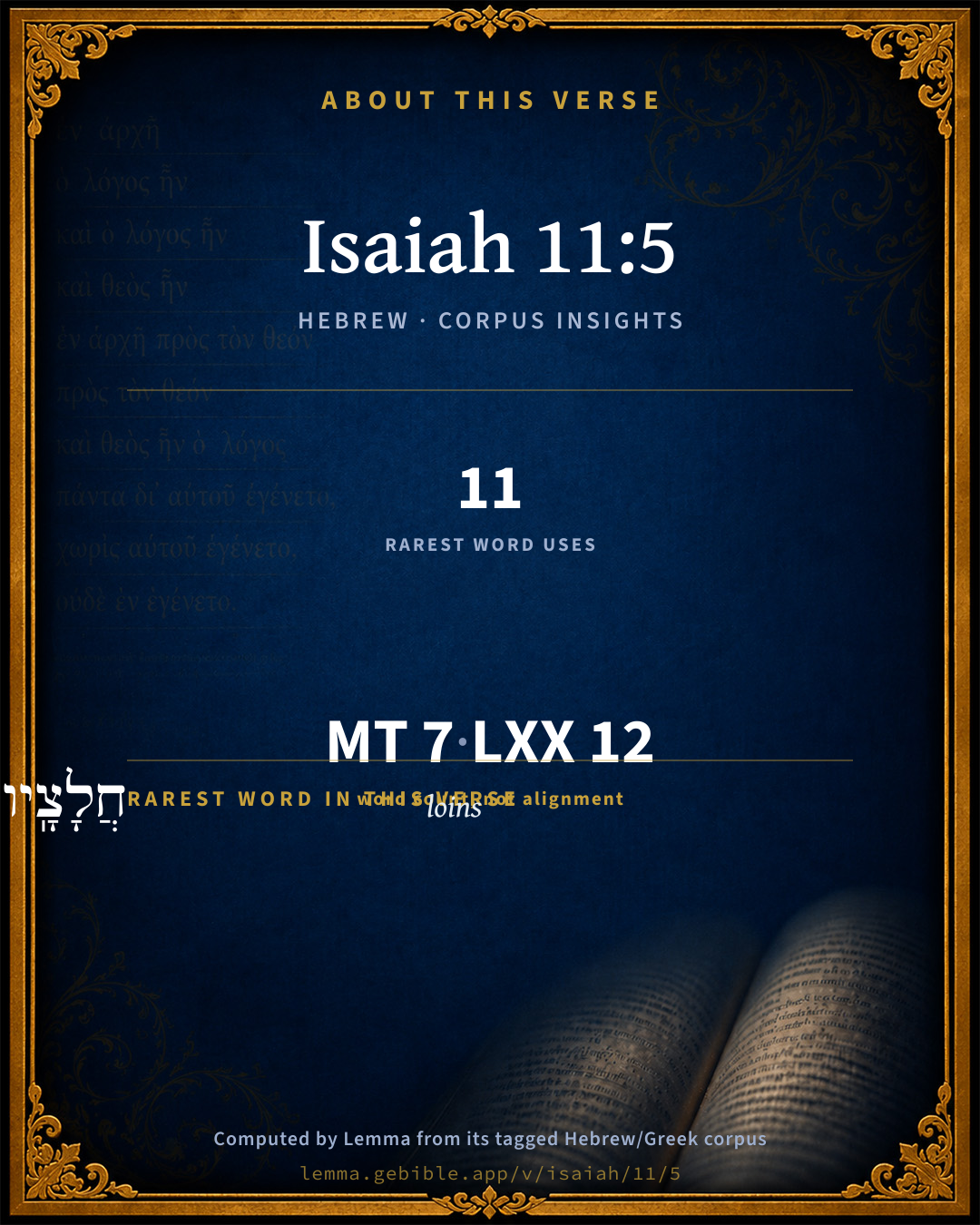
About this verse

These counts appear in no published source. They are computed here, from the morphology-tagged text and Lemma’s own curated glosses. What Lemma adds →

7
words
6
distinct lemmas
Prophets
section

Notable vocabulary

The rarest word here is חֲלָצָֽיו loins H2504 — appearing just 11 times in the whole Hebrew Bible.

Shared distinctive vocabulary

חֲלָצָֽיו loins H2504 occurs in 10 verses of the Hebrew Bible. Also found in:

Grammatical profile

  • 1 verb
  • 6 nouns

Verb forms

  • וְהָ֥יָה Qal · Sequential Perfect

Repetition

A word recurs within this verse — often emphatic in Hebrew:

  • אֵז֣וֹר waist H232 ×2

Hebrew & Septuagint length

In English translation the verse runs 15 words from the Hebrew and 15 from the Septuagint (LXX English) — the same length.

A rough comparison of the two English renderings, which tokenize alike — not a word-level alignment.

Word counts can differ between the Hebrew and the Greek without any difference in meaning — e.g. the Hebrew direct-object marker אֵת has no separate Greek word, and Greek often adds the article ὁ.

In the original languages it is 7 Hebrew tokens and 12 Greek tokens — but the two are counted differently (Hebrew bundles its prefixes and suffixes into one token; the Greek is in lemma form), so that isn’t a like-for-like length.

Cross-references

11

Topical passages linked to Isaiah 11:5 in the Treasury of Scripture Knowledge — connected by theme and wording, ordered by reader-vote popularity; previews shown in the World English Bible.

  • Ephesians 6:14 Stand therefore, having the utility belt of truth buckled around your waist, and having put on the breastplate of righteousness,
  • 1 John 1:9 If we confess our sins, he is faithful and righteous to forgive us the sins, and to cleanse us from all unrighteousness.
  • Isaiah 25:1 Yahweh, you are my God; I will exalt you, I will praise your name; for you have done wonderful things, [even] counsels of old, in faithfulness [and] truth.
  • Isaiah 59:17 He put on righteousness as a breastplate, and a helmet of salvation on his head; and he put on garments of vengeance for clothing, and was clad with zeal as a mantle.
  • 2 Corinthians 6:7 in the word of truth, in the power of God; by the armor of righteousness on the right hand and on the left,
  • Hosea 2:20 I will even betroth you to me in faithfulness; And you shall know Yahweh.
  • 1 Peter 4:1 Forasmuch then as Christ suffered for us in the flesh, arm yourselves also with the same mind; for he who has suffered in the flesh has ceased from sin;
  • Revelation 1:13 And among the lampstands was one like a son of man, clothed with a robe reaching down to his feet, and with a golden sash around his chest.
  • Revelation 3:14 "To the angel of the assembly in Laodicea write: "The Amen, the Faithful and True Witness, the Head of God's creation, says these things:
  • Psalms 93:1 Yahweh reigns! He is clothed with majesty! Yahweh is armed with strength. The world also is established. It can't be moved.
  • Hebrews 2:17 Therefore he was obligated in all things to be made like his brothers, that he might become a merciful and faithful high priest in things pertaining to God, to make atonement for the sins of the people.

Cross-references courtesy of OpenBible.info (CC BY 4.0).

Hebrew and Greek witnesses Masoretic Hebrew ↔ Greek Septuagint

The same verse in the two great witnesses to the Old Testament, shown verse-for-verse.

These are two independent witnesses, not word-aligned to each other, and the Septuagint is shown in lemma (dictionary) form.

Hebrew Isaiah 11:5 Masoretic · Westminster Leningrad Codex

וְהָ֥יָה צֶ֖דֶק אֵז֣וֹר מָתְנָ֑יו וְהָאֱמוּנָ֖ה אֵז֥וֹר חֲלָצָֽיו

Righteousness shall be the belt of his waist, and faithfulness the belt of his loins.

World English Bible · Public Domain

Greek LXX Isaiah 11:5 Septuagint · lemma form

καί εἰμί δικαιοσύνη ζώννυμι ὁ ὀσφύς αὐτός καί ἀλήθεια εἱλέω ὁ πλευρά

And he shall have his loins girded with righteousness, and his sides clothed with truth.

LXX2012 (modern English Septuagint) · Public Domain

Hebrew: Westminster Leningrad Codex (CC BY 4.0). Greek: Septuagint (public domain); English from LXX2012 (modern English Septuagint) (Public Domain). How the Septuagint differs from the Hebrew →

Targum (Aramaic paraphrase)

1

The Targum is the ancient Jewish Aramaic paraphrase of the Hebrew Scriptures — an interpretive translation, not the Hebrew text itself. Onkelos (literal) and Pseudo-Jonathan (expansive) render the Torah, and Jonathan the Prophets. Coverage is partial: where no permissively-licensed English translation exists for a verse, only the Aramaic is shown. This is verse-level text, not a word-by-word alignment to the Hebrew.

  1. Targum Jonathan Prophets (Joshua–Malachi)
    וִיהוֹן צַדִיקַיָא סְחוֹר סְחוֹר לֵיהּ וְעָבְדֵי הַמְנוּתָא מְקָרְבִין לֵיהּ:

    And the righteous shall be round about him, and the workers of faith shall draw nigh unto him.

    Targum Jonathan — Aramaic: “Mikraot Gedolot” (public domain). English: “Sefaria Community Translation” (CC0 1.0 (public-domain dedication)); “London "Chaldee Paraphrase," 1871” (public domain). Text via Sefaria.

Commentary

Notes on Isaiah 11:5 from classic Christian and Jewish commentators (each source and its license shown beneath its notes). The classic Christian expositions comment on the surrounding passage and are grouped to its opening verse, so a note may address several verses; the Jewish commentaries on the Tanakh (Rashi and others) are per-verse, so they appear only where the commentator wrote on this verse.

Lemma curates 59 commentaries, every one of them public domain or Creative Commons licensed, each selected and text-cleaned for this edition rather than reprinted as found. About our sources →

Trapp's Complete Commentary

John Trapp

Isa 11:5 And righteousness shall be the girdle of his loins, and faithfulness the girdle of his reins.

Ver. 5. And righteousness shall be the girdle of his loins.] Symbolum Regis hoc est, saith Scultetus. Kings and princes have their scita in scutis, their mottoes on their shields; so hath our king here, viz., "Righteousness and faithfulness"; and this is so manifest as if written on his girdle, {a} or belt, see Rev 19:16; where, for like cause, Christ’s high titles are written "on his vesture, and on his thigh." Others by this expression understand Christ’s alacrity and promptitude to vindicate his elect, and to punish the wicked, according to his promise, Vaticinatur de Christi solertia in obeundis regni Dei negotiis, ac tribuit illi cincturam, seu industriam spiritualem pro qualilate obeundae dispensationis. {b} Let us also, Christ-like, "gird up the loins of our minds; be sober, and hope perfectly." {1Pe 1:13} Gird ourselves, and serve him, {Luk 17:8} readily, nimbly, handsomely, and hardily. A loose, discinct, and diffluent (fluid) mind is unfit for God’s service.

{a} The belt is put for a kingly ensign. Calvin. {Job 12:18}

{b} Zeged.

John Trapp, A Commentary or Exposition upon All the Books of the Old and New Testament (1647–1656) — public domain. Text from a community e-Sword module.

The Biblical Illustrator

Joseph S. Exell

Isa_11:5

And righteousness shall be the girdle of His loins and faithfulness the girdle of His reins

The right girdle

I.

We have the Saviour here represented in His RIGHTEOUSNESS. The Saviour was abstractedly, in and of and from Himself, righteous. But the righteousness here means the actual accomplishment of His mission. He saith of Himself. Ought not Christ to suffer these things? But He was not only righteous in His work, He was righteous on all sides. Righteousness shall be the girdle of His loins; go all round Him. That cannot be said of us except by faith. By faith we put on the girdle of righteousness. But personally we are compassed with infirmity. Not so the Saviour. He was tempted or tried, but never showed a weak part anywhere. Not only was He righteous, He was also strong.

II. We have the Saviour here represented in His FAITHFULNESS. By the reins, as Cruden well observes, the vital affections of the soul are meant. Did Christs vital affections ever give way? No! How faithful He was in love! (James Wells.)

Girdles

Girdles of various kinds, made of valuable materials, were anciently worn by persons of high rank, which distinguished them from those of inferior station, by whom girdles of some sort were likewise worn. The girdles which the priests put on were made of gold, of blue, of purple, scarlet, and fine-twined linen. The military girdle was sometimes of considerable excellence and value, as is plainly intimated in what Joab said to the young man who informed him he had seen Absalom hanging in a tree (2Sa_18:11). (R. Macculloch.)

Righteousness and faithfulness

Righteousness and faithfulness, agreeably blended together, compose the girdle of the Messiah. These two amiable qualities cannot be separated, and serve mutually to illustrate each other; faithfulness is necessary to fulfil the promises of God, and righteousness is no less requisite to discern the characters of those to whom they ought to be fulfilled, in what measure, and in what time they should be accomplished. (R. Macculloch.)

Christ's girdle

1. As a girdle surrounds a mans whole body, and is seen to advantage whithersoever he turn himself, so, in like manner, these two Divine excellences should every way appear most conspicuous in the Messiahs administration of the affairs of His kingdom.

2. As the girdles which were anciently worn, served to fasten the loose and flowing garments that were then used and to strengthen the loins of those who were girt with them, so these glorious perfections complete the character of the King of Israel and give vigour to the honourable and successful exercise of regal authority.

3. As girdles served in ancient times for ornaments to the illustrious persons who put them on, so righteousness and faithfulness were eminently to adorn the personal conduct and public character of the Prince of Peace, the King of kings, and Lord of lords (Rev_19:11). (R. Macculloch.)

The trilogy of the prophetic figures of the Messiah

The trilogy of the prophetic figures of the Messiah as about to be born, as born, and as ruling--is now complete. (F. Delitzsch, D. D.)

The Biblical Illustrator, edited by Joseph S. Exell (c. 1880s–1900s) — public domain. Text from a community e-Sword module.

Joseph Benson's Commentary

Isa 11:5. And righteousness shall be the girdle of his loins — It shall adorn him, and be the glory of his government, as a girdle was used for an ornament, Isa 3:24; and as an ensign of power, Job 12:18; and it shall constantly cleave to him in all his administrations, as a girdle cleaveth to a man’s loins. And faithfulness the girdle of his reins — The same thing in other words. Here then we have the basis and foundation of this kingdom, namely, the justice and fidelity of the king. These virtues shall be conspicuous in the whole administration of his government, and, at once, be the ornament and the support of it. “The sum is, that the kingdom of Christ should be a kingdom of the highest equity, and the king of it perfect: who, though judging his true subjects by the law of grace, by faithfully performing all the promises of the gospel, and every condition of the covenant to them, will yet not omit to punish the enemies of his church according to their deserts, and thus to satisfy the law of justice: so that he shall not be less venerable and awful for his justice in judgment, than amiable and desirable for his truth, fidelity, and constancy in performing his promises; which being things naturally united, are not, by any means, to be separated.” — Dodd.

Joseph Benson's Commentary on the Old and New Testaments (1811–1818) — public domain. Text from a community e-Sword module.

Tyndale Open Study Notes

Tyndale Open Resources

11:5 By virtue of the righteous character of the Messiah, his reign will be characterized by justice, righteousness, and truth, in contrast to the conditions of Jerusalem described in 1:21.

Tyndale Open Study Notes — © Tyndale Open Resources, licensed CC BY-SA 4.0. Text via the HelloAO Bible API.

Jamieson, Fausset & Brown

Robert Jamieson, A. R. Fausset & David Brown

righteousness . . . girdle-- (Rev 1:13; Rev 19:11). The antitypical High Priest (Exo 28:4). The girdle secures firmly the rest of the garments (Pe1 1:13). So "truth" gives firm consistency to the whole character (Eph 5:14). In Isa 59:17, "righteousness" is His breastplate.

Jamieson, Fausset & Brown — Commentary Critical and Explanatory on the Whole Bible (1871) — public domain (CC PDM 1.0). Text via the HelloAO Bible API.

Adam Clarke's Commentary

Verse 5. The girdle - "The cincture"] All the ancient Versions, except that of Symmachus, have two different words for girdle in the two hemistichs. It is not probable that Isaiah would have repeated אזור azer, when a synonymous word so obvious as חגור chagor occurred. The tautology seems to have arisen from the mistake of some transcriber. The meaning of this verse is, that a zeal for justice and truth shall make him active and strong in executing the great work which he shall undertake. See note on Isa 5:27.

Adam Clarke's Commentary on the Bible (1810–1826) — public domain. Text from a community e-Sword/MySword module.

Ellicott's Commentary for English Readers

(5) Righteousness shall be the girdle of his loins . . .—The image of clothing as the symbol of habit or character was already familiar (Psa_109:18-19). The repetition of “girdle” has needlessly offended some fastidious critics, but the emphasis of iteration is quite after Isaiah’s manner (Isa_15:8; Isa_16:7; Isa_17:12-13). It perhaps implies an upper and a lower girdle as the symbol of complete equipment. In the “loins girt about with truth” of Eph_6:14, we may probably trace an allusive reference. The armour of the followers of Christ was to be like that of Christ Himself.

A Bible Commentary for English Readers, edited by Charles John Ellicott (1878–1897) — public domain. Text from a community e-Sword module.

The Cambridge Bible for Schools and Colleges

gen. ed. J. J. S. Perowne

5. “Righteousness” and “faithfulness” are the strength of the Messiah’s government (ch. Isa_9:7). The girdle is the symbol of resolute and vigorous action. Comp. the “girdle of truth” in Eph_6:14.

The Cambridge Bible for Schools and Colleges (gen. ed. J. J. S. Perowne; Cambridge University Press, 1878–1918) — public domain. Text from a community e-Sword module.

John Gill's Exposition

And righteousness shall be the girdle of his loins,.... He shall be adorned with it, strengthened by it, and ready at all times to perform it; he loved righteousness, and did acts of righteousness throughout the whole course of his life; and, by his active and passive obedience, wrought out an everlasting righteousness for his people; he is a King that reigns in righteousness, righteousness is the sceptre of his kingdom; all his administrations of government are righteous; just and true are all his ways:

and faithfulness the girdle of his reins; he was faithful to God, that appointed him as King and Head of the church; faithful as a Prophet, in declaring his mind and will; and is a faithful High Priest, as well as a merciful one. The Targum, interprets this of righteous and faithful men, thus,

"and the righteous shall be round about him, and they that work (the work) of faith shall draw nigh unto him;''

but it is said of a single person, of the Messiah only, to whom it properly belongs.

John Gill's Exposition of the Whole Bible (1746–1763) — public domain (CC PDM 1.0). Text via the HelloAO Bible API.

Albert Barnes' Notes on the Bible

And righteousness shall be the gridle of his loins - The sense of this verse is plain. He will always exhibit himself as a just and faithful king. “The girdle of the loins” refers to the cincture, or band, with which the ancients girded themselves. A part of their dress consisted of an outward, loose, flowing robe. This robe it was necessary to gird up, or to confine close to the body in active labor, or in running; and the meaning of the figure used here is, probably, that the virtues of righteousness and justice would adhere to him as closely and inseparably as the garment does to the body to which it was bound. The figure of representing the virtues as clothing, or describing them as parts of dress with which we are invested, is common in the Scriptures:

I put on righteousness, and it clothes me;

My judgment was as a robe and a diadem.

Job 29:14.

I will greatly rejoice in the Lord,

My soul shall be joyful in my God;

For he hath clothed me with the garments of salvation,

He hath covered me with the robe of righteousness,

As a bridegroom decketh himself with ornaments,

And as a bride adorneth herself with her jewels.

Isa 61:10.

Compare Rev 19:8, and Paul’s beautiful description in Eph 6:13-17. In like manner, vice and wickedness are sometimes represented as so closely adhering to a man as to be a part of his very clothing; Psa 109:18-19 :

He clothed himself with cursing, like as with a garment.

Let it be unto him as the garment which covereth him,

And for a girdle, wherewith he is girded continually.

The Chaldee renders this, ‘And the just shall be round about him on every side - סחור סחור sehôr sehôr - and the servants of truth shall come near to him.’ The idea is, that he shall be distinguished for justice and truth, and that a zeal for these shall make him strong and active in executing the purposes of his reign. This closes the description of the “personal” qualities of the Messiah. The account of the effects of his reign follows in the subsequent verses.

Albert Barnes' Notes on the Bible (1834–1885) — public domain. Text from a community e-Sword/MySword module.

Haydock's Catholic Bible Commentary

Reins. He shall possess these virtues, performing his promises with the strictest fidelity. (Calmet)

George Leo Haydock (1774–1849), Haydock's Catholic Family Bible and Commentary, 1859 edition — public domain. Excludes Psalms (Douay-Rheims chapter numbering differs from Protestant) and Deuterocanonical books (Catholic canon only).

Matthew Poole's English Annotations

Shall be the girdle of his loins; it shall adorn him, and be the glory of his government, as a girdle was used for ornament, Isa 3:24, and as an ensign of power, Job 12:18; and it shall constantly cleave to him, in all his administrations, as a girdle cleaveth to a man’s loins, which is the prophet’s similitude, Jer 13:11.

The girdle of his reins; the same thing in other words.

Matthew Poole's English Annotations on the Holy Bible (1683–1685) — public domain. Text from a community e-Sword/MySword module.

Whedon's Commentary on the Bible

Daniel D. Whedon

5. Righteousness… girdle of his loins — That which is spotlessly just in his dealings with men is, by figure, the cincture or band which shall engirdle him.

Girdle — This essential article in the dress of the East, both among men and women — worn about the waist, or, if loose, the loins — was of leather or linen, cheap or costly, and was used to hold in place or gird up, as might be needed, the outside flowing garment which it enclosed. It was common to represent the better habits under the figure of clothing; the meaning of which was, that they adhere to character as inseparably and closely as the garment did to the body to which it was bound. Job_29:14; Psa_109:18; Isa_61:10.

Nothing is more clear than that the new succession out of Jesse is the Messiah, with features in the description here much like those belonging to the humble and holy Jesus of Nazareth. “The root of Jesse” is a figure which answers to the lowly remnant-reduction of Israel, who become, instead of a worldly Davidic house, a lowly body of true adherents to Jehovah despite of all vicissitudes and tribulations; and become, also, the genuine stock out of which the incarnate and true David is to arise. As a ruler and administrator he is, in the last five verses, set before us as making earth as peaceful a realm as is heaven, the ideal realm divinely intended for king David to build up, but in respect to which himself, but more particularly his successors on the throne, had made a shocking failure.

The verses following (6-9) present in a strain of allegory the results of Messiah’s righteous and peaceful government.

Daniel D. Whedon (gen. ed.), Commentary on the Old and New Testaments (1874–1909) — public domain. Text from a community e-Sword module.

The Pulpit Commentary

Righteousness shall be the girdle of his loins, etc.; i.e. "righteousness shall be ever with him, ever ready for active use, ever (as it were) bracing him for action." Assuredly, he was "righteous in all his ways, and holy in all his works". (Psa_145:17) Faithfulness. (comp. Eph_6:14, "Having your loins girt about with truth

The Pulpit Commentary (1880–1919), ed. H.D.M. Spence-Jones & Joseph S. Exell — public domain. Text from a community e-Sword module.

John Wesley's Explanatory Notes

The girdle - It shall adorn him, and be the glory of his government, as a girdle was used for an ornament, chap. iii, 24, and as an ensign of power, Job xii, 18, and it shall constantly cleave to him in all his administrations, as a girdle cleaveth to a man's loins.

John Wesley, Explanatory Notes Upon the Whole Bible (1754–1765) — public domain. Text via the GEBible commentary corpus.

J. A. Alexander on Isaiah

Joseph Addison Alexander

“And righteousness shall be the girdle of His loins, and faithfulness the girdle of His reins” (i.e., He shall be clothed or invested with these attributes, and they shall adhere closely to Him). The metaphor of putting on or clothing one’s self with moral attributes is not infrequent in the Scriptures. The girdle is mentioned as an essential part of oriental dress, and that which keeps the others in their proper place, and qualifies the wearer for exertion.

Joseph Addison Alexander, The Prophecies of Isaiah (1846–1847; New York: Scribner, 1870–1878) — public domain. Text from a community e-Sword module.

Rashi

Rabbi Shlomo Yitzchaki (Rashi)

And righteousness shall be the girdle of his loins Jonathan [renders:] And the righteous shall surround him; i.e., they will cleave to him like a girdle.

Rashi on the Tanakh — English translations: “The Judaica Press complete Tanach with Rashi, translated by A. J. Rosenberg” (CC BY 4.0); “Pentateuch with Rashi's commentary by M. Rosenbaum and A.M. Silbermann, 1929-1934” (public domain); “The Metsudah Tanach series, Lakewood, N.J” (CC BY 4.0); and “The Book of Joshua, Metsudah Publications, 1997” (CC BY 4.0). Text via Sefaria.

Ibn Ezra

Rabbi Abraham ibn Ezra

And righteousness shall be, etc. And uprightness will never depart from him in all his doings.

Ibn Ezra on the Tanakh — English translations: “Sefaria Community Translation” (CC0 1.0 (public-domain dedication)); “Yalkut, Sifsei Chachomim Chumash, Metsudah Publications, 2009” (CC BY 4.0); and “Commentary of Ibn Ezra on Isaiah - trans. by M. Friedlander, 1873” (public domain). Text via Sefaria.

Lesson kit

Teaching starters — assembled from the data on this page, not authored interpretation. Every prompt links to the verse data it draws on. Edit before teaching.

Isaiah, in the Prophets, opens this verse with 7 words (6 distinct Hebrew lemmas). Its most distinctive word is châlâts (“loins”). A historical commentator’s framing appears above. Read the whole chapter for the surrounding context.

Discussion questions

  1. What does “loins” (châlâts) contribute to the verse as a whole?
  2. Genesis 35:11 shares the word «loins» with this verse. How do the two illuminate each other?
  3. “waist” occurs 2× in this one verse. What is the effect of the repetition?
  4. The translations on this page render this verse differently — a whole-verse word diff, not a word-by-word alignment. What might account for the different wordings?
  5. The verb «וְהָ֥יָה» is Qal Sequential Perfect. How does its form color the action?
  6. Reading how Trapp's Complete Commentary and The Biblical Illustrator read this verse, where do the two commentators agree and where do they part?

Things to notice

Reading settings

Reading text

Shown beneath each verse's original-language words.

Old Testament
Old Testament edition

Read the OT as the Masoretic Hebrew (MT) or the Greek Septuagint (LXX).

English shown for the Greek Septuagint (in the Hebrew ↔ Greek comparison).

Comparing translations? Open the Compare panel on any verse page to stack up to four side by side.