Ezekiel 44:18

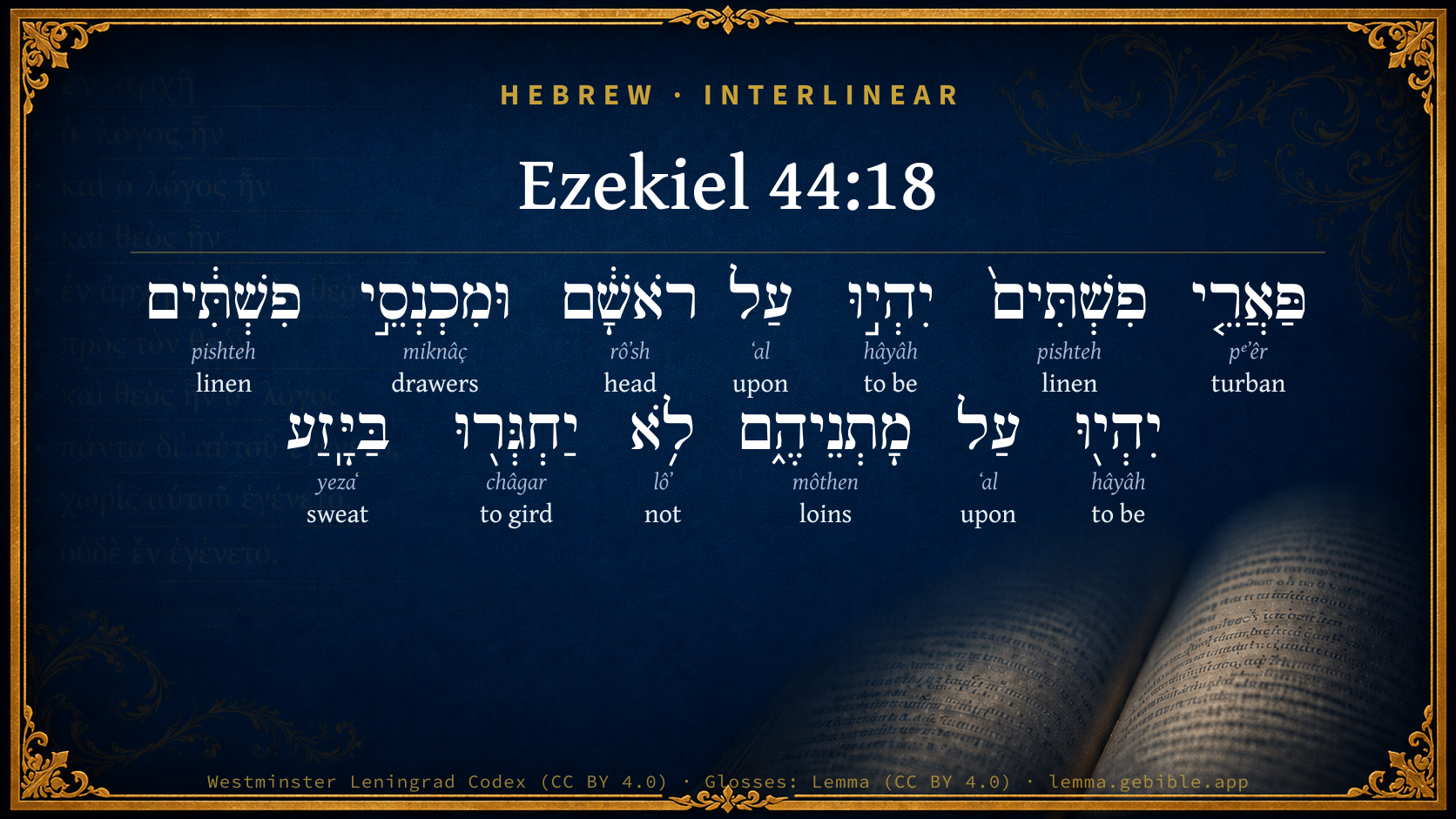
Hebrew (Westminster Leningrad Codex) Ezekiel 44:18 appears in the Hebrew Old Testament. The text above is from the Westminster Leningrad Codex. Each word links to its Strong’s number, a concise gloss, and parsing drawn from the Open Scriptures Hebrew Bible morphology. Click any word for its full Brown-Driver-Briggs (BDB) entry.
Download image
Cite this verse

Ezekiel 44:18 (World English Bible). Public Domain. Lemma interlinear Bible study tool, https://lemma.gebible.app/v/ezekiel/44/18.

Show BibTeX & RIS
BibTeX
RIS
English Translation
They shall have linen tires on their heads, and shall have linen breeches on their loins; they shall not gird themselves with [anything that causes] sweat.
World English Bible · Public Domain
Highlights
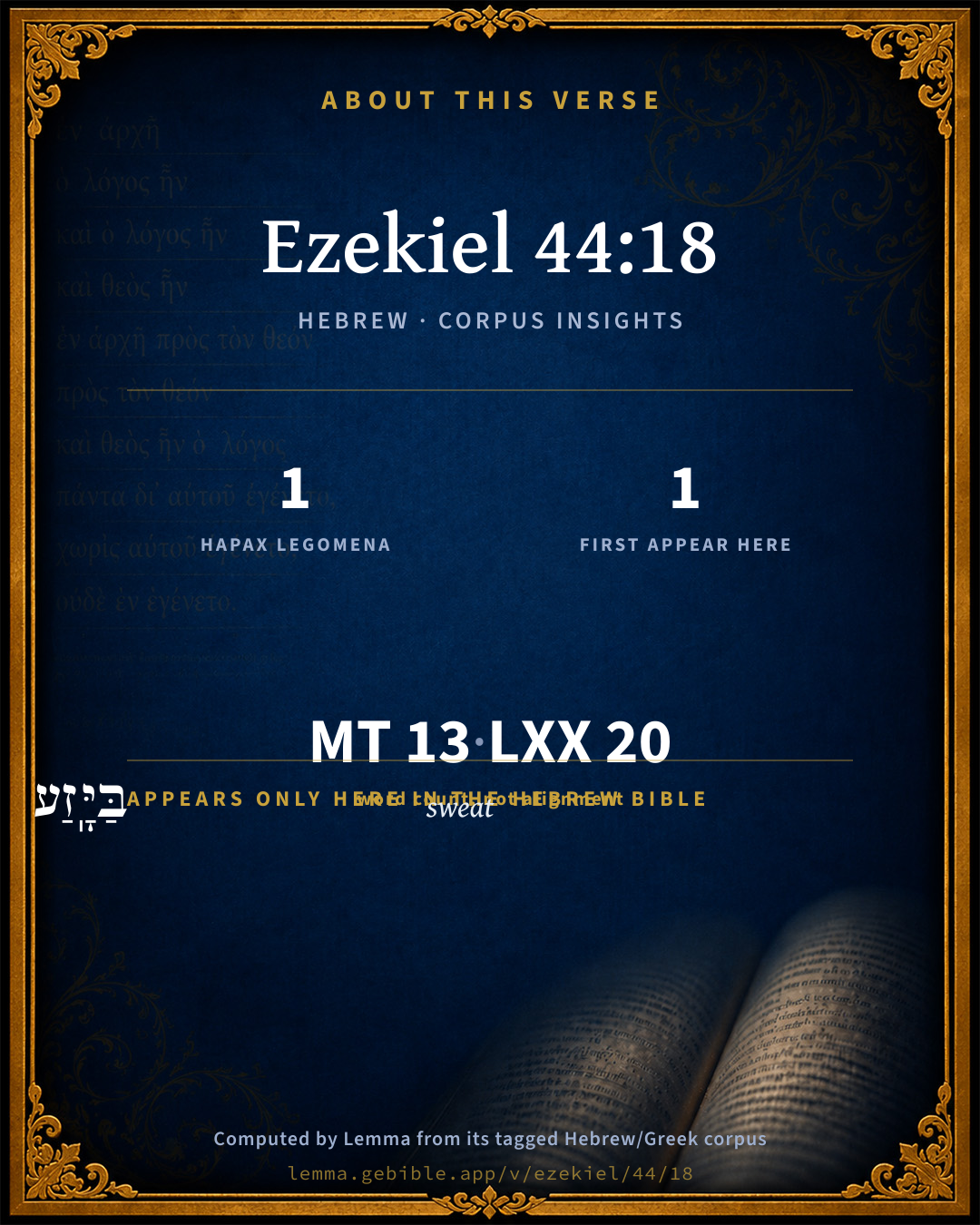
  • 1 hapax legomenon — only here in the Hebrew Bible
  • 1 first appearance in the Hebrew Bible
Full analysis ↓
Download a study sheet

One document with this verse’s original text, its word-by-word gloss line, the meaning frame, cross-references with their text, attributed commentary, and full source and license credits — printable, and it pastes into notes with its structure intact.

This verse Autodidact and up

Study sheet (.html) Plain text (.txt)

A passage Seminary Student

Up to 50 verses in one chapter. A passage sheet keeps up to 6 commentary sources and 12 cross-references per verse, in the order this page ranks them, and says so on the sheet whenever that leaves anything out. Ask for a single verse and you get the Autodidact verse sheet above.

Everything on this page stays free to read, with no account — the sheet is a download of what is already on screen, not access to it.

Want to remove ads? Support Godless Engineer
Compare translations 3

The same verse in 3 English versions, stacked beneath the original-language interlinear above. Click any original word for its lexicon entry.

Each is an independent rendering of the whole verse — the interlinear is not word-aligned to these translations.

Highlighted words mark where these versions differ — a whole-verse word diff, not a word-by-word alignment.

  • World English Bible Public Domain
    They shall have linen tires on their heads, and shall have linen breeches on their loins; they shall not gird themselves with [anything that causes] sweat.
  • King James Version Public Domain
    They shall have linen bonnets upon their heads, and shall have linen breeches upon their loins; they shall not gird themselves with any thing that causeth sweat.
  • unfoldingWord Literal Text CC BY-SA 4.0
    There should be linen turbans on their heads and linen underclothes on their hips. They must not dress in clothes that make them sweat.

unfoldingWord Literal Text — © unfoldingWord, licensed CC BY-SA 4.0. Word-aligned USFM3 via Door43 (git.door43.org/unfoldingWord/en_ult).

Versions to compare (up to 4)

3 of 4 selected

Show all 18 translations

Every available English version of this verse, each an independent rendering of the whole verse.

  • World English Bible Public Domain
    They shall have linen tires on their heads, and shall have linen breeches on their loins; they shall not gird themselves with [anything that causes] sweat.
  • Berean Standard Bible Public Domain
    They are to wear linen turbans on their heads and linen undergarments around their waists. They must not wear anything that makes them perspire.
  • Majority Standard Bible Public Domain
    They are to wear linen turbans on their heads and linen undergarments around their waists. They must not wear anything that makes them perspire.
  • King James Version Public Domain
    They shall have linen bonnets upon their heads, and shall have linen breeches upon their loins; they shall not gird themselves with any thing that causeth sweat.
  • American Standard Version (1901) Public Domain
    They shall have linen tires upon their heads, and shall have linen breeches upon their loins; they shall not gird themselves with `anything that causeth' sweat.
  • Revised Version (1885) Public Domain
    They shall have linen tires upon their heads, and shall have linen breeches upon their loins; they shall not gird themselves with any thing that causeth sweat.
  • Geneva Bible (1599) Public Domain
    They shall haue linnen bonets vpon their heades, and shall haue linnen breeches vpon their loynes: they shall not girde them selues in the sweating places.
  • Douay-Rheims (1899) Public Domain
    They shall have linen mitres on their heads, and linen breeches on their loins, and they shall not be girded with any thing that causeth sweat.
  • Young's Literal Translation Public Domain
    Linen bonnets are on their head, and linen trousers are on their loins, they are not restrained with sweat.
  • Literal Standard Version CC BY-SA 4.0
    Linen headdresses are on their head, and linen trousers are on their loins, they are not restrained with sweat.
  • Unlocked Literal Bible CC BY-SA 4.0
    There should be linen turbans on their heads and linen underclothes on their hips. They must not dress in clothes that make them sweat.
  • unfoldingWord Literal Text CC BY-SA 4.0
    There should be linen turbans on their heads and linen underclothes on their hips. They must not dress in clothes that make them sweat.
  • Darby Bible Public Domain
    They shall have linen tires upon their heads, and shall have linen breeches upon their loins; they shall not gird on anything that causeth sweat.
  • World Messianic Bible Public Domain
    They shall have linen turbans on their heads, and shall have linen trousers on their waists. They shall not clothe themselves with anything that makes them sweat.
  • Webster's Bible Public Domain
    They shall have linen bonnets upon their heads, and shall have linen breeches upon their loins; they shall not gird themselves with any thing that causeth sweat.
  • Free Bible Version CC BY-SA 4.0
    They shall wear linen turbans on their heads and linen underwear. They are not to wear anything that makes them sweat.
  • Bible in Basic English Public Domain
    They are to have linen head-dresses on their heads and linen trousers on their legs, and they are to have nothing round them to make their skin wet with heat.
  • JPS Tanakh (1917) Public Domain
    They shall have linen tires upon their heads, and shall have linen breeches upon their loins; they shall not gird themselves with any thing that causeth sweat.

Literal Standard Version (2020), Covenant Press — licensed CC BY-SA 4.0. Text via the HelloAO Bible API (eBible.org). Unlocked Literal Bible (unfoldingWord) — licensed CC BY-SA 4.0. Text via the HelloAO Bible API (eBible.org). unfoldingWord Literal Text — © unfoldingWord, licensed CC BY-SA 4.0. Word-aligned USFM3 via Door43 (git.door43.org/unfoldingWord/en_ult). Free Bible Version, Dr. Jonathan Gallagher — licensed CC BY-SA 4.0. Text via the HelloAO Bible API (eBible.org).

Word by word

More ways to search: Search by grammar → Find every occurrence → Compare this word →

Practice this passage: Drill this verse → Learn its vocabulary →

בַּיָּֽזַע
yezaʻ
H3154
“in/at the · sweat”
Preposition, Determined + Noun, Common, Masculine, Singular, Absolute
Part of Speech
Preposition + Noun
Type
Common
Gender
Masculine
Number
Singular
State
Absolute
Full BDB Definition

Origin: from an unused root mean to ooze

TWOT: 857a

sweat, perspiration
  1. פַּאֲרֵ֤י pᵉʼêr H6287 “turbans of” Noun, Common, Masculine, Plural, Construct
  2. פִשְׁתִּים֙ pishteh H6593 “linen” Noun, Common, Masculine, Plural, Absolute
  3. יִהְי֣וּ hâyâh H1961 “to be” Verb, Qal, Imperfect, 3rd Person, Masculine, Plural
  4. עַל ʻal H5921 “upon” Preposition
  5. רֹאשָׁ֔ם rôʼsh H7218 “head · their” Noun, Common, Masculine, Singular, Construct + Suffix, Personal, 3rd Person, Masculine, Plural
  6. וּמִכְנְסֵ֣י miknâç H4370 “and · drawers of” Conjunction + Noun, Common, Masculine, Plural, Construct
  7. פִשְׁתִּ֔ים pishteh H6593 “linen” Noun, Common, Masculine, Plural, Absolute
  8. יִהְי֖וּ hâyâh H1961 “to be” Verb, Qal, Imperfect, 3rd Person, Masculine, Plural
  9. עַל ʻal H5921 “upon” Preposition
  10. מָתְנֵיהֶ֑ם môthen H4975 “loins · their” Noun, Common, Masculine, Dual, Construct + Suffix, Personal, 3rd Person, Masculine, Plural
  11. לֹ֥א lôʼ H3808 “not” Particle, Negative
  12. יַחְגְּר֖וּ châgar H2296 “to gird” Verb, Qal, Imperfect, 3rd Person, Masculine, Plural

About this verse

These counts appear in no published source. They are computed here, from the morphology-tagged text and Lemma’s own curated glosses. What Lemma adds →

13
words
10
distinct lemmas
Prophets
section

Notable vocabulary

1 hapax legomenon — a word that appears only here in the entire Hebrew Bible:

  • בַּיָּֽזַע sweat H3154

First appearance in Scripture

This word makes its first canonical appearance in the Hebrew Bible here:

  • בַּיָּֽזַע sweat H3154

Shared distinctive vocabulary

וּמִכְנְסֵ֣י drawers H4370 occurs in 5 verses of the Hebrew Bible. Also found in:

Grammatical profile

  • 3 verbs
  • 7 nouns
  • 2 prepositions
  • 1 particle

Verb forms

  • יִהְי֣וּ Qal · Imperfect
  • יִהְי֖וּ Qal · Imperfect
  • יַחְגְּר֖וּ Qal · Imperfect

Repetition

Words recur within this verse — often emphatic in Hebrew:

  • פִשְׁתִּים֙ linen H6593 ×2
  • יִהְי֣וּ to be H1961 ×2
  • עַל upon H5921 ×2

Hebrew & Septuagint length

In English translation the verse runs 26 words from the Hebrew and 24 from the Septuagint (LXX English) — closely comparable.

A rough comparison of the two English renderings, which tokenize alike — not a word-level alignment.

Word counts can differ between the Hebrew and the Greek without any difference in meaning — e.g. the Hebrew direct-object marker אֵת has no separate Greek word, and Greek often adds the article ὁ.

In the original languages it is 13 Hebrew tokens and 20 Greek tokens — but the two are counted differently (Hebrew bundles its prefixes and suffixes into one token; the Greek is in lemma form), so that isn’t a like-for-like length.

Cross-references

6

Topical passages linked to Ezekiel 44:18 in the Treasury of Scripture Knowledge — connected by theme and wording, ordered by reader-vote popularity; previews shown in the World English Bible.

  • Exodus 28:40–43 "You shall make coats for Aaron's sons, and you shall make sashes for them and headbands shall you make for them, for glory and for beauty.
  • Exodus 39:28 and the turban of fine linen, and the linen headbands of fine linen, and the linen breeches of fine twined linen,
  • Leviticus 16:4 He shall put on the holy linen coat, and he shall have the linen breeches on his body, and shall put on the linen sash, and he shall be dressed with the linen turban. They are the holy garments. He shall bathe his body in water, and put them on.
  • Isaiah 3:20 the headdresses, the ankle chains, the sashes, the perfume bottles, the charms,
  • 1 Corinthians 11:4–10 Every man praying or prophesying, having his head covered, dishonors his head.
  • 1 Corinthians 14:40 Let all things be done decently and in order.

Cross-references courtesy of OpenBible.info (CC BY 4.0).

Hebrew and Greek witnesses Masoretic Hebrew ↔ Greek Septuagint

The same verse in the two great witnesses to the Old Testament, shown verse-for-verse.

These are two independent witnesses, not word-aligned to each other, and the Septuagint is shown in lemma (dictionary) form.

Hebrew Ezekiel 44:18 Masoretic · Westminster Leningrad Codex

פַּאֲרֵ֤י פִשְׁתִּים֙ יִהְי֣וּ עַל רֹאשָׁ֔ם וּמִכְנְסֵ֣י פִשְׁתִּ֔ים יִהְי֖וּ עַל מָתְנֵיהֶ֑ם לֹ֥א יַחְגְּר֖וּ בַּיָּֽזַע

They shall have linen tires on their heads, and shall have linen breeches on their loins; they shall not gird themselves with [anything that causes] sweat.

World English Bible · Public Domain

Greek LXX Ezekiel 44:18 Septuagint · lemma form

καί κίδαρις λινοῦς ἔχω ἐπί ὁ κεφαλή αὐτός καί περισκελής λινοῦς ἔχω ἐπί ὁ ὀσφύς αὐτός καί οὐ περιζωννύω βία

And they shall have linen mitres upon their heads, and shall have linen drawers upon their loins; and they shall not tightly gird themselves.

LXX2012 (modern English Septuagint) · Public Domain

On this verse, Haydock's Catholic Bible Commentary discusses the Septuagint’s reading. Read the note in Commentary ↓

Hebrew: Westminster Leningrad Codex (CC BY 4.0). Greek: Septuagint (public domain); English from LXX2012 (modern English Septuagint) (Public Domain). How the Septuagint differs from the Hebrew →

Targum (Aramaic paraphrase)

1

The Targum is the ancient Jewish Aramaic paraphrase of the Hebrew Scriptures — an interpretive translation, not the Hebrew text itself. Onkelos (literal) and Pseudo-Jonathan (expansive) render the Torah, and Jonathan the Prophets. Coverage is partial: where no permissively-licensed English translation exists for a verse, only the Aramaic is shown. This is verse-level text, not a word-by-word alignment to the Hebrew.

  1. Targum Jonathan Prophets (Joshua–Malachi)
    כּוֹבְעִין דְבוּץ יְהוֹן עַל רֵישֵׁיהוֹן וּמִכְנְסִין דְבוּץ יְהוֹן עַל חַרְצֵיהוֹן וְלָא יְזַרְזוּן עַל חַרְצֵיהוֹן אֱלָהֵין עַל לְבָבֵיהוֹן יֵיסָרוּן:

    (no public-domain English translation for this verse)

    Targum Jonathan — Aramaic: “Mikraot Gedolot” (public domain). English: “Sefaria Community Translation” (CC0 1.0 (public-domain dedication)); “London "Chaldee Paraphrase," 1871” (public domain). Text via Sefaria.

Commentary

Notes on Ezekiel 44:18 from classic Christian and Jewish commentators (each source and its license shown beneath its notes). The classic Christian expositions comment on the surrounding passage and are grouped to its opening verse, so a note may address several verses; the Jewish commentaries on the Tanakh (Rashi and others) are per-verse, so they appear only where the commentator wrote on this verse.

Lemma curates 59 commentaries, every one of them public domain or Creative Commons licensed, each selected and text-cleaned for this edition rather than reprinted as found. About our sources →

Trapp's Complete Commentary

John Trapp

Eze 44:18 They shall have linen bonnets upon their heads, and shall have linen breeches upon their loins; they shall not gird [themselves] with any thing that causeth sweat.

Ver. 18. They shall have linen bonnets upon their heads.] In token of constant subjection to God. {1Co 11:6-7; 1Co 11:10}

They shall have linen breeches.] For honesty sake; and to admonish them to procure and "provide for things honest not only in the sight of the Lord, but in the sight of men." {2Co 8:21}

With anything that causeth sweat.] That they may not have an ill savour, or seem to do God’s work to their own trouble: the Lord loveth a cheerful giver.

John Trapp, A Commentary or Exposition upon All the Books of the Old and New Testament (1647–1656) — public domain. Text from a community e-Sword module.

Jamieson, Fausset & Brown

Robert Jamieson, A. R. Fausset & David Brown

bonnets--turbans.

Jamieson, Fausset & Brown — Commentary Critical and Explanatory on the Whole Bible (1871) — public domain (CC PDM 1.0). Text via the HelloAO Bible API.

The Cambridge Bible for Schools and Colleges

gen. ed. J. J. S. Perowne

18. Sweat is regarded as uncleanness.

The Cambridge Bible for Schools and Colleges (gen. ed. J. J. S. Perowne; Cambridge University Press, 1878–1918) — public domain. Text from a community e-Sword module.

John Gill's Exposition

And they shall have linen bonnets upon their heads,.... Denoting gravity and modesty, subjection to God, and authority among men under him; and also purity of doctrine, and clearness of light and knowledge:

and shall have linen breeches upon their loins; expressive of chastity; see Exo 28:40,

they shall not gird themselves with anything that causeth sweat; so not with wool, which is apt to cause sweat; and is thought to be the reason why it is forbidden in the preceding verse; and so this girdle must be different from the priest's girdle under the law, for that had wool in it: sweat is of an ill smell, and very offensive; and may denote unsound doctrine and immorality in life and conversation, which give offence, and cause the ministry to be blamed, to which is opposed the girdle of truth and holiness, Eph 6:14. The Talmudic doctors interpret this of the place of girding, which is liable to sweat; and they say (o),

"they used not to gird neither below the loins, nor above the arm holes; but over against, or about the armholes;''

which is observed by Jarchi and Kimchi on the text; and the Targum is,

"they shall not gird upon or about the loins, but about the heart;''

that is, about the breast or paps; hence Christ our great High Priest is described as girt about the paps with a golden girdle, Rev 1:13 so these are girt that are made priests by him; denoting their hearty zeal and affection for the truths of his Gospel, and the honour of his name, and their readiness to serve and glorify him: or,

they shall not gird themselves loosely (p); in a negligent manner, which is both indecent, and hinders business.

(o) T. Bab. Zevachim, fol. 18. 2. & 19. 1. (p) "non cingent seipsos modo instabili, nempe neglectim circumponendo cingulum nimis laxum", Gussetius, p. 315. The Tigurine version is, "quae non adstringent arctius".

John Gill's Exposition of the Whole Bible (1746–1763) — public domain (CC PDM 1.0). Text via the HelloAO Bible API.

Haydock's Catholic Bible Commentary

Sweat, or so as to make them perspire. Septuagint, "girded violently." (Haydock) --- They must have liberty to move, (St. Jerome) and have the girdle about their breast. (Braun.)

George Leo Haydock (1774–1849), Haydock's Catholic Family Bible and Commentary, 1859 edition — public domain. Excludes Psalms (Douay-Rheims chapter numbering differs from Protestant) and Deuterocanonical books (Catholic canon only).

Matthew Poole's English Annotations

This verse recounts but two garments of linen, the bonnet and the breeches, but Exo 28:39; 1Sa 2:18,28; 14:3, mention a linen coat, or ephod; so they had three linen garments, and a girdle of fine twined linen about to gird the coat fast, yet so as not to make them sweat, or smell offensively.

Matthew Poole's English Annotations on the Holy Bible (1683–1685) — public domain. Text from a community e-Sword/MySword module.

The Pulpit Commentary

In particular the priests should have linen bonnets upon their heads literally, linen tires shall be upon their heads and linen breeches upon their loins. To infer from the use of twOBgmi in Lev_8:13 and of raep) here for the head-dress of the priests, that Ezekiel was composed before Leviticus, is not convincing. Smend explains the latter term as the customary headdress of common people, and the former as a specially ornamental tiara or turban. Gesenius reverses this meaning, making the former the ordinary round cap, and the latter a tiara (see for the former, Exo_28:40 Exo_29:9 Exo_39:28; and for the latter, Exo_39:28; Isa_61:10; Eze_24:17, Eze_24:23) In addition, the priests should not gird themselves with any thing that causeth sweat; literally, should not gird themselves in, or with sweat, which was another way of forbidding them to wear woollen clothing, which might cause them to sweat and so lead to uncleanness.

The Pulpit Commentary (1880–1919), ed. H.D.M. Spence-Jones & Joseph S. Exell — public domain. Text from a community e-Sword module.

Rashi

Rabbi Shlomo Yitzchaki (Rashi)

hats [Heb. פַאֲרֵי.] c(h)apelas in O.F., hats, head dress.

they shall not gird themselves in a place that sweats We learned in a baraitha (Zeb. 18b, 19a): They do not gird themselves in a place where they sweat, neither above their elbows nor below their loins, which is a place of sweat, en la suor in O.F., on (whatever causes) sweat. Another explanation: The Torah prohibited the priests from wearing woolen raiment because wool causes the body to sweat (not found in some editions).

Rashi on the Tanakh — English translations: “The Judaica Press complete Tanach with Rashi, translated by A. J. Rosenberg” (CC BY 4.0); “Pentateuch with Rashi's commentary by M. Rosenbaum and A.M. Silbermann, 1929-1934” (public domain); “The Metsudah Tanach series, Lakewood, N.J” (CC BY 4.0); and “The Book of Joshua, Metsudah Publications, 1997” (CC BY 4.0). Text via Sefaria.

Lesson kit

Teaching starters — assembled from the data on this page, not authored interpretation. Every prompt links to the verse data it draws on. Edit before teaching.

Ezekiel, in the Prophets, opens this verse with 13 words (10 distinct Hebrew lemmas). Its most distinctive word is yezaʻ (“sweat”). A historical commentator’s framing appears above. Read the whole chapter for the surrounding context.

Discussion questions

  1. How does “sweat” (yezaʻ) shape what this verse is saying?
  2. This verse holds 1 word here found nowhere else in the Hebrew Bible. What might the rare word draw attention to?
  3. The word “sweat” first appears here in Scripture. What is being introduced at this debut?
  4. Exodus 28:42 shares the word «drawers» with this verse. How do the two illuminate each other?
  5. “linen” occurs 2× in this one verse. What is the effect of the repetition?
  6. These translations render this verse differently. What is at stake in choosing one wording over another?
  7. The verb «יִהְי֣וּ» is Qal Imperfect. How does its form color the action?
  8. Reading how Trapp's Complete Commentary and Jamieson, Fausset & Brown read this verse, where do the two commentators agree and where do they part?

Things to notice

  • 1 word in this verse appears nowhere else in the Hebrew Bible.
  • 1 word makes its first canonical appearance in Scripture here.
  • This verse counts 13 Hebrew ↔ 20 Greek words.
  • These translations choose different wording for 23 words in this verse.
  • “linen” occurs 2× in this single verse.

Reading settings

Reading text

Shown beneath each verse's original-language words.

Old Testament
Old Testament edition

Read the OT as the Masoretic Hebrew (MT) or the Greek Septuagint (LXX).

English shown for the Greek Septuagint (in the Hebrew ↔ Greek comparison).

Comparing translations? Open the Compare panel on any verse page to stack up to four side by side.