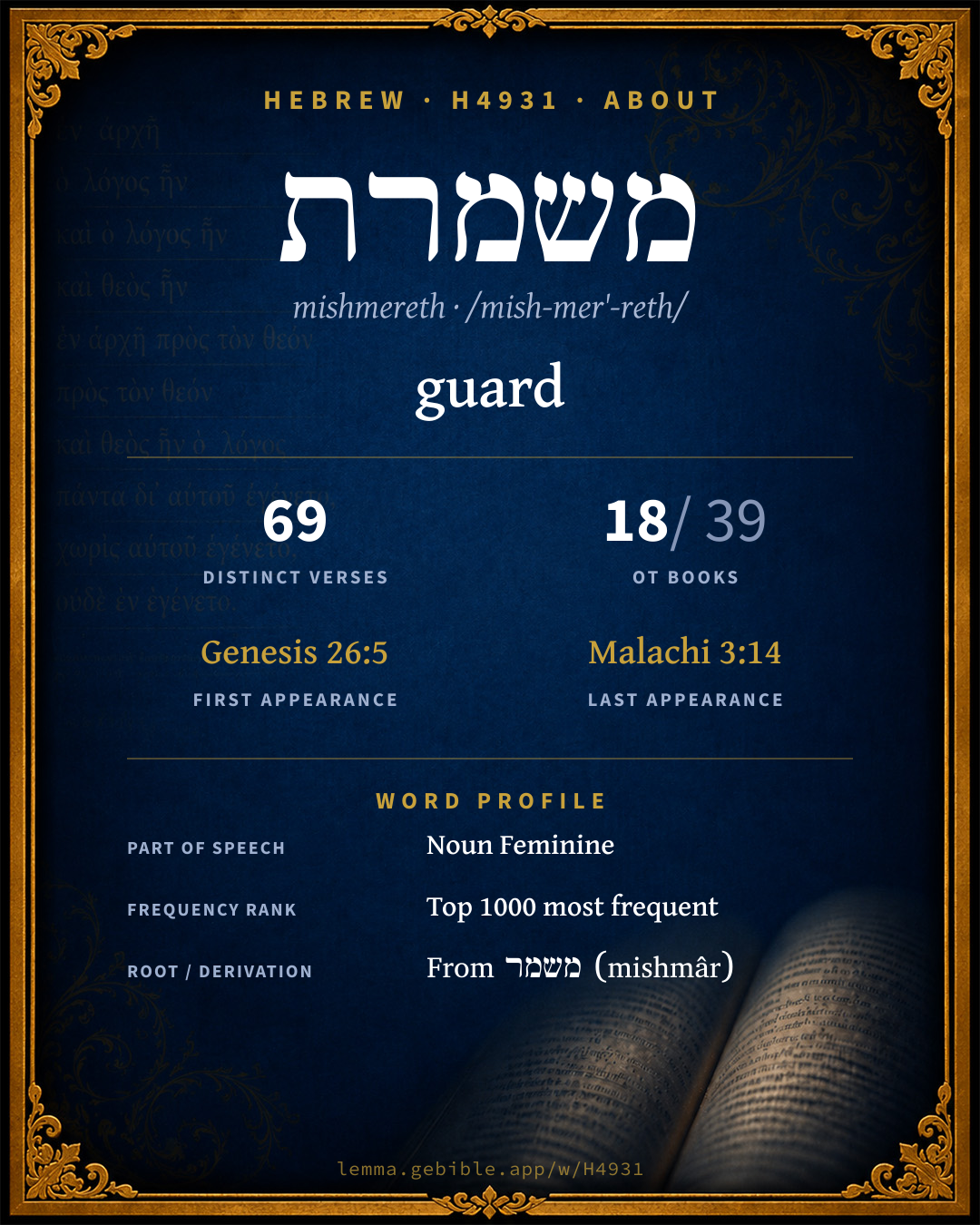
מִשְׁמֶ֫רֶת
guard
also: charge, function, obligation, service fuller range ↓
Full lexicon entry — Brown-Driver-Briggs (BDB)
From Brown-Driver-Briggs (BDB)
Where this word appears
Grammar key — what these labels mean
Part of speech
- Noun
- A naming word — a person, place, thing, or idea.
Noun type
- Common
- A common noun — a general class of person, place, or thing (“king,” “city,” “water”), not a specific name.
State
- Construct
- A noun bound to a following noun in a possessive / “of” relationship (the construct chain).
- Absolute
- The independent form of a noun, not bound to a following word.
Gender
- Feminine
- Grammatically feminine.
Number
- Singular
- One.
- Plural
- More than one (in Hebrew, generally three or more).
Every verse where H4931 appears in the Book of 2 Chronicles — 7 distinct verses. Click any verse to open its interlinear word-by-word view. Verse text shown in the World English Bible for context — . Each verse’s Hebrew form is shown with its reference; the English is not keyword-highlighted, since the data carries no word-level English alignment. Use “Compare translations” on any verse to read it across multiple English versions. This concordance covers the Hebrew Bible; Septuagint (Greek Old Testament) occurrences are not indexed here.
2 Chronicles
- 2 Chronicles 7:6 מִשְׁמְרוֹתָ֣/ם n c fp cs + sfx pers 3mp The priests stood, according to their offices; the Levites also with instruments of music of Yahweh, which David the king had made to give thanks to Yahweh, (for his loving kindness endures for ever), when David praised by their ministry: and the priests sounded trumpets before them; and all Israel stood.
- 2 Chronicles 8:14 מִ֠שְׁמְרוֹתָ/ם n c fp cs + sfx pers 3mp He appointed, according to the ordinance of David his father, the divisions of the priests to their service, and the Levites to their offices, to praise, and to minister before the priests, as the duty of every day required; the doorkeepers also by their divisions at every gate: for so had David the man of God commanded.
- 2 Chronicles 13:11 מִשְׁמֶ֖רֶת n c fs cs and they burn to Yahweh every morning and every evening burnt offerings and sweet incense: the show bread also [set they] in order on the pure table; and the lampstand of gold with the lamps of it, to burn every evening: for we keep the charge of Yahweh our God; but you have forsaken him.
- 2 Chronicles 23:6 מִשְׁמֶ֥רֶת n c fs cs But let none come into the house of Yahweh, save the priests, and those who minister of the Levites; they shall come in, for they are holy: but all the people shall keep the charge of Yahweh.
- 2 Chronicles 31:16 בְּ/מִשְׁמְרוֹתָ֖/ם prep + n c fp cs + sfx pers 3mp besides those who were reckoned by genealogy of males, from three years old and upward, even everyone who entered into the house of Yahweh, as the duty of every day required, for their service in their offices according to their divisions;
- 2 Chronicles 31:17 בְּ/מִשְׁמְרוֹתֵי/הֶ֖ם prep + n c fp cs + sfx pers 3mp and those who were reckoned by genealogy of the priests by their fathers' houses, and the Levites from twenty years old and upward, in their offices by their divisions;
- 2 Chronicles 35:2 מִשְׁמְרוֹתָ֑/ם n c fp cs + sfx pers 3mp He set the priests in their offices, and encouraged them to the service of the house of Yahweh.
About this entry
At a glance — auto-summarized from this page’s data, not written by a person. Every figure links to its source below. This summary describes the numbers; it doesn’t interpret them.
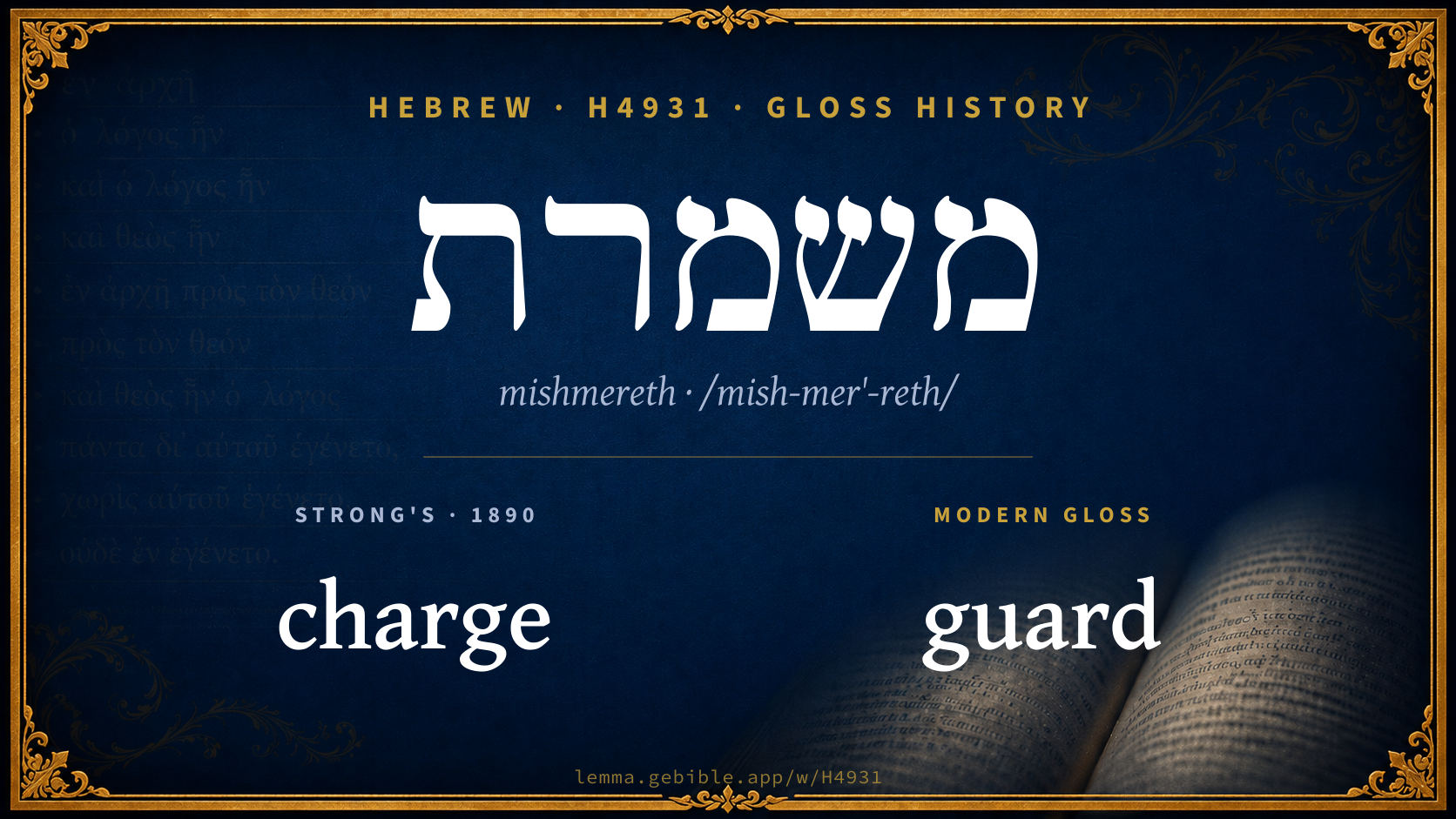
משמרת — transliterated mishmereth — is a Hebrew noun carrying the sense “guard.” The King James Version usually renders it “charge,” while modern versions prefer “keeping of” (unfoldingWord Literal Text) — see the renderings breakdown. With 69 verses in 18 books, it is a moderately common word in the Hebrew Bible. Its uses concentrate in Numbers (35% of all occurrences). Alongside “guard” the lexicon also lists “charge”, “function”, and “obligation” — part of its full sense range. Each statement above links to its evidence; the full detail follows below.
Gloss history
Strong's 1890 vs modern scholarship
About this word
Strong's H4931 catalogs a Hebrew word from the Hebrew Old Testament.
These counts are not copied from any lexicon or concordance. They are computed here, from the morphology-tagged Hebrew Old Testament. What Lemma adds →
- 69
- distinct verses
- The word appears in 69 distinct verses.
- 18 / 39
- OT books
- The word appears in 18 of 39 Old Testament books.
- #514
- by frequency
- Top 1000 most frequent Hebrew words (rank 514 of 8,640 Hebrew words by occurrence).
View all 69 occurrences in the concordance →
Most concentrated in
- Numbers 24 verses 35%
- 2 Chronicles 7 verses 10%
- Ezekiel 7 verses 10%
By section of the Old Testament
By traditional corpus
Conventional, traditional groupings — biblical authorship is debated, so this is a traditional corpus grouping, not an authorship claim. Each share is this word’s portion of its verses in that division of the Hebrew canon. Each figure is a share of the word’s 69 distinct verses.
- Torah (Pentateuch) 34 verses · 49%
- Prophets (Nevi'im) 18 verses · 26%
- Writings (Ketuvim) 17 verses · 25%
How translations render this word
Counts come from each version’s own published word-to-Strong’s tagging or interlinear alignment — an approximate guide to how each version renders this word, not a word-level alignment the data otherwise carries. Because each total is that version’s own tagged count, the per-version totals vary from one another and need not match the appearance or distinct-verse counts above. These counts may also differ from a printed concordance because Lemma counts each distinctly tagged rendering and does not collapse phrase taggings into a single head-word total. This is a fixed set of word-tagged versions (KJV, ASV, BSB, ULT) and does not change with the reading translation you choose elsewhere. Each version’s license is shown beside its name below (and on Sources).
- King James Version: Charge 42×, Ward 6×, Watch 5×
- American Standard Version: Charge 45×, Offices 5×, Be kept 4×
- Berean Standard Bible: Charge 20×, Duties 15×, Responsibilities 3×
- unfoldingWord Literal Text: Keeping of 20×, Keeping 16×, Preservation 5×
King James Version Public Domain
Renders H4931 across 78 tagged occurrences — most commonly:
Plus 12 renderings that appear only once — usually multi-word phrases or single function words the recovered tagging swept in, not distinct renderings.
American Standard Version Public Domain
Renders H4931 across 77 tagged occurrences — most commonly:
Plus 17 renderings that appear only once — usually multi-word phrases or single function words the recovered tagging swept in, not distinct renderings.
Berean Standard Bible Public Domain
Renders H4931 across 72 tagged occurrences — most commonly:
Plus 23 renderings that appear only once — usually multi-word phrases or single function words the recovered tagging swept in, not distinct renderings. Not rendered by a distinct English word in 6 further occurrences.
unfoldingWord Literal Text CC BY-SA 4.0
Renders H4931 across 78 tagged occurrences — most commonly:
Plus 18 renderings that appear only once — usually multi-word phrases or single function words the recovered tagging swept in, not distinct renderings.
Senses in the full BDB
What do BDB’s symbols mean?
BDB uses these scholarly abbreviations:
| Symbol | Meaning |
|---|---|
| 𝔊 | the Septuagint (the ancient Greek translation, LXX) |
| 𝔙 | the Vulgate (the Latin translation) |
| 𝔖 | the Syriac version (the Peshitta) |
| 𝔗 | the Targum (the Aramaic translation) |
| ψ | the Psalms |
| √ | root (the underlying root or stem) |
| ‖ | parallel passage (a synonymous or contrasted parallel) |
| † | the dagger: every passage where the word occurs is cited |
The 5 senses and sub-senses the full Brown-Driver-Briggs lexicon distinguishes for this word, in lexicon order (not ranked by frequency), with BDB’s own verbatim wording and sub-sense lettering. Shown in Hebrew script with BDB’s own scholarly abbreviations. The condensed entry is in the Lexicon Entry tab. See also the Forms in the corpus table below.
- 1. guard, watch: בֵּית מ׳ 2 S 20:3 = house of detention, confinement; מ׳ אַתָּה עִמָּדִי 1 S 22:23 i.e. protected, secure; c. שָׁמַר keep the watch 2 K 11:5, 6, 7; 1 Ch 12:30 (van d. H. v 29); = post of watch (fig.) Is 21:8 (‖ מִצְפֶּה), Hb 2:1 (‖ מָצוֹר); pl. = guards Ne 7:3; 1 Ch 9:23. e.g. 2 Samuel 20:3
- 2. keeping, preserving, וְהָיָה לָכֶם לְמ׳ Ex 12:6 i.e. ye shall keep it; הַנִּיחוּ לָכֶם לְמ׳ 16:23, cf. v 32, 33, 34; Nu 17:25; 19:9 (all P). e.g. Exodus 12:6
- 3. charge, injunction of י׳, c. שָׁמַר, in gen. Dt 11:1 (+ חֻקּוֹת, מִשְׁפָּטִים, מִצְוֹת), cf. Gn 26:5; 1 K 2:3, and (מ׳ מִצְוַת י׳) Jos 22:3 (all RD), Mal 3:14; of specif. injunctions Lv 18:30; Nu 9:19, 23. e.g. Deuteronomy 11:1
- 4.
- a. ceremoniral office or function (AV RV usually charge) of priest or Levite (P [especially Nu], Ez 40, 44, 48, Chr Zc), mostly c. שָׁמַר: מ׳ מִשְׁכַּן הָעֵדוּת Nu 1:53, מ׳ מִשְׁכַּן י׳ 31:30, 47, מ׳ הַמִּקְדָּשׁ Ez 44:15; Nu 3:38, מ׳ אֹהֶל מוֹעֵד 18:4 cf. v 3; 1 Ch 23:32, מ׳ הַקֹּדֶשׁ Nu 3:28, 32; 18:5 1 Ch 23:32, מ׳ קָדָשַׁי (of Isr. in gen.) Ez 44:8, מ׳ הַמִּזְבֵּחַ Nu 18:5; Ez 40:46, תְּרוּמֹתָ֑י Nu 18:8, מ׳ הַבַּיִת Ez 40:45; 44:14, מ׳ הַטָּהֳרָה Ne 12:45; c. genit. (sf.) שׁ׳ מ׳ = perform the service imposed by, due to, Lv 8:35; 22:9; Ez 44:8, 16; 48:11; Zc 3:7, מ׳ אֱלֹהֵיהֶם Ne 12:45 (of Judah in gen.); מ׳ הָעֵדָה Nu 3:7a, מ׳ בְּנֵי יִשׂ׳ 3:8, 38, מ׳ בְּנֵי גֵרְשׁוֹן 3:25, cf. v 7a, 31, 36; 4:27, 28, 31, 32; 18:3; 1 Ch 23:32; also, in secular sense, מ׳ בֵּית שָׁאוּל 1 Ch 12:30; מ׳ מַשָּׂאָם Nu 4:31, כְּלֵי מ׳ מַשָּׂאָם v 32 (v 27 read c. 𝔊 Di Gr Gray, etc. בְּשֵׁמוֹת for במ׳, and perhaps מִשְׁמֶרֶת after אֵת, cf. v 32); עֲלֵיהֶם מ׳ 1 Ch 9:27 i.e. the duty rested upon them;—25:8; 26:12 v. i. עֻמָּה c, d (p. 769 supr.); עַל־מ׳ עֹמְדִים 2 Ch 7:6 were standing according to (or in) their offices, הֱעֶמִיד עַל מ׳ appoint to their offices 8:14; 35:2. e.g. Numbers 1:53
- b. pl. of Levitical divisions for service Ne 12:9. e.g. Nehemiah 12:9
Senses from the full Brown-Driver-Briggs lexicon (Brown, Driver, Briggs; Oxford 1906 — public domain), digitized via Sefaria, supplemented by the OpenScriptures HebrewLexicon (CC BY 4.0). Full attribution on Sources.
Word origin
n.f. guard, watch, also charge, function;—מ׳ abs. 2 S 20:3 +, cstr. 2 K 11:5 +; abs. מִשְׁמָ֑רֶת Ex 16:34; sf. מִשְׁמַרְתִּי Gn 26:5 +, etc.; pl. מִשְׁמָרוֹת 1 Ch 9:23 +; cstr. מִשְׁמְרוֹת Ne 7:3; sf. -רוֹתָם 2 Ch 7:6 +, -תֵיהֶם 2 Ch 31:17;—
— Brown-Driver-Briggs (Oxford 1906, public domain), digitized via Sefaria, supplemented by the OpenScriptures HebrewLexicon (CC BY 4.0). See Sources.
Derived from משמר (mishmâr) (H4929) — guard.
Jastrow Dictionary
A second Hebrew/Aramaic lexicon for comparison, covering Aramaic and post-biblical (Talmudic, Targumic, Midrashic) usage that the biblical-Hebrew BDB does not. Matched by lemma rather than by Strong’s number, so a lemma may carry more than one Jastrow headword (shown separately below), and the entries cover usage well beyond the Bible.
מִשְׁמֶרֶת
- preced.) guard, trnsf. (v. גֶּדֶר) preventive measure. M. Kat. 5ᵃ; Yeb. 21ᵃ (ref. to Lev. XVIII, 30) עשו מ׳ למִשְׁמַרְתִּי make a guard to my guard, enact measures to prevent a transgression of Biblical laws. e.g. Leviticus 18:30
מְשַׁמֶּרֶת
- (שָׁמַר Pa.) filter, strainer. Sabb. XX, 1 you may suspend (spread out) a strainer &c. Y. Ter. VIII, 45ᵈ המ׳ של יין a strainer filled with wine; a. fr.—Trnsf. Ab. V, 15 מ׳ a scholar retaining what is useless and discarding the useful knowledge.
A Dictionary of the Targumim, the Talmud Babli and Yerushalmi, and the Midrashic Literature (Marcus Jastrow; London, Luzac, 1903) — Public Domain. Digitized via Sefaria. Digitized via Sefaria. Full attribution on Sources.
Forms in the corpus
The 41 distinct written forms H4931 takes in the Hebrew Bible, most frequent first — each parse links to that state’s occurrences in the concordance. Hebrew forms include their vowel points and cantillation, so a single lemma takes many written forms.
Septuagint verse parallels
This word appears in 65 verses that also exist in the Greek Old Testament (Septuagint), out of the 69 Hebrew verses it occurs in. You can read those verses in Greek by switching the Old Testament edition to the Septuagint.
Read these verses in the Septuagint
- Genesis 26:5
- Exodus 12:6
- Leviticus 8:35
- Numbers 1:53
- Deuteronomy 11:1
- Joshua 22:3
- 1 Samuel 22:23
- 2 Samuel 20:3
- 1 Kings 2:3
- 2 Kings 11:5
- 1 Chronicles 9:23
- 2 Chronicles 7:6
This is a verse-level parallel only — the same verses exist in both the Hebrew and Greek Old Testaments. No word-level Hebrew↔Greek correspondence is claimed: the data carries no such alignment, so no Greek word is shown as this Hebrew word’s translation. Coverage is not total — the Septuagint omits the deuterocanon and renumbers the Psalms, so some Hebrew verses have no direct Greek parallel.