
Ezekiel 48:11

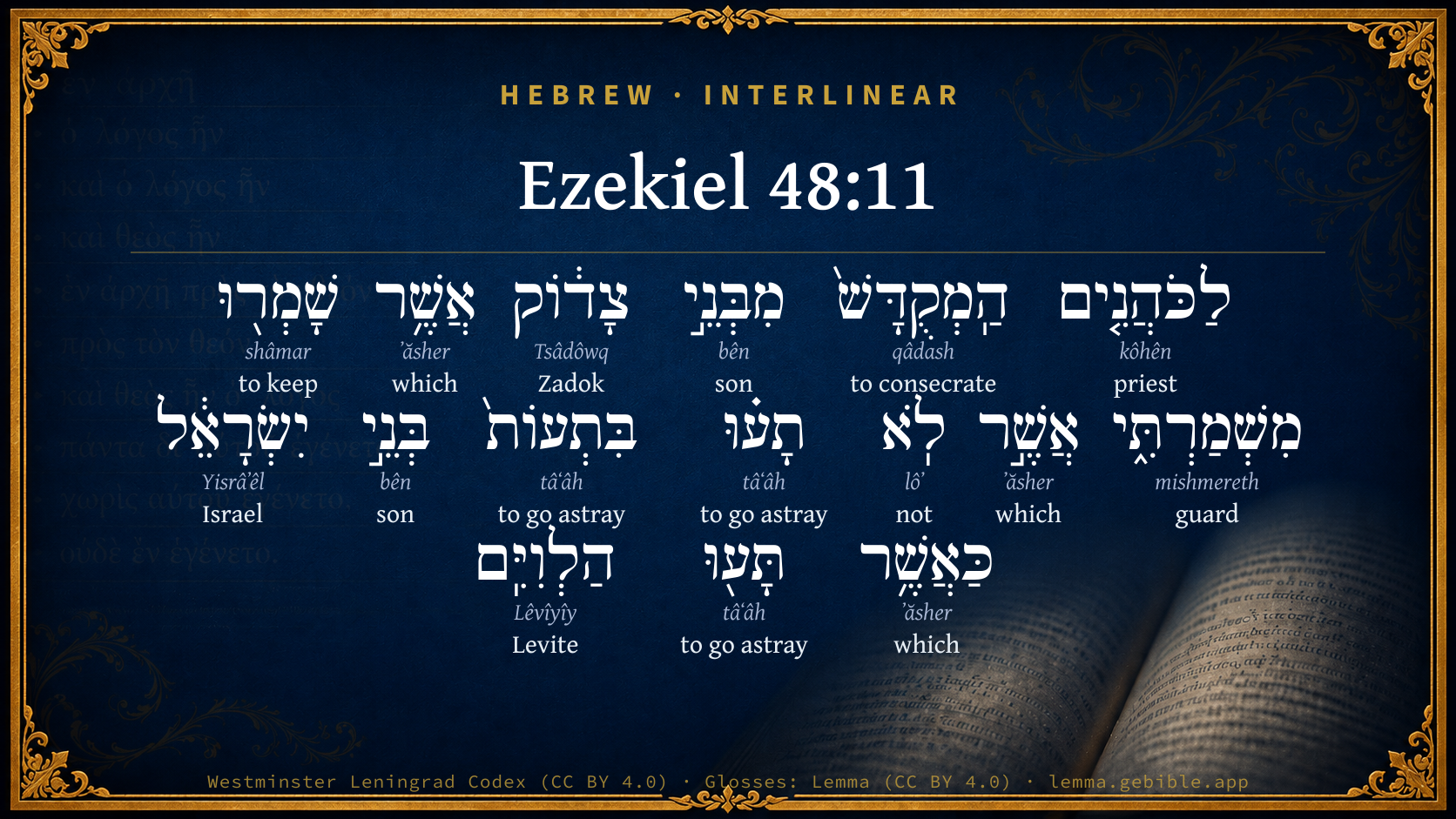
Hebrew (Westminster Leningrad Codex) Ezekiel 48:11 appears in the Hebrew Old Testament. The text above is from the Westminster Leningrad Codex. Each word links to its Strong’s number, a concise gloss, and parsing drawn from the Open Scriptures Hebrew Bible morphology. Click any word for its full Brown-Driver-Briggs (BDB) entry.
Download image
Cite this verse

Ezekiel 48:11 (World English Bible). Public Domain. Lemma interlinear Bible study tool, https://lemma.gebible.app/v/ezekiel/48/11.

Show BibTeX & RIS
BibTeX
RIS
English Translation
[It shall be] for the priests who are sanctified of the sons of Zadok, who have kept my charge, who didn't go astray when the children of Israel went astray, as the Levites went astray.
World English Bible · Public Domain
Download a study sheet

One document with this verse’s original text, its word-by-word gloss line, the meaning frame, cross-references with their text, attributed commentary, and full source and license credits — printable, and it pastes into notes with its structure intact.

This verse Autodidact and up

Study sheet (.html) Plain text (.txt)

A passage Seminary Student

Up to 50 verses in one chapter. A passage sheet keeps up to 6 commentary sources and 12 cross-references per verse, in the order this page ranks them, and says so on the sheet whenever that leaves anything out. Ask for a single verse and you get the Autodidact verse sheet above.

Everything on this page stays free to read, with no account — the sheet is a download of what is already on screen, not access to it.

Want to remove ads? Support Godless Engineer
Compare translations 3

The same verse in 3 English versions, stacked beneath the original-language interlinear above. Click any original word for its lexicon entry.

Each is an independent rendering of the whole verse — the interlinear is not word-aligned to these translations.

Highlighted words mark where these versions differ — a whole-verse word diff, not a word-by-word alignment.

  • World English Bible Public Domain
    [It shall be] for the priests who are sanctified of the sons of Zadok, who have kept my charge, who didn't go astray when the children of Israel went astray, as the Levites went astray.
  • King James Version Public Domain
    It shall be for the priests that are sanctified of the sons of Zadok; which have kept my charge, which went not astray when the children of Israel went astray, as the Levites went astray.
  • unfoldingWord Literal Text CC BY-SA 4.0
    This will be for the consecration of the priests of the line of Zadok, who have served me faithfully and who did not go astray when the people of Israel went astray, as the Levites did.

unfoldingWord Literal Text — © unfoldingWord, licensed CC BY-SA 4.0. Word-aligned USFM3 via Door43 (git.door43.org/unfoldingWord/en_ult).

Versions to compare (up to 4)

3 of 4 selected

Show all 18 translations

Every available English version of this verse, each an independent rendering of the whole verse.

  • World English Bible Public Domain
    [It shall be] for the priests who are sanctified of the sons of Zadok, who have kept my charge, who didn't go astray when the children of Israel went astray, as the Levites went astray.
  • Berean Standard Bible Public Domain
    It will be for the consecrated priests, the descendants of Zadok, who kept My charge and did not go astray as the Levites did when the Israelites went astray.
  • Majority Standard Bible Public Domain
    It will be for the consecrated priests, the descendants of Zadok, who kept My charge and did not go astray as the Levites did when the Israelites went astray.
  • King James Version Public Domain
    It shall be for the priests that are sanctified of the sons of Zadok; which have kept my charge, which went not astray when the children of Israel went astray, as the Levites went astray.
  • American Standard Version (1901) Public Domain
    `It shall be' for the priests that are sanctified of the sons of Zadok, that have kept my charge, that went not astray when the children of Israel went astray, as the Levites went astray.
  • Revised Version (1885) Public Domain
    It shall be for the priests that are sanctified of the sons of Zadok, which have kept my charge; which went not astray when the children of Israel went astray, as the Levites went astray.
  • Geneva Bible (1599) Public Domain
    It shalbe for the Priestes that are sanctified of the sonnes of Zadok, which haue kept my charge, which went not astray when the children of Israel went astray, as the Leuites went astray.
  • Douay-Rheims (1899) Public Domain
    The sanctuary shall be for the priests of the sons of Sadoc, who kept my ceremonies, and went not astray when the children of Israel went astray, as the Levites also went astray.
  • Young's Literal Translation Public Domain
    For the priests who are sanctified of the sons of Zadok, who have kept My charge, who erred not in the erring of the sons of Israel, as the Levites erred,
  • Literal Standard Version CC BY-SA 4.0
    For the priests who are sanctified of the sons of Zadok, who have kept My charge, who did not err in the erring of the sons of Israel, as the Levites erred,
  • Unlocked Literal Bible CC BY-SA 4.0
    This will be for the consecration of the priests of the line of Zadok, who have served me faithfully and who did not go astray when the people of Israel went astray, as the Levites did.
  • unfoldingWord Literal Text CC BY-SA 4.0
    This will be for the consecration of the priests of the line of Zadok, who have served me faithfully and who did not go astray when the people of Israel went astray, as the Levites did.
  • Darby Bible Public Domain
    [It shall be] for the priests that are hallowed of the sons of Zadok, who kept my charge and went not astray when the children of Israel went astray, as the Levites went astray.
  • World Messianic Bible Public Domain
    It shall be for the priests who are sanctified of the sons of Zadok, who have kept my instruction, who didn’t go astray when the children of Israel went astray, as the Levites went astray.
  • Webster's Bible Public Domain
    It shall be for the priests that are sanctified of the sons of Zadok; who have kept my charge, who went not astray when the children of Israel went astray, as the Levites went astray.
  • Free Bible Version CC BY-SA 4.0
    It is for the holy priests, descendants of Zadok, who stayed faithful and did not abandon me when the Israelites abandoned me.
  • Bible in Basic English Public Domain
    For the priests who have been made holy, those of the sons of Zadok who kept the orders I gave them, who did not go out of the right way when the children of Israel went from the way, as the Levites did,
  • JPS Tanakh (1917) Public Domain
    The sanctified portion shall be for the priests of the sons of Zadok, that have kept My charge, that went not astray when the children of Israel went astray, as the Levites went astray.

Literal Standard Version (2020), Covenant Press — licensed CC BY-SA 4.0. Text via the HelloAO Bible API (eBible.org). Unlocked Literal Bible (unfoldingWord) — licensed CC BY-SA 4.0. Text via the HelloAO Bible API (eBible.org). unfoldingWord Literal Text — © unfoldingWord, licensed CC BY-SA 4.0. Word-aligned USFM3 via Door43 (git.door43.org/unfoldingWord/en_ult). Free Bible Version, Dr. Jonathan Gallagher — licensed CC BY-SA 4.0. Text via the HelloAO Bible API (eBible.org).

Word by word

More ways to search: Search by grammar → Find every occurrence → Compare this word →

Practice this passage: Drill this verse → Learn its vocabulary →

תָע֗וּ
tâʻâh
H8582
“to go astray”
Verb, Qal, Perfect, 3rd Person, Common, Plural
Part of Speech
Verb
Stem
Qal
Form
Perfect
Person
3rd Person
Gender
Common
Number
Plural
Full BDB Definition

Origin: a primitive root

TWOT: 2531

to err, wander, go astray, stagger - (Qal) to err - to wander about (physically) - of intoxication - of sin (ethically) - wandering (of the mind) - (Niphal) - to be made to wander about, be made to stagger (drunkard) - to be led astray (ethically) - (Hiphil) to cause to wander - to cause to wander about (physically) - to cause to wander (of intoxication) - to cause to err, mislead (mentally and morally)
  1. לַכֹּהֲנִ֤ים kôhên H3548 “to/for the · priests” Preposition, Determined + Noun, Common, Masculine, Plural, Absolute
  2. הַֽמְקֻדָּשׁ֙ qâdash H6942 “the · consecrated” Particle, Definite Article + Verb, Pual, Participle Passive, Masculine, Singular, Absolute
  3. מִבְּנֵ֣י bên H1121 “from · sons of” Preposition + Noun, Common, Masculine, Plural, Construct
  4. צָד֔וֹק Tsâdôwq H6659 “Zadok” Noun, Proper
  5. אֲשֶׁ֥ר ʼăsher H834 “which” Particle, Relative
  6. שָׁמְר֖וּ shâmar H8104 “to keep” Verb, Qal, Perfect, 3rd Person, Common, Plural
  7. מִשְׁמַרְתִּ֑י mishmereth H4931 “guard · my” Noun, Common, Feminine, Singular, Construct + Suffix, Personal, 1st Person, Common, Singular
  8. אֲשֶׁ֣ר ʼăsher H834 “which” Particle, Relative
  9. לֹֽא lôʼ H3808 “not” Particle, Negative
  10. בִּתְעוֹת֙ tâʻâh H8582 “in/at · to go astray” Preposition + Verb, Qal, Infinitive Construct
  11. בְּנֵ֣י bên H1121 “sons of” Noun, Common, Masculine, Plural, Construct
  12. יִשְׂרָאֵ֔ל Yisrâʼêl H3478 “Israel” Noun, Proper
  13. כַּאֲשֶׁ֥ר ʼăsher H834 “like/as · which” Preposition + Particle, Relative
  14. תָּע֖וּ tâʻâh H8582 “to go astray” Verb, Qal, Perfect, 3rd Person, Common, Plural
  15. הַלְוִיִּֽם Lêvîyîy H3881 “the · Levites” Particle, Definite Article + Noun, Gentilic, Masculine, Plural, Absolute

About this verse

These counts appear in no published source. They are computed here, from the morphology-tagged text and Lemma’s own curated glosses. What Lemma adds →

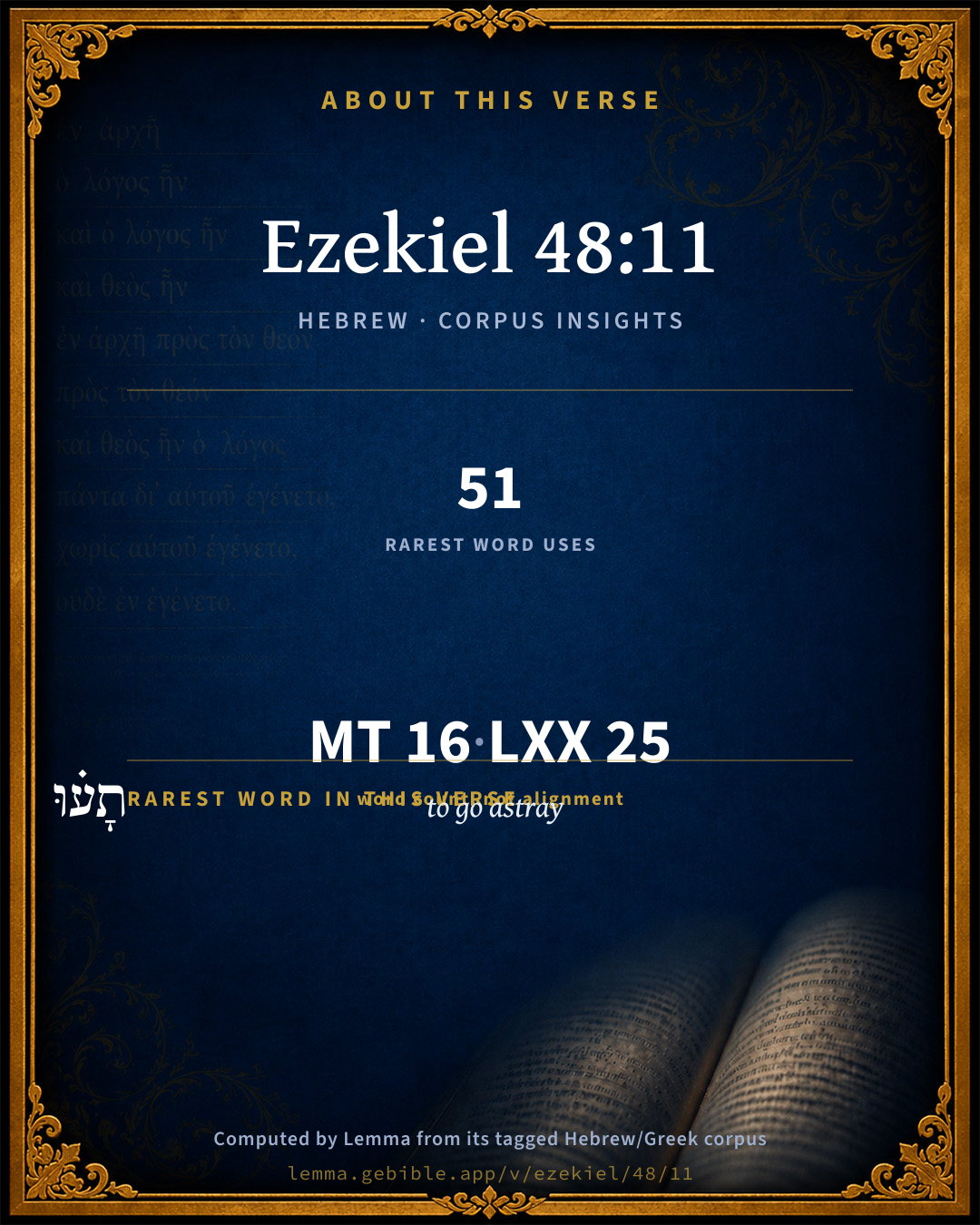
16
words
11
distinct lemmas
Prophets
section

Shared distinctive vocabulary

תָע֗וּ to go astray H8582 occurs in 45 verses of the Hebrew Bible. Also found in:

Grammatical profile

  • 5 verbs
  • 7 nouns
  • 4 particles

Verb forms

  • הַֽמְקֻדָּשׁ֙ Pual · Participle Passive
  • שָׁמְר֖וּ Qal · Perfect
  • תָע֗וּ Qal · Perfect
  • בִּתְעוֹת֙ Qal · Infinitive Construct
  • תָּע֖וּ Qal · Perfect

Repetition

Words recur within this verse — often emphatic in Hebrew:

  • תָע֗וּ to go astray H8582 ×3
  • מִבְּנֵ֣י son H1121 ×2
  • אֲשֶׁ֥ר which H834 ×3

Hebrew & Septuagint length

In English translation the verse runs 35 words from the Hebrew and 31 from the Septuagint (LXX English) — closely comparable.

A rough comparison of the two English renderings, which tokenize alike — not a word-level alignment.

Word counts can differ between the Hebrew and the Greek without any difference in meaning — e.g. the Hebrew direct-object marker אֵת has no separate Greek word, and Greek often adds the article ὁ.

In the original languages it is 16 Hebrew tokens and 25 Greek tokens — but the two are counted differently (Hebrew bundles its prefixes and suffixes into one token; the Greek is in lemma form), so that isn’t a like-for-like length.

Cross-references

8

Topical passages linked to Ezekiel 48:11 in the Treasury of Scripture Knowledge — connected by theme and wording, ordered by reader-vote popularity; previews shown in the World English Bible.

  • Ezekiel 40:46 and the chamber whose prospect is toward the north is for the priests, the keepers of the charge of the altar: these are the sons of Zadok, who from among the sons of Levi come near to Yahweh to minister to him.
  • Ezekiel 44:10 But the Levites who went far from me, when Israel went astray, who went astray from me after their idols, they shall bear their iniquity.
  • Matthew 24:45–46 "Who then is the faithful and wise servant, whom his lord has set over his household, to give them their food in due season?
  • Ezekiel 43:19 You shall give to the priests the Levites who are of the seed of Zadok, who are near to me, to minister to me, says the Lord Yahweh, a young bull for a sin-offering.
  • Ezekiel 44:15–16 But the priests the Levites, the sons of Zadok, who kept the charge of my sanctuary when the children of Israel went astray from me, they shall come near to me to minister to me; and they shall stand before me to offer to me the fat and the blood, says the Lord Yahweh:
  • 2 Timothy 4:7–8 I have fought the good fight. I have finished the course. I have kept the faith.
  • 1 Peter 5:4 When the chief Shepherd is revealed, you will receive the crown of glory that doesn't fade away.
  • Revelation 2:10 Don't be afraid of the things which you are about to suffer. Behold, the devil is about to throw some of you into prison, that you may be tested; and you will have oppression for ten days. Be faithful to death, and I will give you the crown of life.

Cross-references courtesy of OpenBible.info (CC BY 4.0).

Hebrew and Greek witnesses Masoretic Hebrew ↔ Greek Septuagint

The same verse in the two great witnesses to the Old Testament, shown verse-for-verse.

These are two independent witnesses, not word-aligned to each other, and the Septuagint is shown in lemma (dictionary) form.

Hebrew Ezekiel 48:11 Masoretic · Westminster Leningrad Codex

לַכֹּהֲנִ֤ים הַֽמְקֻדָּשׁ֙ מִבְּנֵ֣י צָד֔וֹק אֲשֶׁ֥ר שָׁמְר֖וּ מִשְׁמַרְתִּ֑י אֲשֶׁ֣ר לֹֽא תָע֗וּ בִּתְעוֹת֙ בְּנֵ֣י יִשְׂרָאֵ֔ל כַּאֲשֶׁ֥ר תָּע֖וּ הַלְוִיִּֽם

[It shall be] for the priests who are sanctified of the sons of Zadok, who have kept my charge, who didn't go astray when the children of Israel went astray, as the Levites went astray.

World English Bible · Public Domain

Greek LXX Ezekiel 48:11 Septuagint · lemma form

ὁ ἱερεύς ὁ ἁγιάζω υἱός σαδδουκ ὁ φυλάσσω ὁ φυλακή ὁ οἶκος ὅστις οὐ πλανάω ἐν ὁ πλάνησις υἱός ἰσραήλ ὅς τρόπος πλανάω ὁ λευίτης

for the priests, for the consecrated sons of Sadduc, who keep the charges of the house, who erred not in the error of the children of Israel, as the Levites erred.

LXX2012 (modern English Septuagint) · Public Domain

Hebrew: Westminster Leningrad Codex (CC BY 4.0). Greek: Septuagint (public domain); English from LXX2012 (modern English Septuagint) (Public Domain). How the Septuagint differs from the Hebrew →

Targum (Aramaic paraphrase)

1

The Targum is the ancient Jewish Aramaic paraphrase of the Hebrew Scriptures — an interpretive translation, not the Hebrew text itself. Onkelos (literal) and Pseudo-Jonathan (expansive) render the Torah, and Jonathan the Prophets. Coverage is partial: where no permissively-licensed English translation exists for a verse, only the Aramaic is shown. This is verse-level text, not a word-by-word alignment to the Hebrew.

  1. Targum Jonathan Prophets (Joshua–Malachi)
    לְכַהֲנַיָא דְקַדִישִׁין מִבְּנֵי צָדוֹק דִנְטָרוּ מַטְרַת מֵימְרִי דְלָא טָעוּ בִּטְעוֹת בְנֵי יִשְׂרָאֵל כְּמָא דְטָעוּ לֵיוָאֵי:

    (no public-domain English translation for this verse)

    Targum Jonathan — Aramaic: “Mikraot Gedolot” (public domain). English: “Sefaria Community Translation” (CC0 1.0 (public-domain dedication)); “London "Chaldee Paraphrase," 1871” (public domain). Text via Sefaria.

Commentary

Notes on Ezekiel 48:11 from classic Christian and Jewish commentators (each source and its license shown beneath its notes). The classic Christian expositions comment on the surrounding passage and are grouped to its opening verse, so a note may address several verses; the Jewish commentaries on the Tanakh (Rashi and others) are per-verse, so they appear only where the commentator wrote on this verse.

Lemma curates 59 commentaries, every one of them public domain or Creative Commons licensed, each selected and text-cleaned for this edition rather than reprinted as found. About our sources →

Trapp's Complete Commentary

John Trapp

Eze 48:11 [It shall be] for the priests that are sanctified of the sons of Zadok; which have kept my charge, which went not astray when the children of Israel went astray, as the Levites went astray.

Ver. 11. Of the sons of Zadok.] See Eze 44:15-18.

Which went not astray.] To be faithful with God in a common defection is a singular praise. See my Righteous Man’s Recompense, p. 695.

John Trapp, A Commentary or Exposition upon All the Books of the Old and New Testament (1647–1656) — public domain. Text from a community e-Sword module.

Joseph Benson's Commentary

Eze 48:11-12. It shall be for the priests of the sons of Zadok — See note on Eze 44:10; Eze 44:15. Which went not astray as the Levites — Or, as the other Levites went astray. “The word Levites is here used in its greatest latitude, and comprehends the priests, as well as those who were properly called Levites. Many of these had defiled themselves with idolatry, for which crime they were to be degraded from the honours due to those priests who had continued faithful in their office.” — Lowth. This oblation shall be unto them a thing most holy — As all things dedicated to God were. By the border of the Levites — It shall lie next to the portion of the Levites which lay southward between the priests’ and the city’s portion.

Joseph Benson's Commentary on the Old and New Testaments (1811–1818) — public domain. Text from a community e-Sword module.

The Cambridge Bible for Schools and Colleges

gen. ed. J. J. S. Perowne

11. that are sanctified of the sons] Lit. the priests, the sanctified thing, from the sons. Possibly the words should be divided differently: it shall be for the priests that are sanctified, the sons of Zadok. On the erring of the Levites, cf. Eze_44:10.

The Cambridge Bible for Schools and Colleges (gen. ed. J. J. S. Perowne; Cambridge University Press, 1878–1918) — public domain. Text from a community e-Sword module.

John Gill's Exposition

And the five thousand that are left in the breadth over against the five and twenty thousand,.... Which belonged to the Levites, which was a square of twenty five thousand reeds by twenty five thousand; by the side of, or parallel to, the twenty five thousand in length, ran twenty five thousand in breadth, two ten thousands, as in the portion of the priests, Eze 48:10 so in theirs, Eze 48:13, the residue whereof, five thousand,

shall be a profane place for the city, for dwelling, and for suburbs; to build a city upon for the Israelites to dwell in, and suburbs to be inhabited by those that were not of the city; or for fields and gardens, to supply the city with things necessary and convenient; though the Jewish commentators, Jarchi, Kimchi, and Ben Melech, say the suburbs were an open place, where were neither houses, nor fields, nor gardens: when this spot for the city and suburbs is said to be a "profane place", it is to be understood comparatively, with respect to the portion for the priests and Levites; otherwise it was a part of the holy oblation; or rather, that it was common to all the people of Israel, who might all dwell in it; and therefore Symmachus and Theodotion render it This "city" signifies the Gospel church, often compared to a city in Scripture, being compact together; consisting of Christians knit together in love, of the same sentiment, and joining in religious worship: a city seated on an eminence; well founded; built on the rock Christ Jesus; its buildings large and beautiful, and of lively stones; its inhabitants many, the fellow citizens of the saints; these inhabitants, of all nations, of every rank, age, and sex; and very healthful, none of them sick and diseased; healed of all maladies; living in a wholesome air, by a river, the streams whereof make glad this city, and the inhabitants of it; who have many privileges, being Christ's freemen; governed by good laws, under proper officers appointed to explain them, and see them executed: a city well fortified with the bulwarks of salvation; the city of solemnities, and of the great King. The suburbs of it are for such who are not yet of it, but are waiting at Wisdom's gates, and at the posts of her door, hoping for admittance ere long:

and the city shall be in the midst thereof; of the area of five thousand reeds.

John Gill's Exposition of the Whole Bible (1746–1763) — public domain (CC PDM 1.0). Text via the HelloAO Bible API.

Haydock's Catholic Bible Commentary

Astray, &c. By this we see, that in the worst of times God always preserves some of the priests from going astray; an that the synagogue never fell so universally into idolatry, but that a remnant was still left free from this corruption. (Challoner)

George Leo Haydock (1774–1849), Haydock's Catholic Family Bible and Commentary, 1859 edition — public domain. Excludes Psalms (Douay-Rheims chapter numbering differs from Protestant) and Deuterocanonical books (Catholic canon only).

Matthew Poole's English Annotations

See this verse explained Eze 44:15,16.

Matthew Poole's English Annotations on the Holy Bible (1683–1685) — public domain. Text from a community e-Sword/MySword module.

Whedon's Commentary on the Bible

Daniel D. Whedon

11. “It shall be for the priests that are sanctified of the sons of Zadok, which have kept my charge; which went not astray when the children of Israel went astray, as the Levites went astray” (R.V.; see note Eze_44:9-16).

Daniel D. Whedon (gen. ed.), Commentary on the Old and New Testaments (1874–1909) — public domain. Text from a community e-Sword module.

The Pulpit Commentary

HOMILIES BY J.R. THOMSON

Fidelity.

It was highly creditable to these sons of Zadok that, when the children of Israel generally and the Levites in particular went astray, they resisted the influence of a very general example, and remained faithful to the worship and service of Jehovah. "Faithful among the faithless," they were recognized and remembered by God himself, and their fidelity was rewarded in the apportionment of the territory among, the people. It is a virtue which every Christian should aim at possessing and exercising.

I FIDELITY IS IN CONTRAST TO GENERAL UNFAITHFULNESS. Doubtless there was a period in the history of Israel when apostasy was remarkably general. But such is the weakness and vacillation, the inconstancy and mutability, of human nature, that fidelity is in every age and in every state of society a noticeable virtue. When multitudes turn from God and abandon themselves to error or superstition, to infidelity and irreligion, they are conspicuous and commendable who cleave unto the Lord with purpose of heart.

II FIDELITY IS DISPLAYED IN THE RESISTANCE OF TEMPTATION. Two considerations account for unfaithfulness the inducement of interest, indolence, worldliness, etc.; and the weakness of the moral nature, the frailty of resolution. To brave unpopularity, to dare to be singular, to turn a deaf ear to the instigations of the lower parts of the nature, to follow the guidance of deliberate convictions, such is the way of honor and of piety. Life is a scene of discipline; none can escape the probation; the faithful endure it and profit by it.

III FIDELITY CONSISTS IN KEEPING THE LORD"S CHARGE. We are all trustees to whom the great Ruler and Judge of all has confided a charge. It may be a deposit of truth, it may be a certain service to be rendered; but whatever it be, it is required in us as stewards that we be found faithful. There are those who boast of their fidelity so their fellowmen, who have, however, no just and practical sense of the duty of faithfulness to God himself. But of all our responsibilities the most sacred is that to him in whom we live and move and have our being, who has assigned to us our work and vocation on earth, and who will require of every one of us a strict account.

IV FIDELITY IS A VIRTUE THE MANIFEST EXHIBITION OF WHICH MUST NEEDS INFLUENCE THE COMMUNITY FOR HIGHEST GOOD. The faithful are the salt of human society; they are a rebuke to the vacillating, and an encouragement and inspiration especially to the younger members of society whose aim it is to serve their generation according to the will of God. In Jewish history are to be found not a few illustrations of the beneficial effects of examples of faithfulness to God and to the mission and the witness appointed by God.

V FIDELITY IS APPRECIATED AND REWARDED BY GOD HIMSELF. The text furnishes us with an instance of the Divine satisfaction with those who do not shrink from fulfilling the charge Committed to them. And our Lord Jesus Christ has assured us that those who are faithful in a few things shall he made rulers over many things. The prospect of Divine approval may well sustain the servants of God when they have to endure tribulation, persecution, and desertion because of their steadfastness and integrity in the discharge of sacred duty; all this God is "not unrighteous to forget. T.

The Pulpit Commentary (1880–1919), ed. H.D.M. Spence-Jones & Joseph S. Exell — public domain. Text from a community e-Sword module.

Rashi

Rabbi Shlomo Yitzchaki (Rashi)

The hallowed part shall be for the priests This part, which is hallowed, shall be for the priests.

Rashi on the Tanakh — English translations: “The Judaica Press complete Tanach with Rashi, translated by A. J. Rosenberg” (CC BY 4.0); “Pentateuch with Rashi's commentary by M. Rosenbaum and A.M. Silbermann, 1929-1934” (public domain); “The Metsudah Tanach series, Lakewood, N.J” (CC BY 4.0); and “The Book of Joshua, Metsudah Publications, 1997” (CC BY 4.0). Text via Sefaria.

Lesson kit

Teaching starters — assembled from the data on this page, not authored interpretation. Every prompt links to the verse data it draws on. Edit before teaching.

Ezekiel, in the Prophets, opens this verse with 16 words (11 distinct Hebrew lemmas). Its most distinctive word is tâʻâh (“to go astray”). A historical commentator’s framing appears above. Read the whole chapter for the surrounding context.

Discussion questions

  1. The word tâʻâh carries the sense “to go astray.” How does it shape the verse?
  2. How does Genesis 20:13, which shares the word «to go astray», read alongside this verse?
  3. What does the repetition of “to go astray” (3× in this one verse) do in this verse?
  4. The translations on this page render this verse differently — a whole-verse word diff, not a word-by-word alignment. What might account for the different wordings?
  5. «הַֽמְקֻדָּשׁ֙» is a Pual Participle Passive verb. How does that grammatical form shape the action described?
  6. Compare how Trapp's Complete Commentary and Joseph Benson's Commentary read this verse. Where do they agree or differ?

Things to notice

Reading settings

Reading text

Shown beneath each verse's original-language words.

Old Testament
Old Testament edition

Read the OT as the Masoretic Hebrew (MT) or the Greek Septuagint (LXX).

English shown for the Greek Septuagint (in the Hebrew ↔ Greek comparison).

Comparing translations? Open the Compare panel on any verse page to stack up to four side by side.