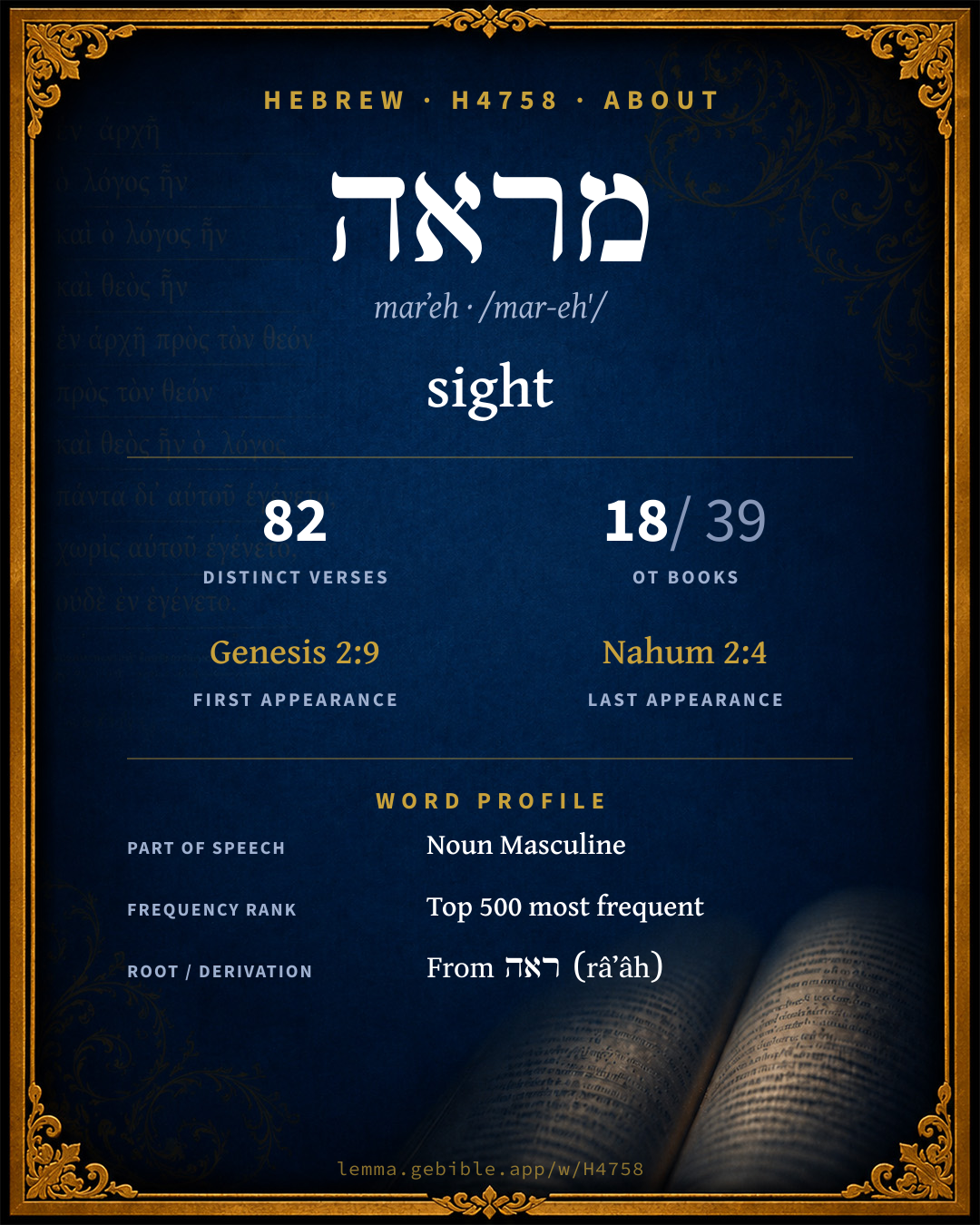
מַרְאֶה
sight
also: appearance, vision fuller range ↓
Full lexicon entry — Brown-Driver-Briggs (BDB)
From Brown-Driver-Briggs (BDB)
Where this word appears
See every Construct-state word in the Hebrew Bible →
Grammar key — what these labels mean
Part of speech
- Noun
- A naming word — a person, place, thing, or idea.
Noun type
- Common
- A common noun — a general class of person, place, or thing (“king,” “city,” “water”), not a specific name.
State
- Construct
- A noun bound to a following noun in a possessive / “of” relationship (the construct chain).
- Absolute
- The independent form of a noun, not bound to a following word.
Gender
- Masculine
- Grammatically masculine.
Number
- Singular
- One.
- Plural
- More than one (in Hebrew, generally three or more).
4 verses where H4758 appears in the Absolute state in the Book of Ezekiel. Filtered view — show all forms. Click any verse to open its interlinear word-by-word view. Verse text shown in the World English Bible for context — . Each verse’s Hebrew form is shown with its reference; the English is not keyword-highlighted, since the data carries no word-level English alignment. Use “Compare translations” on any verse to read it across multiple English versions. This concordance covers the Hebrew Bible; Septuagint (Greek Old Testament) occurrences are not indexed here.
Ezekiel
- Ezekiel 8:4 כַּ/מַּרְאֶ֕ה prep det + n c ms Behold, the glory of the God of Israel was there, according to the appearance that I saw in the plain.
- Ezekiel 11:24 בַּ/מַּרְאֶ֖ה הַ/מַּרְאֶ֖ה prep det + n c ms ptcl def.art + n c ms The Spirit lifted me up, and brought me in the vision by the Spirit of God into Chaldea, to them of the captivity. So the vision that I had seen went up from me.
- Ezekiel 41:21 הַ/מַּרְאֶ֖ה כַּ/מַּרְאֶֽה ptcl def.art + n c ms prep det + n c ms As for the temple, the door-posts were squared; and as for the face of the sanctuary, the appearance [of it] was as the appearance [of the temple].
- Ezekiel 43:3 וּ/כְ/מַרְאֵ֨ה הַ/מַּרְאֶ֜ה כַּ/מַּרְאֶ֤ה וּ/מַרְא֕וֹת כַּ/מַּרְאֶ֕ה conj + prep + n c ms cs ptcl def.art + n c ms prep det + n c ms conj + n c mp prep det + n c ms It was according to the appearance of the vision which I saw, even according to the vision that I saw when I came to destroy the city; and the visions were like the vision that I saw by the river Chebar; and I fell on my face.
About this entry
At a glance — auto-summarized from this page’s data, not written by a person. Every figure links to its source below. This summary describes the numbers; it doesn’t interpret them.
“sight” is the headline sense of the Hebrew noun מראה (marʼeh). Not a single-sense word: its full sense range also takes in “appearance” and “vision”. It appears 82 verses across 18 books of the Hebrew Bible, among its moderately common vocabulary. Scripture first uses it in Genesis 2:9. It shares a root with ראה, מראה and ראה. The sections below give every sense, occurrence, and version rendering.
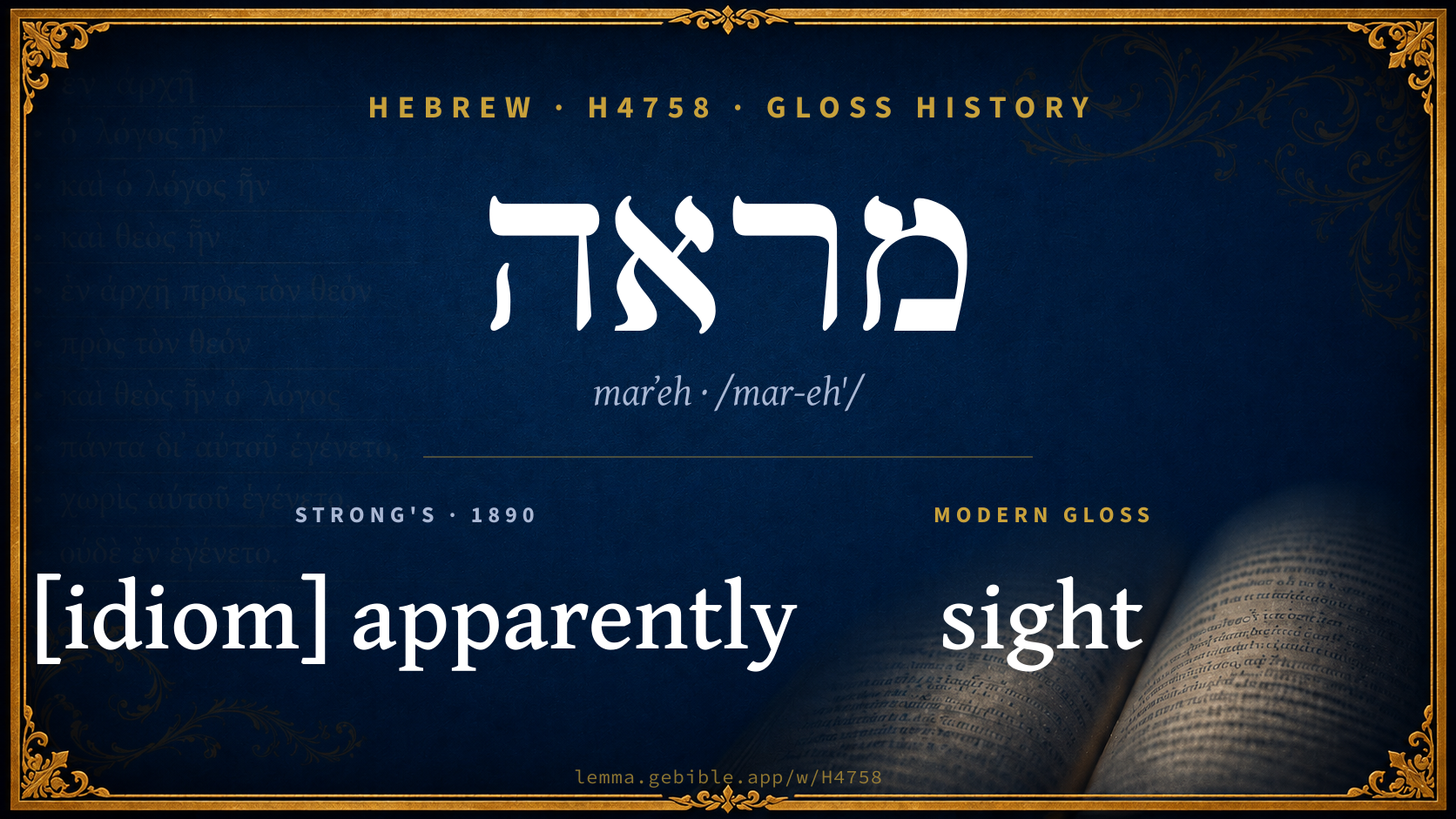
Gloss history
Strong's 1890 vs modern scholarship
About this word
Strong's H4758 catalogs a Hebrew word from the Hebrew Old Testament.
These counts are not copied from any lexicon or concordance. They are computed here, from the morphology-tagged Hebrew Old Testament. What Lemma adds →
- 82
- distinct verses
- The word appears in 82 distinct verses.
- 18 / 39
- OT books
- The word appears in 18 of 39 Old Testament books.
- #410
- by frequency
- Top 500 most frequent Hebrew words (rank 410 of 8,640 Hebrew words by occurrence).
View all 82 occurrences in the concordance →
By section of the Old Testament
By traditional corpus
Conventional, traditional groupings — biblical authorship is debated, so this is a traditional corpus grouping, not an authorship claim. Each share is this word’s portion of its verses in that division of the Hebrew canon. Each figure is a share of the word’s 82 distinct verses.
- Prophets (Nevi'im) 32 verses · 39%
- Torah (Pentateuch) 29 verses · 35%
- Writings (Ketuvim) 21 verses · 26%
How translations render this word
Counts come from each version’s own published word-to-Strong’s tagging or interlinear alignment — an approximate guide to how each version renders this word, not a word-level alignment the data otherwise carries. Because each total is that version’s own tagged count, the per-version totals vary from one another and need not match the appearance or distinct-verse counts above. These counts may also differ from a printed concordance because Lemma counts each distinctly tagged rendering and does not collapse phrase taggings into a single head-word total. This is a fixed set of word-tagged versions (KJV, ASV, BSB, ULT) and does not change with the reading translation you choose elsewhere. Each version’s license is shown beside its name below (and on Sources).
BDB lists this Strong’s number as 2 distinct words (homographs). Each count above pools all of them and is not split by sense — see the Senses section below. A low-frequency rendering may belong to a different one of those words, not the primary meaning.
- King James Version†: Appearance 19×, Sight 10×, Vision 8×
- American Standard Version†: Appearance 28×, Vision 8×, And 5×
- Berean Standard Bible†: Appearance 13×, Vision 7×, Appear 4×
- unfoldingWord Literal Text†: Appearance 39×, Was 8×, Appearance of 7×
King James Version Public Domain
Renders H4758 across 100† tagged occurrences — most commonly:
Plus 35 renderings that appear only once — usually multi-word phrases or single function words the recovered tagging swept in, not distinct renderings. Not rendered by a distinct English word in 3 further occurrences.
American Standard Version Public Domain
Renders H4758 across 103† tagged occurrences — most commonly:
Plus 34 renderings that appear only once — usually multi-word phrases or single function words the recovered tagging swept in, not distinct renderings.
Berean Standard Bible Public Domain
Renders H4758 across 76† tagged occurrences — most commonly:
Plus 34 renderings that appear only once — usually multi-word phrases or single function words the recovered tagging swept in, not distinct renderings. Not rendered by a distinct English word in 26 further occurrences.
unfoldingWord Literal Text CC BY-SA 4.0
Renders H4758 across 112† tagged occurrences — most commonly:
Plus other, less common renderings. Plus 19 renderings that appear only once — usually multi-word phrases or single function words the recovered tagging swept in, not distinct renderings.
6 senses and sub-senses in the full BDB
What do BDB’s symbols mean?
BDB uses these scholarly abbreviations:
| Symbol | Meaning |
|---|---|
| 𝔊 | the Septuagint (the ancient Greek translation, LXX) |
| 𝔙 | the Vulgate (the Latin translation) |
| 𝔖 | the Syriac version (the Peshitta) |
| 𝔗 | the Targum (the Aramaic translation) |
| ψ | the Psalms |
| √ | root (the underlying root or stem) |
| ‖ | parallel passage (a synonymous or contrasted parallel) |
| † | the dagger: every passage where the word occurs is cited |
The 6 senses and sub-senses the full Brown-Driver-Briggs lexicon distinguishes for this word, in lexicon order (not ranked by frequency), with BDB’s own verbatim wording and sub-sense lettering. Shown in Hebrew script with BDB’s own scholarly abbreviations. The condensed entry is in the Lexicon Entry tab. See also the Forms in the corpus table below.
- 1.
- a. sight, phenomenon, spectacle Ex 3:3 (J). e.g. Exodus 3:3
- b. appearance נֶחְמָד לְמ׳ Gn 2:9 (J) desirable in appearance, גָּדוֹל לְמ׳ Jos 22:10; appearance of man (or woman), Ju 13:6(×2) (angel), Is 52:14 (servant of י׳), Ct 5:15; Dn 8:15; 10:18; = outward person (opp. inner man) 1 S 16:7; visible form Ct 2:14(×2); Dn 1:13(×2), 15; בְּמ׳ Nu 12:8 (E; so read Sam 𝔊 𝔖 𝔗 Di, for MT מַרְאֶה), i.e. in personal presence (Hpt לֹא בְמ׳); כְּמַרְאֵה סוּסִים מַרְאֵהוּ Jo 2:4; of crocod. Jb 41:2; מ׳ כְּבוֹד י׳ Ex 24:17 (P), מ׳ הַנֶּגַע Lv 13:3, מ׳־אֵשׁ Nu 9:15, 16, מ׳ בָּרָק Dn 10:6 +; especially Ez appearance pers. vel rei (27 times, sometimes redundant), 1:5, 13, 26; 8:2; 10:1 +, מִמּ׳ מָתְנָיו 1:27(×2); 8:2 (‖ מִמָתְנָיו); of beauty וִיפֵה מַרְאֶה fair of appearance Gn 39:6 (J; + יְפֵה־תֹאַר), cf. 1 S 17:42 (read עֶלֶם [q.v.] for עִם); fem. יְפַת־מ׳ (אִשָּׁה) Gn 12:11 (J), 29:17 (E; + יְפַת תֹּאַר), 2 S 14:27; of kine יְפוֹת (הַ)מ׳ Gn 41:2, 4 (E), opp. רָעוֹת (הַ)מ׳ v 3, 4, מַרְאֵיהֶן רַע v 21 (all E); of women also טֹבַת מ׳ Gn 24:16; 26:7 (both J), 2 S 11:2; Est 1:11; 2:3, 7, טוֹבוֹת מ׳ 2:2; of boys טוֹבֵי מ׳ Dn 1:4, cf. מ׳ alone in לֹא־מ׳ וְנֶחְמְדֵהוּ (of suffering servant of י׳) Is 53:2; אִישׁ מ׳ 2 S 23:21 (but read as ‖ 1 Ch 11:23 אִישׁ מִדָּה We Dr al.). e.g. Genesis 2:9
- c. appearance, sight, vision Nu 8:4 (P). e.g. Numbers 8:4
- 2. in gen. what is seen, מ׳ עֵינָיו Is 11:3 i.e. what his outward eyes see (cf. 1 S 16:7 1 b), לִמ׳ עֵינֶיהָ Ez 23:16, מ׳ עֵינֶיךָ אֲשֶׁר תִּרְאֶה Dt 28:34, 67, לְכָל־מ׳ עֵינֵי הַכֹּהֵן Lv 13:12 (P). e.g. Isaiah 11:3
- 3. specif. a (supernat.) vision (in Ez Dn; often acc. cogn. c. ראה): Ez 8:4; 11:24; 43:3(×3), read also מַרֶאֵה הָרֶכֶב v 3 (for מַרְאוֹת v. i. מַרְאָה supr.); בַּמּ׳ 11:24; Dn 8:16, 27; 9:23; 10:1; מ׳ הָעֶרֶב וְהַבֹּקֶר 8:26. e.g. Ezekiel 8:4
- 4. sight, vision = power of seeing (and enjoying), late: מ׳ עֵינַיִם Ec 6:9, הַלֵּךְ בְּדַרְכֵי לִבְּךָ וּבְמַרְאֵי עֵינֶיךָ 11:9. e.g. Ecclesiastes 6:9
Senses from the full Brown-Driver-Briggs lexicon (Brown, Driver, Briggs; Oxford 1906 — public domain), digitized via Sefaria, supplemented by the OpenScriptures HebrewLexicon (CC BY 4.0). Full attribution on Sources.
Word origin
n.m. Ex 3:3 sight, appearance, vision;—מ׳ abs. Gn 12:11 +; cstr. מַרְאֵה Dt 28:34 +; sf. מַרְאֵהוּ Jo 2:4 +, מַרְאֶהָ Lv 13:4 +; appar. pl. cstr. מַרְאֵי Ec 11:9 (Köii. 1, 112), sf. (prob. in fact sg. Ges93 ss) מַרְאַיִךְ Ct 2:14(×2), מַרְאֵיהֶן Na 2:5 +, etc.;—
— Brown-Driver-Briggs (Oxford 1906, public domain), digitized via Sefaria, supplemented by the OpenScriptures HebrewLexicon (CC BY 4.0). See Sources.
Derived from ראה (râʼâh) (H7200) — to see.
Jastrow Dictionary
A second Hebrew/Aramaic lexicon for comparison, covering Aramaic and post-biblical (Talmudic, Targumic, Midrashic) usage that the biblical-Hebrew BDB does not. Matched by lemma rather than by Strong’s number, so a lemma may carry more than one Jastrow headword (shown separately below), and the entries cover usage well beyond the Bible.
מַרְאֶה
- , m.(b. h.; sight, looks, appearance; color, shade. Yoma 74ᵇ מַרְאֵה עינים באשה the pleasure of looking at one’s wife. Tosef. Neg. I, 2 מ׳ ראשון the first inspection of a leprous affection (Lev. XIII, 3), מ׳ שני the second (ib. 5) &c. Ib. 4 כל מ׳ לבן all shades of white; מ׳ סיבות grey color. Ib. 5 מ׳ גבוה the appearance of an elevation; כמ׳ צל בחמה as the appearance of a shade thrown on a sunlit object; Sifra Thazr., Neg., ch. I; a. fr.—Pl. מַרְאוֹת (with pronom. suffix) מַרְאָיו, מַרְאֶיהָ &c. Neg. I, 1. Sifra l. c., Par. 2, ch. II במראיו its retaining original color; כהה ממראיו fainter than its original color. Bekh. VII, 5; v. חָשׁוּךְ; a. fr. e.g. Leviticus 13:3
מַרְאָה
- preced.)
- 1. mirror. Kel. XIV, 6 שעשה בו מ׳ (not שעשאה) one part of which he polished to serve as a mirror. Tosef. Sabb. XIII (XIV), 16; a. fr.—Pl. מַרְאוֹת. Gen. R. s. 4 מ׳ גדולות magnifying mirrors; מ׳ קטנות diminishing mirrors; a. e.
- 2. picture.—Pl. as ab. Gen. R. s. 73 היה לך מ׳ בתוך ביתך didst thou have pictures in thy house? שחורה … או לבנה of black persons or of white?
מֻרְאָה
- , v. מוּרְאָה
A Dictionary of the Targumim, the Talmud Babli and Yerushalmi, and the Midrashic Literature (Marcus Jastrow; London, Luzac, 1903) — Public Domain. Digitized via Sefaria. Digitized via Sefaria. Full attribution on Sources.
Forms in the corpus
The 64 distinct written forms H4758 takes in the Hebrew Bible, most frequent first — each parse links to that state’s occurrences in the concordance. Hebrew forms include their vowel points and cantillation, so a single lemma takes many written forms.
The 60 most common forms are shown; 4 rarer forms follow in the full concordance.
Same root — word family
Other BDB entries built from the same root as H4758, grouped by Strong’s listed origin. These share a root / origin per the lexicon — not necessarily a shared meaning. Each links to that word’s own entry.
Derives from
Shares the same root
- מראה murʼâh H4760 crop
- ראה râʼâh H7201 bird of prey
- ראה râʼeh H7202 seeing
- ראה rôʼeh H7203 seer
- ראוה raʼăvâh H7207 beholding
- ראי rᵉʼîy H7209 mirror
- ראי rŏʼîy H7210 appearance
- ראית rᵉʼîyth H7212 beholding
- רו rêv H7299 appearance
Derived from this word
Proper names from this root
People and places named from this root — a name, not an additional meaning of the word.
Compare all same-root words → Showing 4 of 15 — not the complete family. 3 of the same-root words are proper names (people or places). They share a root, not necessarily a meaning.
Septuagint verse parallels
This word appears in 80 verses that also exist in the Greek Old Testament (Septuagint), out of the 82 Hebrew verses it occurs in. You can read those verses in Greek by switching the Old Testament edition to the Septuagint.
Read these verses in the Septuagint
- Genesis 2:9
- Exodus 3:3
- Leviticus 13:3
- Numbers 8:4
- Deuteronomy 28:34
- Joshua 22:10
- Judges 13:6
- 1 Samuel 16:7
- 2 Samuel 11:2
- Esther 1:11
- Job 4:16
- Ecclesiastes 6:9
This is a verse-level parallel only — the same verses exist in both the Hebrew and Greek Old Testaments. No word-level Hebrew↔Greek correspondence is claimed: the data carries no such alignment, so no Greek word is shown as this Hebrew word’s translation. Coverage is not total — the Septuagint omits the deuterocanon and renumbers the Psalms, so some Hebrew verses have no direct Greek parallel.