Ezekiel 41:21

Hebrew (Westminster Leningrad Codex) Ezekiel 41:21 appears in the Hebrew Old Testament. The text above is from the Westminster Leningrad Codex. Each word links to its Strong’s number, a concise gloss, and parsing drawn from the Open Scriptures Hebrew Bible morphology. Click any word for its full Brown-Driver-Briggs (BDB) entry.
Download image
Cite this verse

Ezekiel 41:21 (World English Bible). Public Domain. Lemma interlinear Bible study tool, https://lemma.gebible.app/v/ezekiel/41/21.

Show BibTeX & RIS
BibTeX
RIS
English Translation
As for the temple, the door-posts were squared; and as for the face of the sanctuary, the appearance [of it] was as the appearance [of the temple].
World English Bible · Public Domain
Download a study sheet

One document with this verse’s original text, its word-by-word gloss line, the meaning frame, cross-references with their text, attributed commentary, and full source and license credits — printable, and it pastes into notes with its structure intact.

This verse Autodidact and up

Study sheet (.html) Plain text (.txt)

A passage Seminary Student

Up to 50 verses in one chapter. A passage sheet keeps up to 6 commentary sources and 12 cross-references per verse, in the order this page ranks them, and says so on the sheet whenever that leaves anything out. Ask for a single verse and you get the Autodidact verse sheet above.

Everything on this page stays free to read, with no account — the sheet is a download of what is already on screen, not access to it.

Want to remove ads? Support Godless Engineer
Compare translations 3

The same verse in 3 English versions, stacked beneath the original-language interlinear above. Click any original word for its lexicon entry.

Each is an independent rendering of the whole verse — the interlinear is not word-aligned to these translations.

Highlighted words mark where these versions differ — a whole-verse word diff, not a word-by-word alignment.

  • World English Bible Public Domain
    As for the temple, the door-posts were squared; and as for the face of the sanctuary, the appearance [of it] was as the appearance [of the temple].
  • King James Version Public Domain
    The posts of the temple were squared, and the face of the sanctuary; the appearance of the one as the appearance of the other.
  • unfoldingWord Literal Text CC BY-SA 4.0
    The gate posts of the holy place were square. Their appearance was like the appearance of

unfoldingWord Literal Text — © unfoldingWord, licensed CC BY-SA 4.0. Word-aligned USFM3 via Door43 (git.door43.org/unfoldingWord/en_ult).

Versions to compare (up to 4)

3 of 4 selected

Show all 18 translations

Every available English version of this verse, each an independent rendering of the whole verse.

  • World English Bible Public Domain
    As for the temple, the door-posts were squared; and as for the face of the sanctuary, the appearance [of it] was as the appearance [of the temple].
  • Berean Standard Bible Public Domain
    The outer sanctuary had a rectangular doorframe, and the doorframe of the sanctuary was similar.
  • Majority Standard Bible Public Domain
    The outer sanctuary had a rectangular doorframe, and the doorframe of the sanctuary was similar.
  • King James Version Public Domain
    The posts of the temple were squared, and the face of the sanctuary; the appearance of the one as the appearance of the other.
  • American Standard Version (1901) Public Domain
    As for the temple, the door-posts were squared; and as for the face of the sanctuary, the appearance `thereof' was as the appearance `of the temple'.
  • Revised Version (1885) Public Domain
    As for the temple, the door posts were squared; and as for the face of the sanctuary, the appearance thereof was as the appearance of the temple.
  • Geneva Bible (1599) Public Domain
    The postes of the Temple were squared, and thus to looke vnto was the similitude and forme of the Sanctuarie.
  • Douay-Rheims (1899) Public Domain
    The threshold was foursquare, and the face of the sanctuary, sight to sight.
  • Young's Literal Translation Public Domain
    Of the temple the side post `is' square, and of the front of the sanctuary, the appearance `is' as the appearance.
  • Literal Standard Version CC BY-SA 4.0
    The doorpost of the temple [is] square, and of the front of the sanctuary, the appearance [is] as that appearance.
  • Unlocked Literal Bible CC BY-SA 4.0
    The gate posts of the holy place were square. Their appearance was like the appearance of
  • unfoldingWord Literal Text CC BY-SA 4.0
    The gate posts of the holy place were square. Their appearance was like the appearance of
  • Darby Bible Public Domain
    As for the temple, the door-posts were squared; and the front of the sanctuary had the same appearance.
  • World Messianic Bible Public Domain
    The door posts of the nave were squared. As for the face of the nave, its appearance was as the appearance of the temple.
  • Webster's Bible Public Domain
    The posts of the temple were squared, and the face of the sanctuary; the appearance of the one as the appearance of the other.
  • Free Bible Version CC BY-SA 4.0
    The Temple's doorframe was rectangular, as was the doorframe of the sanctuary.
  • Bible in Basic English Public Domain
    ...
  • JPS Tanakh (1917) Public Domain
    As for the temple, the jambs were squared; and the face of the sanctuary had an appearance such as is the appearance.

Literal Standard Version (2020), Covenant Press — licensed CC BY-SA 4.0. Text via the HelloAO Bible API (eBible.org). Unlocked Literal Bible (unfoldingWord) — licensed CC BY-SA 4.0. Text via the HelloAO Bible API (eBible.org). unfoldingWord Literal Text — © unfoldingWord, licensed CC BY-SA 4.0. Word-aligned USFM3 via Door43 (git.door43.org/unfoldingWord/en_ult). Free Bible Version, Dr. Jonathan Gallagher — licensed CC BY-SA 4.0. Text via the HelloAO Bible API (eBible.org).

Word by word

More ways to search: Search by grammar → Find every occurrence → Compare this word →

Practice this passage: Drill this verse → Learn its vocabulary →

רְבֻעָ֑ה
râbaʻ
H7251
“squared”
Verb, Qal, Participle Passive, Feminine, Singular, Absolute
Part of Speech
Verb
Stem
Qal
Form
Participle Passive
Gender
Feminine
Number
Singular
State
Absolute
Full BDB Definition

Origin: a primitive root [rather identical with H7250 through the idea of sprawling "at all fours" (or possibly the reverse is the order of deriv)

TWOT: 2107

to square, be squared - (Qal) square (participle) - (Pual) square (participle)
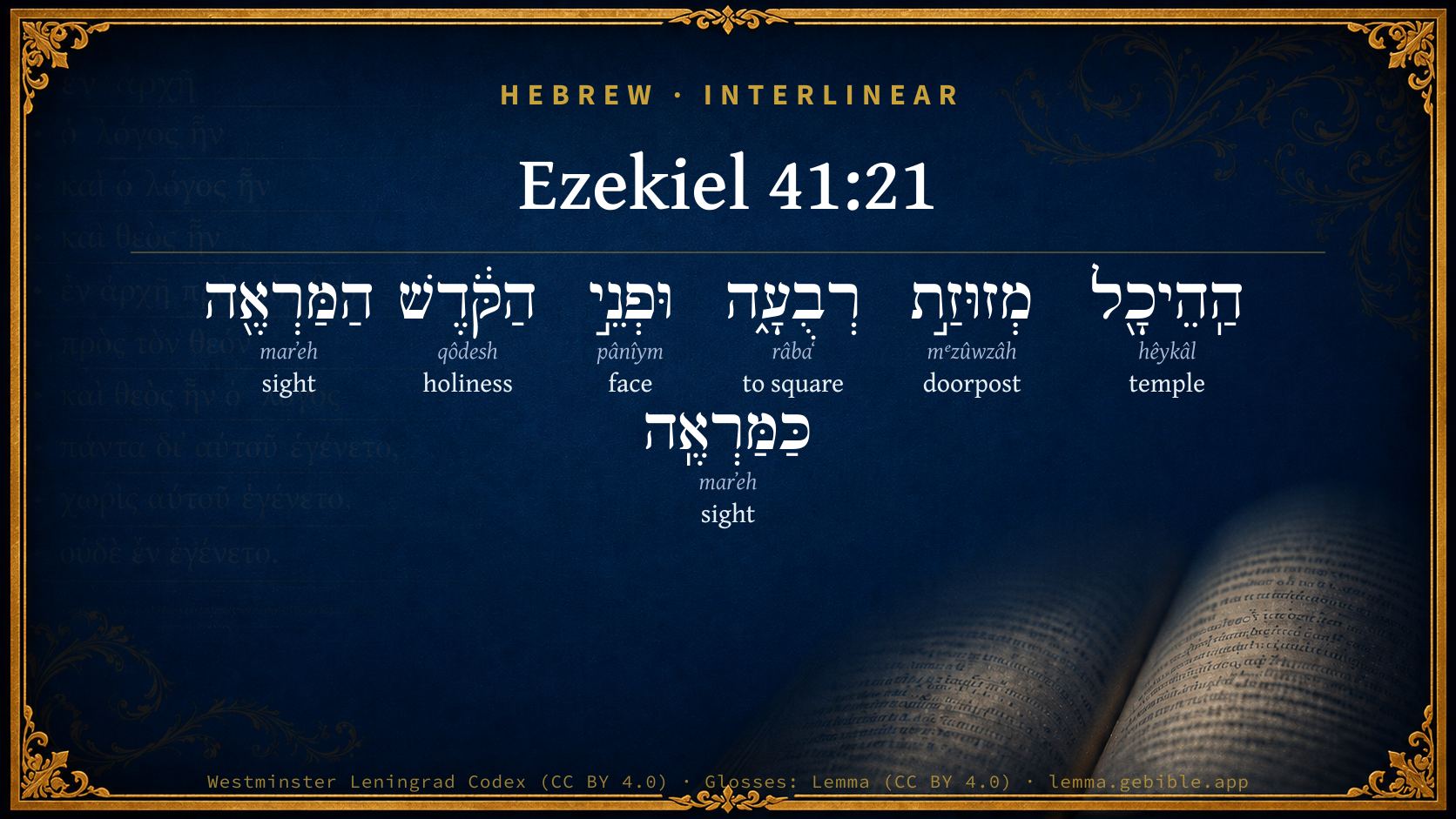
  1. הַֽהֵיכָ֖ל hêykâl H1964 “the · temple” Particle, Definite Article + Noun, Common, Masculine, Singular, Absolute
  2. מְזוּזַ֣ת mᵉzûwzâh H4201 “doorpost of” Noun, Common, Feminine, Singular, Construct
  3. וּפְנֵ֣י pânîym H6440 “and · face(s) of” Conjunction + Noun, Common, Both, Plural, Construct
  4. הַקֹּ֔דֶשׁ qôdesh H6944 “the · holiness” Particle, Definite Article + Noun, Common, Masculine, Singular, Absolute
  5. הַמַּרְאֶ֖ה marʼeh H4758 “the · sight” Particle, Definite Article + Noun, Common, Masculine, Singular, Absolute
  6. כַּמַּרְאֶֽה marʼeh H4758 “like/as the · sight” Preposition, Determined + Noun, Common, Masculine, Singular, Absolute

About this verse

These counts appear in no published source. They are computed here, from the morphology-tagged text and Lemma’s own curated glosses. What Lemma adds →

7
words
6
distinct lemmas
Prophets
section

Notable vocabulary

The rarest word here is רְבֻעָ֑ה to square H7251 — appearing just 12 times in the whole Hebrew Bible.

Shared distinctive vocabulary

רְבֻעָ֑ה to square H7251 occurs in 12 verses of the Hebrew Bible. Also found in:

Grammatical profile

  • 1 verb
  • 6 nouns

Verb forms

  • רְבֻעָ֑ה Qal · Participle Passive

Repetition

A word recurs within this verse — often emphatic in Hebrew:

  • הַמַּרְאֶ֖ה sight H4758 ×2

Hebrew & Septuagint length

In English translation the verse runs 27 words from the Hebrew and 24 from the Septuagint (LXX English) — closely comparable.

A rough comparison of the two English renderings, which tokenize alike — not a word-level alignment.

Word counts can differ between the Hebrew and the Greek without any difference in meaning — e.g. the Hebrew direct-object marker אֵת has no separate Greek word, and Greek often adds the article ὁ.

Cross-references

3

Topical passages linked to Ezekiel 41:21 in the Treasury of Scripture Knowledge — connected by theme and wording, ordered by reader-vote popularity; previews shown in the World English Bible.

  • Ezekiel 41:1 He brought me to the temple, and measured the posts, six cubits broad on the one side, and six cubits broad on the other side, which was the breadth of the tent.
  • 1 Kings 6:33 So also made he for the entrance of the temple door-posts of olive-wood, out of a fourth part [of the wall];
  • Ezekiel 40:14 He made also posts, sixty cubits; and the court [reached] to the posts, round about the gate.

Cross-references courtesy of OpenBible.info (CC BY 4.0).

Hebrew and Greek witnesses Masoretic Hebrew ↔ Greek Septuagint

The same verse in the two great witnesses to the Old Testament, shown verse-for-verse.

These are two independent witnesses, not word-aligned to each other, and the Septuagint is shown in lemma (dictionary) form.

Hebrew Ezekiel 41:21 Masoretic · Westminster Leningrad Codex

הַֽהֵיכָ֖ל מְזוּזַ֣ת רְבֻעָ֑ה וּפְנֵ֣י הַקֹּ֔דֶשׁ הַמַּרְאֶ֖ה כַּמַּרְאֶֽה

As for the temple, the door-posts were squared; and as for the face of the sanctuary, the appearance [of it] was as the appearance [of the temple].

World English Bible · Public Domain

Greek LXX Ezekiel 41:21 Septuagint · lemma form

καί ὁ ἅγιος καί ὁ ναός ἀναπτύσσω τετράγωνος κατά πρόσωπον ὁ ἅγιος ὅρασις ὡς ὄψις

And the holy place and the temple opened on four sides; in front of the holy places the appearance was as the look of

LXX2012 (modern English Septuagint) · Public Domain

On this verse, Joseph Benson's Commentary discusses the Septuagint’s reading. Read the note in Commentary ↓

Hebrew: Westminster Leningrad Codex (CC BY 4.0). Greek: Septuagint (public domain); English from LXX2012 (modern English Septuagint) (Public Domain). How the Septuagint differs from the Hebrew →

Targum (Aramaic paraphrase)

1

The Targum is the ancient Jewish Aramaic paraphrase of the Hebrew Scriptures — an interpretive translation, not the Hebrew text itself. Onkelos (literal) and Pseudo-Jonathan (expansive) render the Torah, and Jonathan the Prophets. Coverage is partial: where no permissively-licensed English translation exists for a verse, only the Aramaic is shown. This is verse-level text, not a word-by-word alignment to the Hebrew.

  1. Targum Jonathan Prophets (Joshua–Malachi)
    הֵיכָלָא דְסִפּוֹהִי מְרֻבָּעִין וְאַפֵי בֵית כִּפּוּרֵי חֶזְוֵיהּ כְּחֵיזוּ יְקָרֵהּ:

    (no public-domain English translation for this verse)

    Targum Jonathan — Aramaic: “Mikraot Gedolot” (public domain). English: “Sefaria Community Translation” (CC0 1.0 (public-domain dedication)); “London "Chaldee Paraphrase," 1871” (public domain). Text via Sefaria.

Commentary

Notes on Ezekiel 41:21 from classic Christian and Jewish commentators (each source and its license shown beneath its notes). The classic Christian expositions comment on the surrounding passage and are grouped to its opening verse, so a note may address several verses; the Jewish commentaries on the Tanakh (Rashi and others) are per-verse, so they appear only where the commentator wrote on this verse.

Lemma curates 59 commentaries, every one of them public domain or Creative Commons licensed, each selected and text-cleaned for this edition rather than reprinted as found. About our sources →

Trapp's Complete Commentary

John Trapp

Eze 41:21 The posts of the temple [were] squared, [and] the face of the sanctuary; the appearance [of the one] as the appearance [of the other].

Ver. 21. The posts of the temple,] i.e., Of the doors of the temple, were not round or arched, but square; as are at this day the doors of the Pantheon in Rome, saith Vilalpandus, built of old in honour of all gods, and now consecrated by the Pope to the honour of all saints with like superstition.

John Trapp, A Commentary or Exposition upon All the Books of the Old and New Testament (1647–1656) — public domain. Text from a community e-Sword module.

Joseph Benson's Commentary

Eze 41:21-22. The posts of the temple were squared, &c. — The lintels, or door-posts, both of the temple and inner sanctuary, were not arched, but square, with a flat beam, or upper lintel, laid upon the top of the side-posts: compare the margin of 1Ki 6:33. The altar of wood was three cubits high, and the length thereof two cubits — The LXX. add, by way of explication, και το ευρος πηχων δυο, and the breadth thereof two cubits; that it might be foursquare, as Moses’s altar of incense was, Exo 30:2. The altar here described is a cubit higher, and double the breadth to that of Moses, which is supposed to be agreeable to the dimensions of the altar made by Solomon, who did not exactly observe the proportions prescribed to Moses, in making the cherubim and the other furniture of the temple; God having given a new model to David of all the parts and ornaments of the temple, 1Ch 28:12; 1Ch 28:19. This altar was made of wood, but overlaid with gold, Exo 30:3, and therefore is called the golden altar. And the corners thereof, &c., were of wood — The corners are the same with the horns, mentioned Exo 30:2, being made out of the four posts which supported each corner of the altar. The surface, or top of it, is called the length, and the sides the walls. This is the table that is before the Lord — The words altar and table are used promiscuously; and this table, or altar, is said to be before the Lord, as being in the place of his peculiar presence: compare Exo 30:8. In the same sense the burnt-offering is said to be made at the door of the tabernacle of the congregation before the Lord, that is, in the place dedicated to his worship, Exo 29:42; and the lamp is said to burn before the Lord, chap. Eze 27:21, though the candlestick stood in the outward sanctuary.

Joseph Benson's Commentary on the Old and New Testaments (1811–1818) — public domain. Text from a community e-Sword module.

Jamieson, Fausset & Brown

Robert Jamieson, A. R. Fausset & David Brown

appearance of the one as the appearance of the other--The appearance of the sanctuary or holy of holies was similar to that of the temple. They differed only in magnitude.

Jamieson, Fausset & Brown — Commentary Critical and Explanatory on the Whole Bible (1871) — public domain (CC PDM 1.0). Text via the HelloAO Bible API.

Ellicott's Commentary for English Readers

(21) The posts of the temple.—Posts is a different word from that hitherto used, and always means the framework in which the doors were hung. Temple is, as before, the Holy Place, in distinction from the sanctuary, or Holy of Holies. The door-frames of both were square and just alike.

A Bible Commentary for English Readers, edited by Charles John Ellicott (1878–1897) — public domain. Text from a community e-Sword module.

The Cambridge Bible for Schools and Colleges

gen. ed. J. J. S. Perowne

21. the posts … squared] The text is very uncertain, the versions deviating from Heb. and from one another. The word “temple” (Eze_41:20) being omitted the words read: and the wall, 21 of the temple was square door-posts—a construction scarcely possible to express the idea that the wall had square door-posts. Syriac read: and the wall of the temple was four-square—omitting “door-posts.” LXX.: and the holy place (holiest) and the temple opened (spread out) four-square—reading “holy place” for wall, and “opened” for door-posts. It is probable that something is said of the holiest, because the next clause refers to an article that stood in front of it. It is also probable that the “door” referred to Eze_41:20 is that from the holy place into the holiest. But the witnesses leave us uncertain whether something be said about the wall or about the door-posts. If of the first the reading may be: and the wall of the holiest was four-square (Hitz., Corn.). Reference, however, might be to the door-posts. In Solomon’s temple those of the holy place appear to have been four-cornered, and those of the holiest five-cornered (1Ki_6:31; 1Ki_6:33).

face of the sanctuary … the other] This has no probability. The clause is rather to be connected with Eze_41:22. Perhaps: and in front of the sanctuary (the holiest) was the appearance as the appearance 22 of an altar of wood, three cubits the height thereof, &c. So LXX. and partly Syr. In the holy place in front of the holiest there stood an object having the appearance of an altar of wood. The present text might read: “and (as for) the front of the sanctuary, the appearance was as the appearance,” i.e. it had the appearance which is well known and does not need further description—a form of speech common enough in Shemitic, but quite improbable here.

The Cambridge Bible for Schools and Colleges (gen. ed. J. J. S. Perowne; Cambridge University Press, 1878–1918) — public domain. Text from a community e-Sword module.

John Gill's Exposition

The posts of the temple were squared,.... Or, were "foursquare" (n); the two posts on each side the door, the lintel and the threshold, made a square; the posts themselves were not round, as pillars, but flat and square; and the upper part was not arched, as in some buildings, but square. Jarchi says he had heard that the posts of Solomon's temple were foursquare; but that is not certain; however, these were. The Vulgate Latin version renders it "four cornered"; as doors formerly were: this was the ancient way of building, as Philander (o) observes; almost everything in this wonderful building was foursquare; denoting the firmness, stability, and perfection of all things in it:

and the face of the sanctuary; the appearance of the one as the appearance of the other; that is, the front of the holy of holies was like that of the temple; they both had the same appearance, though one was larger than another. The posts of the one were squared, even as the posts of the other; showing that the same is the way of entrance into the Gospel church and into the New Jerusalem church state, and even into the heavenly glory, which is Christ; and, whether in the less or more perfect state of the church on earth, there are the same precious faith, and love, and communion, though different degrees. The Targum is,

"and the face of the house of the propitiatory; and its appearance as the appearance of its glory;''

which Jarchi interprets, as the appearance of the throne of glory, seen by the prophet at the river Chebar, Eze 1:26.

(n) "quadratus", Montanus, Vatablus, Junius & Tremellius, Piscator. (o) Not. in Vitruvium de Architect. l. 4. c. 6. p. 153.

John Gill's Exposition of the Whole Bible (1746–1763) — public domain (CC PDM 1.0). Text via the HelloAO Bible API.

Albert Barnes' Notes on the Bible

The posts - Not the word used before (see Eze 40:9 note). These “posts” are rather pilasters forming part of the inner walls.

The appearance ... other - i. e., the appearance in this vision was the same as in the actual temple (compare Eze 43:3); (or, according to others, the front of the sanctuary resembled, the front of the holy place).

Albert Barnes' Notes on the Bible (1834–1885) — public domain. Text from a community e-Sword/MySword module.

Haydock's Catholic Bible Commentary

The threshold was four-square. That is, the gate of the temple was four-square, and so placed as to answer the gate of the sanctuary within. (Challoner) --- It was not an arch, though not a perfect square, 3 Kings vi. 34.

George Leo Haydock (1774–1849), Haydock's Catholic Family Bible and Commentary, 1859 edition — public domain. Excludes Psalms (Douay-Rheims chapter numbering differs from Protestant) and Deuterocanonical books (Catholic canon only).

Matthew Poole's English Annotations

The posts on each side of the gate or door, both of temple and oracle, were squared; not round, as some other were, and as the posts of the door of the tabernacle were, but of exact square.

The face, the form of the door, or gate of the temple, was square, i.e. not arched, as the gates of our churches ordinarily are, but with a flat beam, or upper lintel, laid on the top of the posts, and so either made an equilateral square, or an oblong square.

The appearance of the one as the appearance of the other; as was the form of the gate of the temple in its larger, so was the form of the gate of the oracle in its lesser dimensions.

Matthew Poole's English Annotations on the Holy Bible (1683–1685) — public domain. Text from a community e-Sword/MySword module.

The Pulpit Commentary

The posts of the temple were squared; literally, as for the temple the doorposts were squared, or "the sanctuary post work of square form" (Keil). The remaining clauses ought to read as in the Revised Version, "As for the face of the sanctuary, the appearance thereof was as the appearance of the temple," the sanctuary being the holy of holies as distinguished from the holy place or the house as a whole, The precise force of the last words, the appearance as the appearance, is supposed by Kliefoth and Keil to be that the sanctuary door, like that of the temple, had square pests; by Ewald, that it appeared to be what it really was; by Plumptre, that the appearance was like that he (Ezekiel) had formerly described: by Currey, that the appearance in this vision was the same as in the other visions, and as in the actual temple. (comp. Eze_43:2)

Something can be said for each of these attempts to elucidate a dark phrase. Smend and Hitzig, follow the LXX in connecting the last clause of ver. 21 with ver. 22 in this fashion, "And in front of the holy place was an appearance like the sight of a wooden altar."

The Pulpit Commentary (1880–1919), ed. H.D.M. Spence-Jones & Joseph S. Exell — public domain. Text from a community e-Sword module.

John Wesley's Explanatory Notes

The face - The door or gate of the temple was square, not arched. As the appearance - As was the form of the gate of the temple in its larger, so was the form of the gate of the oracle in its lesser dimensions.

John Wesley, Explanatory Notes Upon the Whole Bible (1754–1765) — public domain. Text via the GEBible commentary corpus.

unfoldingWord translationNotes

Door43 World Missions Community

Their appearance was like the appearance of the wooden altar

The abstract noun "appearance" can be translated as a verb. AT: "They appeared the same way the wooden altar appeared" (See: Abstract Nouns)

three cubits ... two cubits

Each long cubit was about 54 centimeters. See how you translated this in Ezekiel 40:5. AT: "about 1.6 meters ... about 1.1 meters" (See: Biblical Distance)

There were double doors for the holy place and the most holy place

"The holy place and the most holy place both had two doors"

These doors had two hinged door panels each

"Each door had two parts that were on hinges." Hinges connect doors to the wall and allow the doors to swing.

two panels for one door and two panels for the other

"both of the doors for both the holy place and the most holy place had two parts"

translationWords

holy place

altar

Yahweh

unfoldingWord translationNotes — © Distant Shores Media and the Door43 World Missions Community, licensed CC BY-SA 4.0. Source: git.door43.org/Door43/en_tn.

Rashi

Rabbi Shlomo Yitzchaki (Rashi)

a square doorpost [Heb. רְבֻעָה.] I heard that in Solomon’s edifice, the doorpost was fourfold; i.e., it had doorposts on both sides, a threshold below and a lintel above, but I say that the doorposts were square.

like [that] appearance Jonathan rendered: “Its appearance was like the appearance of His Glory” - like the appearance of the Throne of Glory that I saw in the Chariot by the River Chebar; I saw a bright light in the Holy of Holies.

Rashi on the Tanakh — English translations: “The Judaica Press complete Tanach with Rashi, translated by A. J. Rosenberg” (CC BY 4.0); “Pentateuch with Rashi's commentary by M. Rosenbaum and A.M. Silbermann, 1929-1934” (public domain); “The Metsudah Tanach series, Lakewood, N.J” (CC BY 4.0); and “The Book of Joshua, Metsudah Publications, 1997” (CC BY 4.0). Text via Sefaria.

Lesson kit

Teaching starters — assembled from the data on this page, not authored interpretation. Every prompt links to the verse data it draws on. Edit before teaching.

Ezekiel, in the Prophets, opens this verse with 7 words (6 distinct Hebrew lemmas). Its most distinctive word is râbaʻ (“to square”). A historical commentator’s framing appears above. Read the whole chapter for the surrounding context.

Discussion questions

  1. How does “to square” (râbaʻ) shape what this verse is saying?
  2. How does Exodus 27:1, which shares the word «to square», read alongside this verse?
  3. What does the repetition of “sight” (2× in this one verse) do in this verse?
  4. These translations render this verse differently; the difference is in the English rendering, not the original. What questions does that raise?
  5. «רְבֻעָ֑ה» is a Qal Participle Passive verb. How does that grammatical form shape the action described?
  6. Compare how Trapp's Complete Commentary and Joseph Benson's Commentary read this verse. Where do they agree or differ?

Things to notice

Reading settings

Reading text

Shown beneath each verse's original-language words.

Old Testament
Old Testament edition

Read the OT as the Masoretic Hebrew (MT) or the Greek Septuagint (LXX).

English shown for the Greek Septuagint (in the Hebrew ↔ Greek comparison).

Comparing translations? Open the Compare panel on any verse page to stack up to four side by side.