
Ezekiel 43:3

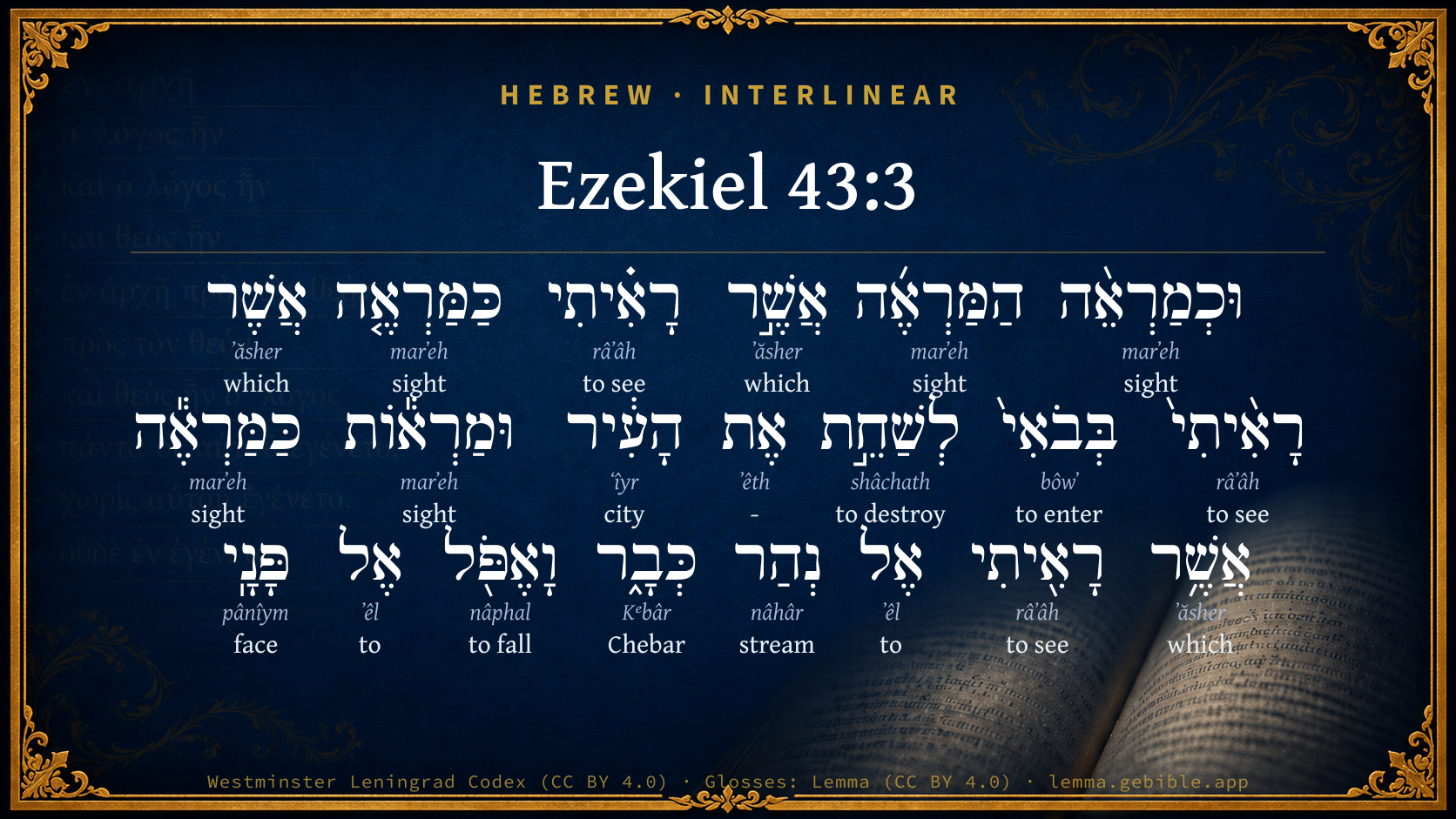
Hebrew (Westminster Leningrad Codex) Ezekiel 43:3 appears in the Hebrew Old Testament. The text above is from the Westminster Leningrad Codex. Each word links to its Strong’s number, a concise gloss, and parsing drawn from the Open Scriptures Hebrew Bible morphology. Click any word for its full Brown-Driver-Briggs (BDB) entry.
Download image
Cite this verse

Ezekiel 43:3 (World English Bible). Public Domain. Lemma interlinear Bible study tool, https://lemma.gebible.app/v/ezekiel/43/3.

Show BibTeX & RIS
BibTeX
RIS
English Translation
It was according to the appearance of the vision which I saw, even according to the vision that I saw when I came to destroy the city; and the visions were like the vision that I saw by the river Chebar; and I fell on my face.
World English Bible · Public Domain
Download a study sheet

One document with this verse’s original text, its word-by-word gloss line, the meaning frame, cross-references with their text, attributed commentary, and full source and license credits — printable, and it pastes into notes with its structure intact.

This verse Autodidact and up

Study sheet (.html) Plain text (.txt)

A passage Seminary Student

Up to 50 verses in one chapter. A passage sheet keeps up to 6 commentary sources and 12 cross-references per verse, in the order this page ranks them, and says so on the sheet whenever that leaves anything out. Ask for a single verse and you get the Autodidact verse sheet above.

Everything on this page stays free to read, with no account — the sheet is a download of what is already on screen, not access to it.

Want to remove ads? Support Godless Engineer
Compare translations 3

The same verse in 3 English versions, stacked beneath the original-language interlinear above. Click any original word for its lexicon entry.

Each is an independent rendering of the whole verse — the interlinear is not word-aligned to these translations.

Highlighted words mark where these versions differ — a whole-verse word diff, not a word-by-word alignment.

  • World English Bible Public Domain
    It was according to the appearance of the vision which I saw, even according to the vision that I saw when I came to destroy the city; and the visions were like the vision that I saw by the river Chebar; and I fell on my face.
  • King James Version Public Domain
    And it was according to the appearance of the vision which I saw, even according to the vision that I saw when I came to destroy the city: and the visions were like the vision that I saw by the river Chebar; and I fell upon my face.
  • unfoldingWord Literal Text CC BY-SA 4.0
    It was according to the appearance of the vision that I saw, according to the vision that I saw when he had come to destroy the city, and the visions were like the vision that I saw at the Kebar Canal—and I fell to my face.

unfoldingWord Literal Text — © unfoldingWord, licensed CC BY-SA 4.0. Word-aligned USFM3 via Door43 (git.door43.org/unfoldingWord/en_ult).

Versions to compare (up to 4)

3 of 4 selected

Show all 18 translations

Every available English version of this verse, each an independent rendering of the whole verse.

  • World English Bible Public Domain
    It was according to the appearance of the vision which I saw, even according to the vision that I saw when I came to destroy the city; and the visions were like the vision that I saw by the river Chebar; and I fell on my face.
  • Berean Standard Bible Public Domain
    The vision I saw was like the vision I had seen when He came to destroy the city and like the visions I had seen by the River Kebar. I fell facedown,
  • Majority Standard Bible Public Domain
    The vision I saw was like the vision I had seen when He came to destroy the city and like the visions I had seen by the River Kebar. I fell facedown,
  • King James Version Public Domain
    And it was according to the appearance of the vision which I saw, even according to the vision that I saw when I came to destroy the city: and the visions were like the vision that I saw by the river Chebar; and I fell upon my face.
  • American Standard Version (1901) Public Domain
    And it was according to the appearance of the vision which I saw, even according to the vision that I saw when I came to destroy the city; and the visions were like the vision that I saw by the river Chebar; and I fell upon my face.
  • Revised Version (1885) Public Domain
    And it was according to the appearance of the vision which I saw, even according to the vision that I saw when I came to destroy the city; and the visions were like the vision that I saw by the river Chebar: and I fell upon my face.
  • Geneva Bible (1599) Public Domain
    And the vision which I saw was like the vision, euen as the vision that I sawe when I came to destroy the citie: and the visions were like the vision that I sawe by the riuer Chebar: and I fell vpon my face.
  • Douay-Rheims (1899) Public Domain
    And I saw the vision according to the appearance which I had seen when he came to destroy the city: and the appearance was according to the vision which I had seen by the river Chobar: and I fell upon my face.
  • Young's Literal Translation Public Domain
    And according to the appearance `is' the appearance that I saw, as the appearance that I saw in my coming in to destroy the city, and the appearances `are' as the appearance that I saw at the river Chebar, and I fall on my face.
  • Literal Standard Version CC BY-SA 4.0
    And according to the appearance [is] the appearance that I saw, as the appearance that I saw in my coming in to destroy the city, and the appearances [are] as the appearance that I saw at the river Chebar, and I fall on my face.
  • Unlocked Literal Bible CC BY-SA 4.0
    It was according to the appearance of the vision that I saw, according to the vision that I saw when he had come to destroy the city, and the visions were like the vision that I saw at the Kebar Canal—and I fell to my face.
  • unfoldingWord Literal Text CC BY-SA 4.0
    It was according to the appearance of the vision that I saw, according to the vision that I saw when he had come to destroy the city, and the visions were like the vision that I saw at the Kebar Canal—and I fell to my face.
  • Darby Bible Public Domain
    And the appearance of the vision that I saw was according to the vision that I had seen when I came to destroy the city; and the visions were like the vision that I saw by the river Chebar: and I fell upon my face.
  • World Messianic Bible Public Domain
    It was like the appearance of the vision which I saw, even according to the vision that I saw when I came to destroy the city; and the visions were like the vision that I saw by the river Chebar; and I fell on my face.
  • Webster's Bible Public Domain
    And it was according to the appearance of the vision which I saw, even according to the vision that I saw when I came to destroy the city: and the visions were like the vision that I saw by the river Kebar; and I fell upon my face.
  • Free Bible Version CC BY-SA 4.0
    The vision I saw was just like the vision I'd seen when he came to destroy the city of Jerusalem and like the visions I'd seen beside the River Kebar. I fell facedown on the ground.
  • Bible in Basic English Public Domain
    And the vision which I saw was like the vision I had seen when he came for the destruction of the town: and like the vision which I saw by the river Chebar; and I went down on my face.
  • JPS Tanakh (1917) Public Domain
    And the appearance of the vision which I saw was like the vision that I saw when I came to destroy the city; and the visions were like the vision that I saw by the river Chebar; and I fell upon my face.

Literal Standard Version (2020), Covenant Press — licensed CC BY-SA 4.0. Text via the HelloAO Bible API (eBible.org). Unlocked Literal Bible (unfoldingWord) — licensed CC BY-SA 4.0. Text via the HelloAO Bible API (eBible.org). unfoldingWord Literal Text — © unfoldingWord, licensed CC BY-SA 4.0. Word-aligned USFM3 via Door43 (git.door43.org/unfoldingWord/en_ult). Free Bible Version, Dr. Jonathan Gallagher — licensed CC BY-SA 4.0. Text via the HelloAO Bible API (eBible.org).

Word by word

More ways to search: Search by grammar → Find every occurrence → Compare this word →

Practice this passage: Drill this verse → Learn its vocabulary →

כְּבָ֑ר
Kᵉbâr
H3529
“Chebar”
Noun, Proper
Part of Speech
Noun
Type
Proper
Full BDB Definition

Origin: the same as H3528

TWOT: 947d

Chebar = "far-off" - a Babylonian river near which many Israelite exiles settled; maybe the 'Habor' or the 'Royal Canal' of Nebuchadnezzar
  1. וּכְמַרְאֵ֨ה marʼeh H4758 “and · like/as · sight of” Conjunction + Preposition + Noun, Common, Masculine, Singular, Construct
  2. הַמַּרְאֶ֜ה marʼeh H4758 “the · sight” Particle, Definite Article + Noun, Common, Masculine, Singular, Absolute
  3. אֲשֶׁ֣ר ʼăsher H834 “which” Particle, Relative
  4. רָאִ֗יתִי râʼâh H7200 “to see” Verb, Qal, Perfect, 1st Person, Common, Singular
  5. כַּמַּרְאֶ֤ה marʼeh H4758 “like/as the · sight” Preposition, Determined + Noun, Common, Masculine, Singular, Absolute
  6. אֲשֶׁר ʼăsher H834 “which” Particle, Relative
  7. רָאִ֨יתִי֙ râʼâh H7200 “to see” Verb, Qal, Perfect, 1st Person, Common, Singular
  8. בְּבֹאִי֙ bôwʼ H935 “in/at · to enter · me” Preposition + Verb, Qal, Infinitive Construct + Suffix, Personal, 1st Person, Common, Singular
  9. לְשַׁחֵ֣ת shâchath H7843 “to destroy” Preposition + Verb, Piel, Infinitive Construct
  10. אֶת ʼêth H853 “-” Particle, Direct Object
  11. הָעִ֔יר ʻîyr H5892 “the · city” Particle, Definite Article + Noun, Common, Feminine, Singular, Absolute
  12. וּמַרְא֕וֹת marʼeh H4758 “and · sights” Conjunction + Noun, Common, Masculine, Plural, Absolute
  13. כַּמַּרְאֶ֕ה marʼeh H4758 “like/as the · sight” Preposition, Determined + Noun, Common, Masculine, Singular, Absolute
  14. אֲשֶׁ֥ר ʼăsher H834 “which” Particle, Relative
  15. רָאִ֖יתִי râʼâh H7200 “to see” Verb, Qal, Perfect, 1st Person, Common, Singular
  16. אֶל ʼêl H413 “to” Preposition
  17. נְהַר nâhâr H5104 “stream of” Noun, Common, Masculine, Singular, Construct
  18. וָאֶפֹּ֖ל nâphal H5307 “and · to fall” Conjunction + Verb, Qal, Sequential Imperfect, 1st Person, Common, Singular
  19. אֶל ʼêl H413 “to” Preposition
  20. פָּנָֽי pânîym H6440 “face(s) · my” Noun, Common, Both, Plural, Construct + Suffix, Personal, 1st Person, Common, Singular

About this verse

These counts appear in no published source. They are computed here, from the morphology-tagged text and Lemma’s own curated glosses. What Lemma adds →

21
words
12
distinct lemmas
Prophets
section

Notable vocabulary

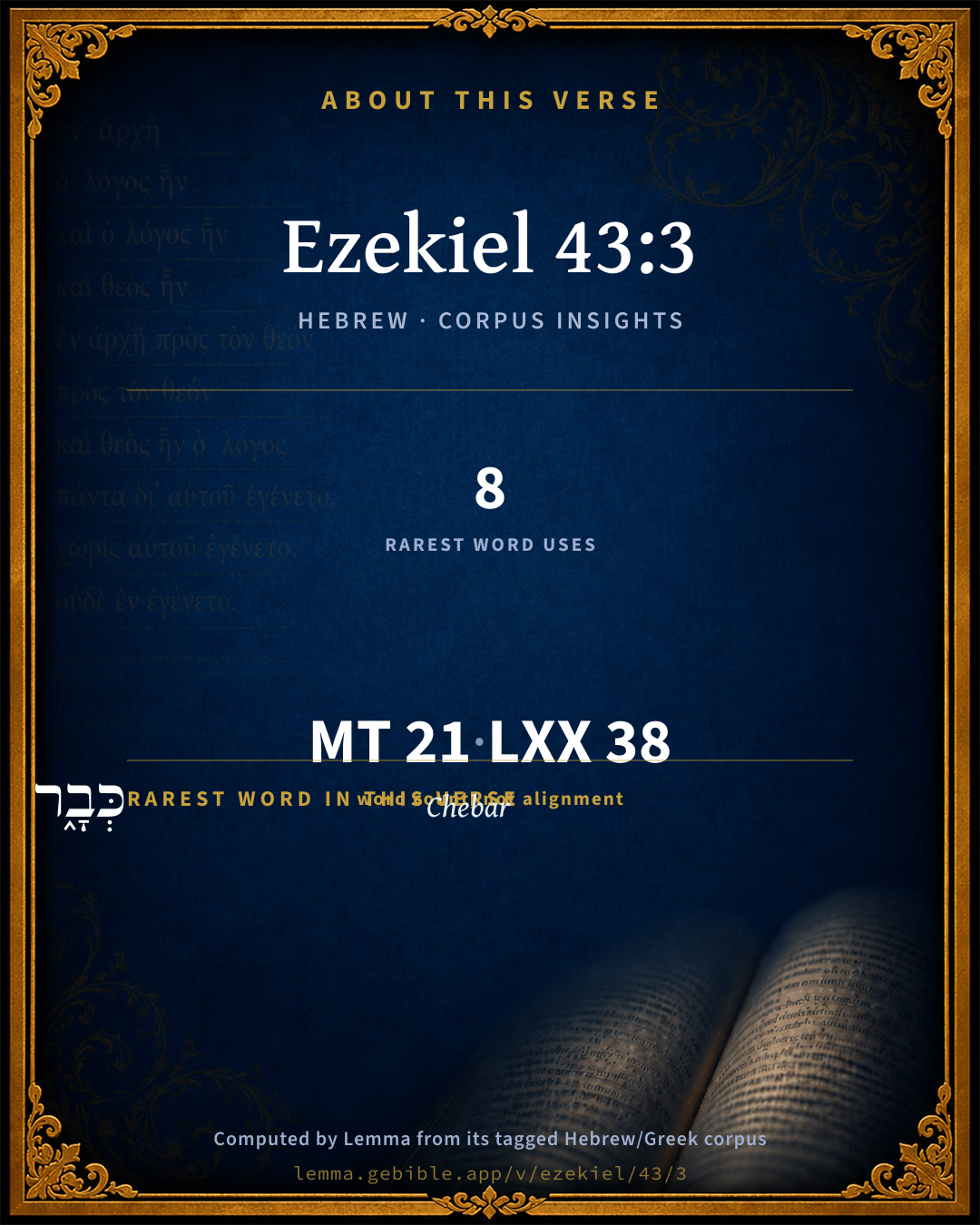
The rarest word here is כְּבָ֑ר Chebar H3529 — appearing just 8 times in the whole Hebrew Bible.

Shared distinctive vocabulary

כְּבָ֑ר Chebar H3529 occurs in 8 verses of the Hebrew Bible. Also found in:

Grammatical profile

  • 6 verbs
  • 9 nouns
  • 2 prepositions
  • 4 particles

Verb forms

  • רָאִ֗יתִי Qal · Perfect
  • רָאִ֨יתִי֙ Qal · Perfect
  • בְּבֹאִי֙ Qal · Infinitive Construct
  • לְשַׁחֵ֣ת Piel · Infinitive Construct
  • רָאִ֖יתִי Qal · Perfect
  • וָאֶפֹּ֖ל Qal · Sequential Imperfect

Repetition

Words recur within this verse — often emphatic in Hebrew:

  • וּכְמַרְאֵ֨ה sight H4758 ×5
  • רָאִ֗יתִי to see H7200 ×3
  • אֲשֶׁ֣ר which H834 ×3
  • אֶל to H413 ×2

Hebrew & Septuagint length

In English translation the verse runs 47 words from the Hebrew and 47 from the Septuagint (LXX English) — the same length.

A rough comparison of the two English renderings, which tokenize alike — not a word-level alignment.

Word counts can differ between the Hebrew and the Greek without any difference in meaning — e.g. the Hebrew direct-object marker אֵת has no separate Greek word, and Greek often adds the article ὁ.

In the original languages it is 21 Hebrew tokens and 38 Greek tokens — but the two are counted differently (Hebrew bundles its prefixes and suffixes into one token; the Greek is in lemma form), so that isn’t a like-for-like length.

Cross-references

11

Topical passages linked to Ezekiel 43:3 in the Treasury of Scripture Knowledge — connected by theme and wording, ordered by reader-vote popularity; previews shown in the World English Bible.

  • Ezekiel 9:1 Then he cried in my ears with a loud voice, saying, Cause you them that have charge over the city to draw near, every man with his destroying weapon in his hand.
  • Ezekiel 9:5 To the others he said in my hearing, Go you through the city after him, and strike: don't let your eye spare, neither have you pity;
  • Jeremiah 1:10 behold, I have this day set you over the nations and over the kingdoms, to pluck up and to break down and to destroy and to overthrow, to build and to plant.
  • Ezekiel 1:3–28 the word of Yahweh came expressly to Ezekiel the priest, the son of Buzi, in the land of the Chaldeans by the river Chebar; and the hand of Yahweh was there on him.
  • Ezekiel 3:23 Then I arose, and went forth into the plain: and, behold, the glory of Yahweh stood there, as the glory which I saw by the river Chebar; and I fell on my face.
  • Ezekiel 32:18 Son of man, wail for the multitude of Egypt, and cast them down, even her, and the daughters of the famous nations, to the lower parts of the earth, with those who go down into the pit.
  • Ezekiel 8:4 Behold, the glory of the God of Israel was there, according to the appearance that I saw in the plain.
  • Ezekiel 9:3 The glory of the God of Israel was gone up from the cherub, whereupon it was, to the threshold of the house: and he called to the man clothed in linen, who had the writer's inkhorn by his side.
  • Ezekiel 10:1–22 Then I looked, and see, in the expanse that was over the head of the cherubim there appeared above them as it were a sapphire stone, as the appearance of the likeness of a throne.
  • Ezekiel 11:22–23 Then did the cherubim lift up their wings, and the wheels were beside them; and the glory of the God of Israel was over them above.
  • Revelation 11:3–6 I will give power to my two witnesses, and they will prophesy one thousand two hundred sixty days, clothed in sackcloth."

Cross-references courtesy of OpenBible.info (CC BY 4.0).

Hebrew and Greek witnesses Masoretic Hebrew ↔ Greek Septuagint

The same verse in the two great witnesses to the Old Testament, shown verse-for-verse.

These are two independent witnesses, not word-aligned to each other, and the Septuagint is shown in lemma (dictionary) form.

Hebrew Ezekiel 43:3 Masoretic · Westminster Leningrad Codex

וּכְמַרְאֵ֨ה הַמַּרְאֶ֜ה אֲשֶׁ֣ר רָאִ֗יתִי כַּמַּרְאֶ֤ה אֲשֶׁר רָאִ֨יתִי֙ בְּבֹאִי֙ לְשַׁחֵ֣ת אֶת הָעִ֔יר וּמַרְא֕וֹת כַּמַּרְאֶ֕ה אֲשֶׁ֥ר רָאִ֖יתִי אֶל נְהַר כְּבָ֑ר וָאֶפֹּ֖ל אֶל פָּנָֽי

It was according to the appearance of the vision which I saw, even according to the vision that I saw when I came to destroy the city; and the visions were like the vision that I saw by the river Chebar; and I fell on my face.

World English Bible · Public Domain

Greek LXX Ezekiel 43:3 Septuagint · lemma form

καί ὁ ὅρασις ὅς ὁράω κατά ὁ ὅρασις ὅς ὁράω ὅτε εἰςπορεύομαι ὁ χρίω ὁ πόλις καί ὁ ὅρασις ὁ ἅρμα ὅς ὁράω κατά ὁ ὅρασις ὅς ὁράω ἐπί ὁ ποταμός ὁ χοβαρ καί πίπτω ἐπί πρόσωπον ἐγώ

And the vision which I saw was like the vision which I saw when I went in to anoint the city: and the vision of the chariot which I saw was like the vision which I saw at the river Chobar; and I fell upon my face.

LXX2012 (modern English Septuagint) · Public Domain

On this verse, The Cambridge Bible for Schools and Colleges discusses the Septuagint’s reading. Read the note in Commentary ↓

Hebrew: Westminster Leningrad Codex (CC BY 4.0). Greek: Septuagint (public domain); English from LXX2012 (modern English Septuagint) (Public Domain). How the Septuagint differs from the Hebrew →

Targum (Aramaic paraphrase)

1

The Targum is the ancient Jewish Aramaic paraphrase of the Hebrew Scriptures — an interpretive translation, not the Hebrew text itself. Onkelos (literal) and Pseudo-Jonathan (expansive) render the Torah, and Jonathan the Prophets. Coverage is partial: where no permissively-licensed English translation exists for a verse, only the Aramaic is shown. This is verse-level text, not a word-by-word alignment to the Hebrew.

  1. Targum Jonathan Prophets (Joshua–Malachi)
    וּכְחֵיזוּ חֶזְוָא דַחֲזֵיתִי כְּחֶזְוָא דַחֲזֵיתִי בְּאִתְנַבְּיוּתִי לְחַבָּלָא יַת קַרְתָּא וְחֶזְוָא כְּחֵיזוּ דַחֲזִיתִי עַל נְהַר כְּבַר וְאִשְׁתַּטְחֵית עַל אַפָּי:

    (no public-domain English translation for this verse)

    Targum Jonathan — Aramaic: “Mikraot Gedolot” (public domain). English: “Sefaria Community Translation” (CC0 1.0 (public-domain dedication)); “London "Chaldee Paraphrase," 1871” (public domain). Text via Sefaria.

Commentary

Notes on Ezekiel 43:3 from classic Christian and Jewish commentators (each source and its license shown beneath its notes). The classic Christian expositions comment on the surrounding passage and are grouped to its opening verse, so a note may address several verses; the Jewish commentaries on the Tanakh (Rashi and others) are per-verse, so they appear only where the commentator wrote on this verse.

Lemma curates 59 commentaries, every one of them public domain or Creative Commons licensed, each selected and text-cleaned for this edition rather than reprinted as found. About our sources →

Trapp's Complete Commentary

John Trapp

Eze 43:3 And [it was] according to the appearance of the vision which I saw, [even] according to the vision that I saw when I came to destroy the city: and the visions [were] like the vision that I saw by the river Chebar; and I fell upon my face.

Ver. 3. And it was according to the vision.] Being so much the sweeter and the welcomer to me. Hence he so oft repeateth it; and the Jewish doctors observe that eight times in this one verse, visionis ac videndi vocabulum repetitur, the word for vision and to see it is made use of.

When I came to destroy the city,] i.e., To foretell the destruction of it, {Eze 9:2; Eze 9:5} from which time forth it was a done thing. See Jer 1:10. {See Trapp on "Jer 1:10"}

And I fell upon my face.] In reverence to his majesty, in admiration of his mercy, and in the sense of mine own unworthiness. The nearer any one cometh to God, the lower he falleth in his own eyes, and the more doth "rottenness enter into his bones."

John Trapp, A Commentary or Exposition upon All the Books of the Old and New Testament (1647–1656) — public domain. Text from a community e-Sword module.

Joseph Benson's Commentary

Eze 43:3-5. And it — This glory of the God of Israel; was according to the vision, &c., when I came to destroy the city — That is, to prophesy that the city would be destroyed. The prophets are often said to do those things which they foretel shall be done. And I fell upon my face — In humble and reverent adoration of the divine majesty, or overwhelmed, as it were, and not able to bear the lustre of such glory. But the Spirit took him up, when the glory of the Lord was come into the house, that he might see how the house was filled with it. He had formerly seen, to his great grief, how the glory of the Lord, in this same appearance, departed from the temple; because it was profaned; and now he sees, to his great satisfaction, how it returns to it. As we do not find that ever the Shechinah did in such a manner take possession of the second temple, it seems evident that this was to have its accomplishment in that glory of the divine grace which shines so bright in the gospel church, and fills it.

Joseph Benson's Commentary on the Old and New Testaments (1811–1818) — public domain. Text from a community e-Sword module.

Geneva Bible (1599)

Geneva Bible translators

When I prophesied the destruction of the city of the Chaldeans.

Geneva Bible (1599) marginal notes — public domain. Text via Bolls.life.

Jamieson, Fausset & Brown

Robert Jamieson, A. R. Fausset & David Brown

when I came to destroy the city--that is, to pronounce God's word for its destruction. So completely did the prophets identify themselves with Him in whose name they spake.

Jamieson, Fausset & Brown — Commentary Critical and Explanatory on the Whole Bible (1871) — public domain (CC PDM 1.0). Text via the HelloAO Bible API.

Ellicott's Commentary for English Readers

(3) When I came to destroy the city.—That is, to announce its destruction. (Comp. Eze_32:18; Gen_49:7; Isa_6:10; Jer_1:10.)

Like the vision that I saw.—Comp. Eze_1:4, &c.; Eze_3:23; Eze_10:15; Eze_10:22. The manifestation of Divine glory to the prophet was the same throughout.

A Bible Commentary for English Readers, edited by Charles John Ellicott (1878–1897) — public domain. Text from a community e-Sword module.

The Cambridge Bible for Schools and Colleges

gen. ed. J. J. S. Perowne

3. And it was according to] And the appearance which I saw was like the appearance which I saw when I came—the word “appearance” at the beginning of the verse being omitted.

I came to destroy] Reference is to ch. 8–11. and the destruction of the city there seen in vision by the prophet. He was carried to Jerusalem to witness the destruction, and he calls this his coming to destroy it. Vulg., when he (Jehovah) came.

the visions were like the vision] like the appearance. The words “and the visions” are rather unnatural; LXX. reads: and the vision of the chariot which I saw was like &c. The “chariot,” i.e. the whole theophany of cherubim and wheels is often spoken of in later times (e.g. Ecclesus. 49:8), but is nowhere named in the Bible (cf. 1Ch_28:18). The reading of LXX. is probably a gloss in explanation of the Heb., which is awkward. Possibly the word “visions” should be omitted: … the city, and like the appearance that I saw by the river Chebar. Cf. Eze_3:23, where LXX. interpolates “according to the vision.”

The Cambridge Bible for Schools and Colleges (gen. ed. J. J. S. Perowne; Cambridge University Press, 1878–1918) — public domain. Text from a community e-Sword module.

John Gill's Exposition

And it was according to the appearance of the vision which I saw,.... Recorded in the first, ninth, and tenth chapters of this book; the form in which the glory of the God of Israel now appeared was like to what he then saw; in each of which visions was the likeness of a throne, and on it the appearance of the glory of God:

even according to the vision that I saw when I came to destroy the city; the city of Jerusalem; not that the prophet destroyed it, or came to destroy it himself, which was to be done, and was done, by the Chaldeans; but to foretell the destruction of it; which prediction of his made it as certain as if it was done. So the Targum,

"when I prophesied to destroy the city;''

and this was, when he was bid to cause, in a visionary and prophetic manner, six men, with their destroying weapons, to draw near unto it, and smite it; at which time he saw the glory of the God of Israel go up from the cherub, Eze 9:1.

And the visions were like the vision that I saw by the river Chebar; the four living creatures and the wheels; the throne of sapphire stone, and the glorious appearance above it, Eze 1:3 only with this difference, then he saw the glory of the God of Israel departing, especially in the last vision, but now returning:

and I fell upon my face; in reverence of such glorious majesty: affected with such a display of grace and goodness, and sensible of his own unworthiness to behold it: the clearer and fuller views saints have of the grace and glory of Christ, the more humble they are; see Isa 6:1.

John Gill's Exposition of the Whole Bible (1746–1763) — public domain (CC PDM 1.0). Text via the HelloAO Bible API.

Haydock's Catholic Bible Commentary

He came. Hebrew, "I came to destroy (Septuagint, to anoint) the city," marking such as should be spared, chap. ix. The glorious chariot entered by the eastern gate, and the prophet followed to the court of the priests, ver. 5, 13. (Calmet) --- The Jews says the second temple was deprived of the Shekinah, or glory of the Lord. Yet it seems here to enter; and Christ himself adorned this second house, more than the first, by his adorable presence, Aggeus ii. 8. (Haydock)

George Leo Haydock (1774–1849), Haydock's Catholic Family Bible and Commentary, 1859 edition — public domain. Excludes Psalms (Douay-Rheims chapter numbering differs from Protestant) and Deuterocanonical books (Catholic canon only).

Matthew Poole's English Annotations

And it, this glory of the God of Israel,

was according to the appearance of the vision which I saw: see Eze 1:4,28.

To destroy the city; to declare that their sins would ruin their city, Eze 9:3; 10:4, which see. Here the effect seems ascribed to him, though he only declares it will be.

By the river Chebar: see Eze 1:1,3.

Fell upon my face; overwhelmed, and as it were swallowed up: see Eze 1:28.

Matthew Poole's English Annotations on the Holy Bible (1683–1685) — public domain. Text from a community e-Sword/MySword module.

The Pulpit Commentary

The prophet identifies the vision on which he now looks as the same he had formerly beheld on the hanks of the Chebar, when he came to destroy the city, i.e. when, in obedience to Divine command, he stood forth to announce the destruction of Jerusalem. Ewald and Smend follow the Vulgate. quando venit ut disperderet, in substituting "he," Jehovah, for "I," Ezekiel; but the change is unnecessary, as the prophet"s language is perfectly intelligible and quite correct, since "the prophet destroyed the city ideally by his prophecy" (Hitzig), and it is not unusual for Scripture to represent a prophet as himself doing what he is only sent to predict. (comp. Eze_4:2 Eze_32:18; Jer_1:10) The prophet"s reason for introducing this clause was manifestly the same he had for identifying the visions to show that, while it was the same Jehovah who had departed from the old temple that was now returning to the new, there was nothing incongruous in the idea that he who in the past had shown himself a God of justice and judgment by overturning and destroying the old, should in the future exhibit himself as a God of grace and mercy by condescending to establish his abode in the new. The impression produced upon the prophet"s soul by his vision was the same that had been produced by the formerhe fell upon his face in awe and wonder.

God the same in judgment and in mercy.

The remarkable point of this verse lies in the fact that Ezekiel could detect no change in the manifestation of the Divine glory when he compared the new appearance which heralded the great redemption of Israel with the earlier appearance which preceded the denunciation of wrath and doom. God is the same in both cases.

I THE FACT. This has two sides one relating to the time of judgment, and the other concerned with the period of redemption.

1. God"s mercy is not lost in judg ment. He was glorious when he came to judgment, and one essential element of the glory of God is his ineffable love. We may not see love in wrath, but it is present, for "whom the Lord loveth he chasteneth". (Heb_12:6) God does not change his nature because men sin, nor indeed does he cease to yearn over his poor fallen children with infinite pity because it has become well that he should smite them in his great anger.

2. God"s righteousness is not lost in redemption. He loses none of the glory of his holiness by saving sinners. Christ came to "magnify the Law and make it honorable". (Isa_42:21) Righteousness is honored

(1) in the Person of Christ, our great Representative, who offered his pure and spotless soul as a perfect sacrifice to God;

(2) in the deliverance of man from sin. Righteousness itself desires an end of sin more than the mere punishment, which is but a means towards that end. Thus the glory of God"s holiness is most manifest when he redeems man from sin and leads him into a new, holy life.

II ITS CONSEQUENCES.

1. There is no escape from the law of righteousness. The subjects of a changeable autocrat watch his fickle moods, and endeavor to seize on lucky moments when he appears to be in a good burnout, in order to extract some favor from him. No such maneuvers are needed, or can be of any use, when men are looking for God"s grace. On the one hand, he is always desirous to save and bless; on the other hand, he is never weakly negligent in regard to the great principles of justice. We can never evade his laws.

2. There is no reason to despair on account of the wrath of God against sin. That wrath was always felt by God, though it has not always been perceived by man. "God is angry with the wicked every day ". (Psa_7:11) Yet God has shown continuous love, and has put forth repeated efforts of mercy to save his fallen children. He has not changed towards us because he has veiled his mercy and displayed his wrath for a season. The same ever-righteous and ever-merciful Father who at one time smites in anger and at another saves in grace will act to us just as we do to him. With the froward thou wilt show thyself froward, etc.. (Psa_18:26) Therefore our part is to be plain and straight with God, simply trusting his great love, and honestly endeavoring to fulfill his holy will.

The Pulpit Commentary (1880–1919), ed. H.D.M. Spence-Jones & Joseph S. Exell — public domain. Text from a community e-Sword module.

John Wesley's Explanatory Notes

And it - This glory of the God of Israel. To destroy - To declare, that their sins would ruin their city, chap. ix, 3, 4. I fell - Overwhelmed, and as it were swallowed up.

John Wesley, Explanatory Notes Upon the Whole Bible (1754–1765) — public domain. Text via the GEBible commentary corpus.

unfoldingWord translationNotes

Door43 World Missions Community

It was

"The glory of God coming from the east was"

according to the appearance of the vision

The abstract noun "appearance" can be translated as a verb. AT: "just like what appeared in the vision" (See: Abstract Nouns)

when he had come to destroy the city

Possible meanings are 1) "when the God of Israel had come to destroy the city" or 2) "when I had come to see the God of Israel destroy the city."

Behold

Your language may have a different word to show that Ezekiel was surprised by what he saw.

translationWords

vision

Yahweh

house

Holy Spirit

unfoldingWord translationNotes — © Distant Shores Media and the Door43 World Missions Community, licensed CC BY-SA 4.0. Source: git.door43.org/Door43/en_tn.

Rashi

Rabbi Shlomo Yitzchaki (Rashi)

And it was like the appearance of the vision, etc. [Heb. וּכְמַרְאֵה הַמַרְאֶה.] Nine visions [or “mirrors”] (מַרְאוֹת) are written here through which the prophets perceived. Moses, however, was an exception, for he saw through one vision. Therefore, his mirror reflected clearly and he saw reality more closely. And this is [what is behind] the words of the liturgical poet. The mirrors polished with nine visions.

when I came to destroy the city in the section (9:4) of “and you shall mark a sign,” where it says (verse 1): “Bring near those appointed over the city,” and delineates the form of the Celestial Chariot.

Rashi on the Tanakh — English translations: “The Judaica Press complete Tanach with Rashi, translated by A. J. Rosenberg” (CC BY 4.0); “Pentateuch with Rashi's commentary by M. Rosenbaum and A.M. Silbermann, 1929-1934” (public domain); “The Metsudah Tanach series, Lakewood, N.J” (CC BY 4.0); and “The Book of Joshua, Metsudah Publications, 1997” (CC BY 4.0). Text via Sefaria.

Lesson kit

Teaching starters — assembled from the data on this page, not authored interpretation. Every prompt links to the verse data it draws on. Edit before teaching.

Ezekiel, in the Prophets, opens this verse with 21 words (12 distinct Hebrew lemmas). Its most distinctive word is Kᵉbâr (“Chebar”). A historical commentator’s framing appears above. Read the whole chapter for the surrounding context.

Discussion questions

  1. How does “Chebar” (Kᵉbâr) shape what this verse is saying?
  2. How does Ezekiel 1:1, which shares the word «Chebar», read alongside this verse?
  3. What does the repetition of “sight” (5× in this one verse) do in this verse?
  4. These translations render this verse differently; the difference is in the English rendering, not the original. What questions does that raise?
  5. «רָאִ֗יתִי» is a Qal Perfect verb. How does that grammatical form shape the action described?
  6. Compare how Trapp's Complete Commentary and Joseph Benson's Commentary read this verse. Where do they agree or differ?

Things to notice

Reading settings

Reading text

Shown beneath each verse's original-language words.

Old Testament
Old Testament edition

Read the OT as the Masoretic Hebrew (MT) or the Greek Septuagint (LXX).

English shown for the Greek Septuagint (in the Hebrew ↔ Greek comparison).

Comparing translations? Open the Compare panel on any verse page to stack up to four side by side.