
Ezekiel 8:4

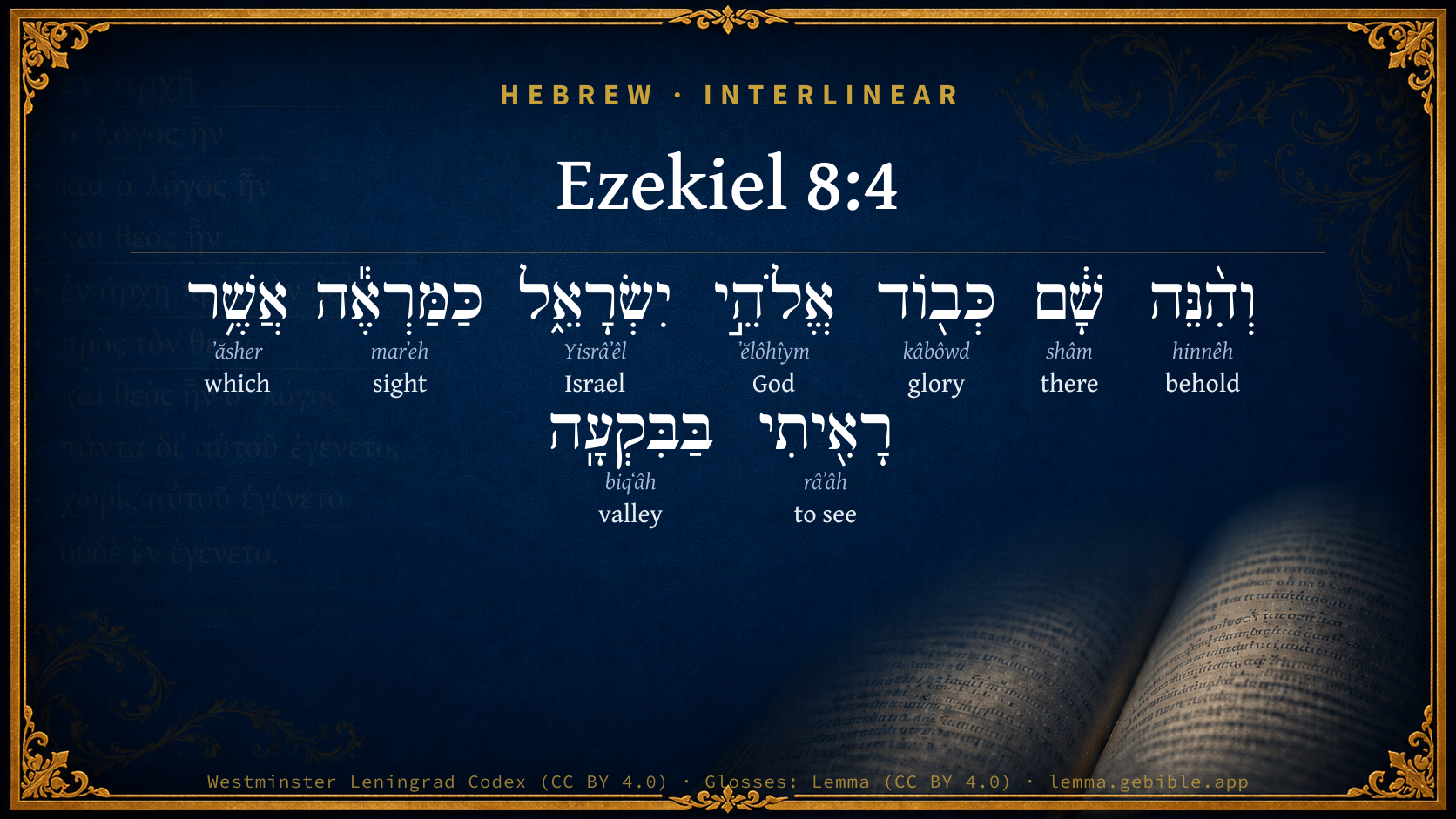
Hebrew (Westminster Leningrad Codex) Ezekiel 8:4 appears in the Hebrew Old Testament. The text above is from the Westminster Leningrad Codex. Each word links to its Strong’s number, a concise gloss, and parsing drawn from the Open Scriptures Hebrew Bible morphology. Click any word for its full Brown-Driver-Briggs (BDB) entry.
Download image
Cite this verse

Ezekiel 8:4 (World English Bible). Public Domain. Lemma interlinear Bible study tool, https://lemma.gebible.app/v/ezekiel/8/4.

Show BibTeX & RIS
BibTeX
RIS
English Translation
Behold, the glory of the God of Israel was there, according to the appearance that I saw in the plain.
World English Bible · Public Domain
Download a study sheet

One document with this verse’s original text, its word-by-word gloss line, the meaning frame, cross-references with their text, attributed commentary, and full source and license credits — printable, and it pastes into notes with its structure intact.

This verse Autodidact and up

Study sheet (.html) Plain text (.txt)

A passage Seminary Student

Up to 50 verses in one chapter. A passage sheet keeps up to 6 commentary sources and 12 cross-references per verse, in the order this page ranks them, and says so on the sheet whenever that leaves anything out. Ask for a single verse and you get the Autodidact verse sheet above.

Everything on this page stays free to read, with no account — the sheet is a download of what is already on screen, not access to it.

Want to remove ads? Support Godless Engineer
Compare translations 3

The same verse in 3 English versions, stacked beneath the original-language interlinear above. Click any original word for its lexicon entry.

Each is an independent rendering of the whole verse — the interlinear is not word-aligned to these translations.

Highlighted words mark where these versions differ — a whole-verse word diff, not a word-by-word alignment.

  • World English Bible Public Domain
    Behold, the glory of the God of Israel was there, according to the appearance that I saw in the plain.
  • King James Version Public Domain
    And, behold, the glory of the God of Israel was there, according to the vision that I saw in the plain.
  • unfoldingWord Literal Text CC BY-SA 4.0
    Then behold, the glory of the God of Israel was there, according to the vision I had seen on the plain.

unfoldingWord Literal Text — © unfoldingWord, licensed CC BY-SA 4.0. Word-aligned USFM3 via Door43 (git.door43.org/unfoldingWord/en_ult).

Versions to compare (up to 4)

3 of 4 selected

Show all 18 translations

Every available English version of this verse, each an independent rendering of the whole verse.

  • World English Bible Public Domain
    Behold, the glory of the God of Israel was there, according to the appearance that I saw in the plain.
  • Berean Standard Bible Public Domain
    And there I saw the glory of the God of Israel, like the vision I had seen in the plain.
  • Majority Standard Bible Public Domain
    And there I saw the glory of the God of Israel, like the vision I had seen in the plain.
  • King James Version Public Domain
    And, behold, the glory of the God of Israel was there, according to the vision that I saw in the plain.
  • American Standard Version (1901) Public Domain
    And, behold, the glory of the God of Israel was there, according to the appearance that I saw in the plain.
  • Revised Version (1885) Public Domain
    And, behold, the glory of the God of Israel was there, according to the appearance that I saw in the plain.
  • Geneva Bible (1599) Public Domain
    And beholde, the glorie of the God of Israel was there according to the vision, that I saw in the fielde.
  • Douay-Rheims (1899) Public Domain
    And behold the glory of the God of Israel was there, according to the vision which I had seen in the plain.
  • Young's Literal Translation Public Domain
    and lo, there the honour of the God of Israel, as the appearance that I saw in the valley.
  • Literal Standard Version CC BY-SA 4.0
    and behold, there the glory of the God of Israel [is] as the appearance that I saw in the valley.
  • Unlocked Literal Bible CC BY-SA 4.0
    Then behold, the glory of the God of Israel was there, according to the vision I had seen on the plain.
  • unfoldingWord Literal Text CC BY-SA 4.0
    Then behold, the glory of the God of Israel was there, according to the vision I had seen on the plain.
  • Darby Bible Public Domain
    And behold, the glory of the God of Israel was there, according to the appearance that I saw in the valley.
  • World Messianic Bible Public Domain
    Behold, the glory of the God of Israel was there, according to the appearance that I saw in the plain.
  • Webster's Bible Public Domain
    And behold, the glory of the God of Israel was there, according to the vision that I saw in the plain.
  • Free Bible Version CC BY-SA 4.0
    I saw the glory of the God of Israel there, just like I had in the vision I'd seen in the valley.
  • Bible in Basic English Public Domain
    And I saw the glory of the Lord there, as in the vision which I saw in the valley.
  • JPS Tanakh (1917) Public Domain
    And, behold, the glory of the God of Israel was there, according to the vision that I saw in the plain.

Literal Standard Version (2020), Covenant Press — licensed CC BY-SA 4.0. Text via the HelloAO Bible API (eBible.org). Unlocked Literal Bible (unfoldingWord) — licensed CC BY-SA 4.0. Text via the HelloAO Bible API (eBible.org). unfoldingWord Literal Text — © unfoldingWord, licensed CC BY-SA 4.0. Word-aligned USFM3 via Door43 (git.door43.org/unfoldingWord/en_ult). Free Bible Version, Dr. Jonathan Gallagher — licensed CC BY-SA 4.0. Text via the HelloAO Bible API (eBible.org).

Word by word

More ways to search: Search by grammar → Find every occurrence → Compare this word →

Practice this passage: Drill this verse → Learn its vocabulary →

About this verse

These counts appear in no published source. They are computed here, from the morphology-tagged text and Lemma’s own curated glosses. What Lemma adds →

9
words
9
distinct lemmas
Prophets
section

Notable vocabulary

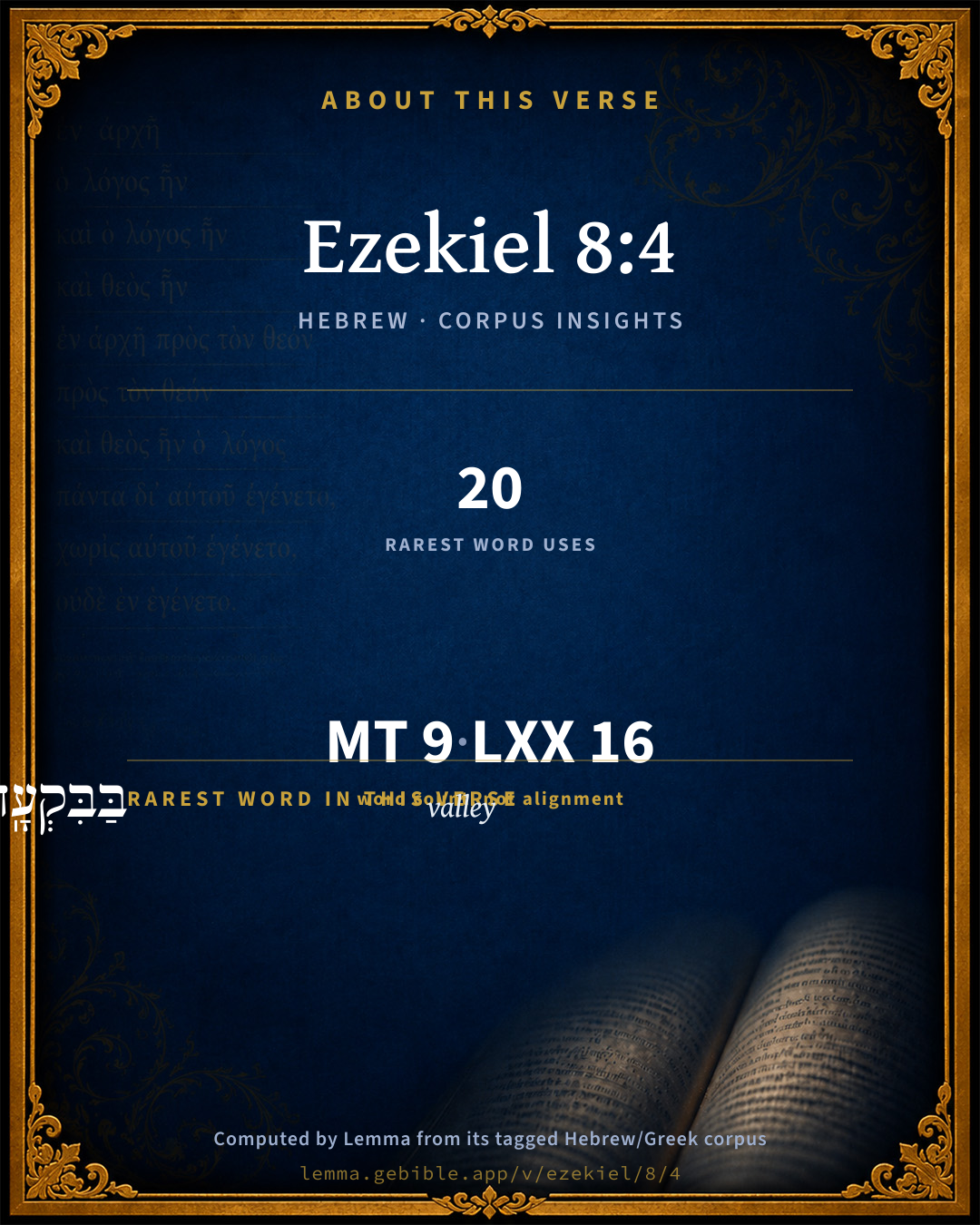
The rarest word here is בַּבִּקְעָֽה valley H1237 — appearing just 20 times in the whole Hebrew Bible.

Shared distinctive vocabulary

בַּבִּקְעָֽה valley H1237 occurs in 20 verses of the Hebrew Bible. Also found in:

Grammatical profile

  • 1 verb
  • 5 nouns
  • 1 adverb
  • 2 particles

Verb forms

  • רָאִ֖יתִי Qal · Perfect

Hebrew & Septuagint length

In English translation the verse runs 20 words from the Hebrew and 22 from the Septuagint (LXX English) — closely comparable.

A rough comparison of the two English renderings, which tokenize alike — not a word-level alignment.

Word counts can differ between the Hebrew and the Greek without any difference in meaning — e.g. the Hebrew direct-object marker אֵת has no separate Greek word, and Greek often adds the article ὁ.

In the original languages it is 9 Hebrew tokens and 16 Greek tokens — but the two are counted differently (Hebrew bundles its prefixes and suffixes into one token; the Greek is in lemma form), so that isn’t a like-for-like length.

Cross-references

11

Topical passages linked to Ezekiel 8:4 in the Treasury of Scripture Knowledge — connected by theme and wording, ordered by reader-vote popularity; previews shown in the World English Bible.

  • Ezekiel 3:22–23 The hand of Yahweh was there on me; and he said to me, Arise, go forth into the plain, and I will there talk with you.
  • Ezekiel 1:26–28 Above the expanse that was over their heads was the likeness of a throne, as the appearance of a sapphire stone; and on the likeness of the throne was a likeness as the appearance of a man on it above.
  • Exodus 25:22 There I will meet with you, and I will tell you from above the mercy seat, from between the two cherubim which are on the ark of the testimony, all that I command you for the children of Israel.
  • Exodus 40:34–35 Then the cloud covered the tent of meeting, and the glory of Yahweh filled the tent.
  • Ezekiel 9:3 The glory of the God of Israel was gone up from the cherub, whereupon it was, to the threshold of the house: and he called to the man clothed in linen, who had the writer's inkhorn by his side.
  • Ezekiel 10:1–4 Then I looked, and see, in the expanse that was over the head of the cherubim there appeared above them as it were a sapphire stone, as the appearance of the likeness of a throne.
  • Ezekiel 11:22–23 Then did the cherubim lift up their wings, and the wheels were beside them; and the glory of the God of Israel was over them above.
  • Ezekiel 43:2–4 Behold, the glory of the God of Israel came from the way of the east: and his voice was like the sound of many waters; and the earth shined with his glory.
  • 2 Corinthians 3:18 But we all, with unveiled face beholding as in a mirror the glory of the Lord, are transformed into the same image from glory to glory, even as from the Lord, the Spirit.
  • 2 Corinthians 4:4–6 in whom the god of this world has blinded the minds of the unbelieving, that the light of the Gospel of the glory of Christ, who is the image of God, should not dawn on them.
  • Hebrews 1:3 His Son is the radiance of his glory, the very image of his substance, and upholding all things by the word of his power, when he had by himself made purification for our sins, sat down on the right hand of the Majesty on high;

Cross-references courtesy of OpenBible.info (CC BY 4.0).

Hebrew and Greek witnesses Masoretic Hebrew ↔ Greek Septuagint

The same verse in the two great witnesses to the Old Testament, shown verse-for-verse.

These are two independent witnesses, not word-aligned to each other, and the Septuagint is shown in lemma (dictionary) form.

Hebrew Ezekiel 8:4 Masoretic · Westminster Leningrad Codex

וְהִ֨נֵּה שָׁ֔ם כְּב֖וֹד אֱלֹהֵ֣י יִשְׂרָאֵ֑ל כַּמַּרְאֶ֕ה אֲשֶׁ֥ר רָאִ֖יתִי בַּבִּקְעָֽה

Behold, the glory of the God of Israel was there, according to the appearance that I saw in the plain.

World English Bible · Public Domain

Greek LXX Ezekiel 8:4 Septuagint · lemma form

καί ἰδού ἐκεῖ εἰμί δόξα κύριος θεός ἰσραήλ κατά ὁ ὅρασις ὅς ὁράω ἐν ὁ πεδίον

And, behold, the glory of the Lord God of Israel was there, according to the vision which I saw in the plain.

LXX2012 (modern English Septuagint) · Public Domain

Hebrew: Westminster Leningrad Codex (CC BY 4.0). Greek: Septuagint (public domain); English from LXX2012 (modern English Septuagint) (Public Domain). How the Septuagint differs from the Hebrew →

Targum (Aramaic paraphrase)

1

The Targum is the ancient Jewish Aramaic paraphrase of the Hebrew Scriptures — an interpretive translation, not the Hebrew text itself. Onkelos (literal) and Pseudo-Jonathan (expansive) render the Torah, and Jonathan the Prophets. Coverage is partial: where no permissively-licensed English translation exists for a verse, only the Aramaic is shown. This is verse-level text, not a word-by-word alignment to the Hebrew.

  1. Targum Jonathan Prophets (Joshua–Malachi)
    וְהָא תַמָן יְקַר אֱלָהָא דְיִשְׂרָאֵל כְּחֵיזְוָא דַחֲזֵיתִי בְּבִקְעֲתָא:

    (no public-domain English translation for this verse)

    Targum Jonathan — Aramaic: “Mikraot Gedolot” (public domain). English: “Sefaria Community Translation” (CC0 1.0 (public-domain dedication)); “London "Chaldee Paraphrase," 1871” (public domain). Text via Sefaria.

Commentary

Notes on Ezekiel 8:4 from classic Christian and Jewish commentators (each source and its license shown beneath its notes). The classic Christian expositions comment on the surrounding passage and are grouped to its opening verse, so a note may address several verses; the Jewish commentaries on the Tanakh (Rashi and others) are per-verse, so they appear only where the commentator wrote on this verse.

Lemma curates 59 commentaries, every one of them public domain or Creative Commons licensed, each selected and text-cleaned for this edition rather than reprinted as found. About our sources →

Trapp's Complete Commentary

John Trapp

Eze 8:4 And, behold, the glory of the God of Israel [was] there, according to the vision that I saw in the plain.

Ver. 4. And behold the glory of the God of Israel,] i.e., The glorious God of Israel. {Act 7:2} {See Trapp on "Act 7:2"}

Was there,] scil., At the inner gate, where that image of jealousy stood. The Jews were great idolaters before the captivity, not so afterwards. {Rom 2:22}

According to the vision.] See Eze 3:23. This befell for his further confirmation, ne remum abjiceret, ut aiunt: this was now the third time, and all was but enough.

John Trapp, A Commentary or Exposition upon All the Books of the Old and New Testament (1647–1656) — public domain. Text from a community e-Sword module.

Geneva Bible (1599)

Geneva Bible translators

Read Ezek. 3:22.

Geneva Bible (1599) marginal notes — public domain. Text via Bolls.life.

Jamieson, Fausset & Brown

Robert Jamieson, A. R. Fausset & David Brown

The Shekinah cloud of Jehovah's glory, notwithstanding the provocation of the idol, still remains in the temple, like that which Ezekiel saw "in the plain" (Eze 3:22-23); not till Eze 10:4, Eze 10:18 did it leave the temple at Jerusalem, showing the long-suffering of God, which ought to move the Jews to repentance.

Jamieson, Fausset & Brown — Commentary Critical and Explanatory on the Whole Bible (1871) — public domain (CC PDM 1.0). Text via the HelloAO Bible API.

Adam Clarke's Commentary

Verse 4. The vision that I saw in the plain.] See Clarke on Eze 3:23; see also Eze 1:3.

Adam Clarke's Commentary on the Bible (1810–1826) — public domain. Text from a community e-Sword/MySword module.

John Calvin's Commentaries

Now he only says that he saw God’s glory as he had formerly beheld it near the bank of the river. This was as it were the seal of his prophecy: for the holy man ought to be so strengthened, that he should boldly restrain the furious audacity and obstinacy of the people. Hence he had to strive with hard heads, and God did not arm him in vain; and to this end again a new vision was offered. He knew that to be the glory of God. Hence he was again made more certain that the whole action was under divine direction, and that it was neither human nor fictitious, nor deceptive nor doubtful. It follows —

John Calvin's Commentaries (1540-1563) — public domain. Text from the Calvin Translation Society English edition (1840s-50s) via the Christian Classics Ethereal Library (ccel.org). Calvin's coverage is partial (roughly two-thirds of the Bible); uncommented books and verses are honest gaps, never fabricated. The 19th-century editor's footnotes and remarks are omitted so the notes are faithfully Calvin's own voice.

Ellicott's Commentary for English Readers

(4) The glory of the God of Israel was there.—Not the glory of the Lord filling the temple as in the days of old, but the glory “according to the vision that I saw in the plain”—i.e., the same vision which had before appeared to the prophet now in his vision—a vision within a vision—appeared to him again in the temple. The identity of the vision is again particularly mentioned in Eze_10:15; Eze_10:22, and even without this would be plain from the description given of it in Ezekiel 10. At the same time, various particulars are mentioned (as in Eze_10:12) which were omitted in Ezekiel 1, and others are mentioned there which are omitted here, as the cloud and the firmament (Eze_1:4; Eze_1:22); and there are also some entirely new features introduced, as the “six men” and “the man clothed in linen” (Eze_9:2), for which there was no occasion in the former vision. “The God of Israel” is emphatic, the God who had loved and chosen Israel, and Whom Israel should have served, in contrast with the idol which they had placed in His temple.

A Bible Commentary for English Readers, edited by Charles John Ellicott (1878–1897) — public domain. Text from a community e-Sword module.

The Cambridge Bible for Schools and Colleges

gen. ed. J. J. S. Perowne

4. The glory of the Lord was that seen by the prophet at the Chebar (ch. 1). This glory expressed the prophet’s conception of Jehovah. And this Jehovah is here, in contrast with the deities worshipped by the people, and beholding their worship.

The Cambridge Bible for Schools and Colleges (gen. ed. J. J. S. Perowne; Cambridge University Press, 1878–1918) — public domain. Text from a community e-Sword module.

John Gill's Exposition

And, behold, the glory of the God of Israel was there,.... In the temple, between the cherubim, where the Shechinah or the glory of the divine Majesty dwelt; for as yet he had not removed, though provoked to it, and as he afterwards did; or he was here to destroy the idols, and both city and temple, for the idolatry of the people; or this is here mentioned, to show the baseness and wickedness of the people, that they should place an idol where the Lord himself was:

according to the vision that I saw in the plain; it was the same glorious Person he saw in the temple whom he had before seen in the plain, Eze 3:22; and that was the same he had seen in the vision by the river Chebar, Eze 1:3.

John Gill's Exposition of the Whole Bible (1746–1763) — public domain (CC PDM 1.0). Text via the HelloAO Bible API.

Albert Barnes' Notes on the Bible

The glory of the Lord having departed from His seat between the cherubims in the holy of holies (see Eze 9:3) rests in the threshold of the temple, to execute vengeance before it quits the house altogether Eze 10:18. The “there” in the inner court, which was “full of the brightness of the Lord’S glory” Eze 10:4, and at the gate of which Ezekiel stands.

Albert Barnes' Notes on the Bible (1834–1885) — public domain. Text from a community e-Sword/MySword module.

Matthew Poole's English Annotations

The glory of God: see Eze 1:28; 3:23.

Was there; whither he carried me, and there it showed me what I saw.

According to the vision that I saw; like that; which gave further confirmation to the prophet, and encouraged him in his work and call.

Matthew Poole's English Annotations on the Holy Bible (1683–1685) — public domain. Text from a community e-Sword/MySword module.

Whedon's Commentary on the Bible

Daniel D. Whedon

4. The glory of the God of Israel was there — See notes chaps. i and 10. Jehovah in his omnipotent and omniscient splendor was present and saw all these insults to his majesty. Whether this “glory of Jehovah” had accompanied the prophet from Babylon and entered the temple with him is not distinctly stated, but Eze_8:2-3 (compare Eze_1:15-28) would suggest this. Although heretofore on various occasions Jehovah’s glory has left his temple for short periods, he still abides there until the final farewell, in chap. Eze_10:1 to Eze_11:23. There is a special aptness in the name “God of Israel” (compare Eze_3:23) as used here. They have forsaken their own God, glorious as he is, for strange deities of the most beastly character.

Daniel D. Whedon (gen. ed.), Commentary on the Old and New Testaments (1874–1909) — public domain. Text from a community e-Sword module.

The Pulpit Commentary

Vers. 4, 5. And, behold, etc. In appalling contrast with that "image of jealousy," Ezekiel saw what he had not seen, as he first became conscious that he was in the court of the temple the vision of the Divine glory, such as he had seen it on the banks of Chebar. (Eze_1:4-28) He was to look first on this picture and then on that, and the guilt of Judah was measured by that contrast.

HOMILIES BY J.R. THOMSON Vers. 4, 5. The glory of God and the image of jealousy.

In prophetic vision Ezekiel was transported from the place of exile to his country"s metropolis, and to the temple which was the very centre of his people"s religious observances. It may not be certain whether what in this vision he discerned actually took place, or whether the vision was representative and symbolical of what was occurring elsewhere in Judah and even in Jerusalem. But what an extraordinary juxtaposition and contrast is that described in these verses! One observer in one spot is brought face to face both with the splendour of the Divine manifestation and with the horror of idolatrous rites!

I THE GLORY OF THE GOD OF ISRAEL. The prophet beheld an appearance of splendour, such as he had previously beheld in the plain, and had described in an earlier passage of iris prophecies.

1. This appearance was emblematical of the Divine attributes; alike of God"s power to punish and to save, and of his moral excellences, justice and truth, mercy and love.

2. This appearance was peculiarly suitable to the place where it wasdiscerned: the temple of Jehovah was his dwelling place, and the scene of his peculiar presence, who giveth not his glory to another.

3. This appearance was a reminder that for the Jewish people there wasone, and only one, proper Object of adoration and worship.

II THE IDOLATROUS IMAGE.

1. This was doubtless a figure of one of the false gods worshipped by oneof the nations in the neighbourhood of Palestine, by whom Judah had been corrupted and seduced. Which of the several idols was at that time worshipped by the Jews we are not told; and, indeed, this does not signify.

2. Whatever this imaginary deity may have been, it is certain that theattributes assigned to it were opposed to those belonging to Jehovah. Cruelty and impurity were certainly qualities attributed to this false god.

3. Thus moral degradation was involved in the worship of this image; degradation all the more signal because the Jews forsook a God of righteousness and clemency, and fashioned or accepted an imaginary deity embodying their own worst faults and vices.

III THE INDIGNATION WITH WHICH JEHOVAH REGARDED JUDAH"S PREFERENCE. The image was an "image of jealousy, which provoketh to jealousy." The reasons why the idol should be so designated, why such should be the way in which it was regarded, are obvious enough.

1. Jehovah had enjoined upon the posterity of Abraham abstinence fromthe idolatries from which the great forefather of the chosen people had been delivered. Monotheism was the very stamp and seal of their election.

2. The very first and second commandments of the first table of the moralLaw prohibited idolatry.

3. The history of Israel had been one long rebuke of idolatry, and one longwarning against falling into this seductive snare.

4. The ordinances and institutions of the nation were expressly designed toact as a check and dissuasive against the sin of the surrounding and heathen nations.

APPLICATION. Apostasy from the service of the one living and true God is rendered inexcusable, and is worthy of severe condemnation, when, as in the case of Judah, and in our case, light is clear, privileges are many, and opportunities and inducements abound to be faithful and diligent in the practice of pure religion. T.

The Pulpit Commentary (1880–1919), ed. H.D.M. Spence-Jones & Joseph S. Exell — public domain. Text from a community e-Sword module.

Lesson kit

Teaching starters — assembled from the data on this page, not authored interpretation. Every prompt links to the verse data it draws on. Edit before teaching.

Ezekiel, in the Prophets, opens this verse with 9 words (9 distinct Hebrew lemmas). Its most distinctive word is biqʻâh (“valley”). A historical commentator’s framing appears above. Read the whole chapter for the surrounding context.

Discussion questions

  1. What does “valley” (biqʻâh) contribute to the verse as a whole?
  2. How does Genesis 11:2, which shares the word «valley», read alongside this verse?
  3. The translations on this page render this verse differently — a whole-verse word diff, not a word-by-word alignment. What might account for the different wordings?
  4. «רָאִ֖יתִי» is a Qal Perfect verb. How does that grammatical form shape the action described?
  5. Compare how Trapp's Complete Commentary and Geneva Bible (1599) read this verse. Where do they agree or differ?

Things to notice

Reading settings

Reading text

Shown beneath each verse's original-language words.

Old Testament
Old Testament edition

Read the OT as the Masoretic Hebrew (MT) or the Greek Septuagint (LXX).

English shown for the Greek Septuagint (in the Hebrew ↔ Greek comparison).

Comparing translations? Open the Compare panel on any verse page to stack up to four side by side.