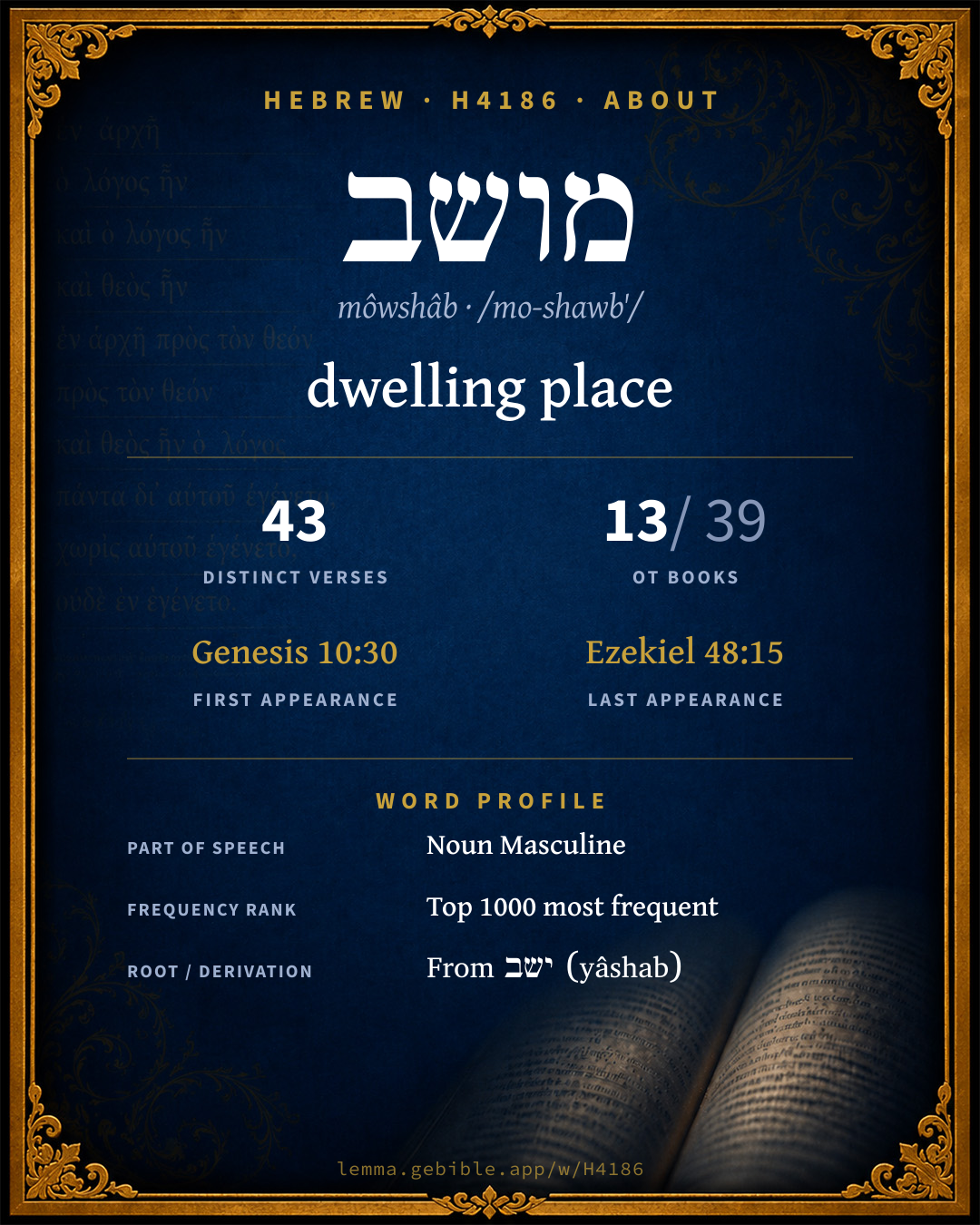
מוֹשָׁב
dwelling place
‘dwelling place’ is one of 6 main senses fuller range ↓
Full lexicon entry — Brown-Driver-Briggs (BDB)
From Brown-Driver-Briggs (BDB)
Where this word appears
See every Construct-state word in the Hebrew Bible →
Grammar key — what these labels mean
Part of speech
- Noun
- A naming word — a person, place, thing, or idea.
Noun type
- Common
- A common noun — a general class of person, place, or thing (“king,” “city,” “water”), not a specific name.
State
- Construct
- A noun bound to a following noun in a possessive / “of” relationship (the construct chain).
- Absolute
- The independent form of a noun, not bound to a following word.
Gender
- Masculine
- Grammatically masculine.
Number
- Plural
- More than one (in Hebrew, generally three or more).
- Singular
- One.
Every verse where H4186 appears in the Book of Ezekiel — 7 distinct verses. Click any verse to open its interlinear word-by-word view. Verse text shown in the World English Bible for context — . Each verse’s Hebrew form is shown with its reference; the English is not keyword-highlighted, since the data carries no word-level English alignment. Use “Compare translations” on any verse to read it across multiple English versions. This concordance covers the Hebrew Bible; Septuagint (Greek Old Testament) occurrences are not indexed here.
Ezekiel
- Ezekiel 6:6 מוֹשְׁב֣וֹתֵי/כֶ֔ם n c mp cs + sfx pers 2mp In all your dwelling-places the cities shall be laid waste, and the high places shall be desolate; that your altars may be laid waste and made desolate, and your idols may be broken and cease, and your sun-images may be hewn down, and your works may be abolished.
- Ezekiel 6:14 מוֹשְׁבֽוֹתֵי/הֶ֑ם n c mp cs + sfx pers 3mp I will stretch out my hand on them, and make the land desolate and waste, from the wilderness toward Diblah, throughout all their habitations: and they shall know that I am Yahweh.
- Ezekiel 8:3 מוֹשַׁ֔ב n c ms cs He put forth the form of a hand, and took me by a lock of my head; and the Spirit lifted me up between earth and the sky, and brought me in the visions of God to Jerusalem, to the door of the gate of the inner [court] that looks toward the north; where was the seat of the image of jealousy, which provokes to jealousy.
- Ezekiel 28:2 מוֹשַׁ֧ב n c ms cs Son of man, tell the prince of Tyre, Thus says the Lord Yahweh: Because your heart is lifted up, and you have said, I am a god, I sit in the seat of God, in the midst of the seas; yet you are man, and not God, though you did set your heart as the heart of God;-
- Ezekiel 34:13 מוֹשְׁבֵ֥י n c mp cs I will bring them out from the peoples, and gather them from the countries, and will bring them into their own land; and I will feed them on the mountains of Israel, by the watercourses, and in all the inhabited places of the country.
- Ezekiel 37:23 מוֹשְׁבֹֽתֵי/הֶם֙ n c mp cs + sfx pers 3mp neither shall they defile themselves any more with their idols, nor with their detestable things, nor with any of their transgressions; but I will save them out of all their dwelling-places, in which they have sinned, and will cleanse them: so shall they be my people, and I will be their God.
- Ezekiel 48:15 לְ/מוֹשָׁ֖ב prep + n c ms The five thousand that are left in the breadth, in front of the twenty-five thousand, shall be for common use, for the city, for dwelling and for suburbs; and the city shall be in the midst of it.
About this entry
At a glance — auto-summarized from this page’s data, not written by a person. Every figure links to its source below. This summary describes the numbers; it doesn’t interpret them.
מושב (môwshâb) is a Hebrew noun most often rendered “dwelling place.” The King James Version usually renders it “seat,” while modern versions prefer “you live” (Berean Standard Bible) and “dwellings” (unfoldingWord Literal Text) — see the renderings breakdown. Spanning 43 verses in 13 books, it ranks among the moderately common words of the Hebrew Bible. Scripture first uses it in Genesis 10:30. Not a single-sense word: explore its full sense range. For the data behind this summary, explore the sense tree and the renderings breakdown below.
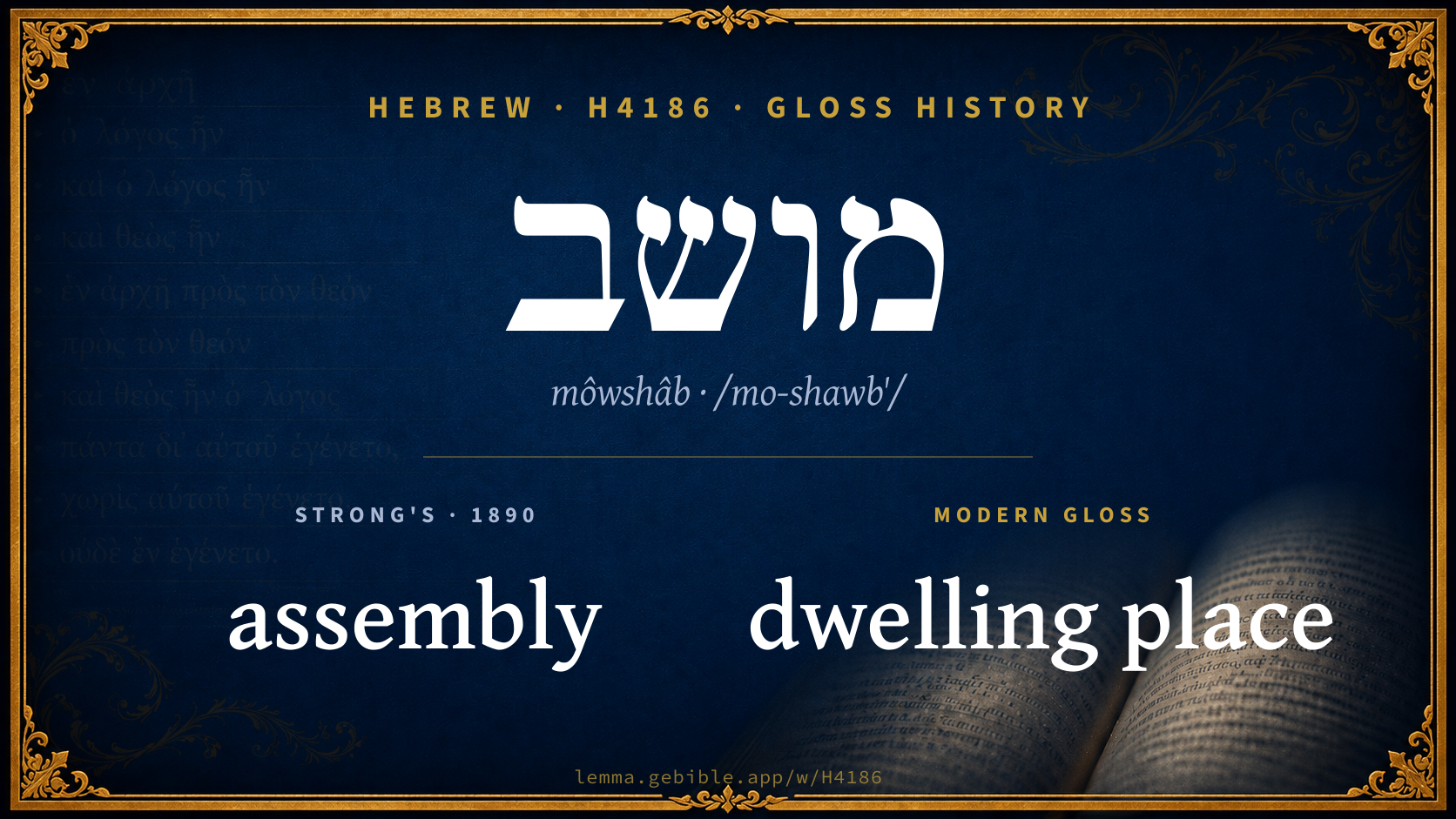
Gloss history
Strong's 1890 vs modern scholarship
About this word
Strong's H4186 catalogs a Hebrew word from the Hebrew Old Testament.
These counts are not copied from any lexicon or concordance. They are computed here, from the morphology-tagged Hebrew Old Testament. What Lemma adds →
- 43
- distinct verses
- The word appears in 43 distinct verses.
- 13 / 39
- OT books
- The word appears in 13 of 39 Old Testament books.
- #819
- by frequency
- Top 1000 most frequent Hebrew words (rank 819 of 8,640 Hebrew words by occurrence).
View all 43 occurrences in the concordance →
By section of the Old Testament
By traditional corpus
Conventional, traditional groupings — biblical authorship is debated, so this is a traditional corpus grouping, not an authorship claim. Each share is this word’s portion of its verses in that division of the Hebrew canon. Each figure is a share of the word’s 43 distinct verses.
- Torah (Pentateuch) 20 verses · 47%
- Prophets (Nevi'im) 12 verses · 28%
- Writings (Ketuvim) 11 verses · 26%
How translations render this word
Counts come from each version’s own published word-to-Strong’s tagging or interlinear alignment — an approximate guide to how each version renders this word, not a word-level alignment the data otherwise carries. Because each total is that version’s own tagged count, the per-version totals vary from one another and need not match the appearance or distinct-verse counts above. These counts may also differ from a printed concordance because Lemma counts each distinctly tagged rendering and does not collapse phrase taggings into a single head-word total. This is a fixed set of word-tagged versions (KJV, ASV, BSB, ULT) and does not change with the reading translation you choose elsewhere. Each version’s license is shown beside its name below (and on Sources).
- King James Version: Seat 6×, All your dwellings 5×, Dwelling 3×
- American Standard Version: Seat 7×, All your dwellings 6×, Habitation 4×
- Berean Standard Bible: You live 7×, Dwellings 4×, Seat 4×
- unfoldingWord Literal Text: Dwellings 10×, Dwelling 8×, Dwelling places 4×
King James Version Public Domain
Renders H4186 across 44 tagged occurrences — most commonly:
Plus 22 renderings that appear only once — usually multi-word phrases or single function words the recovered tagging swept in, not distinct renderings.
American Standard Version Public Domain
Renders H4186 across 44 tagged occurrences — most commonly:
Plus 20 renderings that appear only once — usually multi-word phrases or single function words the recovered tagging swept in, not distinct renderings.
Berean Standard Bible Public Domain
Renders H4186 across 42 tagged occurrences — most commonly:
Plus 14 renderings that appear only once — usually multi-word phrases or single function words the recovered tagging swept in, not distinct renderings. Not rendered by a distinct English word in 2 further occurrences.
unfoldingWord Literal Text CC BY-SA 4.0
Renders H4186 across 45 tagged occurrences — most commonly:
Plus 14 renderings that appear only once — usually multi-word phrases or single function words the recovered tagging swept in, not distinct renderings.
8 senses and sub-senses in the full BDB
What do BDB’s symbols mean?
BDB uses these scholarly abbreviations:
| Symbol | Meaning |
|---|---|
| 𝔊 | the Septuagint (the ancient Greek translation, LXX) |
| 𝔙 | the Vulgate (the Latin translation) |
| 𝔖 | the Syriac version (the Peshitta) |
| 𝔗 | the Targum (the Aramaic translation) |
| ψ | the Psalms |
| √ | root (the underlying root or stem) |
| ‖ | parallel passage (a synonymous or contrasted parallel) |
| † | the dagger: every passage where the word occurs is cited |
The 8 senses and sub-senses the full Brown-Driver-Briggs lexicon distinguishes for this word, in lexicon order (not ranked by frequency), with BDB’s own verbatim wording and sub-sense lettering. Shown in Hebrew script with BDB’s own scholarly abbreviations. The condensed entry is in the Lexicon Entry tab. See also the Forms in the corpus table below.
- 1.
- a. seat 1 S 20:18, 25(×2) Jb 29:7; fig. מ׳ אלהים יָשַׁבְתִּי Ez 28:2. e.g. 1 Samuel 20:18
- b. sitting = those sitting, sitting company or assembly, מוֹשַׁב עֲבָדָיו 1 K 10:5 (‖ מַעֲמַד מְשָֽׁרְתָיו) = 2 Ch 9:4; so ψ 1:1; 107:32 (‖ קהל). e.g. 1 Kings 10:5
- 2.
- a. dwelling-place of people, tribe, etc., often = territory, district, or, later city; Gn 10:30; 27:39 (both J), Ex 10:23 (E), Nu 24:21 (JE), Gn 36:43 (P), Ez 6:14; 48:15; 1 Ch 4:33; 6:39; 7:28; מ׳ הָאָרֶץ Ez 34:13 = habitable places of the land; distinct from city עָרֵיהֶם בְּמוֹשְׁבֹתָם Nu 31:10, cf. Ez 6:6, but also עִיר מוֹשָׁב ψ 107:4, 7, 36; of Zion as מ׳ י׳ 132:13. e.g. Genesis 10:30
- b. alm. = abstr. dwelling בֵּית מוֹשַׁב עִיר Lv 25:29 (P); אֶרֶץ מ׳ Nu 15:2 land of your dwelling-place or dwelling (P). e.g. Leviticus 25:29
- c. = house Ex 12:20 (‖ ביה v 19), 35:3; Lv 3:17; 7:26; 13:46; 23:3, 14, 21, 31; Nu 35:29 (all P), Lv 23:17 (H). e.g. Exodus 12:20
- 3. situation of city 2 K 2:19; location of image Ez 8:3. e.g. 2 Kings 2:19
- 4. time of dwelling Ex 12:40 (P). e.g. Exodus 12:40
- 5. coll. = those dwelling, כֹּל מוֹשַׁב וגו׳ 2 S 9:12 all those dwelling in the house of Ṣiba—Ez 37:23 v. supr. and מְשׁוּבָה sub שׁוּב. e.g. 2 Samuel 9:12
Senses from the full Brown-Driver-Briggs lexicon (Brown, Driver, Briggs; Oxford 1906 — public domain), digitized via Sefaria, supplemented by the OpenScriptures HebrewLexicon (CC BY 4.0). Full attribution on Sources.
Word origin
n.m. 2 K 2:19 seat, assembly, dwelling-place, dwelling, dwellers;—abs. מ׳ ψ 107:4 + 4 times; cstr. מוֹשַׁב Ex 12:40 + 9 times; sf. מוֹשָׁבִי Jb 29:7 etc.; pl. cstr. מוֹשְׁבֵי Ez 34:13; sf. 2 mpl. מוֹשְׁבֹתֵיכֶם etc. Ex 12:20 + 11 times; sf. 3 mpl. מוֹשְׁבֹתָם etc. 10:23 + 5 times; מוֹשְׁבֹתֵיהֶם Ez 37:23, but read מְשׁוּב׳ their apostasies 𝔊 Comm., see VB; מוֹשְׁבוֹתֵיהֶם Ez 6:14;—
— Brown-Driver-Briggs (Oxford 1906, public domain), digitized via Sefaria, supplemented by the OpenScriptures HebrewLexicon (CC BY 4.0). See Sources.
Derived from ישב (yâshab) (H3427) — to dwell.
Jastrow Dictionary
A second Hebrew/Aramaic lexicon for comparison, covering Aramaic and post-biblical (Talmudic, Targumic, Midrashic) usage that the biblical-Hebrew BDB does not. Matched by lemma rather than by Strong’s number, so a lemma may carry more than one Jastrow headword (shown separately below), and the entries cover usage well beyond the Bible.
מוֹשָׁב
- seat, sitting. Y. Ber. IX, 13ᵃ top מוֹשָׁבוֹ בקדושה His sitting (in judgment) is in holiness (with ref. to Ps. XLVII, 9). Meg. IV, 3 (23ᵇ) מעמד ומ׳ the ceremony of rising and sitting down at funerals; a. fr.—מוֹשַׁב לצים, v. לֵץ.—Esp. (טומאת) מ׳ the uncleanness caused by an unclean man’s sitting, the unclean seat (Lev. XV, 4). Kel. I, 5 מטמא משכב ומ׳ causes uncleanness of couch and seat; Zab. I, 1; a. fr.—[Ḥull. 124ᵃ מוֹשַׁב זב the privy chair of one afflicted with gonorrhoea; Ar. reads: מושבזג, משבזג, ‘a leather seat of a folding chair’, v. זוּג.]—Pl. מוֹשָׁבוֹת. Lev. R. s. 1; Tanḥ. Vayikra 1 (ref. to Prov. XXV, 7) רחק מן מקומך מ׳ וכ׳ keep removed from thy place two or three seats (behind that which is due to thy position), that they may say to thee, go up. e.g. Psalms 47:9
A Dictionary of the Targumim, the Talmud Babli and Yerushalmi, and the Midrashic Literature (Marcus Jastrow; London, Luzac, 1903) — Public Domain. Digitized via Sefaria. Digitized via Sefaria. Full attribution on Sources.
Forms in the corpus
The 39 distinct written forms H4186 takes in the Hebrew Bible, most frequent first — each parse links to that state’s occurrences in the concordance. Hebrew forms include their vowel points and cantillation, so a single lemma takes many written forms.
Same root — word family
Other BDB entries built from the same root as H4186, grouped by Strong’s listed origin. These share a root / origin per the lexicon — not necessarily a shared meaning. Each links to that word’s own entry.
Derives from
Shares the same root
- יתב yᵉthib H3488 to sit
- שבת shebeth H7675 seat
- שיבה shîybâh H7871 sojourn
- תושב tôwshâb H8453 sojourner
Proper names from this root
People and places named from this root — a name, not an additional meaning of the word.
- יושביה Yôwshibyâh H3143 Josibiah
- ישבאב Yeshebʼâb H3428 Jeshebeab
- ישב בשבת Yôshêb bash-Shebeth H3429 Josheb-basshebeth
- ישבו בנב Yishbôw bᵉ-Nôb H3430 Ishbi-benob
- ישבקשה Yoshbᵉqâshâh H3436 Joshbekashah
Compare all same-root words → Showing 4 of 11 — not the complete family. 5 of the same-root words are proper names (people or places). They share a root, not necessarily a meaning.
Septuagint verse parallels
This word appears in 40 verses that also exist in the Greek Old Testament (Septuagint), out of the 43 Hebrew verses it occurs in. You can read those verses in Greek by switching the Old Testament edition to the Septuagint.
Read these verses in the Septuagint
- Genesis 10:30
- Exodus 10:23
- Leviticus 3:17
- Numbers 15:2
- 1 Samuel 20:18
- 2 Samuel 9:12
- 1 Kings 10:5
- 2 Kings 2:19
- 1 Chronicles 4:33
- 2 Chronicles 9:4
- Job 29:7
- Psalms 1:1
This is a verse-level parallel only — the same verses exist in both the Hebrew and Greek Old Testaments. No word-level Hebrew↔Greek correspondence is claimed: the data carries no such alignment, so no Greek word is shown as this Hebrew word’s translation. Coverage is not total — the Septuagint omits the deuterocanon and renumbers the Psalms, so some Hebrew verses have no direct Greek parallel.