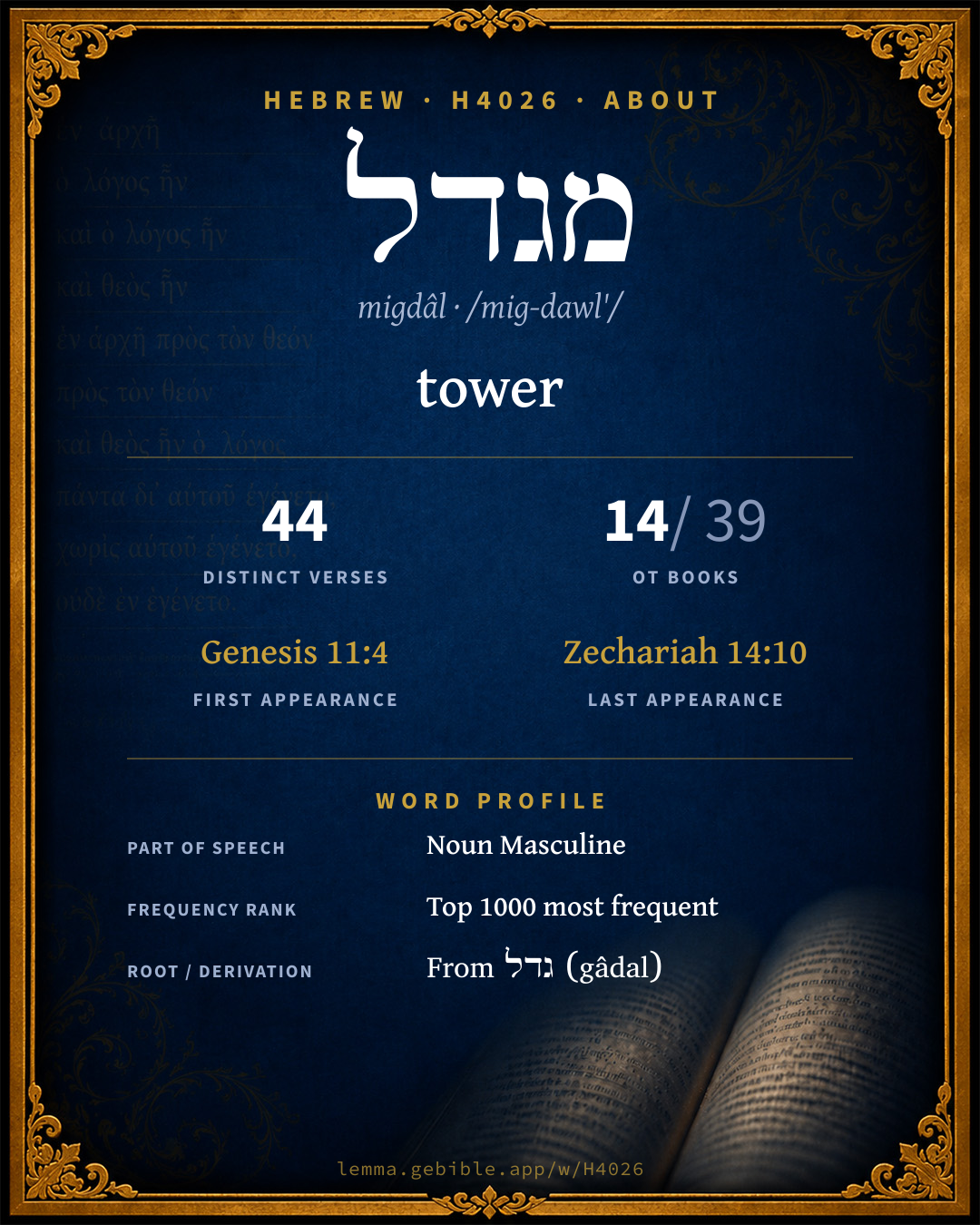
מִגְדָּל
tower
‘tower’ is one of 3 main senses fuller range ↓
Full lexicon entry — Brown-Driver-Briggs (BDB)
From Brown-Driver-Briggs (BDB)
Where this word appears
See every Construct-state word in the Hebrew Bible →
Grammar key — what these labels mean
Part of speech
- Noun
- A naming word — a person, place, thing, or idea.
Noun type
- Common
- A common noun — a general class of person, place, or thing (“king,” “city,” “water”), not a specific name.
State
- Construct
- A noun bound to a following noun in a possessive / “of” relationship (the construct chain).
- Absolute
- The independent form of a noun, not bound to a following word.
Gender
- Both
- Attested as both masculine and feminine.
Number
- Singular
- One.
- Plural
- More than one (in Hebrew, generally three or more).
Grammatical forms
- Noun, Common, Both, Singular, Construct 22 times (45%)
- Noun, Common, Both, Singular, Absolute 12 times (24%)
- Noun, Common, Both, Plural, Absolute 10 times (20%)
- Noun, Common, Both, Plural, Construct 5 times (10%)
Parsed forms decoded from the imported morphology (morphhb / Westminster Leningrad Codex — WLC text public domain, morphhb tagging CC BY 4.0), counted across 49 parsed occurrences — not distinct verses.
Every verse where H4026 appears — 44 distinct verses across 14 books. Click any verse to open its interlinear word-by-word view. Verse text shown in the World English Bible for context — . Each verse’s Hebrew form is shown with its reference; the English is not keyword-highlighted, since the data carries no word-level English alignment. Use “Compare translations” on any verse to read it across multiple English versions. This concordance covers the Hebrew Bible; Septuagint (Greek Old Testament) occurrences are not indexed here.
Genesis 2 verses
- Genesis 11:4 וּ/מִגְדָּל֙ conj + n c bs They said, "Come, let's build us a city, and a tower, whose top reaches to the sky, and let's make us a name; lest we be scattered abroad on the surface of the whole earth."
- Genesis 11:5 הַ/מִּגְדָּ֑ל ptcl def.art + n c bs Yahweh came down to see the city and the tower, which the children of men built.
Judges 7 verses
- Judges 8:9 הַ/מִּגְדָּ֥ל ptcl def.art + n c bs He spoke also to the men of Penuel, saying, When I come again in peace, I will break down this tower.
- Judges 8:17 מִגְדַּ֥ל n c bs cs He broke down the tower of Penuel, and killed the men of the city.
- Judges 9:46 מִֽגְדַּל n c bs cs When all the men of the tower of Shechem heard of it, they entered into the stronghold of the house of Elberith.
- Judges 9:47 מִֽגְדַּל n c bs cs It was told Abimelech that all the men of the tower of Shechem were gathered together.
- Judges 9:49 מִֽגְדַּל n c bs cs All the people likewise cut down every man his bough, and followed Abimelech, and put them to the stronghold, and set the stronghold on fire on them; so that all the men of the tower of Shechem died also, about a thousand men and women.
- Judges 9:51 וּ/מִגְדַּל הַ/מִּגְדָּֽל conj + n c bs cs ptcl def.art + n c bs But there was a strong tower within the city, and there fled all the men and women, and all they of the city, and shut themselves in, and got them up to the roof of the tower.
- Judges 9:52 הַ/מִּגְדָּ֔ל הַ/מִּגְדָּ֖ל ptcl def.art + n c bs ptcl def.art + n c bs Abimelech came to the tower, and fought against it, and drew near to the door of the tower to burn it with fire.
2 Kings 3 verses
- 2 Kings 9:17 הַ/מִּגְדָּ֜ל ptcl def.art + n c bs Now the watchman was standing on the tower in Jezreel, and he spied the company of Jehu as he came, and said, I see a company. Joram said, Take a horseman, and send to meet them, and let him say, Is it peace?
- 2 Kings 17:9 מִ/מִּגְדַּ֥ל prep + n c bs cs The children of Israel did secretly things that were not right against Yahweh their God: and they built them high places in all their cities, from the tower of the watchmen to the fortified city;
- 2 Kings 18:8 מִ/מִּגְדַּ֥ל prep + n c bs cs He struck the Philistines to Gaza and the borders of it, from the tower of the watchmen to the fortified city.
1 Chronicles 1 verse
2 Chronicles 6 verses
- 2 Chronicles 14:7 וּ/מִגְדָּלִים֮ conj + n c bp For he said to Judah, Let us build these cities, and make about them walls, and towers, gates, and bars; the land is yet before us, because we have sought Yahweh our God; we have sought him, and he has given us rest on every side. So they built and prospered.
- 2 Chronicles 26:9 מִגְדָּלִים֙ n c bp Moreover Uzziah built towers in Jerusalem at the corner gate, and at the valley gate, and at the turning [of the wall], and fortified them.
- 2 Chronicles 26:10 מִגְדָּלִ֜ים n c bp He built towers in the wilderness, and hewed out many cisterns, for he had much cattle; in the lowland also, and in the plain: [and he had] farmers and vineyard keepers in the mountains and in the fruitful fields; for he loved farming.
- 2 Chronicles 26:15 הַ/מִּגְדָּלִים֙ ptcl def.art + n c bp He made in Jerusalem engines, invented by skillful men, to be on the towers and on the battlements, with which to shoot arrows and great stones. His name spread far abroad; for he was marvelously helped, until he was strong.
- 2 Chronicles 27:4 וּ/מִגְדָּלִֽים conj + n c bp Moreover he built cities in the hill-country of Judah, and in the forests he built castles and towers.
- 2 Chronicles 32:5 הַ/מִּגְדָּל֗וֹת ptcl def.art + n c bp He took courage, and built up all the wall that was broken down, and raised [it] up to the towers, and the other wall outside, and strengthened Millo [in] the city of David, and made weapons and shields in abundance.
Nehemiah 8 verses
- Nehemiah 3:1 מִגְדַּ֤ל מִגְדַּ֥ל n c bs cs n c bs cs Then Eliashib the high priest rose up with his brothers the priests, and they built the sheep gate; they sanctified it, and set up the doors of it; even to the tower of Hammeah they sanctified it, to the tower of Hananel.
- Nehemiah 3:11 מִגְדַּ֥ל n c bs cs Malchijah the son of Harim, and Hasshub the son of Pahath-moab, repaired another portion, and the tower of the furnaces.
- Nehemiah 3:25 וְ/הַ/מִּגְדָּ֗ל conj + ptcl def.art + n c bs Palal the son of Uzai [repaired] over against the turning [of the wall], and the tower that stands out from the upper house of the king, which is by the court of the guard. After him Pedaiah the son of Parosh [repaired].
- Nehemiah 3:26 וְ/הַ/מִּגְדָּ֖ל conj + ptcl def.art + n c bs (Now the Nethinim lived in Ophel, to the place over against the water gate toward the east, and the tower that stands out.)
- Nehemiah 3:27 הַ/מִּגְדָּ֤ל ptcl def.art + n c bs After him the Tekoites repaired another portion, over against the great tower that stands out, and to the wall of Ophel.
- Nehemiah 8:4 מִגְדַּל n c bs cs Ezra the scribe stood on a pulpit of wood, which they had made for the purpose; and beside him stood Mattithiah, and Shema, and Anaiah, and Uriah, and Hilkiah, and Maaseiah, on his right hand; and on his left hand, Pedaiah, and Mishael, and Malchijah, and Hashum, and Hashbaddanah, Zechariah, [and] Meshullam.
- Nehemiah 12:38 לְ/מִגְדַּ֣ל prep + n c bs cs The other company of those who gave thanks went to meet them, and I after them, with the half of the people, on the wall, above the tower of the furnaces, even to the broad wall,
- Nehemiah 12:39 וּ/מִגְדַּ֤ל וּ/מִגְדַּ֣ל conj + n c bs cs conj + n c bs cs and above the gate of Ephraim, and by the old gate, and by the fish gate, and the tower of Hananel, and the tower of Hammeah, even to the sheep gate: and they stood still in the gate of the guard.
Psalms 2 verses
Proverbs 1 verse
Song of Solomon 4 verses
- Song of Solomon 4:4 כְּ/מִגְדַּ֤ל prep + n c bs cs Your neck is like David's tower built for an armory, Whereon there hang a thousand shields, All the shields of the mighty men.
- Song of Solomon 5:13 מִגְדְּל֖וֹת n c bp cs His cheeks are like a bed of spices with towers of perfumes. His lips are like lilies, dropping liquid myrrh.
- Song of Solomon 7:4 כְּ/מִגְדַּ֣ל כְּ/מִגְדַּ֣ל prep + n c bs cs prep + n c bs cs Your neck is like an ivory tower. Your eyes are like the pools in Heshbon by the gate of Bath-rabbim; Your nose is like the tower of Lebanon which looks toward Damascus.
- Song of Solomon 8:10 כַּ/מִּגְדָּל֑וֹת prep det + n c bp I am a wall, and my breasts like towers, Then I was in his eyes like one who found peace.
Isaiah 4 verses
- Isaiah 2:15 מִגְדָּ֣ל n c bs For every lofty tower, For every fortified wall,
- Isaiah 5:2 מִגְדָּל֙ n c bs He dug it up, Gathered out its stones, Planted it with the choicest vine, Built a tower in its midst, And also cut out a winepress therein. He looked for it to yield grapes, But it yielded wild grapes.
- Isaiah 30:25 מִגְדָּלִֽים n c bp There shall be on every lofty mountain, and on every high hill, brooks [and] streams of waters, in the day of the great slaughter, when the towers fall.
- Isaiah 33:18 הַ/מִּגְדָּלִֽים ptcl def.art + n c bp Your heart shall muse on the terror: Where is he who counted, where is he who weighed [the tribute]? where is he who counted the towers?
Jeremiah 1 verse
Ezekiel 3 verses
- Ezekiel 26:4 מִגְדָּלֶ֔י/הָ n c bp cs + sfx pers 3fs They shall destroy the walls of Tyre, and break down her towers: I will also scrape her dust from her, and make her a bare rock.
- Ezekiel 26:9 וּ/מִ֨גְדְּלֹתַ֔יִ/ךְ conj + n c bp cs + sfx pers 2fs He shall set his battering engines against your walls, and with his axes he shall break down your towers.
- Ezekiel 27:11 בְּ/מִגְדְּלוֹתַ֖יִ/ךְ prep + n c bp cs + sfx pers 2fs The men of Arvad with your army were on your walls round about, and valorous men were in your towers; they hanged their shields on your walls round about; they have perfected your beauty.
Micah 1 verse
Zechariah 1 verse
About this entry
At a glance — auto-summarized from this page’s data, not written by a person. Every figure links to its source below. This summary describes the numbers; it doesn’t interpret them.
The Hebrew noun מגדל centers on the idea of “tower.” First canonically at Genesis 11:4, it enters the text early. The Hebrew Bible uses it across 44 verses — moderately common. Its meaning spans more than one sense — see its full sense range. Related forms include גדל, גדול and גדל. For the data behind this summary, explore the sense tree and the renderings breakdown below.
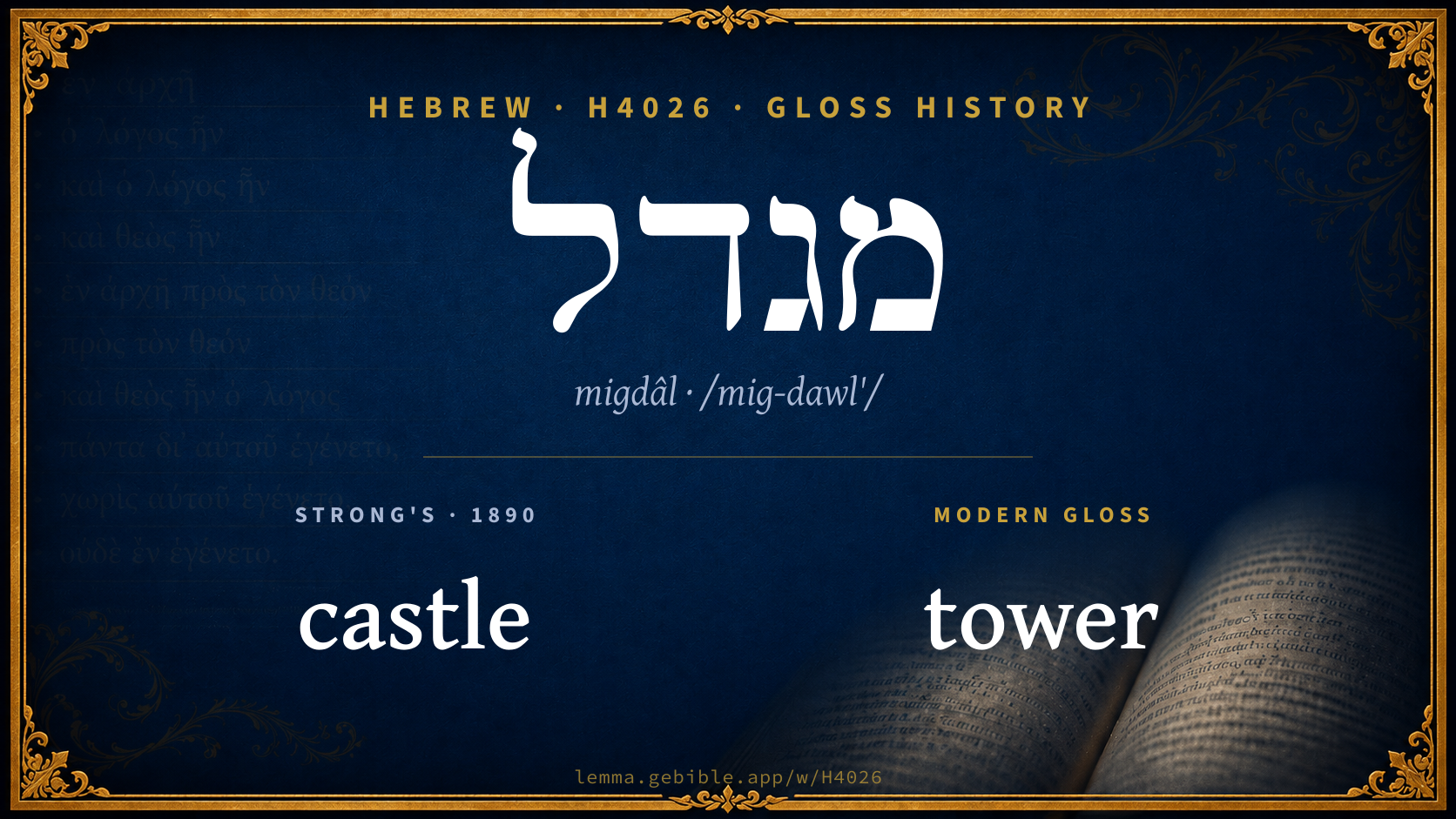
Gloss history
Strong's 1890 vs modern scholarship
About this word
Strong's H4026 catalogs a Hebrew word from the Hebrew Old Testament.
These counts are not copied from any lexicon or concordance. They are computed here, from the morphology-tagged Hebrew Old Testament. What Lemma adds →
- 44
- distinct verses
- The word appears in 44 distinct verses.
- 14 / 39
- OT books
- The word appears in 14 of 39 Old Testament books.
- #752
- by frequency
- Top 1000 most frequent Hebrew words (rank 752 of 8,640 Hebrew words by occurrence).
View all 44 occurrences in the concordance →
Most concentrated in
- Nehemiah 8 verses 18%
- Judges 7 verses 16%
- 2 Chronicles 6 verses 14%
By section of the Old Testament
By traditional corpus
Conventional, traditional groupings — biblical authorship is debated, so this is a traditional corpus grouping, not an authorship claim. Each share is this word’s portion of its verses in that division of the Hebrew canon. Each figure is a share of the word’s 44 distinct verses.
- Writings (Ketuvim) 22 verses · 50%
- Prophets (Nevi'im) 20 verses · 45%
- Torah (Pentateuch) 2 verses · 5%
How translations render this word
Counts come from each version’s own published word-to-Strong’s tagging or interlinear alignment — an approximate guide to how each version renders this word, not a word-level alignment the data otherwise carries. Because each total is that version’s own tagged count, the per-version totals vary from one another and need not match the appearance or distinct-verse counts above. These counts may also differ from a printed concordance because Lemma counts each distinctly tagged rendering and does not collapse phrase taggings into a single head-word total. This is a fixed set of word-tagged versions (KJV, ASV, BSB, ULT) and does not change with the reading translation you choose elsewhere. Each version’s license is shown beside its name below (and on Sources).
BDB lists this Strong’s number as 2 distinct words (homographs). Each count above pools all of them and is not split by sense — see the Senses section below. A low-frequency rendering may belong to a different one of those words, not the primary meaning.
- King James Version†: Tower 27×, Towers 10×
- American Standard Version†: Tower 23×, Towers 7×, Is like the tower 3×
- Berean Standard Bible†: Tower 24×, Towers 13×, Is like the tower 2×
- unfoldingWord Literal Text†: Tower 15×, Towers 13×, Tower of 12×
King James Version Public Domain
Renders H4026 across 50† tagged occurrences — most commonly:
Plus 13 renderings that appear only once — usually multi-word phrases or single function words the recovered tagging swept in, not distinct renderings.
American Standard Version Public Domain
Renders H4026 across 50† tagged occurrences — most commonly:
Plus 15 renderings that appear only once — usually multi-word phrases or single function words the recovered tagging swept in, not distinct renderings.
Berean Standard Bible Public Domain
Renders H4026 across 48† tagged occurrences — most commonly:
Plus 7 renderings that appear only once — usually multi-word phrases or single function words the recovered tagging swept in, not distinct renderings.
unfoldingWord Literal Text CC BY-SA 4.0
Renders H4026 across 55† tagged occurrences — most commonly:
Plus 9 renderings that appear only once — usually multi-word phrases or single function words the recovered tagging swept in, not distinct renderings.
Senses in the full BDB
What do BDB’s symbols mean?
BDB uses these scholarly abbreviations:
| Symbol | Meaning |
|---|---|
| 𝔊 | the Septuagint (the ancient Greek translation, LXX) |
| 𝔙 | the Vulgate (the Latin translation) |
| 𝔖 | the Syriac version (the Peshitta) |
| 𝔗 | the Targum (the Aramaic translation) |
| ψ | the Psalms |
| √ | root (the underlying root or stem) |
| ‖ | parallel passage (a synonymous or contrasted parallel) |
| † | the dagger: every passage where the word occurs is cited |
The 3 senses and sub-senses the full Brown-Driver-Briggs lexicon distinguishes for this word, in lexicon order (not ranked by frequency), with BDB’s own verbatim wording and sub-sense lettering. Shown in Hebrew script with BDB’s own scholarly abbreviations. The condensed entry is in the Lexicon Entry tab. See also the Forms in the corpus table below.
מגדל I tower, 2 S 22
מגדל II tower, Gn 11
- 1. tower Gn 11:4, 5 Ju 8:9; 9:51(×2), 52(×2) 2 K 9:17; 17:9; 18:8 1 Ch 27:25 2 Ch 14:6; 26:9, 10, 15; 27:4; 32:5 Ne 3:25, 26, 27 Is 2:15; 30:25; 33:18 Ez 26:4, 9; 27:11 ψ 48:13, watch-tower in vineyard Is 5:2; fig. of God as refuge ψ 61:4 Pr 18:10; beautiful neck like tower of David Ct 4:4; an ivory tower 7:5; breasts 8:10. (Cf. MI22 מגדלתה, Sab. (more precisely Liḥyân) מגדלנהן, Eut, v. DHMEpigr. Denkm. 4, 1.5). Special towers mentioned on Lebanon Ct 7:5, Penuel Ju 8:17, Shechem Ju 9:46, 47, 49; and at Jerusalem, the tower of David Ct 4:4 (the arsenal), מֵאָה Ne 3:1, חֲנַנְאֵל Ne 3:1; 12:39(×2) Je 31:38 Zc 14:10, תַּנּוּרִים Ne 3:11; 12:38 (tower of the furnaces). e.g. Genesis 11:4
- 2. elevated stage, pulpit of wood Ne 8:4. e.g. Nehemiah 8:4
- 3. raised bed ‖ עֲרוּגָה Ct 5:13 (but 𝔊 𝔙 Hi read מְגַדְּלוֹת). e.g. Song of Solomon 5:13
Senses from the full Brown-Driver-Briggs lexicon (Brown, Driver, Briggs; Oxford 1906 — public domain), digitized via Sefaria, supplemented by the OpenScriptures HebrewLexicon (CC BY 4.0). Full attribution on Sources.
Word origin
I. n.m. tower, 2 S 22:51 Qr (Kt מגדיל = ψ 18:51 מַגְדִּל).
I. n.m. tower, Gn 11:5 + 11 times; cstr. מִגְדַּל Ju 8:17 + 21 times; pl. מִגְדָּלִים 2 Ch 26:9 + 6 times; מִגְדָּלֶיהָ ψ 48:13 Ez 26:4; pl.f. מִגְדָּלוֹת 2 Ch 32:5 + 2 times; cstr. מִגְדְּלוֹת Ct 5:13 (?); sf. מִגְדְּלֹתַיִךְEz 26:9; 27:11;—
— Brown-Driver-Briggs (Oxford 1906, public domain), digitized via Sefaria, supplemented by the OpenScriptures HebrewLexicon (CC BY 4.0). See Sources.
Derived from גדל (gâdal) (H1431) — to grow.
Jastrow Dictionary
A second Hebrew/Aramaic lexicon for comparison, covering Aramaic and post-biblical (Talmudic, Targumic, Midrashic) usage that the biblical-Hebrew BDB does not. Matched by lemma rather than by Strong’s number, so a lemma may carry more than one Jastrow headword (shown separately below), and the entries cover usage well beyond the Bible.
מִגְדָּל
- tower, turret. Sabb. XIII, 5. Tosef. Ohol. XVIII, 5 הנכנס … במ׳ he who enters gentile lands … in a portable turret. Ohol. IV, 1, v. אָוִיר. Ḥag. 15ᵇ; Snh. 106ᵇ three hundred hălakhoth (about levitical cleanness) במ׳ הפורח באויר concerning a turret flying (moving) in the air (cmp. Tosef. l. c.); [oth. opin. = מ׳ העומד באויר, Ohol. l. c.; for oth. explan. v. Rashi to Ḥag. a. Snh. l. c.].—Erub. 34ᵃ מ׳ שאינו מסומר a turret which is not fastened (which can be let up and down). Kel. XII, 3 מ׳ של בעלי וכ׳ a turret (spice chest) of private people, של רופאים of physicians. Tosef. Sot. III, 10 אנשי מ׳ the builders of the Tower of Babel, v. הַפְלָגָה; a. fr.—Pl. מִגְדָּלִים, מִגְדָּלִין, מִגְדָּלוֹת. Y. B. Bath. IV, 14ᶜ bot.; Tosef. B. Bath. III, 3 המ׳ the turrets (store closets) in bath-houses. Tosef. Kel. B. Mets. II, 8, v. אֲקוּנְבִּי. B. Mets. 25ᵃ עשויין כמ׳; Tosef. ib. II, 7 עשויות מגדלות coins piled up pyramidally; ib. מקצתן מגדלין some of them piled up; a. fr.—Esp. מִגְדָּל pr. n. pl. Migdal, Magdala, near Tiberias. Tosef. Erub. VI (V), 13; Y. ib. V, 22ᵈ bot.—In compounds: מִגְדַּל, e. g. מ׳ עדר, מ׳ חרוב, v. respective determinants.
מִגְדַּל
- Targ. Is. II, 15. Targ. Gen. XI, 4 (ed. Berl. מַ׳). Targ. Jud. VIII, 9; a. fr.—Pl. מִגְדָּלַיָּא, מוּגְ׳. Targ. II Chr. XXVI, 9, sq. Targ. Ez. XXXVIII, 20 (h. text מדרגות); a. fr.—Esp. מַגְדְּלָא, מוּגְ׳ Magdala, v. preced. Y. Snh. II, beg. 19ᵈ ערק לדא מוג׳ he fied to M.; Y. Hor. III, beg. 47ᵃ ערק בדא דמ׳ (read: לדא, sub. כנישתא) to the synagogue (and school house) of M.; ib. בדא דמ׳ he is in the synagogue of M.; Y. Snh. l. c. 20ᵃ top בהדא מ׳; Midr. Sam. ch. VII מִגְדַּל צְבוֹעַיָּיא. Y. Maasr. III, 50ᶜ top. Koh. R. to X, 8 כנישתא דמ׳, v. supra; a. fr.—In compounds: מִגְדַּל, מגדלא ד־, v. respective determinants.
A Dictionary of the Targumim, the Talmud Babli and Yerushalmi, and the Midrashic Literature (Marcus Jastrow; London, Luzac, 1903) — Public Domain. Digitized via Sefaria. Digitized via Sefaria. Full attribution on Sources.
Forms in the corpus
The 38 distinct written forms H4026 takes in the Hebrew Bible, most frequent first — each parse links to that state’s occurrences in the concordance. Hebrew forms include their vowel points and cantillation, so a single lemma takes many written forms.
Same root — word family
Other BDB entries built from the same root as H4026, grouped by Strong’s listed origin. These share a root / origin per the lexicon — not necessarily a shared meaning. Each links to that word’s own entry.
Derives from
Shares the same root
- גדול gâdôwl H1419 great
- גדל gâdêl H1432 growing up
- גדל gôdel H1433 greatness
- גדל gᵉdil H1434 tassels
Proper names from this root
People and places named from this root — a name, not an additional meaning of the word.
- גדל Giddêl H1435 Giddel
- גדליה Gᵉdalyâh H1436 Gedaliah
- גדלתי Giddaltîy H1437 Giddalti
- יגדליהו Yigdalyâhûw H3012 Igdaliah
- מגדלאל Migdal-ʼÊl H4027 Migdal-el
- מגדלגד Migdal-Gâd H4028 Migdal-gad
- מגדלעדר Migdal-ʻÊder H4029 Migdal-eder
Compare all same-root words → Showing 4 of 13 — not the complete family. 7 of the same-root words are proper names (people or places). They share a root, not necessarily a meaning.
Septuagint verse parallels
This word appears in 36 verses that also exist in the Greek Old Testament (Septuagint), out of the 44 Hebrew verses it occurs in. You can read those verses in Greek by switching the Old Testament edition to the Septuagint.
Read these verses in the Septuagint
- Genesis 11:4
- Judges 8:9
- 2 Kings 9:17
- 1 Chronicles 27:25
- 2 Chronicles 14:7
- Psalms 48:12
- Proverbs 18:10
- Song of Solomon 4:4
- Isaiah 2:15
- Jeremiah 31:38
- Ezekiel 26:4
- Micah 4:8
This is a verse-level parallel only — the same verses exist in both the Hebrew and Greek Old Testaments. No word-level Hebrew↔Greek correspondence is claimed: the data carries no such alignment, so no Greek word is shown as this Hebrew word’s translation. Coverage is not total — the Septuagint omits the deuterocanon and renumbers the Psalms, so some Hebrew verses have no direct Greek parallel.