Song of Solomon 5:13

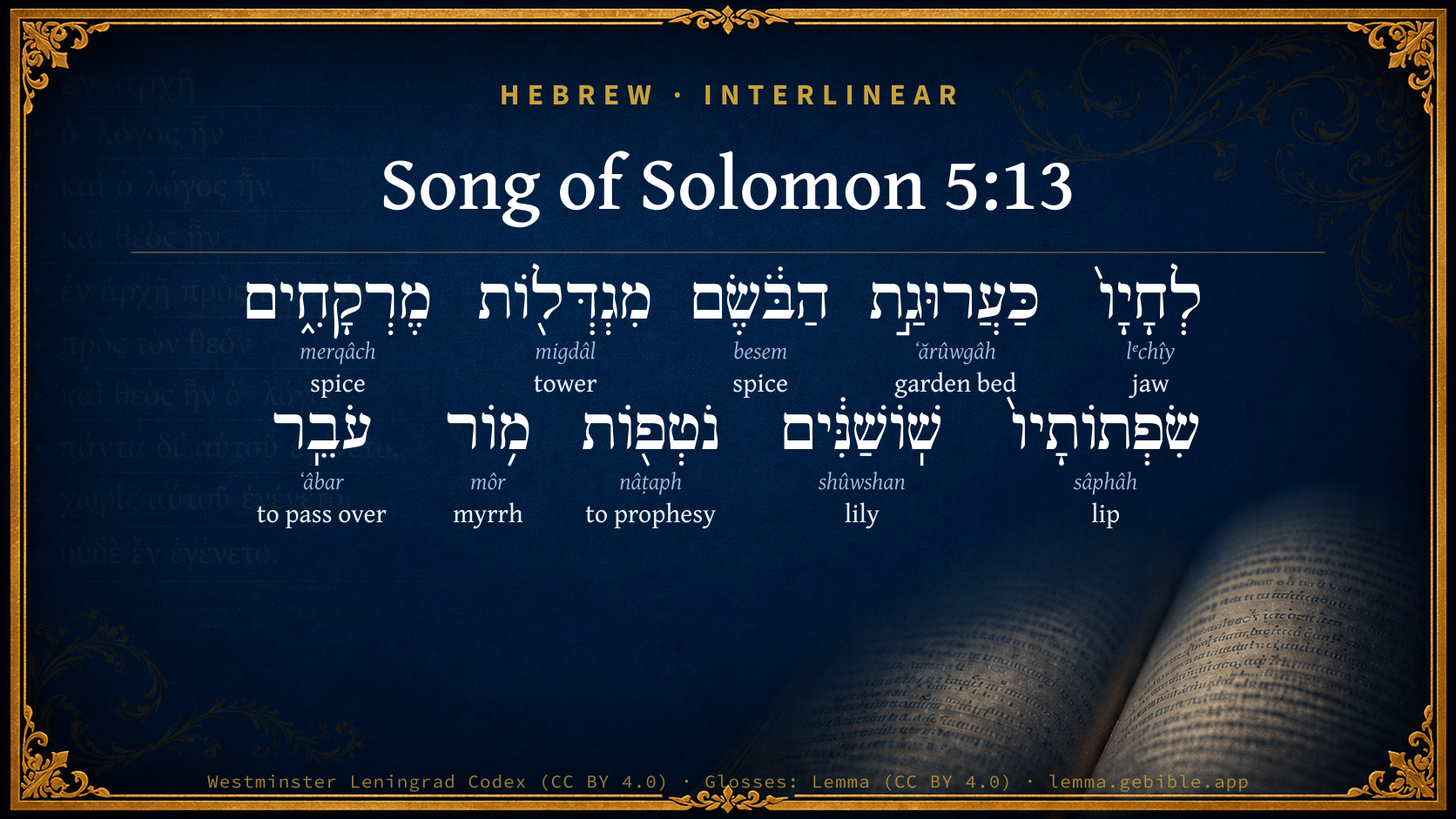
Hebrew (Westminster Leningrad Codex) Song of Solomon 5:13 appears in the Hebrew Old Testament. The text above is from the Westminster Leningrad Codex. Each word links to its Strong’s number, a concise gloss, and parsing drawn from the Open Scriptures Hebrew Bible morphology. Click any word for its full Brown-Driver-Briggs (BDB) entry.
Download image
Cite this verse

Song of Solomon 5:13 (World English Bible). Public Domain. Lemma interlinear Bible study tool, https://lemma.gebible.app/v/song-of-solomon/5/13.

Show BibTeX & RIS
BibTeX
RIS
English Translation
His cheeks are like a bed of spices with towers of perfumes. His lips are like lilies, dropping liquid myrrh.
World English Bible · Public Domain
Highlights
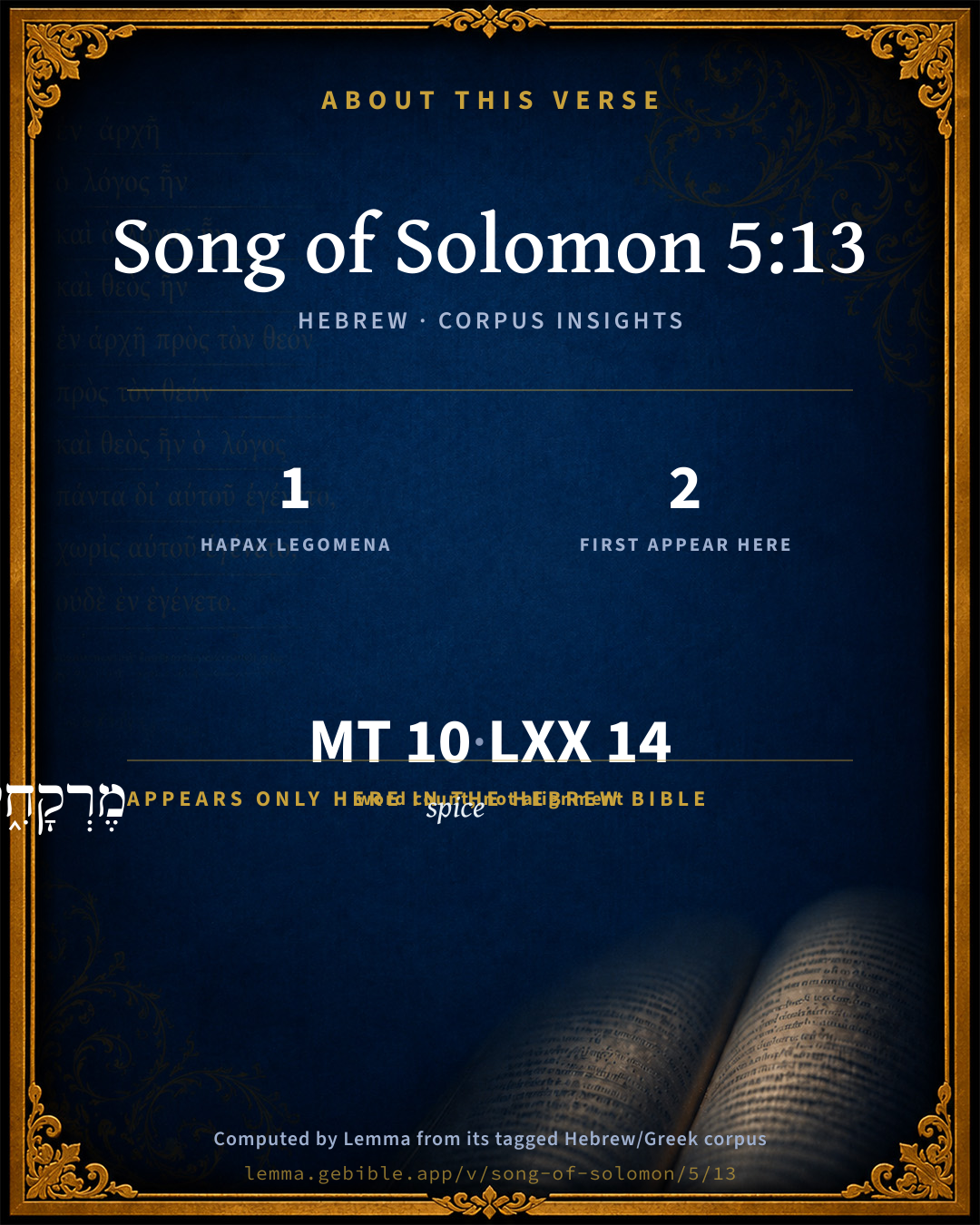
  • 1 hapax legomenon — only here in the Hebrew Bible
  • 2 first appearances in the Hebrew Bible
Full analysis ↓
Download a study sheet

One document with this verse’s original text, its word-by-word gloss line, the meaning frame, cross-references with their text, attributed commentary, and full source and license credits — printable, and it pastes into notes with its structure intact.

This verse Autodidact and up

Study sheet (.html) Plain text (.txt)

A passage Seminary Student

Up to 50 verses in one chapter. A passage sheet keeps up to 6 commentary sources and 12 cross-references per verse, in the order this page ranks them, and says so on the sheet whenever that leaves anything out. Ask for a single verse and you get the Autodidact verse sheet above.

Everything on this page stays free to read, with no account — the sheet is a download of what is already on screen, not access to it.

Want to remove ads? Support Godless Engineer
Compare translations 3

The same verse in 3 English versions, stacked beneath the original-language interlinear above. Click any original word for its lexicon entry.

Each is an independent rendering of the whole verse — the interlinear is not word-aligned to these translations.

Highlighted words mark where these versions differ — a whole-verse word diff, not a word-by-word alignment.

  • World English Bible Public Domain
    His cheeks are like a bed of spices with towers of perfumes. His lips are like lilies, dropping liquid myrrh.
  • King James Version Public Domain
    His cheeks are as a bed of spices, as sweet flowers: his lips like lilies, dropping sweet smelling myrrh.
  • unfoldingWord Literal Text CC BY-SA 4.0
    His cheeks like a bed of spices, towers of herbal spices. His lips lilies, dripping flowing myrrh.

unfoldingWord Literal Text — © unfoldingWord, licensed CC BY-SA 4.0. Word-aligned USFM3 via Door43 (git.door43.org/unfoldingWord/en_ult).

Versions to compare (up to 4)

3 of 4 selected

Show all 18 translations

Every available English version of this verse, each an independent rendering of the whole verse.

  • World English Bible Public Domain
    His cheeks are like a bed of spices with towers of perfumes. His lips are like lilies, dropping liquid myrrh.
  • Berean Standard Bible Public Domain
    His cheeks are like beds of spice, towers of perfume. His lips are like lilies, dripping with flowing myrrh.
  • Majority Standard Bible Public Domain
    His cheeks are like beds of spice, towers of perfume. His lips are like lilies, dripping with flowing myrrh.
  • King James Version Public Domain
    His cheeks are as a bed of spices, as sweet flowers: his lips like lilies, dropping sweet smelling myrrh.
  • American Standard Version (1901) Public Domain
    His cheeks are as a bed of spices, `As' banks of sweet herbs: His lips are `as' lilies, dropping liquid myrrh.
  • Revised Version (1885) Public Domain
    His cheeks are as a bed of spices, as banks of sweet herbs: his lips are as lilies, dropping liquid myrrh.
  • Geneva Bible (1599) Public Domain
    His cheekes are as a bedde of spices, and as sweete flowres, and his lippes like lilies dropping downe pure myrrhe.
  • Douay-Rheims (1899) Public Domain
    His cheeks are as beds of aromatical spices set by the perfumers. His lips are as lilies dropping choice myrrb.
  • Young's Literal Translation Public Domain
    His cheeks as a bed of the spice, towers of perfumes, His lips `are' lilies, dropping flowing myrrh,
  • Literal Standard Version CC BY-SA 4.0
    His cheeks [are] as a bed of the spice, towers of perfumes, || His lips—lilies, dripping [and] flowing [with] myrrh,
  • Unlocked Literal Bible CC BY-SA 4.0
    His cheeks are like beds of spices, yielding aromatic scents. His lips are lilies, dripping liquid myrrh.
  • unfoldingWord Literal Text CC BY-SA 4.0
    His cheeks like a bed of spices, towers of herbal spices. His lips lilies, dripping flowing myrrh.
  • Darby Bible Public Domain
    His cheeks are as a bed of spices, raised beds of sweet plants; His lips lilies, dropping liquid myrrh.
  • World Messianic Bible Public Domain
    His cheeks are like a bed of spices with towers of perfumes. His lips are like lilies, dropping liquid myrrh.
  • Webster's Bible Public Domain
    His cheeks are as a bed of spices, as sweet flowers: his lips like lilies, dropping sweet-smelling myrrh.
  • Free Bible Version CC BY-SA 4.0
    His cheeks are like a flowerbed of spices that produces fragrance. His lips are like lilies, dripping with liquid myrrh.
  • Bible in Basic English Public Domain
    His face is as beds of spices, giving out perfumes of every sort; his lips like lilies, dropping liquid myrrh.
  • JPS Tanakh (1917) Public Domain
    His cheeks are as a bed of spices, as banks of sweet herbs; his lips are as lilies, dropping with flowing myrrh.

Literal Standard Version (2020), Covenant Press — licensed CC BY-SA 4.0. Text via the HelloAO Bible API (eBible.org). Unlocked Literal Bible (unfoldingWord) — licensed CC BY-SA 4.0. Text via the HelloAO Bible API (eBible.org). unfoldingWord Literal Text — © unfoldingWord, licensed CC BY-SA 4.0. Word-aligned USFM3 via Door43 (git.door43.org/unfoldingWord/en_ult). Free Bible Version, Dr. Jonathan Gallagher — licensed CC BY-SA 4.0. Text via the HelloAO Bible API (eBible.org).

Word by word

More ways to search: Search by grammar → Find every occurrence → Compare this word →

Practice this passage: Drill this verse → Learn its vocabulary →

מֶרְקָחִ֑ים
merqâch
H4840
“spices”
Noun, Common, Masculine, Plural, Absolute
Part of Speech
Noun
Type
Common
Gender
Masculine
Number
Plural
State
Absolute
Full BDB Definition

Origin: from H7543

TWOT: 2215f

spice, perfume, aromatic spices
  1. לְחָיָו֙ lᵉchîy H3895 “jaws · his” Noun, Common, Both, Dual, Construct + Suffix, Personal, 3rd Person, Masculine, Singular
  2. כַּעֲרוּגַ֣ת ʻărûwgâh H6170 “like/as · garden bed of” Preposition + Noun, Common, Feminine, Singular, Construct
  3. הַבֹּ֔שֶׂם besem H1314 “the · spice” Particle, Definite Article + Noun, Common, Masculine, Singular, Absolute
  4. מִגְדְּל֖וֹת migdâl H4026 “towers of” Noun, Common, Both, Plural, Construct
  5. שִׂפְתוֹתָיו֙ sâphâh H8193 “lips · his” Noun, Common, Feminine, Plural, Construct + Suffix, Personal, 3rd Person, Masculine, Singular
  6. שֽׁוֹשַׁנִּ֔ים shûwshan H7799 “lilies” Noun, Common, Both, Plural, Absolute
  7. נֹטְפ֖וֹת nâṭaph H5197 “prophesying” Verb, Qal, Participle Active, Feminine, Plural, Absolute
  8. מ֥וֹר môr H4753 “myrrh” Noun, Common, Masculine, Singular, Absolute
  9. עֹבֵֽר ʻâbar H5674 “passing over” Verb, Qal, Participle Active, Masculine, Singular, Absolute

About this verse

These counts appear in no published source. They are computed here, from the morphology-tagged text and Lemma’s own curated glosses. What Lemma adds →

10
words
10
distinct lemmas
Wisdom
section

Notable vocabulary

1 hapax legomenon — a word that appears only here in the entire Hebrew Bible:

  • מֶרְקָחִ֑ים spice H4840

First appearance in Scripture

These words make their first canonical appearance in the Hebrew Bible here:

  • כַּעֲרוּגַ֣ת garden bed H6170
  • מֶרְקָחִ֑ים spice H4840

Shared distinctive vocabulary

כַּעֲרוּגַ֣ת garden bed H6170 occurs in 4 verses of the Hebrew Bible. Also found in:

Grammatical profile

  • 2 verbs
  • 8 nouns

Verb forms

  • נֹטְפ֖וֹת Qal · Participle Active
  • עֹבֵֽר Qal · Participle Active

Hebrew & Septuagint length

In English translation the verse runs 20 words from the Hebrew and 17 from the Septuagint (LXX English) — closely comparable.

A rough comparison of the two English renderings, which tokenize alike — not a word-level alignment.

Word counts can differ between the Hebrew and the Greek without any difference in meaning — e.g. the Hebrew direct-object marker אֵת has no separate Greek word, and Greek often adds the article ὁ.

In the original languages it is 10 Hebrew tokens and 14 Greek tokens — but the two are counted differently (Hebrew bundles its prefixes and suffixes into one token; the Greek is in lemma form), so that isn’t a like-for-like length.

Cross-references

14

Topical passages linked to Song of Solomon 5:13 in the Treasury of Scripture Knowledge — connected by theme and wording, ordered by reader-vote popularity; previews shown in the World English Bible.

  • Song of Solomon 1:10 Your cheeks are beautiful with earrings, Your neck with strings of jewels.
  • Song of Solomon 2:1 I am a rose of Sharon, A lily of the valleys.
  • Song of Solomon 6:2 My beloved has gone down to his garden, To the beds of spices, To feed in the gardens, and to gather lilies.
  • Psalms 4:6–7 Many say, "Who will show us any good?" Yahweh, let the light of your face shine on us.
  • Psalms 27:4 One thing I have asked of Yahweh, that I will seek after, That I may dwell in the house of Yahweh all the days of my life, To see Yahweh's beauty, And to inquire in his temple.
  • Psalms 45:2 You are the most excellent of the sons of men. Grace has anointed your lips, Therefore God has blessed you forever.
  • Psalms 89:15 Blessed are the people who learn to acclaim you. They walk in the light of your presence, Yahweh.
  • Song of Solomon 3:6 Who is this who comes up from the wilderness like pillars of smoke, Perfumed with myrrh and frankincense, With all spices of the merchant?
  • Song of Solomon 4:11 Your lips, my bride, drip like the honeycomb. Honey and milk are under your tongue. The smell of your garments is like the smell of Lebanon.
  • Song of Solomon 5:5 I rose up to open for my beloved. My hands dripped with myrrh, My fingers with liquid myrrh, On the handles of the lock.
  • Isaiah 50:6 I gave my back to the strikers, and my cheeks to those who plucked off the hair; I didn't hide my face from shame and spitting.
  • Luke 4:22 All testified about him, and wondered at the gracious words which proceeded out of his mouth, and they said, "Isn't this Joseph's son?"
  • Revelation 21:23 The city has no need for the sun, neither of the moon, to shine, for the very glory of God illuminated it, and its lamp is the Lamb.
  • Isaiah 50:4 The Lord Yahweh has given me the tongue of those who are taught, that I may know how to sustain with words him who is weary: he wakens morning by morning, he wakens my ear to hear as those who are taught.

Cross-references courtesy of OpenBible.info (CC BY 4.0).

Hebrew and Greek witnesses Masoretic Hebrew ↔ Greek Septuagint

The same verse in the two great witnesses to the Old Testament, shown verse-for-verse.

These are two independent witnesses, not word-aligned to each other, and the Septuagint is shown in lemma (dictionary) form.

Hebrew Song of Solomon 5:13 Masoretic · Westminster Leningrad Codex

לְחָיָו֙ כַּעֲרוּגַ֣ת הַבֹּ֔שֶׂם מִגְדְּל֖וֹת מֶרְקָחִ֑ים שִׂפְתוֹתָיו֙ שֽׁוֹשַׁנִּ֔ים נֹטְפ֖וֹת מ֥וֹר עֹבֵֽר

His cheeks are like a bed of spices with towers of perfumes. His lips are like lilies, dropping liquid myrrh.

World English Bible · Public Domain

Greek LXX Song of Solomon 5:13 Septuagint · lemma form

σιαγών αὐτός ὡς φιάλη ὁ ἄρωμα φύω μυρεψικός χεῖλος αὐτός κρίνον στάζω σμύρνα πλήρης

His cheeks are as bowls of spices pouring forth perfumes: his lips are lilies, dropping choice myrrh.

LXX2012 (modern English Septuagint) · Public Domain

On this verse, The Cambridge Bible for Schools and Colleges discusses the Septuagint’s reading. Read the note in Commentary ↓

Hebrew: Westminster Leningrad Codex (CC BY 4.0). Greek: Septuagint (public domain); English from LXX2012 (modern English Septuagint) (Public Domain). How the Septuagint differs from the Hebrew →

Commentary

Notes on Song of Solomon 5:13 from classic Christian and Jewish commentators (each source and its license shown beneath its notes). The classic Christian expositions comment on the surrounding passage and are grouped to its opening verse, so a note may address several verses; the Jewish commentaries on the Tanakh (Rashi and others) are per-verse, so they appear only where the commentator wrote on this verse.

Lemma curates 59 commentaries, every one of them public domain or Creative Commons licensed, each selected and text-cleaned for this edition rather than reprinted as found. About our sources →

Trapp's Complete Commentary

John Trapp

Son 5:13 His cheeks [are] as a bed of spices, [as] sweet flowers: his lips [like] lilies, dropping sweet smelling myrrh.

Ver. 13. His cheeks are as a bed of spices,] i.e., Comely and pleasant to the sight, sweet also to the smell; areolis similes, aromatum plenis; flourishing with a goodly, comely, fresh, and sweet beard; so declaring his face not only to be gracious and amiable, but also full of gravity, glory, and majesty. There are those who would have all these things to be taken literally about Christ’s natural body, and that here is set down his prosopograpohy; but this was written long before Christ was incarnated, and therefore it must needs be meant in a metaphorical and allegorical sense, hard to be explained. Ego quid de singulis statuam fateor me nescire, saith a learned interpreter. Allegorically to handle all these is not in my purpose or power, saith another: since the graces of Christ, as they cannot well be expressed, so, by reason of our weakness, they cannot better be declared. The drift of the Holy Ghost is to paint out unto us the spiritual and heavenly love of his Church to Christ, who doth not and cannot satisfy herself with any words or comparisons of this kind; and, secondly, to stir up our heartiest and liveliest affections to him that hath such a world of worth and wealth in him. As the worth and value of many pieces of silver is in one piece of gold, so all the petty excellencies scattered abroad in the creatures are united in Christ; yea, all the whole volume of perfections which is spread through heaven and earth is epitomised in him. Why do we not then make out to him, and despise all for him with Paul? Why do we not, with David, chide ourselves and others for loving vanity and seeking after leasing? {Psa 4:2} "How long wilt thou go about, O backsliding daughter," {Jer 31:22} and fetch a compass? knowest thou not that "the Lord hath created a new thing in the earth? a woman shall compass a man"; {Isa 7:14} that is, "a virgin shall conceive and bear a son," even the man Christ Jesus, in whom it pleased the Father that there should dwell all fulness. {Col 1:19} Make we therefore straight paths for our feet; {Heb 12:13} let us go speedily to Christ, {Zec 8:21} as bees do to a meadow full of flowers; as merchants do to the Indies, that are full of fruits and spices, that we may return from him full fraught with treasures of truth and grace.

His lips, like lilies, dropping sweet smelling myrrh,] i.e., His word and doctrine is white, sweet, pleasant, far spreading as lilies, sweet to the smell, and yet bitter to the taste as myrrh, no way pleasing to the flesh, which it mortifieth, calling upon men to repent, reform, walk by rule, strive to enter in at the strait gate, resist unto blood, striving against sin. "These things are good and profitable to men," as the apostle speaks in another case, {Tit 3:8} but they naturally care not to hear about them. Drop not ye, say they; we like not your lilies dropping myrrh and nitre; let those drop or prophesy that preach pleasing things. We like your lilies, but care not for your myrrh; or, if we smell it, we like not to taste of it, because little toothsome, however it may be wholesome. See Mic 2:6.

John Trapp, A Commentary or Exposition upon All the Books of the Old and New Testament (1647–1656) — public domain. Text from a community e-Sword module.

The Biblical Illustrator

Joseph S. Exell

Son_5:13

His cheeks are as a bed of spices, as sweet flowers: His lips like lilies, dropping sweet-smelling myrrh.

Spices, flowers, lilies, and myrrh

It is of Christ, the heavenly Bridegroom, that we perceive the spouse to be speaking, and mentioning in detail at least ten particulars, dwelling with delight upon the beauties of His head and His locks, His eyes and His cheeks, His lips and His hands, and every part of Him; and, beloved friends, I think it shows true love to Christ when we want to speak at length upon everything that concerns Him. True love to Christ seeks to get to Him, to live with Him, to live upon Him, and thus to know Him so intimately that things which were unobserved and passed over at the first, stand out in clear light to the increased joy and delight of the contemplative mind.

I. Christ looked upon is very lovely. His cheeks are as a bed of spices, as sweet flowers.

1. But why do they mention His cheeks?

(1) I suppose, first, because every part of Christ is inexpressibly delightful. Take any portion of His countenance that you may, and it has surpassing beauty about it. Think for a moment what is meant by a sight of His cheeks. Though you may not yet see the majesty of His brow as King of kings and Lord of lords,--though you may not perceive the brightness of the lightning flashes of His eyes, which are as a flame of fire,--though you may scarcely be able to imagine at present what will be the glory of His second advent,--yet, if you can but see the cheeks that He gave to the smiters, if you do but know something of Him as the suffering Saviour, you shall find that there is inexpressible delight in Him, and with the spouse you will say, His cheeks are as a bed of spices.

(2) But, methinks, the saints see great loveliness in those parts of Christ which have been most despised. Oh! if we could but see Him now, if we could but gaze upon His face as it is in glory, what a subject of meditation it would be to think that even the spittle of cruel mockers did run a-down those blessed cheeks,--that infinite loveliness was insulted with inconceivable contempt,--the holy face of the Incarnate Son of God distained with the accursed spittle of brutal men. It was I, with my vain and idle talk, with my false and proud speech, that did spit into that dear face. How sad that He should ever have been made to suffer so! O glorious love, that He should be willing even to stoop to this terrible depth of ignominy that He might lift us up to dwell with Him on high I

(3) And next, those parts of Christ in which we do not immediately see any special office or use are, nevertheless, peculiarly lovely to the saints. Do you care only for the lips that speak to you? Have you no love for the cheeks that are silent? Do you care for nothing but for the eyes that are watching over you? If there come to you nothing from those cheeks of your Lord, yet shall they not be to you as a bed of spices, as sweet flowers? The fact is, we are not to judge concerning Christ in any such fashion as this; on the contrary, if there is any duty which Christ has commanded, but which, instead of seeming to be easy and profitable to us, is hard, and requireth that we should give so much that Judas will cry out, To what purpose is this waste? let us never mind him, but break our alabaster boxes, and pour out the sweet perfume upon our dear Master.

(4) But further, the followers of Christ have an intense admiration, an almost infinite love for that part of Christ by which they are able to commune with Him, and perhaps that is one reason why His cheeks are here specially mentioned. The cheek is the place of fellowship where we exchange tokens of love. What a blessing it is that Christ should have had a cheek for the lips of love to approach, and to kiss!

2. The spouse, however, in our text tries to speak of the loveliness of Christ by comparisons. She cannot do it with one emblem, she must have two even concerning His cheeks; they are as a bed of spices, as sweet flowers.

(1) Notice, in the metaphors used by the spouse, that there is a blending of sweetness and beauty; as a bed of spices,--there is sweetness; and then, as sweet flowers,--there is beauty. There is sweetness to the nostrils and beauty to the eye, spice for its fragrance and flowers for their loveliness. In Christ, there is something for every spiritual sense, and for every spiritual sense there is a complete satisfaction and delight in Him.

(2) Notice that, when the spouse is speaking even of the cheeks of her Beloved, she brings in the idea of abundance;--spices, aye, a bed of spices; flowers,--not one or two, but, according to the Hebrew, towers of perfume, which I understand to mean those raised beds which we delight to have in our gardens, where there are many flowers set in order, forming charming banks of beauty. No doubt Solomon had some of those in his garden, for there is nothing new under the sun; and those raised beds of dainty flowers are fit emblems of the beauteous cheek of Christ, with its delicate tints of white and red. So in Christ there is infinite abundance.

(3) There is also in Christ infinite variety; there is in Him all you can want of any one thing, and there is more than all you can want of everything.

(4) The spouses metaphors seem to me also to suggest use and delight. She speaks of spices, for which there is practical use in surgery and in medicine, for preservation and for perfume; and she also mentions sweet flowers, for which there may not be any particular use, but which are charming for ornament, and for the delectation of taste. So, dear friends, in Christ Jesus there is all that we want, but there is a great deal more. There is something beside and beyond our actual necessities, there are many spiritual luxuries.

II. Now let us turn to the other part of our text:

His lips like lilies, dropping sweet-smelling myrrh. These words teach us that Christ listened to is very precious. When He is silent, and we only look at Him, He is lovely to our eyes; but when He speaks, we can see His lips like lilies, dropping sweet-smelling myrrh.

1. Notice, first, that it is well, whenever we hear the voice of Jesus Christ, to try to see the blessed Person who is speaking. Tile spouse does not say in our text, His words are sweet, but she speaks of His lips like lilies, dropping sweet-smelling myrrh. Why should we not believe more in a personal Christ, and why should we not always see the connection between the mercy and the hand that gives it, and between the promise and the lips that speak it?

2. Notice the comparison in the text,--lilies; not white lilies, of course, but red lilies, crimson lilies, lilies of such a colour as are frequently to be seen, which would be a suitable emblem of the Beloveds lips. Christs lips are peculiarly delightful to us, for it is with them that He speaks to us, and intercedes with the Father for us. When Heb, leads as the Intercessor on behalf of a poor soul like me, His lips are indeed in Gods sight like lovely lilies. The Father looks at His dear Sons lips, and He is charmed with them, and blesseth us because of Christs intercession. And whenever Christ turns round, and speaks to us, shall we not listen at once, with eyes and ears wide open, as we say, I like to watch His lips as He is speaking, for His lips are to me as lilies? I suppose this comparison means that Christs lips are very pure, as the lily is the purest of flowers; and that they are very gentle, for we always associate the lily with everything that is tender and soft and kind.

3. But the spouses comparison fails, for she said, His lips like lilies, dropping sweet-smelling myrrh. This lilies do not do, but Christ does. He is more than a lily, or He is a lily of such a sort as never bloomed on earth except once. He was the only lily that ever dropped sweet-smelling myrrh. The spouse says that His lips do that; what means this? Does it not mean that His Word is often full of a very sweet, mysterious, blessed influence? (C. H. Spurgeon.)

The Biblical Illustrator, edited by Joseph S. Exell (c. 1880s–1900s) — public domain. Text from a community e-Sword module.

Tyndale Open Study Notes

Tyndale Open Resources

5:13 His cheeks are like gardens of spices because they were covered by the full beard that was worn by all men of that culture. This beard would have been perfumed.

Tyndale Open Study Notes — © Tyndale Open Resources, licensed CC BY-SA 4.0. Text via the HelloAO Bible API.

Adam Clarke's Commentary

Verse 13. His cheeks are as a bed of spices] Possibly meaning a bed in the garden, where odoriferous herbs grew. But it has been supposed to refer to his beard, which in a young well-made man is exceedingly beautiful. I have seen young Turks, who had taken much care of their beards, mustachios, c., look majestic. Scarcely any thing serves to set off the human face to greater advantage than the beard, when kept in proper order. Females admire it in their suitors and husbands. I have known cases, where they not only despised but execrated Europeans, whose faces were close shaved. The men perfume their beards often and this may be what is intended by spices and sweet-smelling myrrh.

His lips like lilies] The שושנם shoshannim may mean any flower of the lily kind, such as the rubens lilium, mentioned by Pliny, or something of the tulip kind. There are tints in such flowers that bear a very near resemblance to a fine ruby lip.

Adam Clarke's Commentary on the Bible (1810–1826) — public domain. Text from a community e-Sword/MySword module.

Ellicott's Commentary for English Readers

(13) His cheeks are as a bed of spices—Probably with allusion to the beard perfumed (Marg., towers of perfumes), as in Psa_133:2.

Lilies.—Comp. “He pressed the blossom of his lips to mine “(Tennyson, (Enone).

A Bible Commentary for English Readers, edited by Charles John Ellicott (1878–1897) — public domain. Text from a community e-Sword module.

The Cambridge Bible for Schools and Colleges

gen. ed. J. J. S. Perowne

13. as a bed of spices] Rather, as a bed of balsam shrubs. Probably we should read the plur. beds as in Son_6:2, to correspond with the plur. cheeks. The Heb. for ‘bed’ is ‘arûghâh derived from ‘âragh, ‘to mount up,’ and signifying a raised flower-bed. Cp. Driver on Joel, Camb. Bible, p. 47. The points of comparison are the rounded form and the variegated colour.

as sweet flowers] This is rather a paraphrase than a translation. As they stand, the Heb. words mighdĕlôth merqâchîm mean ‘towers of perfume herbs.’ ‘Towers’ is taken to be a synonym of ‘arûghôth, but if these are only raised garden-beds, this can hardly be. Probably we should read with the LXX, Targ. Vulg. meghaddĕlôth for mighdĕlôth, i.e. rearing or producing perfumes. The point of the comparison is the growth of a perfumed beard on the cheeks.

like lilies] The redness of the shôshannâh is the point here. Tristram thinks it is the Anemone coronaria. Cp. note on Son_2:1.

sweet smelling myrrh] or liquid myrrh (R.V.), i.e. the finest myrrh, that oozes from the bark of itself. Cp. note on Son_5:5. The reference is to the perfume of the breath (cp. Son_7:8).

The Cambridge Bible for Schools and Colleges (gen. ed. J. J. S. Perowne; Cambridge University Press, 1878–1918) — public domain. Text from a community e-Sword module.

Albert Barnes' Notes on the Bible

Sweet flowers - Better as in the margin, i. e., plants with fragrant leaves and flowers trained on trellis-work.

Like lilies - Are lilies dropping liquid myrrh (see the Son 5:5 note). Perhaps the fragrance of the flowers, or the delicate curl of the lip-like petals, is here the point of comparison, rather than the color.

Albert Barnes' Notes on the Bible (1834–1885) — public domain. Text from a community e-Sword/MySword module.

Haydock's Catholic Bible Commentary

Set by. Protestants, "as sweet flowers." --- Choice. Literally, "the first," ver. 5. (Haydock) --- The modesty and words of Christ excited admiration, 1 Peter ii. 21., and John vii. 46. (Calmet) --- He exhorted sinners to repent, and rebuked the obstinate. (Menochius)

George Leo Haydock (1774–1849), Haydock's Catholic Family Bible and Commentary, 1859 edition — public domain. Excludes Psalms (Douay-Rheims chapter numbering differs from Protestant) and Deuterocanonical books (Catholic canon only).

Matthew Poole's English Annotations

His cheeks; his face or countenance, an eminent part whereof is the cheeks, in which the beauty or deformity of a face doth much consist.

As a bed; which being higher than other parts of the garden, fitly represents the cheeks, which are higher than other parts of the face.

Of spices; not of dry spices, for they are not in beds; but of aromatical flowers, which delight both the eye with a pleasant prospect, and the smell with their fragrancy. This may also signify the down or hair upon the Bridegroom’s cheeks, which is the evidence of his mature and vigorous age, and may denote that Christ’s sweetness and gentleness is accompanied with majesty, and gravity, and just severity.

Sweet flowers: this may be added to explain the former phrase. Or,

towers of perfumes, i.e. boxes in which perfumes were put, which by their height or form had some resemblance to a turret.

His lips like lilies; beautiful and pleasant. Or this is meant of that sort of lilies which were of a red or purple colour, as ancient writers affirm, and so signify the grateful colour of the lips. This may note that grace which was poured into Christ’s lips, and which flowed from them in sweet and excellent discourses.

Dropping sweet smelling myrrh; not only graceful to the eye, as lilies are, but also fragrant to the smell.

Matthew Poole's English Annotations on the Holy Bible (1683–1685) — public domain. Text from a community e-Sword/MySword module.

Whedon's Commentary on the Bible

Daniel D. Whedon

13. Cheeks… bed of spices — The wearing of the full beard is ancient and uniform in the East. The growth of the cheeks of the Beloved, in its soft, early luxuriance, is like “beds of balsams, rising growths of spiceries.”

From this growth, gracefully dressed, his lips appear as lilies. The Hebrew word here used is not the one for the white lily of the valley, but means, probably, the red crown lily. Dropping, etc. — refers to the lips, not the lilies, meaning pleasant words.

Daniel D. Whedon (gen. ed.), Commentary on the Old and New Testaments (1874–1909) — public domain. Text from a community e-Sword module.

John Wesley's Explanatory Notes

Cheeks - His face or countenance, an eminent part whereof is the cheeks. Spices - Of aromatic flowers which delight both the eye with a pleasant prospect, and the smell with their fragrancy. Lillies - Beautiful and pleasant.

John Wesley, Explanatory Notes Upon the Whole Bible (1754–1765) — public domain. Text via the GEBible commentary corpus.

unfoldingWord translationNotes

Door43 World Missions Community

General Information:

The young woman continues to describe the man.

His cheeks ... aromatic scents

This explains that his cheeks are like beds of spices because they both give off wonderful smells. (See: Simile)

beds of spices

gardens or parts of gardens where people grow spices. Spices give people pleasure. The man's body gives the woman pleasure. (See: Metaphor)

yielding aromatic scents

"that give off wonderful smells."

His lips are lilies

The woman probably compares his lips with lilies because they are beautiful and smell wonderful. (See: Metaphor)

lilies

See how you translated this in Song of Songs 2:16.

dripping liquid myrrh

"that drip with the best myrrh." His lips are moist and have a wonderful smell like myrrh. (See: Metaphor)

translationWords

like

myrrh

unfoldingWord translationNotes — © Distant Shores Media and the Door43 World Missions Community, licensed CC BY-SA 4.0. Source: git.door43.org/Door43/en_tn.

Rashi

Rabbi Shlomo Yitzchaki (Rashi)

His jaws are like a bed of spice in those beds are spice plants.

growths of aromatic plants Heb. מִגְדְלוֹת מֶרְקָחִים, aromatic plants, growths of aromatic plants which are compounded with the art of an apothecary.

Rashi on the Tanakh — English translations: “The Judaica Press complete Tanach with Rashi, translated by A. J. Rosenberg” (CC BY 4.0); “Pentateuch with Rashi's commentary by M. Rosenbaum and A.M. Silbermann, 1929-1934” (public domain); “The Metsudah Tanach series, Lakewood, N.J” (CC BY 4.0); and “The Book of Joshua, Metsudah Publications, 1997” (CC BY 4.0). Text via Sefaria.

Lesson kit

Teaching starters — assembled from the data on this page, not authored interpretation. Every prompt links to the verse data it draws on. Edit before teaching.

Song of Solomon, in the Wisdom, opens this verse with 10 words (10 distinct Hebrew lemmas). Its most distinctive word is merqâch (“spice”). A historical commentator’s framing appears above. Read the whole chapter for the surrounding context.

Discussion questions

  1. The word merqâch carries the sense “spice.” How does it shape the verse?
  2. This verse holds 1 word here found nowhere else in the Hebrew Bible. What might the rare word draw attention to?
  3. 2 words here appear for the first time in Scripture. What is being introduced at this debut?
  4. Song of Solomon 6:2 shares the word «garden bed» with this verse. How do the two illuminate each other?
  5. These translations render this verse differently; the difference is in the English rendering, not the original. What questions does that raise?
  6. The verb «נֹטְפ֖וֹת» is Qal Participle Active. How does its form color the action?
  7. Reading how Trapp's Complete Commentary and The Biblical Illustrator read this verse, where do the two commentators agree and where do they part?

Things to notice

Reading settings

Reading text

Shown beneath each verse's original-language words.

Old Testament
Old Testament edition

Read the OT as the Masoretic Hebrew (MT) or the Greek Septuagint (LXX).

English shown for the Greek Septuagint (in the Hebrew ↔ Greek comparison).

Comparing translations? Open the Compare panel on any verse page to stack up to four side by side.