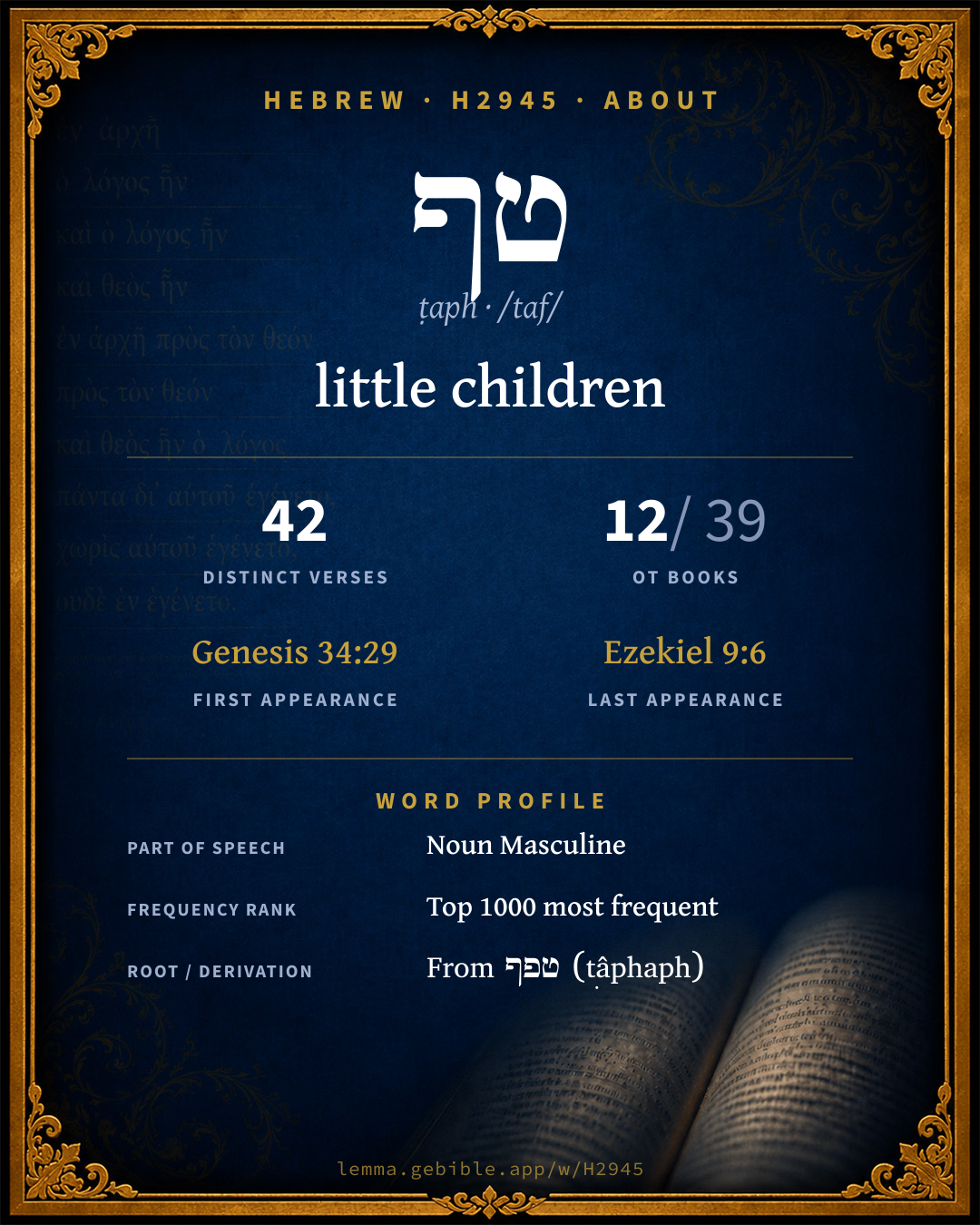
טַף
little children
Full lexicon entry — Brown-Driver-Briggs (BDB)
From Brown-Driver-Briggs (BDB)
Where this word appears
See every Construct-state word in the Hebrew Bible →
Grammar key — what these labels mean
Part of speech
- Noun
- A naming word — a person, place, thing, or idea.
Noun type
- Common
- A common noun — a general class of person, place, or thing (“king,” “city,” “water”), not a specific name.
State
- Absolute
- The independent form of a noun, not bound to a following word.
- Construct
- A noun bound to a following noun in a possessive / “of” relationship (the construct chain).
Gender
- Masculine
- Grammatically masculine.
Number
- Singular
- One.
Grammatical forms
- Noun, Common, Masculine, Singular, Construct 24 times (57%)
- Noun, Common, Masculine, Singular, Absolute 18 times (43%)
Parsed forms decoded from the imported morphology (morphhb / Westminster Leningrad Codex — WLC text public domain, morphhb tagging CC BY 4.0), counted across 42 parsed occurrences — not distinct verses.
Every verse where H2945 appears — 42 distinct verses across 12 books. Click any verse to open its interlinear word-by-word view. Verse text shown in the World English Bible for context — . Each verse’s Hebrew form is shown with its reference; the English is not keyword-highlighted, since the data carries no word-level English alignment. Use “Compare translations” on any verse to read it across multiple English versions. This concordance covers the Hebrew Bible; Septuagint (Greek Old Testament) occurrences are not indexed here.
Genesis 8 verses
- Genesis 34:29 טַפָּ/ם֙ n c ms cs + sfx pers 3mp and all their wealth. They took captive all their little ones and their wives, and took as plunder everything that was in the house.
- Genesis 43:8 טַפֵּֽ/נוּ n c ms cs + sfx pers 1cp Judah said to Israel, his father, "Send the boy with me, and we will arise and go, so that we may live, and not die, both we, and you, and also our little ones.
- Genesis 45:19 לְ/טַפְּ/כֶם֙ prep + n c ms cs + sfx pers 2mp Now you are commanded: do this. Take wagons out of the land of Egypt for your little ones, and for your wives, and bring your father, and come.
- Genesis 46:5 טַפָּ/ם֙ n c ms cs + sfx pers 3mp Jacob rose up from Beersheba, and the sons of Israel carried Jacob, their father, their little ones, and their wives, in the wagons which Pharaoh had sent to carry him.
- Genesis 47:12 הַ/טָּֽף ptcl def.art + n c ms Joseph nourished his father, his brothers, and all of his father's household, with bread, according to their families.
- Genesis 47:24 לְ/טַפְּ/כֶֽם prep + n c ms cs + sfx pers 2mp It will happen at the harvests, that you shall give a fifth to Pharaoh, and four parts will be your own, for seed of the field, for your food, for them of your households, and for food for your little ones."
- Genesis 50:8 טַפָּ/ם֙ n c ms cs + sfx pers 3mp all the house of Joseph, his brothers, and his father's house. Only their little ones, their flocks, and their herds, they left in the land of Goshen.
- Genesis 50:21 טַפְּ/כֶ֑ם n c ms cs + sfx pers 2mp Now therefore don't be afraid. I will nourish you and your little ones." He comforted them, and spoke kindly to them.
Exodus 3 verses
- Exodus 10:10 טַפְּ/כֶ֑ם n c ms cs + sfx pers 2mp He said to them, "Yahweh be with you if I will let you go with your little ones! See, evil is clearly before your faces.
- Exodus 10:24 טַפְּ/כֶ֖ם n c ms cs + sfx pers 2mp Pharaoh called to Moses, and said, "Go, serve Yahweh. Only let your flocks and your herds stay behind. Let your little ones also go with you."
- Exodus 12:37 מִ/טָּֽף prep + n c ms The children of Israel traveled from Rameses to Succoth, about six hundred thousand on foot who were men, besides children.
Numbers 10 verses
- Numbers 14:3 וְ/טַפֵּ֖/נוּ conj + n c ms cs + sfx pers 1cp Why does Yahweh bring us to this land, to fall by the sword? Our wives and our little ones will be a prey: wouldn't it be better for us to return into Egypt?
- Numbers 14:31 וְ/טַ֨פְּ/כֶ֔ם conj + n c ms cs + sfx pers 2mp But your little ones, that you said should be a prey, them will I bring in, and they shall know the land which you have rejected.
- Numbers 16:27 וְ/טַפָּֽ/ם conj + n c ms cs + sfx pers 3mp So they got them up from the tent of Korah, Dathan, and Abiram, on every side: and Dathan and Abiram came out, and stood at the door of their tents, and their wives, and their sons, and their little ones.
- Numbers 31:9 טַפָּ֑/ם n c ms cs + sfx pers 3mp The children of Israel took captive the women of Midian and their little ones; and all their cattle, and all their flocks, and all their goods, they took for a prey.
- Numbers 31:17 בַּ/טָּ֑ף prep det + n c ms Now therefore kill every male among the little ones, and kill every woman who has known man by lying with him.
- Numbers 31:18 הַ/טַּ֣ף ptcl def.art + n c ms But all the girls, who have not known man by lying with him, keep alive for yourselves.
- Numbers 32:16 לְ/טַפֵּֽ/נוּ prep + n c ms cs + sfx pers 1cp They came near to him, and said, We will build sheepfolds here for our cattle, and cities for our little ones:
- Numbers 32:17 טַפֵּ֨/נוּ֙ n c ms cs + sfx pers 1cp but we ourselves will be ready armed to go before the children of Israel, until we have brought them to their place: and our little ones shall dwell in the fortified cities because of the inhabitants of the land.
- Numbers 32:24 לְ/טַפְּ/כֶ֔ם prep + n c ms cs + sfx pers 2mp Build you cities for your little ones, and folds for your sheep; and do that which has proceeded out of your mouth.
- Numbers 32:26 טַפֵּ֣/נוּ n c ms cs + sfx pers 1cp Our little ones, our wives, our flocks, and all our cattle, shall be there in the cities of Gilead;
Deuteronomy 7 verses
- Deuteronomy 1:39 וְ/טַפְּ/כֶם֩ conj + n c ms cs + sfx pers 2mp Moreover your little ones, whom you said should be a prey, and your children, who this day have no knowledge of good or evil, they shall go in there, and to them will I give it, and they shall possess it.
- Deuteronomy 2:34 וְ/הַ/טָּ֑ף conj + ptcl def.art + n c ms We took all his cities at that time, and utterly destroyed every inhabited city, with the women and the little ones; we left none remaining:
- Deuteronomy 3:6 וְ/הַ/טָּֽף conj + ptcl def.art + n c ms We utterly destroyed them, as we did to Sihon king of Heshbon, utterly destroying every inhabited city, with the women and the little ones.
- Deuteronomy 3:19 וְ/טַפְּ/כֶם֮ conj + n c ms cs + sfx pers 2mp But your wives, and your little ones, and your cattle, (I know that you have much cattle), shall abide in your cities which I have given you,
- Deuteronomy 20:14 וְ/הַ/טַּ֨ף conj + ptcl def.art + n c ms but the women, and the little ones, and the cattle, and all that is in the city, even all the spoil of it, shall you take for a prey to yourself; and you shall eat the spoil of your enemies, which Yahweh your God has given you.
- Deuteronomy 29:11 טַפְּ/כֶ֣ם n c ms cs + sfx pers 2mp your little ones, your wives, and your foreigner who is in the midst of your camps, from the one who cuts your wood to the one who draws your water;
- Deuteronomy 31:12 וְ/הַ/טַּ֔ף conj + ptcl def.art + n c ms Assemble the people, the men and the women and the little ones, and your foreigner who is within your gates, that they may hear, and that they may learn, and fear Yahweh your God, and observe to do all the words of this law;
Joshua 2 verses
- Joshua 1:14 טַפְּ/כֶם֮ n c ms cs + sfx pers 2mp Your wives, your little ones, and your cattle, shall abide in the land which Moses gave you beyond the Jordan; but you shall pass over before your brothers armed, all the mighty men of valor, and shall help them;
- Joshua 8:35 וְ/הַ/טַּ֔ף conj + ptcl def.art + n c ms There was not a word of all that Moses commanded, which Joshua didn't read before all the assembly of Israel, and the women, and the little ones, and the foreigners who were among them.
Judges 2 verses
- Judges 18:21 הַ/טַּ֧ף ptcl def.art + n c ms So they turned and departed, and put the little ones and the cattle and the goods before them.
- Judges 21:10 וְ/הַ/טָּֽף conj + ptcl def.art + n c ms The congregation sent there twelve thousand men of the most valiant, and commanded them, saying, Go and strike the inhabitants of Jabesh Gilead with the edge of the sword, with the women and the little ones.
2 Samuel 1 verse
2 Chronicles 2 verses
- 2 Chronicles 20:13 טַפָּ֖/ם n c ms cs + sfx pers 3mp All Judah stood before Yahweh, with their little ones, their wives, and their children.
- 2 Chronicles 31:18 טַפָּ֧/ם n c ms cs + sfx pers 3mp and those who were reckoned by genealogy of all their little ones, their wives, and their sons, and their daughters, through all the congregation: for in their office of trust they sanctified themselves in holiness.
Ezra 1 verse
Esther 2 verses
- Esther 3:13 טַ֤ף n c ms Letters were sent by posts into all the king's provinces, to destroy, to kill, and to cause to perish, all Jews, both young and old, little children and women, in one day, even on the thirteenth [day] of the twelfth month, which is the month Adar, and to take the spoil of them for a prey.
- Esther 8:11 טַ֣ף n c ms in which the king granted the Jews who were in every city to gather themselves together, and to stand for their life, to destroy, to kill, and to cause to perish, all the power of the people and province that would assault them, [their] little ones and women, and to take the spoil of them for a prey,
Jeremiah 3 verses
- Jeremiah 40:7 וָ/טָ֔ף conj + n c ms Now when all the captains of the forces who were in the fields, even they and their men, heard that the king of Babylon had made Gedaliah the son of Ahikam governor in the land, and had committed to him men, and women, and children, and of the poorest of the land, of those who were not carried away captive to Babylon;
- Jeremiah 41:16 וְ/טַף֙ conj + n c ms Then took Johanan the son of Kareah, and all the captains of the forces who were with him, all the remnant of the people whom he had recovered from Ishmael the son of Nethaniah, from Mizpah, after that he had killed Gedaliah the son of Ahikam, [to wit], the men of war, and the women, and the children, and the eunuchs, whom he had brought back from Gibeon:
- Jeremiah 43:6 הַ/טַּף֮ ptcl def.art + n c ms the men, and the women, and the children, and the king's daughters, and every person who Nebuzaradan the captain of the guard had left with Gedaliah the son of Ahikam, the son of Shaphan; and Jeremiah the prophet, and Baruch the son of Neriah;
Ezekiel 1 verse
About this entry
At a glance — auto-summarized from this page’s data, not written by a person. Every figure links to its source below. This summary describes the numbers; it doesn’t interpret them.
טף (ṭaph) is a Hebrew noun most often rendered “little children.” Debuting at Genesis 34:29, it then recurs through the corpus. The Hebrew Bible uses it across 42 verses — moderately common. For the data behind this summary, explore the sense tree and the renderings breakdown below.
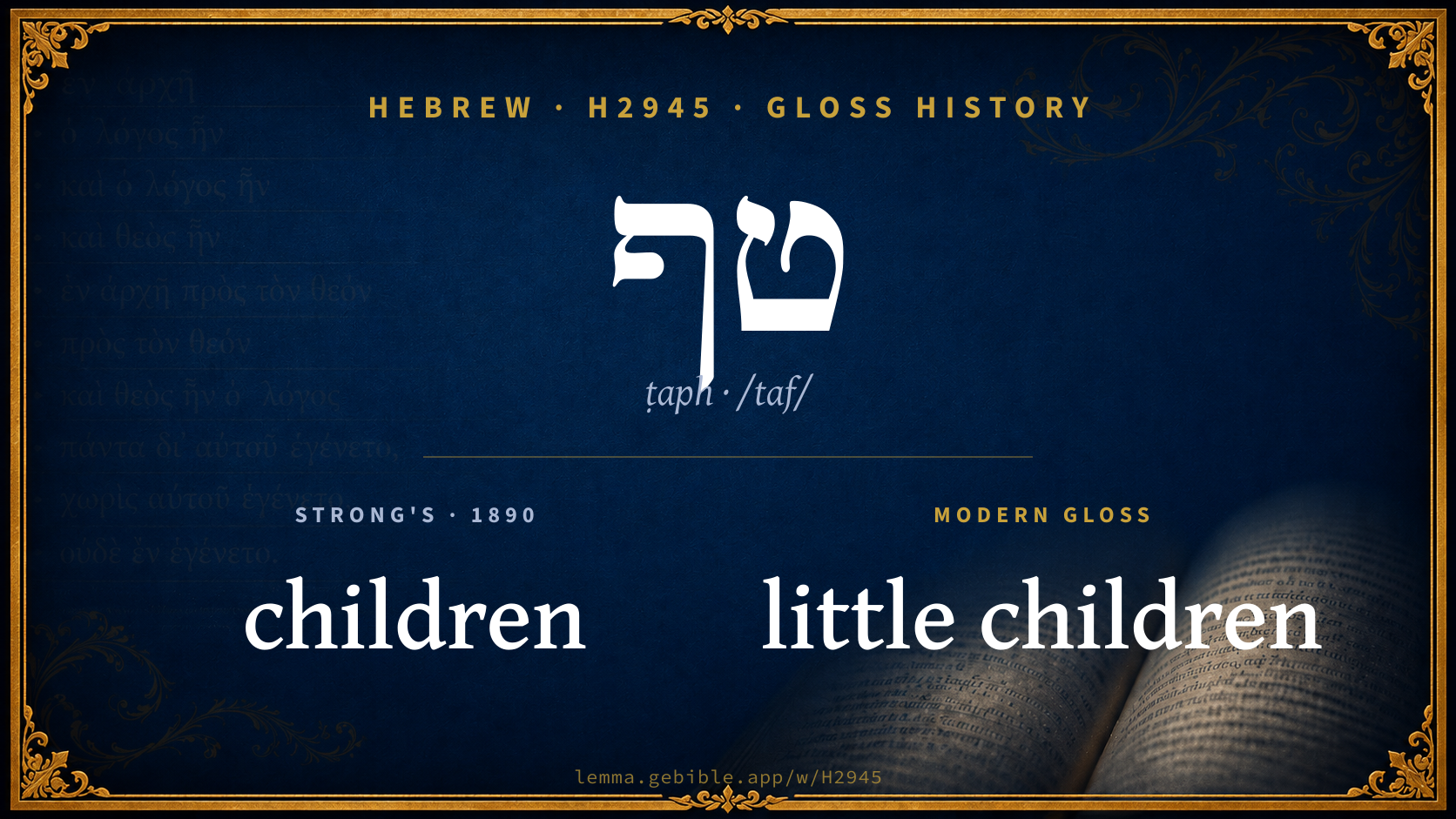
Gloss history
Strong's 1890 vs modern scholarship
About this word
Strong's H2945 catalogs a Hebrew word from the Hebrew Old Testament.
These counts are not copied from any lexicon or concordance. They are computed here, from the morphology-tagged Hebrew Old Testament. What Lemma adds →
- 42
- distinct verses
- The word appears in 42 distinct verses.
- 12 / 39
- OT books
- The word appears in 12 of 39 Old Testament books.
- #864
- by frequency
- Top 1000 most frequent Hebrew words (rank 864 of 8,640 Hebrew words by occurrence).
View all 42 occurrences in the concordance →
Most concentrated in
- Numbers 10 verses 24%
- Genesis 8 verses 19%
- Deuteronomy 7 verses 17%
By section of the Old Testament
By traditional corpus
Conventional, traditional groupings — biblical authorship is debated, so this is a traditional corpus grouping, not an authorship claim. Each share is this word’s portion of its verses in that division of the Hebrew canon. Each figure is a share of the word’s 42 distinct verses.
- Torah (Pentateuch) 28 verses · 67%
- Prophets (Nevi'im) 9 verses · 21%
- Writings (Ketuvim) 5 verses · 12%
How translations render this word
Counts come from each version’s own published word-to-Strong’s tagging or interlinear alignment — an approximate guide to how each version renders this word, not a word-level alignment the data otherwise carries. Because each total is that version’s own tagged count, the per-version totals vary from one another and need not match the appearance or distinct-verse counts above. These counts may also differ from a printed concordance because Lemma counts each distinctly tagged rendering and does not collapse phrase taggings into a single head-word total. This is a fixed set of word-tagged versions (KJV, ASV, BSB, ULT) and does not change with the reading translation you choose elsewhere. Each version’s license is shown beside its name below (and on Sources).
BDB lists this Strong’s number as 2 distinct words (homographs). Each count above pools all of them and is not split by sense — see the Senses section below. A low-frequency rendering may belong to a different one of those words, not the primary meaning.
- King James Version†: Little ones 19×, Children 9×, Little children 3×
- American Standard Version†: Little ones 22×, Children 4×, All their little ones 2×
- Berean Standard Bible†: Children 21×, Little ones 10×, Young children 2×
- unfoldingWord Literal Text†: Children 26×, Little ones 9×
King James Version Public Domain
Renders H2945 across 42† tagged occurrences — most commonly:
Plus 9 renderings that appear only once — usually multi-word phrases or single function words the recovered tagging swept in, not distinct renderings.
American Standard Version Public Domain
Renders H2945 across 42† tagged occurrences — most commonly:
Plus 12 renderings that appear only once — usually multi-word phrases or single function words the recovered tagging swept in, not distinct renderings.
Berean Standard Bible Public Domain
Renders H2945 across 41† tagged occurrences — most commonly:
Plus 8 renderings that appear only once — usually multi-word phrases or single function words the recovered tagging swept in, not distinct renderings. Not rendered by a distinct English word in 1 further occurrence.
unfoldingWord Literal Text CC BY-SA 4.0
Renders H2945 across 40† tagged occurrences — most commonly:
Plus 5 renderings that appear only once — usually multi-word phrases or single function words the recovered tagging swept in, not distinct renderings.
Senses in BDB
The 1 sense BDB distinguishes for this word, in lexicon order (not ranked by frequency or importance). The full entry — with sub-senses — is in the Lexicon Entry tab.
- children, little children, little ones
Word origin
n.m. coll. children (as going with quick, tripping steps; Ethiopic ጣፍ: Di 1251)—טַף Je 41:16 + 11 times; טָ֑ף Je 40:7 + 5 times; sf. טַפֵּנוּ Gn 43:8 + 5 times; טַפְּכֶם Gn 45:19 + 10 times; טַפָּם Gn 34:29 + 6 times; never cstr. and never pl. (in Gn 47:24 om. 𝔊, cf. Di);—children, little ones, Gn 34:29 (E) + 18 times JE (Gn Ex Nu), also Dt 1:39 + 8 times D (incl. Jos 1:14; 8:35); P only Nu 31:9, 17, 18, where note זָכָר בַּטָּ֑ף v 17 = young boys, and הַטַּף בַּנָּשִׁים v 18 = young girls; also Ju 18:21; 21:10 2 S 15:22 Je 40:7; 41:16; 43:6 Ez 9:6 2 Ch 20:13; 31:18 Ezr 8:21 Est 3:13; 8:11; the words מְתִים וְנָשִׁים וְהַטָּ֑ף Dt 2:34; 3:6 incl. all inhabitants; so אֲנָשִׁים וְהַנָּשִׁים וְהַטָּף Dt 31:12 Je 40:7; 43:6; טַף distinguished from בָּחוּר וּבְתוּלָה Ez 9:6; also from בְּנֵיהֶם 2 Ch 20:13, and from בְּנֵיהֶם וּבְנוֹתֵיהֶם 2 Ch 31:18. Note that the word includes (or implies) women as well as children, in foll.: Gn 47:12 Ex 12:37 (E), 10:10, 24 (J), Nu 32:16, 17 (JE; cf. Di on v 26).
— Brown-Driver-Briggs (Oxford 1906, public domain), digitized via Sefaria, supplemented by the OpenScriptures HebrewLexicon (CC BY 4.0). See Sources.
Derived from טפף (ṭâphaph) (H2952) — to skip.
Jastrow Dictionary
A second Hebrew/Aramaic lexicon for comparison, covering Aramaic and post-biblical (Talmudic, Targumic, Midrashic) usage that the biblical-Hebrew BDB does not. Matched by lemma rather than by Strong’s number, so a lemma may carry more than one Jastrow headword (shown separately below), and the entries cover usage well beyond the Bible.
טַף
- collect. pl. (b. h.; טָפַף I; cmp. טפל) [joined to, dependent,] children. Ḥag. 3ᵃ (ref. to Deut. XXXI, 12) טף למה באין why must the children come?; Tosef. Sot. VII, 9 טף למה בא (Var. טְפֵלִין … באין); Ab. d’R. N. ch. XVIII. Mekh. Bo. s. 16 וכי טף היה יודע וכ׳ would children have known to distinguish &c.? e.g. Deuteronomy 31:12
A Dictionary of the Targumim, the Talmud Babli and Yerushalmi, and the Midrashic Literature (Marcus Jastrow; London, Luzac, 1903) — Public Domain. Digitized via Sefaria. Digitized via Sefaria. Full attribution on Sources.
Forms in the corpus
The 37 distinct written forms H2945 takes in the Hebrew Bible, most frequent first — each parse links to that state’s occurrences in the concordance. Hebrew forms include their vowel points and cantillation, so a single lemma takes many written forms.
Septuagint verse parallels
This word appears in 41 verses that also exist in the Greek Old Testament (Septuagint), out of the 42 Hebrew verses it occurs in. You can read those verses in Greek by switching the Old Testament edition to the Septuagint.
Read these verses in the Septuagint
- Genesis 34:29
- Exodus 10:10
- Numbers 14:3
- Deuteronomy 1:39
- Joshua 1:14
- Judges 18:21
- 2 Samuel 15:22
- 2 Chronicles 20:13
- Ezra 8:21
- Esther 3:13
- Jeremiah 40:7
- Ezekiel 9:6
This is a verse-level parallel only — the same verses exist in both the Hebrew and Greek Old Testaments. No word-level Hebrew↔Greek correspondence is claimed: the data carries no such alignment, so no Greek word is shown as this Hebrew word’s translation. Coverage is not total — the Septuagint omits the deuterocanon and renumbers the Psalms, so some Hebrew verses have no direct Greek parallel.