2 Samuel 15:22

Hebrew (Westminster Leningrad Codex) 2 Samuel 15:22 appears in the Hebrew Old Testament. The text above is from the Westminster Leningrad Codex. Each word links to its Strong’s number, a concise gloss, and parsing drawn from the Open Scriptures Hebrew Bible morphology. Click any word for its full Brown-Driver-Briggs (BDB) entry.
Download image
Cite this verse

2 Samuel 15:22 (World English Bible). Public Domain. Lemma interlinear Bible study tool, https://lemma.gebible.app/v/2-samuel/15/22.

Show BibTeX & RIS
BibTeX
RIS
English Translation
David said to Ittai, Go and pass over. Ittai the Gittite passed over, and all his men, and all the little ones who were with him.
World English Bible · Public Domain
Download a study sheet

One document with this verse’s original text, its word-by-word gloss line, the meaning frame, cross-references with their text, attributed commentary, and full source and license credits — printable, and it pastes into notes with its structure intact.

This verse Autodidact and up

Study sheet (.html) Plain text (.txt)

A passage Seminary Student

Up to 50 verses in one chapter. A passage sheet keeps up to 6 commentary sources and 12 cross-references per verse, in the order this page ranks them, and says so on the sheet whenever that leaves anything out. Ask for a single verse and you get the Autodidact verse sheet above.

Everything on this page stays free to read, with no account — the sheet is a download of what is already on screen, not access to it.

Want to remove ads? Support Godless Engineer
Compare translations 3

The same verse in 3 English versions, stacked beneath the original-language interlinear above. Click any original word for its lexicon entry.

Each is an independent rendering of the whole verse — the interlinear is not word-aligned to these translations.

Highlighted words mark where these versions differ — a whole-verse word diff, not a word-by-word alignment.

  • World English Bible Public Domain
    David said to Ittai, Go and pass over. Ittai the Gittite passed over, and all his men, and all the little ones who were with him.
  • King James Version Public Domain
    And David said to Ittai, Go and pass over. And Ittai the Gittite passed over, and all his men, and all the little ones that were with him.
  • unfoldingWord Literal Text CC BY-SA 4.0
    And David said to Ittai, “Go and pass by.” So Ittai the Gittite passed by, and all of his men and all of the little who with him.

unfoldingWord Literal Text — © unfoldingWord, licensed CC BY-SA 4.0. Word-aligned USFM3 via Door43 (git.door43.org/unfoldingWord/en_ult).

Versions to compare (up to 4)

3 of 4 selected

Show all 18 translations

Every available English version of this verse, each an independent rendering of the whole verse.

  • World English Bible Public Domain
    David said to Ittai, Go and pass over. Ittai the Gittite passed over, and all his men, and all the little ones who were with him.
  • Berean Standard Bible Public Domain
    “March on then,” said David to Ittai. So Ittai the Gittite marched past with all his men and all the little ones who were with him.
  • Majority Standard Bible Public Domain
    “March on then,” said David to Ittai. So Ittai the Gittite marched past with all his men and all the little ones who were with him.
  • King James Version Public Domain
    And David said to Ittai, Go and pass over. And Ittai the Gittite passed over, and all his men, and all the little ones that were with him.
  • American Standard Version (1901) Public Domain
    And David said to Ittai, Go and pass over. And Ittai the Gittite passed over, and all his men, and all the little ones that were with him.
  • Revised Version (1885) Public Domain
    And David said to Ittai, Go and pass over. And Ittai the Gittite passed over and all his men, and all the little ones that were with him.
  • Geneva Bible (1599) Public Domain
    Then Dauid sayd to Ittai, Come, and go forward. And Ittai the Gittite went, and all his men, and all the children that were with him.
  • Douay-Rheims (1899) Public Domain
    And David said to Ethai: Come, and pass over. And Ethai the Gethite passed, and all the men that were with him, and the rest of the people.
  • Young's Literal Translation Public Domain
    And David saith unto Ittai, `Go and pass over;' and Ittai the Gittite passeth over, and all his men, and all the infants who `are' with him.
  • Literal Standard Version CC BY-SA 4.0
    And David says to Ittai, “Go and pass over”; and Ittai the Gittite passes over, and all his men, and all the infants who [are] with him.
  • Unlocked Literal Bible CC BY-SA 4.0
    So David said to Ittai, “Go ahead and continue with us.” So Ittai the Gittite marched with the king, along with all his men and all the families who were with him.
  • unfoldingWord Literal Text CC BY-SA 4.0
    And David said to Ittai, “Go and pass by.” So Ittai the Gittite passed by, and all of his men and all of the little who with him.
  • Darby Bible Public Domain
    And David said to Ittai, Go and pass over. And Ittai the Gittite passed over, and all his men, and all the little ones that were with him.
  • World Messianic Bible Public Domain
    David said to Ittai, “Go and pass over.” Ittai the Gittite passed over, and all his men, and all the little ones who were with him.
  • Webster's Bible Public Domain
    And David said to Ittai, Go and pass over. And Ittai the Gittite passed over, and all his men, and all the little ones that were with him.
  • Free Bible Version CC BY-SA 4.0
    “Go ahead, march on!” David replied. Ittai the Gittite marched past with all his men and all the families that were with him.
  • Bible in Basic English Public Domain
    And David said to Ittai, Go forward, then. And Ittai the Gittite went on, with all his men and all the little ones he had with him.
  • JPS Tanakh (1917) Public Domain
    And David said to Ittai: 'Go and pass over.' And Ittai the Gittite passed over, and all his men, and all the little ones that were with him.

Literal Standard Version (2020), Covenant Press — licensed CC BY-SA 4.0. Text via the HelloAO Bible API (eBible.org). Unlocked Literal Bible (unfoldingWord) — licensed CC BY-SA 4.0. Text via the HelloAO Bible API (eBible.org). unfoldingWord Literal Text — © unfoldingWord, licensed CC BY-SA 4.0. Word-aligned USFM3 via Door43 (git.door43.org/unfoldingWord/en_ult). Free Bible Version, Dr. Jonathan Gallagher — licensed CC BY-SA 4.0. Text via the HelloAO Bible API (eBible.org).

Word by word

More ways to search: Search by grammar → Find every occurrence → Compare this word →

Practice this passage: Drill this verse → Learn its vocabulary →

אִתַּ֖י
ʼIttay
H863
“Ittai”
Noun, Proper
Part of Speech
Noun
Type
Proper
Full BDB Definition

Origin: from H854

TWOT: None

Ittai or Ithai = "with me" - a Gittite commander from Gath in David's army - one of David's 30 mighty warriors, a Benjamite
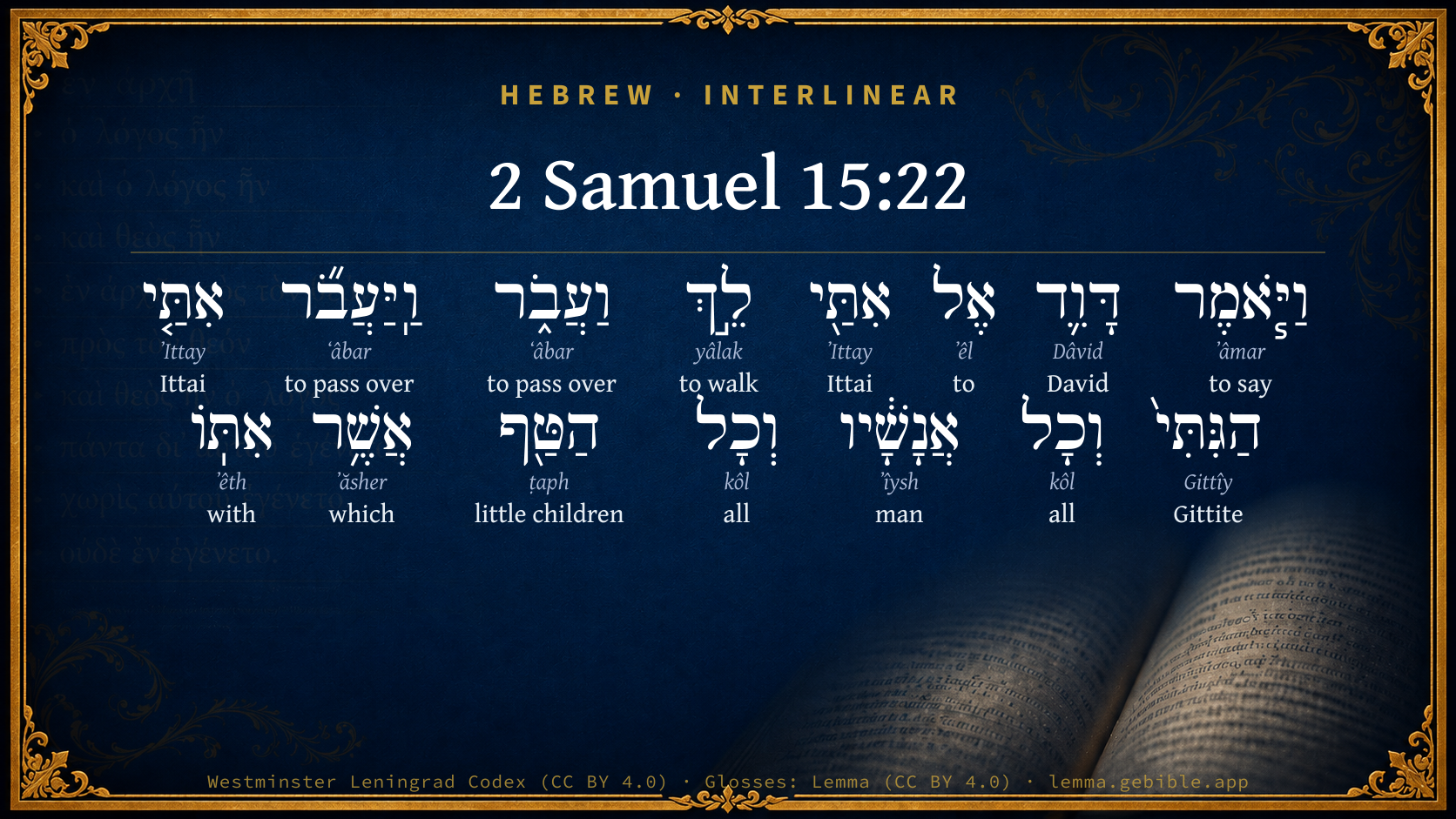
  1. וַיֹּ֧אמֶר ʼâmar H559 “and · to say” Conjunction + Verb, Qal, Sequential Imperfect, 3rd Person, Masculine, Singular
  2. דָּוִ֛ד Dâvid H1732 “David” Noun, Proper
  3. אֶל ʼêl H413 “to” Preposition
  4. לֵ֣ךְ yâlak H3212 “walk” Verb, Qal, Imperative, 2nd Person, Masculine, Singular
  5. וַעֲבֹ֑ר ʻâbar H5674 “and · pass over” Conjunction + Verb, Qal, Imperative, 2nd Person, Masculine, Singular
  6. וַֽיַּעֲבֹ֞ר ʻâbar H5674 “and · to pass over” Conjunction + Verb, Qal, Sequential Imperfect, 3rd Person, Masculine, Singular
  7. אִתַּ֤י ʼIttay H863 “Ittai” Noun, Proper
  8. הַגִּתִּי֙ Gittîy H1663 “the · Gittite” Particle, Definite Article + Noun, Gentilic, Masculine, Singular, Absolute
  9. וְכָל kôl H3605 “and · all of” Conjunction + Noun, Common, Masculine, Singular, Construct
  10. אֲנָשָׁ֔יו ʼîysh H376 “men · his” Noun, Common, Masculine, Plural, Construct + Suffix, Personal, 3rd Person, Masculine, Singular
  11. וְכָל kôl H3605 “and · all of” Conjunction + Noun, Common, Masculine, Singular, Construct
  12. הַטַּ֖ף ṭaph H2945 “the · little children” Particle, Definite Article + Noun, Common, Masculine, Singular, Absolute
  13. אֲשֶׁ֥ר ʼăsher H834 “which” Particle, Relative
  14. אִתּֽוֹ ʼêth H854 “with · him” Preposition + Suffix, Personal, 3rd Person, Masculine, Singular

About this verse

These counts appear in no published source. They are computed here, from the morphology-tagged text and Lemma’s own curated glosses. What Lemma adds →

15
words
12
distinct lemmas
Historical
section

Notable vocabulary

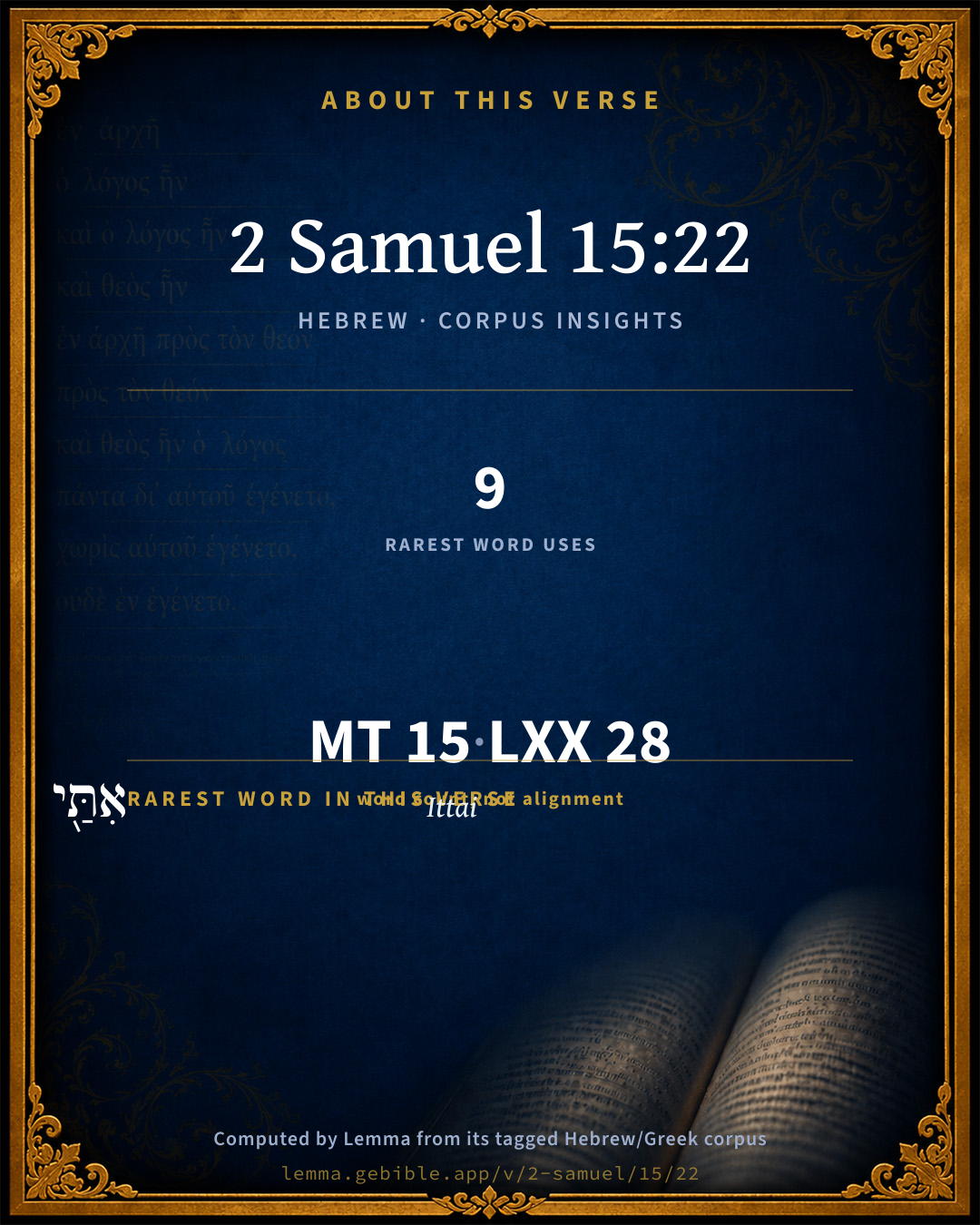
The rarest word here is אִתַּ֖י Ittai H863 — appearing just 9 times in the whole Hebrew Bible.

Shared distinctive vocabulary

אִתַּ֖י Ittai H863 occurs in 8 verses of the Hebrew Bible. Also found in:

Grammatical profile

  • 4 verbs
  • 8 nouns
  • 2 prepositions
  • 1 particle

Verb forms

  • וַיֹּ֧אמֶר Qal · Sequential Imperfect
  • לֵ֣ךְ Qal · Imperative
  • וַעֲבֹ֑ר Qal · Imperative
  • וַֽיַּעֲבֹ֞ר Qal · Sequential Imperfect

Repetition

Words recur within this verse — often emphatic in Hebrew:

  • אִתַּ֖י Ittai H863 ×2
  • וַעֲבֹ֑ר to pass over H5674 ×2
  • וְכָל all H3605 ×2

Hebrew & Septuagint length

In English translation the verse runs 26 words from the Hebrew and 31 from the Septuagint (LXX English) — closely comparable.

A rough comparison of the two English renderings, which tokenize alike — not a word-level alignment.

Word counts can differ between the Hebrew and the Greek without any difference in meaning — e.g. the Hebrew direct-object marker אֵת has no separate Greek word, and Greek often adds the article ὁ.

In the original languages it is 15 Hebrew tokens and 28 Greek tokens — but the two are counted differently (Hebrew bundles its prefixes and suffixes into one token; the Greek is in lemma form), so that isn’t a like-for-like length.

Hebrew and Greek witnesses Masoretic Hebrew ↔ Greek Septuagint

The same verse in the two great witnesses to the Old Testament, shown verse-for-verse.

These are two independent witnesses, not word-aligned to each other, and the Septuagint is shown in lemma (dictionary) form.

Hebrew 2 Samuel 15:22 Masoretic · Westminster Leningrad Codex

וַיֹּ֧אמֶר דָּוִ֛ד אֶל אִתַּ֖י לֵ֣ךְ וַעֲבֹ֑ר וַֽיַּעֲבֹ֞ר אִתַּ֤י הַגִּתִּי֙ וְכָל אֲנָשָׁ֔יו וְכָל הַטַּ֖ף אֲשֶׁ֥ר אִתּֽוֹ

David said to Ittai, Go and pass over. Ittai the Gittite passed over, and all his men, and all the little ones who were with him.

World English Bible · Public Domain

Greek LXX 2 Samuel 15:22 Septuagint · lemma form

καί εἶπον ὁ βασιλεύς πρός εθθι δεῦρο καί διαβαίνω μετά ἐγώ καί παραἔρχομαι εθθι ὁ γεθθαῖος καί πᾶς ὁ παῖς αὐτός καί πᾶς ὁ ὄχλος ὁ μετά αὐτός

And the king said to Ethi, Come and pass over with me. So Ethi the Gittite and the king passed over, and all his servants, and all the multitude with him.

LXX2012 (modern English Septuagint) · Public Domain

On this verse, Keil & Delitzsch discusses the Septuagint’s reading. Read the note in Commentary ↓

Hebrew: Westminster Leningrad Codex (CC BY 4.0). Greek: Septuagint (public domain); English from LXX2012 (modern English Septuagint) (Public Domain). How the Septuagint differs from the Hebrew →

Targum (Aramaic paraphrase)

1

The Targum is the ancient Jewish Aramaic paraphrase of the Hebrew Scriptures — an interpretive translation, not the Hebrew text itself. Onkelos (literal) and Pseudo-Jonathan (expansive) render the Torah, and Jonathan the Prophets. Coverage is partial: where no permissively-licensed English translation exists for a verse, only the Aramaic is shown. This is verse-level text, not a word-by-word alignment to the Hebrew.

  1. Targum Jonathan Prophets (Joshua–Malachi)
    וַאֲמַר דָוִד לְאִתַּי אֱזֵיל וֶעֱבַר וַעֲבַר אִתַּי גִתָאָה וְכָל גַבְרוֹהִי וְכָל טַפְלָא דְעִימֵיהּ:

    (no public-domain English translation for this verse)

    Targum Jonathan — Aramaic: “Mikraot Gedolot” (public domain). English: “Sefaria Community Translation” (CC0 1.0 (public-domain dedication)); “London "Chaldee Paraphrase," 1871” (public domain). Text via Sefaria.

Commentary

Notes on 2 Samuel 15:22 from classic Christian and Jewish commentators (each source and its license shown beneath its notes). The classic Christian expositions comment on the surrounding passage and are grouped to its opening verse, so a note may address several verses; the Jewish commentaries on the Tanakh (Rashi and others) are per-verse, so they appear only where the commentator wrote on this verse.

Lemma curates 59 commentaries, every one of them public domain or Creative Commons licensed, each selected and text-cleaned for this edition rather than reprinted as found. About our sources →

Trapp's Complete Commentary

John Trapp

2Sa 15:22 And David said to Ittai, Go and pass over. And Ittai the Gittite passed over, and all his men, and all the little ones that [were] with him.

Ver. 22. Go and pass over.] The river Kidron, {2Sa 15:23} since thou art resolved to live and die with me. This was some comfort to David, that strangers were thus stirred up to stick to him, when his own son lifted up his heel against him, and sought to get into the throne by making the dead carcass of his father a step to it.

John Trapp, A Commentary or Exposition upon All the Books of the Old and New Testament (1647–1656) — public domain. Text from a community e-Sword module.

Joseph Benson's Commentary

2Sa 15:22. Ittai the Gittite passed over — The brook Kidron, as it follows in the next verse. And all the little ones that were with him — This shows that his whole family were come to sojourn in Judea. And being so deeply engaged for David, he durst not leave his little ones to Absalom’s mercy.

Joseph Benson's Commentary on the Old and New Testaments (1811–1818) — public domain. Text from a community e-Sword module.

Keil & Delitzsch

C. F. Keil & F. Delitzsch

After this assurance of his devotedness, David let Ittai do as he pleased. ועבר לך, "go and pass on." עבר does not mean to pass by, but to go forward. Thus Ittai and his men and all his family that was with him went forward with the king. By "the little ones" (taph) we are to understand a man's whole family, as in many other instances (see at Exo 12:37).

Sa2 15:22-23

The king crosses the Kidron, and sends the priests back with the ark to Jerusalem. - Sa2 15:23. All the land (as in Sa1 14:25) wept aloud when all the people went forward; and the king went over the brook Kidron, and all the people went over in the direction of (lit. in the face of) the way to the desert. The brook Kidron is a winter torrent, i.e., a mountain torrent which only flows during the heavy rains of winter (χείμαῤῥος τοῦ Κεδρών, Joh 18:1). It is on the eastern side of Jerusalem, between the city and the Mount of Olives, and derives its name from the appearance of the water when rendered muddy through the melting of the snow (cf. Job 6:16). In summer it is nothing more than a dry channel in the valley of Jehoshaphat (see Robinson, Pal. i. 396, and v. Raumer, Pal. p. 309, note 81). "The wilderness" (midbar) is the northern part of the desert of Judah, through which the road to Jericho and the Jordan lay.

Sa2 15:24

Zadok the priest and all the Levites (who were in Jerusalem) left the city with the fugitive king, bearing the ark of the covenant: "And they set down the ark of God, and Abiathar came up, till all the people had come completely over from the city." ויּעל, ἀνέβη, ascendit (lxx, Vulg.), may probably be accounted for from the fact that Abiathar did not come to join the fugitives till the procession halted at the Mount of Olives; so that עלה, like ἀναβαίνειν, merely refers to his actually going up, and ויּעל affirms that Abiathar joined them until all the people from the city had arrived. The rendering proposed by Michaelis and Bttcher ("he offered sacrifices") is precluded by the fact that עלה never means to sacrifice when written without עולה, or unless the context points distinctly to sacrifices, as in Sa2 24:22; Sa1 2:28. The ark of the covenant was put down, because those who went out with the king made a halt, to give the people who were still coming time to join the procession.

Sa2 15:25-26

Then the king said to Zadok, "Take back the ark of God into the city! If I find favour in the eyes of Jehovah, He will bring me back and let me see Him (i.e., himself: the reference is to God) and His dwelling (i.e., the ark of the covenant as the throne of the divine glory in the tent that had been set up for it). But if He thus say, I have not delight in thee; behold, here am I, let Him do to me as seemeth good to Him." Thus David put his fate in believing confidence into the hand of the Lord, because he felt that it was the Lord who was chastising him for his sons through this rebellion.

Sa2 15:27-28

He also said still further to Zadok, "Thou seer! return into the city in peace." אתּה הרואה, with ה interrog., does not yield any appropriate sense, as ה cannot stand for הלוא here, simply because it does not relate to a thing which the person addressed could not deny. Consequently the word must be pointed thus, הראה (with the article), and rendered as a vocative, as it has been by Jerome and Luther. ראה, seer, is equivalent to prophet. He applies this epithet to Zadok, as the high priest who received divine revelations by means of the Urim. The meaning is, Thou Zadok art equal to a prophet; therefore thy proper place is in Jerusalem (O. v. Gerlach). Zadok was to stand as it were upon the watch there with Abiathar, and the sons of both to observe the events that occurred, and send him word through their sons into the plain of the Jordan. "Behold, I will tarry by the ferries of the desert, till a word comes from you to show me," sc., what has taken place, or how the things shape themselves in Jerusalem. Instead of בּעברות, the earlier translators as well as the Masoretes adopted the reading בּערבות, "in the steppes of the desert." The allusion in this case would be to the steppes of Jericho (Kg2 25:5). But Bttcher has very properly defended the Chethib on the strength of Sa2 17:16, where the Keri has ערבות again, though עברות is the true reading (cf. Sa2 19:19). The "ferries of the desert" are the places where the Jordan could be crossed, the fords of the Jordan (Jos 2:7; Jdg 3:28).

Sa2 15:29

Zadok and Abiathar then returned to the city with the ark of God.

Keil & Delitzsch — Biblical Commentary on the Old Testament (1861–1891) — public domain (CC PDM 1.0). Text via the HelloAO Bible API. (Old Testament only.)

John Gill's Exposition

And David said unto Ittai, go, and pass over,.... It being his resolution to abide with him, he urged him no more to depart, but bid him pass over the brook Kidron before him:

and Ittai the Gittite passed over, and all his men; the six hundred Gittites that were under his command:

and all the little ones that were with him; that belonged to him and his men, and no doubt their wives also.

John Gill's Exposition of the Whole Bible (1746–1763) — public domain (CC PDM 1.0). Text via the HelloAO Bible API.

Matthew Poole's English Annotations

For being so deeply engaged for David, he durst not leave his little ones to Absalom’s mercy.

Matthew Poole's English Annotations on the Holy Bible (1683–1685) — public domain. Text from a community e-Sword/MySword module.

Whedon's Commentary on the Bible

Daniel D. Whedon

22. All his men — The brethren of 2Sa_15:20.

Daniel D. Whedon (gen. ed.), Commentary on the Old and New Testaments (1874–1909) — public domain. Text from a community e-Sword module.

The Pulpit Commentary

All the little ones; Hebrew, all the taf; in ver. 20 called "his brethren," that is, all the relatives and dependents who had accompanied him in his exile. Their presence with him proves that he had entirely broken with the Philistines, and left his country for good. He may have taken this step for religious reasons, though his swearing by Jehovah (ver. 21) does not prove it, as Achish did the same; (1Sa_29:6) or Ittai, after the capture of Gath by David, (2Sa_8:1) may have made himself unpopular by becoming the ally of the conqueror, and so finally have determined to leave the city, and find a home in Israel.

The Pulpit Commentary (1880–1919), ed. H.D.M. Spence-Jones & Joseph S. Exell — public domain. Text from a community e-Sword module.

John Wesley's Explanatory Notes

Little ones - For being so deeply engaged for David, he durst not leave his little ones to Absalom's mercy.

John Wesley, Explanatory Notes Upon the Whole Bible (1754–1765) — public domain. Text via the GEBible commentary corpus.

Rashi

Rabbi Shlomo Yitzchaki (Rashi)

"Go and pass" Together with the rest of the people now that you do not want to part from me.

Rashi on the Tanakh — English translations: “The Judaica Press complete Tanach with Rashi, translated by A. J. Rosenberg” (CC BY 4.0); “Pentateuch with Rashi's commentary by M. Rosenbaum and A.M. Silbermann, 1929-1934” (public domain); “The Metsudah Tanach series, Lakewood, N.J” (CC BY 4.0); and “The Book of Joshua, Metsudah Publications, 1997” (CC BY 4.0). Text via Sefaria.

Lesson kit

Teaching starters — assembled from the data on this page, not authored interpretation. Every prompt links to the verse data it draws on. Edit before teaching.

2 Samuel, in the Historical, opens this verse with 15 words (12 distinct Hebrew lemmas). Its most distinctive word is ʼIttay (“Ittai”). A historical commentator’s framing appears above. Read the whole chapter for the surrounding context.

Discussion questions

  1. What does “Ittai” (ʼIttay) contribute to the verse as a whole?
  2. How does 2 Samuel 15:19, which shares the word «Ittai», read alongside this verse?
  3. What does the repetition of “Ittai” (2× in this one verse) do in this verse?
  4. The translations on this page render this verse differently — a whole-verse word diff, not a word-by-word alignment. What might account for the different wordings?
  5. «וַיֹּ֧אמֶר» is a Qal Sequential Imperfect verb. How does that grammatical form shape the action described?
  6. Compare how Trapp's Complete Commentary and Joseph Benson's Commentary read this verse. Where do they agree or differ?

Things to notice

Reading settings

Reading text

Shown beneath each verse's original-language words.

Old Testament
Old Testament edition

Read the OT as the Masoretic Hebrew (MT) or the Greek Septuagint (LXX).

English shown for the Greek Septuagint (in the Hebrew ↔ Greek comparison).

Comparing translations? Open the Compare panel on any verse page to stack up to four side by side.