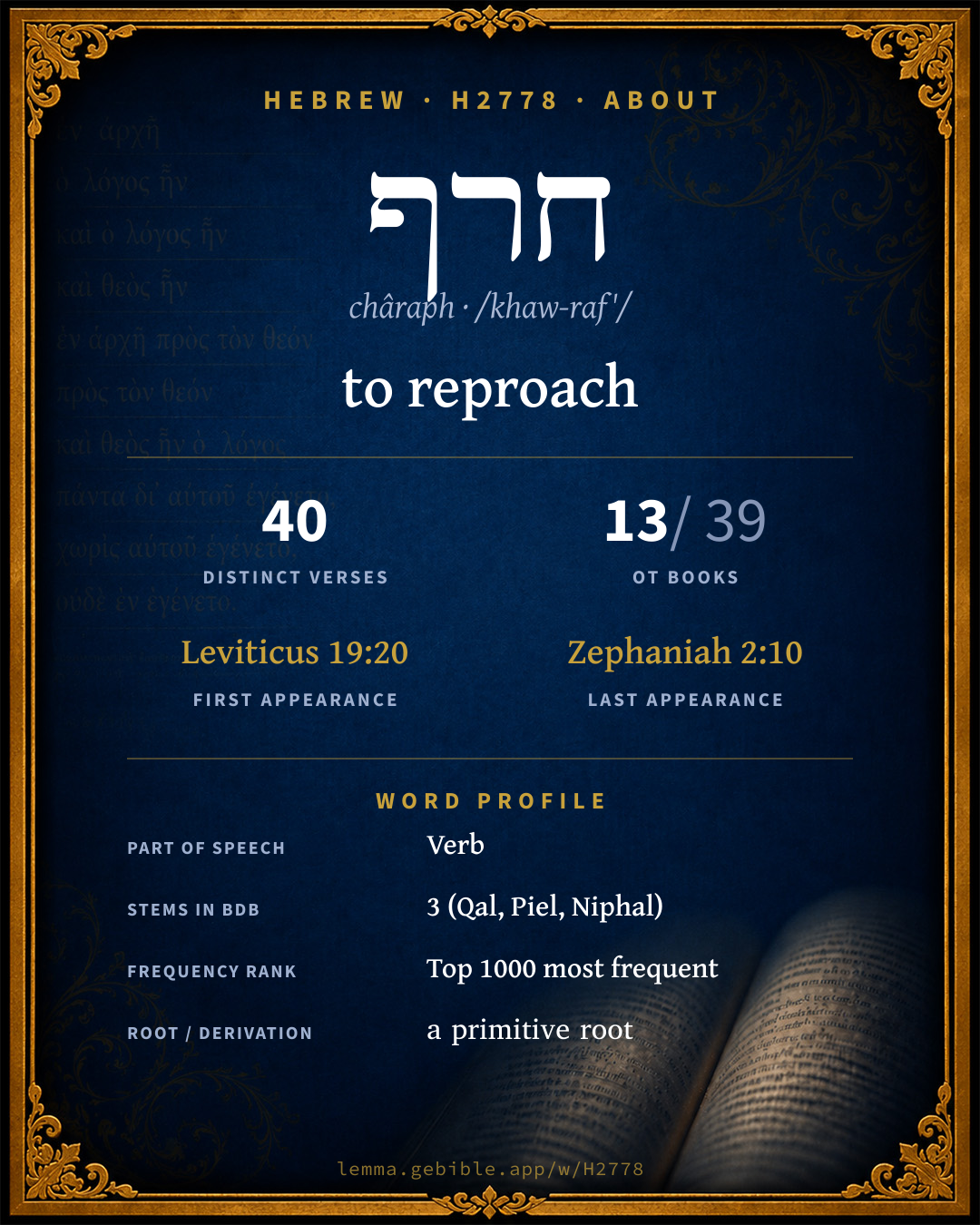
חָרַף
to reproach
also: taunt, blaspheme, defy, jeopardise fuller range ↓
Full lexicon entry — Brown-Driver-Briggs (BDB)
From Brown-Driver-Briggs (BDB)
Where this word appears
See every Piel verb in the Hebrew Bible →
Grammar key — what these labels mean
Part of speech
- Verb
- An action or state-of-being word.
Stem
- Piel
- An intensive or resultative active stem.
- Qal
- The basic, simple active stem — the plain form of the verb (“he wrote”).
- Niphal
- Usually the simple passive or reflexive of the Qal (“he was written”).
Form
- Perfect
- A completed action or state — Hebrew marks aspect (completeness) more than strict tense (“he wrote”).
- Infinitive Construct
- A bound verbal noun, frequently with prepositions (“to write / in writing”).
- Sequential Imperfect
- An imperfect with prefixed waw — the standard past-narrative form (waw-consecutive imperfect).
- Participle Active
- A verbal adjective expressing ongoing or characteristic action (“writing / one who writes”).
- Imperfect
- An incomplete, ongoing, or future action (“he will / would write”).
State
- Construct
- A noun bound to a following noun in a possessive / “of” relationship (the construct chain).
- Absolute
- The independent form of a noun, not bound to a following word.
Person
- 3rd Person
- The one spoken about (“he / she / it / they”).
- 2nd Person
- The one addressed (“you”).
- 1st Person
- The speaker (“I / we”).
Gender
- Masculine
- Grammatically masculine.
- Common
- Either gender — not distinguished for this form.
- Feminine
- Grammatically feminine.
Number
- Singular
- One.
- Plural
- More than one (in Hebrew, generally three or more).
34 distinct verses where H2778 appears in the Piel stem, across 11 books. Filtered view — show all forms. Click any verse to open its interlinear word-by-word view. Verse text shown in the World English Bible for context — . Each verse’s Hebrew form is shown with its reference; the English is not keyword-highlighted, since the data carries no word-level English alignment. Use “Compare translations” on any verse to read it across multiple English versions. This concordance covers the Hebrew Bible; Septuagint (Greek Old Testament) occurrences are not indexed here.
Judges 2 verses
- Judges 5:18 חֵרֵ֥ף Piel pf 3ms Zebulun was a people that jeopardized their lives to the death, Naphtali, on the high places of the field.
- Judges 8:15 חֵרַפְתֶּ֨ם Piel pf 2mp He came to the men of Succoth, and said, See Zebah and Zalmunna, concerning whom you did taunt me, saying, Are the hands of Zebah and Zalmunna now in your hand, that we should give bread to your men who are weary?
1 Samuel 5 verses
- 1 Samuel 17:10 חֵרַ֛פְתִּי Piel pf 1cs The Philistine said, I defy the armies of Israel this day; give me a man, that we may fight together.
- 1 Samuel 17:25 לְ/חָרֵ֥ף prep + Piel inf.cs The men of Israel said, Have you seen this man who is come up? surely to defy Israel is he come up: and it shall be, that the man who kills him, the king will enrich him with great riches, and will give him his daughter, and make his father's house free in Israel.
- 1 Samuel 17:26 חֵרֵ֔ף Piel pf 3ms David spoke to the men who stood by him, saying, What shall be done to the man who kills this Philistine, and takes away the reproach from Israel? for who is this uncircumcised Philistine, that he should defy the armies of the living God?
- 1 Samuel 17:36 חֵרֵ֔ף Piel pf 3ms Your servant struck both the lion and the bear: and this uncircumcised Philistine shall be as one of them, seeing he has defied the armies of the living God.
- 1 Samuel 17:45 חֵרַֽפְתָּ Piel pf 2ms Then said David to the Philistine, You come to me with a sword, and with a spear, and with a javelin: but I come to you in the name of Yahweh of hosts, the God of the armies of Israel, whom you have defied.
2 Samuel 2 verses
- 2 Samuel 21:21 וַ/יְחָרֵ֖ף conj + Piel wimpf 3ms When he defied Israel, Jonathan the son of Shimei, David's brother, killed him.
- 2 Samuel 23:9 בְּ/חָֽרְפָ֤/ם prep + Piel inf.cs + sfx pers 3mp After him was Eleazar the son of Dodai the son of an Ahohite, one of the three mighty men with David, when they defied the Philistines who were there gathered together to battle, and the men of Israel were gone away.
2 Kings 4 verses
- 2 Kings 19:4 לְ/חָרֵף֙ prep + Piel inf.cs It may be Yahweh your God will hear all the words of Rabshakeh, whom the king of Assyria his master has sent to defy the living God, and will rebuke the words which Yahweh your God has heard. Therefore lift up your prayer for the remnant that is left.
- 2 Kings 19:16 לְ/חָרֵ֖ף prep + Piel inf.cs Incline your ear, Yahweh, and hear; open your eyes, Yahweh, and see; and hear the words of Sennacherib, with which he has sent him to defy the living God.
- 2 Kings 19:22 חֵרַ֨פְתָּ֙ Piel pf 2ms Whom have you defied and blasphemed? and against whom have you exalted your voice and lifted up your eyes on high? [even] against the Holy One of Israel.
- 2 Kings 19:23 חֵרַ֣פְתָּ Piel pf 2ms By your messengers you have defied the Lord, and have said, With the multitude of my chariots am I come up to the height of the mountains, to the innermost parts of Lebanon; and I will cut down the tall cedars of it, and the choice fir trees of it; and I will enter into his farthest lodging-place, the forest of his fruitful field.
1 Chronicles 1 verse
2 Chronicles 1 verse
Nehemiah 1 verse
Psalms 9 verses
- Psalms 42:10 חֵרְפ֥וּ/נִי Piel pf 3cp + sfx pers 1cs As with a sword in my bones, my adversaries reproach me, While they continually ask me, "Where is your God?"
- Psalms 44:16 מְחָרֵ֣ף Piel ptcp.act ms At the taunt of one who reproaches and verbally abuses, Because of the enemy and the avenger.
- Psalms 55:12 יְחָֽרְפֵ֗/נִי Piel impf 3ms + sfx pers 1cs For it was not an enemy who insulted me, Then I could have endured it. Neither was it he who hated me who raised himself up against me, Then I would have hid myself from him.
- Psalms 57:3 חֵרֵ֣ף Piel pf 3ms He will send from heaven, and save me, He rebukes the one who is pursuing me. Selah. God will send out his loving kindness and his truth.
- Psalms 74:10 יְחָ֣רֶף Piel impf 3ms How long, God, shall the adversary reproach? Shall the enemy blaspheme your name forever?
- Psalms 74:18 חֵרֵ֣ף Piel pf 3ms Remember this, that the enemy has mocked you, Yahweh. Foolish people have blasphemed your name.
- Psalms 79:12 חֵרְפ֣וּ/ךָ Piel pf 3cp + sfx pers 2ms Pay back to our neighbors seven times into their bosom Their reproach with which they have reproached you, Lord.
- Psalms 89:51 חֵרְפ֖וּ חֵ֝רְפ֗וּ Piel pf 3cp Piel pf 3cp With which your enemies have mocked, Yahweh, With which they have mocked the footsteps of your anointed one.
- Psalms 102:8 חֵרְפ֣וּ/נִי Piel pf 3cp + sfx pers 1cs My enemies reproach me all day. Those who are mad at me use my name as a curse.
Proverbs 2 verses
Isaiah 5 verses
- Isaiah 37:4 לְ/חָרֵף֙ prep + Piel inf.cs It may be Yahweh your God will hear the words of Rabshakeh, whom the king of Assyria his master has sent to defy the living God, and will rebuke the words which Yahweh your God has heard. Therefore lift up your prayer for the remnant that is left.
- Isaiah 37:17 לְ/חָרֵ֖ף prep + Piel inf.cs Turn your ear, Yahweh, and hear; open your eyes, Yahweh, and behold; and hear all the words of Sennacherib, who has sent to defy the living God.
- Isaiah 37:23 חֵרַ֨פְתָּ֙ Piel pf 2ms Whom have you defied and blasphemed? and against whom have you exalted your voice and lifted up your eyes on high? [even] against the Holy One of Israel.
- Isaiah 37:24 חֵרַ֣פְתָּ Piel pf 2ms By your servants have you defied the Lord, and have said, With the multitude of my chariots am I come up to the height of the mountains, to the innermost parts of Lebanon; and I will cut down the tall cedars of it, and the choice fir trees of it; and I will enter into its farthest height, the forest of its fruitful field;
- Isaiah 65:7 חֵרְפ֑וּ/נִי Piel pf 3cp + sfx pers 1cs your own iniquities, and the iniquities of your fathers together, says Yahweh, who have burned incense on the mountains, and blasphemed me on the hills; therefore will I first measure their work into their bosom.
Zephaniah 2 verses
- Zephaniah 2:8 חֵֽרְפוּ֙ Piel pf 3cp I have heard the reproach of Moab, and the insults of the children of Ammon, with which they have reproached my people, and magnified themselves against their border.
- Zephaniah 2:10 חֵֽרְפוּ֙ Piel pf 3cp This they will have for their pride, because they have reproached and magnified themselves against the people of Yahweh of Hosts.
About this entry
At a glance — auto-summarized from this page’s data, not written by a person. Every figure links to its source below. This summary describes the numbers; it doesn’t interpret them.
חרף (châraph) is a Hebrew verb most often rendered “to reproach.” The King James Version usually renders it “reproach,” while modern versions prefer “defy” (Berean Standard Bible) and “taunt” (unfoldingWord Literal Text) — see the renderings breakdown. With 40 verses in 13 books, it is a moderately common word in the Hebrew Bible. It concentrates in Psalms, which alone accounts for 28% of its uses. As a verb its force shifts by stem, across 3 stems (Qal, Piel, and more). For the data behind this summary, explore the sense tree and the renderings breakdown below.
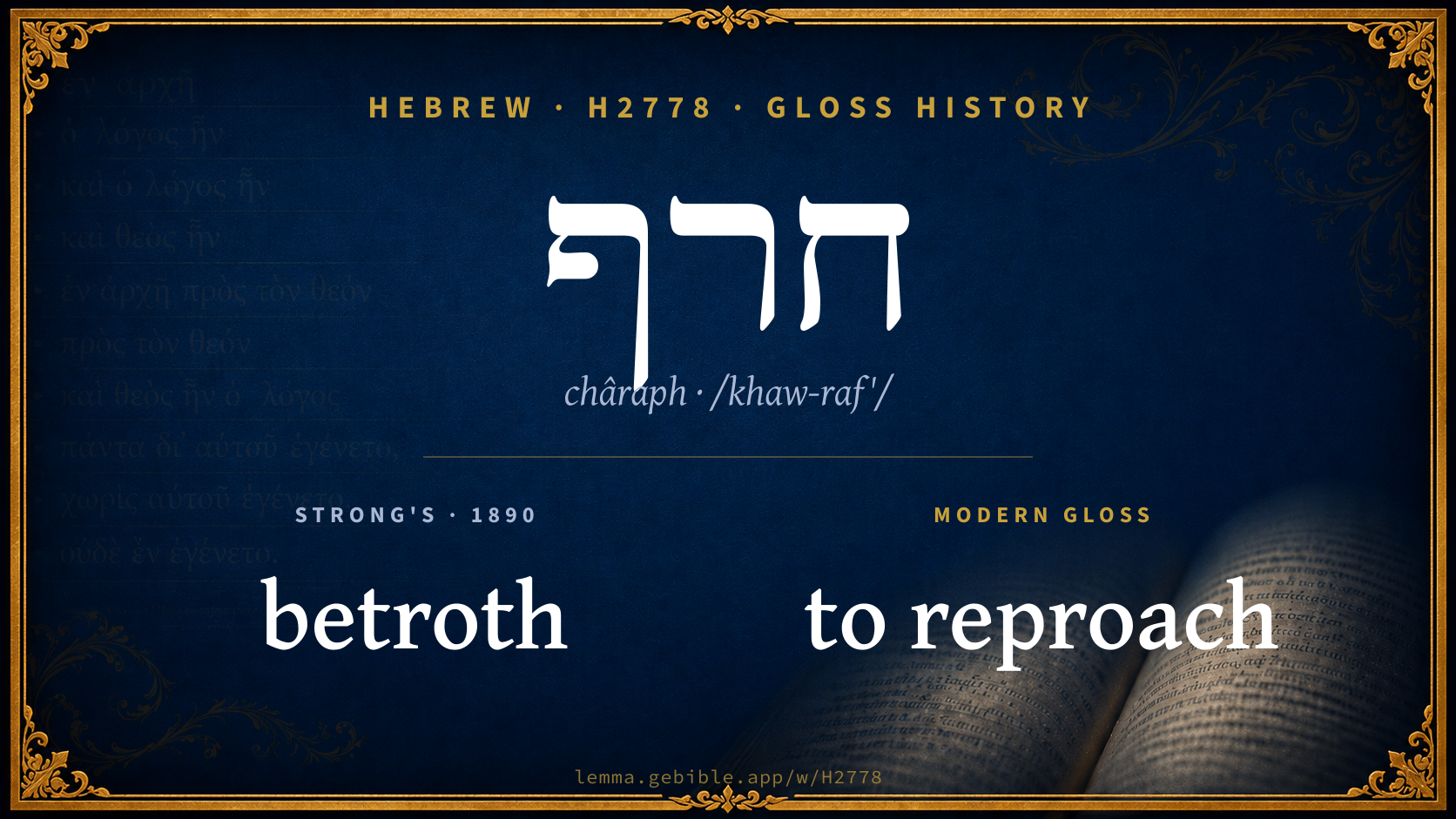
Gloss history
Strong's 1890 vs modern scholarship
About this word
Strong's H2778 catalogs a Hebrew word from the Hebrew Old Testament.
These counts are not copied from any lexicon or concordance. They are computed here, from the morphology-tagged Hebrew Old Testament. What Lemma adds →
- 40
- distinct verses
- The word appears in 40 distinct verses.
- 13 / 39
- OT books
- The word appears in 13 of 39 Old Testament books.
- #891
- by frequency
- Top 1000 most frequent Hebrew words (rank 891 of 8,640 Hebrew words by occurrence).
View all 40 occurrences in the concordance →
By section of the Old Testament
By traditional corpus
Conventional, traditional groupings — biblical authorship is debated, so this is a traditional corpus grouping, not an authorship claim. Each share is this word’s portion of its verses in that division of the Hebrew canon. Each figure is a share of the word’s 40 distinct verses.
- Prophets (Nevi'im) 21 verses · 53%
- Writings (Ketuvim) 18 verses · 45%
- Torah (Pentateuch) 1 verse · 3%
How translations render this word
Counts come from each version’s own published word-to-Strong’s tagging or interlinear alignment — an approximate guide to how each version renders this word, not a word-level alignment the data otherwise carries. Because each total is that version’s own tagged count, the per-version totals vary from one another and need not match the appearance or distinct-verse counts above. These counts may also differ from a printed concordance because Lemma counts each distinctly tagged rendering and does not collapse phrase taggings into a single head-word total. This is a fixed set of word-tagged versions (KJV, ASV, BSB, ULT) and does not change with the reading translation you choose elsewhere. Each version’s license is shown beside its name below (and on Sources).
BDB lists this Strong’s number as 3 distinct words (homographs). Each count above pools all of them and is not split by sense — see the Senses section below. A low-frequency rendering may belong to a different one of those words, not the primary meaning.
- King James Version†: Reproach 8×, Reproacheth 5×, Hast thou reproached 3×
- American Standard Version†: Defy 4×, Reproach 4×, Reproacheth 4×
- Berean Standard Bible†: Defy 6×, Have taunted 2×, Have you taunted 2×
- unfoldingWord Literal Text†: Taunt 7×, Have you mocked 2×, He taunted 2×
King James Version Public Domain
Renders H2778 across 41† tagged occurrences — most commonly:
Plus 19 renderings that appear only once — usually multi-word phrases or single function words the recovered tagging swept in, not distinct renderings.
American Standard Version Public Domain
Renders H2778 across 41† tagged occurrences — most commonly:
Plus 19 renderings that appear only once — usually multi-word phrases or single function words the recovered tagging swept in, not distinct renderings.
Berean Standard Bible Public Domain
Renders H2778 across 41† tagged occurrences — most commonly:
Plus 23 renderings that appear only once — usually multi-word phrases or single function words the recovered tagging swept in, not distinct renderings.
unfoldingWord Literal Text CC BY-SA 4.0
Renders H2778 across 46† tagged occurrences — most commonly:
Plus 25 renderings that appear only once — usually multi-word phrases or single function words the recovered tagging swept in, not distinct renderings.
Senses in the full BDB
Hebrew verbs can shift meaning by stem (binyan): Qal is the basic action, Niphal is often passive or reflexive, Piel often intensifies or makes it factitive, and Hiphil is typically causative. The senses below are grouped under the stem BDB assigns to each.
What do BDB’s symbols mean?
BDB uses these scholarly abbreviations:
| Symbol | Meaning |
|---|---|
| 𝔊 | the Septuagint (the ancient Greek translation, LXX) |
| 𝔙 | the Vulgate (the Latin translation) |
| 𝔖 | the Syriac version (the Peshitta) |
| 𝔗 | the Targum (the Aramaic translation) |
| ψ | the Psalms |
| √ | root (the underlying root or stem) |
| ‖ | parallel passage (a synonymous or contrasted parallel) |
| † | the dagger: every passage where the word occurs is cited |
The 4 senses and sub-senses the full Brown-Driver-Briggs lexicon distinguishes for this word, in lexicon order (not ranked by frequency), with BDB’s own verbatim wording and sub-sense lettering. Shown in Hebrew script with BDB’s own scholarly abbreviations. The condensed entry is in the Lexicon Entry tab. See also the Forms in the corpus table below.
חרף I reproach (NH Pi. id.
Qal
- Impf. לֹא־יֶחֱרַף לְבָבִי מִיָּמָ֑י Jb 27:6; Pt. sf. חֹרְפִי ψ 119:42 Pr 27:11; חוֹרְפֶיךָ ψ 69:10. e.g. Job 27:6
Piel
- Pf. חֵרֵף Ju 5:18 + 6 times; חֵרַפְתָּ Is 37:23 + 4 times etc. + 10 times pf.; Impf. יְחָרֵף 2 S 21:21 1 Ch 20:7; וְחָ֫רֶף ψ 74:10 + 2 times sf.; Inf. לְחָרֵף Is 37:4 + 5 times; בְּחָֽרְפָם 2 S 23:9 (but v. infr.); Pt. מְחָרֵף ψ 44:17;—reproach,—proposes say sharp things against,—taunt, c. acc. Ju 8:15 1 S 17:10, 25, 26, 36, 45 2 S 21:21 + 1 Ch 20:7; God, by injustice to the poor Pr 14:31; 17:5; Yahweh, by idolatry Is 65:7; Yahweh as the God of Israel 2 K 19:4, 16, 22, 23 = Is 37:4, 17, 23, 24 = 2 Ch 32:17 (c. לְ); c. בְּ, Philistines 2 S 23:9 MT (but read בְּפַס דַּמִּים at Pas-dammîm, n.pr.loc., as 1 Ch 11:13 We Dr); reproach, Ne 6:13 ψ 42:11; 44:17; 55:13; 57:4; 74:10, 18; 79:12; 89:52(×2); 102:9 Zp 2:8, 10; poet. and fig., despise, scorn, ח׳ נפשׁ למוּת Ju 5:18. e.g. Judges 5:18
חרף II denom. remain in harvest-time (so Arabic خَرَفَ
Qal
- Impf. 3 fs. כָּל־בֶּהֱמַת הָאָרֶץ עָלָיו תֶּחֱרָ֑ף Is 18:6 all the beasts of the earth shall spend the harvest-time upon it. e.g. Isaiah 18:6
חרף III acquire (cf. Arabic حَرَفَ turn a thing from its proper way or manner, but also gain, acquire [subsistence] for one’s family)
Niphal
- Pt. f. שִׁפְחָה נֶחֱרֶפֶת לְאִישׁ a maidservant acquired for a man (viz. as his concubine) Lv 19:20 (H; cf. NH חֲרוּפָה of woman designated for a man). e.g. Leviticus 19:20
Senses from the full Brown-Driver-Briggs lexicon (Brown, Driver, Briggs; Oxford 1906 — public domain), digitized via Sefaria, supplemented by the OpenScriptures HebrewLexicon (CC BY 4.0). Full attribution on Sources.
Word origin
I. vb. reproach (NH Pi. id.; Aramaic חֲרַף id., ܚܰܪܶܦ sharpen, ܚܰܪܺܝܦ sharp, keen, acute);—
II. vb.denom. remain in harvest-time (so Arabic خَرَفَ; Eng. to winter)—only
III. vb. acquire (cf. Arabic حَرَفَ turn a thing from its proper way or manner, but also gain, acquire [subsistence] for one’s family)—only
— Brown-Driver-Briggs (Oxford 1906, public domain), digitized via Sefaria, supplemented by the OpenScriptures HebrewLexicon (CC BY 4.0). See Sources.
Origin: a primitive root
Jastrow Dictionary
A second Hebrew/Aramaic lexicon for comparison, covering Aramaic and post-biblical (Talmudic, Targumic, Midrashic) usage that the biblical-Hebrew BDB does not. Matched by lemma rather than by Strong’s number, so a lemma may carry more than one Jastrow headword (shown separately below), and the entries cover usage well beyond the Bible.
חֵרֶף
- (next w.) [shame,] ḥeref, a phonetic substitute for חֵרֶם. Ned. I, 2.—Pl. חֲרָפִים, v. חֲרָפַיָּיא.
חָרַף
- (b. h.)
- 1. to scrape, sharpen, grind.—Part. pass. חָרוּף, f. חֲרוּפָה, pl. חֲרוּפוֹת. Pesik. R. s. 21 פנים ח׳ sharp (severe) countenance (Var. הדופות).—Trnsf. to deflour, v. infra.
- 2. (cmp. חלף) to change, transform; to change possession. Part. pass. f. חֲרוּפָה designated for change of condition, v. חֲרוּפָה.
- 1. (of grist) (of grist) to be ground; trnsf. to be defloured, have intercourse. Y. Kidd. I, 59ᵃ top (expl. Lev. XIX, 20) נֶחֱרֶפֶת … בכתושה לפני איש ‘neḥĕrefeth by a man’ means crushed before a man (with ref. to Prov. XXVII, 22, v. הֲרִיפוֹת). e.g. Leviticus 19:20
- 2. to change condition. Kerith. 11ᵃ (ref. to נחרפת explained by בְּעוּלָה) מאי משמע … דשנויי הוא (Rashi: דשינויא) what proof is there that neḥĕrefeth has the meaning of change from natural condition? Answ. ref. to הָרִיפוֹת (II Sam. XVII, 19) and to Prov. l. c. e.g. 2 Samuel 17:19
- (cmp. גָּרַף, גָּדַף) [to scrape off,] to revile, blaspheme, shame. Lev. R. s. 7, end מְחָרֶפֶת ומגדפת she (Rome) blasphemes and reviles. Num. R. s. 10 מְחָרְפָם, v. גָּדַף. Snh. 94ᵃ, sq. שחי׳ ע"י וכ׳ who blasphemed (the Lord) through a messenger; a. fr.
- 1. to be reviled. Midr. Till. to Ps. LXXIV, end שמִתְחָרֵף ומתנאץ which is reviled and blasphemed. Midr. Till. to Ps. XVIII, 1 עד שנִתְחָרַפְתִּי until I was reviled; a. e.
- 2. to become white, pale. Tanḥ. B’resh. 12 (play on קיץ וחרף) שתהיו מתקייצין ופניכם מִתְחָרְפִין (some ed. מתחפרין) that you will feel nauseous and your faces become pale.
חֲרַף
- ; Pa. חָרֵף
- 1. to sharpen, grind. Targ. I Sam. XIII, 20, sq. Targ. Job XVI, 9 (not חָרִיף; h. text ילטש).—Part. pass. מְחַרַף. Targ. Jer. IX, 7 ed. Lag. (oth. ed. מְחָרֵיף, corr. acc.). Targ. Is. V, 28.
- 2. to blaspheme, revile. Targ. Y. Lev. XXIV, 11.; a. fr.—[Ib. 15, sq. יֶחֱרַף Pe.!]
- to be quick, be early. Snh. 70ᵇ אַחֲרִיפוּ ועולו וכ׳ go in early (before sunset), and leave early, that people may take notice of you. Sabb. 115ᵃ דהוו קא מַחְרְפֵי that they did it earlier (than they were told to).
חֹרֶף
- , v. חוֹרֶף
A Dictionary of the Targumim, the Talmud Babli and Yerushalmi, and the Midrashic Literature (Marcus Jastrow; London, Luzac, 1903) — Public Domain. Digitized via Sefaria. Digitized via Sefaria. Full attribution on Sources.
Forms in the corpus
The 30 distinct written forms H2778 takes in the Hebrew Bible, most frequent first — each parse links to that stem’s occurrences in the concordance. Hebrew forms include their vowel points and cantillation, so a single lemma takes many written forms.
Same root — word family
Other BDB entries built from the same root as H2778, grouped by Strong’s listed origin. These share a root / origin per the lexicon — not necessarily a shared meaning. Each links to that word’s own entry.
Derived from this word
Proper names from this root
People and places named from this root — a name, not an additional meaning of the word.
Compare all same-root words → Showing 4 of 5 — not the complete family. 2 of the same-root words are proper names (people or places). They share a root, not necessarily a meaning.
Septuagint verse parallels
This word appears in 32 verses that also exist in the Greek Old Testament (Septuagint), out of the 40 Hebrew verses it occurs in. You can read those verses in Greek by switching the Old Testament edition to the Septuagint.
Read these verses in the Septuagint
- Leviticus 19:20
- Judges 5:18
- 1 Samuel 17:10
- 2 Samuel 21:21
- 2 Kings 19:4
- 1 Chronicles 20:7
- 2 Chronicles 32:17
- Job 27:6
- Psalms 44:16
- Proverbs 14:31
- Isaiah 18:6
- Zephaniah 2:8
This is a verse-level parallel only — the same verses exist in both the Hebrew and Greek Old Testaments. No word-level Hebrew↔Greek correspondence is claimed: the data carries no such alignment, so no Greek word is shown as this Hebrew word’s translation. Coverage is not total — the Septuagint omits the deuterocanon and renumbers the Psalms, so some Hebrew verses have no direct Greek parallel.