
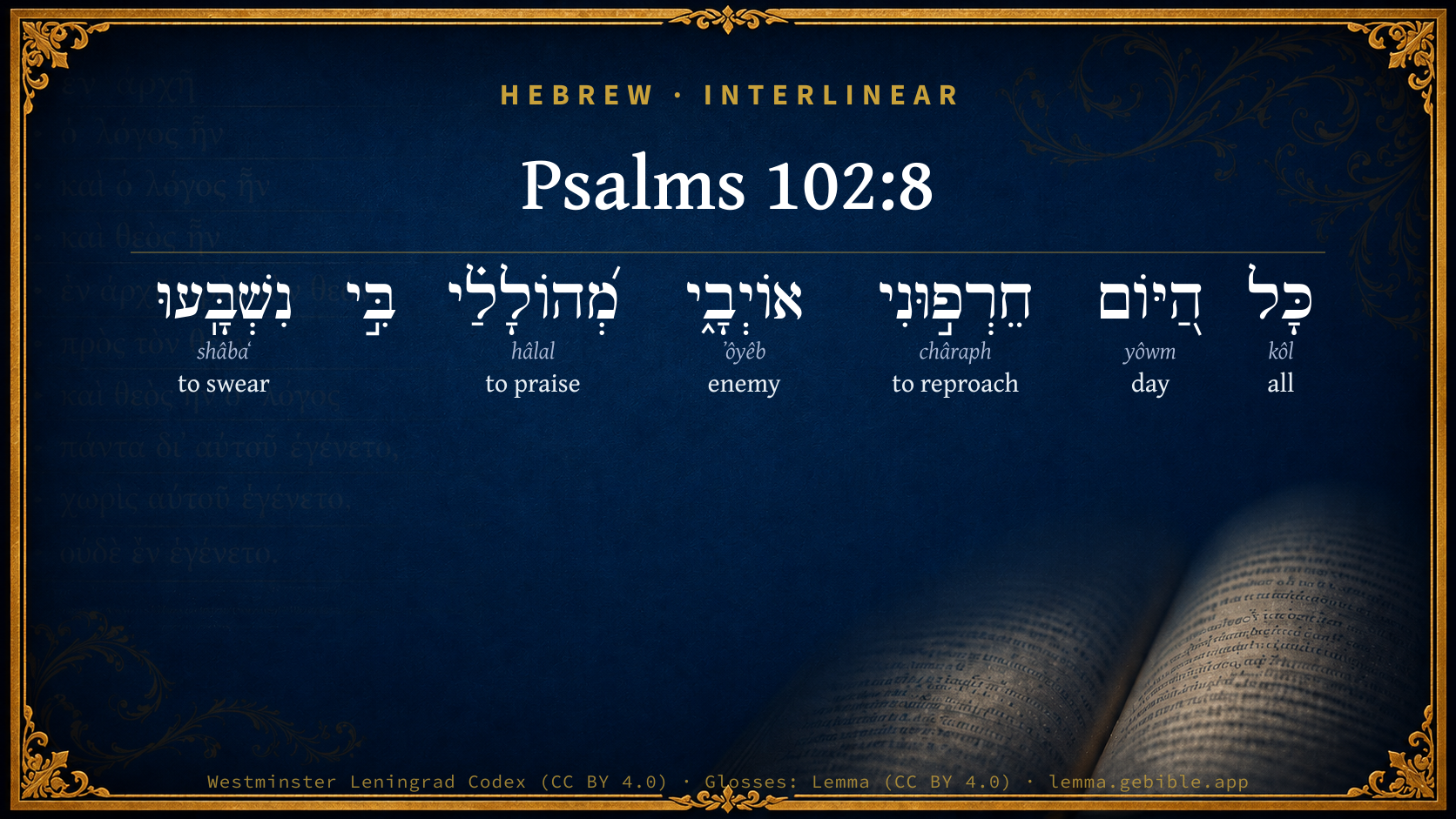
Psalms 102:8

Hebrew (Westminster Leningrad Codex) Psalms 102:8 appears in the Hebrew Old Testament. The text above is from the Westminster Leningrad Codex. Each word links to its Strong’s number, a concise gloss, and parsing drawn from the Open Scriptures Hebrew Bible morphology. Click any word for its full Brown-Driver-Briggs (BDB) entry.
Download image
Cite this verse

Psalms 102:8 (World English Bible). Public Domain. Lemma interlinear Bible study tool, https://lemma.gebible.app/v/psalms/102/8.

Show BibTeX & RIS
BibTeX
RIS
English Translation
My enemies reproach me all day. Those who are mad at me use my name as a curse.
World English Bible · Public Domain
Download a study sheet

One document with this verse’s original text, its word-by-word gloss line, the meaning frame, cross-references with their text, attributed commentary, and full source and license credits — printable, and it pastes into notes with its structure intact.

This verse Autodidact and up

Study sheet (.html) Plain text (.txt)

A passage Seminary Student

Up to 50 verses in one chapter. A passage sheet keeps up to 6 commentary sources and 12 cross-references per verse, in the order this page ranks them, and says so on the sheet whenever that leaves anything out. Ask for a single verse and you get the Autodidact verse sheet above.

Everything on this page stays free to read, with no account — the sheet is a download of what is already on screen, not access to it.

Want to remove ads? Support Godless Engineer
Compare translations 3

The same verse in 3 English versions, stacked beneath the original-language interlinear above. Click any original word for its lexicon entry.

Each is an independent rendering of the whole verse — the interlinear is not word-aligned to these translations.

Highlighted words mark where these versions differ — a whole-verse word diff, not a word-by-word alignment.

  • World English Bible Public Domain
    My enemies reproach me all day. Those who are mad at me use my name as a curse.
  • King James Version Public Domain
    Mine enemies reproach me all the day; and they that are mad against me are sworn against me.
  • unfoldingWord Literal Text CC BY-SA 4.0
    My enemies taunt me all the day; those mocking me swear by me.

unfoldingWord Literal Text — © unfoldingWord, licensed CC BY-SA 4.0. Word-aligned USFM3 via Door43 (git.door43.org/unfoldingWord/en_ult).

Versions to compare (up to 4)

3 of 4 selected

Show all 18 translations

Every available English version of this verse, each an independent rendering of the whole verse.

  • World English Bible Public Domain
    My enemies reproach me all day. Those who are mad at me use my name as a curse.
  • Berean Standard Bible Public Domain
    All day long my enemies taunt me; they ridicule me and curse me.
  • Majority Standard Bible Public Domain
    All day long my enemies taunt me; they ridicule me and curse me.
  • King James Version Public Domain
    Mine enemies reproach me all the day; and they that are mad against me are sworn against me.
  • American Standard Version (1901) Public Domain
    Mine enemies reproach me all the day; They that are mad against me do curse by me.
  • Revised Version (1885) Public Domain
    Mine enemies reproach me all the day; they that are mad against me do curse by me.
  • Geneva Bible (1599) Public Domain
    Mine enemies reuile me dayly, and they that rage against me, haue sworne against me.
  • Douay-Rheims (1899) Public Domain
    I have watched, and am become as a sparrow all alone on the housetop.
  • Young's Literal Translation Public Domain
    All the day mine enemies reproached me, Those mad at me have sworn against me.
  • Literal Standard Version CC BY-SA 4.0
    All the day my enemies reproached me, || Those mad at me have sworn against me.
  • Unlocked Literal Bible CC BY-SA 4.0
    My enemies taunt me all day long; those who mock me use my name in curses.
  • unfoldingWord Literal Text CC BY-SA 4.0
    My enemies taunt me all the day; those mocking me swear by me.
  • Darby Bible Public Domain
    Mine enemies reproach me all the day; they that are mad against me swear by me.
  • World Messianic Bible Public Domain
    My enemies reproach me all day. Those who are mad at me use my name as a curse.
  • Webster's Bible Public Domain
    \\102:7\\I watch, and am as a sparrow alone upon the house top.
  • Free Bible Version CC BY-SA 4.0
    My enemies taunt me all day long. They mock me and swear at me.
  • Bible in Basic English Public Domain
    My haters say evil of me all day; those who are violent against me make use of my name as a curse.
  • JPS Tanakh (1917) Public Domain
    (102-9) Mine enemies taunt me all the day; they that are mad against me do curse by me.

Literal Standard Version (2020), Covenant Press — licensed CC BY-SA 4.0. Text via the HelloAO Bible API (eBible.org). Unlocked Literal Bible (unfoldingWord) — licensed CC BY-SA 4.0. Text via the HelloAO Bible API (eBible.org). unfoldingWord Literal Text — © unfoldingWord, licensed CC BY-SA 4.0. Word-aligned USFM3 via Door43 (git.door43.org/unfoldingWord/en_ult). Free Bible Version, Dr. Jonathan Gallagher — licensed CC BY-SA 4.0. Text via the HelloAO Bible API (eBible.org).

Word by word

More ways to search: Search by grammar → Find every occurrence → Compare this word →

Practice this passage: Drill this verse → Learn its vocabulary →

חֵרְפ֣וּנִי
châraph
H2778
“to reproach · me”
Verb, Piel, Perfect, 3rd Person, Common, Plural + Suffix, Personal, 1st Person, Common, Singular
Part of Speech
Verb
Stem
Piel
Form
Perfect
Person
3rd Person
Gender
Common
Number
Plural
Full BDB Definition

Origin: a primitive root

TWOT: 749 , 750 , 751

to reproach, taunt, blaspheme, defy, jeopardise, rail, upbraid - (Qal) to reproach - (Piel) to reproach, defy, taunt - (Qal) to winter, spend harvest time, remain in harvest time - (Niphal) to acquire, be betrothed
  1. כָּל kôl H3605 “all of” Noun, Common, Masculine, Singular, Construct
  2. הַ֭יּוֹם yôwm H3117 “the · day” Particle, Definite Article + Noun, Common, Masculine, Singular, Absolute
  3. אוֹיְבָ֑י ʼôyêb H341 “enemy · me” Verb, Qal, Participle Active, Masculine, Plural, Construct + Suffix, Personal, 1st Person, Common, Singular
  4. מְ֝הוֹלָלַ֗י hâlal H1984 “praised · me” Verb, Poal, Participle Passive, Masculine, Plural, Construct + Suffix, Personal, 1st Person, Common, Singular
  5. נִשְׁבָּֽעוּ shâbaʻ H7650 “to swear” Verb, Niphal, Perfect, 3rd Person, Common, Plural

About this verse

These counts appear in no published source. They are computed here, from the morphology-tagged text and Lemma’s own curated glosses. What Lemma adds →

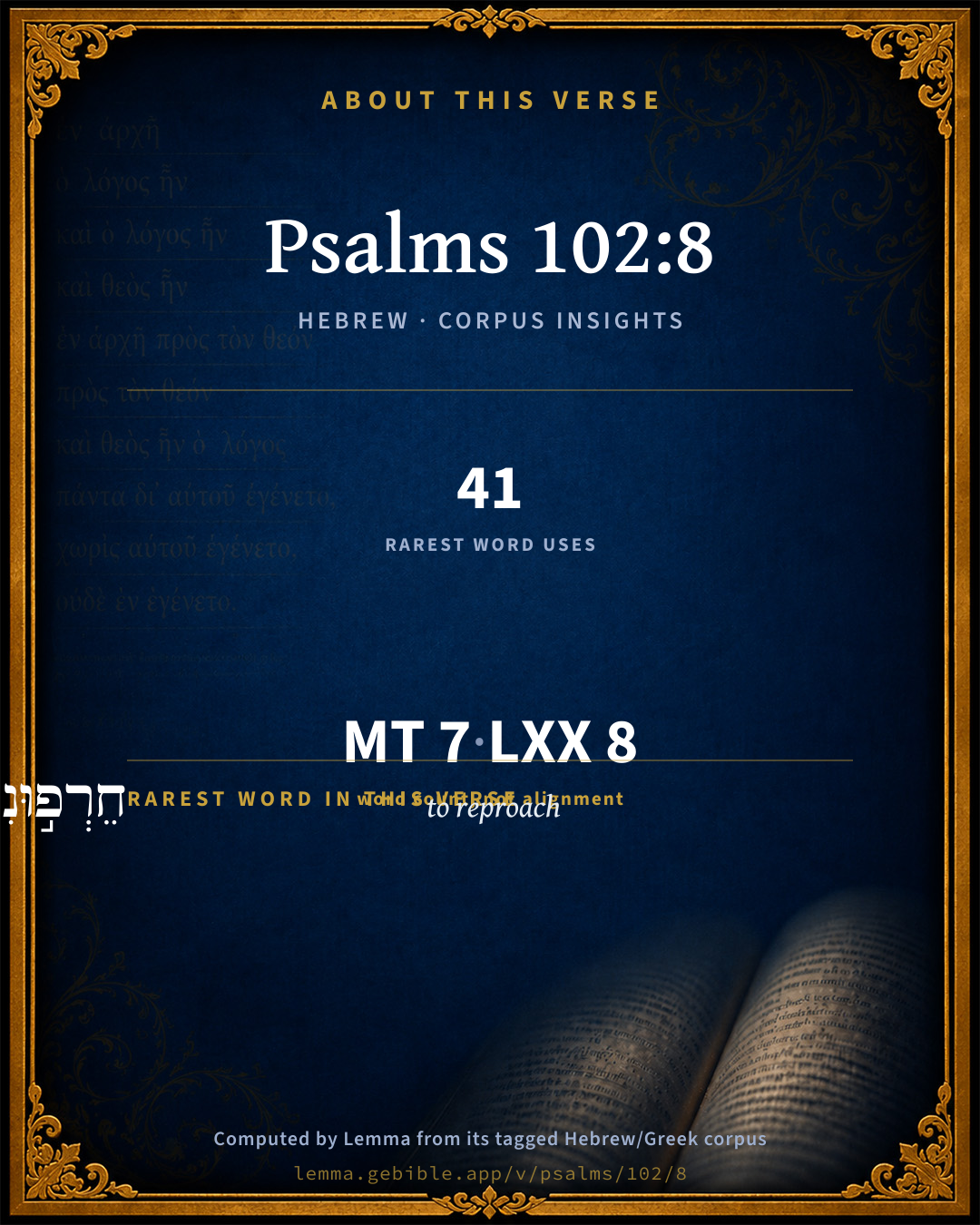
7
words
6
distinct lemmas
Wisdom
section

Shared distinctive vocabulary

חֵרְפ֣וּנִי to reproach H2778 occurs in 40 verses of the Hebrew Bible. Also found in:

Grammatical profile

  • 4 verbs
  • 2 nouns
  • 1 preposition

Verb forms

  • חֵרְפ֣וּנִי Piel · Perfect
  • אוֹיְבָ֑י Qal · Participle Active
  • מְ֝הוֹלָלַ֗י Poal · Participle Passive
  • נִשְׁבָּֽעוּ Niphal · Perfect

Hebrew & Septuagint length

In English translation the verse runs 18 words from the Hebrew and 18 from the Septuagint (LXX English) — the same length.

A rough comparison of the two English renderings, which tokenize alike — not a word-level alignment.

Word counts can differ between the Hebrew and the Greek without any difference in meaning — e.g. the Hebrew direct-object marker אֵת has no separate Greek word, and Greek often adds the article ὁ.

In the original languages it is 7 Hebrew tokens and 8 Greek tokens — but the two are counted differently (Hebrew bundles its prefixes and suffixes into one token; the Greek is in lemma form), so that isn’t a like-for-like length.

Cross-references

13

Topical passages linked to Psalms 102:8 in the Treasury of Scripture Knowledge — connected by theme and wording, ordered by reader-vote popularity; previews shown in the World English Bible.

  • Acts 26:11 Punishing them often in all the synagogues, I tried to make them blaspheme. Being exceedingly enraged against them, I persecuted them even to foreign cities.
  • Psalms 69:9–10 For the zeal of your house consumes me. The reproaches of those who reproach you have fallen on me.
  • Isaiah 65:15 You shall leave your name for a curse to my chosen; and the Lord Yahweh will kill you; and he will call his servants by another name:
  • Acts 7:54 Now when they heard these things, they were cut to the heart, and they gnashed at him with their teeth.
  • Acts 23:12–35 When it was day, some of the Jews banded together, and bound themselves under a curse, saying that they would neither eat nor drink until they had killed Paul.
  • Psalms 2:1 Why do the nations rage, And the peoples plot a vain thing?
  • Psalms 31:11–13 Because of all my adversaries I have become utterly contemptible to my neighbors, A fear to my acquaintances. Those who saw me on the street fled from me.
  • Psalms 55:3 Because of the voice of the enemy, Because of the oppression of the wicked. For they bring suffering on me. In anger they hold a grudge against me.
  • Psalms 69:20 Reproach has broken my heart, and I am full of heaviness. I looked for some to take pity, but there was none; For comforters, but I found none.
  • Psalms 89:51 With which your enemies have mocked, Yahweh, With which they have mocked the footsteps of your anointed one.
  • Jeremiah 29:22 and of them shall be taken up a curse by all the captives of Judah who are in Babylon, saying, Yahweh make you like Zedekiah and like Ahab, whom the king of Babylon roasted in the fire;
  • Luke 6:11 But they were filled with rage, and talked with one another about what they might do to Jesus.
  • Romans 15:3 For even Christ didn't please himself. But, as it is written, "The reproaches of those who reproached you fell on me."

Cross-references courtesy of OpenBible.info (CC BY 4.0).

Hebrew and Greek witnesses Masoretic Hebrew ↔ Greek Septuagint

The same verse in the two great witnesses to the Old Testament, shown verse-for-verse.

You’re reading Greek Psalm 101 (Hebrew Psalm 102). The Septuagint counts the superscription, so verse numbers can differ from the Hebrew — chapter-level alignment, not verse-by-verse. Numbering follows Rahlfs.

These are two independent witnesses, not word-aligned to each other, and the Septuagint is shown in lemma (dictionary) form.

Hebrew Psalms 102:8 Masoretic · Westminster Leningrad Codex

כָּל הַ֭יּוֹם חֵרְפ֣וּנִי אוֹיְבָ֑י מְ֝הוֹלָלַ֗י בִּ֣י נִשְׁבָּֽעוּ

My enemies reproach me all day. Those who are mad at me use my name as a curse.

World English Bible · Public Domain

Greek LXX Greek Psalm 101:8 Septuagint · lemma form

ἀγρυπνέω καί γίγνομαι ὡσεί στρουθίον μονάζω ἐπί δῶμα

All the day long my enemies have reproached me; and they that praised me have sworn against me.

LXX2012 (modern English Septuagint) · Public Domain

On this verse, Ellicott's Commentary for English Readers discusses the Septuagint’s reading. Read the note in Commentary ↓

Hebrew: Westminster Leningrad Codex (CC BY 4.0). Greek: Septuagint (public domain); English from LXX2012 (modern English Septuagint) (Public Domain). How the Septuagint differs from the Hebrew →

Commentary

Notes on Psalms 102:8 from classic Christian and Jewish commentators (each source and its license shown beneath its notes). The classic Christian expositions comment on the surrounding passage and are grouped to its opening verse, so a note may address several verses; the Jewish commentaries on the Tanakh (Rashi and others) are per-verse, so they appear only where the commentator wrote on this verse.

Lemma curates 59 commentaries, every one of them public domain or Creative Commons licensed, each selected and text-cleaned for this edition rather than reprinted as found. About our sources →

Trapp's Complete Commentary

John Trapp

Psa 102:8 Mine enemies reproach me all the day; [and] they that are mad against me are sworn against me.

Ver. 8. Mine enemies reproach me all the day] This is an evil that man’s nature is most impatient with. See Psal. cxxxvii.

And they that are mad against me] That let fly at me, or that once praised me, flattered me. So the Sept.

Are sworn against me] Have sworn my death, or do swear and curse by me, as the Turks do at this day, when, to confirm a truth, they say, Iudaeus sim si fallam, I would I were a Jew, it is so. See Zec 8:13 Isa 6:11-13 Jer 29:22. God make thee as Ahab, and as Zedekiah, &c.

John Trapp, A Commentary or Exposition upon All the Books of the Old and New Testament (1647–1656) — public domain. Text from a community e-Sword module.

Joseph Benson's Commentary

Psa 102:8. Mine enemies reproach me all the day — This my misery hath exposed me to the scorn of mine enemies, who do nothing but upbraid me with my calamities. And they that are mad against me — Or, my slanderers, as Dr. Waterland renders, מהוללי, moholalai, are sworn against me, — Or, they swear by me. They make use of my name and misery, in their forms of swearing and imprecation; for when they would express their malicious and mischievous intentions against any one, they swear they will make him as miserable as a Jew. Or, their form of swearing is this, “If we break our oaths, may the gods pour down their vengeance upon us, and make us as miserable as this captive Jew.”

Joseph Benson's Commentary on the Old and New Testaments (1811–1818) — public domain. Text from a community e-Sword module.

J. A. Alexander on Psalms

Joseph Addison Alexander

9. (Psa 102:8) All the day my enemies have taunted me, my infuriated (foes) swear by me. The verb in the first clause suggests the ideas of contempt and hatred, calumny and insult. See above, on Psa 42:10. The first word of the last clause is a passive participle, my enraged (or maddened) ones, those who are mad (i.e. insane with enmity) against me. The last phrase does not mean swear at me, i.e. vent their rage by oaths and curses, nor are sworn against me, neither of which is justified by Hebrew usage; but swear by me. i. e. use me as a formula of execration, imprecating upon others misery like mine. Compare Isa 65:15, Jer 29:22. The preterite forms imply a long previous continuance of this furious persecution, as all the day does its constant, unremitted raging.

Joseph Addison Alexander, The Psalms Translated and Explained (1850) — public domain. Text from a community e-Sword module.

Geneva Bible (1599)

Geneva Bible translators

Have conspired my death.

Geneva Bible (1599) marginal notes — public domain. Text via Bolls.life.

Adam Clarke's Commentary

Verse 8. They that are mad against me are sworn against me.] The Chaldeans are determined to destroy us; and they have bound themselves by oath to do it. See a similar case related Ac 23:12-14, where a number of Jews had bound themselves by an oath neither to eat nor drink till they had slain Paul.

Adam Clarke's Commentary on the Bible (1810–1826) — public domain. Text from a community e-Sword/MySword module.

John Calvin's Commentaries

8. My enemies have reviled me daily The faithful, to excite the compassion of God towards them, tell him that they are not only objects of mockery to their enemies, but also that they swore by them. The indignity complained of is, that the ungodly so shamefully triumphed over God’s chosen people, as even to borrow from their calamities a form of swearing and imprecation. This was to regard the fate of the Jews as a signal pattern in uttering the language of imprecation. When, therefore, at the present day the ungodly, in like manner, give themselves loose reins in pouring forth against us contumelious language, let us learn to fortify ourselves with this armor, by which such kind of temptation, however sharp, may be overcome. The Holy Spirit, in dictating to the faithful this form of prayer, meant to testify that God is moved by such revilings to succor his people; even as we find it stated in Isaiah 37:23,

“Whom hast thou reproached and blasphemed, and against whom hast thou exalted thy voice? even against the Holy One of Israel;”

and in the verse immediately preceding the prophet had said, “He hath despised thee, O daughter of Zion! against thee hath he shaken the head, O daughter of Jerusalem!” It is surely an inestimable comfort that the more insolent our enemies are against us, the more is God incited to gird himself to aid us. In the second clause the inspired writer expresses more strongly the cruelty of his enemies, when he speaks of their being mad against him As the verb הלל, halal, which we have rendered mad, generally signifies to praise, it might here be understood as having, by the figure antiphrasis, a sense the very opposite — those who dispraised or reproached me. But it is better to follow the commonly received interpretation. Some maintain that they are called mad, because they manifested their own folly, making it evident from the manner in which they acted, that they were worthless persons; but this opinion does too much violence to the text. The more satisfactory sense is, that the people of God charge revilers with cruelty or furious hatred.

John Calvin's Commentaries (1540-1563) — public domain. Text from the Calvin Translation Society English edition (1840s-50s) via the Christian Classics Ethereal Library (ccel.org). Calvin's coverage is partial (roughly two-thirds of the Bible); uncommented books and verses are honest gaps, never fabricated. The 19th-century editor's footnotes and remarks are omitted so the notes are faithfully Calvin's own voice.

Ellicott's Commentary for English Readers

(8) Sworn against me.—Rather, swear by me, i.e., make his name a byeword of execration, to be explained by Isa_65:15; Jer_29:22. LXX. and Vulg., “were swearing against me.”

A Bible Commentary for English Readers, edited by Charles John Ellicott (1878–1897) — public domain. Text from a community e-Sword module.

The Cambridge Bible for Schools and Colleges

gen. ed. J. J. S. Perowne

8. His enemies aggravate his sufferings by mocking him as one forsaken by God (Psa_42:10; Psa_44:13).

are sworn against me] Rather as R.V., do curse by me; using my name in formulas of execration, ‘God make thee like yonder miserable wretch.’ Cp. Isa_65:15; Jer_29:22.

The Cambridge Bible for Schools and Colleges (gen. ed. J. J. S. Perowne; Cambridge University Press, 1878–1918) — public domain. Text from a community e-Sword module.

John Gill's Exposition

For I have eaten ashes like bread,.... He sitting in ashes, as Job did, and rolling himself in them in the manner of mourners; and, having no other table than the ground to eat his food upon, he might eat ashes along with it; and by an hypallage of the words, the sense may be, that he ate bread like ashes, no more savoured and relished it, or was nourished by it, than if he had eaten ashes; the meaning is, that he was fed with the bread of adversity, and water of affliction:

and mingled my drink with weeping; that is, with tears; as he drank, the tears ran down his cheeks, and mixed with the liquor in his cup; he was fed with the bread of tears, and had them to drink in great measure; these were his meat and his drink, day and night, while enemies reproached him, swore at him, against him, and by him; see Psa 80:5.

John Gill's Exposition of the Whole Bible (1746–1763) — public domain (CC PDM 1.0). Text via the HelloAO Bible API.

Albert Barnes' Notes on the Bible

Mine enemies reproach me all the day - Continually. They reproach me as one of thy people; or, I bear reproaches in common with others, and it becomes to me a personal matter, so entirely are my feelings and interests identified with those of thy people. Perhaps there were also, mingled with this, personal reproaches and calumnies.

And they that are mad against me - Angry; excited even to madness.

Are sworn against me - literally, “swear by me,” or against me. The meaning is, that they have conspired together under the solemnity of an oath to do me harm. It is not the wrath of an individual that I am to meet, but the combined wrath of those who act under the solemnities of an oath. Compare Act 23:12.

Albert Barnes' Notes on the Bible (1834–1885) — public domain. Text from a community e-Sword/MySword module.

Matthew Poole's English Annotations

Or, and being mad or enraged at or against me, they swear against me; they swear they will do me yet more mischief: or, they swear by me; they make use of my name and misery in their forms of swearing and imprecation; as when they would express their malicious and mischievous intentions against another, they swear that they will use him or make him as miserable as a Jew. See the like expressions Num 5:21; Isa 65:15; Jer 29:22.

Matthew Poole's English Annotations on the Holy Bible (1683–1685) — public domain. Text from a community e-Sword/MySword module.

The Treasury of David

Charles H. Spurgeon

Ver. 8. Mine enemies reproach me all the day. Their rage was unrelenting and unceasing, and vented itself in taunts and insults, the Psalmist's patriotism and his griefs were both made the subjects of their sport. Pointing to the sad estate of his people they would ask him, "Where is your God?" and exult over him because their false gods were in the ascendant. Reproach cuts like a razor, and when it is continued from hour to hour, and repeated all the day and every day, it makes life itself undesirable.

And they that are mad against me are sworn against me. They were so furious that they bound themselves by oath to destroy him, and used his name as their usual execration, a word to curse by, the synonym of abhorrence and contempt. What with inward sorrows and outward persecutions he was in as ill a plight as may well be conceived.

Ver. 8. Mine enemies reproach me. It is true what Plutarch writes, that men are more touched with reproaches than with other injuries; affliction, too, gives a keener edge to calumny, for the afflicted are more fitting objects of pity than of mockery. Mollerus.

Ver. 8. Mine enemies reproach me, etc. If I be where they are they rail at me to my face; and if I be not amongst them they revile me behind my back; and they do it not by starts and fits, that might give me some breathing time; but they are spitting their poison all the day long; and not single and one by one, that might leave hope of resisting; but they make combinations, and enter leagues against me; and to make their leagues the stronger, and less subject to dissolving, they bind themselves by oath, and take the sacrament upon it. And now sum up all these miseries and afflictions; begin with my fasting; then take my groaning; then add my watching; then the shame of being wondered at in company; then the discomfort of sitting disconsolate alone; and, lastly, add to these the spite and malice of my enemies; and what marvel, then, if these miseries joined all together make me altogether miserable; what marvel if I be nothing but skin and bone, when no flesh that were wise would ever stay upon a body to endure such misery. Sir R. Baker.

Ver. 8 (last clause). Swearing by one, means, to make his name a by-word of execration, or an example of cursing. (Isa 65:15; Je 29:22 42:18). Carl Bernard Moll, in Lange's Commentary.

Psalms 102:9*

Charles H. Spurgeon's The Treasury of David (1869–1885) — public domain. Psalms only. Text from a community e-Sword/MySword module.

Whedon's Commentary on the Bible

Daniel D. Whedon

8. Mine enemies reproach me—This was a chief source of his distress. They taunted him as one forsaken of God. Psa_42:3; Psa_42:10; Mic_7:10.

Mad against me—They rage “against me.” They act like men devoid of reason.

Sworn against me—The peculiar form of the expression would indicate that they used him as a common formula of cursing, as in the passage, “The Lord make thee like Zedekiah and like Ahab,”

Jer_29:22. See, also, Isa_65:15. We know this was the reproach of the exiles while in Babylon, Zec_8:13. This accords well with the historic occasion of the psalm.

Daniel D. Whedon (gen. ed.), Commentary on the Old and New Testaments (1874–1909) — public domain. Text from a community e-Sword module.

The Pulpit Commentary

Mine enemies reproach me all the day. The reproach of their enemies was always felt by the Israelites as a bitter aggravation of their afflictions. (see Psa_42:10 Psa_44:13-16 Psa_79:4 Psa_80:6, etc.) They that are mad against me are sworn against me; rather, use me as their curse. (comp. Jer_29:22) It was a common form of cursing among the Israelites to wish a man the same fate as had befallen some one whose unhappiness was notorious.

The Pulpit Commentary (1880–1919), ed. H.D.M. Spence-Jones & Joseph S. Exell — public domain. Text from a community e-Sword module.

Rashi

Rabbi Shlomo Yitzchaki (Rashi)

I pondered I pondered about myself, and behold I am like a lonely bird on a roof, sitting alone without a mate.

lonely Heb. בודד, sitting alone.

Rashi on the Tanakh — English translations: “The Judaica Press complete Tanach with Rashi, translated by A. J. Rosenberg” (CC BY 4.0); “Pentateuch with Rashi's commentary by M. Rosenbaum and A.M. Silbermann, 1929-1934” (public domain); “The Metsudah Tanach series, Lakewood, N.J” (CC BY 4.0); and “The Book of Joshua, Metsudah Publications, 1997” (CC BY 4.0). Text via Sefaria.

Lesson kit

Teaching starters — assembled from the data on this page, not authored interpretation. Every prompt links to the verse data it draws on. Edit before teaching.

Psalms, in the Wisdom, opens this verse with 7 words (6 distinct Hebrew lemmas). Its most distinctive word is châraph (“to reproach”). A historical commentator’s framing appears above. Read the whole chapter for the surrounding context.

Discussion questions

  1. How does “to reproach” (châraph) shape what this verse is saying?
  2. How does Leviticus 19:20, which shares the word «to reproach», read alongside this verse?
  3. The translations on this page render this verse differently — a whole-verse word diff, not a word-by-word alignment. What might account for the different wordings?
  4. «חֵרְפ֣וּנִי» is a Piel Perfect verb. How does that grammatical form shape the action described?
  5. Compare how Trapp's Complete Commentary and Joseph Benson's Commentary read this verse. Where do they agree or differ?

Things to notice

Reading settings

Reading text

Shown beneath each verse's original-language words.

Old Testament
Old Testament edition

Read the OT as the Masoretic Hebrew (MT) or the Greek Septuagint (LXX).

English shown for the Greek Septuagint (in the Hebrew ↔ Greek comparison).

Comparing translations? Open the Compare panel on any verse page to stack up to four side by side.