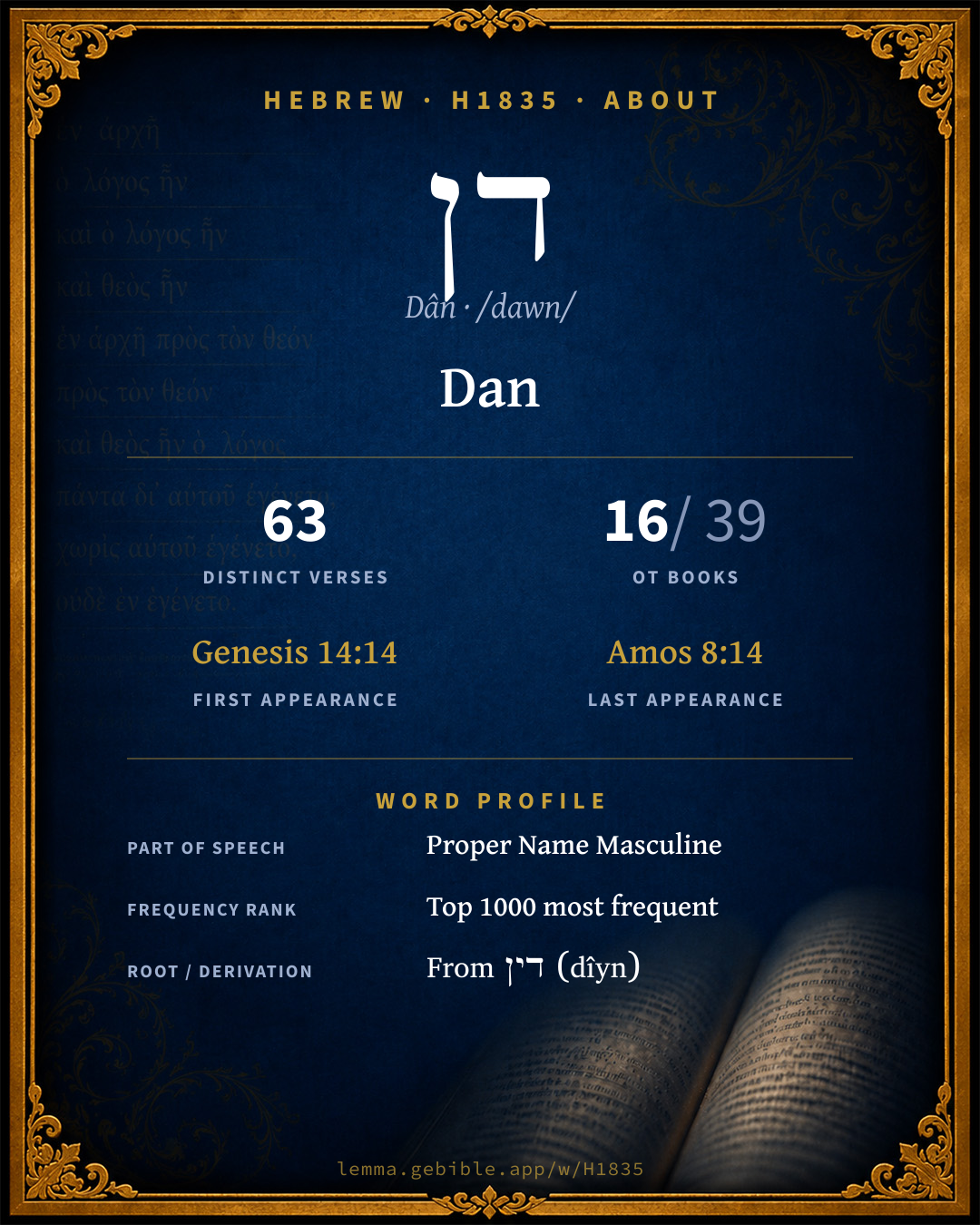
דָּן
Dan
BDB lists 4 entries for ‘Dan’ fuller range ↓
Full lexicon entry — Brown-Driver-Briggs (BDB)
From Brown-Driver-Briggs (BDB)
Where this word appears
Grammar key — what these labels mean
Part of speech
- Noun
- A naming word — a person, place, thing, or idea.
Noun type
- Proper
- A name of a specific person, place, or people (e.g. Abraham, Zion, Israel).
Every verse where H1835 appears in the Book of Judges — 12 distinct verses. Click any verse to open its interlinear word-by-word view. Verse text shown in the World English Bible for context — . Each verse’s Hebrew form is shown with its reference; the English is not keyword-highlighted, since the data carries no word-level English alignment. Use “Compare translations” on any verse to read it across multiple English versions. This concordance covers the Hebrew Bible; Septuagint (Greek Old Testament) occurrences are not indexed here.
Judges
- Judges 1:34 דָ֖ן n Proper The Amorites forced the children of Dan into the hill-country; for they would not allow them to come down to the valley;
- Judges 5:17 וְ/דָ֕ן conj + n Proper Gilead abode beyond the Jordan: Dan, why did he remain in ships? Asher sat still at the haven of the sea, Abode by his creeks.
- Judges 13:25 דָ֑ן n Proper The Spirit of Yahweh began to move him in Mahaneh-dan, between Zorah and Eshtaol.
- Judges 18:2 דָ֣ן n Proper The children of Dan sent of their family five men from their whole number, men of valor, from Zorah, and from Eshtaol, to spy out the land, and to search it; and they said to them, Go, search the land. They came to the hill-country of Ephraim, to the house of Micah, and lodged there.
- Judges 18:16 דָֽן n Proper The six hundred men girt with their weapons of war, who were of the children of Dan, stood by the entrance of the gate.
- Judges 18:22 דָֽן n Proper When they were a good way from the house of Micah, the men who were in the houses near to Micah's house were gathered together, and overtook the children of Dan.
- Judges 18:23 דָ֔ן n Proper They cried to the children of Dan. They turned their faces, and said to Micah, What ails you, that you come with such a company?
- Judges 18:25 דָ֔ן n Proper The children of Dan said to him, "Don't let your voice be heard among us, lest angry fellows fall on you, and you lose your life, with the lives of your household."
- Judges 18:26 דָ֖ן n Proper The children of Dan went their way: and when Micah saw that they were too strong for him, he turned and went back to his house.
- Judges 18:29 דָּ֔ן דָּ֣ן n Proper n Proper They called the name of the city Dan, after the name of Dan their father, who was born to Israel: however the name of the city was Laish at the first.
- Judges 18:30 דָ֖ן n Proper The children of Dan set up for themselves the engraved image: and Jonathan, the son of Gershom, the son of Moses, he and his sons were priests to the tribe of the Danites until the day of the captivity of the land.
- Judges 20:1 לְ/מִ/דָּן֙ prep + prep + n Proper Then all the children of Israel went out, and the congregation was assembled as one man, from Dan even to Beersheba, with the land of Gilead, to Yahweh at Mizpah.
About this entry
At a glance — auto-summarized from this page’s data, not written by a person. Every figure links to its source below. This summary describes the numbers; it doesn’t interpret them.
דן — transliterated Dân — is a Hebrew name carrying the sense “Dan.” Debuting at Genesis 14:14, it then recurs through the corpus. The Hebrew Bible uses it across 63 verses — moderately common. Each statement above links to its evidence; the full detail follows below.
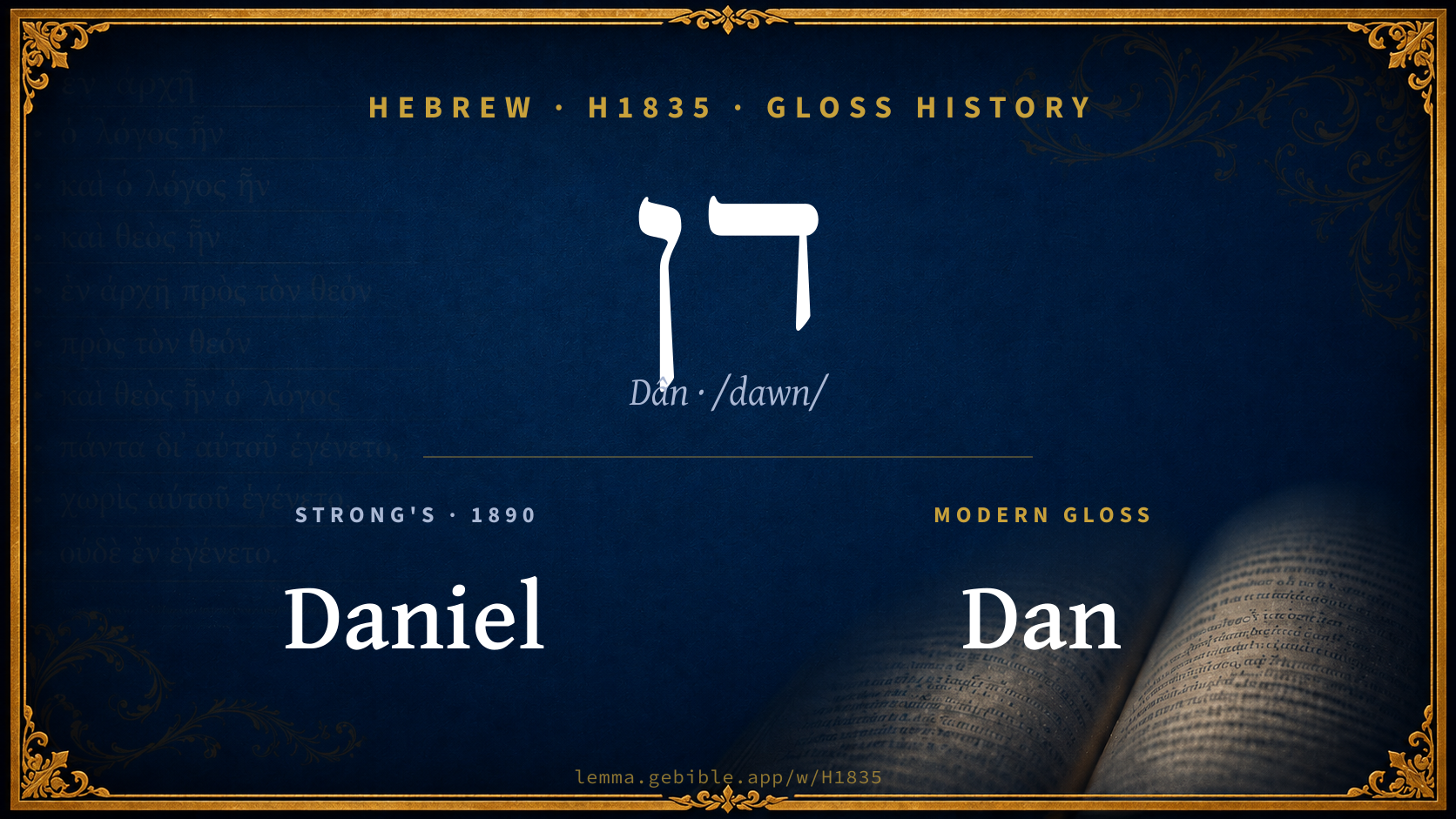
Gloss history
Strong's 1890 vs modern scholarship
About this word
Strong's H1835 catalogs a Hebrew word from the Hebrew Old Testament.
These counts are not copied from any lexicon or concordance. They are computed here, from the morphology-tagged Hebrew Old Testament. What Lemma adds →
- 63
- distinct verses
- The word appears in 63 distinct verses.
- 16 / 39
- OT books
- The word appears in 16 of 39 Old Testament books.
- #569
- by frequency
- Top 1000 most frequent Hebrew words (rank 569 of 8,640 Hebrew words by occurrence).
View all 63 occurrences in the concordance →
By section of the Old Testament
By traditional corpus
Conventional, traditional groupings — biblical authorship is debated, so this is a traditional corpus grouping, not an authorship claim. Each share is this word’s portion of its verses in that division of the Hebrew canon. Each figure is a share of the word’s 63 distinct verses.
- Prophets (Nevi'im) 33 verses · 52%
- Torah (Pentateuch) 24 verses · 38%
- Writings (Ketuvim) 6 verses · 10%
How translations render this word
Counts come from each version’s own published word-to-Strong’s tagging or interlinear alignment — an approximate guide to how each version renders this word, not a word-level alignment the data otherwise carries. Because each total is that version’s own tagged count, the per-version totals vary from one another and need not match the appearance or distinct-verse counts above. These counts may also differ from a printed concordance because Lemma counts each distinctly tagged rendering and does not collapse phrase taggings into a single head-word total. This is a fixed set of word-tagged versions (KJV, ASV, BSB, ULT) and does not change with the reading translation you choose elsewhere. Each version’s license is shown beside its name below (and on Sources).
BDB lists this Strong’s number as 3 distinct words (homographs). Each count above pools all of them and is not split by sense — see the Senses section below. A low-frequency rendering may belong to a different one of those words, not the primary meaning.
- King James Version†: Dan 65×
- American Standard Version†: Dan 63×
- Berean Standard Bible†: Dan 51×
- unfoldingWord Literal Text†: Dan 67×
King James Version Public Domain
Renders H1835 across 70† tagged occurrences — most commonly:
Plus 5 renderings that appear only once — usually multi-word phrases or single function words the recovered tagging swept in, not distinct renderings. Not rendered by a distinct English word in 1 further occurrence.
American Standard Version Public Domain
Renders H1835 across 70† tagged occurrences — most commonly:
Plus 7 renderings that appear only once — usually multi-word phrases or single function words the recovered tagging swept in, not distinct renderings.
Berean Standard Bible Public Domain
Renders H1835 across 55† tagged occurrences — most commonly:
Plus 4 renderings that appear only once — usually multi-word phrases or single function words the recovered tagging swept in, not distinct renderings. Not rendered by a distinct English word in 14 further occurrences.
unfoldingWord Literal Text CC BY-SA 4.0
Renders H1835 across 70† tagged occurrences — most commonly:
Plus 3 renderings that appear only once — usually multi-word phrases or single function words the recovered tagging swept in, not distinct renderings.
Senses in the full BDB
What do BDB’s symbols mean?
BDB uses these scholarly abbreviations:
| Symbol | Meaning |
|---|---|
| 𝔊 | the Septuagint (the ancient Greek translation, LXX) |
| 𝔙 | the Vulgate (the Latin translation) |
| 𝔖 | the Syriac version (the Peshitta) |
| 𝔗 | the Targum (the Aramaic translation) |
| ψ | the Psalms |
| √ | root (the underlying root or stem) |
| ‖ | parallel passage (a synonymous or contrasted parallel) |
| † | the dagger: every passage where the word occurs is cited |
The 4 senses and sub-senses the full Brown-Driver-Briggs lexicon distinguishes for this word, in lexicon order (not ranked by frequency), with BDB’s own verbatim wording and sub-sense lettering. Shown in Hebrew script with BDB’s own scholarly abbreviations. The condensed entry is in the Lexicon Entry tab. See also the Forms in the corpus table below.
דן I loc. whence wine, so Co Ez 27
דן II m. (judge)
- 1. son of Jacob and Bilhah Gn 30:6; 35:25 Ex 1:4 Jos 19:47 Ju 18:29 1 Ch 2:2. e.g. Genesis 30:6
- 2. the tribe of Dan, מַטֵּה דָן Ex 31:6; 35:34; 38:23 Lv 24:11 Nu 1:39; 13:12 Jos 21:5, 23 (all P); בְּנֵי דָן Gn 46:23 Nu 1:38; 2:25; 7:66; 10:25; 26:42; 34:22 Jos 19:40, 47(×2), 48 (all P) Ju 1:34 18:2, 16, 22, 23, 25, 26, 30; מַחֲנֵה דָן Nu 2:25, 31 (P)—on Ju 13:25; 18:12 v. מַחֲנֶה; מִשְׁפְּחֹת דָּן Nu 26:42 (P); דָּן alone in poetry Gn 49:16, 17 Dt 33:22(×2) Ju 5:17, elsewhere Nu 1:12 (P) Dt 27:13 1 Ch 27:22 2 Ch 2:13 Ez 48:1, 2, 32. e.g. Exodus 31:6
- 3. a city on northern frontier of Israel at one of the sources of the Jordan, originally לַיִשׁ Ju 18:29 (cf. v 7); = לָשֶׁם Jos 19:47; captured by a colony of Danites; named Dan, and made a sacred place with rites of worship that lasted until the exile (Ju 18:30); =Tell el Kâdî, RobBR iii. 351, 358 BdPal 265. This place is frequently referred to: Gn 14:14 Dt 34:1 1 K 12:29, 30; 15:20 2 K 10:29 2 Ch 16:4 Je 4:15; 8:16 Am 8:14: read also וּבְדָן for וְכֵן 2 S 20:18 𝔊 Ew We cf. Dr; and v. the phrase מִדָּן וְעַד־בְּאֵר שֶׁבַע Ju 20:1 1 S 3:20 2 S 3:10; 17:11; 24:2, 15 1 K 5:5; given by Chr מִבְּאֵר שֶׁכַע וְעַד־דָּן 1 Ch 21:2 2 Ch 30:5. (Ez 27:19 v. ודן.) e.g. Judges 18:29
- —דָּ֫נָה יַעַן or דַּנָֿה (Bear) 2 S 24:6. No such place known; text usually regarded as corrupt,and, 𝔊 being uncertain, variously changed: (1) דָּ֫נָה יַעַר to Dan in the wood, Thes after 𝔙 silvestria. (2) (וַיָּסֹבּוּ) דָּ֫נָה וְעִיּוֹן to Dan and Ijon Klo (cf. 1 K 15:20). (3) (סָֽבֲבוּ) דָּן וּמִדָּן We Dr cf. 𝔊. e.g. 2 Samuel 24:6
Senses from the full Brown-Driver-Briggs lexicon (Brown, Driver, Briggs; Oxford 1906 — public domain), digitized via Sefaria, supplemented by the OpenScriptures HebrewLexicon (CC BY 4.0). Full attribution on Sources.
Word origin
I. n.pr.loc. whence wine, so Co Ez 27:19 for MT וְדָן וְיָוָן; cf. Assyrian wine of Aranabanim.
I. n.pr.m. (judge)—
— Brown-Driver-Briggs (Oxford 1906, public domain), digitized via Sefaria, supplemented by the OpenScriptures HebrewLexicon (CC BY 4.0). See Sources.
Derived from דין (dîyn) (H1777) — to judge.
Jastrow Dictionary
A second Hebrew/Aramaic lexicon for comparison, covering Aramaic and post-biblical (Talmudic, Targumic, Midrashic) usage that the biblical-Hebrew BDB does not. Matched by lemma rather than by Strong’s number, so a lemma may carry more than one Jastrow headword (shown separately below), and the entries cover usage well beyond the Bible.
דָּן
- (b. h.)
- 1. pr. n. m. Dan, son of Jacob. Pes. 4ᵃ מדן קאתי he is a descendant of Dan; a. e.
- 2. pr. n. pl. Dan in northern Palestine. Pesik. Shek. p. 15ᵃ מזבח שבדן the altar (erected by Jeroboam) in Dan.—Targ. Y. II, Num. XXXIV, 15. Targ. Cant. V, 4; Pirké d’R. El. ch. XXVII expl. = פמיאס, Paneas; Midr. Sam. ch. XXX; XXXII דנה (יען) פנייס.—Y. Dem. II, 22ᶜ bot. כְּפר דָּן.
- 3. name of an idol Dan. Sabb. 67ᵇ; Tosef. ib. VII (VIII), 3; Y. ib. VI, 8ᶜ bot. (ref. to Am. VIII, 14). e.g. Amos 8:14
דֵּן
- c. (cmp. דָּא, דֵּךְ) this, that. Targ. Is. VI, 3. Targ. Deut. II, 3 הָדֵן (ed. Berl. הָדֵין = הָא ד׳); a. v. fr.—Lev. R. s. 7 מן הד׳ קריא from this verse (it is proven). Lev. R. s. 8 ד׳ אמר לינא בעיא לד׳ וכ׳ the one said, I do not want this (woman) &c. Sabb. 112ᵇ לית ד׳ ב"א this is not (an ordinary) human being; ib. כגון ד׳ וכ׳ a man like this is worth the name of a human being; a. fr.—Y. Ab. Zar. II, 41ᵈ bot.; a. e. אסיר לך דנא this (piece) is forbidden to thee.—מן קדמת דנא ere this, formerly. Y. Sot. II, 17ᵈ; a. e.—כְּדֵ׳ a) = h. פֹּה, here (cmp. כָּא, הָכָא). Targ. Jud. XVIII, 3. Targ. Is. XXII, 16 (some ed. בְּדֵין); b) like this, thus. Targ. Gen. XXXII, 4. Targ. Jud. XVIII, 4; a. fr. [Targ. Ps. II, 10 read; כְּדוּן.]—B. Bath. 75ᵃ (play on כדכד, Is. LIV, 12) ליהוי כד׳ וכד׳ let it be as this one says, and as that one; Pesik. Aniy. p. 135ᵇ; Pesik. R. s. 32.—בִּכְדֵין in this manner. Targ. I Kings XXII, 20.—מָדֵין = h. מַה־זֶּה, why. Targ. Jer. XXVI, 9; a. e.—אֵי מִדֵּין from what, which. Targ. Jon. I, 8.—דֵּינוּ (= דֵּין הוּ) this. Y. Erub. VII, 24ᶜ top, a. e. חֵי ד׳ צד וכ׳ (= h. אֵיזֶהוּ) which is ‘side’, and which &c.?, v. הַיְידְּנוּ.—Pl. דֵּינוּן, דֵּינֵי. Y. Snh. IV, 22ᵇ bot. הי ד׳ וכ׳ which are the two additional ones?—[הָדֵין then, v. הֵידֵין.] e.g. Isaiah 54:12
A Dictionary of the Targumim, the Talmud Babli and Yerushalmi, and the Midrashic Literature (Marcus Jastrow; London, Luzac, 1903) — Public Domain. Digitized via Sefaria. Digitized via Sefaria. Full attribution on Sources.
Forms in the corpus
The 26 distinct written forms H1835 takes in the Hebrew Bible, most frequent first — each parse links to that state’s occurrences in the concordance. Hebrew forms include their vowel points and cantillation, so a single lemma takes many written forms.
| Form | Parsing | Example | Uses |
|---|---|---|---|
| דָ֔ן | Noun, Proper | Exodus 31:6 | 9 |
| דָ֖ן | Noun, Proper | Exodus 38:23 | 9 |
| דָּ֔ן | Noun, Proper | Amos 8:14 | 6 |
| דָּ֖ן | Noun, Proper | Deuteronomy 33:22 | 5 |
| דָֽן | Noun, Proper | Exodus 35:34 | 4 |
| דָּ֥ן | Noun, Proper | Deuteronomy 27:13 | 4 |
| דָּֽן | Noun, Proper | Deuteronomy 34:1 | 4 |
| דָ֑ן | Noun, Proper | Judges 13:25 | 3 |
| מִ/דָּ֖ן | Noun, Proper | 1 Kings 4:25 | 3 |
| מִ/דָּן֙ | Noun, Proper | 2 Samuel 17:11 | 3 |
| בְּ/דָֽן | Noun, Proper | 1 Kings 12:29 | 2 |
| דָן֙ | Noun, Proper | Genesis 49:17 | 2 |
| דָּ֗ן | Noun, Proper | Ezekiel 48:2 | 2 |
| לְ/דָ֕ן | Noun, Proper | 1 Chronicles 27:22 | 2 |
| דָ֛ן | Noun, Proper | Numbers 2:25 | 1 |
| דָ֞ן | Noun, Proper | Joshua 21:5 | 1 |
| דָ֠ן | Noun, Proper | Joshua 19:47 | 1 |
| דָ֣ן | Noun, Proper | Judges 18:2 | 1 |
| דָּ֑ן | Noun, Proper | 1 Chronicles 21:2 | 1 |
| דָּ֚ן | Noun, Proper | 1 Chronicles 2:2 | 1 |
| דָּ֣ן | Noun, Proper | Judges 18:29 | 1 |
| וְ/דָ֕ן | Noun, Proper | Judges 5:17 | 1 |
| וּ/לְ/דָ֣ן | Noun, Proper | Deuteronomy 33:22 | 1 |
| לְ/מִ/דָּן֙ | Noun, Proper | Judges 20:1 | 1 |
| מִ/דָּ֑ן | Noun, Proper | Jeremiah 4:15 | 1 |
| מִ/דָּ֤ן | Noun, Proper | Jeremiah 8:16 | 1 |
Same root — word family
Other BDB entries built from the same root as H1835, grouped by Strong’s listed origin. These share a root / origin per the lexicon — not necessarily a shared meaning. Each links to that word’s own entry.
Derives from
Shares the same root
- דין dîyn H1778 to judge
- דין dîyn H1779 judgment
- דין dayân H1781 judge
- מדון mâdôwn H4066 strife
- מדינה mᵉdîynâh H4082 province
Proper names from this root
People and places named from this root — a name, not an additional meaning of the word.
Compare all same-root words → Showing 4 of 10 — not the complete family. 3 of the same-root words are proper names (people or places). They share a root, not necessarily a meaning.
Bible dictionary
Public-domain dictionary articles matched to this entry by name (Dan). A biblical name can be shared by more than one person or place, so an article may treat several.
Easton's Bible Dictionary · M. G. Easton, 1897
A judge. (1.) The fifth son of Jacob. His mother was Bilhah, Rachel's maid (Gen. 30:6, "God hath judged me", Heb. dananni). The blessing pronounced on him by his father was, "Dan shall judge his people" (49:16), probably in allusion to the judgeship of Samson, who was of the tribe of Dan.
The tribe of Dan had their place in the march through the wilderness on the north side of the tabernacle (Num. 2:25, 31; 10:25). It was the last of the tribes to receive a portion in the Land of Promise. Its position and extent are described in Josh. 19:40-48.
The territory of Dan extended from the west of that of Ephraim and Benjamin to the sea. It was a small territory, but was very fertile. It included in it, among others, the cities of Lydda, Ekron, and Joppa, which formed its northern boundary. But this district was too limited. "Squeezed into the narrow strip between the mountains and the sea, its energies were great beyond its numbers." Being pressed by the Amorites and the Philistines, whom they were unable to conquer, they longed for a wider space. They accordingly sent out five spies from two of their towns, who went north to the sources of the Jordan, and brought back a favourable report regarding that region. "Arise," they said, "be not slothful to go, and to possess the land," for it is "a place where there is no want of any thing that is in the earth" (Judg. 18:10). On receiving this report, 600 Danites girded on their weapons of war, and taking with them their wives and their children, marched to the foot of Hermon, and fought against Leshem, and took it from the Sidonians, and dwelt therein, and changed the name of the conquered town to Dan (Josh. 19:47). This new city of Dan became to them a new home, and was wont to be spoken of as the northern limit of Palestine, the length of which came to be denoted by the expression "from Dan to Beersheba", i.e., about 144 miles.
"But like Lot under a similar temptation, they seem to have succumbed to the evil influences around them, and to have sunk down into a condition of semi-heathenism from which they never emerged. The mounds of ruins which mark the site of the city show that it covered a considerable extent of ground. But there remains no record of any noble deed wrought by the degenerate tribe. Their name disappears from the roll-book of the natural and the spiritual Israel.", Manning's Those Holy Fields.
This old border city was originally called Laish. Its modern name is Tell el-Kady, "Hill of the Judge." It stands about four miles below Caesarea Philippi, in the midst of a region of surpassing richness and beauty.
(2.) This name occurs in Ezek 27:19, Authorize Version; but the words there, "Dan also," should be simply, as in the Revised Version, "Vedan," an Arabian city, from which various kinds of merchandise were brought to Tyre. Some suppose it to have been the city of Aden in Arabia. (See MAHANEH-DAN.)
Smith's Bible Dictionary · William Smith, 1863
(a judge).
+ The fifth son of Jacob, and the first of Bilhah, Rachel's maid. (Genesis 30:6) (B.C. after 1753.) The origin of the name is given in the exclamation of Rachel. The records of Dan are unusually meagre. Only one son is attributed to him, (Genesis 46:23) but his tribe was, with the exception of Judah, the most numerous of all. In the division of the promised land Dan was the last of the tribes to receive his portion, which was the smallest of the twelve. (Joshua 19:48) But notwithstanding its smallness it had eminent natural advantages. On the north and east it was completely embraced by its two brother tribes Ephraim and Benjamin, while on the southeast and south it joined Judah, and was thus surrounded by the three most powerful states of the whole confederacy. It was a rich and fertile district; but the Amorites soon "forced them into the mountain," (Judges 1:34) and they had another portion granted them. Judges 18. In the "security" and "quiet," (Judges 18:7,10) of their rich northern possession the Danites enjoyed the leisure and repose which had been denied them in their original seat. In the time of David Dan still kept its place among the tribes. (1 Chronicles 12:35) Asher is omitted, but the "prince of the tribe of Dan" is mentioned in the list of (1 Chronicles 27:22) But from this time forward the name as applied to the tribe vanishes; it is kept alive only by the northern city. In the genealogies of 1Chr 2-12, Dan is omitted entirely. Lastly, Dan is omitted from the list of those who were sealed by the angel in the vision of St. John. (Revelation 7:5-7) + The well-known city, so familiar as the most northern landmark of Palestine, in the common expression "from Dan even to beersheba." The name of the place was originally Laish or Leshem. (Joshua 19:47) After the establishment of the Danites at Dan it became the acknowledged extremity of the country. It is now Tell el-Kadi, a mound, three miles from Banias, from the foot of which gushes out one of the largest fountains in the world, the main source of the Jordan.
Hitchcock's Bible Names Dictionary · Roswell D. Hitchcock, 1869
judgment; he that judges
Classic public-domain reference works; full attribution on Sources.
Septuagint verse parallels
This word appears in 62 verses that also exist in the Greek Old Testament (Septuagint), out of the 63 Hebrew verses it occurs in. You can read those verses in Greek by switching the Old Testament edition to the Septuagint.
Read these verses in the Septuagint
- Genesis 14:14
- Exodus 1:4
- Leviticus 24:11
- Numbers 1:12
- Deuteronomy 27:13
- Joshua 19:40
- Judges 1:34
- 1 Samuel 3:20
- 2 Samuel 3:10
- 1 Kings 12:29
- 2 Kings 10:29
- 1 Chronicles 2:2
This is a verse-level parallel only — the same verses exist in both the Hebrew and Greek Old Testaments. No word-level Hebrew↔Greek correspondence is claimed: the data carries no such alignment, so no Greek word is shown as this Hebrew word’s translation. Coverage is not total — the Septuagint omits the deuterocanon and renumbers the Psalms, so some Hebrew verses have no direct Greek parallel.