
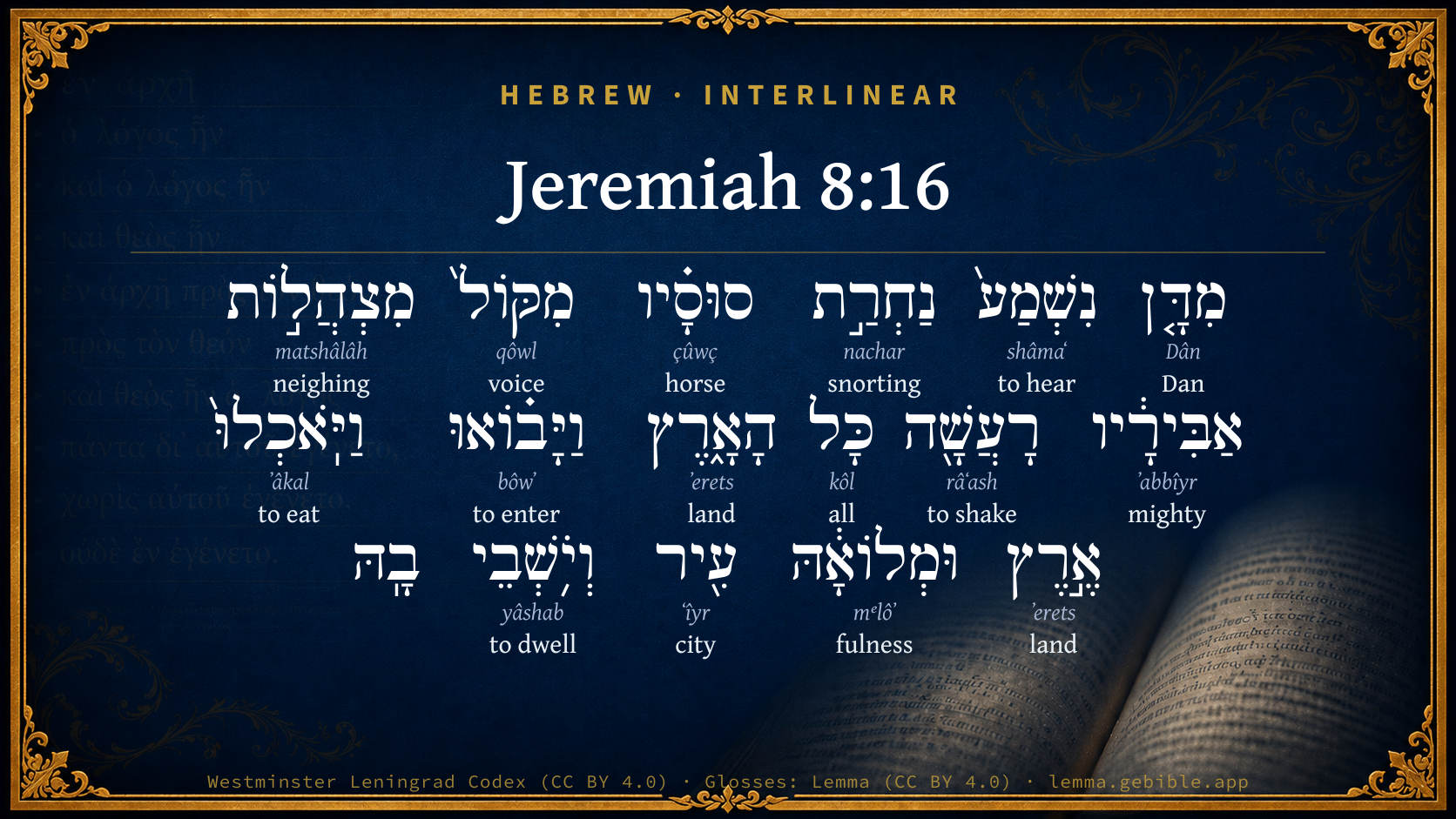
Jeremiah 8:16

Hebrew (Westminster Leningrad Codex) Jeremiah 8:16 appears in the Hebrew Old Testament. The text above is from the Westminster Leningrad Codex. Each word links to its Strong’s number, a concise gloss, and parsing drawn from the Open Scriptures Hebrew Bible morphology. Click any word for its full Brown-Driver-Briggs (BDB) entry.
Download image
Cite this verse

Jeremiah 8:16 (World English Bible). Public Domain. Lemma interlinear Bible study tool, https://lemma.gebible.app/v/jeremiah/8/16.

Show BibTeX & RIS
BibTeX
RIS
English Translation
The snorting of his horses is heard from Dan: at the sound of the neighing of his strong ones the whole land trembles; for they are come, and have devoured the land and all that is in it; the city and those who dwell therein.
World English Bible · Public Domain
Highlights
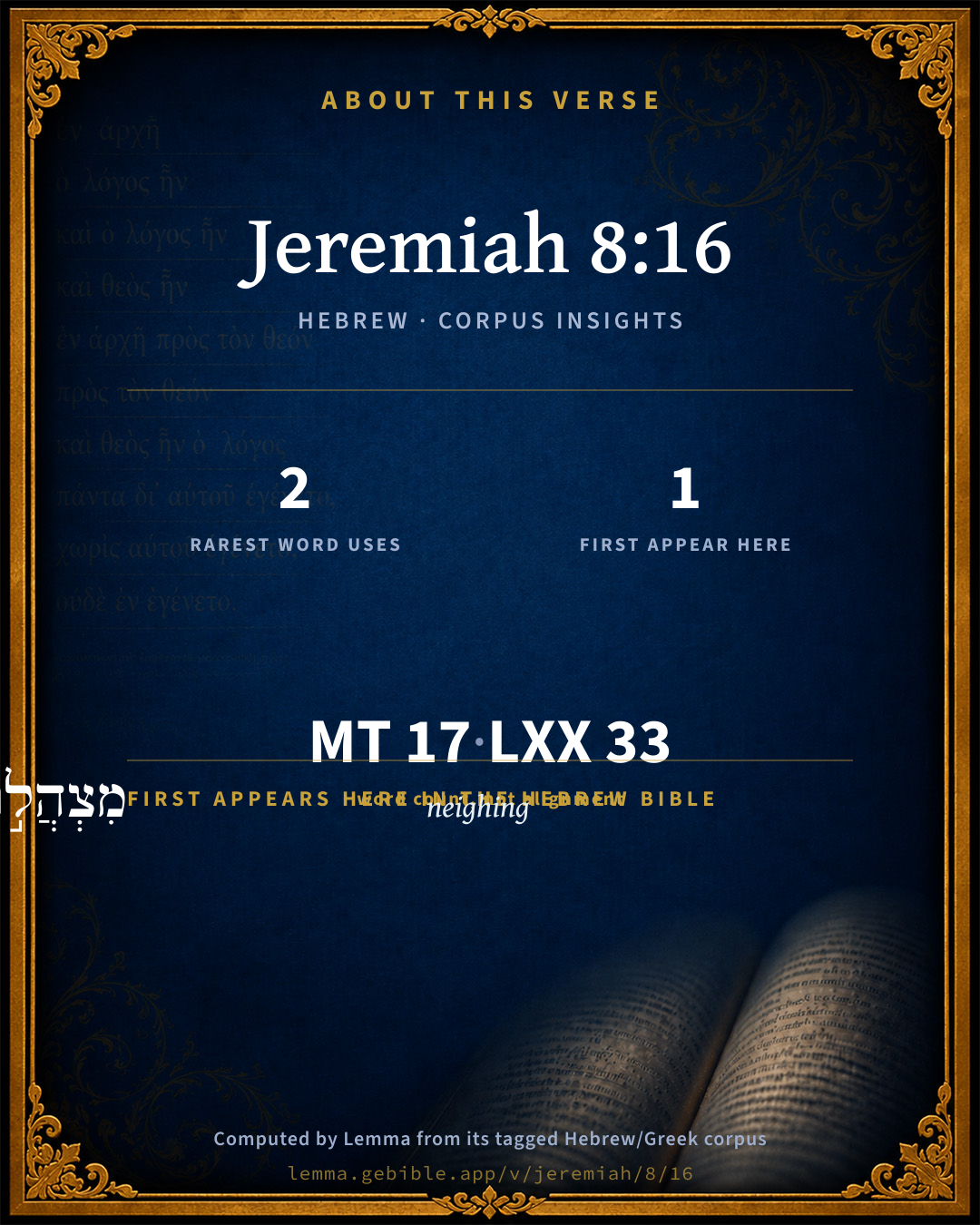
  • 1 first appearance in the Hebrew Bible
Full analysis ↓
Download a study sheet

One document with this verse’s original text, its word-by-word gloss line, the meaning frame, cross-references with their text, attributed commentary, and full source and license credits — printable, and it pastes into notes with its structure intact.

This verse Autodidact and up

Study sheet (.html) Plain text (.txt)

A passage Seminary Student

Up to 50 verses in one chapter. A passage sheet keeps up to 6 commentary sources and 12 cross-references per verse, in the order this page ranks them, and says so on the sheet whenever that leaves anything out. Ask for a single verse and you get the Autodidact verse sheet above.

Everything on this page stays free to read, with no account — the sheet is a download of what is already on screen, not access to it.

Want to remove ads? Support Godless Engineer
Compare translations 3

The same verse in 3 English versions, stacked beneath the original-language interlinear above. Click any original word for its lexicon entry.

Each is an independent rendering of the whole verse — the interlinear is not word-aligned to these translations.

Highlighted words mark where these versions differ — a whole-verse word diff, not a word-by-word alignment.

  • World English Bible Public Domain
    The snorting of his horses is heard from Dan: at the sound of the neighing of his strong ones the whole land trembles; for they are come, and have devoured the land and all that is in it; the city and those who dwell therein.
  • King James Version Public Domain
    The snorting of his horses was heard from Dan: the whole land trembled at the sound of the neighing of his strong ones; for they are come, and have devoured the land, and all that is in it; the city, and those that dwell therein.
  • unfoldingWord Literal Text CC BY-SA 4.0
    The snorting of his horses was heard from Dan. At the sound of the neighing of his mighty ones the whole land quakes, for they have come and consumed the land and its fullness, the city and those dwelling in it.”

unfoldingWord Literal Text — © unfoldingWord, licensed CC BY-SA 4.0. Word-aligned USFM3 via Door43 (git.door43.org/unfoldingWord/en_ult).

Versions to compare (up to 4)

3 of 4 selected

Show all 18 translations

Every available English version of this verse, each an independent rendering of the whole verse.

  • World English Bible Public Domain
    The snorting of his horses is heard from Dan: at the sound of the neighing of his strong ones the whole land trembles; for they are come, and have devoured the land and all that is in it; the city and those who dwell therein.
  • Berean Standard Bible Public Domain
    The snorting of enemy horses is heard from Dan. At the sound of the neighing of mighty steeds, the whole land quakes. They come to devour the land and everything in it, the city and all who dwell in it.
  • Majority Standard Bible Public Domain
    The snorting of enemy horses is heard from Dan. At the sound of the neighing of mighty steeds, the whole land quakes. They come to devour the land and everything in it, the city and all who dwell in it.
  • King James Version Public Domain
    The snorting of his horses was heard from Dan: the whole land trembled at the sound of the neighing of his strong ones; for they are come, and have devoured the land, and all that is in it; the city, and those that dwell therein.
  • American Standard Version (1901) Public Domain
    The snorting of his horses is heard from Dan: at the sound of the neighing of his strong ones the whole land trembleth; for they are come, and have devoured the land and all that is in it; the city and those that dwell therein.
  • Revised Version (1885) Public Domain
    The snorting of his horses is heard from Dan: at the sound of the neighing of his strong ones the whole land trembleth; for they are come, and have devoured the land and all that is in it; the city and those that dwell therein.
  • Geneva Bible (1599) Public Domain
    The neying of his horses was heard from Dan, the whole lande trembled at the noyse of the neying of his strong horses: for they are come, and haue deuoured the land with all that is in it, the citie, and those that dwell therein.
  • Douay-Rheims (1899) Public Domain
    The snorting of his horse was heard from Dan, all the land was moved at the sound of the neighing of his warriors: and they came and devoured the land, and all that was in it: the city and its inhabitants.
  • Young's Literal Translation Public Domain
    From Dan hath been heard the snorting of his horses, From the voice of the neighings of his mighty ones, Trembled hath all the land, And they come in and consume the land and its fulness, The city and the inhabitants in it.
  • Literal Standard Version CC BY-SA 4.0
    The snorting of his horses has been heard from Dan, || From the voice of the neighings of his mighty ones, || All the land has trembled, || And they come in and consume the land and its fullness, || The city and the inhabitants in it.
  • Unlocked Literal Bible CC BY-SA 4.0
    The snorting of his stallions is heard from Dan. The whole earth shakes at the sound of the neighing of his strong horses. For they will come and consume the land and its wealth, the city and the ones living in it.
  • unfoldingWord Literal Text CC BY-SA 4.0
    The snorting of his horses was heard from Dan. At the sound of the neighing of his mighty ones the whole land quakes, for they have come and consumed the land and its fullness, the city and those dwelling in it.”
  • Darby Bible Public Domain
    The snorting of his horses is heard from Dan: the whole land trembleth at the sound of the neighing of his steeds, and they come, and devour the land, and all it contains, the city and those that dwell therein.
  • World Messianic Bible Public Domain
    The snorting of his horses is heard from Dan. The whole land trembles at the sound of the neighing of his strong ones; for they have come, and have devoured the land and all that is in it, the city and those who dwell therein.”
  • Webster's Bible Public Domain
    The snorting of his horses was heard from Dan: the whole land trembled at the sound of the neighing of his strong ones; for they have come, and have devoured the land, and all that is in it; the city, and those that dwell therein.
  • Free Bible Version CC BY-SA 4.0
    The snorting of enemy horses can be heard from Dan. The whole country shakes in fear at the sound of the neighing of these strong stallions, They have come to destroy the country and everything in it; Jerusalem and everyone who lives there.
  • Bible in Basic English Public Domain
    The loud breathing of the horses comes to our ears from Dan: at the sound of the outcry of his war-horses, all the land is shaking with fear; for they have come, and have made a meal of the land and everything in it; the town and the people living in it.
  • JPS Tanakh (1917) Public Domain
    The snorting of his horses is heard from Dan; at the sound of the neighing of his strong ones the whole land trembleth; for they are come, and have devoured the land and all that is in it, the city and those that dwell therein.

Literal Standard Version (2020), Covenant Press — licensed CC BY-SA 4.0. Text via the HelloAO Bible API (eBible.org). Unlocked Literal Bible (unfoldingWord) — licensed CC BY-SA 4.0. Text via the HelloAO Bible API (eBible.org). unfoldingWord Literal Text — © unfoldingWord, licensed CC BY-SA 4.0. Word-aligned USFM3 via Door43 (git.door43.org/unfoldingWord/en_ult). Free Bible Version, Dr. Jonathan Gallagher — licensed CC BY-SA 4.0. Text via the HelloAO Bible API (eBible.org).

Word by word

More ways to search: Search by grammar → Find every occurrence → Compare this word →

Practice this passage: Drill this verse → Learn its vocabulary →

נַחְרַ֣ת
nachar
H5170
“snorting of”
Noun, Common, Feminine, Singular, Construct
Part of Speech
Noun
Type
Common
Gender
Feminine
Number
Singular
State
Construct
Full BDB Definition

Origin: from an unused root meaning to snort or snore

TWOT: TWOT - 1346 , 1346a , 1346b

snorting
  1. מִדָּ֤ן Dân H1835 “from · Dan” Preposition + Noun, Proper
  2. נִשְׁמַע֙ shâmaʻ H8085 “to hear” Verb, Niphal, Perfect, 3rd Person, Masculine, Singular
  3. סוּסָ֗יו çûwç H5483 “horses · his” Noun, Common, Masculine, Plural, Construct + Suffix, Personal, 3rd Person, Masculine, Singular
  4. מִקּוֹל֙ qôwl H6963 “from · voice of” Preposition + Noun, Common, Masculine, Singular, Construct
  5. מִצְהֲל֣וֹת matshâlâh H4684 “neighings of” Noun, Common, Feminine, Plural, Construct
  6. אַבִּירָ֔יו ʼabbîyr H47 “mighty · his” Adjective, Adjective, Masculine, Plural, Construct + Suffix, Personal, 3rd Person, Masculine, Singular
  7. רָעֲשָׁ֖ה râʻash H7493 “to shake” Verb, Qal, Perfect, 3rd Person, Feminine, Singular
  8. כָּל kôl H3605 “all of” Noun, Common, Masculine, Singular, Construct
  9. הָאָ֑רֶץ ʼerets H776 “the · land” Particle, Definite Article + Noun, Common, Both, Singular, Absolute
  10. וַיָּב֗וֹאוּ bôwʼ H935 “and · to enter” Conjunction + Verb, Qal, Sequential Imperfect, 3rd Person, Masculine, Plural
  11. וַיֹּֽאכְלוּ֙ ʼâkal H398 “and · to eat” Conjunction + Verb, Qal, Sequential Imperfect, 3rd Person, Masculine, Plural
  12. אֶ֣רֶץ ʼerets H776 “land” Noun, Common, Both, Singular, Absolute
  13. וּמְלוֹאָ֔הּ mᵉlôʼ H4393 “and · fulness · her” Conjunction + Noun, Common, Masculine, Singular, Construct + Suffix, Personal, 3rd Person, Feminine, Singular
  14. עִ֖יר ʻîyr H5892 “city” Noun, Common, Feminine, Singular, Absolute
  15. וְיֹ֥שְׁבֵי yâshab H3427 “and · dwelling” Conjunction + Verb, Qal, Participle Active, Masculine, Plural, Construct

About this verse

These counts appear in no published source. They are computed here, from the morphology-tagged text and Lemma’s own curated glosses. What Lemma adds →

17
words
15
distinct lemmas
Prophets
section

Notable vocabulary

The rarest word here is נַחְרַ֣ת snorting H5170 — appearing just 2 times in the whole Hebrew Bible.

First appearance in Scripture

This word makes its first canonical appearance in the Hebrew Bible here:

  • מִצְהֲל֣וֹת neighing H4684

Shared distinctive vocabulary

נַחְרַ֣ת snorting H5170 occurs in 2 verses of the Hebrew Bible. Also found in:

Grammatical profile

  • 5 verbs
  • 10 nouns
  • 1 adjective
  • 1 preposition

Verb forms

  • נִשְׁמַע֙ Niphal · Perfect
  • רָעֲשָׁ֖ה Qal · Perfect
  • וַיָּב֗וֹאוּ Qal · Sequential Imperfect
  • וַיֹּֽאכְלוּ֙ Qal · Sequential Imperfect
  • וְיֹ֥שְׁבֵי Qal · Participle Active

Repetition

A word recurs within this verse — often emphatic in Hebrew:

  • הָאָ֑רֶץ land H776 ×2

Hebrew & Septuagint length

In the original languages it is 17 Hebrew tokens and 33 Greek tokens — but the two are counted differently (Hebrew bundles its prefixes and suffixes into one token; the Greek is in lemma form), so that isn’t a like-for-like length.

Cross-references

14

Topical passages linked to Jeremiah 8:16 in the Treasury of Scripture Knowledge — connected by theme and wording, ordered by reader-vote popularity; previews shown in the World English Bible.

  • Judges 5:22 Then did the horse hoofs stamp By reason of the prancings, the prancings of their strong ones.
  • Judges 18:29 They called the name of the city Dan, after the name of Dan their father, who was born to Israel: however the name of the city was Laish at the first.
  • 1 Corinthians 10:28 But if anyone says to you, "This was offered to idols," don't eat it for the sake of the one who told you, and for the sake of conscience. For "the earth is the Lord's, and all its fullness."
  • Jeremiah 4:15–16 For a voice declares from Dan, and publishes evil from the hills of Ephraim:
  • Judges 20:1 Then all the children of Israel went out, and the congregation was assembled as one man, from Dan even to Beersheba, with the land of Gilead, to Yahweh at Mizpah.
  • Psalms 24:1 The earth is Yahweh's, with its fullness; The world, and those who dwell therein.
  • Jeremiah 4:24 I saw the mountains, and, behold, they trembled, and all the hills moved back and forth.
  • Jeremiah 6:23 They lay hold on bow and spear; they are cruel, and have no mercy; their voice roars like the sea, and they ride on horses, everyone set in array, as a man to the battle, against you, daughter of Zion.
  • Jeremiah 10:25 Pour out your wrath on the nations that don't know you, and on the families that don't call on your name: for they have devoured Jacob, yes, they have devoured him and consumed him, and have laid waste his habitation.
  • Jeremiah 47:3 At the noise of the stamping of the hoofs of his strong ones, at the rushing of his chariots, at the rumbling of his wheels, the fathers don't look back to their children for feebleness of hands;
  • Nahum 1:4–5 He rebukes the sea, and makes it dry, and dries up all the rivers. Bashan languishes, and Carmel; and the flower of Lebanon languishes.
  • Nahum 3:2 The noise of the whip, the noise of the rattling of wheels, prancing horses, and bounding chariots,
  • Habakkuk 3:10 The mountains saw you, and were afraid. The tempest of waters passed by. The deep roared and lifted up its hands on high.
  • 1 Corinthians 10:26 for "the earth is the Lord's, and its fullness."

Cross-references courtesy of OpenBible.info (CC BY 4.0).

Hebrew and Greek witnesses Masoretic Hebrew ↔ Greek Septuagint

The same verse in the two great witnesses to the Old Testament, shown verse-for-verse.

These are two independent witnesses, not word-aligned to each other, and the Septuagint is shown in lemma (dictionary) form.

Hebrew Jeremiah 8:16 Masoretic · Westminster Leningrad Codex

מִדָּ֤ן נִשְׁמַע֙ נַחְרַ֣ת סוּסָ֗יו מִקּוֹל֙ מִצְהֲל֣וֹת אַבִּירָ֔יו רָעֲשָׁ֖ה כָּל הָאָ֑רֶץ וַיָּב֗וֹאוּ וַיֹּֽאכְלוּ֙ אֶ֣רֶץ וּמְלוֹאָ֔הּ עִ֖יר וְיֹ֥שְׁבֵי בָֽהּ

The snorting of his horses is heard from Dan: at the sound of the neighing of his strong ones the whole land trembles; for they are come, and have devoured the land and all that is in it; the city and those who dwell therein.

World English Bible · Public Domain

Greek LXX Structure differs

In the Septuagint, Jeremiah is about an eighth shorter than the Hebrew and arranges its material differently — the Oracles Against the Nations (Hebrew chapters 46–51) appear in the middle of the Greek book, after 25:13. Because the chapter and verse boundaries do not line up, a verse-for-verse comparison with the Hebrew is not shown.

A verse-for-verse comparison isn’t shown here because the chapters and verses don’t line up. Switch to the LXX edition with the MT / LXX toggle above to read the Greek directly.

On this verse, Joseph Benson's Commentary discusses the Septuagint’s reading. Read the note in Commentary ↓

Hebrew: Westminster Leningrad Codex (CC BY 4.0). Greek: Septuagint (public domain); English from a public-domain English Septuagint. How the Septuagint differs from the Hebrew →

Targum (Aramaic paraphrase)

1

The Targum is the ancient Jewish Aramaic paraphrase of the Hebrew Scriptures — an interpretive translation, not the Hebrew text itself. Onkelos (literal) and Pseudo-Jonathan (expansive) render the Torah, and Jonathan the Prophets. Coverage is partial: where no permissively-licensed English translation exists for a verse, only the Aramaic is shown. This is verse-level text, not a word-by-word alignment to the Hebrew.

  1. Targum Jonathan Prophets (Joshua–Malachi)
    עַל דִי פְּלָחוּ לְעֶגְלָא דִבְדָן מֶלֶךְ בְּמַשַׁרְיָתֵיהּ יִסַק עֲלֵיהוֹן וִיגַלֵי יַתְהוֹן מִקַל פְּסִיעוּת גִבָּרוֹהִי יְזוּעוּן כָּל יַתְבֵי אַרְעָא יֵיתוּן וְיִבְזוּן אַרְעָא וּמְלוֹאָה קִרְוַיָא וּדְיָתְבִין בְּהוֹן:

    (no public-domain English translation for this verse)

    Targum Jonathan — Aramaic: “Mikraot Gedolot” (public domain). English: “Sefaria Community Translation” (CC0 1.0 (public-domain dedication)); “London "Chaldee Paraphrase," 1871” (public domain). Text via Sefaria.

Commentary

Notes on Jeremiah 8:16 from classic Christian and Jewish commentators (each source and its license shown beneath its notes). The classic Christian expositions comment on the surrounding passage and are grouped to its opening verse, so a note may address several verses; the Jewish commentaries on the Tanakh (Rashi and others) are per-verse, so they appear only where the commentator wrote on this verse.

Lemma curates 59 commentaries, every one of them public domain or Creative Commons licensed, each selected and text-cleaned for this edition rather than reprinted as found. About our sources →

Trapp's Complete Commentary

John Trapp

Jer 8:16 The snorting of his horses was heard from Dan: the whole land trembled at the sound of the neighing of his strong ones; for they are come, and have devoured the land, and all that is in it; the city, and those that dwell therein.

Ver. 16. The snorting of his horses was heard from Dan.] See Jer 4:15. This caused in the Jews’ hearts a motion of trepidation. {cf. Job 39:20} It is the privilege of believers in nothing to be terrified by their adversaries, {Php 1:28} but with the horse spoken of, {Job 39:22} to mock at fear, and not to turn back from the dint of the sword.

John Trapp, A Commentary or Exposition upon All the Books of the Old and New Testament (1647–1656) — public domain. Text from a community e-Sword module.

Joseph Benson's Commentary

Jer 8:16. The snorting of his horses was heard from Dan — Dan was situated in the northern extremity of Palestine, on the side whence the Chaldeans were to come against Jerusalem. Accordingly, Grotius observes, after Jerome, that Nebuchadnezzar, having subdued Phenicia, passed through the tribe of Dan in his way to Judea. When the enemy therefore was advanced so near, it was time for the people of Judah to take the alarm, and to provide for their own safety. The whole land trembled at the neighing of his strong ones — The word אביריו, here rendered strong ones, signifies horses in several places, and is so rendered here by Dr. Waterland, (see Jdg 5:22; Jer 47:3,) and is so understood by the LXX. By the whole land trembling is meant the inhabitants being terrified at the vast number of horses that were in the Chaldean army, the neighing of which they heard; which struck them with great dread, as they had few or no horses in Judea to oppose to them. For they have devoured the land, and all that is in it — All the fruits, and all the forage, they have devoured or taken away. It is to be observed, that the prophet speaks of it as already done, because it was so represented to him in his vision. The city, and those that dwell therein — Both town and country are laid waste before them, and not only the wealth, but the inhabitants of both are taken or destroyed. Jerusalem is here chiefly meant by the city, for, though the taking of other cities was attended with a slaughter of the inhabitants, the sacking of Jerusalem was the greatest of all their calamities, as being the metropolis, and the richest and most populous of all their cities.

Joseph Benson's Commentary on the Old and New Testaments (1811–1818) — public domain. Text from a community e-Sword module.

Tyndale Open Study Notes

Tyndale Open Resources

8:16 See 6:22-23.

Tyndale Open Study Notes — © Tyndale Open Resources, licensed CC BY-SA 4.0. Text via the HelloAO Bible API.

Geneva Bible (1599)

Geneva Bible translators

Read Jer. 4:15.

Geneva Bible (1599) marginal notes — public domain. Text via Bolls.life.

Jamieson, Fausset & Brown

Robert Jamieson, A. R. Fausset & David Brown

his horses--the Chaldean's.

was heard--the prophetical past for the future.

from Dan--bordering on Phœnicia. This was to be Nebuchadnezzar's route in invading Israel; the cavalry in advance of the infantry would scour the country.

strong ones--a poetical phrase for steeds, peculiar to Jeremiah (Jer 47:3; compare Jer 4:13, Jer 4:29; Jer 6:23).

Jamieson, Fausset & Brown — Commentary Critical and Explanatory on the Whole Bible (1871) — public domain (CC PDM 1.0). Text via the HelloAO Bible API.

Adam Clarke's Commentary

Verse 16. The snorting of his horses was heard from Dan:] Dan lay in the way from Babylon to Jerusalem; and it was by this city, after the battle of Carchemish, that Nebuchadnezzar, in pursuing the Egyptians, entered Palestine.

The whole land trembled at the sound of the neighing of his strong ones] Of his war horses. This is a fine image; so terrible was the united neighing of the cavalry of the Babylonians that the reverberation of the air caused the ground to tremble. This is better, and more majestic, than the celebrated line of Virgil:-

Quadrupe-dante pu-trem soni-tu quatit ungula campum. It would be much easier to shake the ground with the prancings of many horses, than to cause an earthquake by the sound of the neighing of the troops of cavalry.

Adam Clarke's Commentary on the Bible (1810–1826) — public domain. Text from a community e-Sword/MySword module.

John Calvin's Commentaries

He says, Heard has been the snorting of horses from Daniel Dan was on the extremities, as it is well known, of the land of Canaan. Some think that the loudness of the noise is intended, as it was heard from such a distance in the holy city itself; but I know not whether this can be gathered from the words of the Prophet. The simpler and the correcter meaning then is, that though Jerusalem rested securely, they were not yet in a quiet state on the borders of the land, for they were disturbed by the snorting of the enemies’ horses. From Dan then has been heard a snorting When the inhabitants of a city indulge in pleasures, while the borders of the land are assailed by enemies, it might be pertinently said to them, “Why do ye here live at your ease? your neighbors and your brethren are exposed to the assaults of enemies: war therefore ought to be waged in your land, though it has not yet reached your gates and your walls.” So the Prophet speaks here: “From Dan has been heard the snorting of his horses.” The relative “his” may be applied to the Assyrians; for the Hebrews often use relatives without antecedents. But it is more probable that Jeremiah refers to the first mover of the war, even God; as though he had said, — “God will send forth hostile armies, which will disturb the borders of your land.” He then calls them the horses of God; for the Chaldeans did not wage that war, but under the authority of God, as we have often seen, and shall have to notice often again.

Then he says, At the noise of the neighings of his strong ones, etc. He calls the horses “strong,“ אבירים, abirim; and as he had not described them, he now does so. Trembled, he says, has the land at the noise of the neighings of his strong ones As he mentions the neighings of horses, we must understand “strong” as referring to the horses themselves. Come, he says, shall they, and shall devour the land and its fullness, the city and its inhabitants Here is an irregularity as to the number; for he puts city for cities, as he threatens not only Jerusalem, but also the neighboring cities. Whatever then might be the abundance in the land, the enemies would devour it; and he says also, that they would devour the cities and their inhabitants. It follows —

John Calvin's Commentaries (1540-1563) — public domain. Text from the Calvin Translation Society English edition (1840s-50s) via the Christian Classics Ethereal Library (ccel.org). Calvin's coverage is partial (roughly two-thirds of the Bible); uncommented books and verses are honest gaps, never fabricated. The 19th-century editor's footnotes and remarks are omitted so the notes are faithfully Calvin's own voice.

Ellicott's Commentary for English Readers

(16) Heard from Dan.—As in Jer_4:13, the invasion by an army of which cavalry and war chariots formed the most terrible contingent was a special terror to Israelites. Even at Dan, the northern boundary of Palestine (see Note on Jer_4:15), there was a sound of terror in the very snortings of the horses. The patristic interpretation that the prophet indicates the coming of Antichrist from the tribe deserves a passing notice as one of the eccentricities of exegesis.

A Bible Commentary for English Readers, edited by Charles John Ellicott (1878–1897) — public domain. Text from a community e-Sword module.

The Cambridge Bible for Schools and Colleges

gen. ed. J. J. S. Perowne

16. Dan] See Jer_4:15.

strong ones] i.e. war-horses. The same epithet is used as a substitute for the noun, chs. Jer_47:3 (“strong ones”), Jer_50:11 (“strong horses”). The horse was the embodiment of strength. See Job_39:19; Psa_33:17; Psa_147:10.

land] or, earth.

The Cambridge Bible for Schools and Colleges (gen. ed. J. J. S. Perowne; Cambridge University Press, 1878–1918) — public domain. Text from a community e-Sword module.

John Gill's Exposition

For, behold, I will send serpents, cockatrices, among you,.... The Chaldeans, comparable to these noxious and hurtful creatures, because of the mischief they should do unto them. The Targum is,

"for, lo, I will raise up against you people that kill as the destroying serpents.''

These were raised up by the Lord, and sent by him, just as he sent fiery serpents among the Israelites in the wilderness, when they sinned against him; there literally, here metaphorically.

Which will not be charmed: Jarchi says, at the end of seventy years a serpent becomes a cockatrice, and stops its ear, that it will not hearken to the voice of the charmer, according to Psa 58:4, the meaning is, that these Chaldeans would not be diverted from their purposes in destroying of the Jews by any arts or methods whatever; as not by force of arms, so not by good words and entreaties, or any way that could be devised.

And they shall bite you, saith the Lord; that is, kill them, as the Targum interprets it; for the bite of a serpent is deadly.

John Gill's Exposition of the Whole Bible (1746–1763) — public domain (CC PDM 1.0). Text via the HelloAO Bible API.

Albert Barnes' Notes on the Bible

Dan - i. e. the northern boundary of the land.

His strong ones - i. e., “his war-horses.”

Albert Barnes' Notes on the Bible (1834–1885) — public domain. Text from a community e-Sword/MySword module.

Haydock's Catholic Bible Commentary

Dan, by which the Chaldeans must pass, chap. iv. 15. Many have hence inferred that antichrist will be the serpent (ver. 17.) of the tribe of Dan, Genesis xlix. 17. (Calmet)

George Leo Haydock (1774–1849), Haydock's Catholic Family Bible and Commentary, 1859 edition — public domain. Excludes Psalms (Douay-Rheims chapter numbering differs from Protestant) and Deuterocanonical books (Catholic canon only).

Matthew Poole's English Annotations

The fury of the Chaldeans’ march is described by the snorting of their horses, which is a noise they make through their nostrils, when they are chafed and fretted.

Was heard from Dan, i.e. even to Jerusalem: q.d. The dreadfulness of the noise shall be heard from far: or rather, Though Jerusalem seem to be secure, yet the farthest coasts of the land are in great consternation, viz. the outmost boundary of Canaan northward, through which the Chaldean army was to march: see Jer 4:15; or it is said to be heard, either the noise itself, or the fame of it, Jer 6:24.

His strong ones; his choice horses or cavalry; or his stout and sturdy ones, as the word signifies, and expressed by their brisk frolicsomeness and courage in the word neighing, properly applied to horses, understanding here the chief of them; and the word for strong ones is applied to any thing that excels, as to man, Job 34:20; to angels, Psa 78:25, angels’ food, or the bread of the mighty; and for horses, as here, and Jdg 5:22; Jer 47:3.

All that is in it, Heb. the fulness of it, the trees, and fruits. and wealth of the land; they are entered upon their spoil, and will leave nothing in the land, Jer 4:20. It is spoken in a prophetical style, who use to express the certainty of what shall be as if it actually were already. The city, viz. Jerusalem; or rather the cities, with all their inhabitants, as well as the country, the singular number being put for the plural, as Isa 27:10.

Matthew Poole's English Annotations on the Holy Bible (1683–1685) — public domain. Text from a community e-Sword/MySword module.

Whedon's Commentary on the Bible

Daniel D. Whedon

16, 17. From Dan — The northern boundary of the land, and hence the place where the alarm of an enemy coming from the north would first be given.

Strong ones — War horses. See Jer_4:13; Jer_4:29, etc.

Cockatrices — Basilisks. From Isa_59:5, we learn that they were oviparous, and from Isa_11:8, that they were subterranean in habit.

It would also appear from this and other passages that they were incapable of being charmed. Ecc_10:11; Psalm 58:45.

Daniel D. Whedon (gen. ed.), Commentary on the Old and New Testaments (1874–1909) — public domain. Text from a community e-Sword module.

The Pulpit Commentary

The invader is introduced with the same mysterious indefiniteness as in Jer_4:13. From Dan; i.e. from the northern frontier. (see on Jer_4:15) Trembled; rather, quaked. (so Jer_49:21) His strong ones. The phrase "strong ones" generally denotes oxen, but here (as in Jer_47:3 Jer_1:11) horses.

The Pulpit Commentary (1880–1919), ed. H.D.M. Spence-Jones & Joseph S. Exell — public domain. Text from a community e-Sword module.

John Wesley's Explanatory Notes

The snorting - The fury of the Chaldeans march is described by the snorting of their horses, which is a noise they make through their nostrils. Heard - Even to Jerusalem. Have devoured - It is spoken in a prophetical style, who use to express the certainty of what shall be, as if it actually were already.

John Wesley, Explanatory Notes Upon the Whole Bible (1754–1765) — public domain. Text via the GEBible commentary corpus.

unfoldingWord translationNotes

Door43 World Missions Community

Connecting Statement:

Yahweh continues his message about the punishment coming to Judah.

General Information:

The words "his" and "they" in these verses refer to the enemies of Judah.

The snorting of his stallions is heard from Dan

This can be expressed in active form. AT: "The people of Dan hear the snorting of his stallions" (See: Active or Passive)

snorting

a loud sound that a horse makes with its nose

stallions

adult male horses

The whole earth shakes

This is an exaggeration that is a metaphor for the people of Judah trembling with fear. AT: "All the people of the land shake with fear" (See: Hyperbole and Generalization and Metaphor)

at the sound of the neighing of his strong horses

"when they hear the sound of the enemy's strong horses"

neighing

a sound that a horse makes

they will come and consume

Here the word "consume" means to eat up. It is an idiom for how the enemies come and destroy the land and its inhabitants. AT: "they will come and destroy" (See: Idiom)

For see

"Now pay attention"

I am sending out snakes among you, vipers that you cannot charm. They will bite you

The snakes and vipers represent the enemy soldiers, and their bite represents the enemy attacks. AT: "I am sending out enemy soldiers among you, beyond your control. They will attack you" (See: Metaphor)

vipers that you cannot charm

To charm means to sing or make music in order to control snakes.

this is Yahweh's declaration

Yahweh speaks of himself by name to express the certainty of what he is declaring. See how you translated this in Jeremiah 1:8. AT: "this is what Yahweh has declared" or "this is what I, Yahweh, have declared" (See: First, Second, or Third Person)

translationWords

Dan

earth

horse

consume

send

serpent

unfoldingWord translationNotes — © Distant Shores Media and the Door43 World Missions Community, licensed CC BY-SA 4.0. Source: git.door43.org/Door43/en_tn.

Rashi

Rabbi Shlomo Yitzchaki (Rashi)

From Dan is heard Because they worshipped the calf that was in Dan.

the snorting of their horses The sneezing of his nostrils.

the neighing of their stallions The neighing of joy of his horses, and we find elsewhere that horses are called אבּירים (Jud. 5:22) by reason of the prancings, “the prancings of their mighty ones (אבּיריו),” an expression of (Nahum 3:2) “a prancing horse.” And Jonathan renders: from the sound of the steps of their mighty ones.

Rashi on the Tanakh — English translations: “The Judaica Press complete Tanach with Rashi, translated by A. J. Rosenberg” (CC BY 4.0); “Pentateuch with Rashi's commentary by M. Rosenbaum and A.M. Silbermann, 1929-1934” (public domain); “The Metsudah Tanach series, Lakewood, N.J” (CC BY 4.0); and “The Book of Joshua, Metsudah Publications, 1997” (CC BY 4.0). Text via Sefaria.

Lesson kit

Teaching starters — assembled from the data on this page, not authored interpretation. Every prompt links to the verse data it draws on. Edit before teaching.

Jeremiah, in the Prophets, opens this verse with 17 words (15 distinct Hebrew lemmas). Its most distinctive word is nachar (“snorting”). A historical commentator’s framing appears above. Read the whole chapter for the surrounding context.

Discussion questions

  1. The word nachar carries the sense “snorting.” How does it shape the verse?
  2. The word “neighing” first appears here in Scripture. What is being introduced at this debut?
  3. Job 39:20 shares the word «snorting» with this verse. How do the two illuminate each other?
  4. “land” occurs 2× in this one verse. What is the effect of the repetition?
  5. These translations render this verse differently; the difference is in the English rendering, not the original. What questions does that raise?
  6. The verb «נִשְׁמַע֙» is Niphal Perfect. How does its form color the action?
  7. Reading how Trapp's Complete Commentary and Joseph Benson's Commentary read this verse, where do the two commentators agree and where do they part?

Things to notice

Reading settings

Reading text

Shown beneath each verse's original-language words.

Old Testament
Old Testament edition

Read the OT as the Masoretic Hebrew (MT) or the Greek Septuagint (LXX).

English shown for the Greek Septuagint (in the Hebrew ↔ Greek comparison).

Comparing translations? Open the Compare panel on any verse page to stack up to four side by side.