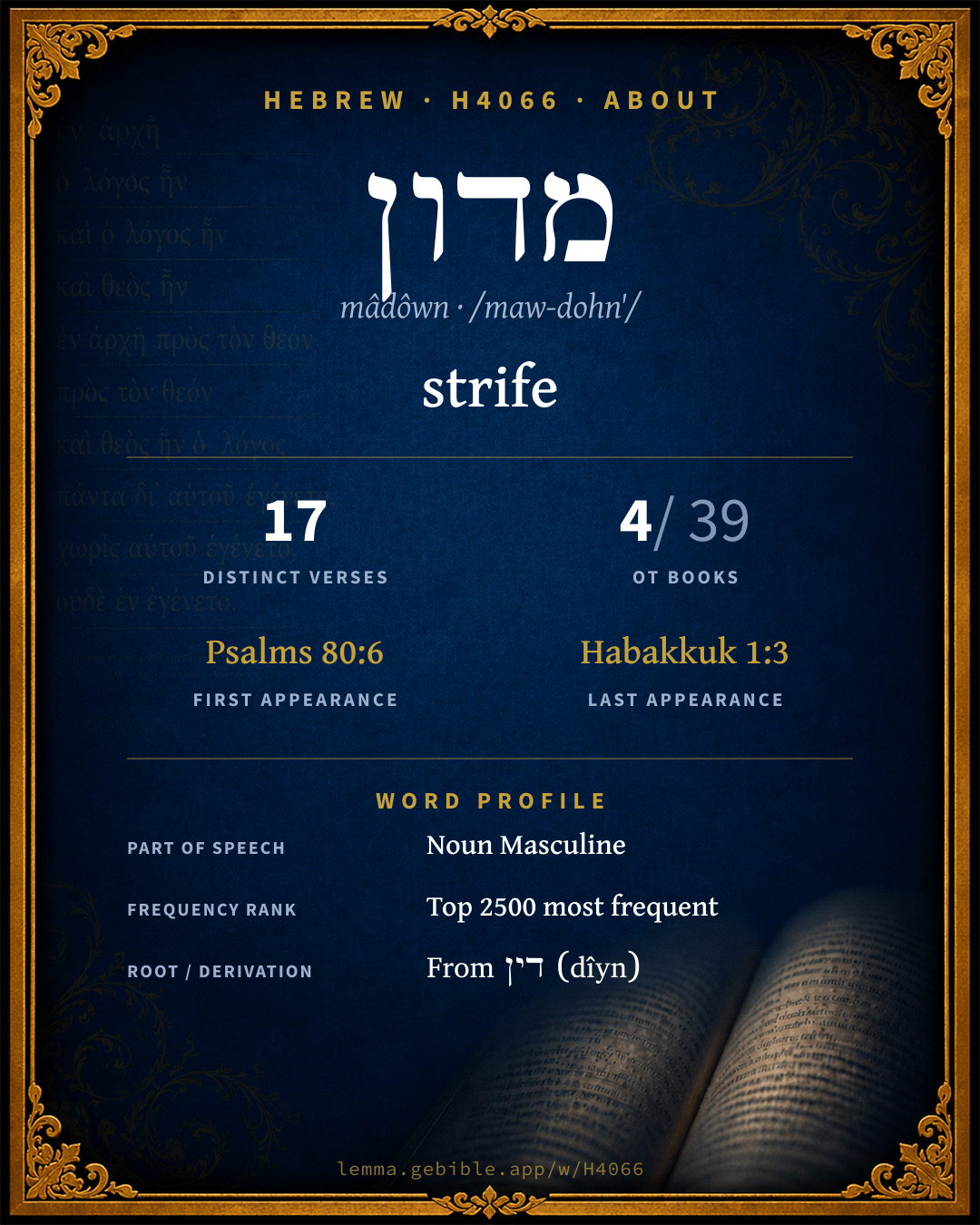
מָדוֹן
strife
‘strife’ is one of 2 main senses fuller range ↓
Full lexicon entry — Brown-Driver-Briggs (BDB)
From Brown-Driver-Briggs (BDB)
Where this word appears
Grammar key — what these labels mean
Part of speech
- Noun
- A naming word — a person, place, thing, or idea.
Noun type
- Common
- A common noun — a general class of person, place, or thing (“king,” “city,” “water”), not a specific name.
State
- Absolute
- The independent form of a noun, not bound to a following word.
Gender
- Masculine
- Grammatically masculine.
Number
- Singular
- One.
- Plural
- More than one (in Hebrew, generally three or more).
Grammatical forms
- Noun, Common, Masculine, Singular, Absolute 10 times (59%)
- Noun, Common, Masculine, Plural, Absolute 7 times (41%)
Parsed forms decoded from the imported morphology (morphhb / Westminster Leningrad Codex — WLC text public domain, morphhb tagging CC BY 4.0), counted across 17 parsed occurrences — not distinct verses.
Every verse where H4066 appears — 17 distinct verses across 4 books. Click any verse to open its interlinear word-by-word view. Verse text shown in the World English Bible for context — . Each verse’s Hebrew form is shown with its reference; the English is not keyword-highlighted, since the data carries no word-level English alignment. Use “Compare translations” on any verse to read it across multiple English versions. This concordance covers the Hebrew Bible; Septuagint (Greek Old Testament) occurrences are not indexed here.
Psalms 1 verse
Proverbs 14 verses
- Proverbs 6:14 מִדְיָנִ֥ים n c mp In whose heart is perverseness, Who devises evil continually, Who always sows discord.
- Proverbs 15:18 מָד֑וֹן n c ms A wrathful man stirs up contention, But one who is slow to anger appeases strife.
- Proverbs 16:28 מָד֑וֹן n c ms A perverse man stirs up strife. A whisperer separates close friends.
- Proverbs 17:14 מָד֑וֹן n c ms The beginning of strife is like breaching a dam, Therefore stop contention before quarreling breaks out.
- Proverbs 18:19 ו/מדונים conj + n c mp A brother offended is more difficult than a fortified city; And disputes are like the bars of a castle.
- Proverbs 21:19 מדונים n c mp It is better to dwell in a desert land, Than with a contentious and fretful woman.
- Proverbs 22:10 מָד֑וֹן n c ms Drive out the mocker, and strife will go out; Yes, quarrels and insults will stop.
- Proverbs 23:29 מדונים n c mp Who has woe? Who has sorrow? Who has strife? Who has complaints? Who has needless bruises? Who has bloodshot eyes?
- Proverbs 25:24 מדונים n c mp It is better to dwell in the corner of the housetop, Than to share a house with a contentious woman.
- Proverbs 26:20 מָדֽוֹן n c ms For lack of wood a fire goes out; Without gossip, a quarrel dies down.
- Proverbs 26:21 מדונים n c mp As coals are to hot embers, And wood to fire, So is a contentious man to kindling strife.
- Proverbs 27:15 מדונים n c mp A continual dropping on a rainy day And a contentious wife are alike:
- Proverbs 28:25 מָד֑וֹן n c ms One who is greedy stirs up strife; But one who trusts in Yahweh will prosper.
- Proverbs 29:22 מָד֑וֹן n c ms An angry man stirs up strife, And a wrathful man abounds in sin.
Jeremiah 1 verse
Habakkuk 1 verse
About this entry
At a glance — auto-summarized from this page’s data, not written by a person. Every figure links to its source below. This summary describes the numbers; it doesn’t interpret them.
מדון (mâdôwn) is a Hebrew noun most often rendered “strife.” It clusters heavily in Proverbs, which alone accounts for 82% of its uses. With 17 verses in 4 books, it is an uncommon word in the Hebrew Bible. Not a single-sense word: explore its full sense range. Translators differ — “strife” in the King James Version, then “quarrels” (unfoldingWord Literal Text), as the renderings breakdown shows. For the data behind this summary, explore the sense tree and the renderings breakdown below.
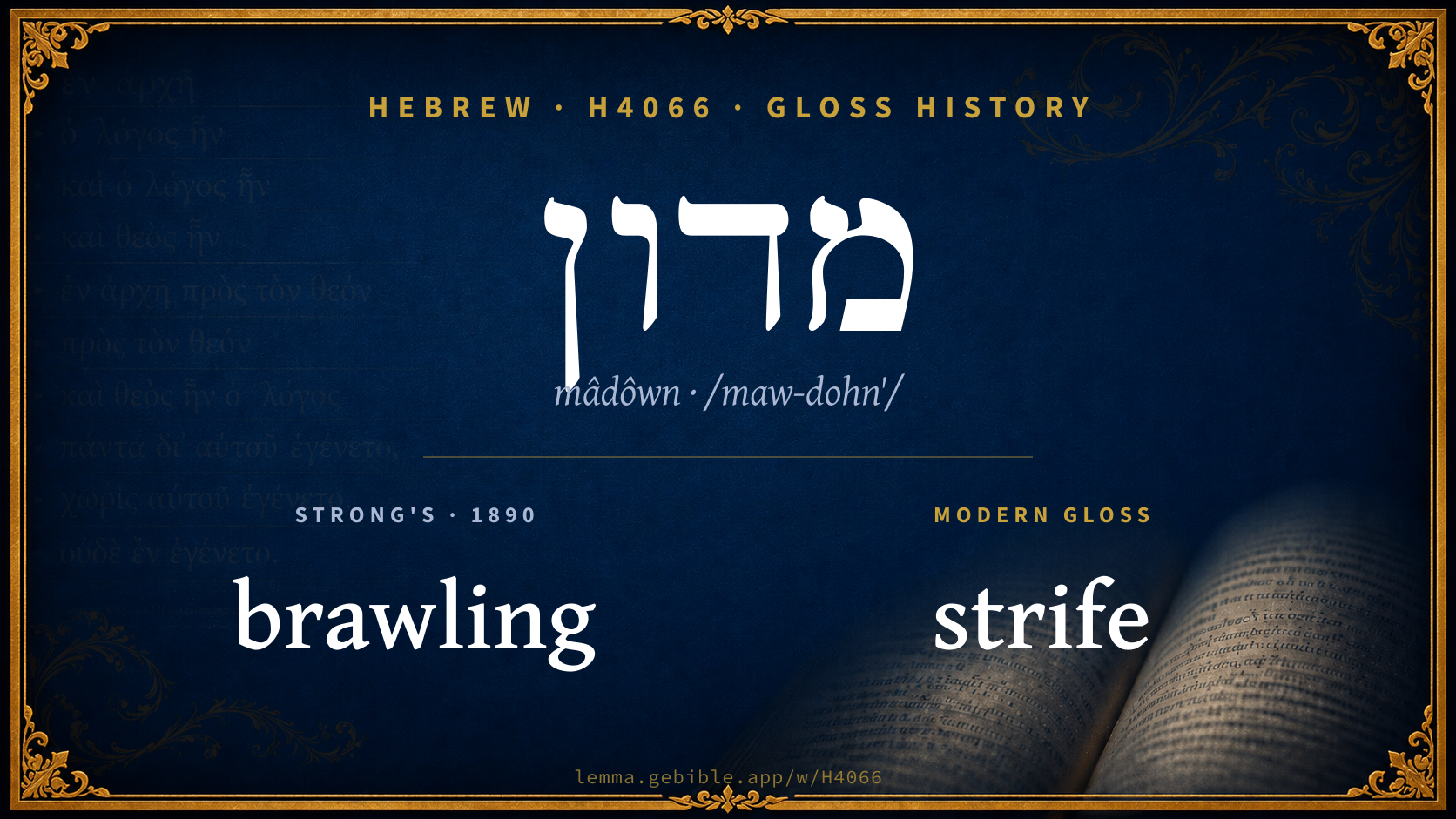
Gloss history
Strong's 1890 vs modern scholarship
About this word
Strong's H4066 catalogs a Hebrew word from the Hebrew Old Testament.
These counts are not copied from any lexicon or concordance. They are computed here, from the morphology-tagged Hebrew Old Testament. What Lemma adds →
- 17
- distinct verses
- The word appears in 17 distinct verses.
- 4 / 39
- OT books
- The word appears in 4 of 39 Old Testament books.
- #1,671
- by frequency
- Top 2500 most frequent Hebrew words (rank 1,671 of 8,640 Hebrew words by occurrence).
View all 17 occurrences in the concordance →
By section of the Old Testament
By traditional corpus
Conventional, traditional groupings — biblical authorship is debated, so this is a traditional corpus grouping, not an authorship claim. Each share is this word’s portion of its verses in that division of the Hebrew canon. Each figure is a share of the word’s 17 distinct verses.
- Writings (Ketuvim) 15 verses · 88%
- Prophets (Nevi'im) 2 verses · 12%
How translations render this word
Counts come from each version’s own published word-to-Strong’s tagging or interlinear alignment — an approximate guide to how each version renders this word, not a word-level alignment the data otherwise carries. Because each total is that version’s own tagged count, the per-version totals vary from one another and need not match the appearance or distinct-verse counts above. These counts may also differ from a printed concordance because Lemma counts each distinctly tagged rendering and does not collapse phrase taggings into a single head-word total. This is a fixed set of word-tagged versions (KJV, ASV, BSB, ULT) and does not change with the reading translation you choose elsewhere. Each version’s license is shown beside its name below (and on Sources).
BDB lists this Strong’s number as 3 distinct words (homographs). Each count above pools all of them and is not split by sense — see the Senses section below. A low-frequency rendering may belong to a different one of those words, not the primary meaning.
- King James Version†: Strife 7×, Contention 3×
- American Standard Version†: Contention 4×, Strife 4×
- Berean Standard Bible†: Conflict 4×, Dissension 2×, Strife 2×
- unfoldingWord Literal Text†: Quarrels 5×, Strife 5×, Quarrel 3×
King James Version Public Domain
Renders H4066 across 11† tagged occurrences — most commonly:
Plus 1 rendering that appears only once — usually multi-word phrases or single function words the recovered tagging swept in, not distinct renderings. Not rendered by a distinct English word in 7 further occurrences.
American Standard Version Public Domain
Renders H4066 across 11† tagged occurrences — most commonly:
Plus 3 renderings that appear only once — usually multi-word phrases or single function words the recovered tagging swept in, not distinct renderings.
Berean Standard Bible Public Domain
Renders H4066 across 16† tagged occurrences — most commonly:
Plus 8 renderings that appear only once — usually multi-word phrases or single function words the recovered tagging swept in, not distinct renderings.
unfoldingWord Literal Text CC BY-SA 4.0
Renders H4066 across 16† tagged occurrences — most commonly:
Plus 1 rendering that appears only once — usually multi-word phrases or single function words the recovered tagging swept in, not distinct renderings.
Senses in the full BDB
What do BDB’s symbols mean?
BDB uses these scholarly abbreviations:
| Symbol | Meaning |
|---|---|
| 𝔊 | the Septuagint (the ancient Greek translation, LXX) |
| 𝔙 | the Vulgate (the Latin translation) |
| 𝔖 | the Syriac version (the Peshitta) |
| 𝔗 | the Targum (the Aramaic translation) |
| ψ | the Psalms |
| √ | root (the underlying root or stem) |
| ‖ | parallel passage (a synonymous or contrasted parallel) |
| † | the dagger: every passage where the word occurs is cited |
The 2 senses and sub-senses the full Brown-Driver-Briggs lexicon distinguishes for this word, in lexicon order (not ranked by frequency), with BDB’s own verbatim wording and sub-sense lettering. Shown in Hebrew script with BDB’s own scholarly abbreviations. The condensed entry is in the Lexicon Entry tab. See also the Forms in the corpus table below.
מדון I
- 1. strife, contention, alm. wholly Pr:—Pr 18:19; 23:29; 26:20; also 17:14 (‖ רִיב), 22:10 (‖ דִּין וְקָלוֹן); מ׳ יִשָּׂא Hb 1:3 contention ariseth (‖ ריב); שׁלּח מ׳ let loose strife Pr 6:14, 19; 16:28; יְגָרֶה מ׳ he stirreth up strife 15:18; 28:25; 29:22; note especially אִישׁ מִדְוָ֯נִים 26:21 = a contentious, quarrelsome man; oftener אֵשֶׁת מ׳ = a contentious woman 21:9; 25:24; 27:15, cf. אֵשֶׁת מ׳ וָכָ֑עַס 21:19. e.g. Proverbs 18:19
- 2. object of contention ψ 80:7, cf. אִישׁ מָדוֹן Je 15:10 (‖ אִישׁ רִיב).—On מָדוֹן 2 S 21:20 Qr, v. i. מִדָּה sub מדד. e.g. Psalms 80:7
מדון II loc. a royal city of the Canaanites Jos 11
Senses from the full Brown-Driver-Briggs lexicon (Brown, Driver, Briggs; Oxford 1906 — public domain), digitized via Sefaria, supplemented by the OpenScriptures HebrewLexicon (CC BY 4.0). Full attribution on Sources.
Word origin
I. n.m. Pr 22:10 strife, contention—ψ 80:7 + 9 times; pl. מִדְיָנִים Pr 18:18, מִדְ֯וָנִים Pr 18:19 + 7 times; contracted into מְדָנִים Pr 6:19; 10:12, מִדֳ֯נִים Pr 6:14; cstr. מִדְיְנֵי Pr 19:13.
II. n.pr.loc. a royal city of the Canaanites Jos 11:1; 12:19; 𝔊 Μαρρν, Μαδων, Λαμορων;= Madîn. close to Hattîn, Surveyi. 365, dub.; a village Maron lies 2 hours WSW. from Kedesh, van deVeldeMem 146, cf. Di.
— Brown-Driver-Briggs (Oxford 1906, public domain), digitized via Sefaria, supplemented by the OpenScriptures HebrewLexicon (CC BY 4.0). See Sources.
Derived from דין (dîyn) (H1777) — to judge.
Forms in the corpus
The 8 distinct written forms H4066 takes in the Hebrew Bible, most frequent first — each parse links to that state’s occurrences in the concordance. Hebrew forms include their vowel points and cantillation, so a single lemma takes many written forms.
| Form | Parsing | Example | Uses |
|---|---|---|---|
| מָד֑וֹן | Noun, Common, Masculine, Singular, Absolute | Proverbs 15:18 | 6 |
| מדונים | Noun, Common, Masculine, Plural, Absolute | Proverbs 21:19 | 5 |
| ו/מדונים | Noun, Common, Masculine, Plural, Absolute | Proverbs 18:19 | 1 |
| וּ/מָד֖וֹן | Noun, Common, Masculine, Singular, Absolute | Habakkuk 1:3 | 1 |
| מִדְיָנִ֥ים | Noun, Common, Masculine, Plural, Absolute | Proverbs 6:14 | 1 |
| מָ֭דוֹן | Noun, Common, Masculine, Singular, Absolute | Psalms 80:6 | 1 |
| מָד֖וֹן | Noun, Common, Masculine, Singular, Absolute | Jeremiah 15:10 | 1 |
| מָדֽוֹן | Noun, Common, Masculine, Singular, Absolute | Proverbs 26:20 | 1 |
Same root — word family
Other BDB entries built from the same root as H4066, grouped by Strong’s listed origin. These share a root / origin per the lexicon — not necessarily a shared meaning. Each links to that word’s own entry.
Derives from
Shares the same root
Derived from this word
Proper names from this root
People and places named from this root — a name, not an additional meaning of the word.
Compare all same-root words → Showing 4 of 9 — not the complete family. 1 of the same-root words is a proper name (a person or place). They share a root, not necessarily a meaning.
Septuagint verse parallels
This word appears in 17 verses that also exist in the Greek Old Testament (Septuagint), out of the 17 Hebrew verses it occurs in. You can read those verses in Greek by switching the Old Testament edition to the Septuagint.
Read these verses in the Septuagint
This is a verse-level parallel only — the same verses exist in both the Hebrew and Greek Old Testaments. No word-level Hebrew↔Greek correspondence is claimed: the data carries no such alignment, so no Greek word is shown as this Hebrew word’s translation. Coverage is not total — the Septuagint omits the deuterocanon and renumbers the Psalms, so some Hebrew verses have no direct Greek parallel.