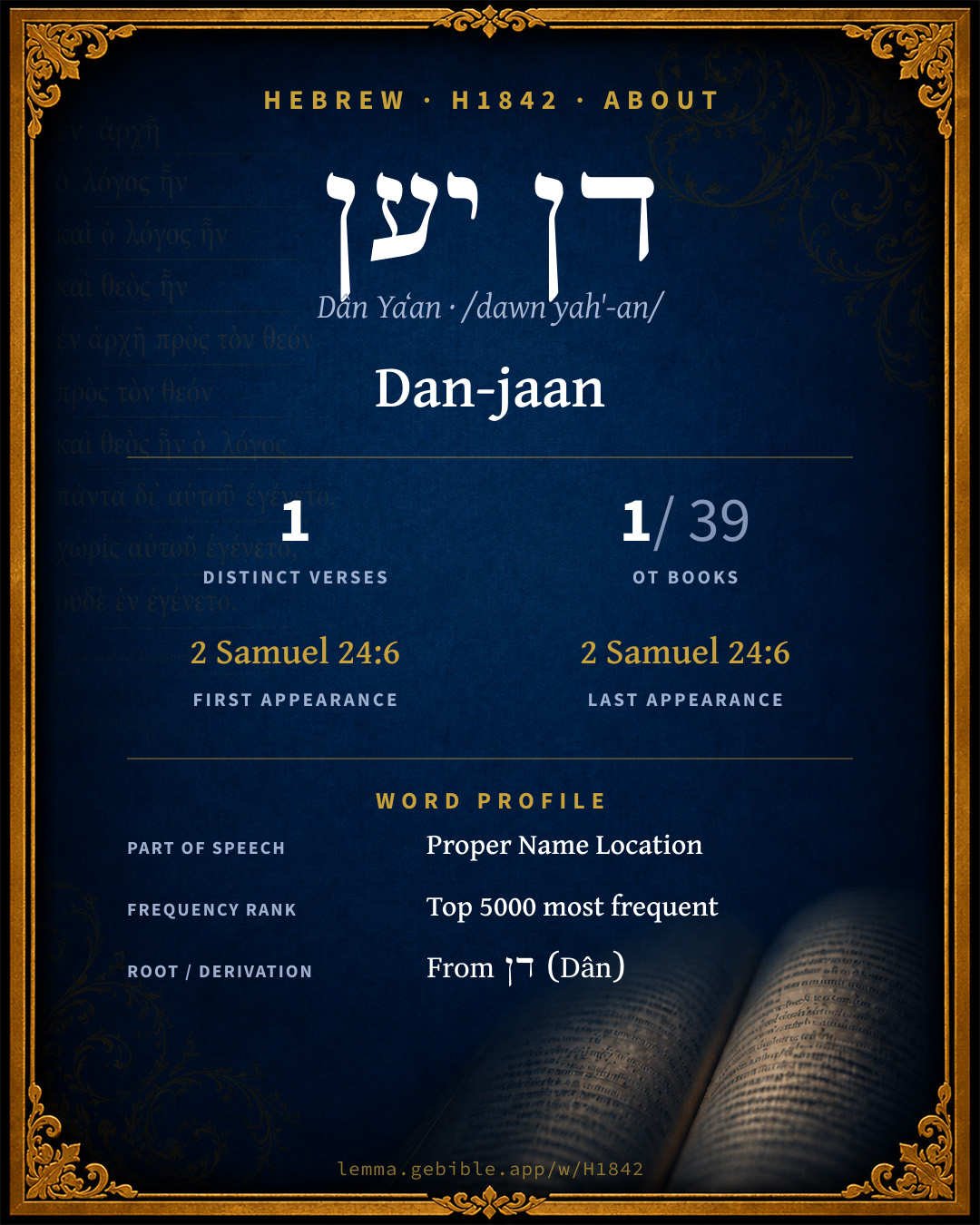
דָּן יַעַן
Dan-jaan
BDB lists 2 entries for ‘Dan-jaan’ fuller range ↓
Full lexicon entry — Brown-Driver-Briggs (BDB)
From Brown-Driver-Briggs (BDB)
Where this word appears
Grammar key — what these labels mean
Part of speech
- Noun
- A naming word — a person, place, thing, or idea.
Noun type
- Proper
- A name of a specific person, place, or people (e.g. Abraham, Zion, Israel).
Every verse where H1842 appears — 1 distinct verse across 1 book. Click any verse to open its interlinear word-by-word view. Verse text shown in the World English Bible for context — . Each verse’s Hebrew form is shown with its reference; the English is not keyword-highlighted, since the data carries no word-level English alignment. Use “Compare translations” on any verse to read it across multiple English versions. This concordance covers the Hebrew Bible; Septuagint (Greek Old Testament) occurrences are not indexed here.
2 Samuel 1 verse
About this entry
At a glance — auto-summarized from this page’s data, not written by a person. Every figure links to its source below. This summary describes the numbers; it doesn’t interpret them.
At its core, דן יען (Dân Yaʻan) means “Dan-jaan.” A scarce word — 1 verse in all of the Hebrew Bible. The word gravitates to 2 Samuel (100%). A true hapax — its single appearance is 2 Samuel 24:6. Each statement above links to its evidence; the full detail follows below.
Gloss history
Strong's 1890 vs modern scholarship
About this word
Strong's H1842 catalogs a Hebrew word from the Hebrew Old Testament.
These counts are not copied from any lexicon or concordance. They are computed here, from the morphology-tagged Hebrew Old Testament. What Lemma adds →
- 1
- distinct verses
- The word appears in 1 distinct verse.
- 1 / 39
- OT books
- The word appears in 1 of 39 Old Testament books.
- #4,807
- by frequency
- Top 5000 most frequent Hebrew words (rank 4,807 of 8,640 Hebrew words by occurrence).
View all 1 occurrence in the concordance →
Most concentrated in
- 2 Samuel 1 verse 100%
By section of the Old Testament
By traditional corpus
Conventional, traditional groupings — biblical authorship is debated, so this is a traditional corpus grouping, not an authorship claim. Each share is this word’s portion of its verses in that division of the Hebrew canon. Each figure is a share of the word’s 1 distinct verse.
- Prophets (Nevi'im) 1 verse · 100%
How translations render this word
Counts come from each version’s own published word-to-Strong’s tagging or interlinear alignment — an approximate guide to how each version renders this word, not a word-level alignment the data otherwise carries. Because each total is that version’s own tagged count, the per-version totals vary from one another and need not match the appearance or distinct-verse counts above. These counts may also differ from a printed concordance because Lemma counts each distinctly tagged rendering and does not collapse phrase taggings into a single head-word total. This is a fixed set of word-tagged versions (KJV, ASV, BSB, ULT) and does not change with the reading translation you choose elsewhere. Each version’s license is shown beside its name below (and on Sources).
- King James Version: Danjaan 1×
- American Standard Version: Dan-jaan 1×
- Berean Standard Bible: Dan-jaan 1×
- unfoldingWord Literal Text: Dan jaan 2×
King James Version Public Domain
Renders H1842 across 1 tagged occurrence — most commonly:
American Standard Version Public Domain
Renders H1842 across 1 tagged occurrence — most commonly:
Berean Standard Bible Public Domain
Renders H1842 across 1 tagged occurrence — most commonly:
unfoldingWord Literal Text CC BY-SA 4.0
Renders H1842 across 2 tagged occurrences — most commonly:
Senses in the full BDB
What do BDB’s symbols mean?
BDB uses these scholarly abbreviations:
| Symbol | Meaning |
|---|---|
| 𝔊 | the Septuagint (the ancient Greek translation, LXX) |
| 𝔙 | the Vulgate (the Latin translation) |
| 𝔖 | the Syriac version (the Peshitta) |
| 𝔗 | the Targum (the Aramaic translation) |
| ψ | the Psalms |
| √ | root (the underlying root or stem) |
| ‖ | parallel passage (a synonymous or contrasted parallel) |
| † | the dagger: every passage where the word occurs is cited |
The 3 senses and sub-senses the full Brown-Driver-Briggs lexicon distinguishes for this word, in lexicon order (not ranked by frequency), with BDB’s own verbatim wording and sub-sense lettering. Shown in Hebrew script with BDB’s own scholarly abbreviations. The condensed entry is in the Lexicon Entry tab. See also the Forms in the corpus table below.
- 1. son of Jacob and Bilhah
- 2. the tribe of Dan
- 3. a city on northern frontier of Israel at one of the sources of the Jordan
Senses from the full Brown-Driver-Briggs lexicon (Brown, Driver, Briggs; Oxford 1906 — public domain), digitized via Sefaria, supplemented by the OpenScriptures HebrewLexicon (CC BY 4.0). Full attribution on Sources.
Word origin
דָּן n.pr.m. ( judge )
— Brown-Driver-Briggs (Oxford 1906, public domain), digitized via Sefaria, supplemented by the OpenScriptures HebrewLexicon (CC BY 4.0). See Sources.
Derived from דן (Dân) (H1835) — Dan.
Jastrow Dictionary
A second Hebrew/Aramaic lexicon for comparison, covering Aramaic and post-biblical (Talmudic, Targumic, Midrashic) usage that the biblical-Hebrew BDB does not. Matched by lemma rather than by Strong’s number, so a lemma may carry more than one Jastrow headword (shown separately below), and the entries cover usage well beyond the Bible.
דָּן
- (b. h.)
- 1. pr. n. m. Dan, son of Jacob. Pes. 4ᵃ מדן קאתי he is a descendant of Dan; a. e.
- 2. pr. n. pl. Dan in northern Palestine. Pesik. Shek. p. 15ᵃ מזבח שבדן the altar (erected by Jeroboam) in Dan.—Targ. Y. II, Num. XXXIV, 15. Targ. Cant. V, 4; Pirké d’R. El. ch. XXVII expl. = פמיאס, Paneas; Midr. Sam. ch. XXX; XXXII דנה (יען) פנייס.—Y. Dem. II, 22ᶜ bot. כְּפר דָּן.
- 3. name of an idol Dan. Sabb. 67ᵇ; Tosef. ib. VII (VIII), 3; Y. ib. VI, 8ᶜ bot. (ref. to Am. VIII, 14). e.g. Amos 8:14
דֵּן
- c. (cmp. דָּא, דֵּךְ) this, that. Targ. Is. VI, 3. Targ. Deut. II, 3 הָדֵן (ed. Berl. הָדֵין = הָא ד׳); a. v. fr.—Lev. R. s. 7 מן הד׳ קריא from this verse (it is proven). Lev. R. s. 8 ד׳ אמר לינא בעיא לד׳ וכ׳ the one said, I do not want this (woman) &c. Sabb. 112ᵇ לית ד׳ ב"א this is not (an ordinary) human being; ib. כגון ד׳ וכ׳ a man like this is worth the name of a human being; a. fr.—Y. Ab. Zar. II, 41ᵈ bot.; a. e. אסיר לך דנא this (piece) is forbidden to thee.—מן קדמת דנא ere this, formerly. Y. Sot. II, 17ᵈ; a. e.—כְּדֵ׳ a) = h. פֹּה, here (cmp. כָּא, הָכָא). Targ. Jud. XVIII, 3. Targ. Is. XXII, 16 (some ed. בְּדֵין); b) like this, thus. Targ. Gen. XXXII, 4. Targ. Jud. XVIII, 4; a. fr. [Targ. Ps. II, 10 read; כְּדוּן.]—B. Bath. 75ᵃ (play on כדכד, Is. LIV, 12) ליהוי כד׳ וכד׳ let it be as this one says, and as that one; Pesik. Aniy. p. 135ᵇ; Pesik. R. s. 32.—בִּכְדֵין in this manner. Targ. I Kings XXII, 20.—מָדֵין = h. מַה־זֶּה, why. Targ. Jer. XXVI, 9; a. e.—אֵי מִדֵּין from what, which. Targ. Jon. I, 8.—דֵּינוּ (= דֵּין הוּ) this. Y. Erub. VII, 24ᶜ top, a. e. חֵי ד׳ צד וכ׳ (= h. אֵיזֶהוּ) which is ‘side’, and which &c.?, v. הַיְידְּנוּ.—Pl. דֵּינוּן, דֵּינֵי. Y. Snh. IV, 22ᵇ bot. הי ד׳ וכ׳ which are the two additional ones?—[הָדֵין then, v. הֵידֵין.] e.g. Isaiah 54:12
יַעַן
- v. עָנָה) corresponding; (conj) because. Sifra B’ḥuck. Par. 2, ch. VIII (ref. to יען וביען, Lev. XXVI, 43) וכי ראש בראש וכ׳ have I indeed paid them item for item (for all their sins)?—Ruth R. to II, 19; Lev. R. s. 34 י׳ ובי׳ הוא י̇ע̇ן̇ הוא ע̇נ̇י̇ ‘because and because’ (Lev. l. c.) yaʿan and ʿani have the same letters (intimating, ‘because they have rejected my statutes concerning the poor’). e.g. Leviticus 26:43
A Dictionary of the Targumim, the Talmud Babli and Yerushalmi, and the Midrashic Literature (Marcus Jastrow; London, Luzac, 1903) — Public Domain. Digitized via Sefaria. Digitized via Sefaria. Full attribution on Sources.
Forms in the corpus
The 2 distinct written forms H1842 takes in the Hebrew Bible, most frequent first — each parse links to that state’s occurrences in the concordance. Hebrew forms include their vowel points and cantillation, so a single lemma takes many written forms.
| Form | Parsing | Example | Uses |
|---|---|---|---|
| דָּ֣נָ/ה | Noun, Proper | 2 Samuel 24:6 | 1 |
| יַּ֔עַן | Noun, Proper | 2 Samuel 24:6 | 1 |
Same root — word family
Other BDB entries built from the same root as H1842, grouped by Strong’s listed origin. These share a root / origin per the lexicon — not necessarily a shared meaning. Each links to that word’s own entry.
Derives from
Proper names from this root
People and places named from this root — a name, not an additional meaning of the word.
Compare all same-root words → 3 of the same-root words are proper names (people or places). They share a root, not necessarily a meaning.
Bible dictionary
Public-domain dictionary articles matched to this entry by name (Dan-jaan). A biblical name can be shared by more than one person or place, so an article may treat several.
Easton's Bible Dictionary · M. G. Easton, 1897
Woodland Dan, a place probably somewhere in the direction of Dan, near the sources of the Jordan (2 Sam. 24:6). The LXX. and the Vulgate read "Dan-ja'ar", i.e., "Dan in the forest."
Smith's Bible Dictionary · William Smith, 1863
(Danian, i.e. belonging to Dan). (2 Samuel 24:6) Probably the same as Dan.
Classic public-domain reference works; full attribution on Sources.
Septuagint verse parallels
This word appears in 1 verse that also exists in the Greek Old Testament (Septuagint), out of the 1 Hebrew verse it occurs in. You can read those verses in Greek by switching the Old Testament edition to the Septuagint.
Read these verses in the Septuagint
This is a verse-level parallel only — the same verses exist in both the Hebrew and Greek Old Testaments. No word-level Hebrew↔Greek correspondence is claimed: the data carries no such alignment, so no Greek word is shown as this Hebrew word’s translation. Coverage is not total — the Septuagint omits the deuterocanon and renumbers the Psalms, so some Hebrew verses have no direct Greek parallel.