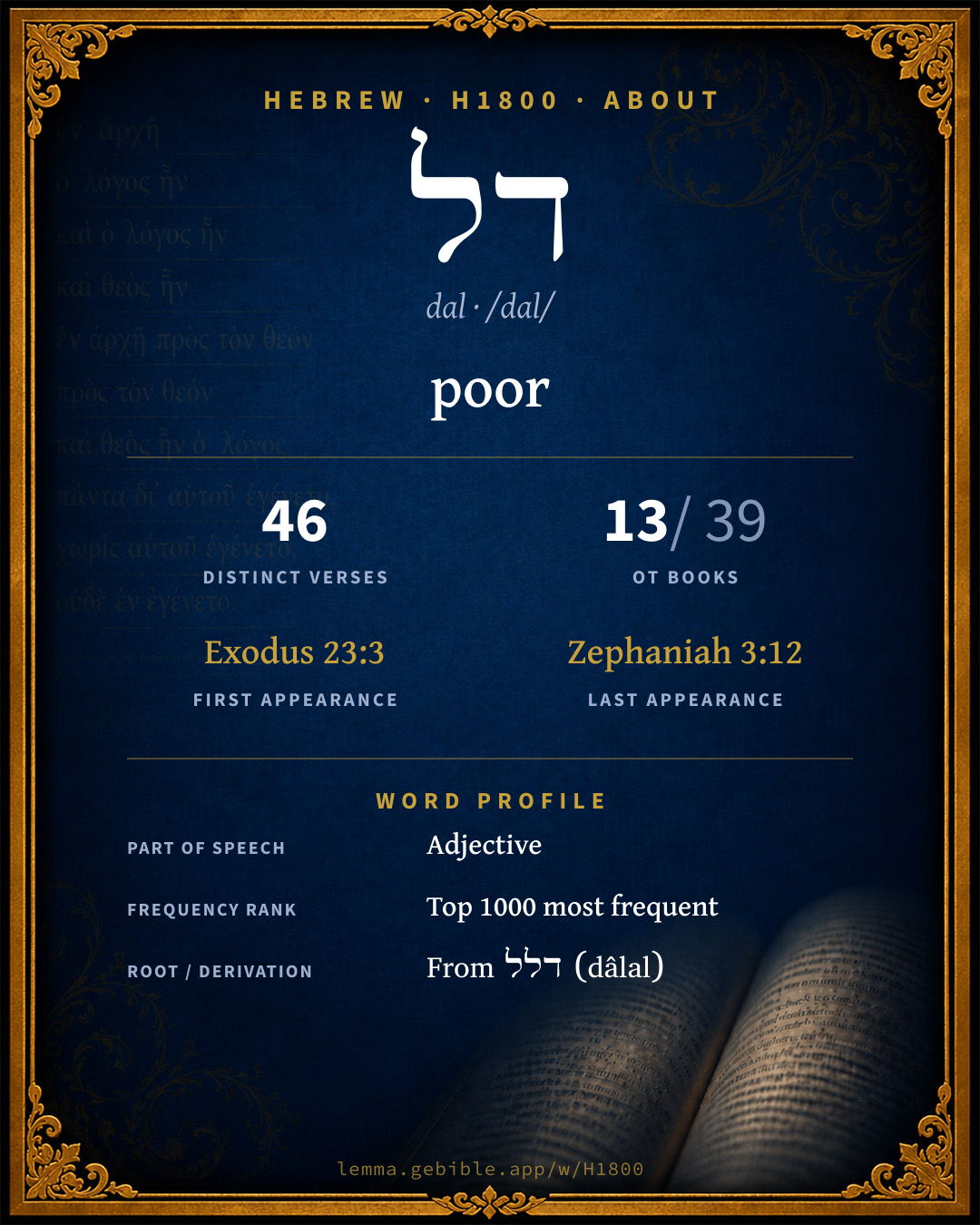
דַּל
poor
Full lexicon entry — Brown-Driver-Briggs (BDB)
From Brown-Driver-Briggs (BDB)
Where this word appears
Grammar key — what these labels mean
Part of speech
- Adjective
- A word that describes or qualifies a noun.
State
- Absolute
- The independent form of a noun, not bound to a following word.
Gender
- Masculine
- Grammatically masculine.
Number
- Singular
- One.
- Plural
- More than one (in Hebrew, generally three or more).
Grammatical forms
- Adjective, Adjective, Masculine, Singular, Absolute 29 times (62%)
- Adjective, Adjective, Masculine, Plural, Absolute 18 times (38%)
Parsed forms decoded from the imported morphology (morphhb / Westminster Leningrad Codex — WLC text public domain, morphhb tagging CC BY 4.0), counted across 47 parsed occurrences — not distinct verses.
Every verse where H1800 appears — 46 distinct verses across 13 books. Click any verse to open its interlinear word-by-word view. Verse text shown in the World English Bible for context — . Each verse’s Hebrew form is shown with its reference; the English is not keyword-highlighted, since the data carries no word-level English alignment. Use “Compare translations” on any verse to read it across multiple English versions. This concordance covers the Hebrew Bible; Septuagint (Greek Old Testament) occurrences are not indexed here.
Exodus 2 verses
- Exodus 23:3 וְ/דָ֕ל conj + Adjective Adjective ms neither shall you favor a poor man in his cause.
- Exodus 30:15 וְ/הַ/דַּל֙ conj + ptcl def.art + Adjective Adjective ms The rich shall not give more, and the poor shall not give less, than the half shekel, when they give the offering of Yahweh, to make atonement for your souls.
Leviticus 2 verses
- Leviticus 14:21 דַּ֣ל adj Adjective ms "If he is poor, and can't afford so much, then he shall take one male lamb for a trespass offering to be waved, to make atonement for him, and one tenth of an ephah of fine flour mingled with oil for a meal offering, and a log of oil;
- Leviticus 19:15 דָ֔ל adj Adjective ms "'You shall do no injustice in judgment: you shall not be partial to the poor, nor show favoritism to the great; but in righteousness shall you judge your neighbor.
Judges 1 verse
Ruth 1 verse
1 Samuel 1 verse
2 Samuel 2 verses
- 2 Samuel 3:1 וְ/דַלִּֽים conj + Adjective Adjective mp Now there was long war between the house of Saul and the house of David: and David grew stronger and stronger, but the house of Saul grew weaker and weaker.
- 2 Samuel 13:4 דַּ֤ל adj Adjective ms He said to him, Why, son of the king, are you thus lean from day to day? Won't you tell me? Amnon said to him, I love Tamar, my brother Absalom's sister.
Job 6 verses
- Job 5:16 לַ/דַּ֣ל prep det + Adjective Adjective ms So the poor has hope, And injustice shuts her mouth.
- Job 20:10 דַלִּ֑ים adj Adjective mp His children shall seek the favor of the poor. His hands shall give back his wealth.
- Job 20:19 דַּלִּ֑ים adj Adjective mp For he has oppressed and forsaken the poor. He has violently taken away a house, and he shall not build it up.
- Job 31:16 דַּלִּ֑ים adj Adjective mp "If I have withheld the poor from their desire, Or have caused the eyes of the widow to fail,
- Job 34:19 דָ֑ל adj Adjective ms Who doesn't respect the persons of princes, Nor regards the rich more than the poor; For they all are the work of his hands.
- Job 34:28 דָּ֑ל adj Adjective ms So that they caused the cry of the poor to come to him, He heard the cry of the afflicted.
Psalms 5 verses
- Psalms 41:1 דָּ֑ל adj Adjective ms Blessed is he who considers the poor: Yahweh will deliver him in the day of evil.
- Psalms 72:13 דַּ֣ל adj Adjective ms He will have pity on the poor and needy. He will save the souls of the needy.
- Psalms 82:3 דַ֥ל adj Adjective ms "Defend the weak, the poor, and the fatherless. Maintain the rights of the poor and oppressed.
- Psalms 82:4 דַ֥ל adj Adjective ms Rescue the weak and needy. Deliver them out of the hand of the wicked."
- Psalms 113:7 דָּ֑ל adj Adjective ms He raises up the poor out of the dust. Lifts up the needy from the ash heap;
Proverbs 14 verses
- Proverbs 10:15 דַּלִּ֣ים adj Adjective mp The rich man's wealth is his strong city. The destruction of the poor is their poverty.
- Proverbs 14:31 דָּ֭ל adj Adjective ms He who oppresses the poor shows contempt for his Maker, But he who is kind to the needy honors him.
- Proverbs 19:4 וְ֝/דָ֗ל conj + Adjective Adjective ms Wealth adds many friends, But the poor is separated from his friend.
- Proverbs 19:17 דָּ֑ל adj Adjective ms He who has pity on the poor lends to Yahweh; He will reward him.
- Proverbs 21:13 דָּ֑ל adj Adjective ms Whoever stops his ears at the cry of the poor, He will also cry out, but shall not be heard.
- Proverbs 22:9 לַ/דָּֽל prep det + Adjective Adjective ms He who has a generous eye will be blessed; For he shares his food with the poor.
- Proverbs 22:16 דָּ֭ל adj Adjective ms Whoever oppresses the poor for his own increase and whoever gives to the rich, Both come to poverty.
- Proverbs 22:22 דָּ֭ל דַל adj Adjective ms adj Adjective ms Don't exploit the poor, because he is poor; And don't crush the needy in court;
- Proverbs 28:3 דַּלִּ֑ים adj Adjective mp A needy man who oppresses the poor Is like a driving rain which leaves no crops.
- Proverbs 28:8 דַּלִּ֣ים adj Adjective mp He who increases his wealth by excessive interest Gathers it for one who has pity on the poor.
- Proverbs 28:11 וְ/דַ֖ל conj + Adjective Adjective ms The rich man is wise in his own eyes; But the poor who has understanding sees through him.
- Proverbs 28:15 דָּֽל adj Adjective ms As a roaring lion or a charging bear, So is a wicked ruler over helpless people.
- Proverbs 29:7 דַּלִּ֑ים adj Adjective mp The righteous care about justice for the poor. The wicked aren't concerned about knowledge.
- Proverbs 29:14 דַּלִּ֑ים adj Adjective mp The king who fairly judges the poor, His throne shall be established forever.
Isaiah 5 verses
- Isaiah 10:2 דַּלִּ֔ים adj Adjective mp to turn aside the needy from justice, and to rob the poor of my people of their right, that widows may be their spoil, and that they may make the fatherless their prey!
- Isaiah 11:4 דַּלִּ֔ים adj Adjective mp but with righteousness shall he judge the poor, and decide with equity for the humble of the earth; and he shall strike the earth with the rod of his mouth; and with the breath of his lips shall he kill the wicked.
- Isaiah 14:30 דַלִּ֔ים adj Adjective mp The firstborn of the poor shall feed, and the needy shall lie down in safety; and I will kill your root with famine, and your remnant shall be killed.
- Isaiah 25:4 לַ/דָּ֛ל prep det + Adjective Adjective ms For you have been a stronghold to the poor, a stronghold to the needy in his distress, a refuge from the storm, a shade from the heat, when the blast of the awesome ones is as a storm against the wall.
- Isaiah 26:6 דַלִּֽים adj Adjective mp The foot shall tread it down; even the feet of the poor, and the steps of the needy.
Jeremiah 2 verses
- Jeremiah 5:4 דַּלִּ֖ים adj Adjective mp Then I said, Surely these are poor; they are foolish; for they don't know the way of Yahweh, nor the law of their God:
- Jeremiah 39:10 הַ/דַּלִּ֗ים ptcl def.art + Adjective Adjective mp But Nebuzaradan the captain of the guard left of the poor of the people, who had nothing, in the land of Judah, and gave them vineyards and fields at the same time.
Amos 4 verses
- Amos 2:7 דַּלִּ֔ים adj Adjective mp They trample on the dust of the earth on the head of the poor, And deny justice to the oppressed; And a man and his father use the same maiden, to profane my holy name;
- Amos 4:1 דַּלִּ֔ים adj Adjective mp Listen to this word, you cows of Bashan, who are on the mountain of Samaria, who oppress the poor, who crush the needy, who tell their lords, "Bring, and let us drink."
- Amos 5:11 דָּ֗ל adj Adjective ms Forasmuch therefore as you trample on the poor, And take taxes from him of wheat: You have built houses of hewn stone, But you will not dwell in them. You have planted pleasant vineyards, But you shall not drink their wine.
- Amos 8:6 דַּלִּ֔ים adj Adjective mp That we may buy the poor for silver, And the needy for a pair of shoes, And sell the sweepings with the wheat?'"
Zephaniah 1 verse
About this entry
At a glance — auto-summarized from this page’s data, not written by a person. Every figure links to its source below. This summary describes the numbers; it doesn’t interpret them.
דל — transliterated dal — is a Hebrew adjective carrying the sense “poor.” Debuting at Exodus 23:3, it then recurs through the corpus. The Hebrew Bible uses it across 46 verses — moderately common. More than a quarter of its appearances fall in Proverbs. It shares a root with דלל, דלה and דלילה. See the sense tree, 46-verse concordance, and the renderings breakdown below.
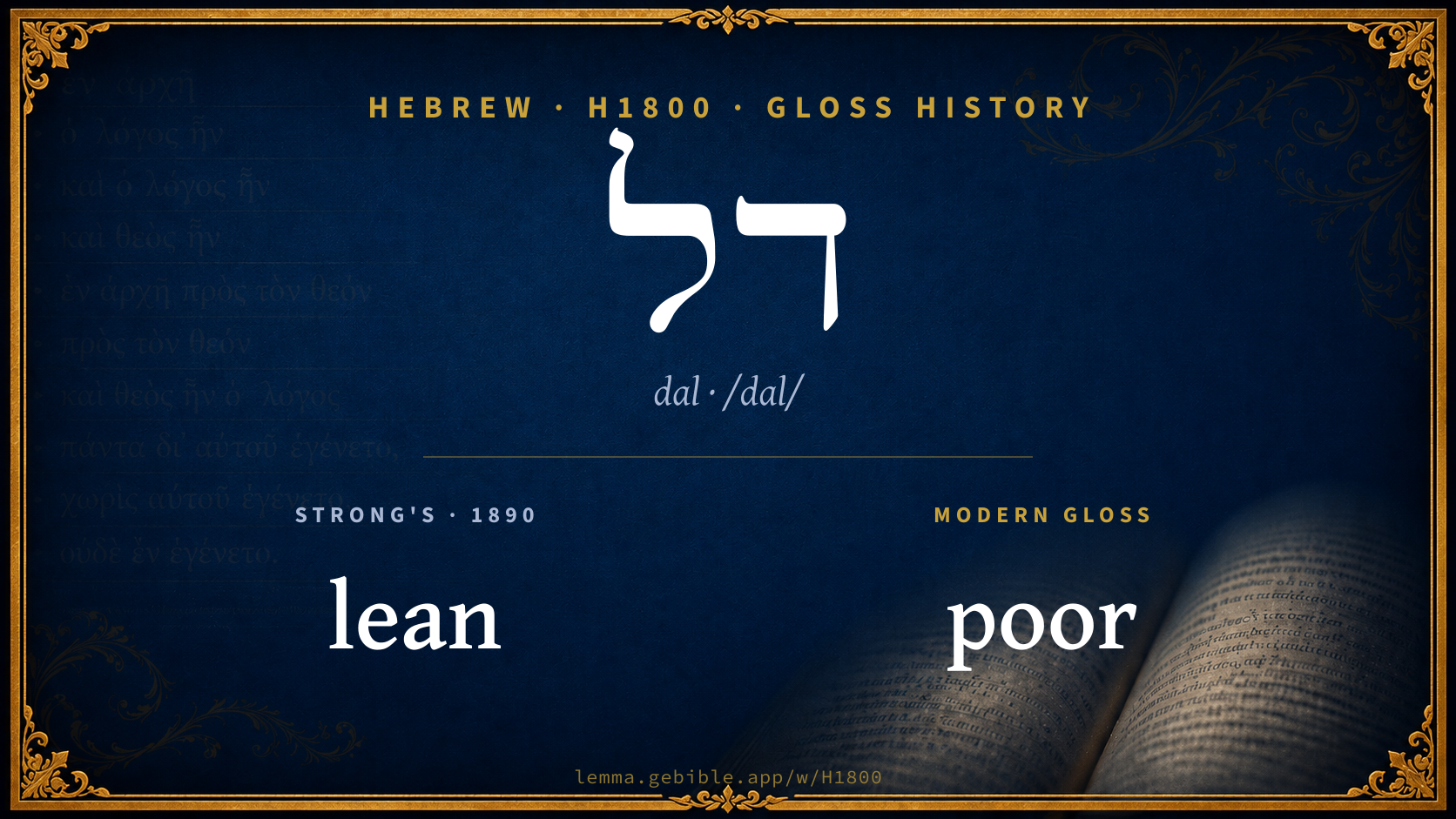
Gloss history
Strong's 1890 vs modern scholarship
About this word
Strong's H1800 catalogs a Hebrew word from the Hebrew Old Testament.
These counts are not copied from any lexicon or concordance. They are computed here, from the morphology-tagged Hebrew Old Testament. What Lemma adds →
- 46
- distinct verses
- The word appears in 46 distinct verses.
- 13 / 39
- OT books
- The word appears in 13 of 39 Old Testament books.
- #783
- by frequency
- Top 1000 most frequent Hebrew words (rank 783 of 8,640 Hebrew words by occurrence).
View all 46 occurrences in the concordance →
By section of the Old Testament
By traditional corpus
Conventional, traditional groupings — biblical authorship is debated, so this is a traditional corpus grouping, not an authorship claim. Each share is this word’s portion of its verses in that division of the Hebrew canon. Each figure is a share of the word’s 46 distinct verses.
- Writings (Ketuvim) 26 verses · 57%
- Prophets (Nevi'im) 16 verses · 35%
- Torah (Pentateuch) 4 verses · 9%
How translations render this word
Counts come from each version’s own published word-to-Strong’s tagging or interlinear alignment — an approximate guide to how each version renders this word, not a word-level alignment the data otherwise carries. Because each total is that version’s own tagged count, the per-version totals vary from one another and need not match the appearance or distinct-verse counts above. These counts may also differ from a printed concordance because Lemma counts each distinctly tagged rendering and does not collapse phrase taggings into a single head-word total. This is a fixed set of word-tagged versions (KJV, ASV, BSB, ULT) and does not change with the reading translation you choose elsewhere. Each version’s license is shown beside its name below (and on Sources).
BDB lists this Strong’s number as 3 distinct words (homographs). Each count above pools all of them and is not split by sense — see the Senses section below. A low-frequency rendering may belong to a different one of those words, not the primary meaning.
- King James Version†: Poor 36×, Needy 2×, Weaker 2×
- American Standard Version†: Poor 37×, Needy 3×, Weaker 2×
- Berean Standard Bible†: Poor 35×, Poor man 3×, Is poor 2×
- unfoldingWord Literal Text†: Poor 19×, Lowly 10×, Lowly one 5×
King James Version Public Domain
Renders H1800 across 48† tagged occurrences — most commonly:
Plus 8 renderings that appear only once — usually multi-word phrases or single function words the recovered tagging swept in, not distinct renderings.
American Standard Version Public Domain
Renders H1800 across 49† tagged occurrences — most commonly:
Plus 7 renderings that appear only once — usually multi-word phrases or single function words the recovered tagging swept in, not distinct renderings.
Berean Standard Bible Public Domain
Renders H1800 across 47† tagged occurrences — most commonly:
Plus 5 renderings that appear only once — usually multi-word phrases or single function words the recovered tagging swept in, not distinct renderings.
unfoldingWord Literal Text CC BY-SA 4.0
Renders H1800 across 56† tagged occurrences — most commonly:
Plus 11 renderings that appear only once — usually multi-word phrases or single function words the recovered tagging swept in, not distinct renderings.
Senses in the full BDB
What do BDB’s symbols mean?
BDB uses these scholarly abbreviations:
| Symbol | Meaning |
|---|---|
| 𝔊 | the Septuagint (the ancient Greek translation, LXX) |
| 𝔙 | the Vulgate (the Latin translation) |
| 𝔖 | the Syriac version (the Peshitta) |
| 𝔗 | the Targum (the Aramaic translation) |
| ψ | the Psalms |
| √ | root (the underlying root or stem) |
| ‖ | parallel passage (a synonymous or contrasted parallel) |
| † | the dagger: every passage where the word occurs is cited |
The 0 senses and sub-senses the full Brown-Driver-Briggs lexicon distinguishes for this word, in lexicon order (not ranked by frequency), with BDB’s own verbatim wording and sub-sense lettering. Shown in Hebrew script with BDB’s own scholarly abbreviations. The condensed entry is in the Lexicon Entry tab. See also the Forms in the corpus table below.
דל I door, v. sub דלה.
דל II low, weak, poor, thin (especially common in Wisd. lit. and poet.)
Senses from the full Brown-Driver-Briggs lexicon (Brown, Driver, Briggs; Oxford 1906 — public domain), digitized via Sefaria, supplemented by the OpenScriptures HebrewLexicon (CC BY 4.0). Full attribution on Sources.
Word origin
I. n. door, v. sub דלה.
II. adj. low, weak, poor, thin (especially common in Wisd. lit. and poet.)—דַּל Lv 14:21 + 8 times, דָּל֑ Ex 23:3 + 17 times + דָּל֥ ψ 82:3; דַּלִּים Am 2:7 + 17 times; דַּלּוֹת Gn 41:19;—weak, thin, of kine Gn 41:19 (E); of Amnon 2 S 13:4; weak, of family of Saul 2 S 3:1 (opp. חָזֵק) cf. Ju 6:15; reduced, poor (opp. rich) Lv 14:21 (P) Ru 3:10 (opp. עָשִׁיר) Je 5:4 (opp. to הגדולים, v 5) Pr 28:15 Zp 3:12 (עַם עָנִי וָדָל֑); mostly subst., a poor (man), the poor Ex 23:3 (JE); opp. to עָשִׁיר Ex 30:15 (P) Pr 10:15; 22:16; 28:11; opp. הוֹן Pr 19:4; ‖ אביון 1 S 2:8 Jb 5:16 ψ 72:13; 82:4; 113:7 Pr 14:31 Is 14:30; 25:4 Am 4:1; 8:6; cf. also Jb 20:10, 19 Pr 22:9 Je 39:10; reduced, weak, helpless (‖ עני) Jb 34:28 ψ 82:3 (‖ also יתום), Pr 22:22 Is 10:2; 11:4; 26:6 Am 2:7; ‖ אלמנה Jb 31:16; opp. שׁוֹעַ Jb 34:19;—cf. also ψ 41:2 Pr 19:17; 21:13; 28:3, 8; 29:7, 14.
— Brown-Driver-Briggs (Oxford 1906, public domain), digitized via Sefaria, supplemented by the OpenScriptures HebrewLexicon (CC BY 4.0). See Sources.
Derived from דלל (dâlal) (H1809) — to hang.
Jastrow Dictionary
A second Hebrew/Aramaic lexicon for comparison, covering Aramaic and post-biblical (Talmudic, Targumic, Midrashic) usage that the biblical-Hebrew BDB does not. Matched by lemma rather than by Strong’s number, so a lemma may carry more than one Jastrow headword (shown separately below), and the entries cover usage well beyond the Bible.
דִּל
- (contract, of דְּאִי לָא) for if not. דִּל כֵּן (joined דִּלָכֵן, דִּילָכֵן, v. דִּי II) for were it not so. Y. Yoma VIII, 44ᵈ bot. Y. Gitt. VII, beg. 48ᶜ; a. e.—Y. Ber. II, 5ᵃ bot.—Y. Shebi. IV, 35ᵃ bot. אכול דילכן וכ׳ eat, for if thou (doest) not so, I shall kill thee.
דַּל I
- (imperat. of דְּלַל) lessen, deduct; (adv.) less. Sabb. 89ᵇ ד׳ עשרין deduct twenty years. R. Hash. 7ᵇ ד׳ רגלים leave out festivals. Succ. 2ᵃ ד׳ עשתרות וכ׳ imagine the Succah outside of the hollow, and there remains the shade of the roof; ד׳ דופנין imagine the walls removed. Ib. 56ᵇ נימא ליה דל בדל let the retiring division of priests say to the coming in, ‘less for less’, i.e. take ye one loaf less and those relieving you will also take one less. Midr. Prov. ch. XXII דל עוד מחייו deduct also from the years of his life; a. e.
דַּל II
- thin, sparse; poor, needy. Kil. V, 1 כרם ד׳ a sparsely planted vineyard; Y. ib. 29ᵈ bot. ד׳ בגפנים וכ׳ poor concerning vines, and rich as regards labor (requiring as much labor as a thickly planted vineyard). Lev. R. s. 34, v. דִּלְדֵּל; a. fr.—Pl. דַּלִּים. Sabb. 104ᵃ, v. גימ"ל. Tanḥ. B’har 3 ד׳ ממע"ט they were void of good deeds. Num. R. s. 5 ד׳ במניין small in numbers; a. fr.—דַּלֵּי דַלּוּת, v. דַּלּוּת.
A Dictionary of the Targumim, the Talmud Babli and Yerushalmi, and the Midrashic Literature (Marcus Jastrow; London, Luzac, 1903) — Public Domain. Digitized via Sefaria. Digitized via Sefaria. Full attribution on Sources.
Forms in the corpus
The 29 distinct written forms H1800 takes in the Hebrew Bible, most frequent first — each parse links to that state’s occurrences in the concordance. Hebrew forms include their vowel points and cantillation, so a single lemma takes many written forms.
| Form | Parsing | Example | Uses |
|---|---|---|---|
| דַּלִּ֑ים | Adjective, Adjective, Masculine, Plural, Absolute | Job 20:19 | 5 |
| דַּלִּ֔ים | Adjective, Adjective, Masculine, Plural, Absolute | Amos 2:7 | 5 |
| דָּ֑ל | Adjective, Adjective, Masculine, Singular, Absolute | Job 34:28 | 5 |
| דָּ֭ל | Adjective, Adjective, Masculine, Singular, Absolute | Proverbs 14:31 | 3 |
| דַ֥ל | Adjective, Adjective, Masculine, Singular, Absolute | Psalms 82:3 | 2 |
| דַּ֣ל | Adjective, Adjective, Masculine, Singular, Absolute | Leviticus 14:21 | 2 |
| דַּלִּ֣ים | Adjective, Adjective, Masculine, Plural, Absolute | Proverbs 10:15 | 2 |
| דָּ֗ל | Adjective, Adjective, Masculine, Singular, Absolute | Amos 5:11 | 2 |
| דַל | Adjective, Adjective, Masculine, Singular, Absolute | Proverbs 22:22 | 1 |
| דַלִּ֑ים | Adjective, Adjective, Masculine, Plural, Absolute | Job 20:10 | 1 |
| דַלִּ֔ים | Adjective, Adjective, Masculine, Plural, Absolute | Isaiah 14:30 | 1 |
| דַלִּֽים | Adjective, Adjective, Masculine, Plural, Absolute | Isaiah 26:6 | 1 |
| דָ֑ל | Adjective, Adjective, Masculine, Singular, Absolute | Job 34:19 | 1 |
| דָ֔ל | Adjective, Adjective, Masculine, Singular, Absolute | Leviticus 19:15 | 1 |
| דַּ֖ל | Adjective, Adjective, Masculine, Singular, Absolute | Ruth 3:10 | 1 |
| דַּ֤ל | Adjective, Adjective, Masculine, Singular, Absolute | 2 Samuel 13:4 | 1 |
| דַּלִּ֖ים | Adjective, Adjective, Masculine, Plural, Absolute | Jeremiah 5:4 | 1 |
| דָּֽל | Adjective, Adjective, Masculine, Singular, Absolute | Proverbs 28:15 | 1 |
| הַ/דַּ֣ל | Adjective, Adjective, Masculine, Singular, Absolute | Judges 6:15 | 1 |
| הַ/דַּלִּ֗ים | Adjective, Adjective, Masculine, Plural, Absolute | Jeremiah 39:10 | 1 |
| וְ/דַ֖ל | Adjective, Adjective, Masculine, Singular, Absolute | Proverbs 28:11 | 1 |
| וְ/דַלִּֽים | Adjective, Adjective, Masculine, Plural, Absolute | 2 Samuel 3:1 | 1 |
| וְ/דָ֕ל | Adjective, Adjective, Masculine, Singular, Absolute | Exodus 23:3 | 1 |
| וְ/הַ/דַּל֙ | Adjective, Adjective, Masculine, Singular, Absolute | Exodus 30:15 | 1 |
| וְ֝/דָ֗ל | Adjective, Adjective, Masculine, Singular, Absolute | Proverbs 19:4 | 1 |
| וָ/דָ֑ל | Adjective, Adjective, Masculine, Singular, Absolute | Zephaniah 3:12 | 1 |
| לַ/דַּ֣ל | Adjective, Adjective, Masculine, Singular, Absolute | Job 5:16 | 1 |
| לַ/דָּ֛ל | Adjective, Adjective, Masculine, Singular, Absolute | Isaiah 25:4 | 1 |
| לַ/דָּֽל | Adjective, Adjective, Masculine, Singular, Absolute | Proverbs 22:9 | 1 |
Same root — word family
Other BDB entries built from the same root as H1800, grouped by Strong’s listed origin. These share a root / origin per the lexicon — not necessarily a shared meaning. Each links to that word’s own entry.
Derives from
Shares the same root
Proper names from this root
People and places named from this root — a name, not an additional meaning of the word.
Compare all same-root words → 1 of the same-root words is a proper name (a person or place). They share a root, not necessarily a meaning.
Septuagint verse parallels
This word appears in 46 verses that also exist in the Greek Old Testament (Septuagint), out of the 46 Hebrew verses it occurs in. You can read those verses in Greek by switching the Old Testament edition to the Septuagint.
Read these verses in the Septuagint
- Exodus 23:3
- Leviticus 14:21
- Judges 6:15
- Ruth 3:10
- 1 Samuel 2:8
- 2 Samuel 3:1
- Job 5:16
- Psalms 41:1
- Proverbs 10:15
- Isaiah 10:2
- Jeremiah 5:4
- Amos 2:7
This is a verse-level parallel only — the same verses exist in both the Hebrew and Greek Old Testaments. No word-level Hebrew↔Greek correspondence is claimed: the data carries no such alignment, so no Greek word is shown as this Hebrew word’s translation. Coverage is not total — the Septuagint omits the deuterocanon and renumbers the Psalms, so some Hebrew verses have no direct Greek parallel.