
Ezekiel 11:25

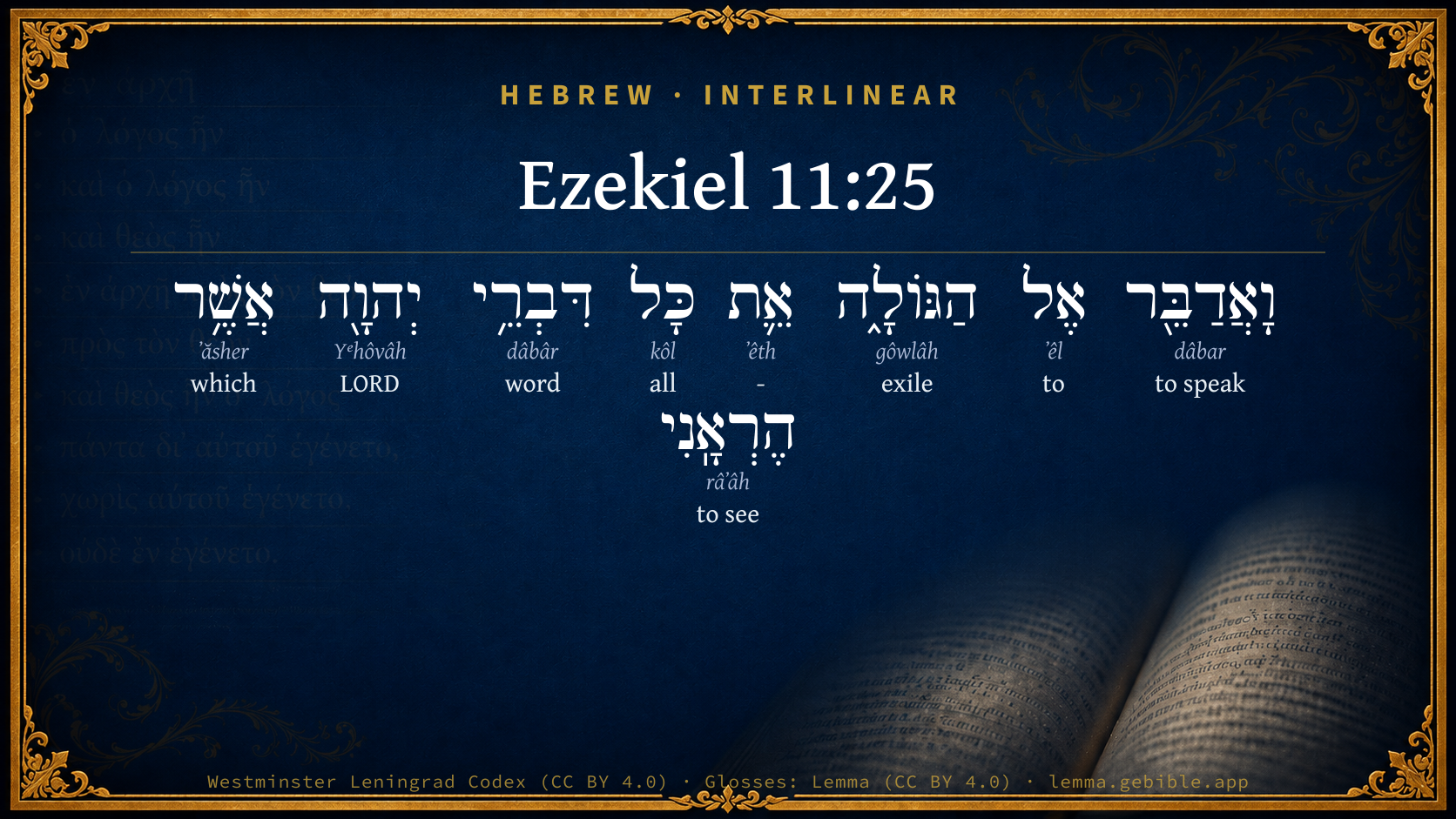
Hebrew (Westminster Leningrad Codex) Ezekiel 11:25 appears in the Hebrew Old Testament. The text above is from the Westminster Leningrad Codex. Each word links to its Strong’s number, a concise gloss, and parsing drawn from the Open Scriptures Hebrew Bible morphology. Click any word for its full Brown-Driver-Briggs (BDB) entry.
Download image
Cite this verse

Ezekiel 11:25 (World English Bible). Public Domain. Lemma interlinear Bible study tool, https://lemma.gebible.app/v/ezekiel/11/25.

Show BibTeX & RIS
BibTeX
RIS
English Translation
Then I spoke to them of the captivity all the things that Yahweh had shown me.
World English Bible · Public Domain
Download a study sheet

One document with this verse’s original text, its word-by-word gloss line, the meaning frame, cross-references with their text, attributed commentary, and full source and license credits — printable, and it pastes into notes with its structure intact.

This verse Autodidact and up

Study sheet (.html) Plain text (.txt)

A passage Seminary Student

Up to 50 verses in one chapter. A passage sheet keeps up to 6 commentary sources and 12 cross-references per verse, in the order this page ranks them, and says so on the sheet whenever that leaves anything out. Ask for a single verse and you get the Autodidact verse sheet above.

Everything on this page stays free to read, with no account — the sheet is a download of what is already on screen, not access to it.

Want to remove ads? Support Godless Engineer
Compare translations 3

The same verse in 3 English versions, stacked beneath the original-language interlinear above. Click any original word for its lexicon entry.

Each is an independent rendering of the whole verse — the interlinear is not word-aligned to these translations.

Highlighted words mark where these versions differ — a whole-verse word diff, not a word-by-word alignment.

  • World English Bible Public Domain
    Then I spoke to them of the captivity all the things that Yahweh had shown me.
  • King James Version Public Domain
    Then I spake unto them of the captivity all the things that the LORD had shewed me.
  • unfoldingWord Literal Text CC BY-SA 4.0
    Then I declared to the exiles all the things of Yahweh that I had seen.

unfoldingWord Literal Text — © unfoldingWord, licensed CC BY-SA 4.0. Word-aligned USFM3 via Door43 (git.door43.org/unfoldingWord/en_ult).

Versions to compare (up to 4)

3 of 4 selected

Show all 18 translations

Every available English version of this verse, each an independent rendering of the whole verse.

  • World English Bible Public Domain
    Then I spoke to them of the captivity all the things that Yahweh had shown me.
  • Berean Standard Bible Public Domain
    I told the exiles everything the LORD had shown me.
  • Majority Standard Bible Public Domain
    I told the exiles everything the LORD had shown me.
  • King James Version Public Domain
    Then I spake unto them of the captivity all the things that the LORD had shewed me.
  • American Standard Version (1901) Public Domain
    Then I spake unto them of the captivity all the things that Jehovah had showed me.
  • Revised Version (1885) Public Domain
    Then I spake unto them of the captivity all the things that the LORD had shewed me.
  • Geneva Bible (1599) Public Domain
    Then I declared vnto them that were led away captiues, all the things that the Lord had shewed me.
  • Douay-Rheims (1899) Public Domain
    And I spoke to them of the captivity all the words of the Lord, which he had shewn me.
  • Young's Literal Translation Public Domain
    and I speak unto the Removed all the matters of Jehovah that He hath shewed me.
  • Literal Standard Version CC BY-SA 4.0
    and I speak to the expulsion all the matters of YHWH that He has showed me.
  • Unlocked Literal Bible CC BY-SA 4.0
    Then I declared to the exiles all the things of Yahweh that I had seen.
  • unfoldingWord Literal Text CC BY-SA 4.0
    Then I declared to the exiles all the things of Yahweh that I had seen.
  • Darby Bible Public Domain
    And I spoke unto them of the captivity all the things that Jehovah had shewn me.
  • World Messianic Bible Public Domain
    Then I spoke to the captives all the things that the LORD had shown me.
  • Webster's Bible Public Domain
    Then I spoke to them of the captivity all the things that the LORD had shown me.
  • Free Bible Version CC BY-SA 4.0
    I explained to the exiles everything the Lord had shown me.
  • Bible in Basic English Public Domain
    Then I gave an account to those who had been taken prisoners of all the things which the Lord had made me see.
  • JPS Tanakh (1917) Public Domain
    Then I spoke unto them of the captivity all the things that the LORD had shown me.

Literal Standard Version (2020), Covenant Press — licensed CC BY-SA 4.0. Text via the HelloAO Bible API (eBible.org). Unlocked Literal Bible (unfoldingWord) — licensed CC BY-SA 4.0. Text via the HelloAO Bible API (eBible.org). unfoldingWord Literal Text — © unfoldingWord, licensed CC BY-SA 4.0. Word-aligned USFM3 via Door43 (git.door43.org/unfoldingWord/en_ult). Free Bible Version, Dr. Jonathan Gallagher — licensed CC BY-SA 4.0. Text via the HelloAO Bible API (eBible.org).

Word by word

More ways to search: Search by grammar → Find every occurrence → Compare this word →

Practice this passage: Drill this verse → Learn its vocabulary →

About this verse

These counts appear in no published source. They are computed here, from the morphology-tagged text and Lemma’s own curated glosses. What Lemma adds →

9
words
9
distinct lemmas
Prophets
section

Shared distinctive vocabulary

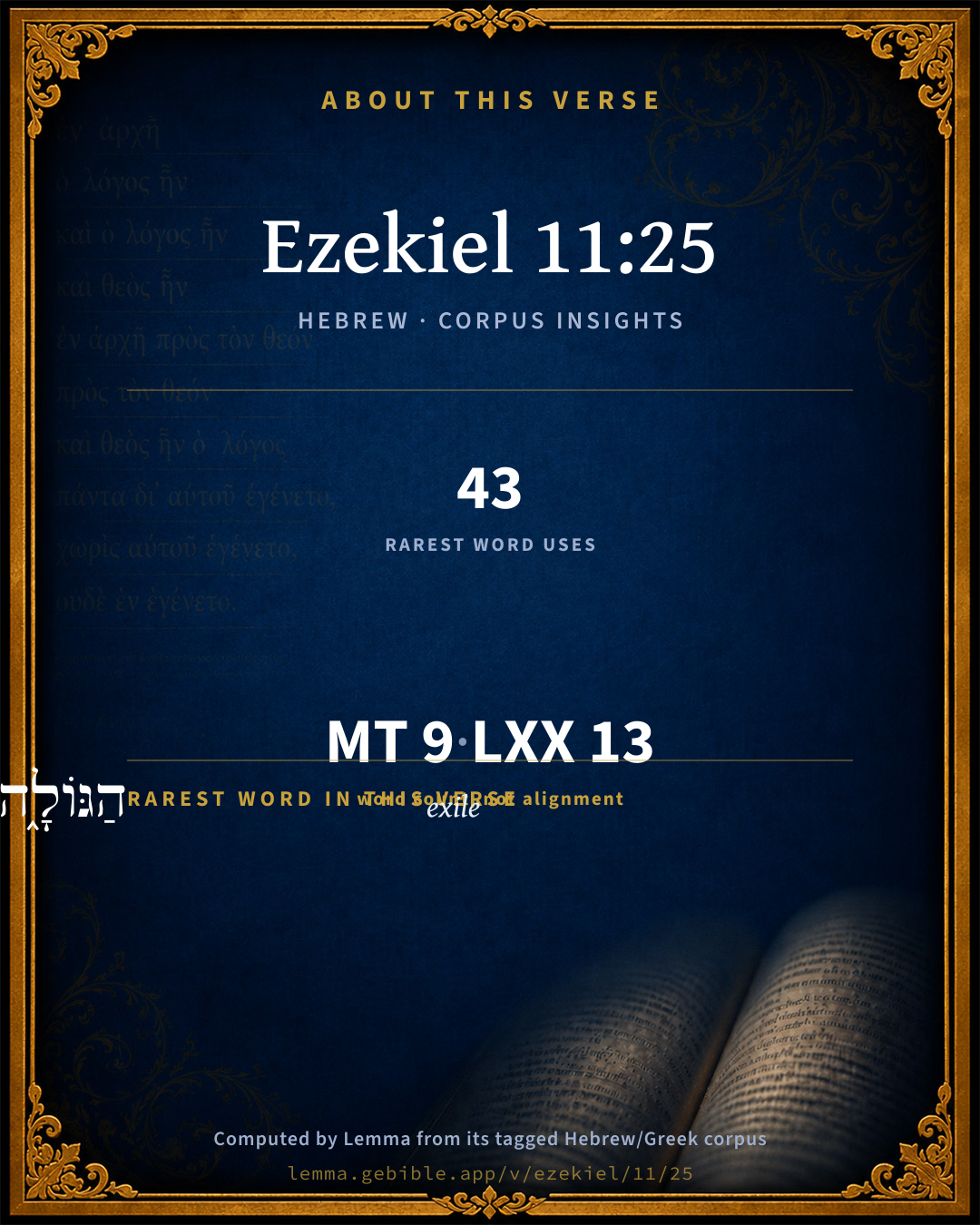
הַגּוֹלָ֑ה exile H1473 occurs in 42 verses of the Hebrew Bible. Also found in:

Grammatical profile

  • 2 verbs
  • 4 nouns
  • 1 preposition
  • 2 particles

Verb forms

  • וָאֲדַבֵּ֖ר Piel · Sequential Imperfect
  • הֶרְאָֽנִי Hiphil · Perfect

Hebrew & Septuagint length

In English translation the verse runs 16 words from the Hebrew and 17 from the Septuagint (LXX English) — closely comparable.

A rough comparison of the two English renderings, which tokenize alike — not a word-level alignment.

Word counts can differ between the Hebrew and the Greek without any difference in meaning — e.g. the Hebrew direct-object marker אֵת has no separate Greek word, and Greek often adds the article ὁ.

In the original languages it is 9 Hebrew tokens and 13 Greek tokens — but the two are counted differently (Hebrew bundles its prefixes and suffixes into one token; the Greek is in lemma form), so that isn’t a like-for-like length.

Cross-references

4

Topical passages linked to Ezekiel 11:25 in the Treasury of Scripture Knowledge — connected by theme and wording, ordered by reader-vote popularity; previews shown in the World English Bible.

  • Ezekiel 3:4 He said to me, Son of man, go, get you to the house of Israel, and speak with my words to them.
  • Ezekiel 3:17 Son of man, I have made you a watchman to the house of Israel: therefore hear the word at my mouth, and give them warning from me.
  • Ezekiel 3:27 But when I speak with you, I will open your mouth, and you shall tell them, Thus says the Lord Yahweh: He who hears, let him hear; and he who forbears, let him forbear: for they are a rebellious house.
  • Ezekiel 2:7 You shall speak my words to them, whether they will hear, or whether they will forbear; for they are most rebellious.

Cross-references courtesy of OpenBible.info (CC BY 4.0).

Hebrew and Greek witnesses Masoretic Hebrew ↔ Greek Septuagint

The same verse in the two great witnesses to the Old Testament, shown verse-for-verse.

These are two independent witnesses, not word-aligned to each other, and the Septuagint is shown in lemma (dictionary) form.

Hebrew Ezekiel 11:25 Masoretic · Westminster Leningrad Codex

וָאֲדַבֵּ֖ר אֶל הַגּוֹלָ֑ה אֵ֛ת כָּל דִּבְרֵ֥י יְהוָ֖ה אֲשֶׁ֥ר הֶרְאָֽנִי

Then I spoke to them of the captivity all the things that Yahweh had shown me.

World English Bible · Public Domain

Greek LXX Ezekiel 11:25 Septuagint · lemma form

καί λαλέω πρός ὁ αἰχμαλωσία πᾶς ὁ λόγος ὁ κύριος ὅς δεικνύω ἐγώ

And I spoke to the captivity all the words of the Lord which he had showed me.

LXX2012 (modern English Septuagint) · Public Domain

Hebrew: Westminster Leningrad Codex (CC BY 4.0). Greek: Septuagint (public domain); English from LXX2012 (modern English Septuagint) (Public Domain). How the Septuagint differs from the Hebrew →

Targum (Aramaic paraphrase)

1

The Targum is the ancient Jewish Aramaic paraphrase of the Hebrew Scriptures — an interpretive translation, not the Hebrew text itself. Onkelos (literal) and Pseudo-Jonathan (expansive) render the Torah, and Jonathan the Prophets. Coverage is partial: where no permissively-licensed English translation exists for a verse, only the Aramaic is shown. This is verse-level text, not a word-by-word alignment to the Hebrew.

  1. Targum Jonathan Prophets (Joshua–Malachi)
    וְאִתְנַבֵּיתִי לִבְנֵי גָלוּתָא יַת כָּל פִּתְגָמַיָא דַייָ דְאַחְזִינִי:

    (no public-domain English translation for this verse)

    Targum Jonathan — Aramaic: “Mikraot Gedolot” (public domain). English: “Sefaria Community Translation” (CC0 1.0 (public-domain dedication)); “London "Chaldee Paraphrase," 1871” (public domain). Text via Sefaria.

Commentary

Notes on Ezekiel 11:25 from classic Christian and Jewish commentators (each source and its license shown beneath its notes). The classic Christian expositions comment on the surrounding passage and are grouped to its opening verse, so a note may address several verses; the Jewish commentaries on the Tanakh (Rashi and others) are per-verse, so they appear only where the commentator wrote on this verse.

Lemma curates 59 commentaries, every one of them public domain or Creative Commons licensed, each selected and text-cleaned for this edition rather than reprinted as found. About our sources →

Trapp's Complete Commentary

John Trapp

Eze 11:25 Then I spake unto them of the captivity all the things that the LORD had shewed me.

Ver. 25. Then I spake unto them of the captivity.] These were his proper charge, and now God’s chiefest care. To them therefore he delivered the whole counsel of God, which he had seen and heard for their better settlement.

John Trapp, A Commentary or Exposition upon All the Books of the Old and New Testament (1647–1656) — public domain. Text from a community e-Sword module.

The Biblical Illustrator

Joseph S. Exell

Eze_11:25

Then I spake unto them of the captivity all the things that the Lord had shewed me.

Babylon with God better than Jerusalem without Him

He told them of the great wickedness he had seen at Jerusalem, and the ruin that was hastening towards that city, that they might not repent of surrendering themselves to the King of Babylon as Jeremiah advised them, and blame themselves for it, nor envy those that stayed behind, and laughed at them for going when they did, nor wish themselves there again, but be content in their captivity. Who would covet to be in a city so full of sin and so near to ruin? It is better to be in Babylon under the favour of God, than in Jerusalem under His wrath and curse. (M. Henry.)

In the uplifted life we are led to the sphere of our duty

I. We are led where needed. Ezekiel was now directed to the place where he was required, because the captives needed comfort, warning, exhortation (verse 25). In the New Testament there is a somewhat parallel illustration of the fact just stated, Philip was enjoying a full tide of success among the Samaritans when he was called to leave this flourishing work, and go down into a desert way, lonely and trackless. Such a change must have seemed strange to the evangelist; but yet God was leading him by His Spirit. Out in this waste district he was brought into touch with a seeker. These two cases of Ezekiel and Philip may assure us that the Lord will lead us if we are in a suitable condition of heart to be led. We may be and are often led by strength of impression or of reasoned conviction, growing clear to our apprehension, without any miraculous interposition.

II. We are led into Gods larger purpose. Sometimes we are so led against our own prejudices and inclinations. Perhaps Ezekiel would have preferred ministering to those of his fellow countrymen who were yet in Jerusalem; but these in Chaldea were more promising than those in Jerusalem, although they seemed most unpromising. How strangely and wonderfully God by His Spirit led Peter to Cornelius, the Roman, the centurion of Caesarea. Peter was slow to respond to the Spirits leading. The uncircumcised Gentile was completely ostracised. Now, those rooted prejudices of ages had to be overcome and broken down. Jewish Christians had to be taught to rise superior to the trammels of exclusive Judaism. They had to learn that the Gospel is not a national prerogative, but a worldwide privilege,--not a lamp for Jerusalem, but the sun in the sky, shining for all. How slow mans heart was to accept the thought of the fraternity of men and the solidarity of the human race! And, to revert to a spiritual parallelism, thoughts have been expressed, judgments have been formed, systems have been made, books have been written, which never would have found a place on Gods earth if the authors had stood upon a higher platform, and beheld with wider and with clearer vision the ways of men and of God.

III. We are led into Gods wider plan. In the uplifted life we are given a larger sphere of usefulness--a greater opportunity for service. How pertinent to this thought is it, that whilst Paul was praying in the temple, probably that his Lord would use him to evangelise his fellow countrymen, he fell into a trance, in which he held communion with his Master, and He made known to him His purpose to send him far hence to the Gentiles! We are reminded age, in in connection with St. Paul, of the apostles anticipated visit into the province of Asia, to evangelise the large cities--Pergamos, Smryna, and Ephesus--when the Spirit suffered him not. His plans to visit Bithynia were completely thwarted. He must not turn to the left or to the right, but must pass on through the territory of Mysia, his way being surely directed, until he reached Troas on the coast, by that narrow but renowned sea strait which separates the east from the west. Many great warriors had stood upon that very shore. Julius Caesar, Alexander of Macedon, and Xerxes; but no braver soul had reached that famed region than this warrior of the Cross. It was at this place that the first famous war between Greece and Asia was fought out; but the engagement in which the apostle entered, resolving upon the conquest of Europe, was fraught with more important and far-reaching results even than that. Paul gazed across the AEgean sea and saw the mountains of Europe. Dean Farter says, in his Life of St. Paul, He had thrown many a wistful glance towards the hills of Imbros and Samothrace; and perhaps when on some clear evening the colossal peak of Athens was visible, it seemed like some vast angel who beckoned him to carry the good tidings to the west. His day thoughts perhaps fashioned his night dreams, and in a vision he saw a man of Macedonia standing and praying, saying, Come over into Macedonia and help us! The man was speaking for the whole modern world. Having seen the vision, the apostle resolves to cross that fated frontier, that possible rubicon, and to exchange familiar Asia for unknown Europe, with its perishing millions. It was a celebrated voyage which the Argonauts took under the command of Jason, when they set sail from the coast of Thessaly, and (B.C. 1280) entered the Hellespont. Those daring Greeks were utterly ignorant of navigation, but were anxious to explore an extent of sea that was altogether unknown to them. That was a more celebrated voyage which was undertaken by the apostle in the vessel bound for Samothracia, as he crossed the surging AEgean with the purpose of carrying into unknown regions--the civilised countries of Europe and perhaps to heathen Britain--the Gospel of the grace of God. Under the Holy Spirits guidance and teaching, he saw Gods wider plan. William Carey, when Sydney Smith sneered at him as the pious shoemaker, had such a view. Dr, Clifford, speaking of those days (a century ago), says, True, in some quarters the breath of the evangelical revival was blowing healthily. Methodism was passionately seeking the lost Englishman, Raikes was creating a school for the Englishmans child, and Howard was opening the door of the European prisons for Englands dawning philanthropy. But the great missionary idea, which is the soul of the Christianity of Christ Jesus, was so completely lost, that practically it was inoperative, or so obscured that it was only present to a few solitary souls. But the Spirit took Carey up, as He had taken up Ezekiel, and he not only saw the many peoples and wide-reaching lands that still sat in darkness and the shadow of death--the warlike Kaffir, the cannibal islander, the savage Fuegian, the Brahmin, the Moslem, the negro, but he also saw that Gods great plan of salvation was for all kindreds and peoples and tribes and tongues. Now, this uplifted life is for us all. Let us be Christians of the hills, and not of the plain! We want, as one has said, to realise the sense of vastness. (A. W. Welch.)

.

The Biblical Illustrator, edited by Joseph S. Exell (c. 1880s–1900s) — public domain. Text from a community e-Sword module.

Geneva Bible (1599)

Geneva Bible translators

When Jeconiah was led away captive.

Geneva Bible (1599) marginal notes — public domain. Text via Bolls.life.

Jamieson, Fausset & Brown

Robert Jamieson, A. R. Fausset & David Brown

things . . . showed me--literally, "words"; an appropriate expression; for the word communicated to him was not simply a word, but one clothed with outward symbols "shown" to him as in the sacrament, which AUGUSTINE terms "the visible word" [CALVIN].

Next: Ezekiel Chapter 12

Jamieson, Fausset & Brown — Commentary Critical and Explanatory on the Whole Bible (1871) — public domain (CC PDM 1.0). Text via the HelloAO Bible API.

John Calvin's Commentaries

Afterwards he says, that he spoke all those words to the captives, or exiles. This passage seems superfluous. For to what purpose had the Prophet been taught concerning the destruction of the city, the overthrow of the kingdom, and the ruin of the temple, unless to induce the Jews who still remained in the country to desist from their superstition? But we must remember that the Prophet had a hard contest with those exiles among whom he dwelt, as will more clearly appear in the next chapter. For as the Jews boasted that they remained safe, and laughed at the captives who had suffered themselves to be drawn away into a distant land, so the exiles were weary of their miseries. For their condition was very sorrowful when they saw themselves exposed to every reproach, and treated by the Chaldeans servilely and insultingly. Since, then, this was their condition, they roared among themselves and were indignant, since they had to bear the manners of the Prophets, and especially Jeremiah. Since, therefore, the captives repented of their lot, it was needful for the Prophet to restrain their contumely. And this is the meaning of the words that he related the words of Jehovah to the captives. Nor was this admonition less needful for the exiles, than for the Jews who as yet remained safe in the city. He says, the words which God caused him to see, improperly, but very appositely to the sense; for not only had God spoken, but he had placed the thing itself before the eyes of the Prophet. Hence we see why he says, that words had been shown to him that he might behold them I have already said that this language is improper for words, because it applies to the sight, for eyes do not receive words, but cars. But here the Prophet signifies that it was not the naked and simple word of God, but clothed in an external symbol. Augustine says that a sacrament is a word made visible, and he speaks correctly; because in baptism God addresses our eyes, when he brings forward water as a symbol of our ablution and regeneration. In the Supper also he directs his speech to our eyes, since Christ shows his flesh to us as truly food, and his blood as truly drink, when bread and wine are set before us. For this reason also the Prophet now says, that he saw the word of God, because it was clothed in outward symbols. For God appeared to his Prophet, as I have said, and showed him the temple, and there erected a theater, as it were, in which he beheld the whole state of the city Jerusalem. Let us go on —

John Calvin's Commentaries (1540-1563) — public domain. Text from the Calvin Translation Society English edition (1840s-50s) via the Christian Classics Ethereal Library (ccel.org). Calvin's coverage is partial (roughly two-thirds of the Bible); uncommented books and verses are honest gaps, never fabricated. The 19th-century editor's footnotes and remarks are omitted so the notes are faithfully Calvin's own voice.

John Gill's Exposition

Then I spake unto them of the captivity,.... The elders of Judah, and others with them, at Telabib, where the prophet had a house:

all the things the Lord had showed me; all the visions contained in the preceding chapters, from the beginning of the fourth chapter to the end of this: as the portraying Jerusalem on a tile, and lying on his side for a long time, as an emblem of the siege of that city; the barley cakes, denoting a famine; the sharp knife with which he cut off his hair, signifying the destruction of its inhabitants; how he was brought to Jerusalem, what idolatries he saw in the temple; the vision of the six men with slaughter weapons, and of another with a writer's inkhorn by his side; and also the vision of the cherubim and wheels, and the glory of the God of Israel, and their departure from the city and temple, together with what was threatened to the Jews in Jerusalem, and was promised to them in Chaldea; all which the prophet faithfully related, and kept back nothing that the Lord had made known unto him by words or signs.

Next: Ezekiel Chapter 12

John Gill's Exposition of the Whole Bible (1746–1763) — public domain (CC PDM 1.0). Text via the HelloAO Bible API.

Matthew Poole's English Annotations

When the ecstasy was past,

I spake unto them; either the elders who came to him, Eze 8:1, or to the body of the people, who were in those parts where Ezekiel was; for many were scattered into other parts of Chaldea.

All the things that the Lord had showed me: here is his faithfulness, both to God and the people, who were concerned to know, for God had showed them to the prophet that he might show them to the people, and, that this might surely be done, God had commanded him to speak to them plainly and fully.

Matthew Poole's English Annotations on the Holy Bible (1683–1685) — public domain. Text from a community e-Sword/MySword module.

The Pulpit Commentary

Preaching to the captives.

I THE PREACHER MUST START FROM A REVELATION MADE TO HIMSELF. The prophets were seers. The apostles were eyewitnesses of the life, death, and resurrection of Christ. No preacher can go forth with God"s Word unless he has first received that Word. For it is not his business to gather congregations merely to hear his "guesses at truth," nor is he called to set before men his most profound speculations, if those speculations are only wrought out of his own ideas. He is a messenger therefore he must bear a message; a herald therefore he must have a gospel to proclaim. Where shall the modern preacher find his Divine word? He cannot pretend to be an Ezekiel at home among the cherubim, to whom the inmost wheels of the Divine mysteries seemed to be revealed. Nevertheless, he has his revelations:

1. In the Bible. Of all men the preacher is called to be a diligent student of this rich storehouse of revelation. The modern preacher does not see Ezekiel"s cherubim, but he can read the New Testament, of which Ezekiel knew nothing; and the gospel story of Jesus of Nazareth is a greater revelation than the visions of an Old Testament prophet.

2. In experience. Every preacher must have his own vision of Scripture truth. We can only speak what we have seen and heard. The truth must be interpreted by experience.

II THE PRIVATE REVELATION OF TRUTH IS GIVEN FOR PUBLIC DECLARATION. Ezekiel might have thought himself a rarely privileged soul, and have considered his visions as choice mysteries to be kept secret, and not to be waisted on unsympathetic ears, like pearls cast before swine, if he had not understood his duty as a prophet of Israel too well to make such a mistake. Freely he had received, freely he must give. All who know God"s truth are under sacred obligations to do what in them lies to declare that truth. It is not possible forevery one to be a preacher by word of mouth. Still, in some way missionary enterprise should follow the reception of Divine truth. We who have the gospel are bound to give it to those to whom it is vet an undreamed secret.

1. This declaration is to be unreserved. Ezekiel spoke all the things. Some were obscure; some might cause offence; some might be abused. Yet he was not at liberty to hold hack anything. The preacher must not shun to "declare the whole counsel of God.

2. This declaration is for all. It was given to Ezekiel"s neighbours, the captives, without distinction. As there are no esoteric truths in God"s revelation, so there is no spiritual aristocracy of the initiated. The only limit is our capacity to receive. "He that hath ears to hear, let him hear.

III THE DECLARATION OF DIVINE TRUTH IS ESPECIALLY NEEDED BY THOSE WHO ARE IN TROUBLE. Ezekiel "spake unto them of the Captivity.

1. It is a peculiarly Christian duty to bring the consolation of God to the troubled. This is suited to the sorrowful. Lighter thoughts may amuse in hours of ease. But when darkness gathers about the soul, nothing short of the deep verities of God will satisfy. Those verities may not be always pleasant. Much that Ezekiel saw filled him with distress. Still God"s truth is all wholesome and healing, and his last words are his best, as Ezekiel"s hearers must have found when the prophet concluded with the wonderful promise of the "heart of flesh" (ver. 19).

2. The gospel is peculiarly appropriate for those who are spiritually captives, i.e. in bondage to

1. superstition,

2. doubt,

3. fear, or

4. sin.

Christ came to proclaim liberty to such captives. (Luk_4:15)

The prophetic office.

In these few and simple words we have a declaration of the office and function of the inspired prophet, and in a certain sense of every true religions teacher whom God commissions to be the vehicle and conscious agent in communicating his truth, counsels, admonitions, and encouragements to men.

I RECEPTION. The prophet and every religious teacher must come mediately or immediately into spiritual communication with the Divine Mind.

1. The Source from which the communication proceeds is none other than God himself.

2. The matter which is received is what is commonly called revelation; the thoughts and commands and purposes of the Supreme are made known to a human spirit.

3. The vision, the hearing, of the prophetic soul are made ready by Divine grace to appreciate the communication.

II IMPARTATION.

1. Thus the prophet, the religious teacher, is a mediator, capable on the oneside, of fellowship with God, and on the other of correspondence and communion with his fellow men.

2. There are special qualifications, by reason of which he can fulfil thecommission received; he should be a man of quick intelligence, of tender sympathy, of dauntless courage, of manifest authority.

3. Yet his chief credentials are simple and moral truthfulness,conscientiousness, and simplicity of nature and habit. T.

The Pulpit Commentary (1880–1919), ed. H.D.M. Spence-Jones & Joseph S. Exell — public domain. Text from a community e-Sword module.

Lesson kit

Teaching starters — assembled from the data on this page, not authored interpretation. Every prompt links to the verse data it draws on. Edit before teaching.

Ezekiel, in the Prophets, opens this verse with 9 words (9 distinct Hebrew lemmas). Its most distinctive word is gôwlâh (“exile”). A historical commentator’s framing appears above. Read the whole chapter for the surrounding context.

Discussion questions

  1. The word gôwlâh carries the sense “exile.” How does it shape the verse?
  2. 2 Kings 24:14 shares the word «exile» with this verse. How do the two illuminate each other?
  3. These translations render this verse differently. What is at stake in choosing one wording over another?
  4. The verb «וָאֲדַבֵּ֖ר» is Piel Sequential Imperfect. How does its form color the action?
  5. Reading how Trapp's Complete Commentary and The Biblical Illustrator read this verse, where do the two commentators agree and where do they part?

Things to notice

Reading settings

Reading text

Shown beneath each verse's original-language words.

Old Testament
Old Testament edition

Read the OT as the Masoretic Hebrew (MT) or the Greek Septuagint (LXX).

English shown for the Greek Septuagint (in the Hebrew ↔ Greek comparison).

Comparing translations? Open the Compare panel on any verse page to stack up to four side by side.