
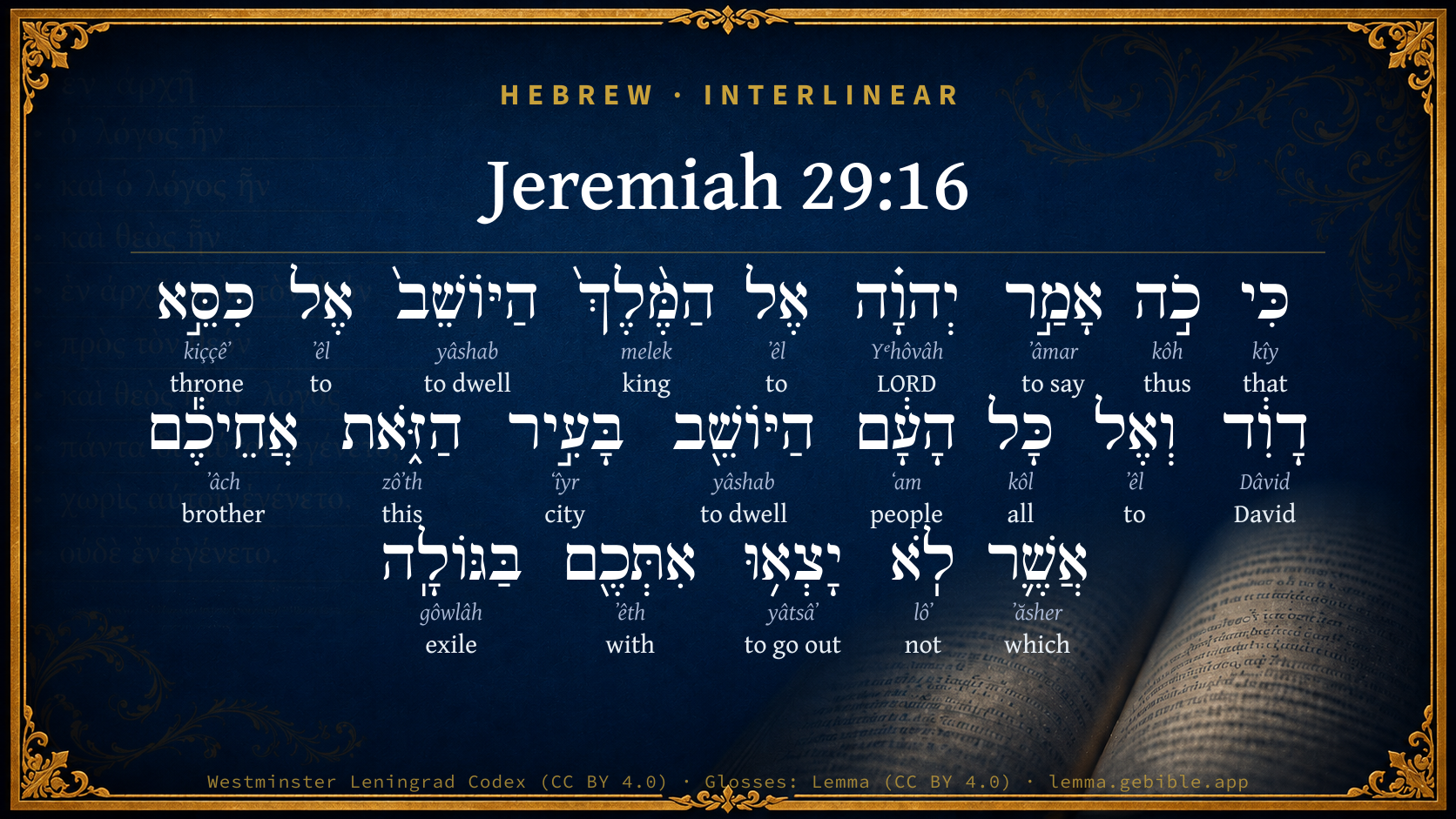
Jeremiah 29:16

Hebrew (Westminster Leningrad Codex) Jeremiah 29:16 appears in the Hebrew Old Testament. The text above is from the Westminster Leningrad Codex. Each word links to its Strong’s number, a concise gloss, and parsing drawn from the Open Scriptures Hebrew Bible morphology. Click any word for its full Brown-Driver-Briggs (BDB) entry.
Download image
Cite this verse

Jeremiah 29:16 (World English Bible). Public Domain. Lemma interlinear Bible study tool, https://lemma.gebible.app/v/jeremiah/29/16.

Show BibTeX & RIS
BibTeX
RIS
English Translation
thus says Yahweh concerning the king who sits on the throne of David, and concerning all the people who dwell in this city, your brothers who haven't gone forth with you into captivity;
World English Bible · Public Domain
Download a study sheet

One document with this verse’s original text, its word-by-word gloss line, the meaning frame, cross-references with their text, attributed commentary, and full source and license credits — printable, and it pastes into notes with its structure intact.

This verse Autodidact and up

Study sheet (.html) Plain text (.txt)

A passage Seminary Student

Up to 50 verses in one chapter. A passage sheet keeps up to 6 commentary sources and 12 cross-references per verse, in the order this page ranks them, and says so on the sheet whenever that leaves anything out. Ask for a single verse and you get the Autodidact verse sheet above.

Everything on this page stays free to read, with no account — the sheet is a download of what is already on screen, not access to it.

Want to remove ads? Support Godless Engineer
Compare translations 3

The same verse in 3 English versions, stacked beneath the original-language interlinear above. Click any original word for its lexicon entry.

Each is an independent rendering of the whole verse — the interlinear is not word-aligned to these translations.

Highlighted words mark where these versions differ — a whole-verse word diff, not a word-by-word alignment.

  • World English Bible Public Domain
    thus says Yahweh concerning the king who sits on the throne of David, and concerning all the people who dwell in this city, your brothers who haven't gone forth with you into captivity;
  • King James Version Public Domain
    Know that thus saith the LORD of the king that sitteth upon the throne of David, and of all the people that dwelleth in this city, and of your brethren that are not gone forth with you into captivity;
  • unfoldingWord Literal Text CC BY-SA 4.0
    Yahweh says this to the king who sits on the throne of David and to all the people who are staying in that city, your brothers who have not gone out with you into captivity—

unfoldingWord Literal Text — © unfoldingWord, licensed CC BY-SA 4.0. Word-aligned USFM3 via Door43 (git.door43.org/unfoldingWord/en_ult).

Versions to compare (up to 4)

3 of 4 selected

Show all 18 translations

Every available English version of this verse, each an independent rendering of the whole verse.

  • World English Bible Public Domain
    thus says Yahweh concerning the king who sits on the throne of David, and concerning all the people who dwell in this city, your brothers who haven't gone forth with you into captivity;
  • Berean Standard Bible Public Domain
    this is what the LORD says about the king who sits on David’s throne and all the people who remain in this city, your brothers who did not go with you into exile—
  • Majority Standard Bible Public Domain
    this is what the LORD says about the king who sits on David’s throne and all the people who remain in this city, your brothers who did not go with you into exile—
  • King James Version Public Domain
    Know that thus saith the LORD of the king that sitteth upon the throne of David, and of all the people that dwelleth in this city, and of your brethren that are not gone forth with you into captivity;
  • American Standard Version (1901) Public Domain
    thus saith Jehovah concerning the king that sitteth upon the throne of David, and concerning all the people that dwell in this city, your brethren that are not gone forth with you into captivity;
  • Revised Version (1885) Public Domain
    for thus saith the LORD concerning the king that sitteth upon the throne of David, and concerning all the people that dwell in this city, your brethren that are not gone forth with you into captivity;
  • Geneva Bible (1599) Public Domain
    Therefore thus saith the Lord of the King, that sitteth vpon the throne of Dauid, and of all the people, that dwell in this citie, your brethren that are not gone forth with you into captiuitie:
  • Douay-Rheims (1899) Public Domain
    For thus saith the Lord to the king that sitteth upon the throne of David, and to all the people that dwell in this city, to your brethren that are not gone forth with you into captivity.
  • Young's Literal Translation Public Domain
    Surely thus said Jehovah concerning the king who is sitting on the throne of David, and concerning all the people that is dwelling in this city, your brethren who went not forth with you in the removal;
  • Literal Standard Version CC BY-SA 4.0
    surely thus said YHWH concerning the king who is sitting on the throne of David, and concerning all the people that are dwelling in this city, your brothers who did not go forth with you in the expulsion—
  • Unlocked Literal Bible CC BY-SA 4.0
    Yahweh says this to the king who sits on the throne of David and to all the people who are staying in that city, your brothers who have not gone out with you into captivity—
  • unfoldingWord Literal Text CC BY-SA 4.0
    Yahweh says this to the king who sits on the throne of David and to all the people who are staying in that city, your brothers who have not gone out with you into captivity—
  • Darby Bible Public Domain
    yea, thus saith Jehovah concerning the king that sitteth upon the throne of David, and concerning all the people that dwell in this city, your brethren that are not gone forth with you into captivity;
  • World Messianic Bible Public Domain
    the LORD says concerning the king who sits on David’s throne, and concerning all the people who dwell in this city, your brothers who haven’t gone with you into captivity,
  • Webster's Bible Public Domain
    Know that thus saith the LORD concerning the king that sitteth upon the throne of David, and concerning all the people that dwelleth in this city, and concerning your brethren that are not gone forth with you into captivity;
  • Free Bible Version CC BY-SA 4.0
    this is what the Lord says about the king who sits on David's throne and everyone who's left in Jerusalem, your fellow citizens who weren't taken with you into exile.
  • Bible in Basic English Public Domain
    For this is what the Lord has said about the king who is seated on the seat of David's kingdom, and about all the people living in this town, your countrymen who have not gone out with you as prisoners;
  • JPS Tanakh (1917) Public Domain
    For thus saith the LORD concerning the king that sitteth upon the throne of David, and concerning all the people that dwell in this city, your brethren that are not gone forth with you into captivity;

Literal Standard Version (2020), Covenant Press — licensed CC BY-SA 4.0. Text via the HelloAO Bible API (eBible.org). Unlocked Literal Bible (unfoldingWord) — licensed CC BY-SA 4.0. Text via the HelloAO Bible API (eBible.org). unfoldingWord Literal Text — © unfoldingWord, licensed CC BY-SA 4.0. Word-aligned USFM3 via Door43 (git.door43.org/unfoldingWord/en_ult). Free Bible Version, Dr. Jonathan Gallagher — licensed CC BY-SA 4.0. Text via the HelloAO Bible API (eBible.org).

Word by word

More ways to search: Search by grammar → Find every occurrence → Compare this word →

Practice this passage: Drill this verse → Learn its vocabulary →

בַּגּוֹלָֽה
gôwlâh
H1473
“in/at the · exile”
Preposition, Determined + Noun, Common, Feminine, Singular, Absolute
Part of Speech
Preposition + Noun
Type
Common
Gender
Feminine
Number
Singular
State
Absolute
Full BDB Definition

Origin: active participle of H1540

TWOT: 350a

exiles, exile, captivity - exiles (collective) - exile, captivity (abstract)
  1. כִּי kîy H3588 “that” Conjunction
  2. כֹ֣ה kôh H3541 “thus” Adverb
  3. אָמַ֣ר ʼâmar H559 “to say” Verb, Qal, Perfect, 3rd Person, Masculine, Singular
  4. יְהוָ֗ה Yᵉhôvâh H3068 “LORD” Noun, Proper
  5. אֶל ʼêl H413 “to” Preposition
  6. הַמֶּ֨לֶךְ֙ melek H4428 “the · king” Particle, Definite Article + Noun, Common, Masculine, Singular, Absolute
  7. הַיּוֹשֵׁב֙ yâshab H3427 “the · dwelling” Particle, Definite Article + Verb, Qal, Participle Active, Masculine, Singular, Absolute
  8. אֶל ʼêl H413 “to” Preposition
  9. כִּסֵּ֣א kiççêʼ H3678 “throne of” Noun, Common, Masculine, Singular, Construct
  10. דָוִ֔ד Dâvid H1732 “David” Noun, Proper
  11. וְאֶל ʼêl H413 “and · to” Conjunction + Preposition
  12. כָּל kôl H3605 “all of” Noun, Common, Masculine, Singular, Construct
  13. הָעָ֔ם ʻam H5971 “the · people” Particle, Definite Article + Noun, Common, Masculine, Singular, Absolute
  14. הַיּוֹשֵׁ֖ב yâshab H3427 “the · dwelling” Particle, Definite Article + Verb, Qal, Participle Active, Masculine, Singular, Absolute
  15. בָּעִ֣יר ʻîyr H5892 “in/at the · city” Preposition, Determined + Noun, Common, Feminine, Singular, Absolute
  16. הַזֹּ֑את zôʼth H2063 “the · this” Particle, Definite Article + Pronoun, Demonstrative, Feminine, Singular
  17. אֲחֵיכֶ֕ם ʼâch H251 “brothers · your” Noun, Common, Masculine, Plural, Construct + Suffix, Personal, 2nd Person, Masculine, Plural
  18. אֲשֶׁ֛ר ʼăsher H834 “which” Particle, Relative
  19. לֹֽא lôʼ H3808 “not” Particle, Negative
  20. יָצְא֥וּ yâtsâʼ H3318 “to go out” Verb, Qal, Perfect, 3rd Person, Common, Plural
  21. אִתְּכֶ֖ם ʼêth H854 “with · you” Preposition + Suffix, Personal, 2nd Person, Masculine, Plural

About this verse

These counts appear in no published source. They are computed here, from the morphology-tagged text and Lemma’s own curated glosses. What Lemma adds →

22
words
19
distinct lemmas
Prophets
section

Shared distinctive vocabulary

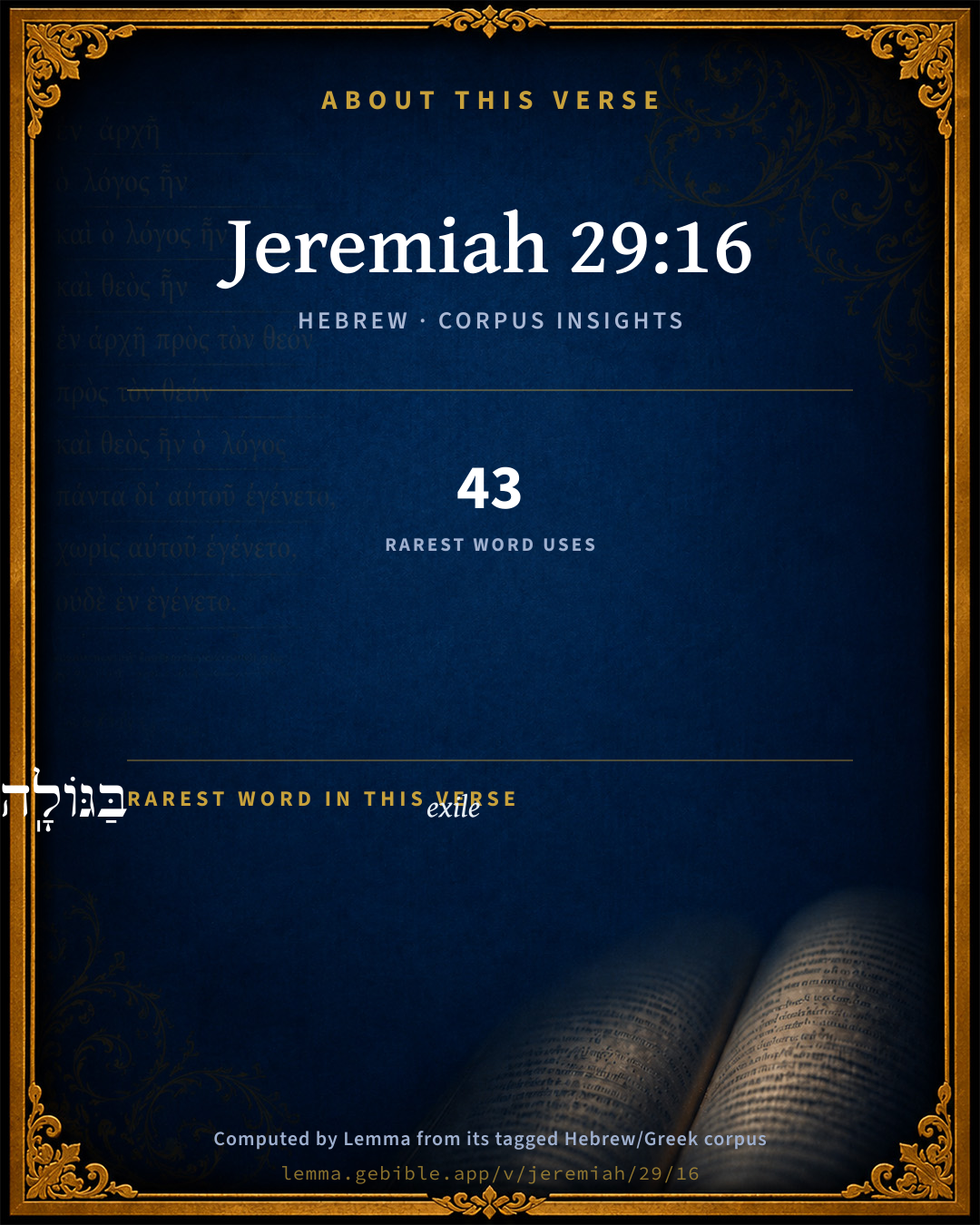
בַּגּוֹלָֽה exile H1473 occurs in 42 verses of the Hebrew Bible. Also found in:

Grammatical profile

  • 4 verbs
  • 9 nouns
  • 1 pronoun
  • 4 prepositions
  • 1 conjunction
  • 1 adverb
  • 2 particles

Verb forms

  • אָמַ֣ר Qal · Perfect
  • הַיּוֹשֵׁב֙ Qal · Participle Active
  • הַיּוֹשֵׁ֖ב Qal · Participle Active
  • יָצְא֥וּ Qal · Perfect

Repetition

Words recur within this verse — often emphatic in Hebrew:

  • הַיּוֹשֵׁב֙ to dwell H3427 ×2
  • אֶל to H413 ×3

Cross-references

9

Topical passages linked to Jeremiah 29:16 in the Treasury of Scripture Knowledge — connected by theme and wording, ordered by reader-vote popularity; previews shown in the World English Bible.

  • Jeremiah 38:2–3 Thus says Yahweh, He who remains in this city shall die by the sword, by the famine, and by the pestilence; but he who goes forth to the Chaldeans shall live, and his life shall be to him for a prey, and he shall live.
  • Jeremiah 38:17–23 Then said Jeremiah to Zedekiah, Thus says Yahweh, the God of hosts, the God of Israel: If you will go forth to the king of Babylon's princes, then your soul shall live, and this city shall not be burned with fire; and you shall live, and your house.
  • Jeremiah 24:2 One basket had very good figs, like the figs that are first-ripe; and the other basket had very bad figs, which could not be eaten, they were so bad.
  • Jeremiah 29:3 by the hand of Elasah the son of Shaphan, and Gemariah the son of Hilkiah, (whom Zedekiah king of Judah sent to Babylon to Nebuchadnezzar king of Babylon), saying,
  • Ezekiel 6:1–9 The word of Yahweh came to me, saying,
  • Ezekiel 17:12–21 Say now to the rebellious house, Don't you know what these things mean? tell them, Behold, the king of Babylon came to Jerusalem, and took the king of it, and the princes of it, and brought them to him to Babylon:
  • Ezekiel 21:9–27 Son of man, prophesy, and say, Thus says Yahweh: Say, A sword, a sword, it is sharpened, and also furbished;
  • Ezekiel 22:31 Therefore have I poured out my indignation on them; I have consumed them with the fire of my wrath: their own way have I brought on their heads, says the Lord Yahweh.
  • Ezekiel 24:1–14 Again, in the ninth year, in the tenth month, in the tenth [day] of the month, the word of Yahweh came to me, saying,

Cross-references courtesy of OpenBible.info (CC BY 4.0).

Hebrew and Greek witnesses Masoretic Hebrew ↔ Greek Septuagint

The same verse in the two great witnesses to the Old Testament, shown verse-for-verse.

These are two independent witnesses, not word-aligned to each other, and the Septuagint is shown in lemma (dictionary) form.

Hebrew Jeremiah 29:16 Masoretic · Westminster Leningrad Codex

כִּי כֹ֣ה אָמַ֣ר יְהוָ֗ה אֶל הַמֶּ֨לֶךְ֙ הַיּוֹשֵׁב֙ אֶל כִּסֵּ֣א דָוִ֔ד וְאֶל כָּל הָעָ֔ם הַיּוֹשֵׁ֖ב בָּעִ֣יר הַזֹּ֑את אֲחֵיכֶ֕ם אֲשֶׁ֛ר לֹֽא יָצְא֥וּ אִתְּכֶ֖ם בַּגּוֹלָֽה

thus says Yahweh concerning the king who sits on the throne of David, and concerning all the people who dwell in this city, your brothers who haven't gone forth with you into captivity;

World English Bible · Public Domain

Greek LXX Structure differs

In the Septuagint, Jeremiah is about an eighth shorter than the Hebrew and arranges its material differently — the Oracles Against the Nations (Hebrew chapters 46–51) appear in the middle of the Greek book, after 25:13. Because the chapter and verse boundaries do not line up, a verse-for-verse comparison with the Hebrew is not shown.

A verse-for-verse comparison isn’t shown here because the chapters and verses don’t line up. Switch to the LXX edition with the MT / LXX toggle above to read the Greek directly.

On this verse, Albert Barnes' Notes on the Bible discusses the Septuagint’s reading. Read the note in Commentary ↓

Hebrew: Westminster Leningrad Codex (CC BY 4.0). Greek: Septuagint (public domain); English from a public-domain English Septuagint. How the Septuagint differs from the Hebrew →

Targum (Aramaic paraphrase)

1

The Targum is the ancient Jewish Aramaic paraphrase of the Hebrew Scriptures — an interpretive translation, not the Hebrew text itself. Onkelos (literal) and Pseudo-Jonathan (expansive) render the Torah, and Jonathan the Prophets. Coverage is partial: where no permissively-licensed English translation exists for a verse, only the Aramaic is shown. This is verse-level text, not a word-by-word alignment to the Hebrew.

  1. Targum Jonathan Prophets (Joshua–Malachi)
    אֲרֵי כִדְנַן אֲמַר יְיָ עַל מַלְכָּא דְיָתֵיב עַל כּוּרְסֵי דָוִד וְעַל כָּל עַמָא דְיָתֵיב בְּאַרְעָא הָדָא אֲחֵיכוֹן דְלָא נְפָקוּ עִמְכוֹן בְּגָלוּתָא:

    (no public-domain English translation for this verse)

    Targum Jonathan — Aramaic: “Mikraot Gedolot” (public domain). English: “Sefaria Community Translation” (CC0 1.0 (public-domain dedication)); “London "Chaldee Paraphrase," 1871” (public domain). Text via Sefaria.

Commentary

Notes on Jeremiah 29:16 from classic Christian and Jewish commentators (each source and its license shown beneath its notes). The classic Christian expositions comment on the surrounding passage and are grouped to its opening verse, so a note may address several verses; the Jewish commentaries on the Tanakh (Rashi and others) are per-verse, so they appear only where the commentator wrote on this verse.

Lemma curates 59 commentaries, every one of them public domain or Creative Commons licensed, each selected and text-cleaned for this edition rather than reprinted as found. About our sources →

Trapp's Complete Commentary

John Trapp

Jer 29:16 [Know] that thus saith the LORD of the king that sitteth upon the throne of David, and of all the people that dwelleth in this city, [and] of your brethren that are not gone forth with you into captivity;

Ver. 16. Know that thus saith the Lord.] Or, Therefore thus saith the Lord, whatever ye say, or your counterfeit prophets say, to the contrary.

John Trapp, A Commentary or Exposition upon All the Books of the Old and New Testament (1647–1656) — public domain. Text from a community e-Sword module.

Joseph Benson's Commentary

Jer 29:16-19. Thus saith the Lord of the king and all the people, &c. — See Jer 24:8-10; that dwell in this city — Namely, the city of Jerusalem, which is the city spoken of. I will make them like vile figs — Rather like sour figs, that cannot be eaten — The meaning is, I will deal with them as men deal with bad figs. They have made themselves vile and hateful, and I will use them accordingly. This refers to the vision, chap. 24., and the prophecy which we had there upon it. And I will deliver them to be a curse, &c. — A more severe punishment is denounced upon these than upon those of the two former captivities; because though warned by the example of Jehoiakim and Jeconiah, who suffered heavily for their perfidy, they yet again, a third time, broke the faith which they had pledged to the king of Babylon in the name of God, and despised all the admonitions and counsels of God by Jeremiah, as is observed in the next verse.

Joseph Benson's Commentary on the Old and New Testaments (1811–1818) — public domain. Text from a community e-Sword module.

Tyndale Open Study Notes

Tyndale Open Resources

29:16-18 To keep the exiles in Babylon from thinking that they were worse off than those left behind, the Lord reiterated his decree of disaster for the bad figs still in Jerusalem (see 24:6-10); their time of horror was yet to come.

Tyndale Open Study Notes — © Tyndale Open Resources, licensed CC BY-SA 4.0. Text via the HelloAO Bible API.

Jamieson, Fausset & Brown

Robert Jamieson, A. R. Fausset & David Brown

people . . . in this city . . . not gone forth--So far from your returning to Jerusalem soon, even your brethren still left dwelling there shall themselves also be cast into exile. He mentions "the throne of David," lest they should think that, because David's kingdom was to be perpetual, no severe, though temporary, chastisements could interpose (Psa 89:29-36).

Jamieson, Fausset & Brown — Commentary Critical and Explanatory on the Whole Bible (1871) — public domain (CC PDM 1.0). Text via the HelloAO Bible API.

John Calvin's Commentaries

We now perceive for what purpose the Prophet, after having addressed the captives, turned his discourse to King Zedekiah and to the Jews, who as yet remained at home or in their own country; it was, that the captives might hence know how great was their madness to promise to themselves a return, after having been driven to remote lands, when final ruin was nigh both the king and the people, who as yet remained at Jerusalem; Thus then saith Jehovah to the king who sits on the throne of David, and to all the people who sit in this city, etc

To sit, as I have already said, is to be taken here in two different senses; the king is said to sit on his throne while he retains his dignity; but the people are said to sit while they rest and dwell quietly in any place. It is not without reason that the word king is here expressly mentioned, for the exiles were ever wont to connect it with the hope of their return; “The Temple still remains, God is there worshipped, and the kingdom still exists; these things being secure, it cannot be all over with our nation.” The safety of the people depended on the kingdom and the priesthood. When therefore, on the one hand, they fixed their eyes on royalty, and on the other hand, on the priesthood and sacrifices, they felt persuaded that it could not be otherwise but that God would soon restore them; for God had promised that the kingdom of David would be perpetual, as long as the sun and moon would shine in heaven. Except then this splendor or glory had been extinguished, the Israelites could not have been humiliated, especially as those who had been led into exile were of the tribe of Judah. We now understand why the word king was expressly mentioned. Though, then, a king still sat on the throne of David, he yet declares that his condition and that of his people was harder than that of the captive multitude.

John Calvin's Commentaries (1540-1563) — public domain. Text from the Calvin Translation Society English edition (1840s-50s) via the Christian Classics Ethereal Library (ccel.org). Calvin's coverage is partial (roughly two-thirds of the Bible); uncommented books and verses are honest gaps, never fabricated. The 19th-century editor's footnotes and remarks are omitted so the notes are faithfully Calvin's own voice.

The Cambridge Bible for Schools and Colleges

gen. ed. J. J. S. Perowne

16. the king] Zedekiah. See Jer_28:1. See note on Jer_29:24.

The Cambridge Bible for Schools and Colleges (gen. ed. J. J. S. Perowne; Cambridge University Press, 1878–1918) — public domain. Text from a community e-Sword module.

John Gill's Exposition

Know that thus saith the Lord,.... Or "for", or "wherefore thus saith the Lord" (x); for the word "know" is not in the text, and seems needless; though it is also supplied by other interpreters (y). The words are illative, and follow upon the former; and the sense is, that since they gave heed to their false prophets in Babylon, who told them that they should quickly return; therefore the Lord sent the following message to them, informing them that it was so far from being true that they should in a short time return to Jerusalem, that, on the other hand, they that were there should soon be with them in captivity, or be destroyed:

of, or "concerning"

the king that sitteth on the throne of David; that is, King Zedekiah, who was then the reigning king at Jerusalem:

and of all the people that dwelleth in this city; the city Jerusalem, where Jeremiah was, and from whence this letter was written, in the name of the Lord, to the captives at Babylon:

and of your brethren that are not gone forth with you into captivity; that lived in the several parts of the land of Judea, who were left behind, and not carried captive, when those were to whom these words are directed.

(x) "nam sic ait", Junius & Tremellius, Piscator, Cocceius; "ideo", Calvin; "ita namque", Schmidt. (y) "Scitote quod", Vatablus.

John Gill's Exposition of the Whole Bible (1746–1763) — public domain (CC PDM 1.0). Text via the HelloAO Bible API.

Albert Barnes' Notes on the Bible

These verses are not in the Septuagint. But the text of the Septuagint is here throughout so brief and confused as to be explicable only on the supposition, that it represents what was left behind in Egypt when Jeremiah died, copied probably with extreme haste, and with no opportunity of careful collation afterward. On the other hand the Hebrew text represents no hurried transcript, but the original manuscript, and is especially trustworthy in the case of these letters sent to Babylon (see also Jer. 51), because the originals of them would be available for collation with the text preserved by Jeremiah himself. The verses were probably intended to allay excitement in Babylon consequent upon the knowledge that the representatives of various kings were assembled at that very time at Jerusalem to form a coalition against Babylon Jer 27:3.

Jer 29:17

Vile - The word does not occur elsewhere, but comes from a root signifying to shudder, and thus has an intense meaning.

Albert Barnes' Notes on the Bible (1834–1885) — public domain. Text from a community e-Sword/MySword module.

Matthew Poole's English Annotations

The word

know is, as some think, needlessly supplied, for the following particle might be as well translated for, or because, or therefore. By the king he meaneth Zedekiah, whom he chooseth to express under the notion of him

that sitteth upon the throne of David, to take away the vain hopes which the Jews conceived from the promises which God had made to David, and to his seed.

Matthew Poole's English Annotations on the Holy Bible (1683–1685) — public domain. Text from a community e-Sword/MySword module.

Whedon's Commentary on the Bible

Daniel D. Whedon

16. King… all the people… your brethren — The third noun is in apposition with the first and second, and hence the and of the translators is misleading. Omit it.

Daniel D. Whedon (gen. ed.), Commentary on the Old and New Testaments (1874–1909) — public domain. Text from a community e-Sword module.

The Pulpit Commentary

Know that thus saith the Lord; rather, Surely thus saith the Lord.

The Pulpit Commentary (1880–1919), ed. H.D.M. Spence-Jones & Joseph S. Exell — public domain. Text from a community e-Sword module.

John Wesley's Explanatory Notes

Of the king - Zedekiah.

John Wesley, Explanatory Notes Upon the Whole Bible (1754–1765) — public domain. Text via the GEBible commentary corpus.

Rashi

Rabbi Shlomo Yitzchaki (Rashi)

concerning the king Zedekiah, who has not been exiled.

Rashi on the Tanakh — English translations: “The Judaica Press complete Tanach with Rashi, translated by A. J. Rosenberg” (CC BY 4.0); “Pentateuch with Rashi's commentary by M. Rosenbaum and A.M. Silbermann, 1929-1934” (public domain); “The Metsudah Tanach series, Lakewood, N.J” (CC BY 4.0); and “The Book of Joshua, Metsudah Publications, 1997” (CC BY 4.0). Text via Sefaria.

Lesson kit

Teaching starters — assembled from the data on this page, not authored interpretation. Every prompt links to the verse data it draws on. Edit before teaching.

Jeremiah, in the Prophets, opens this verse with 22 words (19 distinct Hebrew lemmas). Its most distinctive word is gôwlâh (“exile”). A historical commentator’s framing appears above. Read the whole chapter for the surrounding context.

Discussion questions

  1. The word gôwlâh carries the sense “exile.” How does it shape the verse?
  2. How does 2 Kings 24:14, which shares the word «exile», read alongside this verse?
  3. What does the repetition of “to dwell” (2× in this one verse) do in this verse?
  4. These translations render this verse differently. What is at stake in choosing one wording over another?
  5. «אָמַ֣ר» is a Qal Perfect verb. How does that grammatical form shape the action described?
  6. Compare how Trapp's Complete Commentary and Joseph Benson's Commentary read this verse. Where do they agree or differ?

Things to notice

Reading settings

Reading text

Shown beneath each verse's original-language words.

Old Testament
Old Testament edition

Read the OT as the Masoretic Hebrew (MT) or the Greek Septuagint (LXX).

English shown for the Greek Septuagint (in the Hebrew ↔ Greek comparison).

Comparing translations? Open the Compare panel on any verse page to stack up to four side by side.