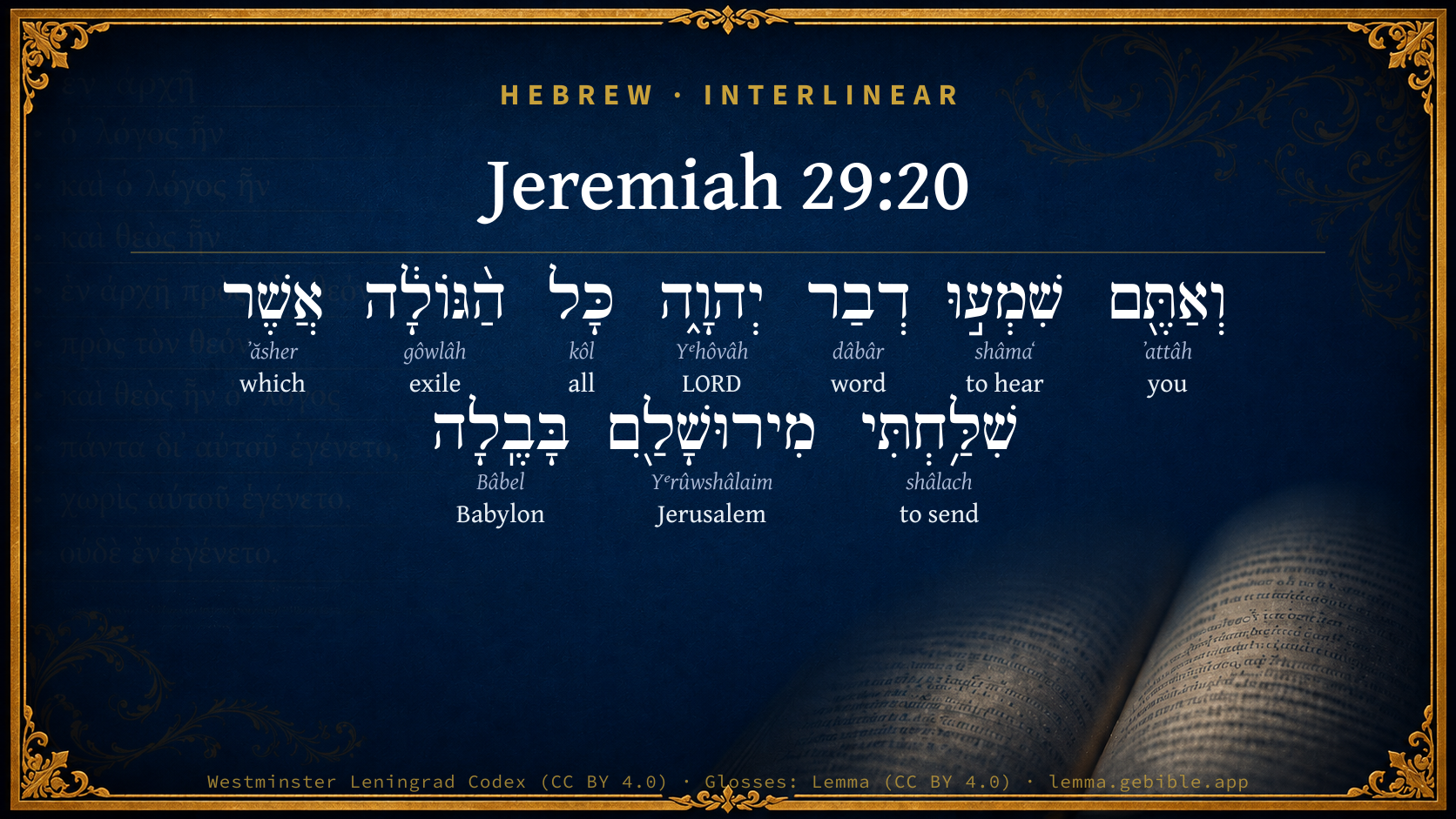
Jeremiah 29:20

Hebrew (Westminster Leningrad Codex) Jeremiah 29:20 appears in the Hebrew Old Testament. The text above is from the Westminster Leningrad Codex. Each word links to its Strong’s number, a concise gloss, and parsing drawn from the Open Scriptures Hebrew Bible morphology. Click any word for its full Brown-Driver-Briggs (BDB) entry.
Download image
Cite this verse

Jeremiah 29:20 (World English Bible). Public Domain. Lemma interlinear Bible study tool, https://lemma.gebible.app/v/jeremiah/29/20.

Show BibTeX & RIS
BibTeX
RIS
English Translation
Hear you therefore the word of Yahweh, all you of the captivity, whom I have sent away from Jerusalem to Babylon.
World English Bible · Public Domain
Download a study sheet

One document with this verse’s original text, its word-by-word gloss line, the meaning frame, cross-references with their text, attributed commentary, and full source and license credits — printable, and it pastes into notes with its structure intact.

This verse Autodidact and up

Study sheet (.html) Plain text (.txt)

A passage Seminary Student

Up to 50 verses in one chapter. A passage sheet keeps up to 6 commentary sources and 12 cross-references per verse, in the order this page ranks them, and says so on the sheet whenever that leaves anything out. Ask for a single verse and you get the Autodidact verse sheet above.

Everything on this page stays free to read, with no account — the sheet is a download of what is already on screen, not access to it.

Want to remove ads? Support Godless Engineer
Compare translations 3

The same verse in 3 English versions, stacked beneath the original-language interlinear above. Click any original word for its lexicon entry.

Each is an independent rendering of the whole verse — the interlinear is not word-aligned to these translations.

Highlighted words mark where these versions differ — a whole-verse word diff, not a word-by-word alignment.

  • World English Bible Public Domain
    Hear you therefore the word of Yahweh, all you of the captivity, whom I have sent away from Jerusalem to Babylon.
  • King James Version Public Domain
    Hear ye therefore the word of the LORD, all ye of the captivity, whom I have sent from Jerusalem to Babylon:
  • unfoldingWord Literal Text CC BY-SA 4.0
    So you yourselves listen to the word of Yahweh, all you exiles whom he has sent out from Jerusalem to Babylon,

unfoldingWord Literal Text — © unfoldingWord, licensed CC BY-SA 4.0. Word-aligned USFM3 via Door43 (git.door43.org/unfoldingWord/en_ult).

Versions to compare (up to 4)

3 of 4 selected

Show all 18 translations

Every available English version of this verse, each an independent rendering of the whole verse.

  • World English Bible Public Domain
    Hear you therefore the word of Yahweh, all you of the captivity, whom I have sent away from Jerusalem to Babylon.
  • Berean Standard Bible Public Domain
    So hear the word of the LORD, all you exiles I have sent away from Jerusalem to Babylon.
  • Majority Standard Bible Public Domain
    So hear the word of the LORD, all you exiles I have sent away from Jerusalem to Babylon.
  • King James Version Public Domain
    Hear ye therefore the word of the LORD, all ye of the captivity, whom I have sent from Jerusalem to Babylon:
  • American Standard Version (1901) Public Domain
    Hear ye therefore the word of Jehovah, all ye of the captivity, whom I have sent away from Jerusalem to Babylon.
  • Revised Version (1885) Public Domain
    Hear ye therefore the word of the LORD, all ye of the captivity, whom I have sent away from Jerusalem to Babylon.
  • Geneva Bible (1599) Public Domain
    Heare ye therefore the word of the Lord all ye of the captiuitie, whome I haue sent from Ierusalem to Babel.
  • Douay-Rheims (1899) Public Domain
    Hear ye therefore the word of the Lord, all ye of the captivity, whom I have sent out from Jerusalem to Babylon.
  • Young's Literal Translation Public Domain
    `And ye, hear ye a word of Jehovah, all ye of the captivity that I have sent from Jerusalem to Babylon,
  • Literal Standard Version CC BY-SA 4.0
    And you, hear a word of YHWH, all you of the captivity that I have sent from Jerusalem to Babylon—
  • Unlocked Literal Bible CC BY-SA 4.0
    So you yourselves listen to the word of Yahweh, all you exiles whom he has sent out from Jerusalem to Babylon,
  • unfoldingWord Literal Text CC BY-SA 4.0
    So you yourselves listen to the word of Yahweh, all you exiles whom he has sent out from Jerusalem to Babylon,
  • Darby Bible Public Domain
    But ye, all ye of the captivity, whom I have sent from Jerusalem to Babylon, hear the word of Jehovah.
  • World Messianic Bible Public Domain
    Hear therefore the LORD’s word, all you captives whom I have sent away from Jerusalem to Babylon.
  • Webster's Bible Public Domain
    Hear ye therefore the word of the LORD, all ye of the captivity, whom I have sent from Jerusalem to Babylon:
  • Free Bible Version CC BY-SA 4.0
    So listen to the word of the Lord, all you exiles I sent from Jerusalem to Babylon.
  • Bible in Basic English Public Domain
    And now, give ear to the word of the Lord, all you whom I have sent away prisoners from Jerusalem to Babylon.
  • JPS Tanakh (1917) Public Domain
    Hear ye therefore the word of the LORD, all ye of the captivity, whom I have sent away from Jerusalem to Babylon:

Literal Standard Version (2020), Covenant Press — licensed CC BY-SA 4.0. Text via the HelloAO Bible API (eBible.org). Unlocked Literal Bible (unfoldingWord) — licensed CC BY-SA 4.0. Text via the HelloAO Bible API (eBible.org). unfoldingWord Literal Text — © unfoldingWord, licensed CC BY-SA 4.0. Word-aligned USFM3 via Door43 (git.door43.org/unfoldingWord/en_ult). Free Bible Version, Dr. Jonathan Gallagher — licensed CC BY-SA 4.0. Text via the HelloAO Bible API (eBible.org).

Word by word

More ways to search: Search by grammar → Find every occurrence → Compare this word →

Practice this passage: Drill this verse → Learn its vocabulary →

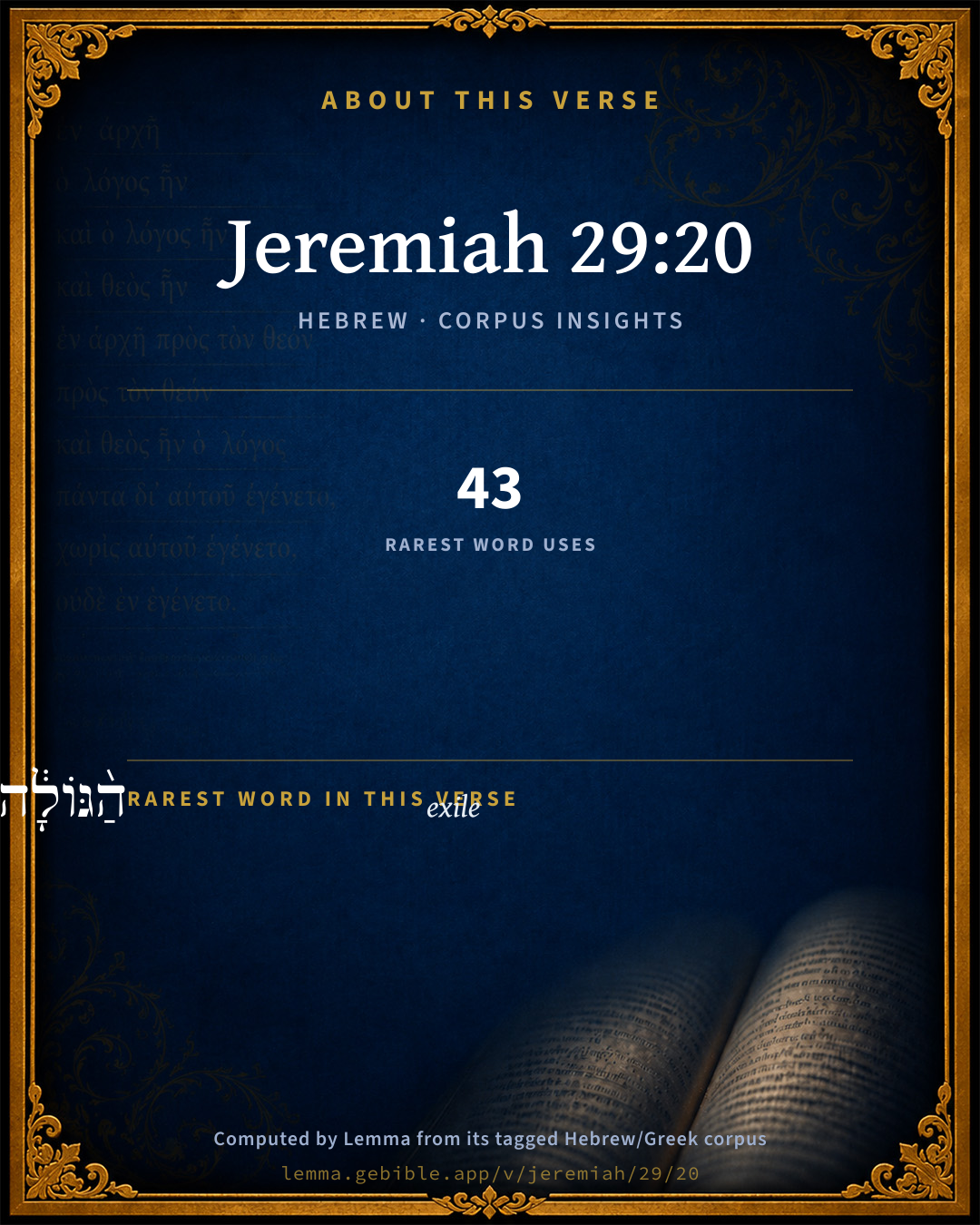
הַ֨גּוֹלָ֔ה
gôwlâh
H1473
“the · exile”
Particle, Definite Article + Noun, Common, Feminine, Singular, Absolute
Part of Speech
Particle + Noun
Type
Common
Gender
Feminine
Number
Singular
State
Absolute
Full BDB Definition

Origin: active participle of H1540

TWOT: 350a

exiles, exile, captivity - exiles (collective) - exile, captivity (abstract)
  1. וְאַתֶּ֖ם ʼattâh H859 “and · you” Conjunction + Pronoun, Personal, 2nd Person, Masculine, Plural
  2. שִׁמְע֣וּ shâmaʻ H8085 “hear” Verb, Qal, Imperative, 2nd Person, Masculine, Plural
  3. דְבַר dâbâr H1697 “word of” Noun, Common, Masculine, Singular, Construct
  4. יְהוָ֑ה Yᵉhôvâh H3068 “LORD” Noun, Proper
  5. כָּל kôl H3605 “all of” Noun, Common, Masculine, Singular, Construct
  6. אֲשֶׁר ʼăsher H834 “which” Particle, Relative
  7. שִׁלַּ֥חְתִּי shâlach H7971 “to send” Verb, Piel, Perfect, 1st Person, Common, Singular
  8. מִירוּשָׁלִַ֖ם Yᵉrûwshâlaim H3389 “from · Jerusalem” Preposition + Noun, Proper
  9. בָּבֶֽלָה Bâbel H894 “Babylon · toward” Noun, Proper + Suffix, Demonstrative

About this verse

These counts appear in no published source. They are computed here, from the morphology-tagged text and Lemma’s own curated glosses. What Lemma adds →

10
words
10
distinct lemmas
Prophets
section

Shared distinctive vocabulary

הַ֨גּוֹלָ֔ה exile H1473 occurs in 42 verses of the Hebrew Bible. Also found in:

Grammatical profile

  • 2 verbs
  • 6 nouns
  • 1 pronoun
  • 1 particle

Verb forms

  • שִׁמְע֣וּ Qal · Imperative
  • שִׁלַּ֥חְתִּי Piel · Perfect

Cross-references

4

Topical passages linked to Jeremiah 29:20 in the Treasury of Scripture Knowledge — connected by theme and wording, ordered by reader-vote popularity; previews shown in the World English Bible.

  • Jeremiah 24:5 Thus says Yahweh, the God of Israel: Like these good figs, so will I regard the captives of Judah, whom I have sent out of this place into the land of the Chaldeans, for good.
  • Micah 4:10 Be in pain, and labor to bring forth, daughter of Zion, Like a woman in travail; For now you will go forth out of the city, And will dwell in the field, And will come even to Babylon. There you will be rescued. There Yahweh will redeem you from the hand of your enemies.
  • Ezekiel 3:11 Go, get you to them of the captivity, to the children of your people, and speak to them, and tell them, Thus says the Lord Yahweh; whether they will hear, or whether they will forbear.
  • Ezekiel 3:15 Then I came to them of the captivity at Tel Aviv, that lived by the river Chebar, and to where they lived; and I sat there overwhelmed among them seven days.

Cross-references courtesy of OpenBible.info (CC BY 4.0).

Hebrew and Greek witnesses Masoretic Hebrew ↔ Greek Septuagint

The same verse in the two great witnesses to the Old Testament, shown verse-for-verse.

These are two independent witnesses, not word-aligned to each other, and the Septuagint is shown in lemma (dictionary) form.

Hebrew Jeremiah 29:20 Masoretic · Westminster Leningrad Codex

וְאַתֶּ֖ם שִׁמְע֣וּ דְבַר יְהוָ֑ה כָּל הַ֨גּוֹלָ֔ה אֲשֶׁר שִׁלַּ֥חְתִּי מִירוּשָׁלִַ֖ם בָּבֶֽלָה

Hear you therefore the word of Yahweh, all you of the captivity, whom I have sent away from Jerusalem to Babylon.

World English Bible · Public Domain

Greek LXX Structure differs

In the Septuagint, Jeremiah is about an eighth shorter than the Hebrew and arranges its material differently — the Oracles Against the Nations (Hebrew chapters 46–51) appear in the middle of the Greek book, after 25:13. Because the chapter and verse boundaries do not line up, a verse-for-verse comparison with the Hebrew is not shown.

A verse-for-verse comparison isn’t shown here because the chapters and verses don’t line up. Switch to the LXX edition with the MT / LXX toggle above to read the Greek directly.

Hebrew: Westminster Leningrad Codex (CC BY 4.0). Greek: Septuagint (public domain); English from a public-domain English Septuagint. How the Septuagint differs from the Hebrew →

Targum (Aramaic paraphrase)

1

The Targum is the ancient Jewish Aramaic paraphrase of the Hebrew Scriptures — an interpretive translation, not the Hebrew text itself. Onkelos (literal) and Pseudo-Jonathan (expansive) render the Torah, and Jonathan the Prophets. Coverage is partial: where no permissively-licensed English translation exists for a verse, only the Aramaic is shown. This is verse-level text, not a word-by-word alignment to the Hebrew.

  1. Targum Jonathan Prophets (Joshua–Malachi)
    וְאַתּוּן קַבִּילוּ פִּתְגָמָא דַייָ כָּל גַלְוָתָא דְאַגְלֵיתִי מִירוּשְׁלֵם לְבָבֶל:

    (no public-domain English translation for this verse)

    Targum Jonathan — Aramaic: “Mikraot Gedolot” (public domain). English: “Sefaria Community Translation” (CC0 1.0 (public-domain dedication)); “London "Chaldee Paraphrase," 1871” (public domain). Text via Sefaria.

Commentary

Notes on Jeremiah 29:20 from classic Christian and Jewish commentators (each source and its license shown beneath its notes). The classic Christian expositions comment on the surrounding passage and are grouped to its opening verse, so a note may address several verses; the Jewish commentaries on the Tanakh (Rashi and others) are per-verse, so they appear only where the commentator wrote on this verse.

Lemma curates 59 commentaries, every one of them public domain or Creative Commons licensed, each selected and text-cleaned for this edition rather than reprinted as found. About our sources →

Trapp's Complete Commentary

John Trapp

Jer 29:20 Hear ye therefore the word of the LORD, all ye of the captivity, whom I have sent from Jerusalem to Babylon:

Ver. 20. Hear ye, therefore.] Or, Hear ye also; ye who have lost the fruit of your afflictions, and are little the better for your being so long in the iron furnace.

John Trapp, A Commentary or Exposition upon All the Books of the Old and New Testament (1647–1656) — public domain. Text from a community e-Sword module.

Joseph Benson's Commentary

Jer 29:20-23. Hear all ye of the captivity whom I have sent, &c. — These phrases, I have sent, I have driven, &c., should be well observed by us. There is no evil or punishment in cities or nations, but, whoever be the instruments in bringing it on, God is the author of it. Thus saith the Lord of Ahab and of Zedekiah — Of these two persons we read no more in holy writ. That they pretended to be prophets, and to reveal God’s will, although he had not called them to any such office, nor had made known his will to them, and that therefore they had abused God’s name, we learn in this verse, and that they came to a miserable end we find in Jer 29:22. He shall slay them before your eyes — As persons that disturbed the minds of the Jews, his subjects, and made them unwilling to submit to his government, by giving them hopes of a speedy deliverance from under it: see Jer 29:7-8. And of them shall be taken up a curse — That is, an imprecation shall be used, namely, The Lord make thee like Zedekiah, &c., or, May thou meet with punishment similar to that which these persons met with. Whom the king of Babylon roasted in the fire — Casting persons into the fire was a punishment used in that country, as appears from the history of Shadrach and his companions, Daniel 3. There was likewise in use a way of roasting persons by a gentle fire, to make them die by a more lingering death, such as Antiochus practised upon the seven brethren, 2Ma 7:5. The word here properly denotes this sort of punishment. Because they have committed villany in Israel, &c. — The Jewish rabbins, as Grotius here observes, have a traditionary notion, that these were the two elders who attempted the chastity of Susannah; the story of which they think to be true in part, though not altogether such as it is represented in the Greek. Some translate the words, Because they HAD committed villany, or, evil in Israel, and HAD committed adultery, &c., understanding them as assigning the cause why Nebuchadnezzar had roasted these persons alive, namely, because they had committed adultery, it being a custom among some of the eastern nations, and they suppose also among the Babylonians, to punish that crime in the most severe manner.

Joseph Benson's Commentary on the Old and New Testaments (1811–1818) — public domain. Text from a community e-Sword module.

Tyndale Open Study Notes

Tyndale Open Resources

29:20-22 Although Jeremiah was in Jerusalem, God was able to tell him what was happening in Babylon, just as he was able to tell Ezekiel in Babylon what was happening in Jerusalem (Ezek 8). • The Lord named two prophets who were telling . . . lies in his name, and sentenced them to death (Deut 18:20-22; cp. Jer 26:14-15; 28:16-17).

Tyndale Open Study Notes — © Tyndale Open Resources, licensed CC BY-SA 4.0. Text via the HelloAO Bible API.

Adam Clarke's Commentary

Verse 20. Hear ye therefore the word] Dr. Blayney thinks there were two letters written by the prophet to the captives in Babylon, and that the first ends with this verse. That having heard, on the return of the embassy (Elasah and Gemariah, whom Zedekiah had sent to Babylon, and to whom the prophet entrusted the above letter, Jer 29:3,) that the captives had not received his advises favourably, because they were deceived by false prophets among them, who promised them a speedier deliverance, he therefore wrote a second letter, beginning with the fifteenth verse, and going on with the twenty-first, &c., in which he denounces God's judgments on three of the chief of those, Ahab, Zedekiah, and Shemaiah.

Adam Clarke's Commentary on the Bible (1810–1826) — public domain. Text from a community e-Sword/MySword module.

John Calvin's Commentaries

Jeremiah announces a special prophecy, but in confirmation of his former doctrine. His object is still the same, to prevent the captives, as they had begun, to listen to flatteries, and to make them feel assured that they were to bear their exile till the end of seventy years. But he speaks here of three impostors; he connects two of them together, and mentions the third by himself. He directs his discourse especially to all the captives, for he deigned not to address those who professed to be God’s enemies, and sold themselves as slaves to the devil for the purpose of deceiving. It was therefore useless to spend labor on them. But he addressed the whole people, and at the same time foretold what would happen to these two false prophets, even Ahab and Zedekiah. He calls one the son of Kolaiah, and the other the son of Maaseiah; for Ahab was a name then in frequent use, and Zedekiah was a name which, on account of the memory of a pious and godly king, was in high esteem among the good. To prevent then any mistake, he mentioned their fathers.

The import of the prophecy is, that a judgment would soon overtake them, as they would be killed by King Nebuchadnezzar. They were in exile, but such madness had possessed them, that they hesitated not to provoke the wrath of that tyrant whom they knew to be cruel and bloody. Then Jeremiah declares, that as they thus deceived the people, they would soon be punished, as Nebuchadnezzar would slay them. There is yet no doubt but that Nebuchadnezzar had regard to his own private advantage; for before they were brought before him, he wished to allay every cause of tumult. As they ceased not to encourage the hope of a speedy return, without some check, it could not be otherwise but that frequent disturbances would arise. Therefore Nebuchadnezzar, as it is usual with earthly kings, consulted his own benefit. But he was in the meantime the servant of God; for those two impostors who had promised a return to the people, were to be exposed to contempt. Their death then disclosed their vanity, for it thereby appeared that they were not sent by God. It is indeed true that God’s faithful servants are often cruelly treated, nay, even slain by the ungodly. But the case was different as to these two. For they were not proved guilty of falsehood, because they happened to have unhappily prophesied, but because they raised up a standard as it were, and said, that the people would soon return to their own country; and hence it was that they were slain. We then see that what would take place was not without reason foretold by Jeremiah; for from their death it might have been concluded, that whatever they had promised respecting the return of the people, were mere fallacies; and they were slain even before the time which they had predicted. We now perceive the meaning. We shall now notice the words.

He says, Hear ye, the, whole captivity, the word of Jehovah He would have the Jews to be attentive, for if a thousand impostors had been killed, yet their faith in falsehood would never have been destroyed, had not Jeremiah prophesied before the time what would take place. He then sits here as a judge; for though Nebuchadnezzar ordered them to be killed, yet it appears evident that it was ordained by God, and indeed for this end, that the people might learn to repent. We hence see that Jeremiah was their judge; and Nebuchadnezzar afterwards executed what God by the mouth of his servant had pronounced as a judgment. This is the reason why he addressed his words to the whole people.

He yet at the same time adds, that they had been sent by God, whom I have sent, etc. and he said this, in order that they might not imagine that they went there by chance or by adverse fortune, and that they might acknowledge that when they were deprived of their own country, it was a just punishment for their sins.

John Calvin's Commentaries (1540-1563) — public domain. Text from the Calvin Translation Society English edition (1840s-50s) via the Christian Classics Ethereal Library (ccel.org). Calvin's coverage is partial (roughly two-thirds of the Bible); uncommented books and verses are honest gaps, never fabricated. The 19th-century editor's footnotes and remarks are omitted so the notes are faithfully Calvin's own voice.

The Cambridge Bible for Schools and Colleges

gen. ed. J. J. S. Perowne

20. This v. is an insertion, to connect the preceding interpolation with what follows.

20–23. The prophets in Babylonia, of whom the exiles speak in Jer_29:15, shall perish by a cruel death.

The Cambridge Bible for Schools and Colleges (gen. ed. J. J. S. Perowne; Cambridge University Press, 1878–1918) — public domain. Text from a community e-Sword module.

John Gill's Exposition

Hear ye therefore the word of the Lord,.... What he was now about to say concerning their false prophets:

all ye of the captivity, whom I have sent from Jerusalem to Babylon; all that were carried captive along with Jeconiah. Some parts of this letter are directed to one sort of the captives, and others to another sort of them; some being good men, some bad; but what follows all are called upon to observe, good and bad; it being a prediction of a certain event, which they would see fulfilled in a short time; and therefore might be of service of them; to the godly, for the confirmation of them in the belief of what the Lord had promised; and to the rest, to make them stop giving heed to false prophets, that should here after arise.

John Gill's Exposition of the Whole Bible (1746–1763) — public domain (CC PDM 1.0). Text via the HelloAO Bible API.

Matthew Poole's English Annotations

Those phrases, I have sent,

and I have driven, &c., are diligently to be observed by us. There is no evil in cities or nations which is an evil of punishment, but, whoever be the instruments to bring it, God is the author of it. These phrases also signified to those Jews that God was likeliest to know best how long they should stay there, because he sent them thither.

Matthew Poole's English Annotations on the Holy Bible (1683–1685) — public domain. Text from a community e-Sword/MySword module.

The Pulpit Commentary

Vers. 20-32. Shemaiah.

I HIS ACTION.

1. He is irritated at the letter of Jeremiah. From Babylon he writes back in a rage. It is foolish to be thus angry with those who tell us unpleasant truths, but it is very common.

2. He describes Jeremiah as mad. People often depreciate the intelligence of those who differ from them. Weak men set down strong words to the excitement of the speaker because they have not the imagination or the nerve to receive them as true.

3. He urges the temple officials to arrest and punish Jeremiah. We have here another instance of the common effort to suppress those whom we are unable to answer.

II HIS MORAL CONDUCT.

1. He usurps the name of a prophet, though he is not sent by God. His pretence to speak in the Name of God is unwarranted. A prophet is one who acts as God"s messenger, as an apostle is one who acts as the messenger of Christ. No man has a right to enter the ministry of Christ unless he is called to it, nor to speak as God"s ambassador unless he is convinced in his conscience that he is sent by God.

2. He deceives the Jews into "trusting in a lie." It is not only that he falsely claims to be a prophet; his prophetic message is also false. Truth is sacred; to tamper with it is a sin, but to deceive others to their hurt increases the sin.

3. He instigates revolt against God. If it is wrong to utter a falsehood to serve a good end, it must be more wrong to do so with a bad intention. But all false religious teaching tends to induce disobedience to the will of God.

III HIS DOOM.

1. He is to be punished. The evil that he discredits shall fall upon him. This is a severe but an appropriate punishment for a deceiving prophet.

2. His children are to share his doom. There is a great mystery in the hereditary character of punishment, and it is increased in some respects by the fact that tendencies to sin are also hereditary. But the fact is as clearly visible in nature as it is revealed in Scripture.

3. He is not to see the joy of the restoration. They who refuse wholesome chastisement cannot receive the happy fruits that follow it. It is natural and reasonable that the willful rejection of Divine warnings should be followed by a severe judgment.

Vers. 20-32. The punishment of false prophets.

The opposition between Jeremiah and the false prophets is one of the most interesting phenomena of the period to which these prophecies belong. It is a real battle, albeit not with earthly weapons. The question between them could not be suffered to remain doubtful, as it involved immense consequences. A striking correspondence is discovered in the antagonism to the labors of the apostles. There is the same barefaced, fearless lying and dishonesty, the same terrible denunciation of judgment. (We are reminded of the sentence on Simon Magus, "Thy silver perish with thee," etc., Act_8:20-24; and the reply to Ananias, the high priest, "God shall smite thee, thou whited wall," (Act_23:3) How is the latter to be regarded? Evidently as the word of God through his true servants, and not as the expression of vindictive feeling. In regard to this punishment notice

I ITS NATURE. It had direct reference to that concerning which they spoke. From the future they had denied they were to be cut off. In the case of Ahab and Zedekiah the instrumentality of man is indirectly employed; in that of Shemaiah it is brought about by what we might regard as natural causes. In both instances the penalty was:

1. Exceptionally were. The fate of the lying prophets, even apart from its associated consequences in the eternal sphere, was tragic in the extreme, and presents hardly an element of hope. Ahab and his companion are subjected to a fearful death and an eternity of shame in Israel. Shemaiah is consigned to effacement and deprived both as regards himself and his posterity, of the promised blessings.

2. Exemplary. Unmistakably these men were but the leaders of many of like mind, and it was intended they should be marked out for signal retribution. Their fate would appeal to the imagination and spiritual feeling of their people, and in either case it corresponded closely with the peculiarity of their conduct. In their heathen exile they were to be taught that God"s hand could still reach them and that an exact justice waited upon their actions. Ahab and Zedekiah so lived that even a heathen monarch had to make them examples.

3. Graduated according to heinousness of offence.

II ITS JUSTIFICATION.

1. The opposition to Gods truth was necessarily direct and malicious, Nothing could well be more consciously wicked than their whole behavior. It occurred at a critical period, when great destinies were determined. The prophet of God was thereby discredited and hindered, and the people prevented from receiving and acting upon his message. In every season of critical consequence and great spiritual activity such manifestations occur. Merely to overcome them is not sufficient. The victory must be signal and conspicuous.

2. The offense was one to which God himself is ever most sensitive. It affected his character and prerogatives, and was therefore nothing else than blasphemy. (cf. Mat_12:32. "Even I know, and am a witness, saith the Lord," ver. 23)

3. The interests of truth required the penalty. The people had to be overawed by the presence of the supernatural; their obedience had to be won to the direction of the true prophet, and the spiritual ends of the Captivity were thus to be secured. A moral demonstration like this was requisite, and enables the human mind more completely to realize the Divine conceptions of righteousness and truth. M.

The Pulpit Commentary (1880–1919), ed. H.D.M. Spence-Jones & Joseph S. Exell — public domain. Text from a community e-Sword module.

unfoldingWord translationNotes

Door43 World Missions Community

So you yourselves listen

Yahweh is now about to issue a command and wants them to pay attention. AT: "But as for you, listen carefully"

Kolaiah ... Maaseiah

These are the names of men. (See: How to Translate Names)

who prophesy falsely to you in my name

Here "name" is a metonym for the person. AT: "liars who tell you that they are speaking my words to you" (See: Metonymy)

See

"Look" or "Listen" or "Pay attention to what I am about to tell you"

I am about to put them into the hand of Nebuchadnezzar king of Babylon

Here "hand" is a metonym for the power that the hand exercises. AT: "I will allow Nebuchadnezzar king of Babylon to conquer them" (See: Metonymy)

before your eyes

"where you can see him do it"

translationWords

Ahab

Zedekiah

false prophet

hand

Nebuchadnezzar

unfoldingWord translationNotes — © Distant Shores Media and the Door43 World Missions Community, licensed CC BY-SA 4.0. Source: git.door43.org/Door43/en_tn.

Lesson kit

Teaching starters — assembled from the data on this page, not authored interpretation. Every prompt links to the verse data it draws on. Edit before teaching.

Jeremiah, in the Prophets, opens this verse with 10 words (10 distinct Hebrew lemmas). Its most distinctive word is gôwlâh (“exile”). A historical commentator’s framing appears above. Read the whole chapter for the surrounding context.

Discussion questions

  1. How does “exile” (gôwlâh) shape what this verse is saying?
  2. 2 Kings 24:14 shares the word «exile» with this verse. How do the two illuminate each other?
  3. These translations render this verse differently. What is at stake in choosing one wording over another?
  4. The verb «שִׁמְע֣וּ» is Qal Imperative. How does its form color the action?
  5. Reading how Trapp's Complete Commentary and Joseph Benson's Commentary read this verse, where do the two commentators agree and where do they part?

Things to notice

Reading settings

Reading text

Shown beneath each verse's original-language words.

Old Testament
Old Testament edition

Read the OT as the Masoretic Hebrew (MT) or the Greek Septuagint (LXX).

English shown for the Greek Septuagint (in the Hebrew ↔ Greek comparison).

Comparing translations? Open the Compare panel on any verse page to stack up to four side by side.