
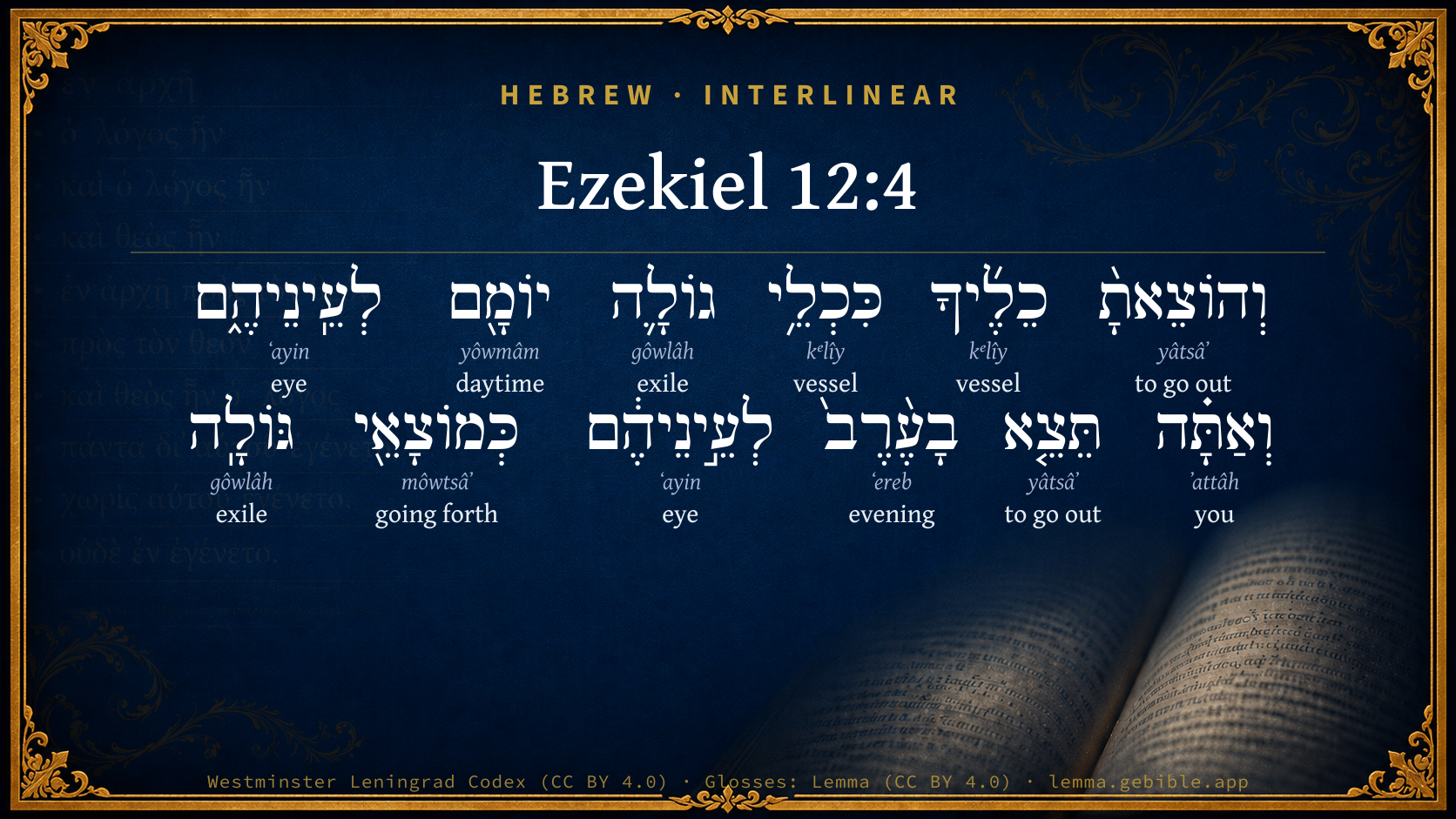
Ezekiel 12:4

Hebrew (Westminster Leningrad Codex) Ezekiel 12:4 appears in the Hebrew Old Testament. The text above is from the Westminster Leningrad Codex. Each word links to its Strong’s number, a concise gloss, and parsing drawn from the Open Scriptures Hebrew Bible morphology. Click any word for its full Brown-Driver-Briggs (BDB) entry.
Download image
Cite this verse

Ezekiel 12:4 (World English Bible). Public Domain. Lemma interlinear Bible study tool, https://lemma.gebible.app/v/ezekiel/12/4.

Show BibTeX & RIS
BibTeX
RIS
English Translation
You shall bring forth your stuff by day in their sight, as stuff for removing; and you shall go forth yourself at even in their sight, as when men go forth into exile.
World English Bible · Public Domain
Download a study sheet

One document with this verse’s original text, its word-by-word gloss line, the meaning frame, cross-references with their text, attributed commentary, and full source and license credits — printable, and it pastes into notes with its structure intact.

This verse Autodidact and up

Study sheet (.html) Plain text (.txt)

A passage Seminary Student

Up to 50 verses in one chapter. A passage sheet keeps up to 6 commentary sources and 12 cross-references per verse, in the order this page ranks them, and says so on the sheet whenever that leaves anything out. Ask for a single verse and you get the Autodidact verse sheet above.

Everything on this page stays free to read, with no account — the sheet is a download of what is already on screen, not access to it.

Want to remove ads? Support Godless Engineer
Compare translations 3

The same verse in 3 English versions, stacked beneath the original-language interlinear above. Click any original word for its lexicon entry.

Each is an independent rendering of the whole verse — the interlinear is not word-aligned to these translations.

Highlighted words mark where these versions differ — a whole-verse word diff, not a word-by-word alignment.

  • World English Bible Public Domain
    You shall bring forth your stuff by day in their sight, as stuff for removing; and you shall go forth yourself at even in their sight, as when men go forth into exile.
  • King James Version Public Domain
    Then shalt thou bring forth thy stuff by day in their sight, as stuff for removing: and thou shalt go forth at even in their sight, as they that go forth into captivity.
  • unfoldingWord Literal Text CC BY-SA 4.0
    You will bring out your things for an exile in the day in their sight; go out in the evening in their sight in the way that anyone goes into exile.

unfoldingWord Literal Text — © unfoldingWord, licensed CC BY-SA 4.0. Word-aligned USFM3 via Door43 (git.door43.org/unfoldingWord/en_ult).

Versions to compare (up to 4)

3 of 4 selected

Show all 18 translations

Every available English version of this verse, each an independent rendering of the whole verse.

  • World English Bible Public Domain
    You shall bring forth your stuff by day in their sight, as stuff for removing; and you shall go forth yourself at even in their sight, as when men go forth into exile.
  • Berean Standard Bible Public Domain
    Bring out your baggage for exile by day, as they watch. Then in the evening, as they watch, go out like those who go into exile.
  • Majority Standard Bible Public Domain
    Bring out your baggage for exile by day, as they watch. Then in the evening, as they watch, go out like those who go into exile.
  • King James Version Public Domain
    Then shalt thou bring forth thy stuff by day in their sight, as stuff for removing: and thou shalt go forth at even in their sight, as they that go forth into captivity.
  • American Standard Version (1901) Public Domain
    And thou shalt bring forth thy stuff by day in their sight, as stuff for removing; and thou shalt go forth thyself at even in their sight, as when men go forth into exile.
  • Revised Version (1885) Public Domain
    And thou shalt bring forth thy stuff by day in their sight, as stuff for removing: and thou shalt go forth thyself at even in their sight, as when men go forth into exile.
  • Geneva Bible (1599) Public Domain
    Then shalt thou bring foorth thy stuffe by day in their sight as the stuffe of him that goeth into captiuitie: and thou shalt go forth at euen in their sight, as they that go foorth into captiuitie.
  • Douay-Rheims (1899) Public Domain
    And thou shalt bring forth thy furniture as the furniture of one that is removing by day in their sight: and thou shalt go forth in the evening in their presence, as one goeth forth that removeth his dwelling.
  • Young's Literal Translation Public Domain
    And thou hast brought forth thy vessels as vessels of removal by day before their eyes, and thou, thou dost go forth at even before their eyes, as the goings forth of a removal.
  • Literal Standard Version CC BY-SA 4.0
    And you have brought forth your vessels as vessels of removal by day before their eyes, and you go forth in the evening before their eyes, as the goings forth of a removal.
  • Unlocked Literal Bible CC BY-SA 4.0
    You will bring out your things for an exile in the day in their sight; go out in the evening in their sight in the way that anyone goes into exile.
  • unfoldingWord Literal Text CC BY-SA 4.0
    You will bring out your things for an exile in the day in their sight; go out in the evening in their sight in the way that anyone goes into exile.
  • Darby Bible Public Domain
    And bring forth thy baggage by day in their sight, as a captive's baggage, and thou thyself, go forth at even in their sight as they that go forth into captivity.
  • World Messianic Bible Public Domain
    You shall bring out your baggage by day in their sight, as baggage for moving. You shall go out yourself at evening in their sight, as when men go out into exile.
  • Webster's Bible Public Domain
    Then shalt thou bring forth thy stuff by day in their sight, as stuff for removing: and thou shalt go forth at evening in their sight, as they that go forth into captivity.
  • Free Bible Version CC BY-SA 4.0
    Take your bags out for traveling into exile during the day while they watch. But you yourself are to leave in the evening as they watch, just like someone going into exile.
  • Bible in Basic English Public Domain
    By day, before their eyes, take out your vessels like those of one who is taken away: and go out in the evening before their eyes, like those who are taken away as prisoners.
  • JPS Tanakh (1917) Public Domain
    And thou shalt bring forth thy stuff by day in their sight, as stuff for exile; and thou shalt go forth thyself at even in their sight, as when men go forth into exile.

Literal Standard Version (2020), Covenant Press — licensed CC BY-SA 4.0. Text via the HelloAO Bible API (eBible.org). Unlocked Literal Bible (unfoldingWord) — licensed CC BY-SA 4.0. Text via the HelloAO Bible API (eBible.org). unfoldingWord Literal Text — © unfoldingWord, licensed CC BY-SA 4.0. Word-aligned USFM3 via Door43 (git.door43.org/unfoldingWord/en_ult). Free Bible Version, Dr. Jonathan Gallagher — licensed CC BY-SA 4.0. Text via the HelloAO Bible API (eBible.org).

Word by word

More ways to search: Search by grammar → Find every occurrence → Compare this word →

Practice this passage: Drill this verse → Learn its vocabulary →

כְּמוֹצָאֵ֖י
môwtsâʼ
H4161
“like/as · goings forth of”
Preposition + Noun, Common, Masculine, Plural, Construct
Part of Speech
Preposition + Noun
Type
Common
Gender
Masculine
Number
Plural
State
Construct
Full BDB Definition

Origin: from H3318

TWOT: 893c

act or place of going out or forth, issue, export, source, spring - a going forth - rising (sun), going forth of a command - goings forth, those going forth - way out, exit - that which goes forth - utterance - export - place of going forth - source or spring (of water) - place of departure - east (of sun) - mine (of silver)
  1. וְהוֹצֵאתָ֨ yâtsâʼ H3318 “and · to go out” Conjunction + Verb, Hiphil, Sequential Perfect, 2nd Person, Masculine, Singular
  2. כֵלֶ֜יךָ kᵉlîy H3627 “vessels · your” Noun, Common, Masculine, Plural, Construct + Suffix, Personal, 2nd Person, Masculine, Singular
  3. כִּכְלֵ֥י kᵉlîy H3627 “like/as · vessels of” Preposition + Noun, Common, Masculine, Plural, Construct
  4. גוֹלָ֛ה gôwlâh H1473 “exile” Noun, Common, Feminine, Singular, Absolute
  5. יוֹמָ֖ם yôwmâm H3119 “daytime” Adverb
  6. לְעֵֽינֵיהֶ֑ם ʻayin H5869 “to/for · eyes · their” Preposition + Noun, Common, Both, Dual, Construct + Suffix, Personal, 3rd Person, Masculine, Plural
  7. וְאַתָּ֗ה ʼattâh H859 “and · you” Conjunction + Pronoun, Personal, 2nd Person, Masculine, Singular
  8. תֵּצֵ֤א yâtsâʼ H3318 “to go out” Verb, Qal, Imperfect, 2nd Person, Masculine, Singular
  9. בָעֶ֨רֶב֙ ʻereb H6153 “in/at the · evening” Preposition, Determined + Noun, Common, Masculine, Singular, Absolute
  10. לְעֵ֣ינֵיהֶ֔ם ʻayin H5869 “to/for · eyes · their” Preposition + Noun, Common, Both, Dual, Construct + Suffix, Personal, 3rd Person, Masculine, Plural
  11. גּוֹלָֽה gôwlâh H1473 “exile” Noun, Common, Feminine, Singular, Absolute

About this verse

These counts appear in no published source. They are computed here, from the morphology-tagged text and Lemma’s own curated glosses. What Lemma adds →

12
words
8
distinct lemmas
Prophets
section

Shared distinctive vocabulary

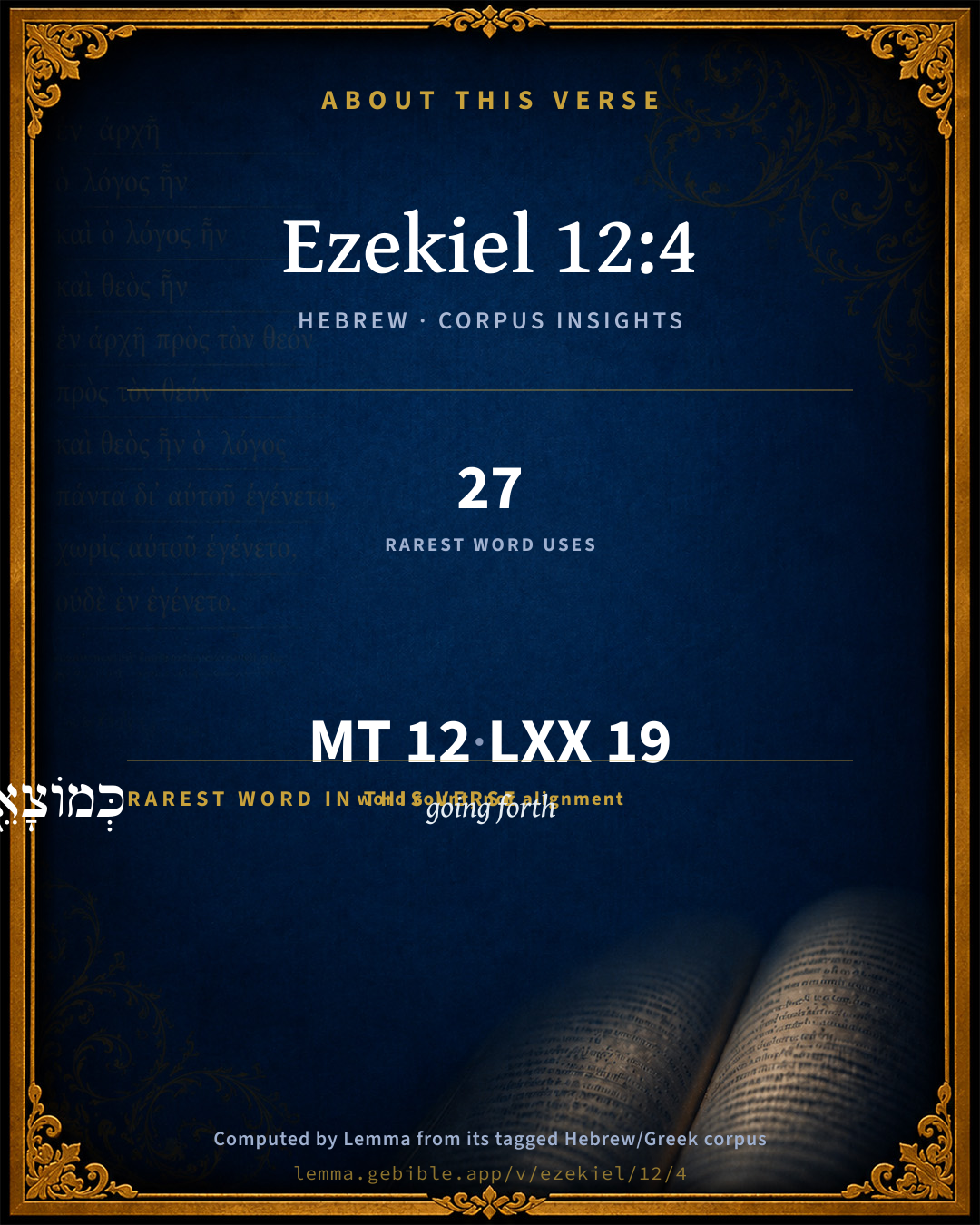
כְּמוֹצָאֵ֖י going forth H4161 occurs in 26 verses of the Hebrew Bible. Also found in:

Grammatical profile

  • 2 verbs
  • 8 nouns
  • 1 pronoun
  • 1 adverb

Verb forms

  • וְהוֹצֵאתָ֨ Hiphil · Sequential Perfect
  • תֵּצֵ֤א Qal · Imperfect

Repetition

Words recur within this verse — often emphatic in Hebrew:

  • וְהוֹצֵאתָ֨ to go out H3318 ×2
  • כֵלֶ֜יךָ vessel H3627 ×2
  • גוֹלָ֛ה exile H1473 ×2
  • לְעֵֽינֵיהֶ֑ם eye H5869 ×2

Hebrew & Septuagint length

In English translation the verse runs 33 words from the Hebrew and 30 from the Septuagint (LXX English) — closely comparable.

A rough comparison of the two English renderings, which tokenize alike — not a word-level alignment.

Word counts can differ between the Hebrew and the Greek without any difference in meaning — e.g. the Hebrew direct-object marker אֵת has no separate Greek word, and Greek often adds the article ὁ.

In the original languages it is 12 Hebrew tokens and 19 Greek tokens — but the two are counted differently (Hebrew bundles its prefixes and suffixes into one token; the Greek is in lemma form), so that isn’t a like-for-like length.

Cross-references

4

Topical passages linked to Ezekiel 12:4 in the Treasury of Scripture Knowledge — connected by theme and wording, ordered by reader-vote popularity; previews shown in the World English Bible.

  • Jeremiah 39:4 It happened that, when Zedekiah the king of Judah and all the men of war saw them, then they fled, and went forth out of the city by night, by the way of the king's garden, through the gate between the two walls; and he went out toward the Arabah.
  • 2 Kings 25:4 Then a breach was made in the city, and all the men of war [fled] by night by the way of the gate between the two walls, which was by the king's garden (now the Chaldeans were against the city round about); and [the king] went by the way of the Arabah.
  • Ezekiel 12:12 The prince who is among them shall bear on his shoulder in the dark, and shall go forth: they shall dig through the wall to carry out thereby: he shall cover his face, because he shall not see the land with his eyes.
  • Jeremiah 52:7 Then a breach was made in the city, and all the men of war fled, and went forth out of the city by night by the way of the gate between the two walls, which was by the king's garden; (now the Chaldeans were against the city round about;) and they went toward the Arabah.

Cross-references courtesy of OpenBible.info (CC BY 4.0).

Hebrew and Greek witnesses Masoretic Hebrew ↔ Greek Septuagint

The same verse in the two great witnesses to the Old Testament, shown verse-for-verse.

These are two independent witnesses, not word-aligned to each other, and the Septuagint is shown in lemma (dictionary) form.

Hebrew Ezekiel 12:4 Masoretic · Westminster Leningrad Codex

וְהוֹצֵאתָ֨ כֵלֶ֜יךָ כִּכְלֵ֥י גוֹלָ֛ה יוֹמָ֖ם לְעֵֽינֵיהֶ֑ם וְאַתָּ֗ה תֵּצֵ֤א בָעֶ֨רֶב֙ לְעֵ֣ינֵיהֶ֔ם כְּמוֹצָאֵ֖י גּוֹלָֽה

You shall bring forth your stuff by day in their sight, as stuff for removing; and you shall go forth yourself at even in their sight, as when men go forth into exile.

World English Bible · Public Domain

Greek LXX Ezekiel 12:4 Septuagint · lemma form

καί ἐκφέρω ὁ σκεῦος σύ ὡς σκεῦος αἰχμαλωσία ἡμέρα κατά ὀφθαλμός αὐτός καί σύ ἐκἔρχομαι ἑσπέρα ὡς ἐκπορεύομαι αἰχμάλωτος

And you shall carry forth your baggage, baggage for captivity, by day before their eyes: and you shall go forth at even, as a captive goes forth, in their sight.

LXX2012 (modern English Septuagint) · Public Domain

Hebrew: Westminster Leningrad Codex (CC BY 4.0). Greek: Septuagint (public domain); English from LXX2012 (modern English Septuagint) (Public Domain). How the Septuagint differs from the Hebrew →

Targum (Aramaic paraphrase)

1

The Targum is the ancient Jewish Aramaic paraphrase of the Hebrew Scriptures — an interpretive translation, not the Hebrew text itself. Onkelos (literal) and Pseudo-Jonathan (expansive) render the Torah, and Jonathan the Prophets. Coverage is partial: where no permissively-licensed English translation exists for a verse, only the Aramaic is shown. This is verse-level text, not a word-by-word alignment to the Hebrew.

  1. Targum Jonathan Prophets (Joshua–Malachi)
    וְתַפֵּיק מָנָךְ כְמָנֵי גָלוּתָא בִּימָם לְעֵינֵיהוֹן וְאַתְּ תִּפּוֹק בְּרַמְשָׁא לְעֵינֵיהוֹן כְּמַפְקָנֵי גָלוּתָא:

    (no public-domain English translation for this verse)

    Targum Jonathan — Aramaic: “Mikraot Gedolot” (public domain). English: “Sefaria Community Translation” (CC0 1.0 (public-domain dedication)); “London "Chaldee Paraphrase," 1871” (public domain). Text via Sefaria.

Commentary

Notes on Ezekiel 12:4 from classic Christian and Jewish commentators (each source and its license shown beneath its notes). The classic Christian expositions comment on the surrounding passage and are grouped to its opening verse, so a note may address several verses; the Jewish commentaries on the Tanakh (Rashi and others) are per-verse, so they appear only where the commentator wrote on this verse.

Lemma curates 59 commentaries, every one of them public domain or Creative Commons licensed, each selected and text-cleaned for this edition rather than reprinted as found. About our sources →

The Cambridge Bible for Schools and Colleges

gen. ed. J. J. S. Perowne

4. Then shalt thou bring] And thou shalt. The prophet is to bring forth the articles which he had prepared, depositing them in some convenient place in readiness to carry with him when he escapes.

and thou shalt go forth] Possibly: and thou shalt go forth thyself, as R.V. The second half of Eze_12:4 is to be connected with Eze_12:5, describing the prophet’s action so far as it symbolizes what refers to the persons of the fugitives.

The Cambridge Bible for Schools and Colleges (gen. ed. J. J. S. Perowne; Cambridge University Press, 1878–1918) — public domain. Text from a community e-Sword module.

Trapp's Complete Commentary

John Trapp

Eze 12:4 Then shalt thou bring forth thy stuff by day in their sight, as stuff for removing: and thou shalt go forth at even in their sight, as they that go forth into captivity.

Ver. 4. Thou shalt bring forth thy stuff.] Arma viatoria; travelling bags for an ocular demonstration. What surer than sight?

Go forth at even.] The king and his men of war were glad to do so, {2Ki 25:4} but it would not do.

John Trapp, A Commentary or Exposition upon All the Books of the Old and New Testament (1647–1656) — public domain. Text from a community e-Sword module.

Jamieson, Fausset & Brown

Robert Jamieson, A. R. Fausset & David Brown

by day--in broad daylight, when all can see thee.

at even--not contradicting the words "by day." The baggage was to be sent before by day, and Ezekiel was to follow at nightfall [GROTIUS]; or, the preparations were to be made by day, the actual departure was to be effected at night [HENDERSON].

as they that go forth into captivity--literally, "as the goings forth of the captivity," that is, of the captive band of exiles, namely, amid the silent darkness: typifying Zedekiah's flight by night on the taking of the city (Jer 39:4; Jer 52:7).

Jamieson, Fausset & Brown — Commentary Critical and Explanatory on the Whole Bible (1871) — public domain (CC PDM 1.0). Text via the HelloAO Bible API.

John Gill's Exposition

Dig thou through the wall in their sight,.... The wall of the house where he was, as an emblem of the city of Jerusalem closely besieged, from whence there was no escape but by digging through the wall this showed the manner in which Zedekiah made his escape, by the way of the gate, between the two walls which was by the king's garden, Jer 52:7;

and carry out thereby; not his stuff, as before; but provisions for himself, necessary for his journey or flight; as no doubt Zedekiah and those with him did.

John Gill's Exposition of the Whole Bible (1746–1763) — public domain (CC PDM 1.0). Text via the HelloAO Bible API.

Albert Barnes' Notes on the Bible

The particulars which Ezekiel here foretold actually occurred (compare 2Ki 25:4; Jer 39:4); but at this time Zedekiah seemed to be prosperous, and the Jews at Jerusalem expected, it is clear, a long continuance of his prosperity (see Eze 17:1 note).

The prophetic character of the passage is undoubted (the prophet is declared to be “a sign,” Eze 12:6) - the genuineness of the book and of the position of the passage in the book, are beyond dispute; in the historical event we have an exact fulfillment. The only legitimate inference is that the prophet received his knowledge from above.

Albert Barnes' Notes on the Bible (1834–1885) — public domain. Text from a community e-Sword/MySword module.

Matthew Poole's English Annotations

Having made all ready, as Eze 12:3, thou shalt proceed to bear it away; not employ servants and laboureth to do it. but thou thyself shalt do it.

By day: see Eze 12:3.

As stuff for removing: see Eze 12:3.

At even: this circumstance, added to what was Eze 12:3, speaks the secrecy and shame, with the danger of their coming out; in the evening, in the dark, when night may soon conceal them, and they gain a night’s journey before the enemy hath notice to pursue. In their sight; before it is quite night, that they, who should learn by this sign, may see it and consider it.

Matthew Poole's English Annotations on the Holy Bible (1683–1685) — public domain. Text from a community e-Sword/MySword module.

Whedon's Commentary on the Bible

Daniel D. Whedon

4. And thou shalt go forth at even — Literally, but thou thyself shalt, etc. The few necessary things for flight can be prepared in the daytime behind the city walls, but the escape from the city can only be attempted at night.

Daniel D. Whedon (gen. ed.), Commentary on the Old and New Testaments (1874–1909) — public domain. Text from a community e-Sword module.

John Wesley's Explanatory Notes

In their sight - Before 'tis quite night, that they, who should learn by this sign, may see and consider it.

John Wesley, Explanatory Notes Upon the Whole Bible (1754–1765) — public domain. Text via the GEBible commentary corpus.

unfoldingWord translationNotes

Door43 World Missions Community

General Information:

God is speaking to Ezekiel and describing how he should act out the parable.

in their sight

"as they watch"

have set you as a sign

Here the word "sign" refers to something that communicates a special warning to those who see it. Yahweh speaks of Ezekiel and his actions as being this warning. AT: "have made you to be a warning" (See: Metaphor)

house of Israel

The word "house" is a metonym for the family that lives in the house, in this case the Israelites, the descendants of Jacob over many years. See how you translated this in Ezekiel 3:1. AT: "the Israelite people group" (See: Metonymy)

translationWords

exile

darkness

sign

house

Israel

unfoldingWord translationNotes — © Distant Shores Media and the Door43 World Missions Community, licensed CC BY-SA 4.0. Source: git.door43.org/Door43/en_tn.

Rashi

Rabbi Shlomo Yitzchaki (Rashi)

like the departures of Heb. כְּמוֹצָאֵי, come issues, essues in Old French, [comme les issues in modern French] like the departures.

Rashi on the Tanakh — English translations: “The Judaica Press complete Tanach with Rashi, translated by A. J. Rosenberg” (CC BY 4.0); “Pentateuch with Rashi's commentary by M. Rosenbaum and A.M. Silbermann, 1929-1934” (public domain); “The Metsudah Tanach series, Lakewood, N.J” (CC BY 4.0); and “The Book of Joshua, Metsudah Publications, 1997” (CC BY 4.0). Text via Sefaria.

Lesson kit

Teaching starters — assembled from the data on this page, not authored interpretation. Every prompt links to the verse data it draws on. Edit before teaching.

Ezekiel, in the Prophets, opens this verse with 12 words (8 distinct Hebrew lemmas). Its most distinctive word is môwtsâʼ (“going forth”). A historical commentator’s framing appears above. Read the whole chapter for the surrounding context.

Discussion questions

  1. The word môwtsâʼ carries the sense “going forth.” How does it shape the verse?
  2. Numbers 30:12 shares the word «going forth» with this verse. How do the two illuminate each other?
  3. “to go out” occurs 2× in this one verse. What is the effect of the repetition?
  4. The translations on this page render this verse differently — a whole-verse word diff, not a word-by-word alignment. What might account for the different wordings?
  5. The verb «וְהוֹצֵאתָ֨» is Hiphil Sequential Perfect. How does its form color the action?
  6. Reading how The Cambridge Bible for Schools and Colleges and Trapp's Complete Commentary read this verse, where do the two commentators agree and where do they part?

Things to notice

Reading settings

Reading text

Shown beneath each verse's original-language words.

Old Testament
Old Testament edition

Read the OT as the Masoretic Hebrew (MT) or the Greek Septuagint (LXX).

English shown for the Greek Septuagint (in the Hebrew ↔ Greek comparison).

Comparing translations? Open the Compare panel on any verse page to stack up to four side by side.