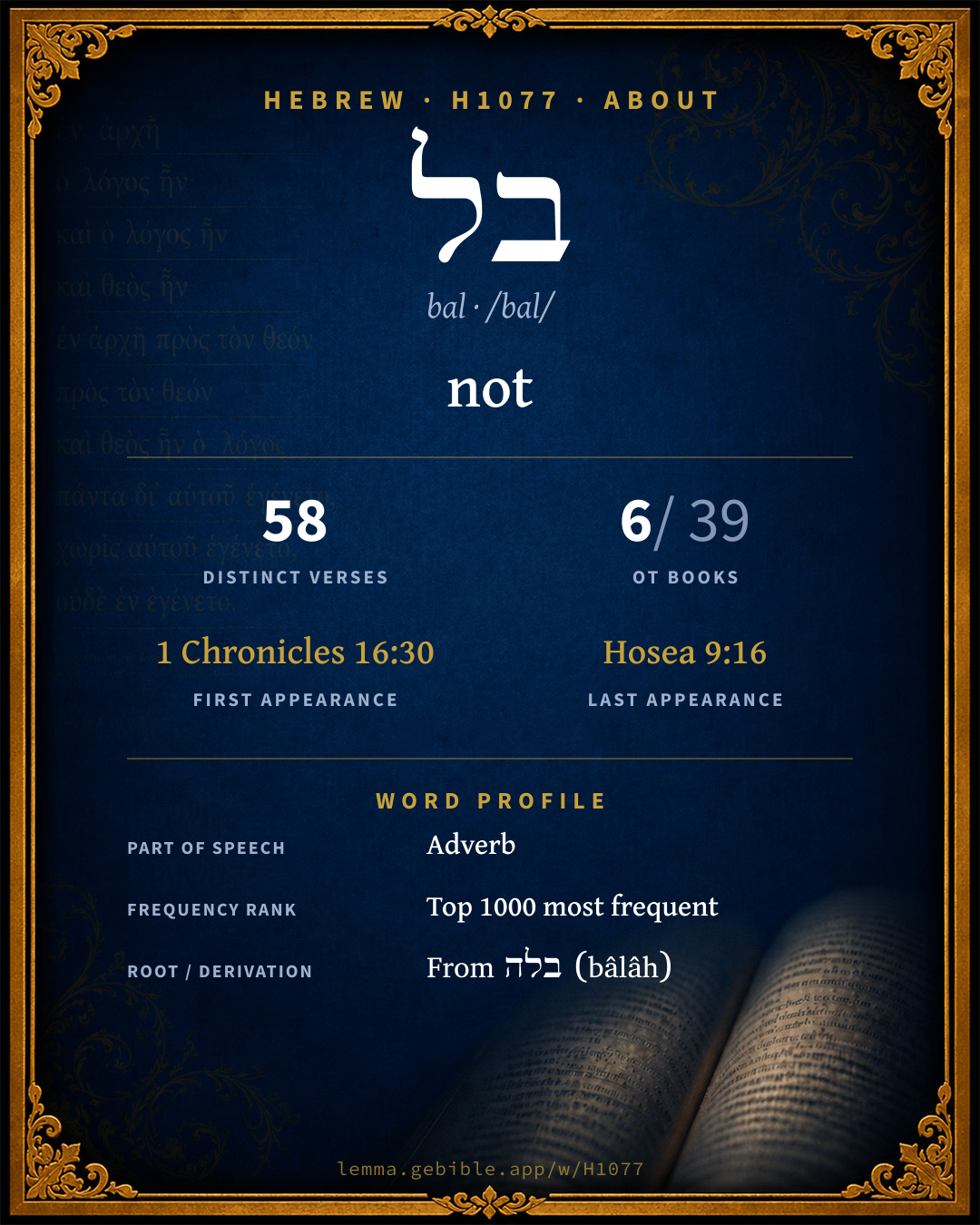
בַּל
not
Full lexicon entry — Brown-Driver-Briggs (BDB)
From Brown-Driver-Briggs (BDB)
Where this word appears
Grammar key — what these labels mean
Part of speech
- Particle
- A short function word — article, negation, interrogative, the sign of the direct object, and the like.
Every verse where H1077 appears in the Book of Psalms — 31 distinct verses. Click any verse to open its interlinear word-by-word view. Verse text shown in the World English Bible for context — . Each verse’s Hebrew form is shown with its reference; the English is not keyword-highlighted, since the data carries no word-level English alignment. Use “Compare translations” on any verse to read it across multiple English versions. This concordance covers the Hebrew Bible; Septuagint (Greek Old Testament) occurrences are not indexed here.
Psalms
- Psalms 10:4 בַּל ptcl neg The wicked, in the pride of his face, Has no room in his thoughts for God.
- Psalms 10:6 בַּל ptcl neg He says in his heart, "I shall not be shaken; For generations I shall have no trouble."
- Psalms 10:11 בַּל ptcl neg He says in his heart, "God has forgotten. He hides his face. He will never see it."
- Psalms 10:15 בַל ptcl neg Break the arm of the wicked. As for the evil man, seek out his wickedness until you find none.
- Psalms 10:18 בַּל ptcl neg To judge the fatherless and the oppressed, That man who is of the earth may terrify no more.
- Psalms 16:2 בַּל ptcl neg My soul, you have said to Yahweh, "You are my Lord. Apart from you I have no good thing."
- Psalms 16:4 בַּל וּֽ/בַל ptcl neg conj + ptcl neg Their sorrows shall be multiplied who give gifts to another god. Their drink-offerings of blood I will not offer, Nor take their names on my lips.
- Psalms 16:8 בַּל ptcl neg I have set Yahweh always before me. Because he is at my right hand, I shall not be moved.
- Psalms 17:3 בַל בַּל ptcl neg ptcl neg You have proved my heart; you have visited me in the night; You have tried me, and found nothing; I have resolved that my mouth shall not disobey.
- Psalms 17:5 בַּל ptcl neg My steps have held fast to your paths, My feet have not slipped.
- Psalms 21:2 בַּל ptcl neg You have given him his heart's desire, And have not withheld the request of his lips. Selah.
- Psalms 21:7 בַּל ptcl neg For the king trusts in Yahweh. Through the loving kindness of the Most High, he shall not be moved.
- Psalms 21:11 בַּל ptcl neg For they intended evil against you. They plotted evil against you which cannot succeed.
- Psalms 30:6 בַּל ptcl neg As for me, I said in my prosperity, "I shall never be moved."
- Psalms 32:9 בַּ֝֗ל ptcl neg Don't be like the horse, or like the mule, which have no understanding, Who are controlled by bit and bridle, or else they will not come near to you.
- Psalms 46:5 בַּל ptcl neg God is in her midst. She shall not be moved. God will help her at dawn.
- Psalms 49:12 בַּל ptcl neg But man, despite his riches, doesn't endure. He is like the animals that perish.
- Psalms 57:9 בַּל ptcl neg I will give thanks to you, Lord, among the peoples. I will sing praises to you among the nations.
- Psalms 58:8 בַּל ptcl neg Let them be like a snail which melts and passes away, Like the stillborn child, who has not seen the sun.
- Psalms 78:44 בַּל ptcl neg Turned their rivers into blood, And their streams, so that they could not drink.
- Psalms 93:1 בַּל ptcl neg Yahweh reigns! He is clothed with majesty! Yahweh is armed with strength. The world also is established. It can't be moved.
- Psalms 96:10 בַּל ptcl neg Say among the nations, "Yahweh reigns." The world is also established. It can't be moved. He will judge the peoples with equity.
- Psalms 104:5 בַּל ptcl neg He laid the foundations of the earth, That it should not be moved forever.
- Psalms 104:9 בַּל בַּל ptcl neg ptcl neg You have set a boundary that they may not pass over; That they don't turn again to cover the earth.
- Psalms 108:3 בַּל ptcl neg I will give thanks to you, Yahweh, among the nations. I will sing praises to you among the peoples.
- Psalms 119:121 בַּל ptcl neg I have done what is just and righteous. Don't leave me to my oppressors.
- Psalms 140:10 בַּֽל ptcl neg Let burning coals fall on them. Let them be thrown into the fire, Into miry pits, from where they never rise.
- Psalms 140:11 בַּל ptcl neg An evil speaker won't be established in the earth. Evil will hunt the violent man to overthrow him.
- Psalms 141:4 וּ/בַל conj + ptcl neg Don't incline my heart to any evil thing, To practice deeds of wickedness with men who work iniquity. Don't let me eat of their delicacies.
- Psalms 147:20 בַּל ptcl neg He has not done this for just any nation. They don't know his ordinances. Praise Yah!
- Psalms 149:7 בַּל ptcl neg To execute vengeance on the nations, And punishments on the peoples;
About this entry
At a glance — auto-summarized from this page’s data, not written by a person. Every figure links to its source below. This summary describes the numbers; it doesn’t interpret them.
“not” is the headline sense of the Hebrew verb בל (bal). More than half of its appearances fall in Psalms. The Hebrew Bible uses it across 58 verses — moderately common. Its earliest occurrence is 1 Chronicles 16:30. Related forms include בלה, בלא and בלה. Each statement above links to its evidence; the full detail follows below.
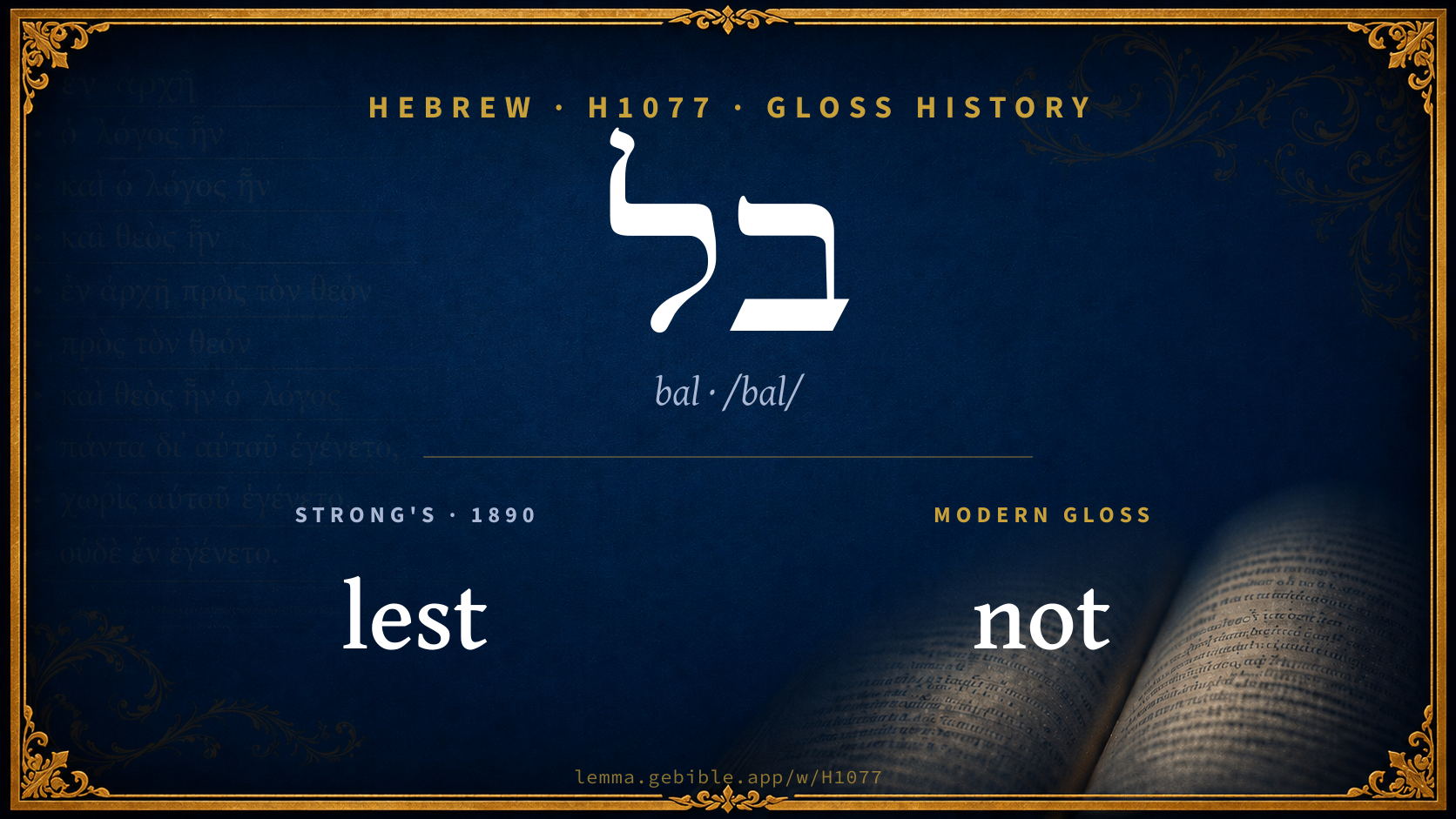
Gloss history
Strong's 1890 vs modern scholarship
About this word
Strong's H1077 catalogs a Hebrew word from the Hebrew Old Testament.
These counts are not copied from any lexicon or concordance. They are computed here, from the morphology-tagged Hebrew Old Testament. What Lemma adds →
- 58
- distinct verses
- The word appears in 58 distinct verses.
- 6 / 39
- OT books
- The word appears in 6 of 39 Old Testament books.
- #550
- by frequency
- Top 1000 most frequent Hebrew words (rank 550 of 8,640 Hebrew words by occurrence).
View all 58 occurrences in the concordance →
By section of the Old Testament
By traditional corpus
Conventional, traditional groupings — biblical authorship is debated, so this is a traditional corpus grouping, not an authorship claim. Each share is this word’s portion of its verses in that division of the Hebrew canon. Each figure is a share of the word’s 58 distinct verses.
- Writings (Ketuvim) 42 verses · 72%
- Prophets (Nevi'im) 16 verses · 28%
How translations render this word
Counts come from each version’s own published word-to-Strong’s tagging or interlinear alignment — an approximate guide to how each version renders this word, not a word-level alignment the data otherwise carries. Because each total is that version’s own tagged count, the per-version totals vary from one another and need not match the appearance or distinct-verse counts above. These counts may also differ from a printed concordance because Lemma counts each distinctly tagged rendering and does not collapse phrase taggings into a single head-word total. This is a fixed set of word-tagged versions (KJV, ASV, BSB, ULT) and does not change with the reading translation you choose elsewhere. Each version’s license is shown beside its name below (and on Sources).
- King James Version: And 1×, Lest 1×, Neither 1×
- American Standard Version: And 1×, In 1×, Neither 1×
- Berean Standard Bible: No 6×, Cannot 5×, Never 4×
- unfoldingWord Literal Text: Not 57×, And 9×, Cannot 3×
King James Version Public Domain
Renders H1077 across 9 tagged occurrences — most commonly:
American Standard Version Public Domain
Renders H1077 across 9 tagged occurrences — most commonly:
Berean Standard Bible Public Domain
Renders H1077 across 63 tagged occurrences — most commonly:
Plus other, less common renderings. Plus 25 renderings that appear only once — usually multi-word phrases or single function words the recovered tagging swept in, not distinct renderings. Not rendered by a distinct English word in 8 further occurrences.
unfoldingWord Literal Text CC BY-SA 4.0
Renders H1077 across 83 tagged occurrences — most commonly:
Plus 12 renderings that appear only once — usually multi-word phrases or single function words the recovered tagging swept in, not distinct renderings.
Senses in BDB
The 1 sense BDB distinguishes for this word, in lexicon order (not ranked by frequency or importance). The full entry — with sub-senses — is in the Lexicon Entry tab.
- not, hardly, else
Word origin
Derived from בלה (bâlâh) (H1086) — to wear out.
Jastrow Dictionary
A second Hebrew/Aramaic lexicon for comparison, covering Aramaic and post-biblical (Talmudic, Targumic, Midrashic) usage that the biblical-Hebrew BDB does not. Matched by lemma rather than by Strong’s number, so a lemma may carry more than one Jastrow headword (shown separately below), and the entries cover usage well beyond the Bible.
בַּל
- , v. Ges. H. Dict. s. v.) not, frequ. used, in connection with a verb, in the sense of a prohibitive law. Erub. 100ᵃ עובר על בל תגרע he transgresses the law which says ‘thou shalt not diminish therefrom’ (Deut. XIII, 1). Pes. III, 3 שמוזהרים עליו בבל יראה וכ׳ concerning which we are cautioned by the law prohibiting leavened things to be seen or to be found (Ex. XIII, 7; XII, 19); a. v. fr. [Our w. is also applied to Bible texts in which לֹא appears.] e.g. Deuteronomy 13:1
בֵּל
- Bel, the Babylonian deity. Ab. Zar. 11ᵇ בית ב׳ בבבל the temple of Bel in Babylon.
*בָּל
- (contr. of בהל, cmp. בָּאלֵי) care, anxiety. Dan. VI, 15. e.g. Daniel 6:15
A Dictionary of the Targumim, the Talmud Babli and Yerushalmi, and the Midrashic Literature (Marcus Jastrow; London, Luzac, 1903) — Public Domain. Digitized via Sefaria. Digitized via Sefaria. Full attribution on Sources.
Forms in the corpus
The 8 distinct written forms H1077 takes in the Hebrew Bible, most frequent first — each parse links to that state’s occurrences in the concordance. Hebrew forms include their vowel points and cantillation, so a single lemma takes many written forms.
| Form | Parsing | Example | Uses |
|---|---|---|---|
| בַּל | Particle, Negative | 1 Chronicles 16:30 | 56 |
| וּ/בַל | Particle, Negative | Hosea 7:2 | 7 |
| בַל | Particle, Negative | Proverbs 23:35 | 3 |
| בַּֽל | Particle, Negative | Isaiah 35:9 | 2 |
| בַֽל | Particle, Negative | Hosea 9:16 | 1 |
| בַּ֝֗ל | Particle, Negative | Psalms 32:9 | 1 |
| וּ/בַֽל | Particle, Negative | Isaiah 26:18 | 1 |
| וּֽ/בַל | Particle, Negative | Psalms 16:4 | 1 |
Same root — word family
Other BDB entries built from the same root as H1077, grouped by Strong’s listed origin. These share a root / origin per the lexicon — not necessarily a shared meaning. Each links to that word’s own entry.
Derives from
Shares the same root
- בלא bᵉlâʼ H1080 to wear out
- בלה bâleh H1087 worn out
- בלו bᵉlôw H1093 tribute
- בלוא bᵉlôwʼ H1094 rags
- בלי bᵉlîy H1097 without
- בלתי biltîy H1115 except
- תבלית tablîyth H8399 destruction
Derived from this word
Proper names from this root
People and places named from this root — a name, not an additional meaning of the word.
Compare all same-root words → Showing 4 of 11 — not the complete family. 1 of the same-root words is a proper name (a person or place). They share a root, not necessarily a meaning.
Septuagint verse parallels
This word appears in 51 verses that also exist in the Greek Old Testament (Septuagint), out of the 58 Hebrew verses it occurs in. You can read those verses in Greek by switching the Old Testament edition to the Septuagint.
Read these verses in the Septuagint
This is a verse-level parallel only — the same verses exist in both the Hebrew and Greek Old Testaments. No word-level Hebrew↔Greek correspondence is claimed: the data carries no such alignment, so no Greek word is shown as this Hebrew word’s translation. Coverage is not total — the Septuagint omits the deuterocanon and renumbers the Psalms, so some Hebrew verses have no direct Greek parallel.