
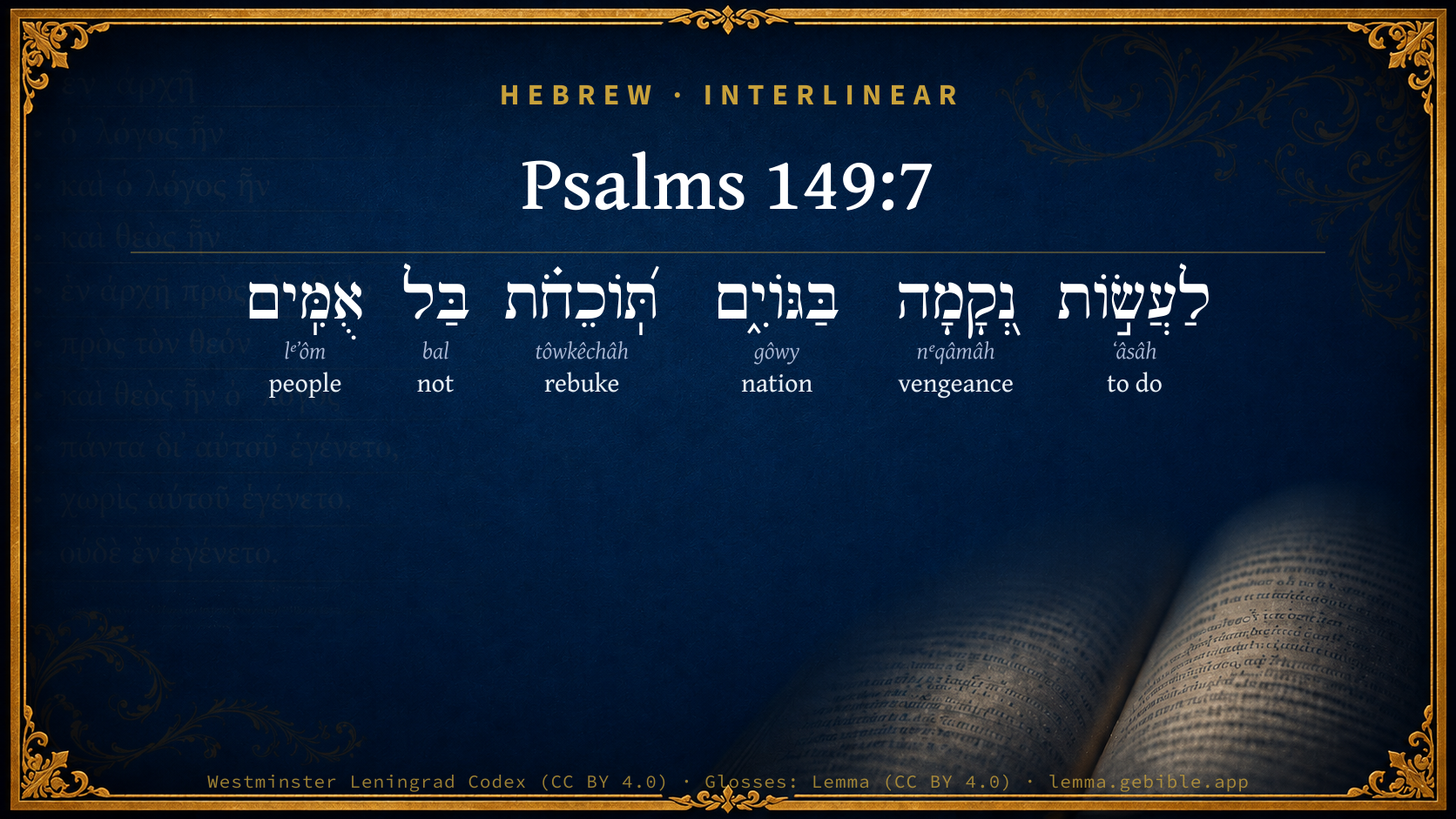
Psalms 149:7

Hebrew (Westminster Leningrad Codex) Psalms 149:7 appears in the Hebrew Old Testament. The text above is from the Westminster Leningrad Codex. Each word links to its Strong’s number, a concise gloss, and parsing drawn from the Open Scriptures Hebrew Bible morphology. Click any word for its full Brown-Driver-Briggs (BDB) entry.
Download image
Cite this verse

Psalms 149:7 (World English Bible). Public Domain. Lemma interlinear Bible study tool, https://lemma.gebible.app/v/psalms/149/7.

Show BibTeX & RIS
BibTeX
RIS
English Translation
To execute vengeance on the nations, And punishments on the peoples;
World English Bible · Public Domain
Download a study sheet

One document with this verse’s original text, its word-by-word gloss line, the meaning frame, cross-references with their text, attributed commentary, and full source and license credits — printable, and it pastes into notes with its structure intact.

This verse Autodidact and up

Study sheet (.html) Plain text (.txt)

A passage Seminary Student

Up to 50 verses in one chapter. A passage sheet keeps up to 6 commentary sources and 12 cross-references per verse, in the order this page ranks them, and says so on the sheet whenever that leaves anything out. Ask for a single verse and you get the Autodidact verse sheet above.

Everything on this page stays free to read, with no account — the sheet is a download of what is already on screen, not access to it.

Want to remove ads? Support Godless Engineer
Compare translations 3

The same verse in 3 English versions, stacked beneath the original-language interlinear above. Click any original word for its lexicon entry.

Each is an independent rendering of the whole verse — the interlinear is not word-aligned to these translations.

Highlighted words mark where these versions differ — a whole-verse word diff, not a word-by-word alignment.

  • World English Bible Public Domain
    To execute vengeance on the nations, And punishments on the peoples;
  • King James Version Public Domain
    To execute vengeance upon the heathen, and punishments upon the people;
  • unfoldingWord Literal Text CC BY-SA 4.0
    to execute vengeance on the nations, punishments on the peoples,

unfoldingWord Literal Text — © unfoldingWord, licensed CC BY-SA 4.0. Word-aligned USFM3 via Door43 (git.door43.org/unfoldingWord/en_ult).

Versions to compare (up to 4)

3 of 4 selected

Show all 17 translations

Every available English version of this verse, each an independent rendering of the whole verse.

  • World English Bible Public Domain
    To execute vengeance on the nations, And punishments on the peoples;
  • Berean Standard Bible Public Domain
    to inflict vengeance on the nations and punishment on the peoples,
  • Majority Standard Bible Public Domain
    to inflict vengeance on the nations and punishment on the peoples,
  • King James Version Public Domain
    To execute vengeance upon the heathen, and punishments upon the people;
  • American Standard Version (1901) Public Domain
    To execute vengeance upon the nations, And punishments upon the peoples;
  • Revised Version (1885) Public Domain
    To execute vengeance upon the nations, and punishments upon the peoples;
  • Geneva Bible (1599) Public Domain
    To execute vengeance vpon the heathen, and corrections among the people:
  • Young's Literal Translation Public Domain
    To do vengeance among nations, Punishments among the peoples.
  • Literal Standard Version CC BY-SA 4.0
    To do vengeance among nations, || Punishments among the peoples.
  • Unlocked Literal Bible CC BY-SA 4.0
    to execute vengeance on the nations and acts of punishment on the peoples.
  • unfoldingWord Literal Text CC BY-SA 4.0
    to execute vengeance on the nations, punishments on the peoples,
  • Darby Bible Public Domain
    To execute vengeance against the nations, [and] punishment among the peoples;
  • World Messianic Bible Public Domain
    to execute vengeance on the nations, and punishments on the peoples;
  • Webster's Bible Public Domain
    To execute vengeance upon the heathen, and punishments upon the people;
  • Free Bible Version CC BY-SA 4.0
    ready to take revenge on the nations, to punish the foreign peoples,
  • Bible in Basic English Public Domain
    To give the nations the reward of their sins, and the peoples their punishment;
  • JPS Tanakh (1917) Public Domain
    To execute vengeance upon the nations, and chastisements upon the peoples;

Literal Standard Version (2020), Covenant Press — licensed CC BY-SA 4.0. Text via the HelloAO Bible API (eBible.org). Unlocked Literal Bible (unfoldingWord) — licensed CC BY-SA 4.0. Text via the HelloAO Bible API (eBible.org). unfoldingWord Literal Text — © unfoldingWord, licensed CC BY-SA 4.0. Word-aligned USFM3 via Door43 (git.door43.org/unfoldingWord/en_ult). Free Bible Version, Dr. Jonathan Gallagher — licensed CC BY-SA 4.0. Text via the HelloAO Bible API (eBible.org).

Word by word

More ways to search: Search by grammar → Find every occurrence → Compare this word →

Practice this passage: Drill this verse → Learn its vocabulary →

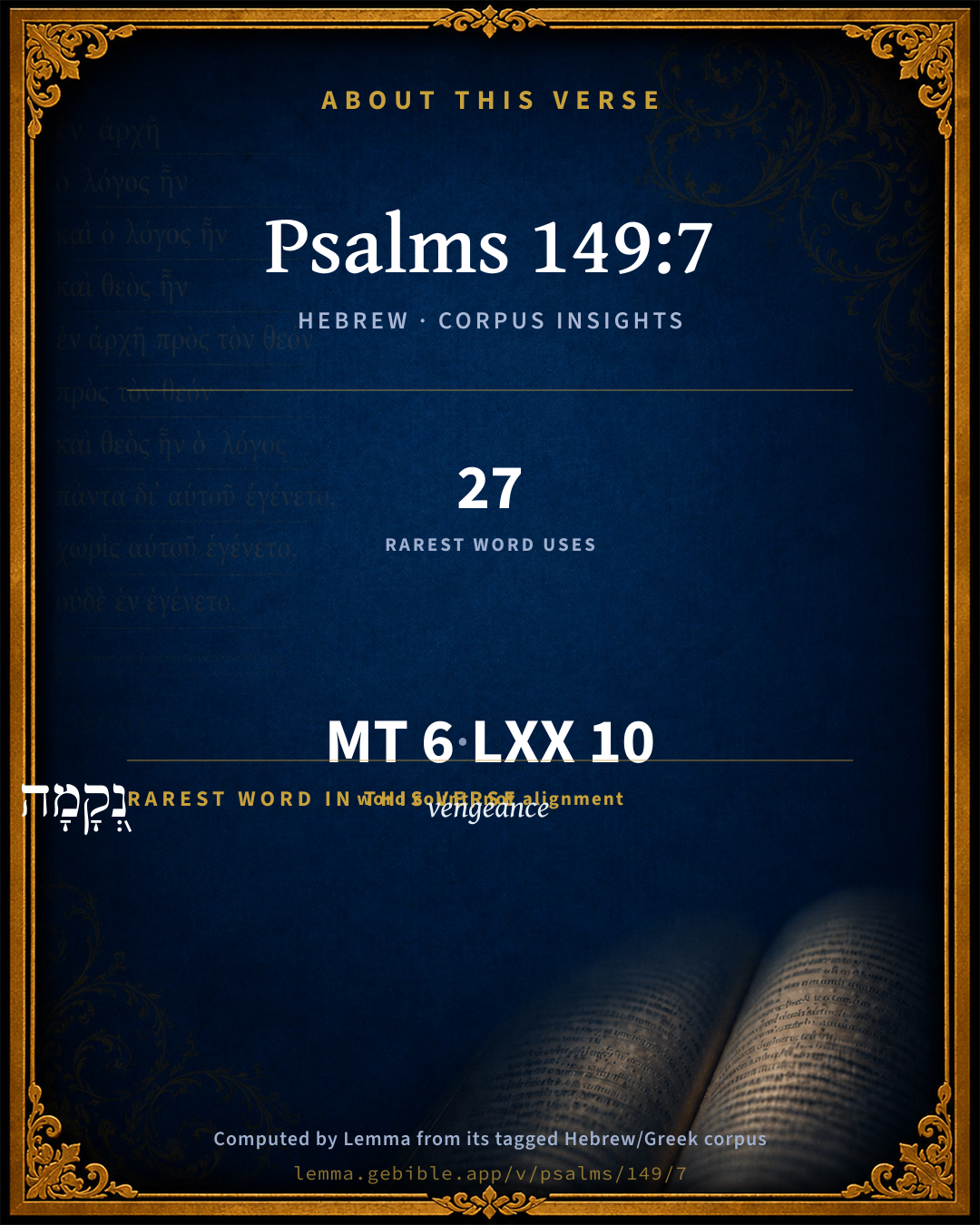
About this verse

These counts appear in no published source. They are computed here, from the morphology-tagged text and Lemma’s own curated glosses. What Lemma adds →

6
words
6
distinct lemmas
Wisdom
section

Shared distinctive vocabulary

נְ֭קָמָה vengeance H5360 occurs in 22 verses of the Hebrew Bible. Also found in:

Grammatical profile

  • 1 verb
  • 4 nouns
  • 1 particle

Verb forms

  • לַעֲשׂ֣וֹת Qal · Infinitive Construct

Hebrew & Septuagint length

In English translation the verse runs 11 words from the Hebrew and 11 from the Septuagint (LXX English) — the same length.

A rough comparison of the two English renderings, which tokenize alike — not a word-level alignment.

Word counts can differ between the Hebrew and the Greek without any difference in meaning — e.g. the Hebrew direct-object marker אֵת has no separate Greek word, and Greek often adds the article ὁ.

In the original languages it is 6 Hebrew tokens and 10 Greek tokens — but the two are counted differently (Hebrew bundles its prefixes and suffixes into one token; the Greek is in lemma form), so that isn’t a like-for-like length.

Cross-references

8

Topical passages linked to Psalms 149:7 in the Treasury of Scripture Knowledge — connected by theme and wording, ordered by reader-vote popularity; previews shown in the World English Bible.

  • 1 Samuel 15:2–3 Thus says Yahweh of Hosts, I have marked that which Amalek did to Israel, how he set himself against him in the way, when he came up out of Egypt.
  • Zechariah 14:17–19 It will be, that whoever of all the families of the earth doesn't go up to Jerusalem to worship the King, Yahweh of Hosts, on them there will be no rain.
  • Revelation 19:11–21 I saw the heaven opened, and behold, a white horse, and he who sat on it is called Faithful and True. In righteousness he judges and makes war.
  • Numbers 31:2–3 Avenge the children of Israel of the Midianites: afterward you shall be gathered to your people.
  • Judges 5:23 Curse you Meroz, said the angel of Yahweh. Curse you bitterly the inhabitants of it, Because they didn't come to the help of Yahweh, To the help of Yahweh against the mighty.
  • 1 Samuel 15:18–23 and Yahweh sent you on a journey, and said, 'Go, and utterly destroy the sinners the Amalekites, and fight against them until they are consumed.'
  • Psalms 137:8–9 Daughter of Babylon, doomed to destruction, He will be happy who rewards you, As you have served us.
  • Zechariah 9:13–16 For indeed I bend Judah as a bow for me. I have filled the bow with Ephraim; And I will stir up your sons, Zion, Against your sons, Greece, And will make you like the sword of a mighty man.

Cross-references courtesy of OpenBible.info (CC BY 4.0).

Hebrew and Greek witnesses Masoretic Hebrew ↔ Greek Septuagint

The same verse in the two great witnesses to the Old Testament, shown verse-for-verse.

You’re reading Greek Psalm 149 (Hebrew Psalm 149). The Septuagint counts the superscription, so verse numbers can differ from the Hebrew — chapter-level alignment, not verse-by-verse. Numbering follows Rahlfs.

These are two independent witnesses, not word-aligned to each other, and the Septuagint is shown in lemma (dictionary) form.

Hebrew Psalms 149:7 Masoretic · Westminster Leningrad Codex

לַעֲשׂ֣וֹת נְ֭קָמָה בַּגּוֹיִ֑ם תּֽ֝וֹכֵחֹ֗ת בַּל אֻמִּֽים

To execute vengeance on the nations, And punishments on the peoples;

World English Bible · Public Domain

Greek LXX Greek Psalm 149:7 Septuagint · lemma form

ὁ ποιέω ἐκδίκησις ἐν ὁ ἔθνος ἐλεγμός ἐν ὁ λαός

to execute vengeance on the nations, and punishments among the peoples;

LXX2012 (modern English Septuagint) · Public Domain

Hebrew: Westminster Leningrad Codex (CC BY 4.0). Greek: Septuagint (public domain); English from LXX2012 (modern English Septuagint) (Public Domain). How the Septuagint differs from the Hebrew →

Commentary

Notes on Psalms 149:7 from classic Christian and Jewish commentators (each source and its license shown beneath its notes). The classic Christian expositions comment on the surrounding passage and are grouped to its opening verse, so a note may address several verses; the Jewish commentaries on the Tanakh (Rashi and others) are per-verse, so they appear only where the commentator wrote on this verse.

Lemma curates 59 commentaries, every one of them public domain or Creative Commons licensed, each selected and text-cleaned for this edition rather than reprinted as found. About our sources →

Trapp's Complete Commentary

John Trapp

Psa 149:7 To execute vengeance upon the heathen, [and] punishments upon the people;

Ver. 7. To execute vengeance upon the heathen] viz. Upon a just calling, and not for private revenge; yea, that soldier can never answer it to God that strikes not more as a justicer than as an enemy, be his cause never so good. But that is the most noble vengeance that is executed upon men’s lusts; while they thrust the sword of the Spirit into the throats of them, and let out their life blood. That is a good sense that some give of these words, viz. that the saints, when they go forth to battle, should go with holy songs in their mouths, as well as with swords in their hands. See Jdg 7:19-20, &c.; 2Ch 20:21, &c.; the victoria Halleluiatica was got on this manner here in Britain, under the conduct of Germanus, against a mighty army of Pelagian Picts and Saxons. Ussier. de Brit. Eccles. Primord. This was the course and custom of the Angrognians in Piedmont against their Popish persecutors; and the like we read of the other French Protestants at the siege of Montaubon; that I mention not those gallant spirits at Edgehill battle with their reboated, Now for the fruit of prayer; together with the many psalms sung by that religious army in their several stations, whereof I have been an ear-witness.

John Trapp, A Commentary or Exposition upon All the Books of the Old and New Testament (1647–1656) — public domain. Text from a community e-Sword module.

J. A. Alexander on Psalms

Joseph Addison Alexander

7. (Psa 149:7) To execute vengeance among the nations, punishments among the peoples. Not their own vengeance, but that of God, to whom alone it appertains. See above, on Psa 18:47; Psa 94:1, and compare Deu 32:35, Rom 12:19, Heb 10:30. This is really nothing more than a prediction, that God would use his people as his instruments in punishing the nations by whom they had themselves been persecuted and oppressed. This was partially fulfilled in the successes of the Maccabees, but under a new and unexpected form, in the spiritual triumphs of the true religion, and its actual or prospective subjugation of the world.

Joseph Addison Alexander, The Psalms Translated and Explained (1850) — public domain. Text from a community e-Sword module.

Geneva Bible (1599)

Geneva Bible translators

This is chiefly accomplished in the kingdom of Christ when God’s people for just causes execute God’s judgments against his enemies: and it giveth no liberty to any to revenge their private injuries.

Geneva Bible (1599) marginal notes — public domain. Text via Bolls.life.

Jamieson, Fausset & Brown

Robert Jamieson, A. R. Fausset & David Brown

The destruction of the incorrigibly wicked attends the propagation of God's truth, so that the military successes of the Jews, after the captivity, typified the triumphs of the Gospel.

Jamieson, Fausset & Brown — Commentary Critical and Explanatory on the Whole Bible (1871) — public domain (CC PDM 1.0). Text via the HelloAO Bible API.

Adam Clarke's Commentary

Verse 7. To execute vengeance upon the heathen] This may refer simply to their purpose of defending themselves to the uttermost, should their enemies attack them while building their wall: and they had every reason to believe that God would be with them; and that, if their enemies did attack them, they should be able to inflict the severest punishment upon them.

Punishments upon the people] The unfaithful and treacherous Jews; for we find that some, even of their nobles, had joined with Sanballat and Tobiah; (see Ne 6:17-19:) and it appears also that many of them had formed alliances with those heathens, which were contrary to the law; see Ne 13:15-29.

Adam Clarke's Commentary on the Bible (1810–1826) — public domain. Text from a community e-Sword/MySword module.

John Calvin's Commentaries

7. To execute vengeance, etc. Both during their exile and after their return from it, this might seem to be altogether incredible. Nor did it take place before the advent of Christ; for though the Machabaei and their posterity reduced the neighboring nations to subjection, this was but a faint prelude and earnest to direct the thoughts of the Lord’s people to what was approaching. But as Haggai prophesied that the glory of the second Temple would be greater than of the first, so here there is promised a more prosperous state than had ever existed. (Haggai 2:9.) Reduced as the Jews were in numbers, and low as was the state of things among them, the Psalmist announces to all nations which opposed and troubled them, that they would have the ascendancy. As they were yet tributary, and dwelt at Jerusalem only by sufferance, they were called to exercise faith in a promise which, to the judgment of sense, might appear visionary, and to raise their thoughts to the infinite power of God, which triumphs over all worldly obstacles. The vengeance spoken of is such as the Israelites would take, not under the influence of private resentment, but by commandment of God; and this we mention that none may infer that they are allowed to take vengeance for personal injuries.

John Calvin's Commentaries (1540-1563) — public domain. Text from the Calvin Translation Society English edition (1840s-50s) via the Christian Classics Ethereal Library (ccel.org). Calvin's coverage is partial (roughly two-thirds of the Bible); uncommented books and verses are honest gaps, never fabricated. The 19th-century editor's footnotes and remarks are omitted so the notes are faithfully Calvin's own voice.

Ellicott's Commentary for English Readers

(7) Heathen . . . people.—Rather, nations . . . peoples.

A Bible Commentary for English Readers, edited by Charles John Ellicott (1878–1897) — public domain. Text from a community e-Sword module.

The Cambridge Bible for Schools and Colleges

gen. ed. J. J. S. Perowne

7. vengeance upon the nations] Cp. Isa_61:2; Isa_63:4.

punishments upon the peoples] Lit. corrections.

The Cambridge Bible for Schools and Colleges (gen. ed. J. J. S. Perowne; Cambridge University Press, 1878–1918) — public domain. Text from a community e-Sword module.

John Gill's Exposition

To execute vengeance upon the Heathen,.... Either upon the Gentile world, in the first times of the Gospel; when the apostles, going there with the twoedged sword of the word, vehemently inveighed against the idolatry of the Heathens, and exhorted them to turn from their idols to serve the living God; and divine power going along with their ministry, multitudes were turned from them; through the success of the Gospel, the oracles of the Heathen were struck dumb, their priests were despised, their idol temples were forsaken, and idols rejected; now were the judgment of the Heathen world, and the prince of it, cast out, and vengeance in this way taken upon it, or their disobedience to God revenged, Joh 12:31. Or else upon the Papists, as will be in the latter times of the Gospel; who are sometimes called Heathens and Gentiles, Psa 10:16; on whom vengeance will be taken for all their idolatry, superstition, and bloodshed of the saints; and they will be smitten and slain by the twoedged sword, proceeding out of the mouth of Christ, and as in the hands of his servants, Rev 19:15;

and punishments upon the people; or "reproofs" (p); sharp and piercing ones; such as the convictions the word of God will strike in the minds of men, and will be very distressing and afflicting to them; as the fire out of the mouths of the witnesses, which is their doctrine, will be to their enemies the Papists; and will torment and kill them, and be the savour of death unto death unto them, Rev 11:5.

(p) "increpationes", V. L. Pagninus, Montanus, Junius & Tremellius, Piscator; "redargutiones", Cocceius, Michaelis; so Ainsworth.

John Gill's Exposition of the Whole Bible (1746–1763) — public domain (CC PDM 1.0). Text via the HelloAO Bible API.

Albert Barnes' Notes on the Bible

To execute vengeance upon the heathen - To inflict punishment upon them as a recompence for their sins. The word pagan here means nations. The allusion is, doubtless, to those who had oppressed and injured the Hebrew people - perhaps referring to those who had destroyed the city and the temple at the time of the Babylonian captivity. They were now to receive the punishment due for the wrongs which they had done to the nation; a just recompence at the hand of God, and by the instrumentality of those whom they had wronged. Compare the notes at Psa 137:7-9.

And punishments upon the people - The people of those lands. Those who had waged war with the Hebrew nation.

Albert Barnes' Notes on the Bible (1834–1885) — public domain. Text from a community e-Sword/MySword module.

Matthew Poole's English Annotations

For all their cruelties and injuries towards God’s people. This was literally accomplished by David upon the Philistines, Ammonites, Syrians, and other neighbouring nations and princes, which were bitter enemies to God’s people. And the same thing was done afterward in the Christian world, when God raised up Christian princes, who did by the help of the Christians, fighting with and under them, severely revenge the blood of the martyred Christians upon their cruel persecutors and tyrants in divers ages. It may also be understood of the spiritual plagues which Christ by the hand or ministry of his apostles and ministers did inflict upon the hearts and consciences of his incorrigible enemies, who by God’s word and ordinances were either tormented or hardened to their destruction. Yea, it may have a respect unto the last day of judgment, in which the saints shall judge the world, 1Co 6:2, which will be a most dreadful execution of this vengeance, &c.

Matthew Poole's English Annotations on the Holy Bible (1683–1685) — public domain. Text from a community e-Sword/MySword module.

The Treasury of David

Charles H. Spurgeon

Ver. 7. To execute vengeance upon the heathen, and punishments upon the people. This was once literally the duty of Israel: when they came into Canaan they fulfilled the righteous sentence of the Lord upon guilty nations. At this hour, under the gentler dispensation of grace, we wrestle not with flesh and blood; yet is our warfare none the less stern, and our victory none the less sure. All evil shall eventually be overthrown: the Lord shall display his justice against evildoers, and in that warfare his servants shall play their parts. The saints shall judge the world. Both the conflict and the victory at the end of it shall cause glory to God, and honour to his holy ones.

Psalms 149:8*

Charles H. Spurgeon's The Treasury of David (1869–1885) — public domain. Psalms only. Text from a community e-Sword/MySword module.

Whedon's Commentary on the Bible

Daniel D. Whedon

7. Vengeance—The word simply means retributive justice, in rendering back to men according to their deeds.

Daniel D. Whedon (gen. ed.), Commentary on the Old and New Testaments (1874–1909) — public domain. Text from a community e-Sword module.

The Pulpit Commentary

To execute vengeance upon the heathen. Not private revenge, but the just vengeance which a threatened nation has, from time to time, to execute on its persecutors in self-defense. And punishments upon the people; rather, upon the peoples. A variant of the phrase in the preceding clause, without any serious modification of the meaning.

The Pulpit Commentary (1880–1919), ed. H.D.M. Spence-Jones & Joseph S. Exell — public domain. Text from a community e-Sword module.

John Wesley's Explanatory Notes

Vengeance - For all their cruelties and injuries towards God's people. This was literally accomplished by David upon the Philistines, Ammonites, Syrians and other neighbouring nations.

John Wesley, Explanatory Notes Upon the Whole Bible (1754–1765) — public domain. Text via the GEBible commentary corpus.

Lesson kit

Teaching starters — assembled from the data on this page, not authored interpretation. Every prompt links to the verse data it draws on. Edit before teaching.

Psalms, in the Wisdom, opens this verse with 6 words (6 distinct Hebrew lemmas). Its most distinctive word is nᵉqâmâh (“vengeance”). A historical commentator’s framing appears above. Read the whole chapter for the surrounding context.

Discussion questions

  1. What does “vengeance” (nᵉqâmâh) contribute to the verse as a whole?
  2. How does Numbers 31:2, which shares the word «vengeance», read alongside this verse?
  3. These translations render this verse differently; the difference is in the English rendering, not the original. What questions does that raise?
  4. «לַעֲשׂ֣וֹת» is a Qal Infinitive Construct verb. How does that grammatical form shape the action described?
  5. Compare how Trapp's Complete Commentary and J. A. Alexander on Psalms read this verse. Where do they agree or differ?

Things to notice

Reading settings

Reading text

Shown beneath each verse's original-language words.

Old Testament
Old Testament edition

Read the OT as the Masoretic Hebrew (MT) or the Greek Septuagint (LXX).

English shown for the Greek Septuagint (in the Hebrew ↔ Greek comparison).

Comparing translations? Open the Compare panel on any verse page to stack up to four side by side.