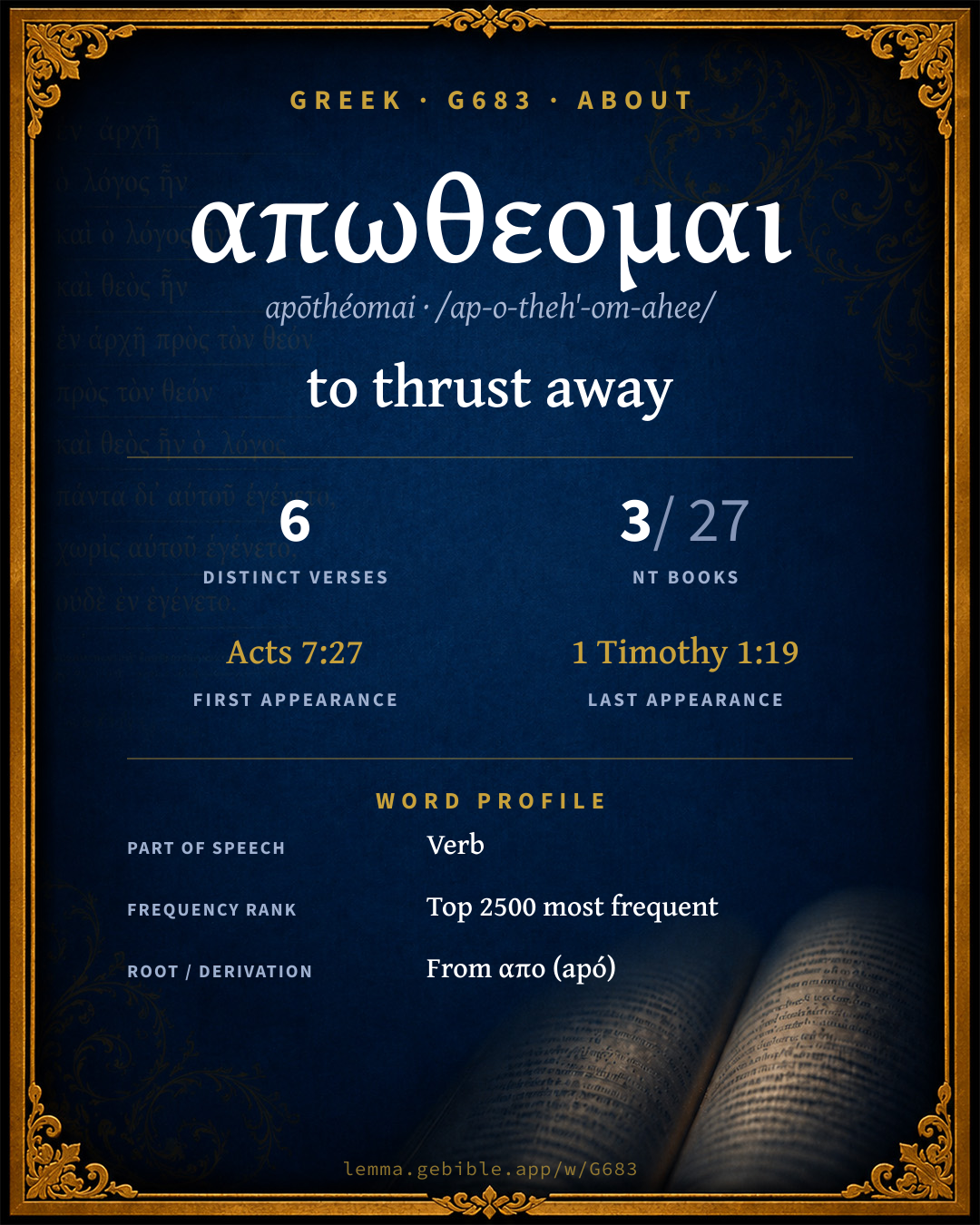
απωθεομαι
to thrust away
also: push away, repel fuller range ↓
Full lexicon entry — Thayer's Greek Lexicon
From Thayer's Greek Lexicon
Where this word appears
See every Aorist-tense verb in the Greek New Testament →
Grammar key — what these labels mean
Part of speech
- Verb
- An action or state-of-being word.
Tense
- Aorist
- Action viewed as a simple whole, without regard to duration — often past (perfective aspect).
- Present
- Ongoing or general action in present time (imperfective aspect).
Voice
- Middle deponent
- Middle in form but active in meaning.
- Middle or Passive deponent
- Middle/passive in form but active in meaning.
Mood
- Indicative
- States a fact or asks a factual question (the mood of reality).
- Participle
- A verbal adjective (“writing,” “having written”).
Case
- Nominative
- The case of the subject (and the predicate nominative).
Person
- 3rd person
- The one spoken about (“he / she / it / they”).
- 2nd person
- The one addressed (“you”).
Gender
- Masculine
- Grammatically masculine.
Number
- Singular
- One.
- Plural
- More than one.
1 verse where G683 appears in the Present tense in the Book of Acts. Filtered view — show all forms. Click any verse to open its interlinear word-by-word view. Verse text shown in the World English Bible for context — . Each verse’s Greek form is shown with its reference; the English is not keyword-highlighted, since the data carries no word-level English alignment. Use “Compare translations” on any verse to read it across multiple English versions. This concordance covers the Greek New Testament; Septuagint (Greek Old Testament) occurrences of this word are not indexed here.
Acts
About this entry
At a glance — auto-summarized from this page’s data, not written by a person. Every figure links to its source below. This summary describes the numbers; it doesn’t interpret them.
απωθεομαι (apōthéomai) is a Greek verb most often rendered “to thrust away.” Acts dominates its distribution — 3 of 6 verses. The Greek New Testament uses it across 6 verses — uncommon. It first appears in Acts 7:27. Ranging over 2 senses, its meaning includes “push away” and “repel”. The sections below give every sense, occurrence, and version rendering.
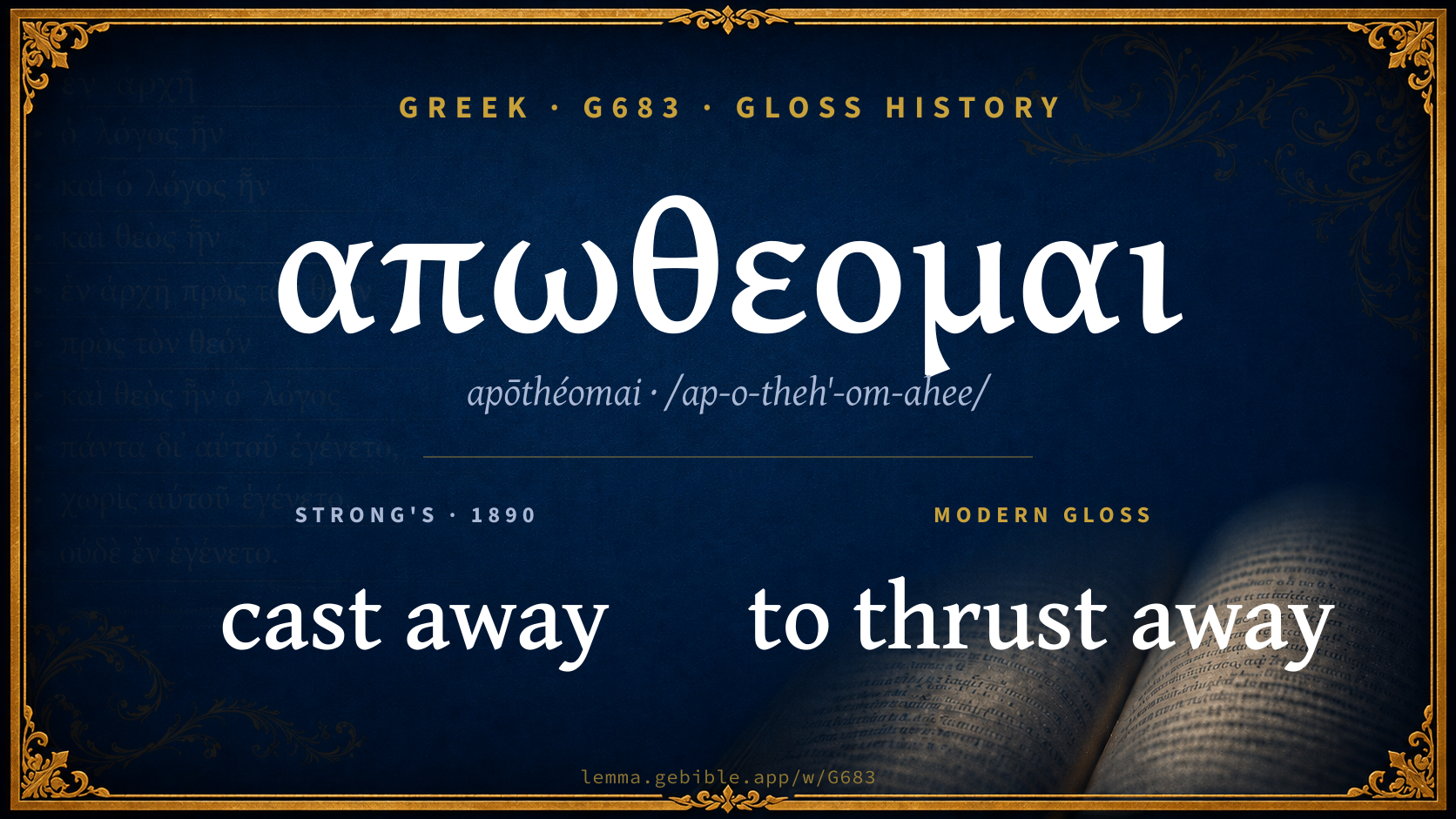
Gloss history
Strong's 1890 vs modern scholarship
About this word
Strong's G683 catalogs a Greek word from the Greek New Testament.
These counts are not copied from any lexicon or concordance. They are computed here, from the morphology-tagged Greek New Testament. What Lemma adds →
- 6
- distinct verses
- The word appears in 6 distinct verses.
- 3 / 27
- NT books
- The word appears in 3 of 27 New Testament books.
- #1,476
- by frequency
- Top 2500 most frequent Greek words (rank 1,476 of 5,347 Greek words by occurrence).
View all 6 occurrences in the concordance →
By section of the New Testament
By traditional corpus
Conventional, traditional groupings — biblical authorship is debated, so this is a traditional corpus grouping, not an authorship claim. Some books belong to more than one corpus (Luke is in both the Gospels and the Lukan corpus, and so on), so these shares overlap and need not total 100%. Each figure is a share of the word’s 6 distinct verses.
- Lukan (Luke–Acts) 3 verses · 50%
- Pauline corpus 3 verses · 50%
How translations render this word
Counts come from each version’s own published word-to-Strong’s tagging or interlinear alignment — an approximate guide to how each version renders this word, not a word-level alignment the data otherwise carries. Because each total is that version’s own tagged count, the per-version totals vary from one another and need not match the appearance or distinct-verse counts above. These counts may also differ from a printed concordance because Lemma counts each distinctly tagged rendering and does not collapse phrase taggings into a single head-word total. This is a fixed set of word-tagged versions (KJV, ASV, BSB, ULT) and does not change with the reading translation you choose elsewhere. Each version’s license is shown beside its name below (and on Sources).
- King James Version: Cast away 2×, Hath 2×
- American Standard Version: Cast off 2×, Did 2×, Thrust 2×
- Berean Standard Bible: Did not reject 1×, Have rejected 1×, Pushed aside 1×
- unfoldingWord Literal Text: Did 2×, Reject 2×
King James Version Public Domain
Renders G683 across 10 tagged occurrences — most commonly:
Plus 6 renderings that appear only once — usually multi-word phrases or single function words the recovered tagging swept in, not distinct renderings.
American Standard Version Public Domain
Renders G683 across 11 tagged occurrences — most commonly:
Plus 5 renderings that appear only once — usually multi-word phrases or single function words the recovered tagging swept in, not distinct renderings.
Berean Standard Bible Public Domain
Renders G683 across 6 tagged occurrences — most commonly:
unfoldingWord Literal Text CC BY-SA 4.0
Renders G683 across 9 tagged occurrences — most commonly:
Plus 5 renderings that appear only once — usually multi-word phrases or single function words the recovered tagging swept in, not distinct renderings.
Senses in Thayer's
The 2 senses Thayer's distinguishes for this word, in lexicon order (not ranked by frequency or importance). The full entry — with sub-senses — is in the Lexicon Entry tab.
- to thrust away, push away, repel
- to thrust away from one's self, to drive away from one's self
Word origin
Derived from απο (apó) (G575) — from.
From G575 and the middle voice of ὠθέω ō theō or ὤθω ō thō (to shove ); to push off figuratively to reject : - cast away put away (from) thrust way (from).
— Strong’s Exhaustive Concordance (1890), public domain.
Forms in the corpus
The 4 distinct written forms G683 takes in the Greek New Testament, most frequent first — each parse links to that tense’s occurrences in the concordance.
| Form | Parsing | Example | Uses |
|---|---|---|---|
| ἀπώσατο apṓsato | Verb, Aorist, Middle deponent, Indicative, 3rd person, Singular | Acts 7:27 | 3 |
| ἀπωθεῖσθε apōtheîsthe | Verb, Present, Middle or Passive deponent, Indicative, 2nd person, Plural | Acts 13:46 | 1 |
| ἀπωσάμενοι apōsámenoi | Verb, Aorist, Middle deponent, Participle, Nominative, Plural, Masculine | 1 Timothy 1:19 | 1 |
| ἀπώσαντο apṓsanto | Verb, Aorist, Middle deponent, Indicative, 3rd person, Plural | Acts 7:39 | 1 |
Same root — word family
Other Thayer's entries built from the same root as G683, grouped by Strong’s listed origin. These share a root / origin per the lexicon — not necessarily a shared meaning. Each links to that word’s own entry.
Derives from
Shares the same root
- απαγγελλω apangéllō G518 to report
- απαγχομαι apánchomai G519 to strangle
- απαγω apágō G520 to lead away
- απαιρω apaírō G522 to take away
- απαιτεω apaitéō G523 to demand back
- απαλγεω apalgéō G524 to cease grieving
- απαλλασσω apallássō G525 to depart
- απαλλοτριοω apallotrióō G526 to estrange
- απανταω apantáō G528 to meet
- απαρνεομαι aparnéomai G533 to deny
- απαρτι apárti G534 henceforth
- απαρχη aparchḗ G536 to offer firstfruits
- απαυγασμα apaúgasma G541 brightness
- απειδω apeídō G542 to look away
- απειμι ápeimi G548 to depart
- απειμι ápeimi G549 to depart
- απειπομην apeipómēn G550 to declare
- απεκδεχομαι apekdéchomai G553 waiting for
- απεκδυομαι apekdýomai G554 to despoil
- απελαυνω apelaúnō G556 to drive away
- απελεγμος apelegmós G557 censure
- απελευθερος apeleútheros G558 freedman
- απελπιζω apelpízō G560 not despairing
- απεναντι apénanti G561 opposite
+85 more words share this root (not shown).
Compare all same-root words → Showing 4 of 111 — not the complete family. They share a root, not necessarily a meaning.
Septuagint usage
The same Greek word απωθεομαι appears 64 times in the Greek Old Testament (Septuagint), across 61 verses in 14 books.
- 64
- LXX occurrences
- Tagged occurrences of this Greek word in the Septuagint.
- 61
- verses
- Distinct Septuagint verses containing this word.
- 14 / 39
- OT books
- The word appears in 14 of the 39 Old Testament books.
Sample Septuagint occurrences
- 1 Samuel 12:22 ἀποὠθέω
- 2 Kings 4:27 ἀποὠθέω
- 2 Chronicles 35:19 ἀποὠθέω
- Job 18:18 ἀποὠθέω
- Psalms 42:2 ἀποὠθέω
- Proverbs 1:8 ἀποὠθέω
- Jeremiah 2:37 ἀποὠθέω
- Lamentations 2:7 ἀποὠθέω
- Ezekiel 5:6 ἀποὠθέω
- Hosea 4:6 ἀποὠθέω
- Amos 2:4 ἀποὠθέω
- Jonah 2:5 ἀποὠθέω
Septuagint occurrences (same lexeme)
Every verse where the same Strong’s number (G683) appears in the Greek Septuagint — showing the first 50 of 61. Verse text shown in the World English Bible for context; the Greek form is the matched word — the English is not keyword-highlighted.
- 1 Samuel 12:22 ἀποὠθέω For Yahweh will not forsake his people for his great name's sake, because it has pleased Yahweh to make you a people to himself.
- 2 Kings 4:27 ἀποὠθέω When she came to the man of God to the hill, she caught hold of his feet. Gehazi came near to thrust her away; but the man of God said, Let her alone: for her soul is vexed within her; and Yahweh has hid it from me, and has not told me.
- 2 Kings 17:20 ἀποὠθέω Yahweh rejected all the seed of Israel, and afflicted them, and delivered them into the hand of spoilers, until he had cast them out of his sight.
- 2 Kings 21:14 ἀποὠθέω I will cast off the remnant of my inheritance, and deliver them into the hand of their enemies; and they shall become a prey and a spoil to all their enemies;
- 2 Kings 23:27 ἀποὠθέω Yahweh said, I will remove Judah also out of my sight, as I have removed Israel, and I will cast off this city which I have chosen, even Jerusalem, and the house of which I said, My name shall be there.
- 2 Chronicles 35:19 ἀποὠθέω In the eighteenth year of the reign of Josiah was this Passover kept.
- Job 18:18 ἀποὠθέω He shall be driven from light into darkness, And chased out of the world.
- Job 34:33 ἀποὠθέω Shall his recompense be as you desire, that you refuse it? For you must choose, and not I. Therefore speak what you know.
- Psalms 42:2 ἀποὠθέω My soul thirsts for God, for the living God. When shall I come and appear before God?
- Psalms 43:10 ἀποὠθέω
- Psalms 43:24 ἀποὠθέω
- Psalms 59:3 ἀποὠθέω For, behold, they lie in wait for my soul. The mighty gather themselves together against me, Not for my disobedience, nor for my sin, Yahweh.
- Psalms 59:12 ἀποὠθέω For the sin of their mouth, and the words of their lips, Let them be caught in their pride, For the curses and lies which they utter.
- Psalms 61:5 ἀποὠθέω For you, God, have heard my vows. You have given me the heritage of those who fear your name.
- Psalms 73:1 ἀποὠθέω Surely God is good to Israel, To those who are pure in heart.
- Psalms 76:8 ἀποὠθέω You pronounced judgment from heaven. The earth feared, and was silent,
- Psalms 77:60 ἀποὠθέω
- Psalms 77:67 ἀποὠθέω
- Psalms 87:6 ἀποὠθέω Yahweh will count, when he writes up the peoples, "This one was born there." Selah.
- Psalms 87:15 ἀποὠθέω
- Psalms 88:39 ἀποὠθέω
- Psalms 93:14 ἀποὠθέω
- Psalms 107:12 ἀποὠθέω Therefore he brought down their heart with labor. They fell down, and there was none to help.
- Psalms 118:10 ἀποὠθέω All the nations surrounded me, But in the name of Yahweh, I cut them off.
- Proverbs 1:8 ἀποὠθέω My son, listen to your father's instruction, And don't forsake your mother's teaching:
- Proverbs 4:24 ἀποὠθέω Put away from yourself a perverse mouth. Put corrupt lips far from you.
- Proverbs 6:20 ἀποὠθέω My son, keep your father's commandment, And don't forsake your mother's teaching.
- Proverbs 14:32 ἀποὠθέω The wicked is brought down in his calamity, But in death, the righteous has a refuge.
- Proverbs 15:32 ἀποὠθέω He who refuses correction despises his own soul, But he who listens to reproof gets understanding.
- Proverbs 19:26 ἀποὠθέω He who robs his father and drives away his mother, Is a son who causes shame and brings reproach.
- Jeremiah 2:37 ἀποὠθέω From there also shall you go forth, with your hands on your head: for Yahweh has rejected those in whom you trust, and you shall not prosper with them.
- Jeremiah 4:30 ἀποὠθέω You, when you are made desolate, what will you do? Though you clothe yourself with scarlet, though you deck you with ornaments of gold, though you enlarge your eyes with paint, in vain do you make yourself beautiful; [your] lovers despise you, they seek your life.
- Jeremiah 6:19 ἀποὠθέω Hear, earth: behold, I will bring evil on this people, even the fruit of their thoughts, because they have not listened to my words; and as for my law, they have rejected it.
- Jeremiah 7:29 ἀποὠθέω Cut off your hair, [Jerusalem], and cast it away, and take up a lamentation on the bare heights; for Yahweh has rejected and forsaken the generation of his wrath.
- Jeremiah 23:17 ἀποὠθέω They say continually to those who despise me, Yahweh has said, You shall have peace; and to everyone who walks in the stubbornness of his own heart they say, No evil shall come on you.
- Lamentations 2:7 ἀποὠθέω The Lord has cast off his altar, he has abhorred his sanctuary; He has given up into the hand of the enemy the walls of her palaces: They have made a noise in the house of Yahweh, as in the day of a solemn assembly.
- Lamentations 3:17 ἀποὠθέω You have removed my soul far off from peace; I forgot prosperity.
- Lamentations 3:31 ἀποὠθέω For the Lord will not cast off forever.
- Lamentations 3:45 ἀποὠθέω You have made us an off-scouring and refuse in the midst of the peoples.
- Lamentations 3:54 ἀποὠθέω Waters flowed over my head; I said, I am cut off.
- Lamentations 5:22 ἀποὠθέω But you have utterly rejected us; You are very angry against us.
- Ezekiel 5:6 ἀποὠθέω She has rebelled against my ordinances in doing wickedness more than the nations, and against my statutes more than the countries that are round about her; for they have rejected my ordinances, and as for my statutes, they have not walked in them.
- Ezekiel 5:11 ἀποὠθέω Therefore, as I live, says the Lord Yahweh, surely, because you have defiled my sanctuary with all your detestable things, and with all your abominations, therefore will I also diminish [you]; neither shall my eye spare, and I also will have no pity.
- Ezekiel 11:16 ἀποὠθέω Therefore say, Thus says the Lord Yahweh: Whereas I have removed them far off among the nations, and whereas I have scattered them among the countries, yet will I be to them a sanctuary for a little while in the countries where they are come.
- Ezekiel 16:45 ἀποὠθέω You are the daughter of your mother, who loathes her husband and her children; and you are the sister of your sisters, who loathed their husbands and their children: your mother was a Hittite, and your father an Amorite.
- Ezekiel 19:5 ἀποὠθέω Now when she saw that she had waited, and her hope was lost, then she took another of her cubs, and made him a young lion.
- Ezekiel 20:13 ἀποὠθέω But the house of Israel rebelled against me in the wilderness: they didn't walk in my statutes, and they rejected my ordinances, which if a man keep, he shall live in them; and my Sabbaths they greatly profaned. Then I said I would pour out my wrath on them in the wilderness, to consume them.
- Ezekiel 20:16 ἀποὠθέω because they rejected my ordinances, and didn't walk in my statutes, and profaned my Sabbaths: for their heart went after their idols.
- Ezekiel 20:24 ἀποὠθέω because they had not executed my ordinances, but had rejected my statutes, and had profaned my Sabbaths, and their eyes were after their fathers' idols.
- Ezekiel 21:15 ἀποὠθέω I have set the threatening sword against all their gates, that their heart may melt, and their stumblings be multiplied: ah! it is made as lightning, it is pointed for slaughter.
These are occurrences of the same Greek lexeme (G683) in the Septuagint — not a translation of any one Hebrew word. The store carries no word-level Hebrew↔Greek alignment, so no Hebrew original is asserted here. Counts come from the recovered LXX Strong's tagging — high-frequency vocabulary is well covered, while rare or late forms may be untagged — so they reflect tagged occurrences and may slightly undercount.