
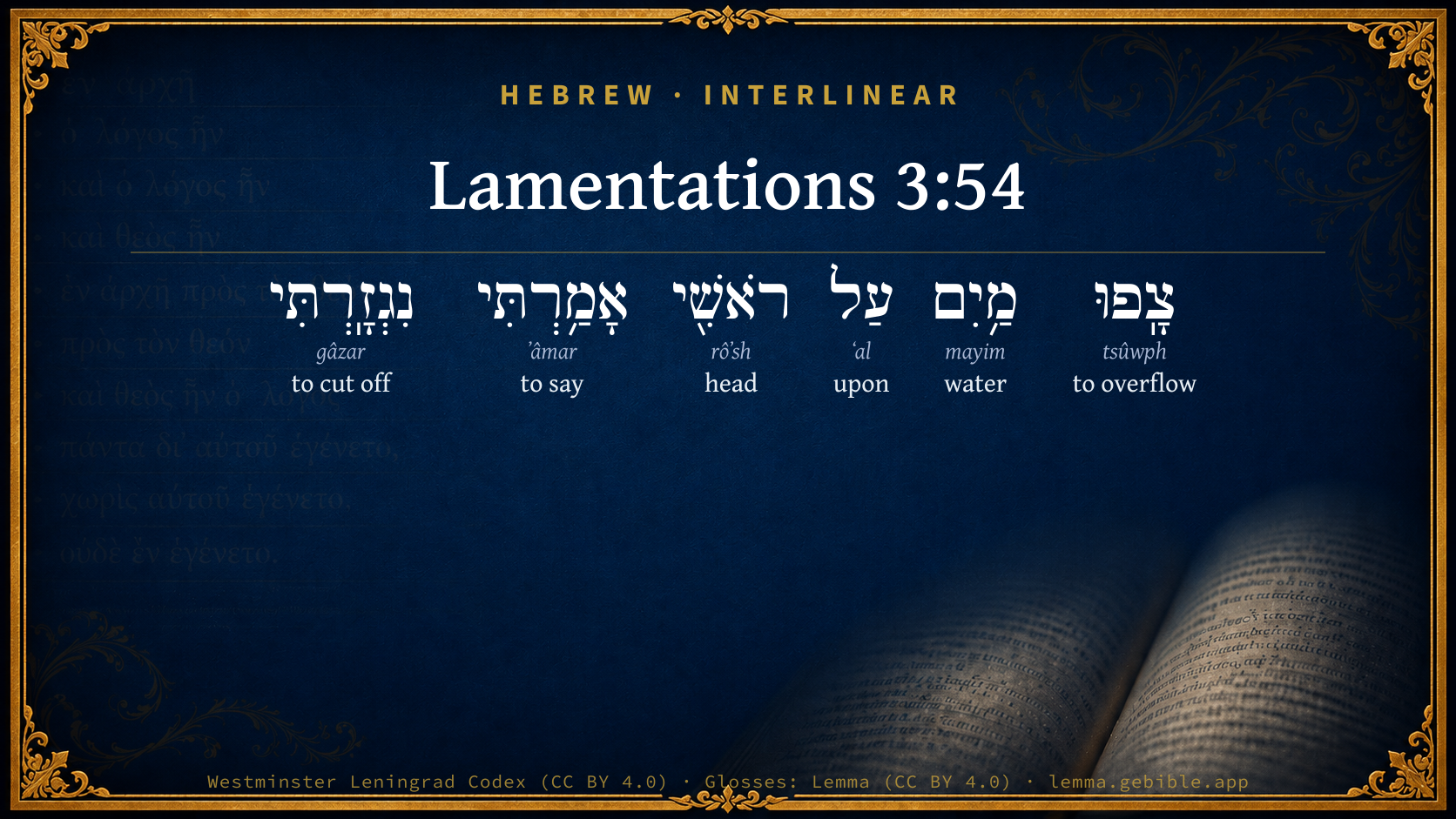
Lamentations 3:54

Hebrew (Westminster Leningrad Codex) Lamentations 3:54 appears in the Hebrew Old Testament. The text above is from the Westminster Leningrad Codex. Each word links to its Strong’s number, a concise gloss, and parsing drawn from the Open Scriptures Hebrew Bible morphology. Click any word for its full Brown-Driver-Briggs (BDB) entry.
Download image
Cite this verse

Lamentations 3:54 (World English Bible). Public Domain. Lemma interlinear Bible study tool, https://lemma.gebible.app/v/lamentations/3/54.

Show BibTeX & RIS
BibTeX
RIS
English Translation
Waters flowed over my head; I said, I am cut off.
World English Bible · Public Domain
Download a study sheet

One document with this verse’s original text, its word-by-word gloss line, the meaning frame, cross-references with their text, attributed commentary, and full source and license credits — printable, and it pastes into notes with its structure intact.

This verse Autodidact and up

Study sheet (.html) Plain text (.txt)

A passage Seminary Student

Up to 50 verses in one chapter. A passage sheet keeps up to 6 commentary sources and 12 cross-references per verse, in the order this page ranks them, and says so on the sheet whenever that leaves anything out. Ask for a single verse and you get the Autodidact verse sheet above.

Everything on this page stays free to read, with no account — the sheet is a download of what is already on screen, not access to it.

Want to remove ads? Support Godless Engineer
Compare translations 3

The same verse in 3 English versions, stacked beneath the original-language interlinear above. Click any original word for its lexicon entry.

Each is an independent rendering of the whole verse — the interlinear is not word-aligned to these translations.

Highlighted words mark where these versions differ — a whole-verse word diff, not a word-by-word alignment.

  • World English Bible Public Domain
    Waters flowed over my head; I said, I am cut off.
  • King James Version Public Domain
    Waters flowed over mine head; then I said, I am cut off.
  • unfoldingWord Literal Text CC BY-SA 4.0
    Waters flowed over my head; I said, “I am cut off.” QOPH

unfoldingWord Literal Text — © unfoldingWord, licensed CC BY-SA 4.0. Word-aligned USFM3 via Door43 (git.door43.org/unfoldingWord/en_ult).

Versions to compare (up to 4)

3 of 4 selected

Show all 18 translations

Every available English version of this verse, each an independent rendering of the whole verse.

  • World English Bible Public Domain
    Waters flowed over my head; I said, I am cut off.
  • Berean Standard Bible Public Domain
    The waters flowed over my head, and I thought I was going to die.
  • Majority Standard Bible Public Domain
    The waters flowed over my head, and I thought I was going to die.
  • King James Version Public Domain
    Waters flowed over mine head; then I said, I am cut off.
  • American Standard Version (1901) Public Domain
    Waters flowed over my head; I said, I am cut off.
  • Revised Version (1885) Public Domain
    Waters flowed over mine head; I said, I am cut off.
  • Geneva Bible (1599) Public Domain
    Waters flowed ouer mine head, then thought I, I am destroyed.
  • Douay-Rheims (1899) Public Domain
    Sade. Waters have flowed over my head: I said: I am cut off.
  • Young's Literal Translation Public Domain
    Flowed have waters over my head, I have said, I have been cut off.
  • Literal Standard Version CC BY-SA 4.0
    Waters have flowed over my head, I have said, I have been cut off.
  • Unlocked Literal Bible CC BY-SA 4.0
    and they caused waters to overflow, covering my head. I said, 'I have been cut off!'
  • unfoldingWord Literal Text CC BY-SA 4.0
    Waters flowed over my head; I said, “I am cut off.” QOPH
  • Darby Bible Public Domain
    Waters streamed over my head; I said, I am cut off.
  • World Messianic Bible Public Domain
    Waters flowed over my head. I said, “I am cut off.”
  • Webster's Bible Public Domain
    Waters flowed over my head; then I said, I am cut off.
  • Free Bible Version CC BY-SA 4.0
    Water flooded over my head, and I thought I was going to die.
  • Bible in Basic English Public Domain
    Waters were flowing over my head; I said, I am cut off.
  • JPS Tanakh (1917) Public Domain
    Waters flowed over my head; I said: 'I am cut off.'

Literal Standard Version (2020), Covenant Press — licensed CC BY-SA 4.0. Text via the HelloAO Bible API (eBible.org). Unlocked Literal Bible (unfoldingWord) — licensed CC BY-SA 4.0. Text via the HelloAO Bible API (eBible.org). unfoldingWord Literal Text — © unfoldingWord, licensed CC BY-SA 4.0. Word-aligned USFM3 via Door43 (git.door43.org/unfoldingWord/en_ult). Free Bible Version, Dr. Jonathan Gallagher — licensed CC BY-SA 4.0. Text via the HelloAO Bible API (eBible.org).

Word by word

More ways to search: Search by grammar → Find every occurrence → Compare this word →

Practice this passage: Drill this verse → Learn its vocabulary →

About this verse

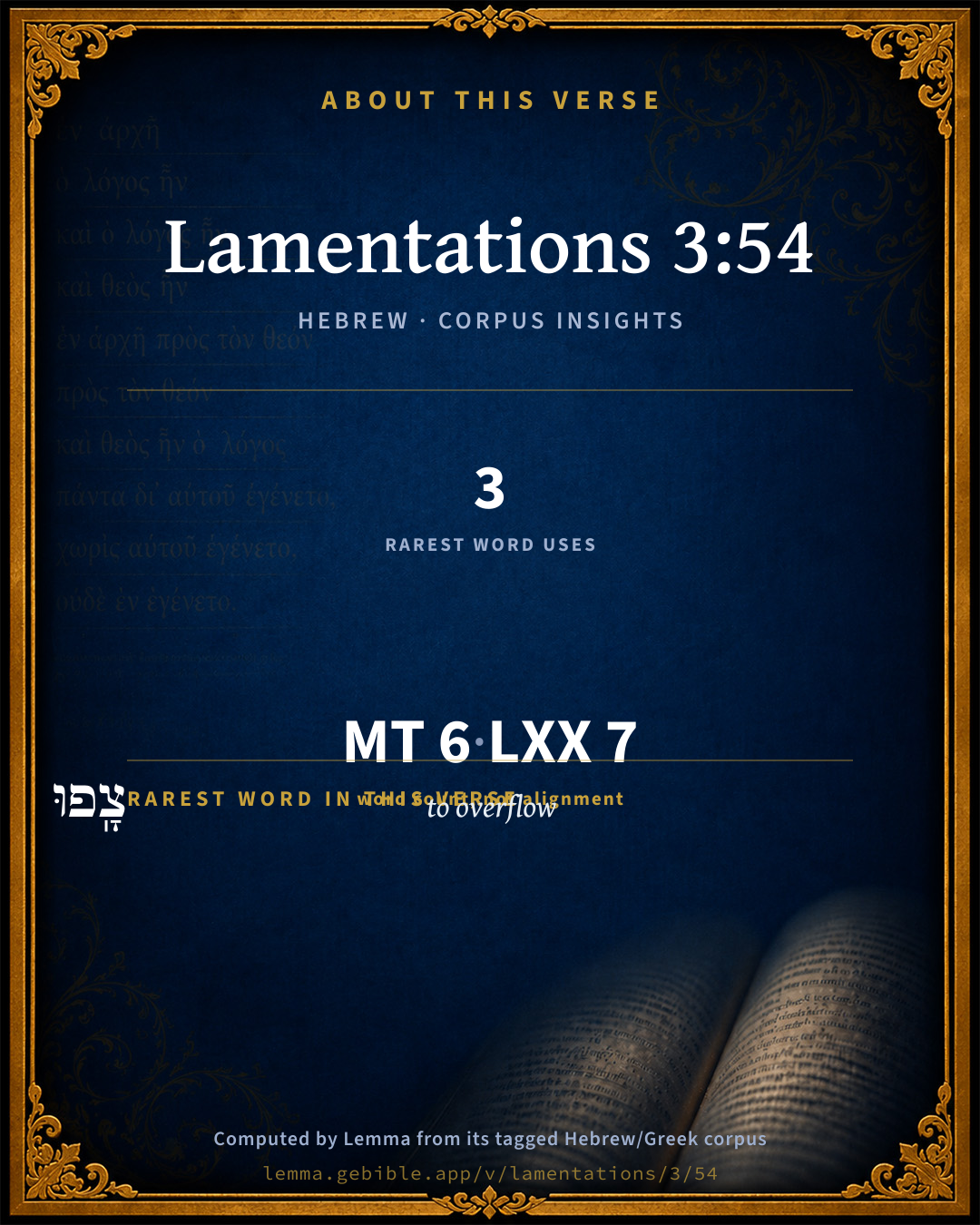
These counts appear in no published source. They are computed here, from the morphology-tagged text and Lemma’s own curated glosses. What Lemma adds →

6
words
6
distinct lemmas
Prophets
section

Notable vocabulary

The rarest word here is צָֽפוּ to overflow H6687 — appearing just 3 times in the whole Hebrew Bible.

Shared distinctive vocabulary

צָֽפוּ to overflow H6687 occurs in 3 verses of the Hebrew Bible. Also found in:

Grammatical profile

  • 3 verbs
  • 2 nouns
  • 1 preposition

Verb forms

  • צָֽפוּ Qal · Perfect
  • אָמַ֥רְתִּי Qal · Perfect
  • נִגְזָֽרְתִּי Niphal · Perfect

Hebrew & Septuagint length

In English translation the verse runs 11 words from the Hebrew and 11 from the Septuagint (LXX English) — the same length.

A rough comparison of the two English renderings, which tokenize alike — not a word-level alignment.

Word counts can differ between the Hebrew and the Greek without any difference in meaning — e.g. the Hebrew direct-object marker אֵת has no separate Greek word, and Greek often adds the article ὁ.

In the original languages it is 6 Hebrew tokens and 7 Greek tokens — but the two are counted differently (Hebrew bundles its prefixes and suffixes into one token; the Greek is in lemma form), so that isn’t a like-for-like length.

Cross-references

11

Topical passages linked to Lamentations 3:54 in the Treasury of Scripture Knowledge — connected by theme and wording, ordered by reader-vote popularity; previews shown in the World English Bible.

  • Jonah 2:3–5 For you threw me into the depths, In the heart of the seas. The flood was all around me. All your waves and your billows passed over me.
  • Ezekiel 37:11 Then he said to me, Son of man, these bones are the whole house of Israel: behold, they say, Our bones are dried up, and our hope is lost; we are clean cut off.
  • Psalms 18:4 The cords of death surrounded me. The floods of ungodliness made me afraid.
  • Lamentations 3:18 I said, My strength is perished, and my expectation from Yahweh.
  • 2 Corinthians 1:8–10 For we don't desire to have you uninformed, brothers, concerning our affliction which happened to us in Asia, that we were weighed down exceedingly, beyond our power, so much that we despaired even of life.
  • Job 17:11–16 My days are past, my plans are broken off, As are the thoughts of my heart.
  • Psalms 31:22 As for me, I said in my haste, "I am cut off from before your eyes." Nevertheless you heard the voice of my petitions when I cried to you.
  • Psalms 69:1–2 Save me, God, For the waters have come up to my neck!
  • Psalms 69:15 Don't let the flood waters overwhelm me, Neither let the deep swallow me up. Don't let the pit shut its mouth on me.
  • Psalms 124:4–5 Then the waters would have overwhelmed us, The stream would have gone over our soul;
  • Isaiah 38:10–13 I said, In the noontide of my days I shall go into the gates of Sheol: I am deprived of the residue of my years.

Cross-references courtesy of OpenBible.info (CC BY 4.0).

Hebrew and Greek witnesses Masoretic Hebrew ↔ Greek Septuagint

The same verse in the two great witnesses to the Old Testament, shown verse-for-verse.

These are two independent witnesses, not word-aligned to each other, and the Septuagint is shown in lemma (dictionary) form.

Hebrew Lamentations 3:54 Masoretic · Westminster Leningrad Codex

צָֽפוּ מַ֥יִם עַל רֹאשִׁ֖י אָמַ֥רְתִּי נִגְזָֽרְתִּי

Waters flowed over my head; I said, I am cut off.

World English Bible · Public Domain

Greek LXX Lamentations 3:54 Septuagint · lemma form

ὑπερχέω ὕδωρ ἐπί κεφαλή ἐγώ εἶπον ἀποὠθέω

Water flowed over my head: I said, I am cut off.

LXX2012 (modern English Septuagint) · Public Domain

Hebrew: Westminster Leningrad Codex (CC BY 4.0). Greek: Septuagint (public domain); English from LXX2012 (modern English Septuagint) (Public Domain). How the Septuagint differs from the Hebrew →

Commentary

Notes on Lamentations 3:54 from classic Christian and Jewish commentators (each source and its license shown beneath its notes). The classic Christian expositions comment on the surrounding passage and are grouped to its opening verse, so a note may address several verses; the Jewish commentaries on the Tanakh (Rashi and others) are per-verse, so they appear only where the commentator wrote on this verse.

Lemma curates 59 commentaries, every one of them public domain or Creative Commons licensed, each selected and text-cleaned for this edition rather than reprinted as found. About our sources →

Trapp's Complete Commentary

John Trapp

Lam 3:54 Waters flowed over mine head; [then] I said, I am cut off.

Ver. 54. Waters flowed over mine head.] Many and great miseries have overwhelmed and oppressed me, both in body and soul. These are frequently compared to waters.

Then I said, I am cut off,] sc., From the land of the living; but God was better to me than my hopes.

John Trapp, A Commentary or Exposition upon All the Books of the Old and New Testament (1647–1656) — public domain. Text from a community e-Sword module.

Jamieson, Fausset & Brown

Robert Jamieson, A. R. Fausset & David Brown

Waters--not literally, for there was "no water" (Jer 38:6) in the place of Jeremiah's confinement, but emblematical of overwhelming calamities (Psa 69:2; Psa 124:4-5).

cut off-- (Isa 38:10-11). I am abandoned by God. He speaks according to carnal sense.

Jamieson, Fausset & Brown — Commentary Critical and Explanatory on the Whole Bible (1871) — public domain (CC PDM 1.0). Text via the HelloAO Bible API.

John Calvin's Commentaries

He now adds a third comparison, — that he had been overwhelmed, as it were, with a flood of evils. This similitude occurs often in Scripture, especially in the Psalms; for when David wished to set forth his despair, lie said that he was sunk in deep waters. (Psalm 69:15, 16.) So also in this place the Prophet complains, that waters had flowed over his head, so that he thought himself lost. Though, indeed, this was the saying of a man in a hopeless state, it is yet evident from the context that the Prophet was firm in the hope of God’s mercy. But he speaks according to the judgment of the flesh; and we know that the faithful are as it were divided; for as they have not put off the flesh, they must necessarily be acquainted with adversities, be stormed by fear and feel anxieties; in short, when death hangs over them, they must in a manner be exposed to fear. In the meantime, faith in their hearts obtains the victory, so that they do not succumb under terrors, or cares, or anxieties.

When, therefore, the Prophet says that in his own judgment he was lost, he does not mean that his faith was so extinguished that he ceased to pray to God; for in the next verse he shews that he persevered in prayer. How, then, did he say or believe that he was lost? even, as I have already said, according to human judgment. And we often see that the faithful complain that they are forsaken, that God is asleep in heaven, that he has turned away from them. All these things are to be referred to the perception of the flesh. While, then, the faithful cast their eyes on dangers, when death comes, they not only tremble, but fear greatly and faint also. In the meantime, as I have said, they struggle by faith against all these temptations. So, then, is this passage to be understood, — that the Prophet believed that he was lost, that is, as far as he could judge by the aspect of things at that time, for no hope appeared then to the Church. But we yet see that the Prophet did not indulge himself in this despair; for he immediately adds, —

John Calvin's Commentaries (1540-1563) — public domain. Text from the Calvin Translation Society English edition (1840s-50s) via the Christian Classics Ethereal Library (ccel.org). Calvin's coverage is partial (roughly two-thirds of the Bible); uncommented books and verses are honest gaps, never fabricated. The 19th-century editor's footnotes and remarks are omitted so the notes are faithfully Calvin's own voice.

The Cambridge Bible for Schools and Colleges

gen. ed. J. J. S. Perowne

54. Waters flowed over mine head] figuratively. So in Psa_42:7; Psa_69:2, which latter Ps. was traditionally ascribed to Jeremiah.

I am cut off] Cp. Psa_31:22; Psa_88:5; 2Ch_26:21; Isa_53:8.

The Cambridge Bible for Schools and Colleges (gen. ed. J. J. S. Perowne; Cambridge University Press, 1878–1918) — public domain. Text from a community e-Sword module.

John Gill's Exposition

O Lord, thou hast seen my wrong,.... Or, "my perverseness" (w); not that he or they had been guilty of; but the wrong that was done to him and them by their enemies; how perverse and ill natured they had been to them; how badly they had used them; what injuries they had done them; none of which escaped the omniscience of God, to which the appeal is made; and upon this follows a petition:

judge thou my cause; the present one; as thou hast pleaded and judged many already, do me justice, right my wrongs, an, save me from mine enemies; and let it appear to all the world my cause is just, and they are in the wrong.

(w) "perversitatem", Pagninus, Montanus; "quae exercetur, vel exercebatur in me", Junius & Tremellius, Piscator.

John Gill's Exposition of the Whole Bible (1746–1763) — public domain (CC PDM 1.0). Text via the HelloAO Bible API.

Albert Barnes' Notes on the Bible

Waters flowed over mine head - A figurative expression for great mental trouble.

Albert Barnes' Notes on the Bible (1834–1885) — public domain. Text from a community e-Sword/MySword module.

Matthew Poole's English Annotations

Afflictions often in Scripture are called waters, Isa 28:17,18; 59:19.

I am cut off; that is, I am utterly undone, there is no hope for me.

Matthew Poole's English Annotations on the Holy Bible (1683–1685) — public domain. Text from a community e-Sword/MySword module.

Whedon's Commentary on the Bible

Daniel D. Whedon

54. Waters flowed — Figurative language, but such as would be very naturally suggested from the circumstance of using underground cisterns for dungeons. Jeremiah’s troubles overwhelmed him, and his case was as hopeless as though “waters” had literally “flowed over” his head. This verse is, in thought, similar to that used by Jonah in chap. Lam_2:5.

Daniel D. Whedon (gen. ed.), Commentary on the Old and New Testaments (1874–1909) — public domain. Text from a community e-Sword module.

The Pulpit Commentary

I am cut off. Some words have to be supplied, and Psa_31:22 suggests which these are: am cut off from before thine eyes," i.e. from the region on which the eyes of God rest.

The Pulpit Commentary (1880–1919), ed. H.D.M. Spence-Jones & Joseph S. Exell — public domain. Text from a community e-Sword module.

John Wesley's Explanatory Notes

Cut off - I am undone, there is no hope for me.

John Wesley, Explanatory Notes Upon the Whole Bible (1754–1765) — public domain. Text via the GEBible commentary corpus.

Rashi

Rabbi Shlomo Yitzchaki (Rashi)

Water flowed, etc. When a person enters water up to his waist, he still has hope, but if the water flows over his head, he then says, “My hope is gone,” but I do not do this, for “I called, etc.”

Water flowed the heathens.

Rashi on the Tanakh — English translations: “The Judaica Press complete Tanach with Rashi, translated by A. J. Rosenberg” (CC BY 4.0); “Pentateuch with Rashi's commentary by M. Rosenbaum and A.M. Silbermann, 1929-1934” (public domain); “The Metsudah Tanach series, Lakewood, N.J” (CC BY 4.0); and “The Book of Joshua, Metsudah Publications, 1997” (CC BY 4.0). Text via Sefaria.

Lesson kit

Teaching starters — assembled from the data on this page, not authored interpretation. Every prompt links to the verse data it draws on. Edit before teaching.

Lamentations, in the Prophets, opens this verse with 6 words (6 distinct Hebrew lemmas). Its most distinctive word is tsûwph (“to overflow”). A historical commentator’s framing appears above. Read the whole chapter for the surrounding context.

Discussion questions

  1. What does “to overflow” (tsûwph) contribute to the verse as a whole?
  2. How does Deuteronomy 11:4, which shares the word «to overflow», read alongside this verse?
  3. These translations render this verse differently; the difference is in the English rendering, not the original. What questions does that raise?
  4. «צָֽפוּ» is a Qal Perfect verb. How does that grammatical form shape the action described?
  5. Compare how Trapp's Complete Commentary and Jamieson, Fausset & Brown read this verse. Where do they agree or differ?

Things to notice

Reading settings

Reading text

Shown beneath each verse's original-language words.

Old Testament
Old Testament edition

Read the OT as the Masoretic Hebrew (MT) or the Greek Septuagint (LXX).

English shown for the Greek Septuagint (in the Hebrew ↔ Greek comparison).

Comparing translations? Open the Compare panel on any verse page to stack up to four side by side.