1 Samuel 12:22

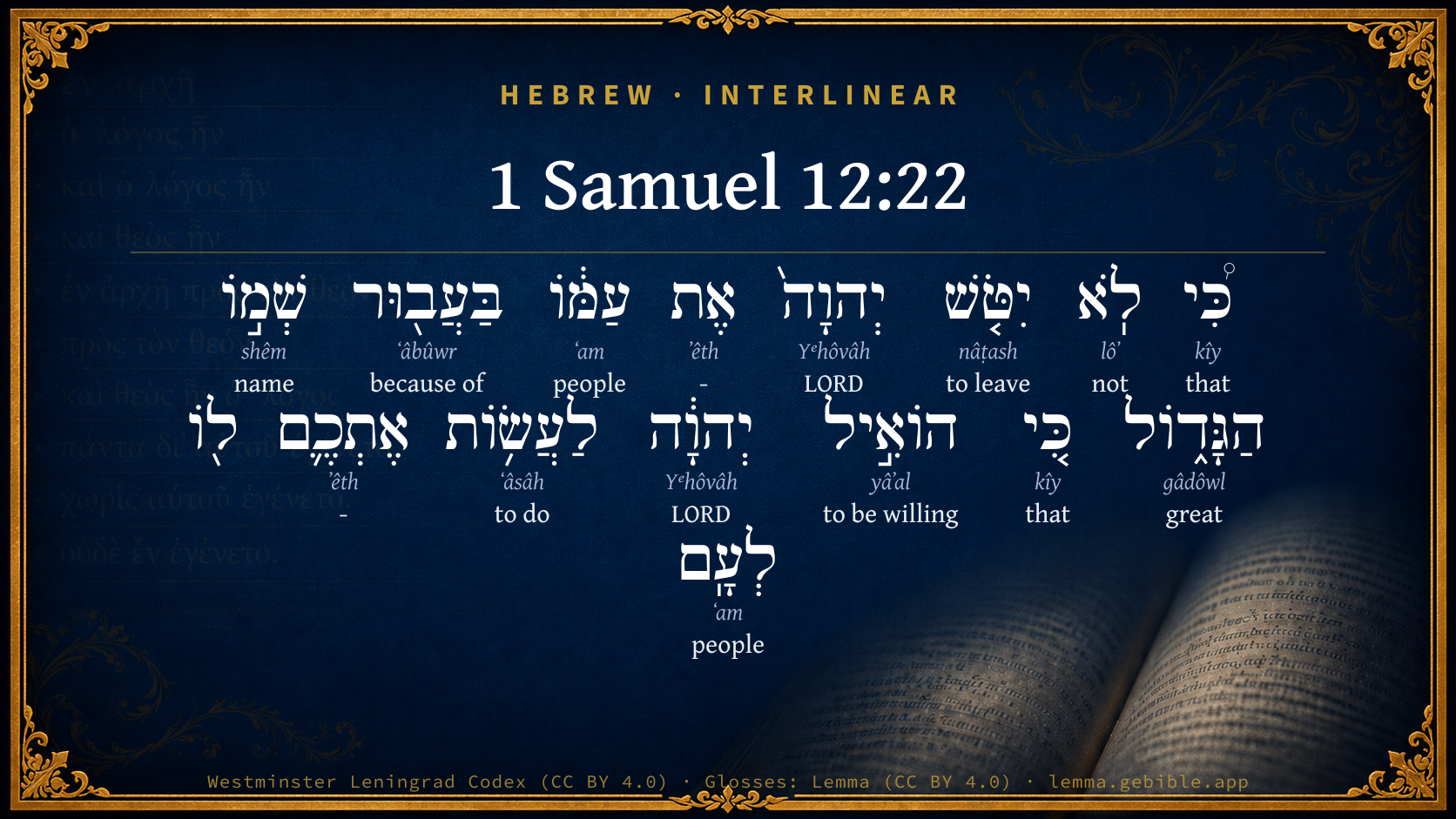
Hebrew (Westminster Leningrad Codex) 1 Samuel 12:22 appears in the Hebrew Old Testament. The text above is from the Westminster Leningrad Codex. Each word links to its Strong’s number, a concise gloss, and parsing drawn from the Open Scriptures Hebrew Bible morphology. Click any word for its full Brown-Driver-Briggs (BDB) entry.
Download image
Cite this verse

1 Samuel 12:22 (World English Bible). Public Domain. Lemma interlinear Bible study tool, https://lemma.gebible.app/v/1-samuel/12/22.

Show BibTeX & RIS
BibTeX
RIS
English Translation
For Yahweh will not forsake his people for his great name's sake, because it has pleased Yahweh to make you a people to himself.
World English Bible · Public Domain
Download a study sheet

One document with this verse’s original text, its word-by-word gloss line, the meaning frame, cross-references with their text, attributed commentary, and full source and license credits — printable, and it pastes into notes with its structure intact.

This verse Autodidact and up

Study sheet (.html) Plain text (.txt)

A passage Seminary Student

Up to 50 verses in one chapter. A passage sheet keeps up to 6 commentary sources and 12 cross-references per verse, in the order this page ranks them, and says so on the sheet whenever that leaves anything out. Ask for a single verse and you get the Autodidact verse sheet above.

Everything on this page stays free to read, with no account — the sheet is a download of what is already on screen, not access to it.

Want to remove ads? Support Godless Engineer
Compare translations 3

The same verse in 3 English versions, stacked beneath the original-language interlinear above. Click any original word for its lexicon entry.

Each is an independent rendering of the whole verse — the interlinear is not word-aligned to these translations.

Highlighted words mark where these versions differ — a whole-verse word diff, not a word-by-word alignment.

  • World English Bible Public Domain
    For Yahweh will not forsake his people for his great name's sake, because it has pleased Yahweh to make you a people to himself.
  • King James Version Public Domain
    For the LORD will not forsake his people for his great name's sake: because it hath pleased the LORD to make you his people.
  • unfoldingWord Literal Text CC BY-SA 4.0
    For Yahweh will not forsake his people, because of his great name. For Yahweh was pleased to make you into a people for himself.

unfoldingWord Literal Text — © unfoldingWord, licensed CC BY-SA 4.0. Word-aligned USFM3 via Door43 (git.door43.org/unfoldingWord/en_ult).

Versions to compare (up to 4)

3 of 4 selected

Show all 18 translations

Every available English version of this verse, each an independent rendering of the whole verse.

  • World English Bible Public Domain
    For Yahweh will not forsake his people for his great name's sake, because it has pleased Yahweh to make you a people to himself.
  • Berean Standard Bible Public Domain
    Indeed, for the sake of His great name, the LORD will not abandon His people, because He was pleased to make you His own.
  • Majority Standard Bible Public Domain
    Indeed, for the sake of His great name, the LORD will not abandon His people, because He was pleased to make you His own.
  • King James Version Public Domain
    For the LORD will not forsake his people for his great name's sake: because it hath pleased the LORD to make you his people.
  • American Standard Version (1901) Public Domain
    For Jehovah will not forsake his people for his great name's sake, because it hath pleased Jehovah to make you a people unto himself.
  • Revised Version (1885) Public Domain
    For the LORD will not forsake his people for his great name’s sake: because it hath pleased the LORD to make you a people unto himself.
  • Geneva Bible (1599) Public Domain
    For the Lord will not forsake his people for his great Names sake: because it hath pleased the Lord to make you his people.
  • Douay-Rheims (1899) Public Domain
    And the Lord will not forsake his people for his great name's sake: because the Lord hath sworn to make you his people.
  • Young's Literal Translation Public Domain
    for Jehovah doth not leave His people, on account of His great name; for Jehovah hath been pleased to make you to Him for a people.
  • Literal Standard Version CC BY-SA 4.0
    for YHWH does not leave His people, on account of His great Name; for YHWH has been pleased to make you for a people to Him.
  • Unlocked Literal Bible CC BY-SA 4.0
    For the sake of his great name, Yahweh will not reject his people, because it has pleased Yahweh to make you a people for himself.
  • unfoldingWord Literal Text CC BY-SA 4.0
    For Yahweh will not forsake his people, because of his great name. For Yahweh was pleased to make you into a people for himself.
  • Darby Bible Public Domain
    For Jehovah will not cast away his people for his great name's sake; because it has pleased Jehovah to make you his people.
  • World Messianic Bible Public Domain
    For the LORD will not forsake his people for his great name’s sake, because it has pleased the LORD to make you a people for himself.
  • Webster's Bible Public Domain
    For the LORD will not forsake his people for his great name's sake: because it hath pleased the LORD to make you his people.
  • Free Bible Version CC BY-SA 4.0
    The fact is because of the kind of person the Lord is, he won't give up on his people, because he was happy to claim you as his own.
  • Bible in Basic English Public Domain
    For the Lord will not give his people up, because of the honour of his name; for it was the Lord's pleasure to make of you a people for himself.
  • JPS Tanakh (1917) Public Domain
    For the LORD will not forsake His people for His great name's sake; because it hath pleased the LORD to make you a people unto Himself.

Literal Standard Version (2020), Covenant Press — licensed CC BY-SA 4.0. Text via the HelloAO Bible API (eBible.org). Unlocked Literal Bible (unfoldingWord) — licensed CC BY-SA 4.0. Text via the HelloAO Bible API (eBible.org). unfoldingWord Literal Text — © unfoldingWord, licensed CC BY-SA 4.0. Word-aligned USFM3 via Door43 (git.door43.org/unfoldingWord/en_ult). Free Bible Version, Dr. Jonathan Gallagher — licensed CC BY-SA 4.0. Text via the HelloAO Bible API (eBible.org).

Word by word

More ways to search: Search by grammar → Find every occurrence → Compare this word →

Practice this passage: Drill this verse → Learn its vocabulary →

הוֹאִ֣יל
yâʼal
H2974
“to be willing”
Verb, Hiphil, Perfect, 3rd Person, Masculine, Singular
Part of Speech
Verb
Stem
Hiphil
Form
Perfect
Person
3rd Person
Gender
Masculine
Number
Singular
Full BDB Definition

Origin: a primitive root [probably rather the same as H2973 through the idea of mental weakness]

TWOT: 831

to begin, make a beginning, show willingness, undertake to do, be pleased, be determined - (Hiphil) - to agree to, show willingness, acquiesce, accept an invitation, be willing - to undertake - to resolve, be pleased, be determined
  1. כִּ֠י kîy H3588 “that” Conjunction
  2. לֹֽא lôʼ H3808 “not” Particle, Negative
  3. יִטֹּ֤שׁ nâṭash H5203 “to leave” Verb, Qal, Imperfect, 3rd Person, Masculine, Singular
  4. יְהוָה֙ Yᵉhôvâh H3068 “LORD” Noun, Proper
  5. אֶת ʼêth H853 “-” Particle, Direct Object
  6. עַמּ֔וֹ ʻam H5971 “people · his” Noun, Common, Masculine, Singular, Construct + Suffix, Personal, 3rd Person, Masculine, Singular
  7. בַּעֲב֖וּר ʻâbûwr H5668 “in/at · because of of” Preposition + Noun, Common, Masculine, Singular, Construct
  8. שְׁמ֣וֹ shêm H8034 “name · his” Noun, Common, Masculine, Singular, Construct + Suffix, Personal, 3rd Person, Masculine, Singular
  9. הַגָּד֑וֹל gâdôwl H1419 “the · great” Particle, Definite Article + Adjective, Adjective, Masculine, Singular, Absolute
  10. כִּ֚י kîy H3588 “that” Conjunction
  11. יְהוָ֔ה Yᵉhôvâh H3068 “LORD” Noun, Proper
  12. לַעֲשׂ֥וֹת ʻâsâh H6213 “to do” Preposition + Verb, Qal, Infinitive Construct
  13. אֶתְכֶ֛ם ʼêth H853 “- · you” Particle, Direct Object + Suffix, Personal, 2nd Person, Masculine, Plural
  14. לְעָֽם ʻam H5971 “to/for · people” Preposition + Noun, Common, Masculine, Singular, Absolute

About this verse

These counts appear in no published source. They are computed here, from the morphology-tagged text and Lemma’s own curated glosses. What Lemma adds →

16
words
11
distinct lemmas
Historical
section

Notable vocabulary

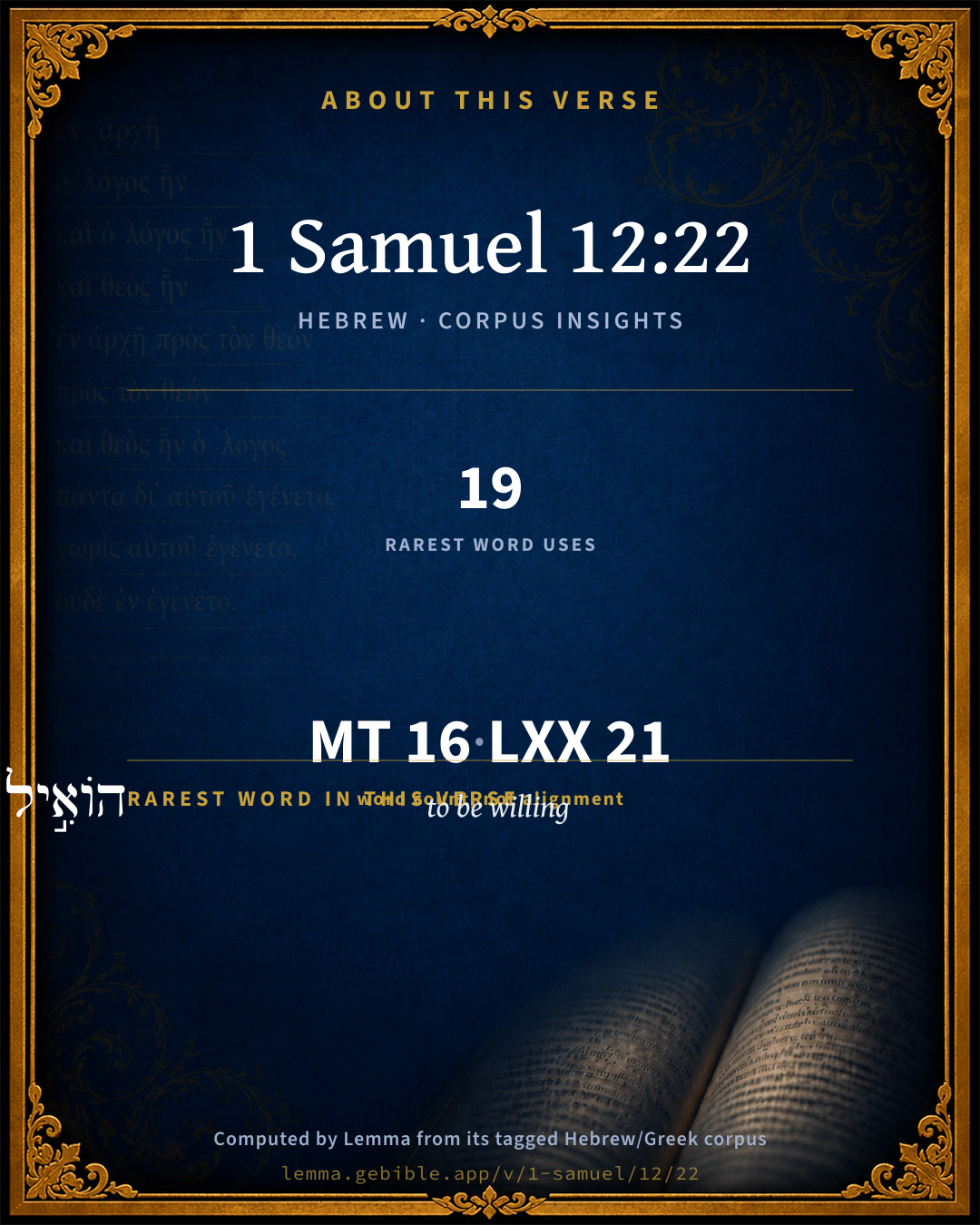
The rarest word here is הוֹאִ֣יל to be willing H2974 — appearing just 19 times in the whole Hebrew Bible.

Shared distinctive vocabulary

הוֹאִ֣יל to be willing H2974 occurs in 19 verses of the Hebrew Bible. Also found in:

Grammatical profile

  • 3 verbs
  • 6 nouns
  • 1 adjective
  • 1 preposition
  • 2 conjunctions
  • 3 particles

Verb forms

  • יִטֹּ֤שׁ Qal · Imperfect
  • הוֹאִ֣יל Hiphil · Perfect
  • לַעֲשׂ֥וֹת Qal · Infinitive Construct

Repetition

Words recur within this verse — often emphatic in Hebrew:

  • יְהוָה֙ LORD H3068 ×2
  • עַמּ֔וֹ people H5971 ×2
  • כִּ֠י that H3588 ×2

Hebrew & Septuagint length

In English translation the verse runs 24 words from the Hebrew and 25 from the Septuagint (LXX English) — closely comparable.

A rough comparison of the two English renderings, which tokenize alike — not a word-level alignment.

Word counts can differ between the Hebrew and the Greek without any difference in meaning — e.g. the Hebrew direct-object marker אֵת has no separate Greek word, and Greek often adds the article ὁ.

In the original languages it is 16 Hebrew tokens and 21 Greek tokens — but the two are counted differently (Hebrew bundles its prefixes and suffixes into one token; the Greek is in lemma form), so that isn’t a like-for-like length.

Cross-references

38

Topical passages linked to 1 Samuel 12:22 in the Treasury of Scripture Knowledge — connected by theme and wording, ordered by reader-vote popularity; previews shown in the World English Bible.

  • Deuteronomy 14:2 For you are a holy people to Yahweh your God, and Yahweh has chosen you to be a people for his own possession, above all peoples who are on the face of the earth.
  • Deuteronomy 7:7–8 Yahweh didn't set his love on you, nor choose you, because you were more in number than any people; for you were the fewest of all peoples:
  • Psalms 106:8 Nevertheless he saved them for his name's sake, That he might make his mighty power known.
  • Philippians 1:6 being confident of this very thing, that he who began a good work in you will complete it until the day of Jesus Christ.
  • 1 Kings 6:13 I will dwell among the children of Israel, and will not forsake my people Israel.
  • Jeremiah 14:21 Do not abhor [us], for your name's sake; do not disgrace the throne of your glory: remember, don't break your covenant with us.
  • Romans 11:29 For the gifts and the calling of God are irrevocable.
  • Joshua 7:9 For the Canaanites and all the inhabitants of the land will hear of it, and will compass us round, and cut off our name from the earth: and what will you do for your great name?
  • Psalms 94:14 For Yahweh won't reject his people, Neither will he forsake his inheritance.
  • Isaiah 43:25 I, even I, am he who blots out your transgressions for my own sake; and I will not remember your sins.
  • Lamentations 3:31–32 For the Lord will not cast off forever.
  • Ezekiel 20:9 But I worked for my name's sake, that it should not be profaned in the sight of the nations, among which they were, in whose sight I made myself known to them, in bringing them forth out of the land of Egypt.
  • Ezekiel 20:14 But I worked for my name's sake, that it should not be profaned in the sight of the nations, in whose sight I brought them out.
  • Ephesians 1:12 to the end that we should be to the praise of his glory, we who had before hoped in Christ:
  • Matthew 11:26 Yes, Father, for so it was well-pleasing in your sight.
  • 1 Peter 2:9 But you are a chosen race, a royal priesthood, a holy nation, a people for God's own possession, that you may show forth the excellencies of him who called you out of darkness into his marvelous light:
  • Exodus 32:12 Why should the Egyptians speak, saying, 'He brought them forth for evil, to kill them in the mountains, and to consume them from the surface of the earth?' Turn from your fierce wrath, and repent of this evil against your people.
  • 2 Chronicles 15:2 and he went out to meet Asa, and said to him, Hear you me, Asa, and all Judah and Benjamin: Yahweh is with you, while you are with him; and if you seek him, he will be found of you; but if you forsake him, he will forsake you.
  • Jeremiah 33:24–26 Don't you consider what this people has spoken, saying, The two families which Yahweh did choose, he has cast them off? thus do they despise my people, that they should be no more a nation before them.
  • 1 Corinthians 4:7 For who makes you different? And what do you have that you didn't receive? But if you did receive it, why do you boast as if you had not received it?
  • Exodus 19:5–6 Now therefore, if you will indeed obey my voice, and keep my covenant, then you shall be my own possession from among all peoples; for all the earth is mine;
  • Numbers 14:13–19 Moses said to Yahweh, Then the Egyptians will hear it; for you brought up this people in your might from among them;
  • Deuteronomy 9:5 Not for your righteousness, or for the uprightness of your heart, do you go in to possess their land; but for the wickedness of these nations Yahweh your God does drive them out from before you, and that he may establish the word which Yahweh swore to your fathers, to Abraham, to Isaac, and to Jacob.
  • Deuteronomy 31:17 Then my anger shall be kindled against them in that day, and I will forsake them, and I will hide my face from them, and they shall be devoured, and many evils and troubles shall come on them; so that they will say in that day, Haven't these evils come on us because our God is not among us?
  • Deuteronomy 32:26–27 I said, I would scatter them afar, I would make the memory of them to cease from among men;
  • 2 Kings 21:14 I will cast off the remnant of my inheritance, and deliver them into the hand of their enemies; and they shall become a prey and a spoil to all their enemies;
  • 1 Chronicles 28:9 You, Solomon my son, know the God of your father, and serve him with a perfect heart and with a willing mind; for Yahweh searches all hearts, and understands all the imaginations of the thoughts: if you seek him, he will be found of you; but if you forsake him, he will cast you off forever.
  • Isaiah 37:35 For I will defend this city to save it, for my own sake, and for my servant David's sake.
  • Isaiah 41:17 The poor and needy seek water, and there is none, and their tongue fails for thirst; I, Yahweh, will answer them, I, the God of Israel, will not forsake them.
  • Isaiah 42:16 I will bring the blind by a way that they don't know; in paths that they don't know will I lead them; I will make darkness light before them, and crooked places straight. These things will I do, and I will not forsake them.
  • Isaiah 48:11 For my own sake, for my own sake, will I do it; for how should [my name] be profaned? and my glory I will not give to another.
  • Jeremiah 14:7 Though our iniquities testify against us, work you for your name's sake, Yahweh; for our backslidings are many; we have sinned against you.
  • Lamentations 5:20 Why do you forget us forever, [And] forsake us so long time?
  • Malachi 1:2 "I have loved you," says Yahweh. Yet you say, "How have you loved us?" "Wasn't Esau Jacob's brother?" says Yahweh, "Yet I loved Jacob;
  • John 15:16 You didn't choose me, but I chose you, and appointed you, that you should go and bear fruit, and that your fruit should remain; that whatever you will ask of the Father in my name, he may give it to you.
  • Romans 9:13–18 Even as it is written, "Jacob I loved, but Esau I hated."
  • Ephesians 1:6 to the praise of the glory of his grace, by which he freely bestowed favor on us in the Beloved,
  • Hebrews 13:5 Be free from the love of money, content with such things as you have, for he has said, "I will in no way leave you, neither will I in any way forsake you."

Cross-references courtesy of OpenBible.info (CC BY 4.0).

Hebrew and Greek witnesses Masoretic Hebrew ↔ Greek Septuagint

The same verse in the two great witnesses to the Old Testament, shown verse-for-verse.

These are two independent witnesses, not word-aligned to each other, and the Septuagint is shown in lemma (dictionary) form.

Hebrew 1 Samuel 12:22 Masoretic · Westminster Leningrad Codex

כִּ֠י לֹֽא יִטֹּ֤שׁ יְהוָה֙ אֶת עַמּ֔וֹ בַּעֲב֖וּר שְׁמ֣וֹ הַגָּד֑וֹל כִּ֚י הוֹאִ֣יל יְהוָ֔ה לַעֲשׂ֥וֹת אֶתְכֶ֛ם ל֖וֹ לְעָֽם

For Yahweh will not forsake his people for his great name's sake, because it has pleased Yahweh to make you a people to himself.

World English Bible · Public Domain

Greek LXX 1 Samuel 12:22 Septuagint · lemma form

ὅτι οὐ ἀποὠθέω κύριος ὁ λαός αὐτός διά ὁ ὄνομα αὐτός ὁ μέγας ὅτι ἐπιεικέως κύριος προςλαμβάνω σύ ἑαυτοῦ εἰς λαός

For the Lord will not cast off his people for his great name's sake, because the Lord graciously took you to himself for a people.

LXX2012 (modern English Septuagint) · Public Domain

Hebrew: Westminster Leningrad Codex (CC BY 4.0). Greek: Septuagint (public domain); English from LXX2012 (modern English Septuagint) (Public Domain). How the Septuagint differs from the Hebrew →

Targum (Aramaic paraphrase)

1

The Targum is the ancient Jewish Aramaic paraphrase of the Hebrew Scriptures — an interpretive translation, not the Hebrew text itself. Onkelos (literal) and Pseudo-Jonathan (expansive) render the Torah, and Jonathan the Prophets. Coverage is partial: where no permissively-licensed English translation exists for a verse, only the Aramaic is shown. This is verse-level text, not a word-by-word alignment to the Hebrew.

  1. Targum Jonathan Prophets (Joshua–Malachi)
    אֲרֵי לָא יַרְחֵיק יְיָ יַת עַמֵיהּ בְּדִיל שְׁמֵיהּ רַבָּא אֲרֵי רַעֲוָא קֳדָם יְיָ לְמֶעְבַּד יַתְכוֹן קֳדָמוֹהִי לְעָם:

    (no public-domain English translation for this verse)

    Targum Jonathan — Aramaic: “Mikraot Gedolot” (public domain). English: “Sefaria Community Translation” (CC0 1.0 (public-domain dedication)); “London "Chaldee Paraphrase," 1871” (public domain). Text via Sefaria.

Commentary

Notes on 1 Samuel 12:22 from classic Christian and Jewish commentators (each source and its license shown beneath its notes). The classic Christian expositions comment on the surrounding passage and are grouped to its opening verse, so a note may address several verses; the Jewish commentaries on the Tanakh (Rashi and others) are per-verse, so they appear only where the commentator wrote on this verse.

Lemma curates 59 commentaries, every one of them public domain or Creative Commons licensed, each selected and text-cleaned for this edition rather than reprinted as found. About our sources →

Trapp's Complete Commentary

John Trapp

1Sa 12:22 For the LORD will not forsake his people for his great name’s sake: because it hath pleased the LORD to make you his people.

Ver. 22. For the Lord will not forsake his people.] Whatever the devil and your own misgiving hearts may suggest to the contrary: as it is ordinary with men to measure God according to their own models, and to think that he should deal by them, as they have done by him. But he is God and not man, yea, there is no God like him for pardoning of sins of all sorts and sizes. {Mic 7:17}

For his great name’s sake,] i.e., For his honour’s sake, which he mainly respecteth in all his actions: there being none higher than himself to whom to have respect.

Because it hath pleased the Lord to make you his people.] He chose you for his love; and he still loveth you for his choice. Go home to him, therefore, again, and he will receive you. As when man and wife drop out, they consider they must live together, and therefore they piece again: so should it be betwixt God and his people.

John Trapp, A Commentary or Exposition upon All the Books of the Old and New Testament (1647–1656) — public domain. Text from a community e-Sword module.

The Biblical Illustrator

Joseph S. Exell

1Sa_12:22

For the Lord will not forsake His people.

God never forsakes His people

I. Let us consider how God has made our nation His peculiar people.

1. It hath pleased the Lord to separate us in a peculiar manner from other nations.

2. It hath pleased the Lord to make us the objects of His peculiar care and protection. Thus He distinguished His ancient chosen people.

3. The Lord has been pleased to form us for His peculiar service, by making us, from the beginning, a religious people.

II. To show what ground we have to hope that God will not forsake us. It appears from the preceding observations, that He has done a good deal to form us for Himself. Can we suppose that He would spend so much time and employ so many means to make us His peculiar people, without some wise and weighty reasons.

1. God will not forsake us because He loved and respected our fathers. As the effectual, fervent prayers of such righteous men must have been pleasing to God, so they give us ground to hope that He will long remember our land, and not forsake the children of those whom He delighted to love.

2. We are encouraged to hope that God will not forsake us, because He loves the pious posterity of our pious ancestors. God often spared the whole Jewish nation for the sake of those pious individuals who remained heartily attached to His cause and His interest. And as long as a succession of these godly men shall remain, we have reason to hope that the Lord will spare us from national ruin.

3. We may confidently hope not to be forsaken by God, because He may still answer very important purposes, by preserving and treating us as His peculiar people. One end may be, to make it appear to the world that He is able to protect a nation whom He has set apart for Himself, against their most, powerful and subtile enemies.

III. Let me now apply this leading sentiment agreeably to the design of the day, and the present state of our religion and government.

1. If God will continue to own us as His peculiar people, then we may confide in His wisdom and goodness, to defeat the designs of those, who attempt to destroy our national peace and prosperity.

2. If God will not forsake us, then He will enlarge us, and make us an exceedingly great and flourishing nation.

3. If God will not forsake us, but own us as His peculiar people, then it is to be expected that He will take effectual care to maintain the cause of religion among us. This will be necessary to promote our prosperity, and to prepare us to answer His chief design in making us His peculiar people. The cause of religion is now in a languishing state. Notwithstanding, therefore, the present triumph of vice and infidelity, we may confidently hope that our churches will live, increase, and flourish, till the end of time. This God will do for us, for His great names sake.

4. If God intends to own and build us up as His favourite people, then He has much for us to do, in carrying into execution His gracious designs. This is probably the last peculiar people which He means to form, and the last great empire which He means to erect, before the kingdoms of this world are absorbed in the kingdom of Christ. God is now loudly proclaiming that we have much to do to maintain His cause, and promote His designs, in opposition to His and our enemies.

5. This subject teaches us how we ought to feel and to act in our present situation. Our feelings and conduct ought to be in conformity with the past and present dispensations of Divine providence towards us. (N. Emmons, D. D.)

Gods protective presence

We can be sure of this, that God will be with us in all the days that He before us. What may be round the next headland we know not; but this we know, that the same sunshine will make a broadening path across the waters right to where we rock on the unknown sea, and the same unmoving mighty star will burn for our guidance. So we may let the waves and currents roll as they list; or rather, as He lists, and be little concerned about the incidents or the companions of our voyage since He is with us. (A. Maclaren, D. D.)

The Biblical Illustrator, edited by Joseph S. Exell (c. 1880s–1900s) — public domain. Text from a community e-Sword module.

Joseph Benson's Commentary

1Sa 12:22. His name’s sake — That is, for his own honour, which would suffer much among men, if he should not preserve and deliver his people in imminent dangers. And this reason God allegeth, to take them off from all conceit of their own merit; and to assure them, that if they did truly repent of all their sins, and serve God with all their hearts, yet even in that case their salvation would not be due to their merits, but the effect of God’s free mercy. To make you his people — Out of his own free grace, without any desert of yours, and therefore he will not forsake you, except you thrust him away.

Joseph Benson's Commentary on the Old and New Testaments (1811–1818) — public domain. Text from a community e-Sword module.

Tyndale Open Study Notes

Tyndale Open Resources

12:22 because that would dishonor his great name: God will never contradict his own character and detract from his glory (see also Isa 37:35; 43:25; 48:9-11). Therefore, he always keeps his covenant promises, even if his people do not. • his very own people: Israel is God’s treasured possession (see Exod 19:5; Deut 9:25-29). He will never abandon them (see Rom 11:1-5, 25-32).

Tyndale Open Study Notes — © Tyndale Open Resources, licensed CC BY-SA 4.0. Text via the HelloAO Bible API.

Geneva Bible (1599)

Geneva Bible translators

Of his free mercy, and not of your merits, and therefore he will not forsake you.

Geneva Bible (1599) marginal notes — public domain. Text via Bolls.life.

Adam Clarke's Commentary

Verse 22. The Lord will not forsake his people] He will not as yet cast you off, though you have deserved it. His purpose in preserving them in their land and religion was not yet accomplished. It was not however for their sake that he would not cast them off, but for his own great name's sake. He drew his reasons from himself.

Adam Clarke's Commentary on the Bible (1810–1826) — public domain. Text from a community e-Sword/MySword module.

Ellicott's Commentary for English Readers

(22) It hath pleased the Lord to make you his people.—The simple doctrine of election—as far as we can see, based alone on the arbitrary will of God (though, no doubt, unseen by us, deep reasons exist for every seemingly arbitrary choice)—is here enunciated. The analogy of every-day life teaches the same truth. “He maketh one vessel to honour and another to dishonour.” These things are to us inscrutable.

A Bible Commentary for English Readers, edited by Charles John Ellicott (1878–1897) — public domain. Text from a community e-Sword module.

The Cambridge Bible for Schools and Colleges

gen. ed. J. J. S. Perowne

22. for his great name’s sake] Lest He should seem in the eyes of the heathen not to be such as He declares Himself to be, Almighty, True, Faithful. Compare the use of this plea by Moses (Exo_32:12; Num_14:13 ff.), and Joshua (Jos_7:9). See also Rom_11:1-2.

it hath pleased the Lord to make you his people] God’s free choice of Israel to be his people is dwelt upon at length in Deu_7:6-11.

The Cambridge Bible for Schools and Colleges (gen. ed. J. J. S. Perowne; Cambridge University Press, 1878–1918) — public domain. Text from a community e-Sword module.

John Gill's Exposition

For the Lord will not forsake his people for his great name's sake. For the sake of himself, his honour and glory; should he forsake his people, and suffer them to come to ruin, his name would be blasphemed among the Heathens; he would be charged either with want of power to help them, or with want of faithfulness to his promise to them, and with inconstancy to himself, or want of kindness and affection for them; all which would reflect upon his honour and glory:

because it hath pleased the Lord to make you his people; it was not owing to any worth or worthiness in them that they became his people, but to his own sovereign good will and pleasure; and therefore, as it was nothing in them that was the cause of their being taken by him for his people, so nothing in them could be the cause of their being rejected by him as such; it was of free grace and favour that they were taken into covenant with him, and by the same would be retained: the Vulgate Latin version is,"the Lord hath sworn to make you a people for himself;''so Jarchi interprets it, he swore, and takes it to have the same sense as in Sa1 14:24.

John Gill's Exposition of the Whole Bible (1746–1763) — public domain (CC PDM 1.0). Text via the HelloAO Bible API.

Haydock's Catholic Bible Commentary

Sake. This motive often proved the salvation of Israel, Exodus xxxii. 12. The Scriptures wholly tend to impress upon our minds, a sense of our own weakness, and of God’s infinite glory and perfection. (Calmet) --- We may all say, "Our hope to rise is all from Thee---our ruin’s all our own." (Austin.[St. Augustine?])

George Leo Haydock (1774–1849), Haydock's Catholic Family Bible and Commentary, 1859 edition — public domain. Excludes Psalms (Douay-Rheims chapter numbering differs from Protestant) and Deuterocanonical books (Catholic canon only).

Matthew Poole's English Annotations

For his great name’s sake, i.e. for his own honour, which would seem to suffer much among men, if he should not preserve and deliver people in eminent dangers; as if he were grown feeble, or forgetful, or inconstant, or unfaithful, or regardless of human affairs, or unkind to those who own and worship him, when all the rest of the world forsake him. Hence this argument hath been oft pleaded with God, not without good success, as Exo 32:12; Num 14:13, &c. And this reason God here allegeth to take them off from all conceit of their own merit; and to assure them, that if they did truly repent of all their sins, and served God with all their heart, which is here supposed, yet even in that case their salvation would not be due to their merits, but only the effect of God’s free mercy.

It hath pleased the Lord, to wit, out of his own free grace, without any desert of yours, as he saith, Deu 7:7; 9:5; and therefore he will not easily forsake you, except you thrust him away.

Matthew Poole's English Annotations on the Holy Bible (1683–1685) — public domain. Text from a community e-Sword/MySword module.

Whedon's Commentary on the Bible

Daniel D. Whedon

22. For his great name’s sake — Jehovah is jealous of his glory; and all its sublime manifestations in defence of his people he could not well forget.

Daniel D. Whedon (gen. ed.), Commentary on the Old and New Testaments (1874–1909) — public domain. Text from a community e-Sword module.

The Pulpit Commentary

For his great name"s sake. Though Samuel in ver. 14 had described their well being as dependent upon their own conduct, yet in a higher light it depended upon God"s will. He had chosen Israel not for its own sake, (Deu_7:7, Deu_7:8) but for a special purpose, to minister to the Divine plan for the redemption of all mankind, and so, though individuals might sin to their own ruin, and the nation bring upon itself severe chastisements, yet it must continue according to the tenor of God"s promises, (see on 1Sa_2:30) and through weal and woe discharge the duty imposed upon it.

The Pulpit Commentary (1880–1919), ed. H.D.M. Spence-Jones & Joseph S. Exell — public domain. Text from a community e-Sword module.

John Wesley's Explanatory Notes

His name's sake - That is, for his own honour, which would suffer much among men, if he should not preserve and deliver his people in eminent dangers. And this reason God alledgeth to take them off from all conceit of their own merit; and to assure them, that if they did truly repent of all their sins, and serve God with all their heart; yet even in that case their salvation would not be due to their merits; but the effect of God's free mercy. To make - Out of his own free grace, without any desert of yours, and therefore he will not forsake you, except you thrust him away.

John Wesley, Explanatory Notes Upon the Whole Bible (1754–1765) — public domain. Text via the GEBible commentary corpus.

Keil & Delitzsch

C. F. Keil & F. Delitzsch

"For (כּי gives the reason for the main thought of the previous verse, 'Fear not, but serve the Lord,' etc.) the Lord will not forsake His people for His great name's sake; for it hath pleased the Lord (for הואיל, see at Deu 1:5) to make you His people." The emphasis lies upon His. This the Israelites could only be, when they proved themselves to be the people of God, by serving Jehovah with all their heart. "For His great name's sake," i.e., for the great name which He had acquired in the sight of all the nations, by the marvellous guidance of Israel thus far, to preserve it against misapprehension and blasphemy (see at Jos 7:9).

Keil & Delitzsch — Biblical Commentary on the Old Testament (1861–1891) — public domain (CC PDM 1.0). Text via the HelloAO Bible API. (Old Testament only.)

unfoldingWord translationNotes

Door43 World Missions Community

For the sake of his great name

Here "name" refers to the reputation of Yahweh. AT: "So that people will continue to honor and respect Yahweh" (See: Metonymy)

far be it from me that I should sin against Yahweh by ceasing to pray for you

The people are filled with fear because of the rain and thunder that Yahweh sent when Samuel prayed. Some people may believe Samuel would use his prayers to harm them. (See: Assumed Knowledge and Implicit Information)

translationWords

name

Yahweh

reject

people group

people of God

unfoldingWord translationNotes — © Distant Shores Media and the Door43 World Missions Community, licensed CC BY-SA 4.0. Source: git.door43.org/Door43/en_tn.

Rashi

Rabbi Shlomo Yitzchaki (Rashi)

For the sake of His great Name. For His fame has spread because of you, that He is your savior, and lest the fame of His greatness be lessened.

Adonoy has sworn.הוֹאִיל meaning he swore, as in, "And Shaul made the people swear ]וַיֹאֶל[."

Rashi on the Tanakh — English translations: “The Judaica Press complete Tanach with Rashi, translated by A. J. Rosenberg” (CC BY 4.0); “Pentateuch with Rashi's commentary by M. Rosenbaum and A.M. Silbermann, 1929-1934” (public domain); “The Metsudah Tanach series, Lakewood, N.J” (CC BY 4.0); and “The Book of Joshua, Metsudah Publications, 1997” (CC BY 4.0). Text via Sefaria.

Lesson kit

Teaching starters — assembled from the data on this page, not authored interpretation. Every prompt links to the verse data it draws on. Edit before teaching.

1 Samuel, in the Historical, opens this verse with 16 words (11 distinct Hebrew lemmas). Its most distinctive word is yâʼal (“to be willing”). A historical commentator’s framing appears above. Read the whole chapter for the surrounding context.

Discussion questions

  1. How does “to be willing” (yâʼal) shape what this verse is saying?
  2. How does Genesis 18:27, which shares the word «to be willing», read alongside this verse?
  3. What does the repetition of “LORD” (2× in this one verse) do in this verse?
  4. The translations on this page render this verse differently — a whole-verse word diff, not a word-by-word alignment. What might account for the different wordings?
  5. «יִטֹּ֤שׁ» is a Qal Imperfect verb. How does that grammatical form shape the action described?
  6. Compare how Trapp's Complete Commentary and The Biblical Illustrator read this verse. Where do they agree or differ?

Things to notice

Reading settings

Reading text

Shown beneath each verse's original-language words.

Old Testament
Old Testament edition

Read the OT as the Masoretic Hebrew (MT) or the Greek Septuagint (LXX).

English shown for the Greek Septuagint (in the Hebrew ↔ Greek comparison).

Comparing translations? Open the Compare panel on any verse page to stack up to four side by side.