
Psalms 76:8

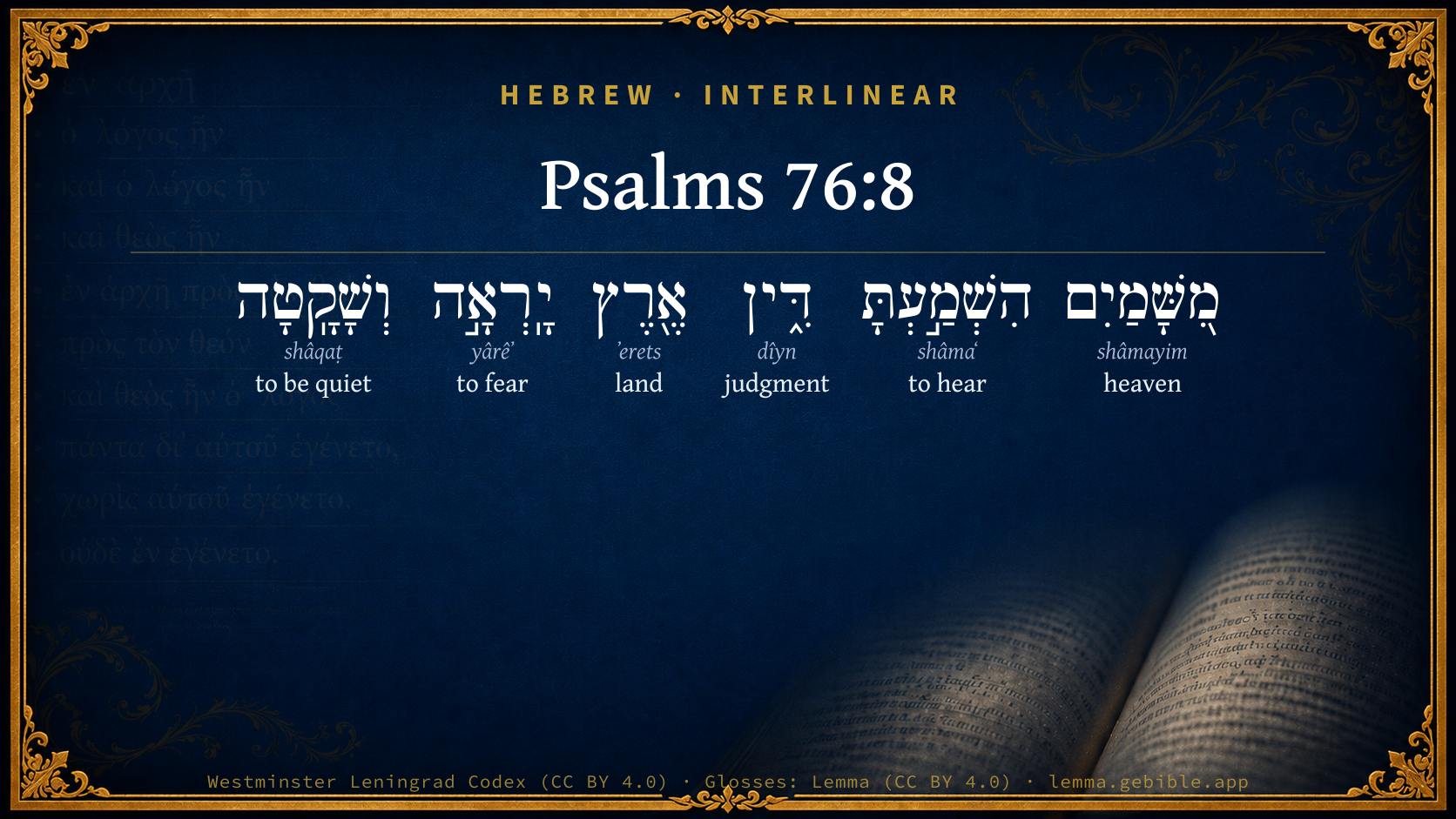
Hebrew (Westminster Leningrad Codex) Psalms 76:8 appears in the Hebrew Old Testament. The text above is from the Westminster Leningrad Codex. Each word links to its Strong’s number, a concise gloss, and parsing drawn from the Open Scriptures Hebrew Bible morphology. Click any word for its full Brown-Driver-Briggs (BDB) entry.
Download image
Cite this verse

Psalms 76:8 (World English Bible). Public Domain. Lemma interlinear Bible study tool, https://lemma.gebible.app/v/psalms/76/8.

Show BibTeX & RIS
BibTeX
RIS
English Translation
You pronounced judgment from heaven. The earth feared, and was silent,
World English Bible · Public Domain
Download a study sheet

One document with this verse’s original text, its word-by-word gloss line, the meaning frame, cross-references with their text, attributed commentary, and full source and license credits — printable, and it pastes into notes with its structure intact.

This verse Autodidact and up

Study sheet (.html) Plain text (.txt)

A passage Seminary Student

Up to 50 verses in one chapter. A passage sheet keeps up to 6 commentary sources and 12 cross-references per verse, in the order this page ranks them, and says so on the sheet whenever that leaves anything out. Ask for a single verse and you get the Autodidact verse sheet above.

Everything on this page stays free to read, with no account — the sheet is a download of what is already on screen, not access to it.

Want to remove ads? Support Godless Engineer
Compare translations 3

The same verse in 3 English versions, stacked beneath the original-language interlinear above. Click any original word for its lexicon entry.

Each is an independent rendering of the whole verse — the interlinear is not word-aligned to these translations.

Highlighted words mark where these versions differ — a whole-verse word diff, not a word-by-word alignment.

  • World English Bible Public Domain
    You pronounced judgment from heaven. The earth feared, and was silent,
  • King James Version Public Domain
    Thou didst cause judgment to be heard from heaven; the earth feared, and was still,
  • unfoldingWord Literal Text CC BY-SA 4.0
    From heaven you caused judgment to be heard; the earth feared and was quiet

unfoldingWord Literal Text — © unfoldingWord, licensed CC BY-SA 4.0. Word-aligned USFM3 via Door43 (git.door43.org/unfoldingWord/en_ult).

Versions to compare (up to 4)

3 of 4 selected

Show all 18 translations

Every available English version of this verse, each an independent rendering of the whole verse.

  • World English Bible Public Domain
    You pronounced judgment from heaven. The earth feared, and was silent,
  • Berean Standard Bible Public Domain
    From heaven You pronounced judgment, and the earth feared and was still
  • Majority Standard Bible Public Domain
    From heaven You pronounced judgment, and the earth feared and was still
  • King James Version Public Domain
    Thou didst cause judgment to be heard from heaven; the earth feared, and was still,
  • American Standard Version (1901) Public Domain
    Thou didst cause sentence to be heard from heaven; The earth feared, and was still,
  • Revised Version (1885) Public Domain
    Thou didst cause sentence to be heard from heaven; the earth feared, and was still,
  • Geneva Bible (1599) Public Domain
    Thou didest cause thy iudgement to bee heard from heauen: therefore the earth feared and was still,
  • Douay-Rheims (1899) Public Domain
    Thou art terrible, and who shall resist thee? from that time thy wrath.
  • Young's Literal Translation Public Domain
    From heaven Thou hast sounded judgment, Earth hath feared, and hath been still,
  • Literal Standard Version CC BY-SA 4.0
    You have sounded judgment from the heavens, || Earth has feared, and has been still,
  • Unlocked Literal Bible CC BY-SA 4.0
    From heaven you made your judgment heard; the earth was afraid and silent
  • unfoldingWord Literal Text CC BY-SA 4.0
    From heaven you caused judgment to be heard; the earth feared and was quiet
  • Darby Bible Public Domain
    Thou didst cause judgment to be heard from the heavens; the earth feared, and was still,
  • World Messianic Bible Public Domain
    You pronounced judgment from heaven. The earth feared, and was silent,
  • Webster's Bible Public Domain
    \\76:7\\Thou, even thou, art to be feared: and who may stand in thy sight when once thou art angry?
  • Free Bible Version CC BY-SA 4.0
    From heaven you announced judgment. Everyone on earth was afraid and stood still,
  • Bible in Basic English Public Domain
    From heaven you gave your decision; the earth, in its fear, gave no sound,
  • JPS Tanakh (1917) Public Domain
    (76-9) Thou didst cause sentence to be heard from heaven; the earth feared, and was still,

Literal Standard Version (2020), Covenant Press — licensed CC BY-SA 4.0. Text via the HelloAO Bible API (eBible.org). Unlocked Literal Bible (unfoldingWord) — licensed CC BY-SA 4.0. Text via the HelloAO Bible API (eBible.org). unfoldingWord Literal Text — © unfoldingWord, licensed CC BY-SA 4.0. Word-aligned USFM3 via Door43 (git.door43.org/unfoldingWord/en_ult). Free Bible Version, Dr. Jonathan Gallagher — licensed CC BY-SA 4.0. Text via the HelloAO Bible API (eBible.org).

Word by word

More ways to search: Search by grammar → Find every occurrence → Compare this word →

Practice this passage: Drill this verse → Learn its vocabulary →

About this verse

These counts appear in no published source. They are computed here, from the morphology-tagged text and Lemma’s own curated glosses. What Lemma adds →

6
words
6
distinct lemmas
Wisdom
section

Notable vocabulary

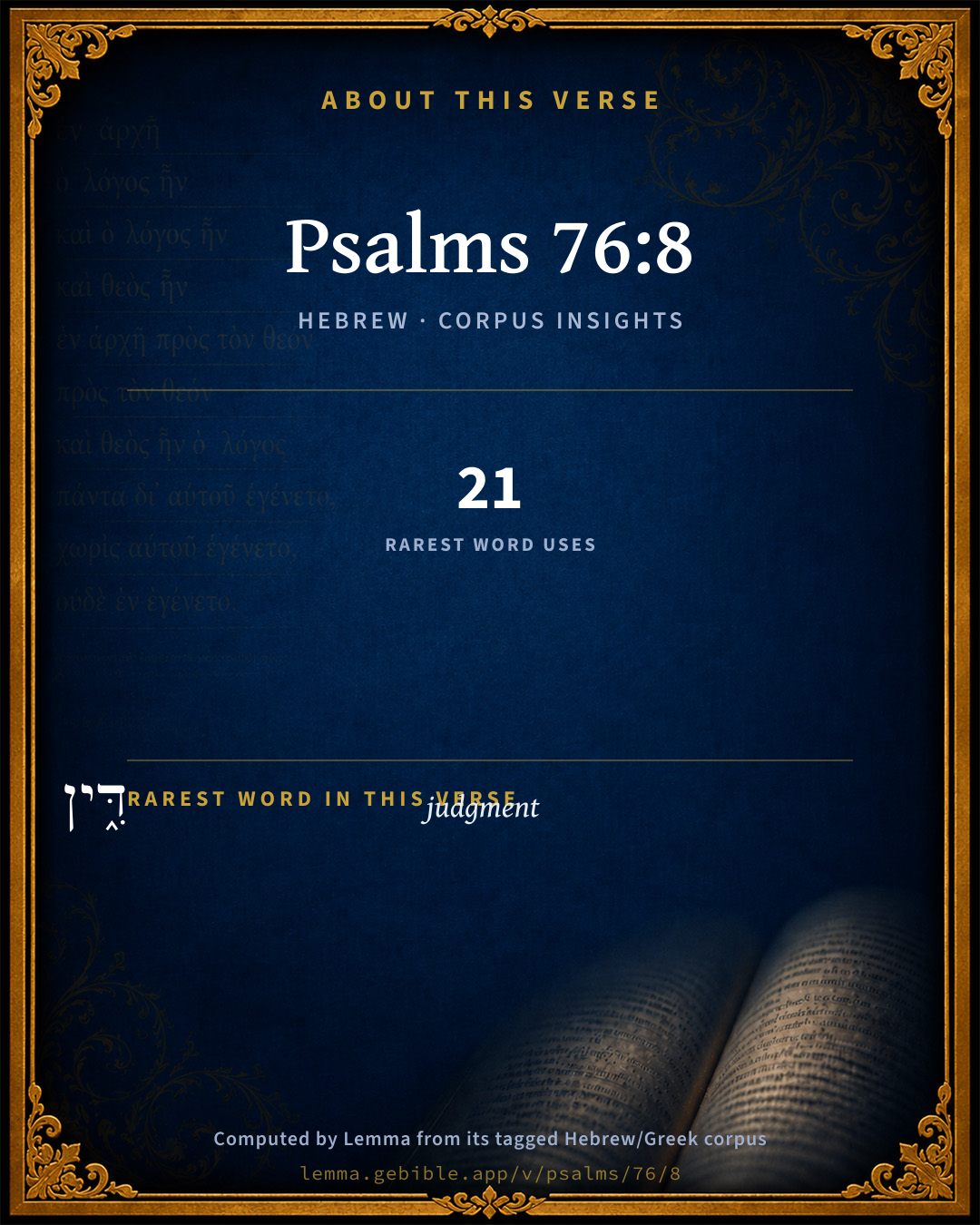
The rarest word here is דִּ֑ין judgment H1779 — appearing just 21 times in the whole Hebrew Bible.

Shared distinctive vocabulary

דִּ֑ין judgment H1779 occurs in 17 verses of the Hebrew Bible. Also found in:

Grammatical profile

  • 3 verbs
  • 3 nouns

Verb forms

  • הִשְׁמַ֣עְתָּ Hiphil · Perfect
  • יָֽרְאָ֣ה Qal · Perfect
  • וְשָׁקָֽטָה Qal · Perfect

Hebrew & Septuagint length

In English translation the verse runs 11 words from the Hebrew and 15 from the Septuagint (LXX English) — closely comparable.

A rough comparison of the two English renderings, which tokenize alike — not a word-level alignment.

Word counts can differ between the Hebrew and the Greek without any difference in meaning — e.g. the Hebrew direct-object marker אֵת has no separate Greek word, and Greek often adds the article ὁ.

Cross-references

9

Topical passages linked to Psalms 76:8 in the Treasury of Scripture Knowledge — connected by theme and wording, ordered by reader-vote popularity; previews shown in the World English Bible.

  • 2 Chronicles 20:29–30 The fear of God was on all the kingdoms of the countries, when they heard that Yahweh fought against the enemies of Israel.
  • Habakkuk 2:20 But Yahweh is in his holy temple. Let all the earth be silent before him!"
  • Exodus 19:10 Yahweh said to Moses, "Go to the people, and sanctify them today and tomorrow, and let them wash their garments,
  • Judges 5:20 From the sky the stars fought, From their courses they fought against Sisera.
  • 1 Chronicles 16:30 Tremble before him, all the earth: The world also is established that it can't be moved.
  • 2 Chronicles 32:20–22 Hezekiah the king, and Isaiah the prophet the son of Amoz, prayed because of this, and cried to heaven.
  • Psalms 46:10 "Be still, and know that I am God. I will be exalted among the nations. I will be exalted in the earth."
  • Ezekiel 38:20–23 so that the fish of the sea, and the birds of the sky, and the animals of the field, and all creeping things who creep on the earth, and all the men who are on the surface of the earth, shall shake at my presence, and the mountains shall be thrown down, and the steep places shall fall, and every wall shall fall to the ground.
  • Zechariah 2:13 Be silent, all flesh, before Yahweh; for he has roused himself from his holy habitation!"

Cross-references courtesy of OpenBible.info (CC BY 4.0).

Hebrew and Greek witnesses Masoretic Hebrew ↔ Greek Septuagint

The same verse in the two great witnesses to the Old Testament, shown verse-for-verse.

You’re reading Greek Psalm 75 (Hebrew Psalm 76). The Septuagint counts the superscription, so verse numbers can differ from the Hebrew — chapter-level alignment, not verse-by-verse. Numbering follows Rahlfs.

These are two independent witnesses, not word-aligned to each other, and the Septuagint is shown in lemma (dictionary) form.

Hebrew Psalms 76:8 Masoretic · Westminster Leningrad Codex

מִ֭שָּׁמַיִם הִשְׁמַ֣עְתָּ דִּ֑ין אֶ֖רֶץ יָֽרְאָ֣ה וְשָׁקָֽטָה

You pronounced judgment from heaven. The earth feared, and was silent,

World English Bible · Public Domain

Greek LXX Greek Psalm 75:8 Septuagint · lemma form

σύ φοβερός εἰμί καί τίς ἀντιἵστημι σύ ἀπό τότε ὁ ὀργή σύ

You did cause judgment to be heard from heaven; the earth feared, and was still,

LXX2012 (modern English Septuagint) · Public Domain

Hebrew: Westminster Leningrad Codex (CC BY 4.0). Greek: Septuagint (public domain); English from LXX2012 (modern English Septuagint) (Public Domain). How the Septuagint differs from the Hebrew →

Commentary

Notes on Psalms 76:8 from classic Christian and Jewish commentators (each source and its license shown beneath its notes). The classic Christian expositions comment on the surrounding passage and are grouped to its opening verse, so a note may address several verses; the Jewish commentaries on the Tanakh (Rashi and others) are per-verse, so they appear only where the commentator wrote on this verse.

Lemma curates 59 commentaries, every one of them public domain or Creative Commons licensed, each selected and text-cleaned for this edition rather than reprinted as found. About our sources →

Trapp's Complete Commentary

John Trapp

Psa 76:8 Thou didst cause judgment to be heard from heaven; the earth feared, and was still,

Ver. 8. Thou didst cause judgment to be heard from heaven] From thence is God’s wrath revealed plainly and plentifully, Rom 1:18, and thence he oft appeareth for his people as out of an engine.

The earth feared] All was hushed, as after a thunder clap.

John Trapp, A Commentary or Exposition upon All the Books of the Old and New Testament (1647–1656) — public domain. Text from a community e-Sword module.

The Biblical Illustrator

Joseph S. Exell

Psa_76:8

For in the hand of the Lord there is a cup, and the wine is red.

Gods threatenings against incorrigible sinners

In this verse we have a lively description and amplification of the judgments of God upon the world, which are hero set forth unto us under a threefold representation of them. First, in their preparation. Secondly, in their execution. Thirdly, in their participation.

I. The preparation.

1. The vessel--a cup. By this we may understand whatsoever it is which is the means, and conveyance, and derivation of any evil unto us. God makes the same providences to be a cup of physic to His children, for the recovering of them from their spiritual infirmities, and a cup of poison to His enemies, for the destroying of them, in the midst of their sins.

2. The liquor.

(1) Red wine--a cup of blood prepared for the inhabitants of the world, as an expression of Gods vengeance upon them.

(2) Full of mixture, i.e. wrath and revenge.

3. The preparer--God Himself.

II. The execution. God will not be always in the forewarnings of judgment, He will be at last in the dispensations of it. He will not be always tempering it, He will be at last pouring out of it. The Lord is full of patience and longsuffering, and bears much with the sons of men for a long while together; but when His patience and longsuffering is once abused, He then comes on to punishment and execution. And this I say it is, when sin is come to its ripeness and maturity, and is at its full growth. There are three aggravations of sin which do put God upon the execution of judgment, and this pouring forth of wrath.

1. Boldness and insolence in sinning (Jer_8:12).

2. Generality in sinning; when it comes to taint and overspread a whole nation.

3. Security and presumption.

III. The participation.

1. The persons mentioned. The wicked of the earth, that is, such as are more scandalous, and presumptuous, and impenitent, and farthest from reformation; such as those who, for the nature of sin, are more abominable, and for the continuance in it, are more incorrigible; these are they which the Holy Ghost does here point at in a more principal manner.

2. The evil denounced against them.

(1) The potion or draught itself, it is the dregs of the cup. This is the potion of wicked men, while tis said they shall drink the dregs, there are three things implied in this expression as belonging unto it.

(a) The reservation of judgment, they shall drink the last.

(b) The aggravation of judgment, they shall drink the worst.

(c) The perfection and confirmation of judgment, they shall drink up all. They shall drink the last, they shall drink the worst, they shall drink all; each of these are implied in the dregs. (T. Horton, D. D.)

The Lords cup

I. The contents of the Lords cup. The wine is red; it is full of mixture; that is, however fair the appearances of things may be, however splendid any state of happiness, or any situation of life may appear, there is always added to it a certain portion of evil. By evil, I mean only the usual misfortunes and afflictions of human life. These are what temper the cup of the Lord; and in this mixed state it is poured out to the inhabitants of the earth. Man being compounded of good and evil, all his labours partake of the mixture. Let him form what schemes he will; let him employ all his little prudence and foresight in bringing them to perfection, still we will find mixed with them in one shape or other, uncertainty, disappointment, and miscarriage.

II. How the ungodly man drinks it. The text says, He drinks the dregs. Now, the dregs of any liquor are the pernicious parts. It is fairly implied, therefore, that the ungodly man turns both the good and evil of life to his own destruction.

III. How the godly man drinks it. As the ungodly man drinks the dregs, the finer parts of the liquor are, of course, the portion of the godly man. In the first place, he expects to find a degree of bitterness in his cup. He sees the propriety of it, and fully acknowledges the great usefulness of this mixture of good and evil. If the potion were perfectly palatable, he fears he might drink to excess. When it pleases Heaven to bless him; when his designs succeed; and his hopes dilate in some view of happiness before him, Now is the time (he suggests to himself) when I must guard my heart with double care. Now is the time when insolence, and wantonness, and pride, the attendants of a prosperous hour, are most liable to corrupt me. Let prosperity soften my heart, instead of hardening it. Let me be humble, and mild, and condescending, and obliging to all. In the midst of my own enjoy meats, let my heart expand. Let me feel the misery of others; and turn my plenty to the relief of their necessity. Again, when it pleases Heaven to mix some bitter ingredients in his cup, still he has the same sense of acting under the will of God. Now, he cries, is the time when I am to exorcise patience and resignation. Now my religion is put to the test. Shall I receive good at the hand of the Lord, and not receive evil? Gracious God! grant that I may improve my heart under this trial of my faith; and make my sufferings, through Jesus Christ, the means of purifying my affections. Let me for His sake bear a trifling part of what He bore for me; and lot me keep that great pattern of suffering resignation always before my eyes. Thus the godly man drinks of the Lords cup, and his draught, whether sweet or bitter, is wholesome to him. (W. Gilpin.)

The Biblical Illustrator, edited by Joseph S. Exell (c. 1880s–1900s) — public domain. Text from a community e-Sword module.

Joseph Benson's Commentary

Psa 76:8-9. Thou didst cause judgment to be heard, &c. — Thou didst execute judgment upon thine enemies by an angel sent from heaven. The earth feared, and was still — The effect of this terrible judgment was, that the rest of the world was afraid to invade or disturb the land and people of Israel; and chose rather to be still and stay quietly in their own territories. When God — Who had long suffered their insolence; arose to judgment — To execute judgment upon his enemies, and the enemies of his people. Hebrew, בקום, bekum, in his arising, or, after he had risen, or, because he did arise; to save all the meek — The humble, the patient, the mild, and gentle; or, the godly, who are often called meek ones; of the earth — Rather, of the land, for whose sakes, and in answer to whose prayers, God wrought this great deliverance which reached to all the people of the land.

Joseph Benson's Commentary on the Old and New Testaments (1811–1818) — public domain. Text from a community e-Sword module.

J. A. Alexander on Psalms

Joseph Addison Alexander

9. (Psa 76:8). From, heaven thou halt caused judgment to be heard; the earth feared and rested, or, the earth was afraid and was still. From his throne in heaven God had pronounced judgment on his wicked enemies, the sound of which had struck the dwellers upon earth with awe and calmed their tumult. The last Hebrew verb is especially applied to repose after the noise and agitation of war. See Jos 14:15, Jdg 5:31, Isa 14:7.

Joseph Addison Alexander, The Psalms Translated and Explained (1850) — public domain. Text from a community e-Sword module.

Adam Clarke's Commentary

Verse 8. Thou didst cause judgment to be heard] When God declared by his prophet that the enemy should not prevail, but on the contrary be destroyed, the earth - the land, and by metonymy the inhabitants of the land, were struck with astonishment and terror, so as not to be able to move. The great boaster Sennacherib, who carried terror, dismay and desolation every where, was now struck with dumb amazement; and the angel of the Almighty, in a moment, stopped the breath of those hosts in which he confided.

Adam Clarke's Commentary on the Bible (1810–1826) — public domain. Text from a community e-Sword/MySword module.

John Calvin's Commentaries

8. From heaven thou hast made thy judgment to be heard. By the name of heaven, the Psalmist forcibly intimates that the judgment of God was too manifest to admit of the possibility of its being ascribed either to fortune or to the policy of men. Sometimes God executes his judgments obscurely, so that they seem to proceed out of the earth. For example, when he raises up a godly and courageous prince, the holy and lawful administration which will flourish under the reign of such a prince will be the judgment of God, but it will not be vividly seen to proceed from heaven. As, therefore, the assistance spoken of was of an extraordinary kind, it is distinguished by special commendation. The same remarks apply to the hearing of God’s judgment, of which the Psalmist speaks. It is more for the divine judgments to sound aloud like a peal of thunder, and to stun the ears of all men with their noise, than if they were merely seen with the eyes. There is here, I have no doubt, an allusion to those mighty thunder-claps by which men are stricken with fear. When it is said, the earth was still, it is properly to be referred to the ungodly, who, being panic-struck, yield the victory to God, and dare no longer to rage as they had been accustomed to do. It is only fear which has the effect of bringing them to subjection; and, accordingly, fear is justly represented as the cause of this stillness. It is not meant that they restrain themselves willingly, but that God compels them whether they will or no. The amount is, that whenever God thunders from heaven, the tumults which the insolence of the ungodly stir up, when things are in a state of confusion, come to an end. We are, at the same time, warned of what men may expect to gain by their rebellion; for, whoever despise the paternal voice of God which is loudly uttered, must be destroyed by the bolts of his wrath.

John Calvin's Commentaries (1540-1563) — public domain. Text from the Calvin Translation Society English edition (1840s-50s) via the Christian Classics Ethereal Library (ccel.org). Calvin's coverage is partial (roughly two-thirds of the Bible); uncommented books and verses are honest gaps, never fabricated. The 19th-century editor's footnotes and remarks are omitted so the notes are faithfully Calvin's own voice.

The Cambridge Bible for Schools and Colleges

gen. ed. J. J. S. Perowne

8. Thou didst cause judgement to be heard] Or, as R.V., sentence. God pronounced sentence upon the proud Assyrian when He intervened for the rescue of His people. Cp. Psa_46:6; Isa_30:30; 1Sa_2:10.

from heaven] For though God has chosen Zion for His earthly dwelling-place, His true abode and seat of judgement is in heaven.

the meek of the earth] Cp. Isa_11:4; Zep_2:3. Israel, regarded ideally as ‘the righteous one’ (Psa_75:10), and contrasted with ‘the wicked of the earth’ (Psa_75:8), is meant.

The Cambridge Bible for Schools and Colleges (gen. ed. J. J. S. Perowne; Cambridge University Press, 1878–1918) — public domain. Text from a community e-Sword module.

John Gill's Exposition

Thou didst cause judgment to be heard from heaven,.... When an angel was sent down from heaven, and destroyed the Assyrian army, a judgment of God upon them; at which time some think there was a violent clap of thunder, which is the voice of God: and it may refer to the judgments which God has decreed to execute on the antichristian states, the seven vials of his wrath he will pour upon them; for all decrees, as Aben Ezra on the place observes, come from heaven; or to the last judgment, when Christ the Judge shall descend from heaven, the voice of the archangel shall be heard, the last trumpet shall sound, the dead in their graves shall hear it, and rise and stand before the judgment seat, and hear the sentence pronounced:

the earth feared, and was still: or "trembled, and was quiet" (c); that is, again: some think there was an earthquake when the angel smote the Assyrian camp, but was quickly over. It may regard the panic the other nations were in when they heard of it, and therefore were still and quiet, and never offered to give the Israelites any disturbance. Some understand this of the remainder of the army that escaped with Sennacherib; these were seized with fear, and quickly withdrew, and silently departed into their own land. Aben Ezra observes it as the sense of some, "the earth feared", these are the wicked; "and was still", they are the righteous; so the Targum,

"the land of the people feared, the land of Israel was still;''

reference may be had to the consternation, fear, and dread, that will fall on them that escape the judgments inflicted on the antichristian party, Rev 11:13 and the fear and silence that will attend the last and awful judgment; see Zac 2:13.

(c) "terra tremuit, et quievit", V. L.

John Gill's Exposition of the Whole Bible (1746–1763) — public domain (CC PDM 1.0). Text via the HelloAO Bible API.

Albert Barnes' Notes on the Bible

Thou didst cause judgment to be heard from heavens - It seemed to come from heaven; it was manifestly from thee. The overthrow of these enemies of thy people was a manifest judgment from thee, and should be so regarded.

The earth feared - The world itself seemed to hear the voice of God, and to stand in awe.

And was still - It seemed to be profoundly attentive to what God said, and as if it reverently listened to his voice. It is not uncommon in the Scriptures to represent the earth - the hills, the mountains, the streams, the rivers, the plains - as conscious of the presence of God; as either rejoicing or trembling at his voice. Compare Psa 65:12-13; Psa 114:3-7; Hab 3:8-11.

Albert Barnes' Notes on the Bible (1834–1885) — public domain. Text from a community e-Sword/MySword module.

Matthew Poole's English Annotations

Thou didst execute judgment upon thine enemies by an angel sent from heaven; which is said to be heard, either because that was accompanied with terrible thunders and earthquakes, which was not unusual in the descent of an angel, as Mat 28:2, and elsewhere; or because the fame of it was quickly spread abroad in the land, and in the world. The effect of this terrible judgment was, that the rest of the world were afraid to invade or disturb the land and people of Israel, and chose rather to sit still in their own territories.

Matthew Poole's English Annotations on the Holy Bible (1683–1685) — public domain. Text from a community e-Sword/MySword module.

The Treasury of David

Charles H. Spurgeon

Ver. 8. Thou didst cause judgment to be heard from heaven. So complete an overthrow was evidently a judgment from heaven; those who saw it not, yet heard the report of it, and said, "This is the finger of God." Man will not hear God's voice if he can help it, but God takes care to cause it to be heard. The echoes of that judgment executed on the haughty Assyrian are heard still, and will ring on down all the ages, to the praise of divine justice.

The earth feared and was still. All nations trembled at the tidings, and sat in humbled awe. Repose followed the former turmoils of war, when the oppressor's power was broken, and God was reverenced for having given quiet to the peoples. How readily can Jehovah command an audience! It may be that in the latter days he will, by some such miracles of power in the realms of grace, constrain all earth's inhabitants to attend to the gospel, and submit to the reign of his all glorious Son. So be it, good Lord.

Whole Psalm. No Psalm has a greater right to follow Psalm 75 than this, which is inscribed To the Precentor, with accompaniment of stringed instruments (vid. iv. 1), a Psalm by Asaph, a song. Similar expressions (God of Jacob, Ps 75:10 77:7; saints, wicked of the earth, Ps 75:9 76:10), and the same impress throughout speak in favour of unity of authorship. In other respects too, they form a pair: Psalm 75 prepares the way for the divine deed of judgments as imminent, which Psalm 76 celebrates as having taken place. Franz Delitzsch.

Ver. 8-9.

I. The characters described: the meek of the earth.

II. The need implied.

1. To be vindicated.

2. To be saved. III. The divine interposition on their behalf: Thou didst cause, etc. When God arose, etc. IV. The effect of their deliverance: The earth feared, etc. G. R.

Psalms 76:9*

Ver. 8-9.

I. The characters described: the meek of the earth.

II. The need implied.

1. To be vindicated.

2. To be saved. III. The divine interposition on their behalf: Thou didst cause, etc. When God arose, etc. IV. The effect of their deliverance: The earth feared, etc. G. R.

Psalms 76:10*

Charles H. Spurgeon's The Treasury of David (1869–1885) — public domain. Psalms only. Text from a community e-Sword/MySword module.

Whedon's Commentary on the Bible

Daniel D. Whedon

8. Judgment to be heard from heaven—The case was a clear one. No delay of secondary causes. The judgment fell like a bolt from heaven. No one, not even Sennacherib, doubted it was of God.

The earth feared, and was still—A sublime conception of the majesty of God. “When he arose to judgment” the tumult was hushed, the din of war ceased. Silence and fear pervaded the earth, when God arose for the “meek” ones. See on Psa_46:10.“The Babylonian Talmud hath it, that this destruction of the army of the Assyrians was executed by lightning; and some of the targums are quoted for saying the same thing. But it seems most likely that it was effected by bringing on them the hot wind which is frequent in those parts, and often, when it lights among a multitude, destroys great numbers of them in a moment, as it frequently happens in those vast caravans of Mohammedans who go their annual pilgrimages to Mecca.”—Prideaux.

And the words of Isaiah (Isa_37:7,) which threatened Sennacherib with a “blast” from heaven, seem to denote the same. The poet has the same:—

“For the angel of death spread his wings on the blast,

And breathed in the face of the foe as he passed.”

The account of Herodotus, (book ii, chap. 141,) 450 years before Christ, that “so immense a number of mice infested by night Sennacherib’s camp that their quivers and bows, together with what secured their shields to their arms, were gnawed in pieces,” and thus rendered the army powerless, while it corroborates the great fact of the catastrophe, and calls Sennacherib by name, is incorrect as to the circumstances, and puerile. See on Psalms 46

Daniel D. Whedon (gen. ed.), Commentary on the Old and New Testaments (1874–1909) — public domain. Text from a community e-Sword module.

The Pulpit Commentary

Thou didst cause judgment to be heard from heaven. By the destruction of Sennacherib"s host, God spoke, as it were, with a voice of thunder, to the whole earth. He delivered a "judgment," or a "sentence" (Revised Version), which could not be ignored. The earth feared, and was still. All the world, i.e. all the Oriental world, feared. The attention of the nations of Western Asia generally was attracted, (2Ch_32:23) and their minds were affected with a wholesome fear of Jehovah. The result was that they remained at rest and gave Israel rest.

The Pulpit Commentary (1880–1919), ed. H.D.M. Spence-Jones & Joseph S. Exell — public domain. Text from a community e-Sword module.

John Wesley's Explanatory Notes

Thou - Didst execute judgment upon thine enemies, by an angel from heaven: which is said to be heard, either because it was accompanied with thunders and earthquakes, or because the fame of it was quickly spread abroad. Feared - The rest of the world were afraid to disturb Israel.

10 Surely - The furious attempts of thine enemies, shall cause thy people and others to praise thee for thy admirable wisdom, power, and faithfulness.

John Wesley, Explanatory Notes Upon the Whole Bible (1754–1765) — public domain. Text via the GEBible commentary corpus.

unfoldingWord translationNotes

Door43 World Missions Community

you made your judgment heard

"you pronounced judgment" or "you announced how you were going to punish wicked people"

the earth was

Here "the earth" is a metonym for the people living on the earth. AT: "the people of the earth were" (See: Metonymy)

execute judgment

"carry out judgment" or "punish wicked people"

Selah

This may be a musical term that tells people how to sing or play their instruments here. Some translations write the Hebrew word, and some translations do not include it. See how you translated this in (Psalms 3:1). (See: Copy or Borrow Words)

translationWords

judge

heaven

earth

fear

raise

save

oppress

selah

unfoldingWord translationNotes — © Distant Shores Media and the Door43 World Missions Community, licensed CC BY-SA 4.0. Source: git.door43.org/Door43/en_tn.

Rashi

Rabbi Shlomo Yitzchaki (Rashi)

once You are angry From the time You became angry.

Rashi on the Tanakh — English translations: “The Judaica Press complete Tanach with Rashi, translated by A. J. Rosenberg” (CC BY 4.0); “Pentateuch with Rashi's commentary by M. Rosenbaum and A.M. Silbermann, 1929-1934” (public domain); “The Metsudah Tanach series, Lakewood, N.J” (CC BY 4.0); and “The Book of Joshua, Metsudah Publications, 1997” (CC BY 4.0). Text via Sefaria.

Lesson kit

Teaching starters — assembled from the data on this page, not authored interpretation. Every prompt links to the verse data it draws on. Edit before teaching.

Psalms, in the Wisdom, opens this verse with 6 words (6 distinct Hebrew lemmas). Its most distinctive word is dîyn (“judgment”). A historical commentator’s framing appears above. Read the whole chapter for the surrounding context.

Discussion questions

  1. The word dîyn carries the sense “judgment.” How does it shape the verse?
  2. How does Deuteronomy 17:8, which shares the word «judgment», read alongside this verse?
  3. These translations render this verse differently; the difference is in the English rendering, not the original. What questions does that raise?
  4. «הִשְׁמַ֣עְתָּ» is a Hiphil Perfect verb. How does that grammatical form shape the action described?
  5. Compare how Trapp's Complete Commentary and The Biblical Illustrator read this verse. Where do they agree or differ?

Things to notice

Reading settings

Reading text

Shown beneath each verse's original-language words.

Old Testament
Old Testament edition

Read the OT as the Masoretic Hebrew (MT) or the Greek Septuagint (LXX).

English shown for the Greek Septuagint (in the Hebrew ↔ Greek comparison).

Comparing translations? Open the Compare panel on any verse page to stack up to four side by side.