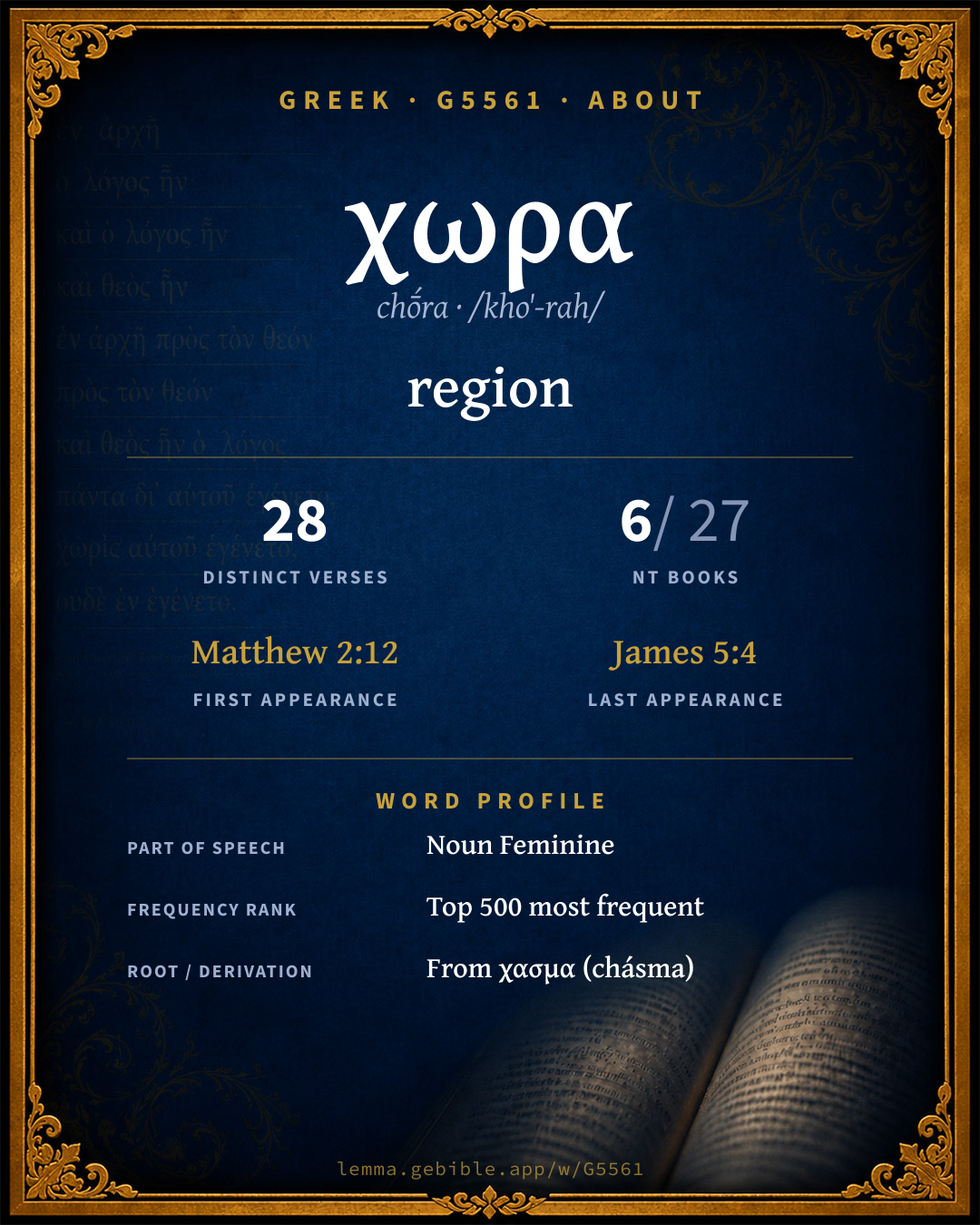
χώρα
region
‘region’ is one of 3 main senses fuller range ↓
Full lexicon entry — Thayer's Greek Lexicon
From Thayer's Greek Lexicon
Where this word appears
See every Accusative-case word in the Greek New Testament →
Grammar key — what these labels mean
Part of speech
- Noun
- A naming word — a person, place, thing, or idea.
Case
- Accusative
- The case of the direct object and of extent.
- Genitive
- The case of source, possession, or “of” — answers “whose / from what.”
- Dative
- The case of the indirect object, means, or location — “to / for / with / in.”
- Nominative
- The case of the subject (and the predicate nominative).
Gender
- Feminine
- Grammatically feminine.
Number
- Singular
- One.
- Plural
- More than one.
1 verse where G5561 appears in the Nominative case in the Book of Luke. Filtered view — show all forms. Click any verse to open its interlinear word-by-word view. Verse text shown in the World English Bible for context — . Each verse’s Greek form is shown with its reference; the English is not keyword-highlighted, since the data carries no word-level English alignment. Use “Compare translations” on any verse to read it across multiple English versions. This concordance covers the Greek New Testament; Septuagint (Greek Old Testament) occurrences of this word are not indexed here.
Luke
About this entry
At a glance — auto-summarized from this page’s data, not written by a person. Every figure links to its source below. This summary describes the numbers; it doesn’t interpret them.
“region” is the headline sense of the Greek noun χωρα (chṓra). Scripture first uses it in Matthew 2:12. With 28 verses in 6 books, it is a moderately common word in the Greek New Testament. It concentrates in Luke, which alone accounts for 32% of its uses. Catalogued under 3 senses, its meaning is not single-sense. The sections below give every sense, occurrence, and version rendering.
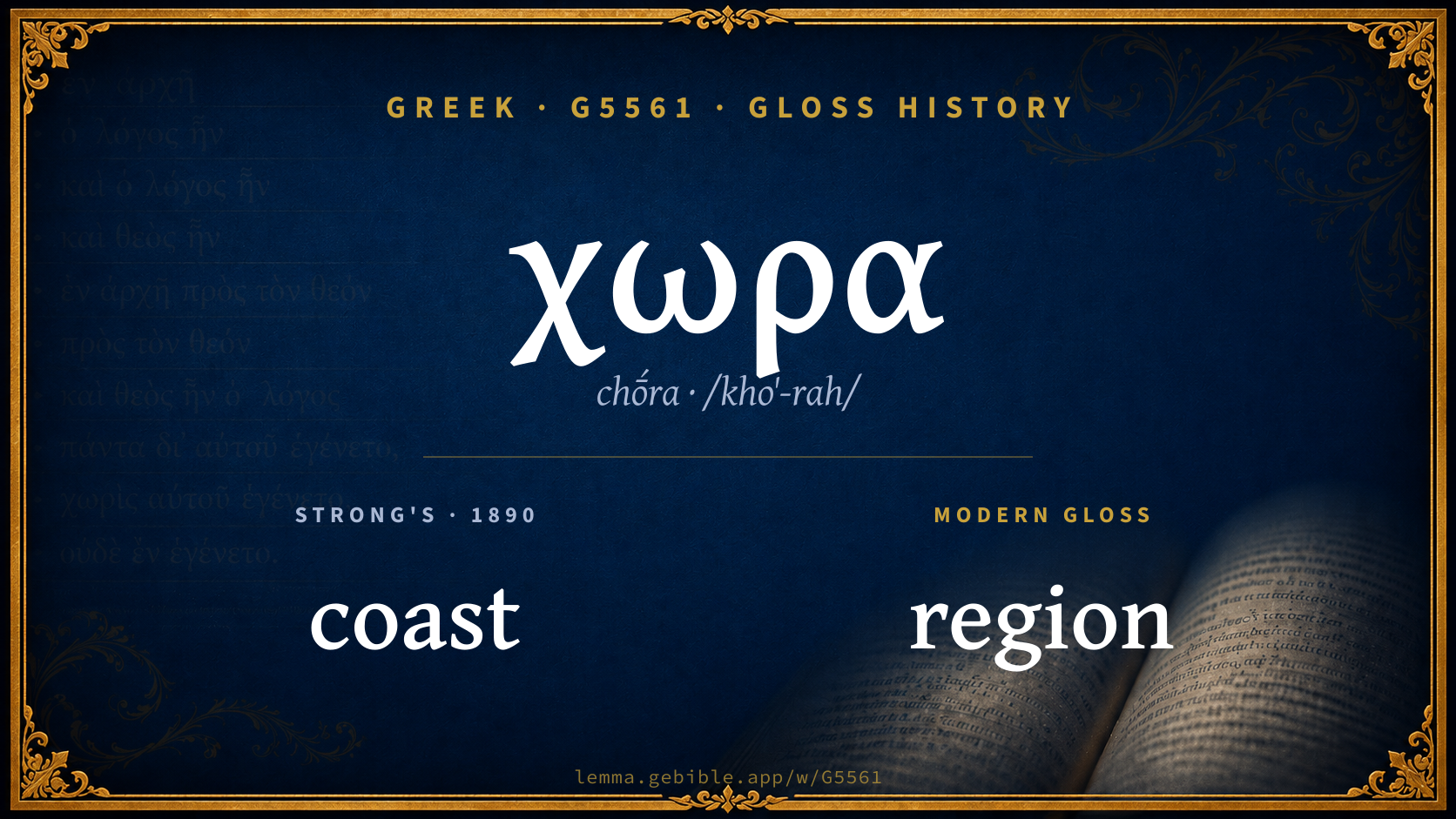
Gloss history
Strong's 1890 vs modern scholarship
About this word
Strong's G5561 catalogs a Greek word from the Greek New Testament.
These counts are not copied from any lexicon or concordance. They are computed here, from the morphology-tagged Greek New Testament. What Lemma adds →
- 28
- distinct verses
- The word appears in 28 distinct verses.
- 6 / 27
- NT books
- The word appears in 6 of 27 New Testament books.
- #485
- by frequency
- Top 500 most frequent Greek words (rank 485 of 5,347 Greek words by occurrence).
View all 28 occurrences in the concordance →
By section of the New Testament
By traditional corpus
Conventional, traditional groupings — biblical authorship is debated, so this is a traditional corpus grouping, not an authorship claim. Some books belong to more than one corpus (Luke is in both the Gospels and the Lukan corpus, and so on), so these shares overlap and need not total 100%. Each figure is a share of the word’s 28 distinct verses.
- Gospels 19 verses · 68%
- Lukan (Luke–Acts) 17 verses · 61%
- Johannine 3 verses · 11%
- General (Catholic) Epistles 1 verse · 4%
How translations render this word
Counts come from each version’s own published word-to-Strong’s tagging or interlinear alignment — an approximate guide to how each version renders this word, not a word-level alignment the data otherwise carries. Because each total is that version’s own tagged count, the per-version totals vary from one another and need not match the appearance or distinct-verse counts above. These counts may also differ from a printed concordance because Lemma counts each distinctly tagged rendering and does not collapse phrase taggings into a single head-word total. This is a fixed set of word-tagged versions (KJV, ASV, BSB, ULT) and does not change with the reading translation you choose elsewhere. Each version’s license is shown beside its name below (and on Sources).
- King James Version: Country 13×, Region 4×, Land 3×
- American Standard Version: Country 17×, Region 5×, Fields 2×
- Berean Standard Bible: Region 10×, Country 7×, Land 3×
- unfoldingWord Literal Text: Region 12×, Country 9×, Fields 3×
King James Version Public Domain
Renders G5561 across 27 tagged occurrences — most commonly:
Plus 5 renderings that appear only once — usually multi-word phrases or single function words the recovered tagging swept in, not distinct renderings.
American Standard Version Public Domain
Renders G5561 across 27 tagged occurrences — most commonly:
Plus 3 renderings that appear only once — usually multi-word phrases or single function words the recovered tagging swept in, not distinct renderings.
Berean Standard Bible Public Domain
Renders G5561 across 26 tagged occurrences — most commonly:
Plus 4 renderings that appear only once — usually multi-word phrases or single function words the recovered tagging swept in, not distinct renderings. Not rendered by a distinct English word in 1 further occurrence.
unfoldingWord Literal Text CC BY-SA 4.0
Renders G5561 across 32 tagged occurrences — most commonly:
Plus 4 renderings that appear only once — usually multi-word phrases or single function words the recovered tagging swept in, not distinct renderings.
Senses in Thayer's
The 3 senses Thayer's distinguishes for this word, in lexicon order (not ranked by frequency or importance). The full entry — with sub-senses — is in the Lexicon Entry tab.
- the space lying between two places or limits
- a region or country i.e. a tract of land
- land which is ploughed or cultivated, ground
Word origin
Derived from χασμα (chásma) (G5490) — chasm.
Forms in the corpus
The 5 distinct written forms G5561 takes in the Greek New Testament, most frequent first — each parse links to that case’s occurrences in the concordance.
| Form | Parsing | Example | Uses |
|---|---|---|---|
| χώραν chṓran | Noun, Accusative, Singular, Feminine | Matthew 2:12 | 14 |
| χώρας chṓras | Noun, Genitive, Singular, Feminine | Mark 5:10 | 8 |
| χώρᾳ chṓra | Noun, Dative, Singular, Feminine | Matthew 4:16 | 3 |
| χώρα chṓra | Noun, Nominative, Singular, Feminine | Mark 1:5 | 2 |
| χώραις chṓrais | Noun, Dative, Plural, Feminine | Luke 21:21 | 1 |
Same root — word family
Other Thayer's entries built from the same root as G5561, grouped by Strong’s listed origin. These share a root / origin per the lexicon — not necessarily a shared meaning. Each links to that word’s own entry.
Derives from
Shares the same root
- κητος kētos G2785 sea monster
- χαλαω chaláō G5465 to relax
- χαμαι chamaí G5476 to the ground
- χειλος cheîlos G5491 lip
- χειμων cheimṓn G5494 winter
- χηρα chḗra G5503 widow
- χιων chiṓn G5510 snow
Derived from this word
- ευρυχωρος eurýchōros G2149 broad
- χωρεω chōréō G5562 to make room
- χωριζω chōrízō G5563 to separate
- χωριον chōríon G5564 field
- χωρις chōrís G5565 separate
Compare all same-root words → Showing 4 of 14 — not the complete family. They share a root, not necessarily a meaning.
Septuagint usage
The same Greek word χωρα appears 146 times in the Greek Old Testament (Septuagint), across 134 verses in 24 books.
- 146
- LXX occurrences
- Tagged occurrences of this Greek word in the Septuagint.
- 134
- verses
- Distinct Septuagint verses containing this word.
- 24 / 39
- OT books
- The word appears in 24 of the 39 Old Testament books.
Sample Septuagint occurrences
- Genesis 10:20 χώρα
- Exodus 14:27 χώρα
- Leviticus 13:23 χώρα
- Numbers 32:1 χώρα
- Joshua 4:18 χώρα
- 1 Samuel 5:6 χώρα
- 1 Kings 7:16 χώρα
- 2 Kings 18:33 χώρα
- 1 Chronicles 20:1 χώρα
- 2 Chronicles 15:5 χώρα
- Ezra 2:1 χώρα
- Esther 1:1 χώρα
Septuagint occurrences (same lexeme)
Every verse where the same Strong’s number (G5561) appears in the Greek Septuagint — showing the first 50 of 134. Verse text shown in the World English Bible for context; the Greek form is the matched word — the English is not keyword-highlighted.
- Genesis 10:20 χώρα These are the sons of Ham, after their families, after their languages, in their lands, in their nations.
- Genesis 10:31 χώρα These are the sons of Shem, after their families, after their languages, in their lands, after their nations.
- Genesis 11:28 χώρα Haran died before his father Terah in the land of his birth, in Ur of the Chaldees.
- Genesis 11:31 χώρα Terah took Abram his son, Lot the son of Haran, his son's son, and Sarai his daughter-in-law, his son Abram's wife. They went forth from Ur of the Chaldees, to go into the land of Canaan. They came to Haran, and lived there.
- Genesis 15:7 χώρα He said to him, "I am Yahweh who brought you out of Ur of the Chaldees, to give you this land to inherit it."
- Genesis 32:4 χώρα He commanded them, saying, "This is what you shall tell my lord, Esau: 'This is what your servant, Jacob, says. I have lived as a foreigner with Laban, and stayed until now.
- Genesis 36:40 χώρα These are the names of the chiefs who came from Esau, according to their families, after their places, and by their names: chief Timna, chief Alvah, chief Jetheth,
- Genesis 41:57 χώρα All countries came into Egypt, to Joseph, to buy grain, because the famine was severe in all the earth.
- Genesis 42:9 χώρα Joseph remembered the dreams which he dreamed about them, and said to them, "You are spies! You have come to see the nakedness of the land."
- Exodus 14:27 χώρα Moses stretched out his hand over the sea, and the sea returned to its strength when the morning appeared; and the Egyptians fled against it. Yahweh overthrew the Egyptians in the midst of the sea.
- Leviticus 13:23 χώρα But if the bright spot stays in its place, and hasn't spread, it is the scar from the boil; and the priest shall pronounce him clean.
- Leviticus 13:28 χώρα If the bright spot stays in its place, and hasn't spread in the skin, but is faded, it is the swelling from the burn, and the priest shall pronounce him clean; for it is the scar from the burn.
- Leviticus 13:37 χώρα But if in his eyes the itch is arrested, and black hair has grown in it; the itch is healed, he is clean. The priest shall pronounce him clean.
- Numbers 32:1 χώρα Now the children of Reuben and the children of Gad had a very great multitude of cattle: and when they saw the land of Jazer, and the land of Gilead, that behold, the place was a place for cattle;
- Joshua 4:18 χώρα It happened, when the priests who bore the ark of the covenant of Yahweh were come up out of the midst of the Jordan, and the soles of the priests' feet were lifted up to the dry ground, that the waters of the Jordan returned to their place, and went over all its banks, as before.
- Joshua 5:12 χώρα The manna ceased on the next day, after they had eaten of the produce of the land; neither had the children of Israel manna any more; but they ate of the fruit of the land of Canaan that year.
- 1 Samuel 5:6 χώρα But the hand of Yahweh was heavy on them of Ashdod, and he destroyed them, and struck them with tumors, even Ashdod and the borders of it.
- 1 Kings 7:16 χώρα He made two capitals of molten brass, to set on the tops of the pillars: the height of the one capital was five cubits, and the height of the other capital was five cubits.
- 1 Kings 7:41 χώρα the two pillars, and the two bowls of the capitals that were on the top of the pillars; and the two networks to cover the two bowls of the capitals that were on the top of the pillars;
- 1 Kings 7:42 χώρα and the four hundred pomegranates for the two networks; two rows of pomegranates for each network, to cover the two bowls of the capitals that were on the pillars;
- 1 Kings 18:10 χώρα As Yahweh your God lives, there is no nation or kingdom, where my lord has not sent to seek you: and when they said, He is not here, he took an oath of the kingdom and nation, that they didn't find you.
- 1 Kings 21:14 χώρα Then they sent to Jezebel, saying, Naboth is stoned, and is dead.
- 1 Kings 21:15 χώρα It happened, when Jezebel heard that Naboth was stoned, and was dead, that Jezebel said to Ahab, Arise, take possession of the vineyard of Naboth the Jezreelite, which he refused to give you for money; for Naboth is not alive, but dead.
- 1 Kings 21:17 χώρα The word of Yahweh came to Elijah the Tishbite, saying,
- 1 Kings 21:19 χώρα You shall speak to him, saying, Thus says Yahweh, Have you killed and also taken possession? You shall speak to him, saying, Thus says Yahweh, In the place where dogs licked the blood of Naboth shall dogs lick your blood, even yours.
- 2 Kings 18:33 χώρα Has any of the gods of the nations ever delivered his land out of the hand of the king of Assyria?
- 1 Chronicles 20:1 χώρα It happened, at the time of the return of the year, at the time when kings go out [to battle], that Joab led forth the army, and wasted the country of the children of Ammon, and came and besieged Rabbah. But David stayed at Jerusalem. Joab struck Rabbah, and overthrew it.
- 2 Chronicles 15:5 χώρα In those times there was no peace to him who went out, nor to him who came in; but great vexations were on all the inhabitants of the lands.
- 2 Chronicles 32:13 χώρα Don't you know what I and my fathers have done to all the peoples of the lands? Were the gods of the nations of the lands in any wise able to deliver their land out of my hand?
- Ezra 2:1 χώρα Now these are the children of the province, who went up out of the captivity of those who had been carried away, whom Nebuchadnezzar the king of Babylon had carried away to Babylon, and who returned to Jerusalem and Judah, everyone to his city;
- Ezra 4:15 χώρα that search may be made in the book of the records of your fathers: so shall you find in the book of the records, and know that this city is a rebellious city, and hurtful to kings and provinces, and that they have moved sedition within the same of old time; for which cause was this city laid waste.
- Ezra 5:8 χώρα Be it known to the king, that we went into the province of Judah, to the house of the great God, which is built with great stones, and timber is laid in the walls; and this work goes on with diligence and prospers in their hands.
- Ezra 7:16 χώρα and all the silver and gold that you shall find in all the province of Babylon, with the freewill-offering of the people, and of the priests, offering willingly for the house of their God which is in Jerusalem;
- Ezra 11:3 χώρα
- Ezra 17:6 χώρα
- Ezra 19:7 χώρα
- Ezra 21:3 χώρα
- Esther 1:1 χώρα Now it happened in the days of Ahasuerus (this is Ahasuerus who reigned from India even to Ethiopia, over one hundred twenty-seven provinces),
- Esther 1:22 χώρα for he sent letters into all the king's provinces, into every province according to the writing of it, and to every people after their language, that every man should bear rule in his own house, and should speak according to the language of his people.
- Esther 2:3 χώρα and let the king appoint officers in all the provinces of his kingdom, that they may gather together all the beautiful young virgins to Shushan the palace, to the house of the women, to the custody of Hegai the king's chamberlain, keeper of the women; and let their things for purification be given them;
- Esther 3:12 χώρα Then were the king's scribes called in the first month, on the thirteenth day of it; and there was written according to all that Haman commanded to the king's satraps, and to the governors who were over every province, and to the princes of every people, to every province according to the writing of it, and to every people after their language; in the name of king Ahasuerus was it written, and it was sealed with the king's ring.
- Esther 3:14 χώρα A copy of the writing, that the decree should be given out in every province, was published to all the peoples, that they should be ready against that day.
- Esther 4:3 χώρα In every province, wherever the king's commandment and his decree came, there was great mourning among the Jews, and fasting, and weeping, and wailing; and many lay in sackcloth and ashes.
- Esther 8:9 χώρα Then were the king's scribes called at that time, in the third month Sivan, on the three and twentieth [day] of it; and it was written according to all that Mordecai commanded to the Jews, and to the satraps, and the governors and princes of the provinces which are from India to Ethiopia, one hundred twenty-seven provinces, to every province according to the writing of it, and to every people after their language, and to the Jews according to their writing, and according to their language.
- Esther 8:17 χώρα In every province, and in every city, wherever the king's commandment and his decree came, the Jews had gladness and joy, a feast and a good day. Many from among the peoples of the land became Jews; for the fear of the Jews was fallen on them.
- Esther 9:19 χώρα Therefore do the Jews of the villages, who dwell in the unwalled towns, make the fourteenth day of the month Adar [a day of] gladness and feasting, and a good day, and of sending portions one to another.
- Esther 9:27 χώρα the Jews ordained, and took on them, and on their seed, and on all such as joined themselves to them, so that it should not fail, that they would keep these two days according to the writing of it, and according to the appointed time of it, every year;
- Job 1:1 χώρα There was a man in the land of Uz, whose name was Job. That man was blameless and upright, and one who feared God, and turned away from evil.
- Job 2:11 χώρα Now when Job's three friends heard of all this evil that had come on him, they each came from his own place: Eliphaz the Temanite, Bildad the Shuhite, and Zophar the Naamathite, and they made an appointment together to come to sympathize with him and to comfort him.
- Job 32:2 χώρα Then the wrath of Elihu the son of Barachel, the Buzite, of the family of Ram, was kindled against Job. His wrath was kindled because he justified himself rather than God.
These are occurrences of the same Greek lexeme (G5561) in the Septuagint — not a translation of any one Hebrew word. The store carries no word-level Hebrew↔Greek alignment, so no Hebrew original is asserted here. Counts come from the recovered LXX Strong's tagging — high-frequency vocabulary is well covered, while rare or late forms may be untagged — so they reflect tagged occurrences and may slightly undercount.