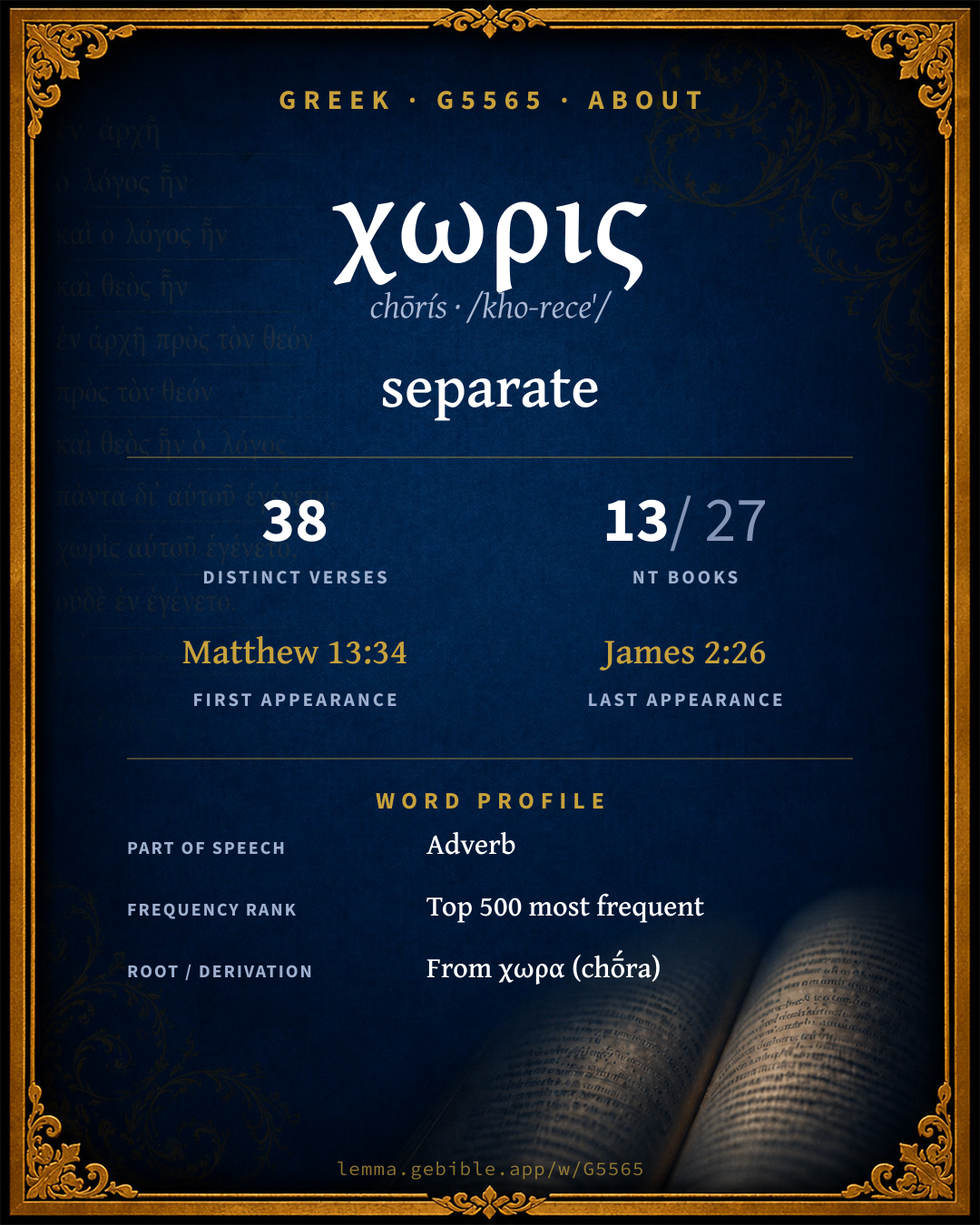
χωρίς
separate
Full lexicon entry — Thayer's Greek Lexicon
From Thayer's Greek Lexicon
Where this word appears
Grammar key — what these labels mean
Part of speech
- Adverb
- A word that modifies a verb, adjective, or other adverb.
Every verse where G5565 appears — 38 distinct verses across 13 books. Click any verse to open its interlinear word-by-word view. Verse text shown in the World English Bible for context — . Each verse’s Greek form is shown with its reference; the English is not keyword-highlighted, since the data carries no word-level English alignment. Use “Compare translations” on any verse to read it across multiple English versions. This concordance covers the Greek New Testament; Septuagint (Greek Old Testament) occurrences of this word are not indexed here.
Matthew 3 verses
- Matthew 13:34 χωρὶς adv Jesus spoke all these things in parables to the multitudes; and without a parable, he didn't speak to them,
- Matthew 14:21 χωρὶς adv Those who ate were about five thousand men, besides women and children.
- Matthew 15:38 χωρὶς adv Those who ate were four thousand men, besides women and children.
Mark 1 verse
Luke 1 verse
John 3 verses
- John 1:3 χωρὶς adv All things were made through him. Without him was not anything made that has been made.
- John 15:5 χωρὶς adv I am the vine. You are the branches. He who remains in me, and I in him, the same bears much fruit, for apart from me you can do nothing.
- John 20:7 χωρὶς adv and the cloth that had been on his head, not lying with the linen cloths, but rolled up in a place by itself.
Romans 6 verses
- Romans 3:21 χωρὶς adv But now apart from the law, a righteousness of God has been revealed, being testified by the law and the prophets;
- Romans 3:28 χωρὶς adv We maintain therefore that a man is justified by faith apart from the works of the law.
- Romans 4:6 χωρὶς adv Even as David also pronounces blessing on the man to whom God counts righteousness apart from works,
- Romans 7:8 χωρὶς adv But sin, finding occasion through the commandment, produced in me all kinds of coveting. For apart from the law, sin is dead.
- Romans 7:9 χωρὶς adv I was alive apart from the law once, but when the commandment came, sin revived, and I died.
- Romans 10:14 χωρὶς adv How then will they call on him in whom they have not believed? How will they believe in him whom they have not heard? How will they hear without a preacher?
1 Corinthians 2 verses
- 1 Corinthians 4:8 χωρὶς adv You are already filled. You have already become rich. You have come to reign without us. Yes, and I wish that you did reign, that we also might reign with you.
- 1 Corinthians 11:11 χωρὶς χωρὶς adv adv Nevertheless, neither is the woman independent of the man, nor the man independent of the woman, in the Lord.
2 Corinthians 2 verses
Ephesians 1 verse
Philippians 1 verse
1 Timothy 2 verses
- 1 Timothy 2:8 χωρὶς adv I desire therefore that the men in every place pray, lifting up holy hands without wrath and doubting.
- 1 Timothy 5:21 χωρὶς adv I charge you in the sight of God, and Christ Jesus, and the chosen angels, that you observe these things without prejudice, doing nothing by partiality.
Philemon 1 verse
Hebrews 12 verses
- Hebrews 4:15 χωρὶς adv For we don't have a high priest who can't be touched with the feeling of our infirmities, but one who has been in all points tempted like we are, yet without sin.
- Hebrews 7:7 χωρὶς adv But without any dispute the less is blessed by the better.
- Hebrews 7:20 χωρὶς χωρὶς adv adv Inasmuch as he was not made priest without the taking of an oath
- Hebrews 9:7 χωρὶς adv but into the second the high priest alone, once in the year, not without blood, which he offers for himself, and for the errors of the people.
- Hebrews 9:18 χωρὶς adv Therefore even the first covenant has not been dedicated without blood.
- Hebrews 9:22 χωρὶς adv According to the law, nearly everything is cleansed with blood, and apart from shedding of blood there is no remission.
- Hebrews 9:28 χωρὶς adv so Christ also, having been once offered to bear the sins of many, will appear a second time, without sin, to those who are eagerly waiting for him for salvation.
- Hebrews 10:28 χωρὶς adv A man who disregards Moses' law dies without compassion on the word of two or three witnesses.
- Hebrews 11:6 χωρὶς adv Without faith it is impossible to be well pleasing to him, for he who comes to God must believe that he exists, and that he is a rewarder of those who seek him.
- Hebrews 11:40 χωρὶς adv God having provided some better thing concerning us, so that apart from us they should not be made perfect.
- Hebrews 12:8 χωρίς adv But if you are without discipline, of which all have been made partakers, then are you illegitimate, and not children.
- Hebrews 12:14 χωρὶς adv Follow after peace with all men, and the sanctification without which no man will see the Lord,
James 3 verses
- James 2:18 χωρὶς adv Yes, a man will say, "You have faith, and I have works." Show me your faith from your works, and I by my works will show you my faith.
- James 2:20 χωρὶς adv But do you want to know, vain man, that faith apart from works is dead?
- James 2:26 χωρὶς χωρὶς adv adv For as the body apart from the spirit is dead, even so faith apart from works is dead.
About this entry
At a glance — auto-summarized from this page’s data, not written by a person. Every figure links to its source below. This summary describes the numbers; it doesn’t interpret them.
“separate” is the headline sense of the Greek verb χωρις (chōrís). First canonically at Matthew 13:34, it enters the text early. With 38 verses in 13 books, it is a moderately common word in the Greek New Testament. It concentrates in Hebrews, which alone accounts for 32% of its uses. It clusters with χωρα, ευρυχωρος and χωρεω under a shared root. The sections below give every sense, occurrence, and version rendering.
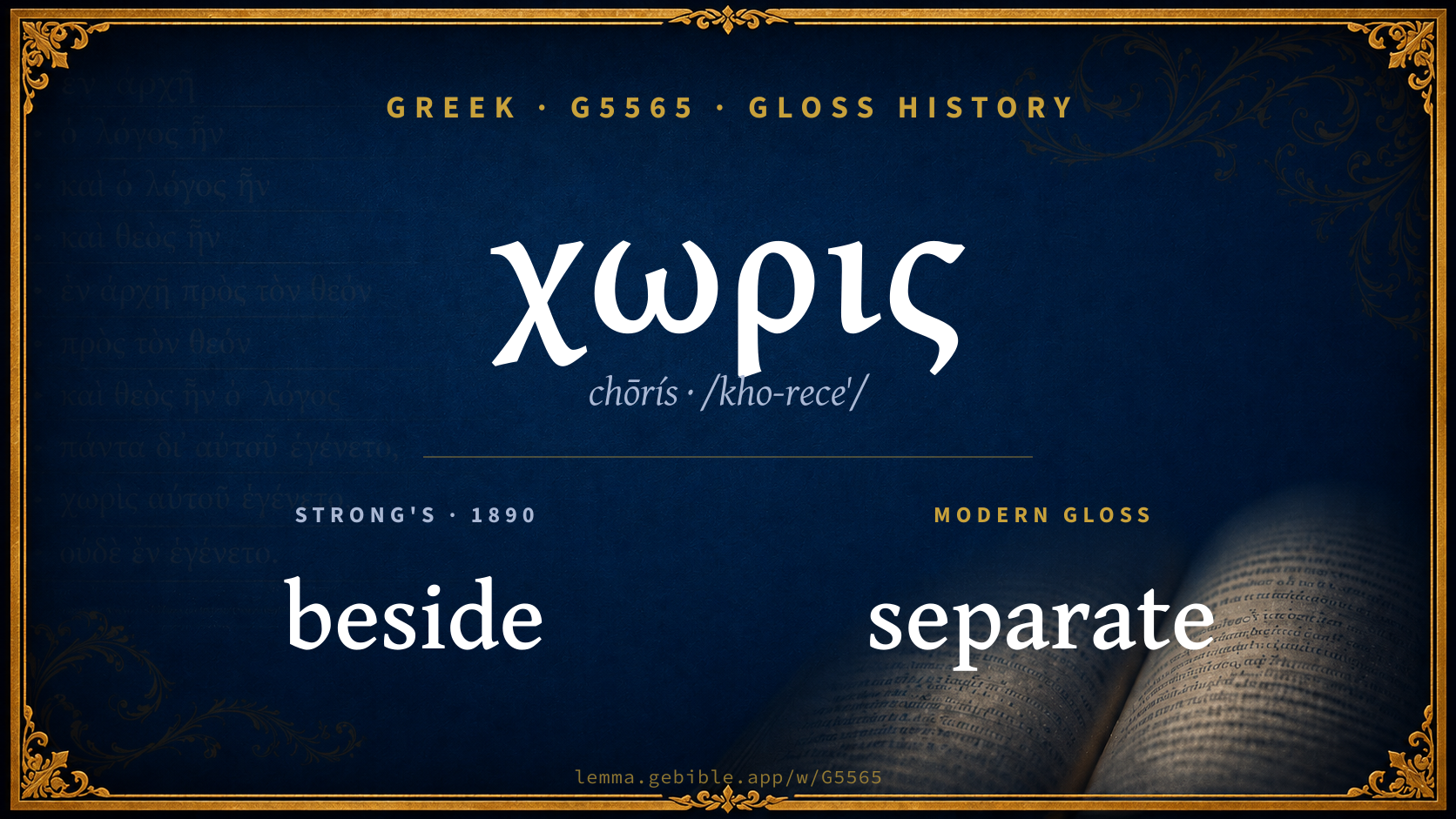
Gloss history
Strong's 1890 vs modern scholarship
About this word
Strong's G5565 catalogs a Greek word from the Greek New Testament.
These counts are not copied from any lexicon or concordance. They are computed here, from the morphology-tagged Greek New Testament. What Lemma adds →
- 38
- distinct verses
- The word appears in 38 distinct verses.
- 13 / 27
- NT books
- The word appears in 13 of 27 New Testament books.
- #364
- by frequency
- Top 500 most frequent Greek words (rank 364 of 5,347 Greek words by occurrence).
View all 38 occurrences in the concordance →
By section of the New Testament
By traditional corpus
Conventional, traditional groupings — biblical authorship is debated, so this is a traditional corpus grouping, not an authorship claim. Some books belong to more than one corpus (Luke is in both the Gospels and the Lukan corpus, and so on), so these shares overlap and need not total 100%. Each figure is a share of the word’s 38 distinct verses.
- Pauline corpus 15 verses · 39%
- Hebrews 12 verses · 32%
- Gospels 8 verses · 21%
- Johannine 3 verses · 8%
- General (Catholic) Epistles 3 verses · 8%
- Lukan (Luke–Acts) 1 verse · 3%
How translations render this word
Counts come from each version’s own published word-to-Strong’s tagging or interlinear alignment — an approximate guide to how each version renders this word, not a word-level alignment the data otherwise carries. Because each total is that version’s own tagged count, the per-version totals vary from one another and need not match the appearance or distinct-verse counts above. These counts may also differ from a printed concordance because Lemma counts each distinctly tagged rendering and does not collapse phrase taggings into a single head-word total. This is a fixed set of word-tagged versions (KJV, ASV, BSB, ULT) and does not change with the reading translation you choose elsewhere. Each version’s license is shown beside its name below (and on Sources).
- King James Version: Without 34×, Beside 3×
- American Standard Version: Without 21×, Apart 12×, Besides 3×
- Berean Standard Bible: Without 21×, Apart from 7×, Besides 2×
- unfoldingWord Literal Text: Without 27×, Apart from 8×, Besides 2×
King James Version Public Domain
Renders G5565 across 38 tagged occurrences — most commonly:
Plus 1 rendering that appears only once — usually multi-word phrases or single function words the recovered tagging swept in, not distinct renderings. Not rendered by a distinct English word in 1 further occurrence.
American Standard Version Public Domain
Renders G5565 across 39 tagged occurrences — most commonly:
Plus 3 renderings that appear only once — usually multi-word phrases or single function words the recovered tagging swept in, not distinct renderings.
Berean Standard Bible Public Domain
Renders G5565 across 38 tagged occurrences — most commonly:
Plus 4 renderings that appear only once — usually multi-word phrases or single function words the recovered tagging swept in, not distinct renderings. Not rendered by a distinct English word in 2 further occurrences.
unfoldingWord Literal Text CC BY-SA 4.0
Renders G5565 across 41 tagged occurrences — most commonly:
Plus 2 renderings that appear only once — usually multi-word phrases or single function words the recovered tagging swept in, not distinct renderings.
Senses in Thayer's
The 1 sense Thayer's distinguishes for this word, in lexicon order (not ranked by frequency or importance). The full entry — with sub-senses — is in the Lexicon Entry tab.
- separate, apart
Word origin
Derived from χωρα (chṓra) (G5561) — region.
Adverb from G5561 ; at a space that is separately or apart from (often as preposition): - beside by itself without.
— Strong’s Exhaustive Concordance (1890), public domain.
Forms in the corpus
The 2 distinct written forms G5565 takes in the Greek New Testament, most frequent first — each parse links to that case’s occurrences in the concordance.
| Form | Parsing | Example | Uses |
|---|---|---|---|
| χωρὶς chōrìs | Adverb | Matthew 13:34 | 40 |
| χωρίς chōrís | Adverb | Hebrews 12:8 | 1 |
Same root — word family
Other Thayer's entries built from the same root as G5565, grouped by Strong’s listed origin. These share a root / origin per the lexicon — not necessarily a shared meaning. Each links to that word’s own entry.
Derives from
Shares the same root
- ευρυχωρος eurýchōros G2149 broad
- χωρεω chōréō G5562 to make room
- χωριζω chōrízō G5563 to separate
- χωριον chōríon G5564 field
Compare all same-root words → Showing 4 of 6 — not the complete family. They share a root, not necessarily a meaning.
Septuagint usage
The same Greek word χωρις appears 10 times in the Greek Old Testament (Septuagint), across 10 verses in 5 books.
- 10
- LXX occurrences
- Tagged occurrences of this Greek word in the Septuagint.
- 10
- verses
- Distinct Septuagint verses containing this word.
- 5 / 39
- OT books
- The word appears in 5 of the 39 Old Testament books.
Sample Septuagint occurrences
- Genesis 26:1 χωρίς
- Leviticus 9:17 χωρίς
- Numbers 6:21 χωρίς
- 1 Kings 5:30 χωρίς
- Ezra 2:65 χωρίς
Septuagint occurrences (same lexeme)
Every verse where the same Strong’s number (G5565) appears in the Greek Septuagint. Verse text shown in the World English Bible for context; the Greek form is the matched word — the English is not keyword-highlighted.
- Genesis 26:1 χωρίς There was a famine in the land, besides the first famine that was in the days of Abraham. Isaac went to Abimelech king of the Philistines, to Gerar.
- Genesis 46:26 χωρίς All the souls who came with Jacob into Egypt, who were his direct descendants, besides Jacob's sons' wives, all the souls were sixty-six.
- Genesis 47:22 χωρίς Only he didn't buy the land of the priests, for the priests had a portion from Pharaoh, and ate their portion which Pharaoh gave them. That is why they didn't sell their land.
- Genesis 47:26 χωρίς Joseph made it a statute concerning the land of Egypt to this day, that Pharaoh should have the fifth. Only the land of the priests alone didn't become Pharaoh's.
- Leviticus 9:17 χωρίς He presented the meal offering, and filled his hand from there, and burned it upon the altar, besides the burnt offering of the morning.
- Numbers 6:21 χωρίς "This is the law of the Nazirite who vows, and of his offering to Yahweh for his separation, besides that which he is able to get. According to his vow which he vows, so he must do after the law of his separation."
- Numbers 17:14 χωρίς
- 1 Kings 5:30 χωρίς
- 1 Kings 10:15 χωρίς besides [that which] the traders [brought], and the traffic of the merchants, and of all the kings of the mixed people, and of the governors of the country.
- Ezra 2:65 χωρίς besides their men-servants and their maid-servants, of whom there were seven thousand three hundred thirty-seven: and they had two hundred singing men and singing women.
These are occurrences of the same Greek lexeme (G5565) in the Septuagint — not a translation of any one Hebrew word. The store carries no word-level Hebrew↔Greek alignment, so no Hebrew original is asserted here. Counts come from the recovered LXX Strong's tagging — high-frequency vocabulary is well covered, while rare or late forms may be untagged — so they reflect tagged occurrences and may slightly undercount.