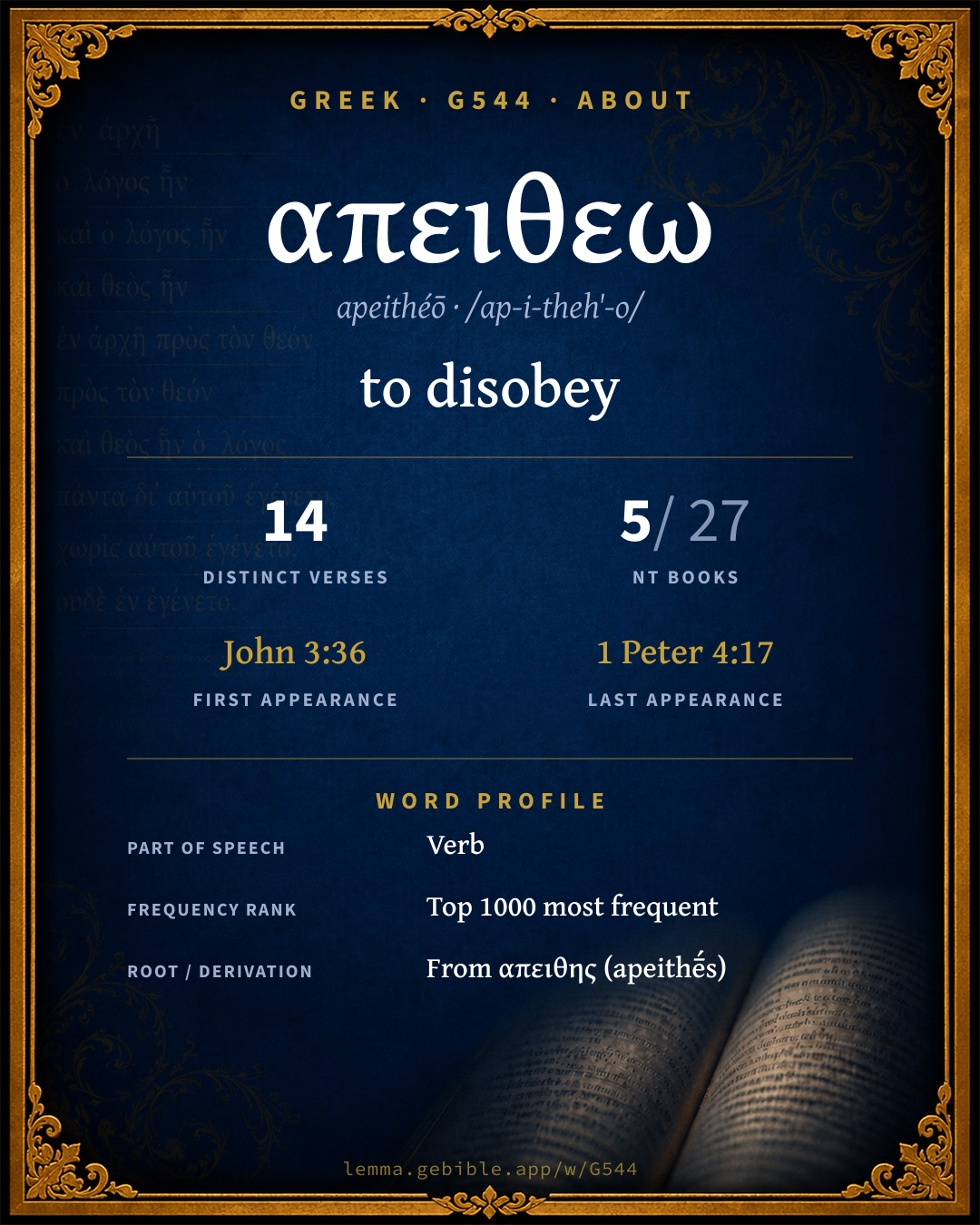
ἀπειθέω
to disobey
‘to disobey’ is one of 2 main senses fuller range ↓
Full lexicon entry — Thayer's Greek Lexicon
From Thayer's Greek Lexicon
Where this word appears
See every Present-tense verb in the Greek New Testament →
Grammar key — what these labels mean
Part of speech
- Verb
- An action or state-of-being word.
Tense
- Aorist
- Action viewed as a simple whole, without regard to duration — often past (perfective aspect).
- Present
- Ongoing or general action in present time (imperfective aspect).
- Imperfect
- Continuous or repeated action in past time (“was writing”).
Voice
- Active
- The subject performs the action.
Mood
- Participle
- A verbal adjective (“writing,” “having written”).
- Indicative
- States a fact or asks a factual question (the mood of reality).
Case
- Dative
- The case of the indirect object, means, or location — “to / for / with / in.”
- Genitive
- The case of source, possession, or “of” — answers “whose / from what.”
- Nominative
- The case of the subject (and the predicate nominative).
- Accusative
- The case of the direct object and of extent.
Person
- 2nd person
- The one addressed (“you”).
- 3rd person
- The one spoken about (“he / she / it / they”).
Gender
- Masculine
- Grammatically masculine.
Number
- Plural
- More than one.
- Singular
- One.
Grammatical forms 11 distinct
- Verb, Aorist, Active, Participle, Dative, Plural, Masculine 3 times (21%)
- Verb, Present, Active, Participle, Genitive, Plural, Masculine 2 times (14%)
- Verb, Aorist, Active, Indicative, 2nd person, Plural 1 time (7%)
- Verb, Aorist, Active, Indicative, 3rd person, Plural 1 time (7%)
- Verb, Aorist, Active, Participle, Nominative, Plural, Masculine 1 time (7%)
- Verb, Imperfect, Active, Indicative, 3rd person, Plural 1 time (7%)
- Verb, Present, Active, Indicative, 3rd person, Plural 1 time (7%)
- Verb, Present, Active, Participle, Accusative, Singular, Masculine 1 time (7%)
+3 more forms (3 occurrences)
Parsed forms decoded from the imported morphology (Robinson–Tischendorf, public domain), counted across 14 parsed occurrences — not distinct verses.
Every verse where G544 appears — 14 distinct verses across 5 books. Click any verse to open its interlinear word-by-word view. Verse text shown in the World English Bible for context — . Each verse’s Greek form is shown with its reference; the English is not keyword-highlighted, since the data carries no word-level English alignment. Use “Compare translations” on any verse to read it across multiple English versions. This concordance covers the Greek New Testament; Septuagint (Greek Old Testament) occurrences of this word are not indexed here.
John 1 verse
Acts 2 verses
- Acts 14:2 ἀπειθήσαντες aor act ptcp nom pl masc But the disbelieving Jews stirred up and embittered the souls of the Gentiles against the brothers.
- Acts 19:9 ἠπείθουν impf act ind 3pl But when some were hardened and disobedient, speaking evil of the Way before the multitude, he departed from them, and separated the disciples, reasoning daily in the school of Tyrannus.
Romans 5 verses
- Romans 2:8 ἀπειθοῦσι pres act ptcp dat pl masc but to those who are self-seeking, and don't obey the truth, but obey unrighteousness, will be wrath and indignation,
- Romans 10:21 ἀπειθοῦντα pres act ptcp acc sg masc But as to Israel he says, "All day long I stretched out my hands to a disobedient and contrary people."
- Romans 11:30 ἠπειθήσατε aor act ind 2pl For as you in time past were disobedient to God, but now have obtained mercy by their disobedience,
- Romans 11:31 ἠπείθησαν aor act ind 3pl even so these also have now been disobedient, that by the mercy shown to you they may also obtain mercy.
- Romans 15:31 ἀπειθούντων pres act ptcp gen pl masc that I may be delivered from those who are disobedient in Judea, and that my service which I have for Jerusalem may be acceptable to the saints;
Hebrews 2 verses
- Hebrews 3:18 ἀπειθήσασιν aor act ptcp dat pl masc To whom did he swear that they wouldn't enter into his rest, but to those who were disobedient?
- Hebrews 11:31 ἀπειθήσασιν aor act ptcp dat pl masc By faith, Rahab the prostitute, didn't perish with those who were disobedient, having received the spies in peace.
1 Peter 4 verses
- 1 Peter 2:8 ἀπειθοῦντες pres act ptcp nom pl masc and, "A stone of stumbling, and a rock of offense." For they stumble at the word, being disobedient, whereunto also they were appointed.
- 1 Peter 3:1 ἀπειθοῦσιν pres act ind 3pl In like manner, wives, be in subjection to your own husbands; so that, even if any don't obey the Word, they may be won by the behavior of their wives without a word;
- 1 Peter 3:20 ἀπειθήσασίν aor act ptcp dat pl masc who before were disobedient, when God waited patiently in the days of Noah, while the ark was being built. In it, few, that is, eight souls, were saved through water.
- 1 Peter 4:17 ἀπειθούντων pres act ptcp gen pl masc For the time has come for judgment to begin at the house of God. If it begins first with us, what will happen to those who don't obey the Gospel of God?
About this entry
At a glance — auto-summarized from this page’s data, not written by a person. Every figure links to its source below. This summary describes the numbers; it doesn’t interpret them.
The Greek verb απειθεω centers on the idea of “to disobey.” Its earliest occurrence is John 3:36. It turns up in 14 verses across 5 books, an uncommon footprint. The word gravitates to Romans (36%), then 1 Peter and Acts. Thayer's distinguishes 2 senses for it. Each statement above links to its evidence; the full detail follows below.
Gloss history
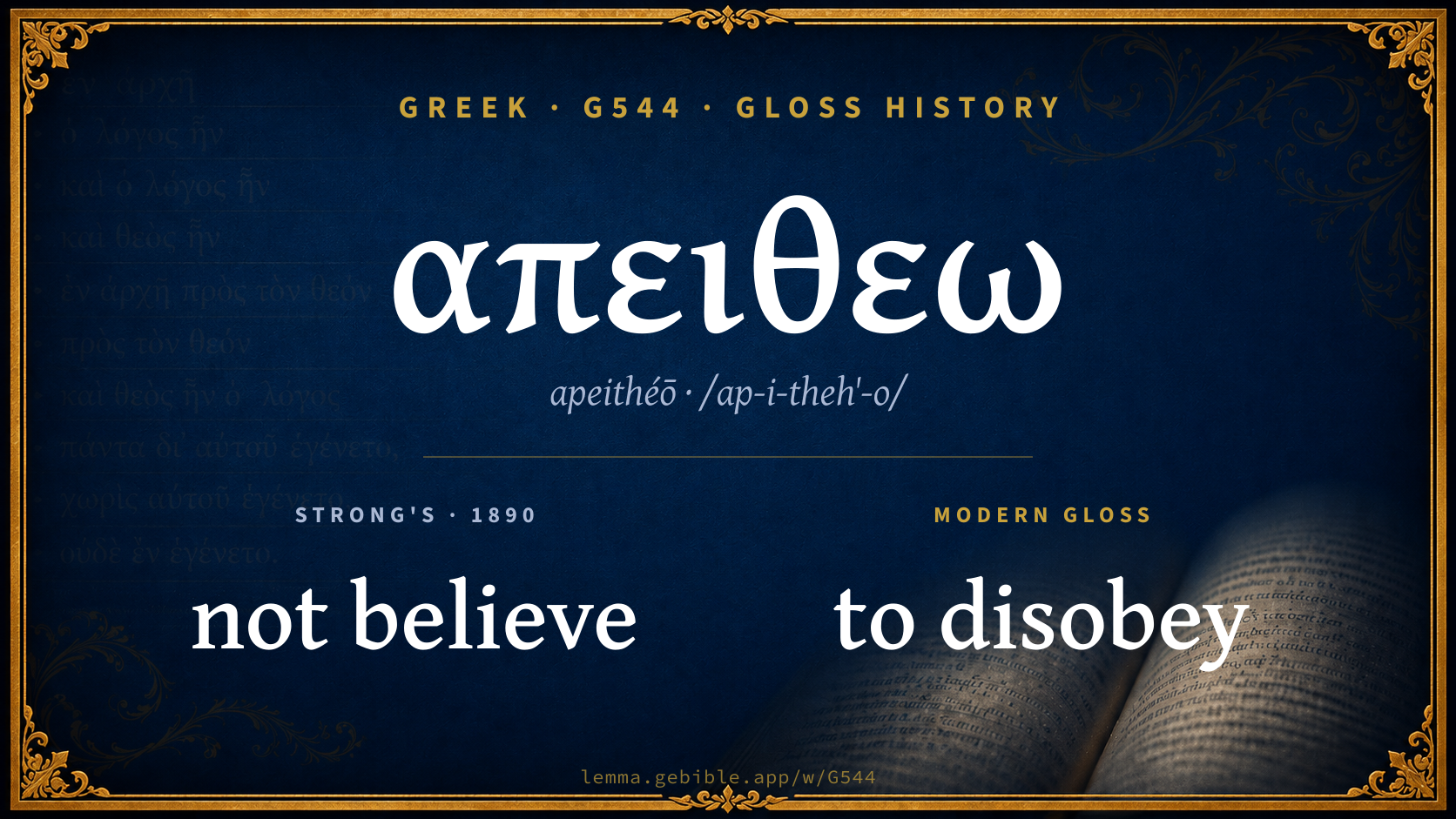
Strong's 1890 vs modern scholarship
About this word
Strong's G544 catalogs a Greek word from the Greek New Testament.
These counts are not copied from any lexicon or concordance. They are computed here, from the morphology-tagged Greek New Testament. What Lemma adds →
- 14
- distinct verses
- The word appears in 14 distinct verses.
- 5 / 27
- NT books
- The word appears in 5 of 27 New Testament books.
- #814
- by frequency
- Top 1000 most frequent Greek words (rank 814 of 5,347 Greek words by occurrence).
View all 14 occurrences in the concordance →
By section of the New Testament
By traditional corpus
Conventional, traditional groupings — biblical authorship is debated, so this is a traditional corpus grouping, not an authorship claim. Some books belong to more than one corpus (Luke is in both the Gospels and the Lukan corpus, and so on), so these shares overlap and need not total 100%. Each figure is a share of the word’s 14 distinct verses.
- Pauline corpus 5 verses · 36%
- General (Catholic) Epistles 4 verses · 29%
- Lukan (Luke–Acts) 2 verses · 14%
- Hebrews 2 verses · 14%
- Gospels 1 verse · 7%
- Johannine 1 verse · 7%
How translations render this word
Counts come from each version’s own published word-to-Strong’s tagging or interlinear alignment — an approximate guide to how each version renders this word, not a word-level alignment the data otherwise carries. Because each total is that version’s own tagged count, the per-version totals vary from one another and need not match the appearance or distinct-verse counts above. These counts may also differ from a printed concordance because Lemma counts each distinctly tagged rendering and does not collapse phrase taggings into a single head-word total. This is a fixed set of word-tagged versions (KJV, ASV, BSB, ULT) and does not change with the reading translation you choose elsewhere. Each version’s license is shown beside its name below (and on Sources).
- King James Version: Believed not 4×
- American Standard Version: Were disobedient 5×, Disobedient 2×, Obey not 2×
- Berean Standard Bible: Disobeyed 3×
- unfoldingWord Literal Text: Disobeying 5×, Having disobeyed 3×, Disobedient 2×
King James Version Public Domain
Renders G544 across 17 tagged occurrences — most commonly:
Plus 13 renderings that appear only once — usually multi-word phrases or single function words the recovered tagging swept in, not distinct renderings.
American Standard Version Public Domain
Renders G544 across 16 tagged occurrences — most commonly:
Plus 7 renderings that appear only once — usually multi-word phrases or single function words the recovered tagging swept in, not distinct renderings.
Berean Standard Bible Public Domain
Renders G544 across 14 tagged occurrences — most commonly:
Plus 11 renderings that appear only once — usually multi-word phrases or single function words the recovered tagging swept in, not distinct renderings.
unfoldingWord Literal Text CC BY-SA 4.0
Renders G544 across 16 tagged occurrences — most commonly:
Plus 6 renderings that appear only once — usually multi-word phrases or single function words the recovered tagging swept in, not distinct renderings.
Senses in Thayer's
The 2 senses Thayer's distinguishes for this word, in lexicon order (not ranked by frequency or importance). The full entry — with sub-senses — is in the Lexicon Entry tab.
- not to allow one's self to be persuaded
- not to comply with
Word origin
Derived from απειθης (apeithḗs) (G545) — disobedient.
From G545 ; to disbelieve (wilfully and perversely): - not believe disobedient obey not unbelieving.
— Strong’s Exhaustive Concordance (1890), public domain.
Forms in the corpus
The 12 distinct written forms G544 takes in the Greek New Testament, most frequent first — each parse links to that tense’s occurrences in the concordance.
Same root — word family
Other Thayer's entries built from the same root as G544, grouped by Strong’s listed origin. These share a root / origin per the lexicon — not necessarily a shared meaning. Each links to that word’s own entry.
Derives from
Shares the same root
Compare all same-root words → They share a root, not necessarily a meaning.
Septuagint usage
The same Greek word απειθεω appears 34 times in the Greek Old Testament (Septuagint), across 33 verses in 14 books.
- 34
- LXX occurrences
- Tagged occurrences of this Greek word in the Septuagint.
- 33
- verses
- Distinct Septuagint verses containing this word.
- 14 / 39
- OT books
- The word appears in 14 of the 39 Old Testament books.
Sample Septuagint occurrences
- Exodus 23:21 ἀπειθέω
- Leviticus 26:15 ἀπειθέω
- Numbers 11:20 ἀπειθέω
- Deuteronomy 1:26 ἀπειθέω
- Joshua 1:18 ἀπειθέω
- 2 Kings 5:16 ἀπειθέω
- Ezra 19:29 ἀπειθέω
- Psalms 67:19 ἀπειθέω
- Proverbs 1:25 ἀπειθέω
- Isaiah 1:23 ἀπειθέω
- Jeremiah 13:25 ἀπειθέω
- Ezekiel 3:27 ἀπειθέω
Septuagint occurrences (same lexeme)
Every verse where the same Strong’s number (G544) appears in the Greek Septuagint. Verse text shown in the World English Bible for context; the Greek form is the matched word — the English is not keyword-highlighted.
- Exodus 23:21 ἀπειθέω Pay attention to him, and listen to his voice. Don't provoke him, for he will not pardon your disobedience, for my name is in him.
- Leviticus 26:15 ἀπειθέω and if you shall reject my statutes, and if your soul abhors my ordinances, so that you will not do all my commandments, but break my covenant;
- Numbers 11:20 ἀπειθέω but a whole month, until it come out at your nostrils, and it be loathsome to you; because that you have rejected Yahweh who is among you, and have wept before him, saying, Why came we forth out of Egypt?
- Numbers 14:43 ἀπειθέω For there the Amalekite and the Canaanite are before you, and you shall fall by the sword: because you are turned back from following Yahweh, therefore Yahweh will not be with you.
- Deuteronomy 1:26 ἀπειθέω Yet you wouldn't go up, but rebelled against the commandment of Yahweh your God:
- Deuteronomy 9:7 ἀπειθέω Remember, don't forget, how you provoked Yahweh your God to wrath in the wilderness: from the day that you went forth out of the land of Egypt, until you came to this place, you have been rebellious against Yahweh.
- Deuteronomy 9:23 ἀπειθέω When Yahweh sent you from Kadesh-barnea, saying, Go up and possess the land which I have given you; then you rebelled against the commandment of Yahweh your God, and you didn't believe him, nor listen to his voice.
- Deuteronomy 9:24 ἀπειθέω You have been rebellious against Yahweh from the day that I knew you.
- Deuteronomy 21:20 ἀπειθέω and they shall tell the elders of his city, This our son is stubborn and rebellious, he will not obey our voice; he is a glutton, and a drunkard.
- Deuteronomy 32:51 ἀπειθέω because you trespassed against me in the midst of the children of Israel at the waters of Meribah of Kadesh, in the wilderness of Zin; because you didn't sanctify me in the midst of the children of Israel.
- Joshua 1:18 ἀπειθέω Whoever he be who shall rebel against your commandment, and shall not listen to your words in all that you command him, he shall be put to death: only be strong and of good courage.
- Joshua 5:6 ἀπειθέω For the children of Israel walked forty years in the wilderness, until all the nation, even the men of war who came forth out of Egypt, were consumed, because they didn't listen to the voice of Yahweh: to whom Yahweh swore that he wouldn't let them see the land which Yahweh swore to their fathers that he would give us, a land flowing with milk and honey.
- 2 Kings 5:16 ἀπειθέω But he said, As Yahweh lives, before whom I stand, I will receive none. He urged him to take it; but he refused.
- Ezra 19:29 ἀπειθέω
- Psalms 67:19 ἀπειθέω
- Proverbs 1:25 ἀπειθέω But you have ignored all my counsel, And wanted none of my reproof;
- Proverbs 24:21 ἀπειθέω My son, fear Yahweh and the king. Don't join those who are rebellious:
- Isaiah 1:23 ἀπειθέω Your princes are rebellious, and companions of thieves. Everyone loves bribes, and follows after rewards. They don't judge the fatherless, Neither does the cause of the widow come to them.
- Isaiah 1:25 ἀπειθέω And I will turn my hand on you, Thoroughly purge away your dross, And will take away all your tin.
- Isaiah 3:8 ἀπειθέω For Jerusalem is ruined, and Judah is fallen; Because their tongue and their doings are against Yahweh, To provoke the eyes of his glory.
- Isaiah 8:11 ἀπειθέω For Yahweh spoke thus to me with a strong hand, and instructed me not to walk in the way of this people, saying,
- Isaiah 30:12 ἀπειθέω Therefore thus says the Holy One of Israel, "Because you despise this word, and trust in oppression and perverseness, and rely thereon;
- Isaiah 33:2 ἀπειθέω Yahweh, be gracious to us; we have waited for you: be our arm every morning, our salvation also in the time of trouble.
- Isaiah 36:5 ἀπειθέω I say, [your] counsel and strength for the war are but vain words: now on whom do you trust, that you have rebelled against me?
- Isaiah 50:5 ἀπειθέω The Lord Yahweh has opened my ear, and I was not rebellious, neither turned away backward.
- Isaiah 59:13 ἀπειθέω transgressing and denying Yahweh, and turning away from following our God, speaking oppression and revolt, conceiving and uttering from the heart words of falsehood.
- Isaiah 63:10 ἀπειθέω But they rebelled, and grieved his holy Spirit: therefore he was turned to be their enemy, [and] himself fought against them.
- Isaiah 65:2 ἀπειθέω I have spread out my hands all the day to a rebellious people, who walk in a way that is not good, after their own thoughts;
- Isaiah 66:14 ἀπειθέω You shall see [it], and your heart shall rejoice, and your bones shall flourish like the tender grass: and the hand of Yahweh shall be known toward his servants; and he will have indignation against his enemies.
- Jeremiah 13:25 ἀπειθέω This is your lot, the portion measured to you from me, says Yahweh; because you have forgotten me, and trusted in falsehood.
- Ezekiel 3:27 ἀπειθέω But when I speak with you, I will open your mouth, and you shall tell them, Thus says the Lord Yahweh: He who hears, let him hear; and he who forbears, let him forbear: for they are a rebellious house.
- Hosea 9:15 ἀπειθέω "All their wickedness is in Gilgal; For there I hated them. Because of the wickedness of their deeds I will drive them out of my house! I will love them no more. All their princes are rebels.
- Zechariah 7:11 ἀπειθέω But they refused to listen, and turned their backs, and stopped their ears, that they might not hear.
These are occurrences of the same Greek lexeme (G544) in the Septuagint — not a translation of any one Hebrew word. The store carries no word-level Hebrew↔Greek alignment, so no Hebrew original is asserted here. Counts come from the recovered LXX Strong's tagging — high-frequency vocabulary is well covered, while rare or late forms may be untagged — so they reflect tagged occurrences and may slightly undercount.