
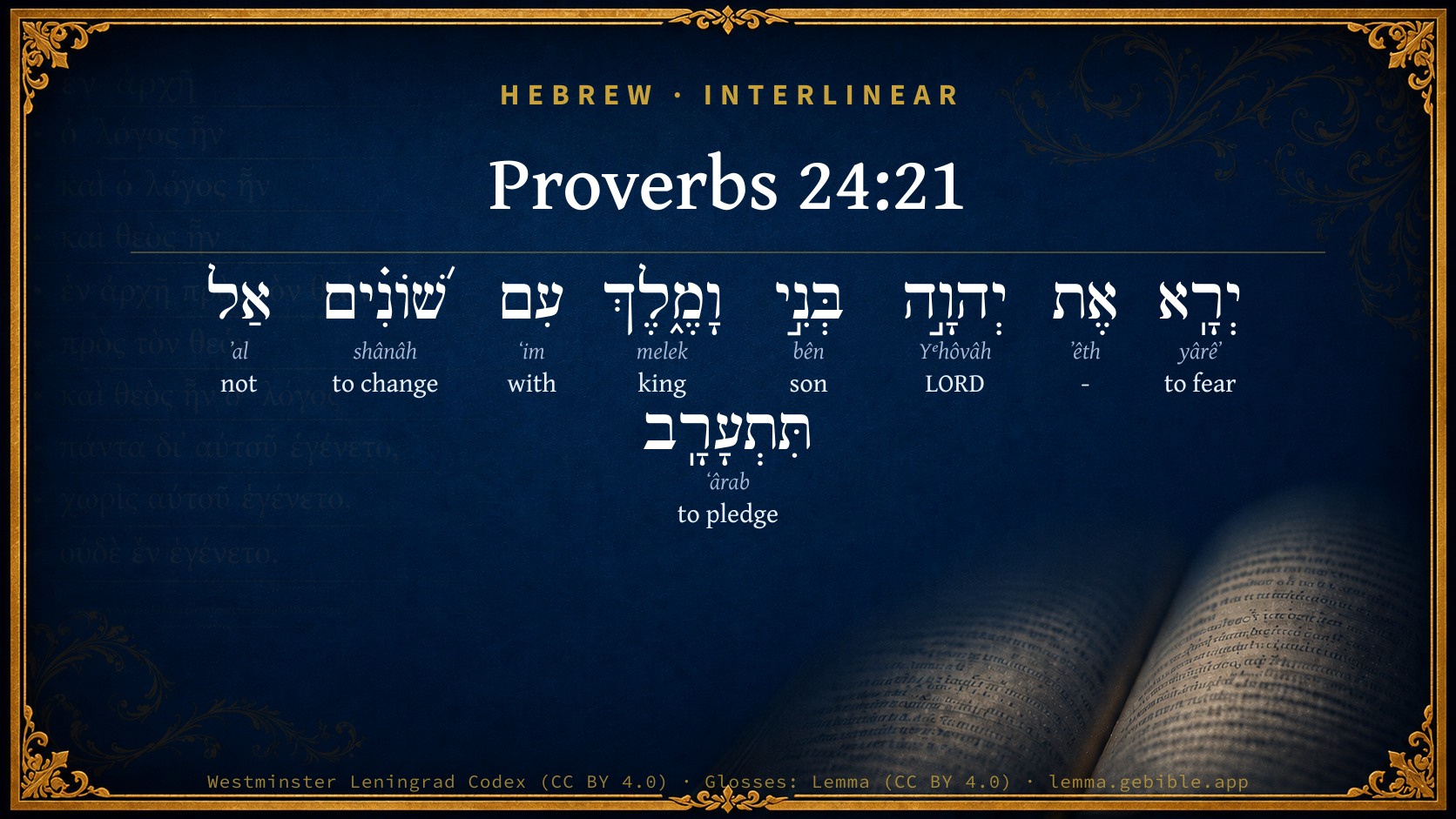
Proverbs 24:21

Hebrew (Westminster Leningrad Codex) Proverbs 24:21 appears in the Hebrew Old Testament. The text above is from the Westminster Leningrad Codex. Each word links to its Strong’s number, a concise gloss, and parsing drawn from the Open Scriptures Hebrew Bible morphology. Click any word for its full Brown-Driver-Briggs (BDB) entry.
Download image
Cite this verse

Proverbs 24:21 (World English Bible). Public Domain. Lemma interlinear Bible study tool, https://lemma.gebible.app/v/proverbs/24/21.

Show BibTeX & RIS
BibTeX
RIS
English Translation
My son, fear Yahweh and the king. Don't join those who are rebellious:
World English Bible · Public Domain
Download a study sheet

One document with this verse’s original text, its word-by-word gloss line, the meaning frame, cross-references with their text, attributed commentary, and full source and license credits — printable, and it pastes into notes with its structure intact.

This verse Autodidact and up

Study sheet (.html) Plain text (.txt)

A passage Seminary Student

Up to 50 verses in one chapter. A passage sheet keeps up to 6 commentary sources and 12 cross-references per verse, in the order this page ranks them, and says so on the sheet whenever that leaves anything out. Ask for a single verse and you get the Autodidact verse sheet above.

Everything on this page stays free to read, with no account — the sheet is a download of what is already on screen, not access to it.

Want to remove ads? Support Godless Engineer
Compare translations 3

The same verse in 3 English versions, stacked beneath the original-language interlinear above. Click any original word for its lexicon entry.

Each is an independent rendering of the whole verse — the interlinear is not word-aligned to these translations.

Highlighted words mark where these versions differ — a whole-verse word diff, not a word-by-word alignment.

  • World English Bible Public Domain
    My son, fear Yahweh and the king. Don't join those who are rebellious:
  • King James Version Public Domain
    My son, fear thou the LORD and the king: and meddle not with them that are given to change:
  • unfoldingWord Literal Text CC BY-SA 4.0
    My son, fear Yahweh and the king; do not associate with ones who change.

unfoldingWord Literal Text — © unfoldingWord, licensed CC BY-SA 4.0. Word-aligned USFM3 via Door43 (git.door43.org/unfoldingWord/en_ult).

Versions to compare (up to 4)

3 of 4 selected

Show all 18 translations

Every available English version of this verse, each an independent rendering of the whole verse.

  • World English Bible Public Domain
    My son, fear Yahweh and the king. Don't join those who are rebellious:
  • Berean Standard Bible Public Domain
    My son, fear the LORD and the king, and do not associate with the rebellious.
  • Majority Standard Bible Public Domain
    My son, fear the LORD and the king, and do not associate with the rebellious.
  • King James Version Public Domain
    My son, fear thou the LORD and the king: and meddle not with them that are given to change:
  • American Standard Version (1901) Public Domain
    My son, fear thou Jehovah and the king; `And' company not with them that are given to change:
  • Revised Version (1885) Public Domain
    My son, fear thou the LORD and the king: and meddle not with them that are given to change:
  • Geneva Bible (1599) Public Domain
    My sonne feare the Lord, and the King, and meddle not with them that are sedicious.
  • Douay-Rheims (1899) Public Domain
    My son, fear the Lord and the king: and have nothing to do with detracters.
  • Young's Literal Translation Public Domain
    Fear Jehovah, my son, and the king, With changers mix not up thyself,
  • Literal Standard Version CC BY-SA 4.0
    Fear YHWH, my son, and the king, || Do not mix yourself up with changers,
  • Unlocked Literal Bible CC BY-SA 4.0
    Fear Yahweh, and fear the king, my son; do not associate with those who rebel against them,
  • unfoldingWord Literal Text CC BY-SA 4.0
    My son, fear Yahweh and the king; do not associate with ones who change.
  • Darby Bible Public Domain
    My son, fear Jehovah and the king: meddle not with them that are given to change.
  • World Messianic Bible Public Domain
    My son, fear the LORD and the king. Don’t join those who are rebellious,
  • Webster's Bible Public Domain
    My son, fear thou the LORD and the king: and meddle not with them that are given to change:
  • Free Bible Version CC BY-SA 4.0
    My son, honor the Lord and the king, and don't join those who are rebellious,
  • Bible in Basic English Public Domain
    My son, go in fear of the Lord and the king: have nothing to do with those who are in high positions:
  • JPS Tanakh (1917) Public Domain
    My son, fear thou the LORD and the king, and meddle not with them that are given to change;

Literal Standard Version (2020), Covenant Press — licensed CC BY-SA 4.0. Text via the HelloAO Bible API (eBible.org). Unlocked Literal Bible (unfoldingWord) — licensed CC BY-SA 4.0. Text via the HelloAO Bible API (eBible.org). unfoldingWord Literal Text — © unfoldingWord, licensed CC BY-SA 4.0. Word-aligned USFM3 via Door43 (git.door43.org/unfoldingWord/en_ult). Free Bible Version, Dr. Jonathan Gallagher — licensed CC BY-SA 4.0. Text via the HelloAO Bible API (eBible.org).

Word by word

More ways to search: Search by grammar → Find every occurrence → Compare this word →

Practice this passage: Drill this verse → Learn its vocabulary →

About this verse

These counts appear in no published source. They are computed here, from the morphology-tagged text and Lemma’s own curated glosses. What Lemma adds →

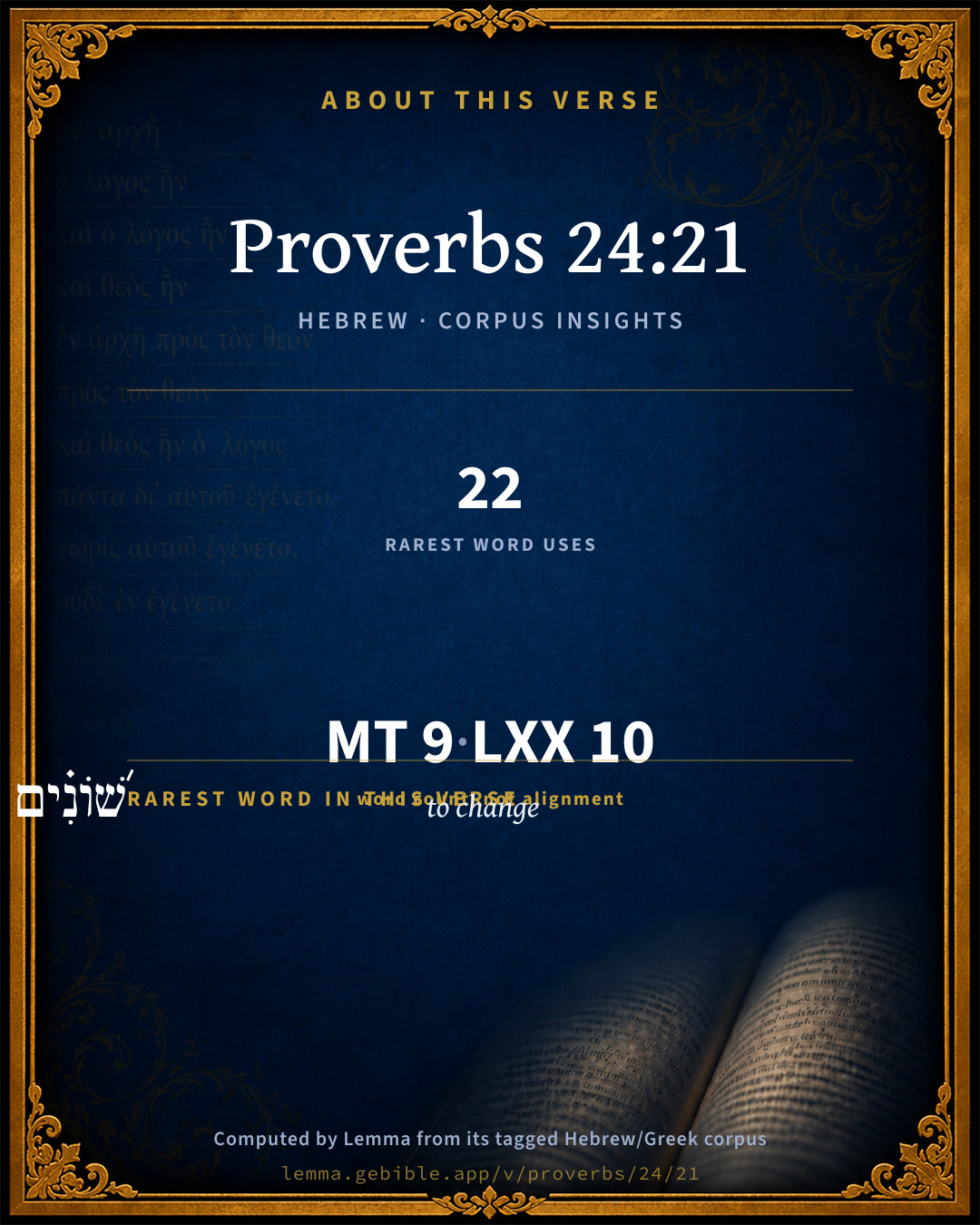
9
words
9
distinct lemmas
Wisdom
section

Notable vocabulary

The rarest word here is שׁ֝וֹנִ֗ים to change H8138 — appearing just 22 times in the whole Hebrew Bible.

Shared distinctive vocabulary

שׁ֝וֹנִ֗ים to change H8138 occurs in 21 verses of the Hebrew Bible. Also found in:

Grammatical profile

  • 3 verbs
  • 3 nouns
  • 1 preposition
  • 2 particles

Verb forms

  • יְרָֽא Qal · Imperative
  • שׁ֝וֹנִ֗ים Qal · Participle Active
  • תִּתְעָרָֽב Hithpael · Jussive

Hebrew & Septuagint length

In English translation the verse runs 13 words from the Hebrew and 14 from the Septuagint (LXX English) — closely comparable.

A rough comparison of the two English renderings, which tokenize alike — not a word-level alignment.

Word counts can differ between the Hebrew and the Greek without any difference in meaning — e.g. the Hebrew direct-object marker אֵת has no separate Greek word, and Greek often adds the article ὁ.

In the original languages it is 9 Hebrew tokens and 10 Greek tokens — but the two are counted differently (Hebrew bundles its prefixes and suffixes into one token; the Greek is in lemma form), so that isn’t a like-for-like length.

Cross-references

12

Topical passages linked to Proverbs 24:21 in the Treasury of Scripture Knowledge — connected by theme and wording, ordered by reader-vote popularity; previews shown in the World English Bible.

  • Romans 13:1–7 Let every soul be in subjection to the higher authorities, for there is no authority except from God, and those who exist are ordained by God.
  • 1 Peter 2:13–17 Therefore subject yourselves to every ordinance of man for the Lord's sake: whether to the king, as supreme;
  • 1 Kings 12:16 When all Israel saw that the king didn't listen to them, the people answered the king, saying, What portion have we in David? neither have we inheritance in the son of Jesse: to your tents, Israel: now see to your own house, David. So Israel departed to their tents.
  • Titus 3:1 Remind them to be in subjection to rulers and to authorities, to be obedient, to be ready for every good work,
  • Exodus 14:31 Israel saw the great work which Yahweh did to the Egyptians, and the people feared Yahweh; and they believed in Yahweh, and in his servant Moses.
  • 1 Samuel 12:12–19 When you saw that Nahash the king of the children of Ammon came against you, you said to me, No, but a king shall reign over us; when Yahweh your God was your king.
  • Matthew 22:21 They said to him, "Caesar's." Then he said to them, "Give therefore to Caesar the things that are Caesar's, and to God the things that are God's."
  • Numbers 16:1–3 Now Korah, the son of Izhar, the son of Kohath, the son of Levi, with Dathan and Abiram, the sons of Eliab, and On, the son of Peleth, sons of Reuben, took [men]:
  • 1 Samuel 8:5–7 and they said to him, Behold, you are old, and your sons don't walk in your ways: now make us a king to judge us like all the nations.
  • Ecclesiastes 8:2–5 I say, "Keep the king's command!" because of the oath to God.
  • 1 Samuel 24:6 He said to his men, Yahweh forbid that I should do this thing to my lord, Yahweh's anointed, to put forth my hand against him, seeing he is Yahweh's anointed.
  • 2 Samuel 15:13–37 There came a messenger to David, saying, The hearts of the men of Israel are after Absalom.

Cross-references courtesy of OpenBible.info (CC BY 4.0).

Hebrew and Greek witnesses Masoretic Hebrew ↔ Greek Septuagint

The same verse in the two great witnesses to the Old Testament, shown verse-for-verse.

These are two independent witnesses, not word-aligned to each other, and the Septuagint is shown in lemma (dictionary) form.

Hebrew Proverbs 24:21 Masoretic · Westminster Leningrad Codex

יְרָֽא אֶת יְהוָ֣ה בְּנִ֣י וָמֶ֑לֶךְ עִם שׁ֝וֹנִ֗ים אַל תִּתְעָרָֽב

My son, fear Yahweh and the king. Don't join those who are rebellious:

World English Bible · Public Domain

Greek LXX Proverbs 24:21 Septuagint · lemma form

φοβέω ὁ θεός υἱός καί βασιλεύς καί μηθέτερος αὐτός ἀπειθέω

My son, fear God and the king; and do not disobey either of them.

LXX2012 (modern English Septuagint) · Public Domain

On this verse, Bridges on Proverbs discusses the Septuagint’s reading. Read the note in Commentary ↓

Hebrew: Westminster Leningrad Codex (CC BY 4.0). Greek: Septuagint (public domain); English from LXX2012 (modern English Septuagint) (Public Domain). How the Septuagint differs from the Hebrew →

Commentary

Notes on Proverbs 24:21 from classic Christian and Jewish commentators (each source and its license shown beneath its notes). The classic Christian expositions comment on the surrounding passage and are grouped to its opening verse, so a note may address several verses; the Jewish commentaries on the Tanakh (Rashi and others) are per-verse, so they appear only where the commentator wrote on this verse.

Lemma curates 59 commentaries, every one of them public domain or Creative Commons licensed, each selected and text-cleaned for this edition rather than reprinted as found. About our sources →

Trapp's Complete Commentary

John Trapp

Pro 24:21 My son, fear thou the LORD and the king: [and] meddle not with them that are given to change:

Ver. 21. My son, fear the Lord and the king.] "Who would not fear thee, O king of nations? for unto thee doth it appertain." {Jer 10:7} God is the prime and proper object of fear. {Psa 76:11} Whence, by an appellative proper, he is called "fear" by the Psalmist. The Greeks call him Yεος quasi Lεος, as some think, from the fear that is due to him. Princes also must be feared and honoured, {1Pe 2:17} as those that are invested with God’s authority, and intrusted with the administration of his kingdom upon earth, by the exercise of vindictive and remunerative justice. And while they be just, ruling in the fear of God, {2Sa 23:3} and commanding things consonant to the word and will of God, they must be obeyed for conscience sake, {Rom 13:5} otherwise not. {See Trapp on "Act 4:19"}

And meddle not with them that are given to change,] i.e., With seditious spirits that affect and effect alterations; lawless persons, as St Paul calls them; malcontents, {a} to whom αει το παρον βαρυ, the present government is ever grievous, as Thucydides notes. Such were Korah and his complices; Absalom; Sheba; the ten tribes that cried, Alleys iugum, Ease our yoke; and before them, those in Samuel’s time that cried, "Nay, but we will have a king." Novatus hath still too many followers, of whom St Cyprian, under whom he lived, thus testifieth: Novatus rerum novarum semper cupidus, arrogantia inflatus, that he was an arrogant innovator. These turbulent spirits prove oft the pests and boutefeaus of the state they live in; and it is dangerous having to deal with them.

{a} Mεμψιμοιροι.

John Trapp, A Commentary or Exposition upon All the Books of the Old and New Testament (1647–1656) — public domain. Text from a community e-Sword module.

The Biblical Illustrator

Joseph S. Exell

Pro_24:21

My son, fear thou the Lord and the king.

Duty to God and the king

I. A double duty laid down. Or rather, a single duty, one included and comprehended in the other. Fear here is a comprehensive notion to contain in it all those duties which we owe to God principally, and to the king subordinately.

1. To fear God is to have awful apprehensions of Him in our thoughts, and to walk carefully before Him in our actions. This fear is the bottom of all true spiritual wisdom; the security against all other fears; a preservative against all sin and wilful offence; and a good preparative for the peace and welfare of society, by restraining peoples minds within the due limits of their subjection, that we may lead quiet and peaceable lives in all godliness and honesty.

2. To fear the king we stand obliged both in conscience to God and out of interest to ourselves, seeing that he is the public guardian, upon whose well-doing the welfare of the whole community depends.

3. The sum of all religion is to be as pure in holiness, so peaceable in righteousness, when we order ourselves piously to God and obediently to the magistrate. The interests of religion and policy are so nearly twisted and woven together that they cannot be severed from one another without the utmost hazard to both. Rebellion and schism are wont to go hand in hand together.

II. The caution.

1. As an expedient for the duty. The way to keep in the fear of God and the king is to forbear the company of these restless folk, to keep at a distance from them, and have nothing to do with them.

2. As a consequent of this duty. He that hath any fear of God and the king will keep himself within compass. A pious soul, a loyal heart, will admit of nothing that may shake or call in question its fidelity.

As to these changers--

1. Inquire who they are. Iterantes, men who go over things again and never have done. Variantes, who vary their course through all points of the compass. Detractors, that speak evil of dignities, both temporal and spiritual. Declinantes, stragglers, who go out of Gods and the kings highway.

2. What is it not to meddle with them? It is to mark these men, and observe the dangerous mixture of their fine parts and foul designs. Consider well the tendency and drift of such principles as theirs.

3. The reasons why such men are not to be meddled with. There is no knowing how far they may lead you. Though you may be innocent, you may get wrapped up in others guilt. If you escape now, you will suffer one day, in the peace of thy conscience. And thou dost endanger the eternal safety of thy soul. Since it is so, let us take heed to ourselves, and establish our spirits in the fear of the Lord and the king, and as we wish well to our own persons and to our posterity after us, let us have nothing to do with these changers. (Adam Littleton, D.D.)

Our duty to God and man

Civil government is the great comprehensive worldly blessing; for it is the foundation of peace and quiet, the spring and fountain of all those inestimable advantages which adorn and felicitate human societies.

I. The duties which we owe to God and the king. The fear of God is oftentimes put for the whole sum of religion. We are also to fear the king, and though there is not an equal reason, yet there is a sufficient one for this fear. The king is Gods vicegerent and representative. And there must be something to work upon mens fears as well as to convince their understandings, before they will learn or practise the duty of subjection. Religion and loyalty have a close dependence on each other, and a strict connection with each other. No man can be truly religious who is not a good subject. No man can be steadily and immovably loyal who is not truly and sincerely religious.

II. A proper means prescribed for securing and preserving us in our duty. Beware of those who are given to changes, e.g., the atheist, the restless, the rebellious. (William Stainforth.)

Religion in national life

I. The perfections which render God the object of our fear.

II. The fear of God and the king is the best preservative against the disturbers of the peace and quiet of all government. It is the foundation of all those virtues from which the peace and happiness of governments must arise, and the most effectual restraint upon the vicious appetites and passions of men. Those in whom this principle rules cannot help looking upon others as the servants of one Sovereign Master, and this consideration must dispose them to have the tenderest regard for their welfare, and tie them together by the strictest bands of fraternal love and friendship. And this principle must naturally contribute to the regulating and composing those disorderly affections and passions which are the great enemies and disturbers of the peace of mankind. Religion fixes that levity and weakness of mind which is so natural to man; it unites his actions and resolutions to one great end, and makes them consistent and regular; and is the best cure of that restlessness of mind which closely adheres to our very natures, and renders us dissatisfied with what we are, or what we at present possess or enjoy; and too often disposes us wantonly to desire changes for the very sake of changing. (John Wilcox, D.D.)

Religious loyalty

The possession of power is one thing; guidance how to use it is another. The sacred writings contemplated your present as well as your future. The present, what is it but the future begun? The future, what is it but the present completed? He will most enjoy the glories of the future whose life of practical holiness best attests the work of grace within him now. The whole power of this verse consists in its unity. It is not, My son, fear thou the Lord, and then, My son, fear thou the king; but, My son, fear thou the Lord and the king.

I. The remarkable command. There is much force in that word, fear thou. Be unmoved by any motives, or influences, or examples, which may press you to do otherwise than thus. If all around you are wrong, fear thou. Multitudes do not prove a matter to be right. Act for yourself, and do not fear to stand alone. The command here is, fear both God and the king. You must do the latter if the former be regarded. The fear of God brings with it a principle of obedience, which will influence your conduct in all things. The two things are united morally, and so a true Christian must be a good subject.

II. The danger of forgetting this command. The antithesis is very striking. Meddle not with them that are given to change. But change must not be confused with progress and improvement. Change means things that imperil primary principles of righteousness.

III. The results of neglecting this command. Their calamity shall come suddenly. Apply--To serve your generation by the will of God is one of the duties and privileges of your present state. You will do it if you fear both God and the king. (George Venables.)

Advice and penalty

I. The advice. The commendation My son stands first. This is such a counsel as a father would give a son. And that it is no evil one we may be sure. There is in this counsel a single act--fear--and a double object--God and the king. The main drift of the advice is, a resentive against meddling with certain persons. It consists of two counter points. Do this and eschew that. Follow one, fly the other.

II. The penalty. It is punishment enough for a man not to follow good counsel when it is given him. Yet God hath so ordered, as there goeth ever some further evil with the contempt of good counsel. The penalty is no less than destruction and ruin; a sudden destruction, an unknown ruin. Solomon sits here as a counsellor and as a judge--a counsellor to advise, a judge to pronounce. Hear his counsel, then; if not, hear your sentence. Choose which verse you will be in. In one of them we must be. In the verse of counsel, Fear God and the king, or in the verse of penalty, For their destruction, etc. (Bp. Lancelot Andrewes.)

Fear God and king

The word fear expresses the general idea of reverence, or of holding in awe. God is to be feared according to the nature and authority of His government, kings according to the nature and authority of theirs; God supremely, kings subordinately; God as the source of all power, kings as holding theirs of God, and responsible to Him for the use they make of it. God for His character; kings simply as the representatives of power. God with a fear ever associated with the love of complacency; kings with as much love as their personal character admits of. (R. Wardlaw, D.D.)

Loyalty of the Christian spirit

Dr. Buchsel, speaking of the conventicles in Germany, early in the century, in which evangelical piety, which had no voice in the Churches, found refuge, says: I noticed that all of this way of thinking, however much they suspected regularly ordained ministers and Church authorities, yet appeared to place heartfelt confidence in the king. They were universally persuaded that his majesty personally was well inclined towards them. The king was invariably prayed for with the utmost affection. (J. F. B. Tinling, B.A.)

And meddle not with them that are given to change.

Given to change

Harmony and order preserve societies, when all men that are in a subordinate state do readily yield to him who is the supreme according to Gods law. Maximus Tyrius, the Platonist, speaks of three sorts of government--monarchy, aristocracy, and democracy. One end of religion is to be serviceable even to the political and civil interests of mankind; and because there can be no temporal felicity without peace, nor peace without loyal and dutiful submission, the text calls on all such as would be truly happy to fear God and the king.

I. An affirmative command. That we express that humble and universal fear which is due to Gods majesty, and that becoming reverence which is due to the kings majesty for Gods sake. (This subject not now treated fully.)

II. A negative precept. That we have nothing to do with those who, when things are well, under pretence of mending would fain mar all, and alter everything, whether it be religion, or laws, or government, that lieth in their way. Some render the verse thus, Meddle not with them that act their iniquities over again; them that are disobedient and disloyal afresh; them that repeat their old sins against the king and his regalities; them that are for a change, but not of their own principles and courses. Solomons own experience led him to warn his son against intractable and ungrateful men. Other expositors do not so restrain the sense of the text, but interpret it generally of all that are given to change, though some of them for a considerable time may have kept touch with the government: Meddle not with them that change their good principles; with them that warp their obedience; with them that are unsteady and inconsistent with themselves, and observe the pulse of the times. Men should be quiet and dutiful, and contented with their lot when things are well and in their right channel, and not abet the practices of those who cannot be at ease until the mire be stirred, and the wheel be turned upside down. Reasons for this advice of the text:

1. A retinue of the most mischievous concomitants and effects, as war, bloodshed, confusion, rapine, the subversion of laws, and ruin of families, follow upon these restless changes, these evils of innovation.

2. Change of government is rarely attempted but under some cleanly disguise and popular pretence. Popular states have been erected by the popular tricks of men.

Recommend three practical things--

1. The fear of the Lord. No confidence can be placed but in men who act upon the right principles of religion and honesty.

2. The fear of the king is coercive of obedience.

3. Avoid the company of restless spirits; have no fellowship with them. (Edward Pelling.)

The fewer changes the better

Mans power of adapting himself to new spheres and work is placed within such strict limitations, that the fewer changes he makes in life the better. There is a law of limitation for animals and men. And the facts respecting the limited range enjoyed by some animals are not more noteworthy than are those respecting the limited range of some men. There are some persons who do well enough in the dull dreary region of a cold official life, whose existence is unendurable in the midst of the associations of wit and romance. The red-tape species die if brought away from the frigid regions of officialism and formality; and there are many poor men who live honest, useful lives in the scenes of indigence who, when fortune unexpectedly transports them into the luxuriant scenes of opulence and gaiety, die from some one or other of the results of the change for which they were not constituted. Many attempts have been made to remove very good men from one position to another, and the result has been a termination of their usefulness, and often of their life. The notion that men can adapt themselves to anything is an error arising from want of observation. There is a sphere for every man; and, as a rule, the removal of him when he is fairly acclimatised either renders him useless altogether, or makes it necessary that he should be sustained by artificial inventions, and in that case he cannot lead that natural life which is necessary in the full development of his powers. It will also be found that these difficulties in adapting men to great changes of position increase with their age. (R. J. Graves, F.R.S.)

Improvement justifies change

To oppose all changes is to set up a plea of perfection. Every improvement (and where is there not need for improvement?) is a change. But public evils are not to be mended by railing. To be given to change; to alter for the sake of altering; to be weary of the old and captivated with the new, however untried; to make experiments upon modes of government, is a fearful hazard. It is losing the substance of real good in the dream of imaginary improvements; as if we must undo everything rather than be idle. (G. Bridges, M.A.)

The Biblical Illustrator, edited by Joseph S. Exell (c. 1880s–1900s) — public domain. Text from a community e-Sword module.

Joseph Benson's Commentary

Pro 24:21-22. My son, fear thou the Lord and the king — Honour and obey both God and the king, and all in authority. He properly puts God before the king, because God is to be served in the first place, and our obedience is to be paid to kings only in subordination to God, and not in those things which are contrary to God’s will and command; and meddle not with them that are given to change — Hebrew, שׁונים אל תתערב

עם, literally, mix not thyself with changers, or changeable persons, that is, join not in the counsels, practices, or familiar conversation of those that love changes; that are unstable in their obedience to God, or to the king, and are prone to rebel against either of them. For their calamity shall rise suddenly — An unexpected and dreadful evil shall unavoidably and violently seize on them. And who knoweth the ruin of them both — Who can conceive how sudden and sore the destruction will be, both of them that fear not God, and of them that fear not the king! For they have two potent and terrible enemies; whom, if they will not obey out of conscience, as their duty enjoins them, yet they ought to obey, at least, for their own sakes, and for fear of those severe punishments which will certainly be inflicted on all rebels and disobedient persons.

Joseph Benson's Commentary on the Old and New Testaments (1811–1818) — public domain. Text from a community e-Sword module.

The Preacher's Complete Homiletical Commentary

Joseph S. Exell (gen. ed.)

CRITICAL NOTES.—

Pro_24:21. Given to change, literally otherwise disposed, or, according to Miller, repeaters, turners back.

Pro_24:22. The ruin of them both, etc. This phrase is variously rendered, and different meanings are also attached to the same rendering. Delitzsch follows the Syriac version, and reads, “the end of their years, who knoweth it?” But Zöckler adopts the reading of the Authorised version, which is supported by the Vulgate, by Luther, Ewald, Elster, and others. Some understand the word both to refer to those who rebel against God, and those who rebel against the king (so Zöckler), while others apply it to God and the king, and the ruin foretold as that proceeding from them. Here begins a short appendix to the third main division of the book of Proverbs, the first clause of Pro_24:33 being its superscription, which is almost in the same words as that which introduces the division itself. (See chap. Pro_22:17.) It extends only to the end of the chapter, and consists of maxims which have no apparent connection with each other.

MAIN HOMILETICS OF Pro_24:21-22

RULE AND REVERENCE

I. The rule of some men and the subjection of others is a Divine ordination. God, by creating men with such different gifts and with powers of mind and body so unequal, evidently intends that society should not be on a dead level, but that in all communities there should be some recognised head. And the tendency of men in all ages to unite under some leader whom they deem worthy to be their head points to an instinct in human nature which we must refer to a Divine origin. The law of subjection and dominion has its place in the natural world. The entire solar system is held together by the subjection of the lesser bodies to one which is greater than all, and as the planets move in their orbits around the sun they seem like so many obedient subjects doing homage to their monarch, while their attendant satellites are in their turn subject to them. And the constant operation of this material law is productive of the most beneficial results. In like manner the observation of some such law among free and intelligent creatures is necessary to the order and consequent peace of society.

II. But the deference of the subject to his earthly ruler must be always subordinate to the will of the Divine ruler of both. There are cases in which to “fear the king,” in the sense of obeying him, would be to dishonour God, and times when he who demands obedience refuses to comply with the Divine demands upon himself. It is obvious therefore that the fear of the earthly king can only be carried so far as is consistent with loyal obedience to the “King of all the kings of the earth.” The first precept of the wise man in this verse admits of no limitation, but the second must be limited by the first. But those who have been the most faithful servants of God have ever been most ready to render “honour to whom honour is due” (Rom_13:7); and when duty has compelled them to disobey their commands they have done so with all due respect for their lawful authority. That fear of God which compels them to disobey unrighteous laws makes them obedient subjects to lawful rule, and constrains them, so far as is possible, to live as peaceable citizens.

III. Therefore the peace of a kingdom and the stability of a throne will be in proportion to the reverence of king and people for the Divine will. The fear of God is the great adjusting power in all relations of life. When it governs in the family the parents are loved and honoured by the children, and the children’s welfare is the constant care of the parents. It is this fear of God alone that can solve the vexed problem of the relations between masters and servants, between capital and labour, and between monarchs and people. Where it is wanting there will be a weak rule on the one hand, and a niggardly service and a halfhearted obedience on the other, and both are responsible for those outbursts of disorder which involve both in a common calamity.

OUTLINES AND SUGGESTIVE COMMENTS

The connection of the two fears in the passage before us is evidently intended to impress the one by the other:—If you fear God, fear the king. God, whom you are bound supremely to fear, and whose fear should produce obedience to His will, has enjoined the fear of earthly rulers: so that a failure in the fear due to them, becomes a violation of the fear due to Him.

I need hardly say, that by the king we are to understand the government of the country. It may be monarchical, or it may not. We are by no means to look upon such expressions as this, in Scripture, as attaching the authority of inspiration to one form of government more than to another. Respecting the comparative merits of different forms, the word of God should not be regarded as giving any decision, whether for the kingly, the aristocratical, the popular, or the mixed. The respect, or fear, is due to the legislative and executive powers, of whichsoever description these may be.—Wardlaw.

Submission of heart and life to the King Eternal overrides and controls, yet does not injure a citizen’s allegiance to an earthly ruler.… The fear of the Lord must go first, but the fear of the king may follow. The supreme does not crush, it protects the subordinate. Although the heart is full of piety, there is plenty of room for patriotism. Nay, more, patriotism nowhere gets full scope except in a heart that is already pervaded by piety. These elements are like the two chief constituent gases of the atmosphere. The space which envelopes the globe is full of one gas—it is also full of the other. To discharge the nitrogen would not make the space capable of containing more of the oxygen. The absence of the one constituent destroys the quality but does not enlarge the quantity of the other. Take away godliness, and your loyalty, without being increased in amount, is seriously deteriorated in kind. Take away loyalty, and you run great risk of spoiling the purity of the remanent godliness. God’s works are all good—His combinations are all beneficial. If we attempt to mend, we shall certainly mar them.… Go forward in your allegiance to “the powers that be,” not until you think you have gone far enough, but until you come upon the law of God, claiming the space in front for Himself, and absolutely forbidding your advance. Go forward with the fear of the king, unless and until the fear of the Lord cross your path like a wall.… No feasible rule can be laid down except what the Scriptures contain. Let any man try to write down a scale showing when and where private persons may lawfully resist public authority, and he will soon be convinced that the case is hopeless. Every attempt to define the liberty of rebellion will be found to open a door to anarchy. In point of fact, very little of the liberty that now exists in the world has been achieved by violent resistance to governments because of oppression in temporal things.—Arnot.

The Preacher's Complete Homiletical Commentary (gen. ed. Joseph S. Exell; Funk & Wagnalls, c. 1892) — public domain (pre-1929). A full-Bible homiletical/sermon-outline anthology covering 65 of 66 books (2 John is absent from the source module). Text from a community e-Sword module.

Bridges on Proverbs

Charles Bridges

(Pro 24:21 quoted in the NT: 1Pe 2:17 )

We have another affectionate exhortation to the fear of God. (Pro 23:17 .) And what wonder? Is it not the substance of our holiness and our happiness? Oh! reverence his majesty. Acknowledge thy dependence upon him. Be as careful in "walking before him" in thy secret thoughts, as in thy outward conduct. No more allow the indulgence of a sinful motive, than a gross sin. If there be no rod of outward shame, will not the thought keenly pierce thy heart — how unkindly does this defilement requite such unspeakable love!

The connection between the fear of God and the King is not local or accidental. Our Lord and his Apostles have thus linked together the throne of his supremacy in heaven, and the throne of his majesty on earth.†1 The one principle indeed is the spring of the other. Disloyalty has often been a libel upon godliness. But the Christian is loyal, because he is godly. (1Sa 24:6 .) "Subjection to the powers that be" is repeatedly inculcated,†2 and revolt is visited with the most heavy condemnation.†3 Yet there is no interference with the primary obligation. Solomon ’puts God before the king, because God is to be served in the first place, and our obedience is to be given to the king only in subordination to God, and not in those things, which are contrary to the will of God.’†4

Man’s independence however naturally kicks against submission. The popular cry is for the voice and sovereignty of the people; a plain proof, that "there is no new thing under the sun" (Ecc 1:9 ); since the picture of those demagogues has been drawn to the life nearly two thousand years ago — "walking after the flesh, despising government, presumptuous, self-willed, not afraid to speak evil of dignities."†5 Such men love change for the sake of change. To become leaders of a party, they disturb the public peace by proposing changes, without any promise of solid advantage.†6 They would prefer a storm which would bring them into note, to a calm in which they were already quietly secure. They are more eager to fish for a name in troubled waters, than to cultivate those quiet and social virtues, which, if generally cultivated, would restrain the commotion. "O my soul, come not thou into their secret." (Gen 49:6 .) It is dangerous to meddle with them. To oppose all change, indeed, is to set up a plea of perfection. Every improvement (and where is there not room for improvement?) is a change. But public evils are not to be mended by railing. To be given to change; to undo all that has been done; to alter for the sake of altering; to be weary of the old, and captivated with the new, however untried; to make experiments upon modes of government — is a fearful hazard. It is losing the substance of real good in the dream of imaginary improvements; as if we must undo everything, rather than be idle. This waywardness we see in Korah’s sin;†7 in Absalom’s rebellion;†8 in the continual struggle for royalty in the Israelitish kings.†9 How suddenly did their calamity rise, even when they seemed to be within the grasp of their object!†10 Who knoweth the ruin, which both the Lord and the king†11 may inflict on the despisers of their authority;†12 often fearful beyond precedent, without remedy?

Footnotes:

†1 Mat 22:21 . 1Pe 2:17 .

†2 Mat 17:24-27. Rom 13:1-7 . Tit 3:1 . 1Pe 2:13-17 .

†3 Rom 13:2. See two valuable sermons by Bishops Horne and Horsley on this text. Agricola’s testimony to the submissive obedience of our uncivilized ancestors is interesting. See Tacitus’ Life of Agricola.

†4 Poole in loco. Compare 1Sa 22:17-18 . Dan 3:16-18 . Act 4:18-19 ; Act 5:27-29 .

†5 2Pe 2:10 . Jud 1:8 . Compare 1Sa 10:27 .

†6 ’He that goeth about,’ saith our judicious Hooker — ’to persuade men that they are not so well governed as they ought to be, shall never want attention and favorable hearers.’ Ibid. Book i. Sallust admirably remarks of these turbulent innovators, that ’they thought the very disturbance of the established order of things a sufficient bribe to set them at work. That which is wanted in the aptness of their speech is supplied by the aptness of men’s minds to accept and believe it.’ See the whole paragraph opening Hooker’s great work, Eccl. Polit.

†7 Num 16:1-13.

†8 2Sa 15:10-13 .

†9 1Ki 16:8-22 .

†10 2Sa 15:13 ; 2Sa 18:9-16 .

†11 French and Skinner. The best critics (Geier, Dathe, Lavater, &c.) most naturally apply the distinctive term (them both) to the separate persons. The ruin foreboded is thus connected with the persons, who had been described separately as the objects of fear. ’Do not disobey either of them, who knoweth their vengeance?’ — LXX.

†12 2Sa 18:7-8 ; 2Sa 20:1-2, 2Sa 20:22 . 2Ki 17:21, 2Ki 17:23 . Ecc 8:2-5 . Act 5:36-37 .

Charles Bridges, An Exposition of the Book of Proverbs (1846) — public domain. Text from a community e-Sword module.

Tyndale Open Study Notes

Tyndale Open Resources

24:21-22 Saying 30: The king is associated with the Lord, reflecting his power and sovereignty on the earth (see 1 Sam 12; Ps 2).

Tyndale Open Study Notes — © Tyndale Open Resources, licensed CC BY-SA 4.0. Text via the HelloAO Bible API.

Matthew Henry's Commentary

Note, 1. Religion and loyalty must go together. As men, it is our duty to honour our Creator, to worship and reverence him, and to be always in his fear; as members of a community, incorporated for mutual benefit, it is our duty to be faithful and dutiful to the government God has set over us, Rom 13:1, Rom 13:2. Those that are truly religious will be loyal, in conscience towards God; the godly in the land will be the quite in the land; and those are not truly loyal, or will be so no longer than is for their interest, that are not religious. How should he be true to his prince that is false to his God? And, if they come in competition, it is an adjudged case, we must obey God rather than men. 2. Innovations in both are to be dreaded. Have nothing to do, he does not say, with those that change, for there may be cause to change for the better, but those that are given to change, that affect change for change-sake, out of a peevish discontent with that which is and a fondness for novelty, or a desire to fish in troubled waters: Meddle not with those that are given to change either in religion or in a civil government; come not into their secret; join not with them in their cabals, nor enter into the mystery of their iniquity. 3. Those that are of restless, factious, turbulent spirits, commonly pull mischief upon their own heads ere they are aware: Their calamity shall rise suddenly. Though they carry on their designs with the utmost secresy, they will be discovered, and brought to condign punishment, when they little think of it. Who knows the time and manner of the ruin which both God and the king will bring on their contemners, both on them and those that meddle with them?

Matthew Henry's Commentary on the Whole Bible (1708–1710) — public domain (CC PDM 1.0). Text via the HelloAO Bible API.

Jamieson, Fausset & Brown

Robert Jamieson, A. R. Fausset & David Brown

A warning against impiety and resistance to lawful rule (Rom 13:1-7; Pe1 2:17).

meddle . . . change--(Compare Margin), literally, "mingle not yourself," avoid the society of restless persons.

Jamieson, Fausset & Brown — Commentary Critical and Explanatory on the Whole Bible (1871) — public domain (CC PDM 1.0). Text via the HelloAO Bible API.

Adam Clarke's Commentary

Verse 21. My son, fear thou the Lord and the king] Pay to each the homage due: to the LORD, Divine honour and adoration; to the king, civil respect, civil honour, and political obedience.

Meddle not with them that are given to change] עם שונים אל תתערב im shonim al titharab: "And with the changelings mingle not thyself." The innovators; those who are always for making experiments on modes of government, forms of religion, &c. The most dangerous spirit that can infect the human mind.

Adam Clarke's Commentary on the Bible (1810–1826) — public domain. Text from a community e-Sword/MySword module.

Ellicott's Commentary for English Readers

(21) Them that are given to change.—Perhaps rather, those who think differently.

A Bible Commentary for English Readers, edited by Charles John Ellicott (1878–1897) — public domain. Text from a community e-Sword module.

The Cambridge Bible for Schools and Colleges

gen. ed. J. J. S. Perowne

21. given to change] i.e. are of a revolutionary and subversive spirit, whether in religion or in politics.

The Cambridge Bible for Schools and Colleges (gen. ed. J. J. S. Perowne; Cambridge University Press, 1878–1918) — public domain. Text from a community e-Sword module.

John Gill's Exposition

For their calamity shall rise suddenly,.... And come upon those that fear not God, and rebel against the king and the state, and innovate in matters of religion; and especially that bring in damnable heresies, and, while they cry Peace, peace, and are pleasing themselves with their new schemes and prosperous success, swift and sudden destruction comes upon them, Pe2 2:1;

and who knoweth the ruin of them both? of those that fear not the Lord, nor the king; or of those who are given to change, and innovate in things civil and religious; and of those who meddle with them and join themselves to them: the ruin of themselves and families, in a civil sense, is great and inexpressible, who rebel against their prince, and endeavour to change and subvert the present government; and the ruin of the souls of men, both of the deceivers and the deceived, is beyond all conception and expression.

John Gill's Exposition of the Whole Bible (1746–1763) — public domain (CC PDM 1.0). Text via the HelloAO Bible API.

Albert Barnes' Notes on the Bible

Them that are given to change - Those that seek to set aside the worship of the true God, or the authority of the true king, who represents Him.

Albert Barnes' Notes on the Bible (1834–1885) — public domain. Text from a community e-Sword/MySword module.

Haydock's Catholic Bible Commentary

Detractors. Or those who speak ill of God or the king. (Calmet) --- Protestants, "that are given to change," (Haydock) and relapses.

George Leo Haydock (1774–1849), Haydock's Catholic Family Bible and Commentary, 1859 edition — public domain. Excludes Psalms (Douay-Rheims chapter numbering differs from Protestant) and Deuterocanonical books (Catholic canon only).

Matthew Poole's English Annotations

Fear thou the Lord and the king; honour and obey both God and the king, and all in authority. He puts God before the king, because God is to be served in the first place, and our obedience is to be giver, to kings only in subordination to God, and not in those things which are contrary to the will and command of God, as is manifest both from plain Scripture, as Act 5:29, and from the judgment and practice of wise and sober heathens.

Meddle not with them, Heb. mix not thyself with them, either in their counsels and practices, or in familiar conversation, that are given to change; that love or use changes; that are unstable in their obedience to God or to the king, and are prone to rebellion against either of them. Those men that wickedly forsake God, and break his laws, are said to change their God, Jer 2:11, and to

change God’s judgments and ordinances, Isa 24:5; Eze 5:6.

Matthew Poole's English Annotations on the Holy Bible (1683–1685) — public domain. Text from a community e-Sword/MySword module.

Whedon's Commentary on the Bible

Daniel D. Whedon

21. Meddle not — Mingle not, associate not, with them that are given to change — revolters, revolutionists, innovators, reckless agitators; disorganizers, disturbers of the peace, whether in Church or State; “men that are seditious.” — Geneva Bible. The precept is a general one, and as such subject to exceptions and limitations. It is here, no doubt, specially directed against those who would set aside the service of the true God and of the true king, who was supposed to represent him. Comp. Pro_16:14.

Daniel D. Whedon (gen. ed.), Commentary on the Old and New Testaments (1874–1909) — public domain. Text from a community e-Sword module.

The Pulpit Commentary

Vers. 21, 22. An injunction urging loyalty to God and the king.

Fear thou the Lord and the king. The king is God"s vicegerent and representative, and therefore to be honoured and obeyed. (see Ecc_8:2 Ecc_10:20 1Pe_2:17) Meddle not with them that are given to change. There is some doubt about the interpretation of the last word (shonim), which may mean those who change, innovators (in which transitive sense the verb does not elsewhere occur), or those who think differently, dissidents, who respect neither God nor the king. The verb hnv signifies transitively "to repeat," and intransitively "to be changed;" so it may be most accurately translated here, with Delitzsch, "those who are otherwise disposed," who have not the proper sentiments of fear and honour for God and the king. St. Jerome has, Et cum detractoribus non commiscearis, by which word he probably means what we call revolutionists, persons who disparage and despise all authority. Septuagint, "Fear God and the king, and disobey neither of them." The verse has been largely used as a text by preachers who desired to recommend loyalty and to censure disaffection and rebellion. It has been a favourite motto for discourses on the Gunpowder Treason and the execution of Charles I.

The Pulpit Commentary (1880–1919), ed. H.D.M. Spence-Jones & Joseph S. Exell — public domain. Text from a community e-Sword module.

John Wesley's Explanatory Notes

To change - That are unstable in their obedience to God or to the king.

John Wesley, Explanatory Notes Upon the Whole Bible (1754–1765) — public domain. Text via the GEBible commentary corpus.

Keil & Delitzsch

C. F. Keil & F. Delitzsch

A warning against rebellious thoughts against God and the king:

21 My son, honour Jahve and the king,

And involve not thyself with those who are otherwise disposed;

22 For suddenly their calamity ariseth,

And the end of their years, who knoweth it?

The verb שׁנה, proceeding from the primary idea of folding (complicare, duplicare), signifies transitively to do twice, to repeat, Pro 17:9; Pro 26:11, according to which Kimchi here inappropriately thinks on relapsing; and intransitively, to change, to be different, Est 1:7; Est 3:8. The Syr. and Targ. translate the word שׁטיי, fools; but the Kal (טעמו) שׁנה occurs, indeed, in the Syr., but not in the Heb., in the meaning alienata est (mens ejus); and besides, this meaning, alieni, is not appropriate here. A few, however, with Saadia (cf. Deutsch-Morgenlndische Zeitschr. xxi. 616), the dualists (Manichees), understand it in a dogmatic sense; but then שׁונים must be denom. of שׁנים, while much more it is its root-word. Either שׁונים means those who change, novantes = novarum rerum studiosi, which is, however, exposed to this objection, that the Heb. שׁנה, in the transitive sense to change, does not elsewhere occur; or it means, according to the usus loq., diversos = diversum sentientes (C. B. Michaelis and others), and that with reference to 21a: הממרים דבריהם ומצותם (Meri, Immanuel), or משׁנים מנהג החכמה (Ahron b. Joseph). Thus they are called (for it is a common name of a particular class of men) dissidents, oppositionists, or revolutionaries, who recognise neither the monarchy of Jahve, the King of kings, nor that of the earthly king, which perhaps Jerome here means by the word detractoribus (= detractatoribus). The Venet. incorrectly, σὺν τοῖς μισοῦσι, i.e., שׂונאים. with ב at Pro 14:10, התערב meant to mix oneself up with something, here with עם, to mix oneself with some one, i.e., to make common cause with him.

The reason assigned in Pro 24:22 is, that although such persons as reject by thought and action human and divine law may for a long time escape punishment, yet suddenly merited ruin falls on them. איד is, according to its primary signification, weighty, oppressive misfortune, vid., i. 27. In יקוּם it is thought of as hostile power (Hos 10:14); or the rising up of God as Judge (e.g., Isa 33:10) is transferred to the means of executing judgment. פּיד (= פּוד of פוד or פיד ro פו, Arab. fâd, fut. jafûdu or jafı̂du, a stronger power of bâd, cogn. אבד) is destruction (Arab. fied, fı̂d, death); this word occurs, besides here, only thrice in the Book of Job. But to what does שׁניהם refer? Certainly not to Jahve and the king (lxx, Schultens, Umbreit, and Bertheau), for in itself it is doubtful to interpret the genit. after פיד as designating the subject, but improper to comprehend God and man under one cipher. Rather it may refer to two, of whom one class refuse to God, the other to the king, the honour that is due (Jerome, Luther, and at last Zckler); but in the foregoing, two are not distinguished, and the want of reverence for God, and for the magistrates appointed by Him, is usually met with, because standing in interchangeable relationship, in one and the same persons. Is there some misprint then in this word? Ewald suggests שׁניהם, i.e., of those who show themselves as שׁונים (altercatores) towards God and the king. In view of קמיהם, Exo 32:25, this brevity of expression must be regarded as possible. But if this were the meaning of the word, then it ought to have stood in the first member (איד שׁניהם), and not in the second. No other conjecture presents itself. Thus שׁניהם is perhaps to be referred to the שׁונים, and those who engage with them: join thyself not with the opposers; for suddenly misfortune will come upon them, and the destruction of both (of themselves and their partisans), who knows it? But that also is not satisfactory, for after the address שׁניכם was to have been expected, 22b. Nothing remains, therefore, but to understand שׁניהם, with the Syr. and Targ., as at Job 36:11; the proverb falls into rhythms פּתאם and פּיד, שׁונים and שׁניהם. But "the end of their year" is not equivalent to the hour of their death (Hitzig), because for this פּידם (cf. Arab. feid and fı̂d, death) was necessary; but to the expiring, the vanishing, the passing by of the year during which they have succeeded in maintaining their ground and playing a part. There will commence a time which no one knows beforehand when all is over with them. In this sense, "who knoweth," with its object, is equivalent to "suddenly ariseth," with its subject. In the lxx, after Pro 24:22, there follow one distich of the relations of man to the word of God as deciding their fate, one distich of fidelity as a duty towards the king, and the duty of the king, and one pentastich or hexastich of the power of the tongue and of the anger of the king. The Heb. text knows nothing of these three proverbs. Ewald has, Jahrb. xi. 18f., attempted to translate them into Heb., and is of opinion that they are worthy of being regarded as original component parts of chap. 1-29, and that they ought certainly to have come in after Pro 24:22. We doubt this originality, but recognise their translation from the Heb. Then follows in the lxx the series of Prov; Pro 30:1-14, which in the Heb. text bear the superscription of "the Words of Agur;" the second half of the "Words of Agur," together with the "Words of Lemuel," stand after Pro 24:34 of the Heb. text. The state of the matter is this, that in the copy from which the Alexandrines translated the Appendix 30:1-31:9, stood half of it, after the "Words of the Wise" [which extend from Pro 22:17 to Pro 24:22], and half after the supplement headed "these also are from wise men" [Pro 24:23-34], so that only the proverbial ode in praise of the excellent matron [Pro 31:10] remains as an appendix to the Book of Hezekiah's collection, chap. 25-29.

Keil & Delitzsch — Biblical Commentary on the Old Testament (1861–1891) — public domain (CC PDM 1.0). Text via the HelloAO Bible API. (Old Testament only.)

Scofield Reference Notes

C. I. Scofield

fear

(See Scofield "Psa 19:9")

The Scofield Reference Bible (1917 edition), notes by C. I. Scofield — public domain. Text from a community e-Sword module.

Kretzmann's Popular Commentary

Paul E. Kretzmann

v. 21. My son, fear thou the Lord and the king, the government established by Jehovah, 1Pe 2:17; Rom 13:1, and meddle not with them that are given to change, those who are always dissatisfied with the government and therefore are always planning revolutions;

Paul E. Kretzmann, Popular Commentary of the Bible (1921–1924) — public domain. Text from a community e-Sword module.

unfoldingWord translationNotes

Door43 World Missions Community

General Information:

These verses continue the "thirty sayings" (Proverbs 22:20).

Fear

a deep respect and awe for a person in authority

who knows the extent of the destruction that will come from both of them?

The writer asks this question to emphasize the disaster. AT: "no one knows the extent of the destruction that will come from both of them." (See: Rhetorical Question)

both of them

these words refer to Yahweh and the king

translationWords

fear

Yahweh

king

unfoldingWord translationNotes — © Distant Shores Media and the Door43 World Missions Community, licensed CC BY-SA 4.0. Source: git.door43.org/Door43/en_tn.

Rashi

Rabbi Shlomo Yitzchaki (Rashi)

My son, fear the Lord and the king Fear the Lord and fear the mortal king, but only if he does not turn you away from the fear of the Lord, for the fear of the Lord is always first.

do not mingle with dualists Heb. שונים, who say that there are two powers [governing the world].

Rashi on the Tanakh — English translations: “The Judaica Press complete Tanach with Rashi, translated by A. J. Rosenberg” (CC BY 4.0); “Pentateuch with Rashi's commentary by M. Rosenbaum and A.M. Silbermann, 1929-1934” (public domain); “The Metsudah Tanach series, Lakewood, N.J” (CC BY 4.0); and “The Book of Joshua, Metsudah Publications, 1997” (CC BY 4.0). Text via Sefaria.

Lesson kit

Teaching starters — assembled from the data on this page, not authored interpretation. Every prompt links to the verse data it draws on. Edit before teaching.

Proverbs, in the Wisdom, opens this verse with 9 words (9 distinct Hebrew lemmas). Its most distinctive word is shânâh (“to change”). A historical commentator’s framing appears above. Read the whole chapter for the surrounding context.

Discussion questions

  1. What does “to change” (shânâh) contribute to the verse as a whole?
  2. Genesis 41:32 shares the word «to change» with this verse. How do the two illuminate each other?
  3. These translations render this verse differently; the difference is in the English rendering, not the original. What questions does that raise?
  4. The verb «יְרָֽא» is Qal Imperative. How does its form color the action?
  5. Reading how Trapp's Complete Commentary and The Biblical Illustrator read this verse, where do the two commentators agree and where do they part?

Things to notice

Reading settings

Reading text

Shown beneath each verse's original-language words.

Old Testament
Old Testament edition

Read the OT as the Masoretic Hebrew (MT) or the Greek Septuagint (LXX).

English shown for the Greek Septuagint (in the Hebrew ↔ Greek comparison).

Comparing translations? Open the Compare panel on any verse page to stack up to four side by side.