Isaiah 8:11

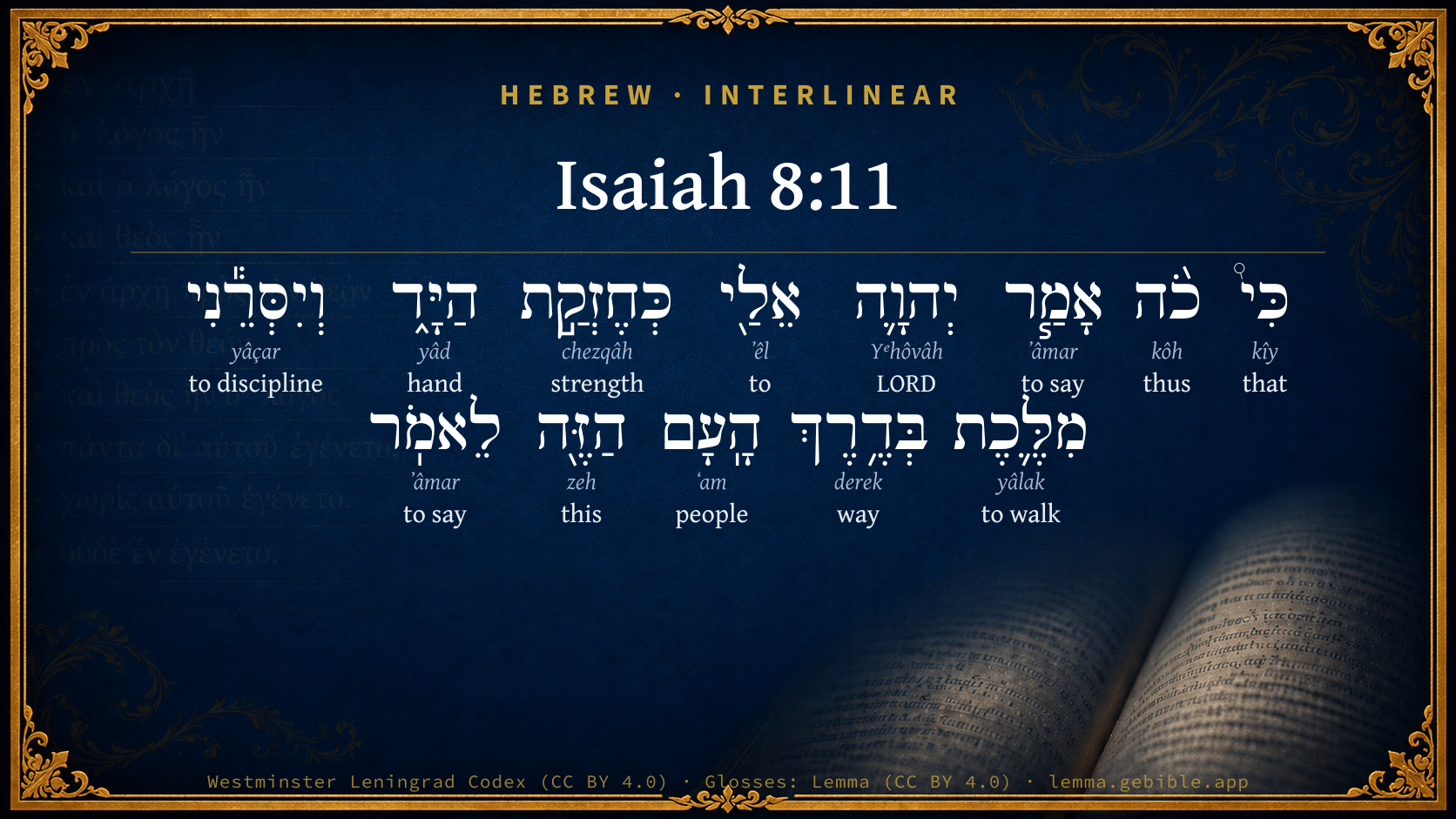
Hebrew (Westminster Leningrad Codex) Isaiah 8:11 appears in the Hebrew Old Testament. The text above is from the Westminster Leningrad Codex. Each word links to its Strong’s number, a concise gloss, and parsing drawn from the Open Scriptures Hebrew Bible morphology. Click any word for its full Brown-Driver-Briggs (BDB) entry.
Download image
Cite this verse

Isaiah 8:11 (World English Bible). Public Domain. Lemma interlinear Bible study tool, https://lemma.gebible.app/v/isaiah/8/11.

Show BibTeX & RIS
BibTeX
RIS
English Translation
For Yahweh spoke thus to me with a strong hand, and instructed me not to walk in the way of this people, saying,
World English Bible · Public Domain
Download a study sheet

One document with this verse’s original text, its word-by-word gloss line, the meaning frame, cross-references with their text, attributed commentary, and full source and license credits — printable, and it pastes into notes with its structure intact.

This verse Autodidact and up

Study sheet (.html) Plain text (.txt)

A passage Seminary Student

Up to 50 verses in one chapter. A passage sheet keeps up to 6 commentary sources and 12 cross-references per verse, in the order this page ranks them, and says so on the sheet whenever that leaves anything out. Ask for a single verse and you get the Autodidact verse sheet above.

Everything on this page stays free to read, with no account — the sheet is a download of what is already on screen, not access to it.

Want to remove ads? Support Godless Engineer
Compare translations 3

The same verse in 3 English versions, stacked beneath the original-language interlinear above. Click any original word for its lexicon entry.

Each is an independent rendering of the whole verse — the interlinear is not word-aligned to these translations.

Highlighted words mark where these versions differ — a whole-verse word diff, not a word-by-word alignment.

  • World English Bible Public Domain
    For Yahweh spoke thus to me with a strong hand, and instructed me not to walk in the way of this people, saying,
  • King James Version Public Domain
    For the LORD spake thus to me with a strong hand, and instructed me that I should not walk in the way of this people, saying,
  • unfoldingWord Literal Text CC BY-SA 4.0
    For thus Yahweh said to me with strength of hand, and he instructed me against walking in the way of this people, saying,

unfoldingWord Literal Text — © unfoldingWord, licensed CC BY-SA 4.0. Word-aligned USFM3 via Door43 (git.door43.org/unfoldingWord/en_ult).

Versions to compare (up to 4)

3 of 4 selected

Show all 18 translations

Every available English version of this verse, each an independent rendering of the whole verse.

  • World English Bible Public Domain
    For Yahweh spoke thus to me with a strong hand, and instructed me not to walk in the way of this people, saying,
  • Berean Standard Bible Public Domain
    For this is what the LORD has spoken to me with a strong hand, instructing me not to walk in the way of this people:
  • Majority Standard Bible Public Domain
    For this is what the LORD has spoken to me with a strong hand, instructing me not to walk in the way of this people:
  • King James Version Public Domain
    For the LORD spake thus to me with a strong hand, and instructed me that I should not walk in the way of this people, saying,
  • American Standard Version (1901) Public Domain
    For Jehovah spake thus to me with a strong hand, and instructed me not to walk in the way of this people, saying,
  • Revised Version (1885) Public Domain
    For the LORD spake thus to me with a strong hand, and instructed me that I should not walk in the way of this people, saying,
  • Geneva Bible (1599) Public Domain
    For the Lord spake thus to me in taking of mine hand, and taught me, that I should not walke in the way of this people, saying,
  • Douay-Rheims (1899) Public Domain
    For thus saith the Lord to me: As he hath taught me, with a strong arm, that I should not walk in the way of this people, saying:
  • Young's Literal Translation Public Domain
    For thus hath Jehovah spoken unto me with strength of hand, and instructeth me against walking in the way of this people, saying,
  • Literal Standard Version CC BY-SA 4.0
    For thus has YHWH spoken to me with strength of hand, and instructs me against walking in the way of this people, saying,
  • Unlocked Literal Bible CC BY-SA 4.0
    Yahweh spoke to me, with his strong hand upon me, and warned me not to walk in the way of this people.
  • unfoldingWord Literal Text CC BY-SA 4.0
    For thus Yahweh said to me with strength of hand, and he instructed me against walking in the way of this people, saying,
  • Darby Bible Public Domain
    For Jehovah spoke thus to me with a strong hand, and he instructed me not to walk in the way of this people, saying,
  • World Messianic Bible Public Domain
    For the LORD spoke this to me with a strong hand, and instructed me not to walk in the way of this people, saying,
  • Webster's Bible Public Domain
    For the LORD spoke thus to me with a strong hand, and instructed me that I should not walk in the way of this people, saying,
  • Free Bible Version CC BY-SA 4.0
    For this is what the Lord told me, holding me with a strong hand, instructing me not to follow the way of this people. He said,
  • Bible in Basic English Public Domain
    For the Lord, controlling me with a strong hand, gave me orders not to go in the way of this people, saying,
  • JPS Tanakh (1917) Public Domain
    For the LORD spoke thus to me with a strong hand, admonishing me that I should not walk in the way of this people, saying:

Literal Standard Version (2020), Covenant Press — licensed CC BY-SA 4.0. Text via the HelloAO Bible API (eBible.org). Unlocked Literal Bible (unfoldingWord) — licensed CC BY-SA 4.0. Text via the HelloAO Bible API (eBible.org). unfoldingWord Literal Text — © unfoldingWord, licensed CC BY-SA 4.0. Word-aligned USFM3 via Door43 (git.door43.org/unfoldingWord/en_ult). Free Bible Version, Dr. Jonathan Gallagher — licensed CC BY-SA 4.0. Text via the HelloAO Bible API (eBible.org).

Word by word

More ways to search: Search by grammar → Find every occurrence → Compare this word →

Practice this passage: Drill this verse → Learn its vocabulary →

כְּחֶזְקַ֣ת
chezqâh
H2393
“like/as · strength of”
Preposition + Noun, Common, Feminine, Singular, Construct
Part of Speech
Preposition + Noun
Type
Common
Gender
Feminine
Number
Singular
State
Construct
Full BDB Definition

Origin: from H2391

TWOT: 636b

strength, strong, being strong, force
  1. כִּי֩ kîy H3588 “that” Conjunction
  2. כֹ֨ה kôh H3541 “thus” Adverb
  3. אָמַ֧ר ʼâmar H559 “to say” Verb, Qal, Perfect, 3rd Person, Masculine, Singular
  4. יְהוָ֛ה Yᵉhôvâh H3068 “LORD” Noun, Proper
  5. אֵלַ֖י ʼêl H413 “to · me” Preposition + Suffix, Personal, 1st Person, Common, Singular
  6. הַיָּ֑ד yâd H3027 “the · hand” Particle, Definite Article + Noun, Common, Both, Singular, Absolute
  7. וְיִסְּרֵ֕נִי yâçar H3256 “and · to discipline · me” Conjunction + Verb, Qal, Imperfect, 3rd Person, Masculine, Singular + Suffix, Personal, 1st Person, Common, Singular
  8. מִלֶּ֛כֶת yâlak H3212 “from · to walk” Preposition + Verb, Qal, Infinitive Construct
  9. בְּדֶ֥רֶךְ derek H1870 “in/at · way of” Preposition + Noun, Common, Both, Singular, Construct
  10. הָֽעָם ʻam H5971 “the · people” Particle, Definite Article + Noun, Common, Masculine, Singular, Absolute
  11. הַזֶּ֖ה zeh H2088 “the · this” Particle, Definite Article + Pronoun, Demonstrative, Masculine, Singular
  12. לֵאמֹֽר ʼâmar H559 “to say” Preposition + Verb, Qal, Infinitive Construct

About this verse

These counts appear in no published source. They are computed here, from the morphology-tagged text and Lemma’s own curated glosses. What Lemma adds →

13
words
12
distinct lemmas
Prophets
section

Notable vocabulary

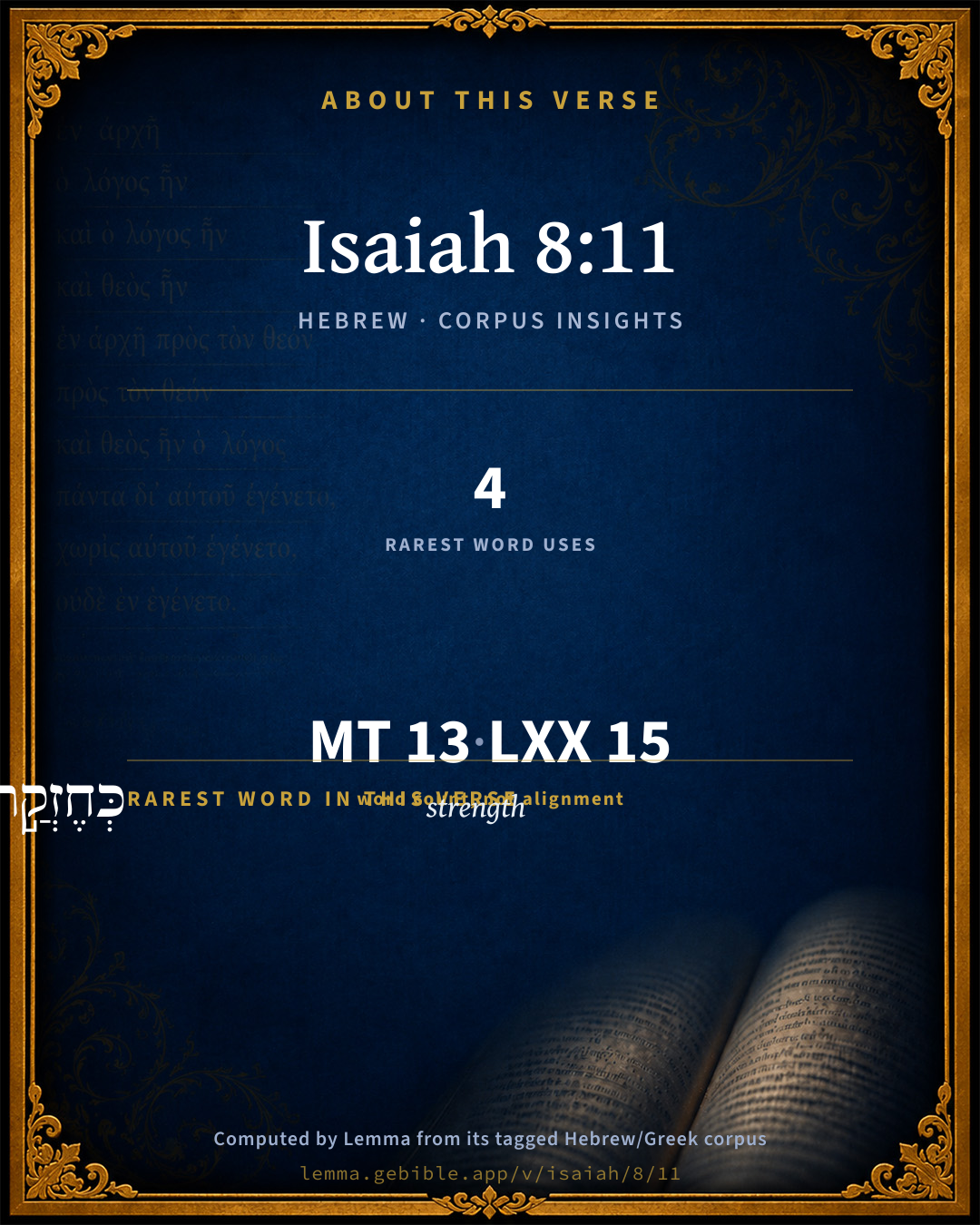
The rarest word here is כְּחֶזְקַ֣ת strength H2393 — appearing just 4 times in the whole Hebrew Bible.

Shared distinctive vocabulary

כְּחֶזְקַ֣ת strength H2393 occurs in 4 verses of the Hebrew Bible. Also found in:

Grammatical profile

  • 4 verbs
  • 5 nouns
  • 1 pronoun
  • 1 preposition
  • 1 conjunction
  • 1 adverb

Verb forms

  • אָמַ֧ר Qal · Perfect
  • וְיִסְּרֵ֕נִי Qal · Imperfect
  • מִלֶּ֛כֶת Qal · Infinitive Construct
  • לֵאמֹֽר Qal · Infinitive Construct

Repetition

A word recurs within this verse — often emphatic in Hebrew:

  • אָמַ֧ר to say H559 ×2

Hebrew & Septuagint length

In English translation the verse runs 23 words from the Hebrew and 20 from the Septuagint (LXX English) — closely comparable.

A rough comparison of the two English renderings, which tokenize alike — not a word-level alignment.

Word counts can differ between the Hebrew and the Greek without any difference in meaning — e.g. the Hebrew direct-object marker אֵת has no separate Greek word, and Greek often adds the article ὁ.

In the original languages it is 13 Hebrew tokens and 15 Greek tokens — but the two are counted differently (Hebrew bundles its prefixes and suffixes into one token; the Greek is in lemma form), so that isn’t a like-for-like length.

Cross-references

8

Topical passages linked to Isaiah 8:11 in the Treasury of Scripture Knowledge — connected by theme and wording, ordered by reader-vote popularity; previews shown in the World English Bible.

  • Ezekiel 3:14 So the Spirit lifted me up, and took me away; and I went in bitterness, in the heat of my spirit; and the hand of Yahweh was strong on me.
  • Proverbs 1:15 My son, don't walk in the way with them. Keep your foot from their path,
  • Psalms 32:8 I will instruct you and teach you in the way which you shall go. I will counsel you with my eye on you.
  • Jeremiah 15:19 Therefore thus says Yahweh, If you return, then will I bring you again, that you may stand before me; and if you take forth the precious from the vile, you shall be as my mouth: they shall return to you, but you shall not return to them.
  • Jeremiah 20:7 Yahweh, you have persuaded me, and I was persuaded; you are stronger than I, and have prevailed: I am become a laughing-stock all the day, every one mocks me.
  • Jeremiah 20:9 If I say, I will not make mention of him, nor speak any more in his name, then there is in my heart as it were a burning fire shut up in my bones, and I am weary with forbearing, and I can't [contain].
  • Acts 4:20 for we can't help telling the things which we saw and heard."
  • Ezekiel 2:6–8 You, son of man, don't be afraid of them, neither be afraid of their words, though briers and thorns are with you, and you do dwell among scorpions: don't be afraid of their words, nor be dismayed at their looks, though they are a rebellious house.

Cross-references courtesy of OpenBible.info (CC BY 4.0).

Hebrew and Greek witnesses Masoretic Hebrew ↔ Greek Septuagint

The same verse in the two great witnesses to the Old Testament, shown verse-for-verse.

These are two independent witnesses, not word-aligned to each other, and the Septuagint is shown in lemma (dictionary) form.

Hebrew Isaiah 8:11 Masoretic · Westminster Leningrad Codex

כִּי֩ כֹ֨ה אָמַ֧ר יְהוָ֛ה אֵלַ֖י כְּחֶזְקַ֣ת הַיָּ֑ד וְיִסְּרֵ֕נִי מִלֶּ֛כֶת בְּדֶ֥רֶךְ הָֽעָם הַזֶּ֖ה לֵאמֹֽר

For Yahweh spoke thus to me with a strong hand, and instructed me not to walk in the way of this people, saying,

World English Bible · Public Domain

Greek LXX Isaiah 8:11 Septuagint · lemma form

οὕτως λέγω κύριος ὁ ἰσχυρός χείρ ἀπειθέω ὁ πορεία ὁ ὁδός ὁ λαός οὗτος λέγω

Thus says the Lord, With a strong hand they revolt from the course of the way of this people, saying,

LXX2012 (modern English Septuagint) · Public Domain

Hebrew: Westminster Leningrad Codex (CC BY 4.0). Greek: Septuagint (public domain); English from LXX2012 (modern English Septuagint) (Public Domain). How the Septuagint differs from the Hebrew →

Targum (Aramaic paraphrase)

1

The Targum is the ancient Jewish Aramaic paraphrase of the Hebrew Scriptures — an interpretive translation, not the Hebrew text itself. Onkelos (literal) and Pseudo-Jonathan (expansive) render the Torah, and Jonathan the Prophets. Coverage is partial: where no permissively-licensed English translation exists for a verse, only the Aramaic is shown. This is verse-level text, not a word-by-word alignment to the Hebrew.

  1. Targum Jonathan Prophets (Joshua–Malachi)
    אֲרֵי כִדְנַן אֲמַר יְיָ לִי בְּמִתְקַף נְבוּאָתָא וְאֶלְפֵנִי מִלְמֵהַךְ בְּאוֹרַח עַמָא הָדֵין לְמֵימָר:

    For the Lord spake thus to me by the power of prophecy, and instructed me that I should not walk in the way of this people, saying,

    Targum Jonathan — Aramaic: “Mikraot Gedolot” (public domain). English: “Sefaria Community Translation” (CC0 1.0 (public-domain dedication)); “London "Chaldee Paraphrase," 1871” (public domain). Text via Sefaria.

Commentary

Notes on Isaiah 8:11 from classic Christian and Jewish commentators (each source and its license shown beneath its notes). The classic Christian expositions comment on the surrounding passage and are grouped to its opening verse, so a note may address several verses; the Jewish commentaries on the Tanakh (Rashi and others) are per-verse, so they appear only where the commentator wrote on this verse.

Lemma curates 59 commentaries, every one of them public domain or Creative Commons licensed, each selected and text-cleaned for this edition rather than reprinted as found. About our sources →

Trapp's Complete Commentary

John Trapp

Isa 8:11 For the LORD spake thus to me with a strong hand, and instructed me that I should not walk in the way of this people, saying,

Ver. 11. For the Lord spake thus to me with a strong hand.] That is, with his Spirit accompanying his word, and setting it home to my heart, that so I might speak from the heart to the heart. Some render it, taking me by the hand, {a} fidelis paedagogi instar, like a loving and faithful schoolmaster, and thereby pulling me back that I should not walk in the common road.

That I should not walk in the way of this people.] Not howl with those wolves, not tune my fiddle to the bass of the times, not follow a multitude to do evil, but rather to keep a constant countermotion to the many, and rather to go right alone than not at all. Cassianus {b} gives very good counsel, Vive ut pauci, ut cum paucis inveniri merearis in regno Dei, Live thou as but few else do, that with those few thou mayest be found in God’s kingdom. Now, none can do thus but only they to whom the Lord both speaketh, and layeth hold also upon their hand that they be not "led away with the error of the wicked." {2Pe 3:17}

{a} Sicut apprehensione manus.

{b} In Epist.

John Trapp, A Commentary or Exposition upon All the Books of the Old and New Testament (1647–1656) — public domain. Text from a community e-Sword module.

The Biblical Illustrator

Joseph S. Exell

Isa_8:11-15

For the Lord spake thus to me

Gods overpowering hand

The hand is the absolute Hand which, when it is laid upon a man, overpowers all his perception, feeling, and thinking.

(F. Delitzsch, D. D.)

With strength of hand

(Isa_8:11):--That is, seizing him and casting him into the prophetic trance (2Ki_3:15; Eze_1:3; Eze_3:14; Eze_8:1). (Prof. S. R. Driver, D. D.)

Warning and encouragement

The cry in Judah had been, There is a conspiracy against us, a formidable combination, which can only be met by a counter-alliance with Assyria (such appears to be the best interpretation of this difficult verse): Isaiah and his little circle of adherents had been warned not to join in it, not to judge of the enterprise, or probable success, of Rezin and Pekah, by the worldly and superficial estimate of the masses. A truer guide for action had been revealed to them. Do not, such is the lesson which he has been taught, do not follow the common people in their unreasonable alarm (verse 12): Jehovah of hosts, Him shall ye count holy; and let Him be your fear, and Him your dread, i.e., in modern phraseology, Do not be guilty of a practical abandonment of Jehovah; do not sacrifice principle to expediency. If you do not lose faith, He will be for you a sanctuary (verse 14), i.e., (apparently) He will be as a sanctuary protecting the territory in which it is situated, and securing for those who honour it safety and peace; but (it is ominously added) a cause of stumbling and ruin to both the houses of Israel, to you of Judah not less than to those of Ephraim, to whom alone you think that the warning can apply. (Prof. S. R. Driver, D. D.)

Principle and expediency

Translated into modem language, the prophets lesson is this--that those who in a time of difficulty and temptation sacrifice principle to expediency, sad abandon the clear path of duty for a course which may seem to lead to some greater immediate advantage, must not be surprised if the penalty which they ultimately have to pay be a severe one. (Prof. S. R. Driver, D. D.)

The Biblical Illustrator, edited by Joseph S. Exell (c. 1880s–1900s) — public domain. Text from a community e-Sword module.

Joseph Benson's Commentary

Isa 8:11-12. For the Lord spake thus unto me — Here the prophet teaches the people by his own example, as one immediately taught by God, with what dispositions they should receive all the attempts of their enemies, to subvert the kingdom of God in their land, even to the time of the Messiah, of whose manifestation this instruction contains a repeated prophecy for the consolation of the pious, together with a denunciation of the most grievous judgments, spiritual and temporal, upon the impious, incredulous, and profane. See Vitringa. With a strong hand — With a vehement and more than ordinary inspiration. The Chaldee renders it, In the strength of prophecy; perhaps it refers to those ecstasies into which the prophets were frequently wrapt. That I should not walk in the way of this people — Of the generality of the people of Judah; whose imminent danger and calamity he foretold, (Isa 8:8,) giving them, however, full assurance that God would deliver them out of it, Isa 8:9-10. Say ye not, A confederacy, &c. — You, my people, be not associated with them in the confederacies which they are projecting: do not join with those that, for the securing of themselves, are for making a league with the Assyrians, through unbelief, and distrust of God and their cause: do not come into any such confederacy. Neither fear ye their fear — Be not afraid of the confederacy with which they frighten themselves and one another, namely, that between Syria and Ephraim; or that thing which they fear, that, if they do not call in the Assyrian succours, they shall be destroyed by those two potent kings. Thus, when sinful confederacies are formed against God’s church and people by their enemies, they should guard against sinful fears of such confederacies.

Joseph Benson's Commentary on the Old and New Testaments (1811–1818) — public domain. Text from a community e-Sword module.

The Preacher's Complete Homiletical Commentary

Joseph S. Exell (gen. ed.)

THREATENED, BUT SAFE

Isa_8:9-10. Associate yourselves, O ye people, and ye shall be broken in pieces, &c.

This is a shout of triumphant defiance which Ahaz and his people might have raised, had they listened to Isaiah’s counsels, and turned to the Lord with full purpose of heart. Then they might have been threatened by foes numerous, powerful, determined, and confederated, but they would have been safe. Its doctrine clearly is, that it matters not who may be against us, if God be with us. This has been the faith of God’s people in all generations.

I. On what ground does it rest?

1. On what may be regarded as a settled conviction of the human mind, that this world, disordered as it is, is really governed by a righteous Ruler, omnipotent and all-wise, and that it must be well with those who have Him on their side.

2. On the declarations of God’s Word (Gen_15:1; Psa_34:7; Isa_54:17, &c.)

3. On the experience of His people as recorded in His Word. The promise to Abraham was kept; David (1Sa_17:37); Hezekiah (2Ki_19:32-35); Daniel and his companions (Dan_6:22; Dan_3:28); Peter (Act_12:7). On these accounts His people have felt and expressed the utmost contempt for, and defiance of, their foes (Psa_27:1-6; Mic_7:8-10). Old as these utterances are, they express the confidence of countless thousands to-day. But, II. Let us look at the grounds that might cause us to hesitate to receive it.

1. There is the undoubted fact that we are living in a world in which many things happen that are contrary to what we would have expected; and it would be only one more contradiction of our à priori expectations if a good man, or a number of good men, were utterly destroyed by a number of bad men.

2. As a matter of fact, this has often happened. Who were “the noble army of martyrs,” but good men who suffered intolerable wrongs, and were put to cruel deaths? If Peter was delivered, James, his fellow-apostle, was left to his fate (Act_12:2); yea, Peter himself at last died by the hands of the executioner, as did nearly all the Apostles. See what a terrible record of the sufferings of righteous men we have in Heb_11:35-37.

III. How are these two sets of facts to be harmonised? How account for it that, notwithstanding the latter set, which are obvious and not denied, it is still the settled conviction of pious and otherwise sensible men, that it shall be well with the righteous?

1. This is undoubtedly true, on the whole. We see what is the teaching of experience, taken on any considerable scale, in the familiar proverb, “Honesty is the best policy.” Deadly as is the conflict between the powers of good and of evil, on the whole, the victory is on the side of goodness, of righteousness, of truth. The world grows better, not worse (H. E. I. 1161, 1162). And it is manifest that “godliness has the promise of the life that now is, as well of that which is to come.”

2. The exceptions to which our attention is directed are necessary. Without them the difficulties in the way of the existence and growth of virtue would be immensely increased. If those who served God ran no risk in doing so, it would be as difficult for them to show that they loved Him for His own sake, as it would be for soldiers to prove their bravery, if it were possible to send them forth to battle in absolutely impregnable armour. If the safety assured to God’s people were absolute and without exceptions, there would be no room for the exercise of faith and loyalty.

3. This life is not all. It is but the prelude to our real existence; and for whatever we suffer in God’s cause here, we shall be abundantly compensated hereafter. So that, with Sir Thomas More, we may say, “They may take off my head, but hurt me they cannot.”

This is a plain and sober statement of the facts of this great problem. What are the practical inferences to be drawn from it?

1. Let us dismiss from our minds all fears for the cause of truth and rightcousness. That is safe (2Co_13:8). God’s Church and God’s Word will survive all the assaults that are made upon them (H. E. I. 642–645, 1246–1251, 2449).

2. Let us not be greatly concerned as to what may happen to ourselves. If God pleases, He can deliver us from any danger that may threaten us. If He is not pleased to do so, He knows how to make our sufferings promote the cause we have at heart. “The blood of the martyrs is the seed of the Church” (P. D. 2421, 2422, 2426).

3. If we are called to suffer, let us rejoice (Php_1:29; 2Ti_2:9; P. D. 2419).

BIBLICAL POLITICIANS

Isa_8:11-15. For the Lord spake thus to me with a strong hand, &c. [844]

[844] There was a general panic among the people: “their heart was moved as the trees of the wood are moved by the wind,” when they heard that Syria was confederate with Ephraim; their cry was everywhere, “A confederacy has been made against us, and we must meet it by a counter-alliance with Assyria;” and the prophet says that he too should have fallen under the influence of this panic, if Jehovah had not laid hold of him with a strong hand, to keep him in the way of dependence on Himself, and if He had not taught him to escape the fear which possessed his fellow-countrymen, by making the Lord of hosts his fear and his dread, by sanctifying Him himself, as he now in His Name calls on them to do. To sanctify Jehovah is in mind and practice to recognise Him as the holy God, the Lord who is absolute (absolutus), free from the limitations which hinder all other beings from carrying their wills into full operation, and to believe with the whole heart that God does and can govern all things according to the counsel of His own will, and that what He determines does certainly come to pass, however probabilities and appearances may be against the belief (Num_20:12; Deu_32:51; Isa_29:23). To the nation which thus sanctifies Jehovah, He (says Isaiah) will be their sanctuary—their protection against all their enemies. Such was His original covenant with both the houses of Israel, and it still holds good. If, therefore, they will break and renounce it, it becomes a stumbling-block to them. When their statesmen endeavour to remedy present mischief and secure future prosperity, by craftily playing off against one another the nations whom they cannot hope to match by force, they are attempting to go counter to the whole plan of Jehovah’s government, and they will do it only to their own confusion.—Strachey.

God’s people are to be “a peculiar people.” Their whole life is to be governed by divine principles.

1. By these principles they will be saved from the grievous practical heresy of abstention from public life [847] Civilised life, especially in a free community, is a partnership, and no man has a right to take all the advantages of a partnership and evade all its labours and obligations. “Owe no man anything.” We are bound to labour as well as pray, that God’s will may be done on earth as it is done in heaven. The result of abstention on the part of Christian men from public life is the domination of bad men, and the employment of the resources of the community for evil purposes (Psa_12:8). If we need example in this matter, we have the example of the prophets, who were much more than preachers of a monastic piety: they were active politicians, and yet politicians of an utterly unworldly type.

2. By these principles they will be guided and kept amid all the duties and difficulties of public life. They will be uplifted above party spirit in all its narrow and debasing forms. Theirs will be that true patriotism which consists in a steady loyalty to truth, and righteousness, and mercy.

[847] H. E. I. 4137–4139.

If we are to be Biblical politicians, and this is the duty of every man among us,

I. We shall not necessarily be found on the side of the majority (Isa_8:11). How often God’s people have been called to stand in what is called “a miserable minority!” (Exo_23:2.)

II. We shall not necessarily adopt as our own the popular cries (Isa_8:12, [850]). Vox populi is often far other than Vox Dei.

[850] The prophet, and such as were on his side, were not to call that kesher which the great mass of the people called kesher (cf. 2Ch_23:13, “She said, Treason, treason! Kesher, kesher!); … the reference is to the conspiracy, as it was called, of the prophet and his disciples. The same thing happened to Isaiah as to Amos (Amo_7:10) and to Jeremiah. Whenever the prophets were at all zealous in their opposition to the appeal for foreign aid, they were accused and branded as standing in the service of the enemy, and conspiring for the overthrow of the kingdom.—Delitzsch.

III. We shall not necessarily share in the prevalent feelings of our time, whether they be those of fear or of hope (Isa_8:13). We shall know that no permanent hurt can be done to our nation while it is in pursuit of righteousness, and that no real advantage can be gained by methods that will not bear the divine scrutiny.

IV. Our supreme desire will be, not to conciliate men, but to please God (Isa_8:13). We shall consider all public questions, and vote for, or withhold our vote from, all public men, as in His sight (Heb_11:27). This may cause us often to cut ourselves off from our “party,” but this will not trouble us. Hostility may thus be excited against us—will be excited against us, for such “impracticable men” are the abhorrence of mere politicians; but then God Himself will be to us “for a sanctuary” [851]

[851] Mikdash generally means the sanctified place or sanctuary, with which the idea of an asylum would easily associate itself, since even among the Israelites the Temple was regarded and respected as an asylum (1Ki_1:50; 1Ki_2:28).… Mikdash is really to be taken in this sense, although it cannot be exactly rendered “asylum,” since this would improperly limit the meaning of the word. The Temple was not only a place of shelter, but also of grace, blessing, and peace. All who sanctified the Lord of lords He surrounded like temple walls; hid them in Himself, whilst death and tribulation reigned without, and comforted, fed, and blessed them in His own gracious fellowship (chap. Isa_4:5-6; Psa_27:5; Psa_31:20).—Delitzsch.

V. We shall never lose sight of the fact that the penalty of ungodliness in public life is ruin (Isa_8:14-15). The real Ruler of the world is God, who governs it according to a plan of truth, righteousness, and mercy; and every human “policy” which is not consistent therewith, though it may win for its authors a short-lived triumph, will inevitably plunge those who accept it into disaster. From those who fight against God, utter defeat cannot be far off.

When these facts are inwrought into the understandings and consciences of God’s people, and have become influential in their public and political life, much will have been done to usher in the millennium for which we daily pray, and of which Isaiah himself has given us such glowing pictures (chaps. Isa_2:4, Isa_32:16-17; Isa_60:17).

The Preacher's Complete Homiletical Commentary (gen. ed. Joseph S. Exell; Funk & Wagnalls, c. 1892) — public domain (pre-1929). A full-Bible homiletical/sermon-outline anthology covering 65 of 66 books (2 John is absent from the source module). Text from a community e-Sword module.

Keil & Delitzsch

C. F. Keil & F. Delitzsch

There then follows in Isa 8:11 an explanatory clause, which seems at first sight to pass on to a totally different theme, but it really stands in the closest connection with the triumphant words of Isa 8:9, Isa 8:10. It is Immanuel whom believers receive, constitute, and hold fast as their refuge in the approaching times of the Assyrian judgment. He is their refuge and God in Him, and not any human support whatever. This is the link of connection with Isa 8:11, Isa 8:12 : "For Jehovah hath spoken thus to me, overpowering me with God's hand, and instructing me not to walk in the way of this people, saying, Call ye not conspiracy all that this people calls conspiracy; and what is feared by it, fear ye not, neither think ye dreadful." היד, "the hand," is the absolute hand, which is no sooner laid upon a man than it overpowers all perception, sensation, and though: Chezkath hayyâd (viz., âlai, upon me, Eze 3:14) therefore describes a condition in which the hand of God was put forth upon the prophet with peculiar force, as distinguished from the more usual prophetic state, the effect of a peculiarly impressive and energetic act of God. Luther is wrong in following the Syriac, and adopting the rendering, "taking me by the hand;" as Chezkath points back to the kal (invalescere), and not to the hiphil (apprehendere). It is this circumstantial statement, which is continued in v'yissereni ("and instructing me"), and not the leading verb âmar ("he said"); for the former is not the third pers. pret. piel, which would be v'yisserani, but the third pers. fut. kal, from the future form yissōr (Hos 10:10, whereas the fut. piel is v'yassēr); and it is closely connected with Chezkath hayyâd, according to the analogy of the change from the participial and infinitive construction to the finite verb (Ges. 132, Anm. 2). With this overpowering influence, and an instructive warning against going in the way of "this people," Jehovah spake to the prophet as follows. With regard to the substance of the following warning, the explanation that has been commonly adopted since the time of Jerome, viz., noli duorum regum timere conjurationem (fear not the conspiracy of the two kings), is contrary to the reading of the words. The warning runs thus: The prophet, and such as were on his side, were not to call that kesher which the great mass of the people called kesher (cf., Ch2 23:13, "She said, Treason, Treason!" kesher, kesher); yet the alliance of Rezin and Pekah was really a conspiracy - a league against the house and people of David. Nor can the warning mean that believers, when they saw how the unbelieving Ahaz brought the nation into distress, were not to join in a conspiracy against the person of the king (Hofmann, Drechsler); they are not warned at all against making a conspiracy, but against joining in the popular cry when the people called out kesher. The true explanation has been given by Roorda, viz., that the reference is to the conspiracy, as it was called, of the prophet and his disciples ("sermo hic est de conjuratione, quae dicebatur prophetae et discipulorum ejus"). The same thing happened to Isaiah as to Amos (Amo 7:10) and to Jeremiah. Whenever the prophets were at all zealous in their opposition to the appeal for foreign aid, they were accused and branded as standing in the service of the enemy, and conspiring for the overthrow of the kingdom. In such perversion of language as this, the honourable among them were not to join. The way of God was now a very different one from the way of that people. If the prophet and his followers opposed the alliance with Asshur, this was not a common human conspiracy against the will of the king and nation, but the inspiration of God, the true policy of Jehovah. Whoever trusted in Him had no need to be afraid of such attempts as those of Rezin and Pekah, or to look upon them as dreadful.

Keil & Delitzsch — Biblical Commentary on the Old Testament (1861–1891) — public domain (CC PDM 1.0). Text via the HelloAO Bible API. (Old Testament only.)

Tyndale Open Study Notes

Tyndale Open Resources

8:11-15 This text reveals the heart of Isaiah’s message. The issue was fear of the Lord versus fear of people (see 7:9; 8:6). When an individual fears people, the Lord becomes a trap and destruction is certain (cp. Prov 29:25; see “Fearing People” Theme Note). For those who fear the Lord, he becomes a sanctuary; their salvation is assured.

Tyndale Open Study Notes — © Tyndale Open Resources, licensed CC BY-SA 4.0. Text via the HelloAO Bible API.

Geneva Bible (1599)

Geneva Bible translators

To encourage me that I should not shrink for the infidelity of this people, and so neglect mine office.

Geneva Bible (1599) marginal notes — public domain. Text via Bolls.life.

Jamieson, Fausset & Brown

Robert Jamieson, A. R. Fausset & David Brown

with a strong hand--or else, "when He grasped me with His hand" [HORSLEY]. MAURER, as English Version, "with the impetus of His hand," that is, the felt impulse of His inspiration in my mind (Jer 15:17; Eze 1:3; Eze 3:14, Eze 3:22; Eze 37:1).

way of . . . people--their distrust of Jehovah, and the panic which led them and Ahab to seek Assyrian aid.

Jamieson, Fausset & Brown — Commentary Critical and Explanatory on the Whole Bible (1871) — public domain (CC PDM 1.0). Text via the HelloAO Bible API.

Adam Clarke's Commentary

Verse 11. With a strong hand - "As taking me by the hand"] Eleven MSS., (two ancient,) of Kennicott's, thirty-four of De Rossi's, and seven editions, read כחזקת kechezkath; and so Symmachus, the Syriac, and Vulgate. Or rather with a strong hand, that is, with a strong and powerful influence of the prophetic Spirit.

Adam Clarke's Commentary on the Bible (1810–1826) — public domain. Text from a community e-Sword/MySword module.

Ellicott's Commentary for English Readers

(11) For the Lord spake thus to me.—We enter on a new section, separated, probably, by a short interval of time, but dealing with the same subject. In the “strong hand” we have an anthropomorphic phrase, implying a specially high degree of the intensity of inspiration (1Ki_18:46; 2Ki_3:15; Eze_1:3; Eze_3:14; Eze_3:22; Eze_8:1; Eze_37:1). Something had occurred which brought the prophet into a state like that of St. Paul in Act_17:16; Act_18:5. Indignation and zeal were roused to their highest point, and were able to resist all human pressure from without. The result was a lesson which was to be specially impressed on the disciples who gathered round the prophet.

A Bible Commentary for English Readers, edited by Charles John Ellicott (1878–1897) — public domain. Text from a community e-Sword module.

The Cambridge Bible for Schools and Colleges

gen. ed. J. J. S. Perowne

11. with a strong hand] Better: while the Hand (of Jehovah) grasped (me), (an infinitive construction). The phrase (cf. Eze_3:14) refers to a prophetic trance, in which the true view of the aspects and issue of the situation was borne in upon Isaiah’s mind with irresistible force. His mind was as it were fixed in one direction, and he was henceforth proof against the disturbing influences of social opinion around him.

and instructed me … walk] Or, to warn me against walking. Grammatically, the clause is a continuation, not of the main sentence (“and Jehovah spake, &c.”), but of the infinitive construction, which is here resolved into the Imperfect (Qal). the way of this people] the prevailing emotions, thoughts and resolves of the hour.

11–15. Isaiah was able to stand alone against the nation during this crisis, because he knew that his thoughts were controlled by a Power not his own.

The Cambridge Bible for Schools and Colleges (gen. ed. J. J. S. Perowne; Cambridge University Press, 1878–1918) — public domain. Text from a community e-Sword module.

John Gill's Exposition

For the Lord spake thus to me with a strong hand,.... In the strength of prophecy, as the Targum explains it; and so all the Jews' interpreters understand it of prophecy, as in Eze 1:3, or, "the Lord spake thus to me, when he took (me) by the hand" (t); as parents or masters take hold of the hands of children, while they are advising and instructing them, as expressive of their great affection for them; and when they would retain them with them, or restrain them from doing amiss:

and instructed me that I should not walk in the way of this people: or join with them in desiring and seeking for the help of the king of Assyria, against Rezin and Remaliah's son; or in being willing to surrender up into their hands:

saying; as follows:

(t) "apprehensione manus", Piscator; "cum manu me apprehenderit", Tigurine version.

John Gill's Exposition of the Whole Bible (1746–1763) — public domain (CC PDM 1.0). Text via the HelloAO Bible API.

Albert Barnes' Notes on the Bible

For the Lord spake thus - Spake that which immediately follows in the next verse. Warned him not to Unite in the alliance with foreign kingdoms which the nation was about forming.

With a strong hand - Margin, ‘With strength of hand.’ That is, when the hand of God urged me. A strong prophetic impulse is often represented as being produced by God’s laying his hand on the prophet; or by his being thus, as it were, urged or impelled to it; Eze 3:14 : ‘The hand of Jehovah was strong upon me;’ 2Ki 3:15 : ‘And it came to pass, that when the minstrel played, the hand of the Lord came upon him;’ Jer 20:7 : ‘O Lord, thou art stronger than I, and hast prevailed;’ see also Ecc 2:24; 1Ki 18:46; 2Ki 3:15; Eze 33:22; Eze 40:1; compare the Introduction, section 7. 11. (3.) The meaning is, that the prophet was strongly, and almost irresistibly, urged by the divine influence, to say what he was about to say.

That I should not walk ... - That I should not approve, and fall in with the design of Ahaz, and of the nation, in calling in the aid of the Assyrian armies.

Albert Barnes' Notes on the Bible (1834–1885) — public domain. Text from a community e-Sword/MySword module.

Matthew Poole's English Annotations

With a strong hand; with a vehement and more than ordinary inspiration, strongly imprinting it in my mind. Of this people; of the generality of the people of Judah; whose eminent danger and calamity he foretells, Isa 8:8, but withal gives them full assurance that God would deliver them out of it, Isa 8:9,10; which he doth to aggravate the present sin of Ahaz and his people, in forsaking God, and seeking to the king of Assyria for help, as they did, 2Ki 16:6-8.

Matthew Poole's English Annotations on the Holy Bible (1683–1685) — public domain. Text from a community e-Sword/MySword module.

Whedon's Commentary on the Bible

Daniel D. Whedon

11. The Lord spake thus to me with a strong hand — With strength of hand, that is, with mighty inspiring power. Passages in Eze_1:3; Eze_3:14; Eze_3:22; Eze_11:5; Eze_33:32; Eze_37:1, offer the same or similar usage of the word “hand,” — “hand of God upon,” etc., — and justify this interpretation. God imparted to Isaiah on the matters stated above, an especially strong prophetic impulse.

And instructed me — Warned me against walking in the way of this people in their distrust of Jehovah, in their inclination to the court policy and to popular factions, or clamouring for foreign human aid. And for persuading this people to trust in Jehovah only, and to sever themselves from those rejecting Jehovah, a cry was probably raised against the prophet and his adherents. In this crisis, imparting a mighty influence to Isaiah, Jehovah spake thus, that is, what follows in the next verse.

Daniel D. Whedon (gen. ed.), Commentary on the Old and New Testaments (1874–1909) — public domain. Text from a community e-Sword module.

The Pulpit Commentary

For the Lord. Mr. Cheyne regards this passage as "a short oracle, complete in itself," and entirely unconnected with what has preceded. But the initial ki, "for," is in that case inexplicable. Spake thus to me with a strong hand; literally, with strength of hand i.e. laying a strong grasp upon him; and, as it were, constraining him to attend. (comp. Eze_1:3 Eze_3:14, Eze_3:22, etc.) That I should not walk in the way of this people. Isaiah was bidden not to "follow a multitude to evil". (Exo_23:2) It was not merely idolatry against which he was warned, but the whole spirit and tone of the society of his day. He was not to entertain their suspicions, or to hope their hopes, or to fear their fears. He was to take a line of his own, to fear God and him only; then God would be "for a Sanctuary" to him.

Vers. 11-15. Our personal relation to God.

It is clearly insufficient to know that we are on the same side as that of the majority of the good. The voice of God"s people is not always his voice; their way not always his way (ver. 11). They may call for "a confederacy" when he disapproves of it. They may cry "peace" when he sees only present confusion and future disaster. They may be shaken with fear when they ought to be calm and trustful (ver. 12). They may be full of complacency when they ought to be overwhelmed with shame. We shall not be to God that which he demands of us, except we come into distinct, direct relation to himself.

I THAT GOD SOMETIMES ACTS UPON US WITH CONSTRAINING POWER. "The Lord spake with a strong hand" (ver. 11; see Eze_3:14). The Divine impulse was one that the prophet felt he must not resist. Not that it was absolutely irresistible, but one that a faithful man knew that he must not hesitate to obey. God often acts upon the soul of men with strong and urgent power to constrain or to restrain. He approaches and influences us thus by

(1) his Divine providence;

(2) one or other of the privileges he has provided for us;

(3) his Holy Spirit.

II THAT GOD HIMSELF IS THE TRUE REFUGE OF THE HUMAN SOUL. (Vers. 13, 14.) Here is:

1. Our duty. We are to fear God, to pay a reverential regard to his will, to shrink from that which grieves him, to dread" his wrath.

2. Its recompense. "He shall be for a Sanctuary." In him, as in a pavilion, we shall hide. He will either deliver us from trouble by saving US from our enemies or in trouble, by granting us the sustaining grace which makes us "more than conquerors" in the midst of it. If we who are his "saints" will but "fear him" with obedient reverence, we shall then "have nothing else to fear." "How was it, lovers of your kind, Though ye were mocked and hated, That ye, with clear and patient mind, Truth"s holy doctrine stated? In God as in an ark ye kept; Around, and not above you, swept The flood till it abated.

III THAT TO RESIST GOD IS TO WALK IN THE WAY OF WRONG AND RUIN. God is, to the perverse and the rebellious, "a Stone of stumbling and a Rock of offense" (ver. 14). God must be everything to us, for life or death. If our relation to him is not to us the fountain of everlasting joy, then it will be to us the source of unspeakable sorrow. The rejection of his truth and of himself will be our sin on earth, our condemnation in judgment, the subject and source of our remorse and retribution in the long hereafter. Our God is One whom it is infinitely worth while to make our Friend, and One whom we must not make our Enemy, if we have any love for ourselves, any interest in our own destiny. C.

The Pulpit Commentary (1880–1919), ed. H.D.M. Spence-Jones & Joseph S. Exell — public domain. Text from a community e-Sword module.

John Wesley's Explanatory Notes

Spake - With a vehement and more than ordinary inspiration. In the way - Of the generality of the people of Judah; whose eminent danger and calamity he foretells.

John Wesley, Explanatory Notes Upon the Whole Bible (1754–1765) — public domain. Text via the GEBible commentary corpus.

J. A. Alexander on Isaiah

Joseph Addison Alexander

The triumphant apostrophe in v. 10 is now justified by an appeal to the divine authority. I have reason to address our enemies in this tone, “for thus said Jehovah to me in strength of hand (i.e., when His hand was strong upon me, when I was under the influence of inspiration), and instructed me away from walking in the way of this people (i.e., warned me not to follow the example of the unbelieving Jews).” When one is spoken of in Scripture as inspired, it is said not only that the spirit was upon him (Eze 11:5), but also that the hand of Jehovah was upon him (Eze 1:3; Eze 3:22; Eze 33:22; Eze 37:1) and in one case at least that it was strong upon him (Eze 3:14). Hence strength of hand may have the sense of inspiration, and the whole phrase here employed be equivalent in meaning to the New Testament expressions ‘in the Spirit’, ev pneumati (Rev 1:10), (‘in a trance’, en ekstasei (Act 11:5), ‘in the Holy Spirit and in much assurance’, en pneumati hagiow kai plerophoria polle (1Th 1:5)).

Joseph Addison Alexander, The Prophecies of Isaiah (1846–1847; New York: Scribner, 1870–1878) — public domain. Text from a community e-Sword module.

unfoldingWord translationNotes

Door43 World Missions Community

Yahweh spoke to me, with his strong hand upon me

Here "his strong hand upon me" is an idiom that refers to Yahweh's power. AT: "Yahweh spoke to me in a very powerful way" (See: Idiom)

warned me not to walk in the way of this people.

This is an indirect quote that ends in Isa 8:17. AT: "warned me and said, 'Do not act like this people.'" (See: Direct and Indirect Quotations)

Do not call conspiracy anything that this people calls conspiracy

The people imagine there are conspiracies, and it makes them anxious. AT: "Do not worry like this people who think someone is always trying to harm them" (See: Assumed Knowledge and Implicit Information)

It is Yahweh of hosts whom you will honor as holy; he is the one you must fear, and he is the one you must dread

If you translate this as a direct quote, you can also translate it with Yahweh speaking in the first person: "But you will consider me, Yahweh of Hosts, as holy. And you will fear and be in awe of me" (See: Direct and Indirect Quotations and Pronouns)

translationWords

hand

walk

people group

fear

Yahweh of hosts

holy

unfoldingWord translationNotes — © Distant Shores Media and the Door43 World Missions Community, licensed CC BY-SA 4.0. Source: git.door43.org/Door43/en_tn.

Rashi

Rabbi Shlomo Yitzchaki (Rashi)

with the overwhelming power of prophecy [Lit., with strength of the hand.] When the prophecy became more intensive over me, when He continued to speak concerning this matter, as it is written above (v. 5): “And the Lord continued to speak to me.” And in this language, Ezekiel said, (3: 14): “And the hand of the Lord became strong over me.” This is an expression of prophecy.

and admonished me from going... He warned me not to participate in the counsel of Shebna the scribe and his company, who conspired to rebel against Hezekiah, as is related in Sanhedrin (26a), to which there is an allusion in this Book (below 22:15): “Go, come to this voluptuary, to Shebna who is appointed over the Temple.”

and He admonished me like “and to admonish me.”

Rashi on the Tanakh — English translations: “The Judaica Press complete Tanach with Rashi, translated by A. J. Rosenberg” (CC BY 4.0); “Pentateuch with Rashi's commentary by M. Rosenbaum and A.M. Silbermann, 1929-1934” (public domain); “The Metsudah Tanach series, Lakewood, N.J” (CC BY 4.0); and “The Book of Joshua, Metsudah Publications, 1997” (CC BY 4.0). Text via Sefaria.

Ibn Ezra

Rabbi Abraham ibn Ezra

For the Lord spake thus to me with a strong hand, that is: When the prophecy came with force upon me; comp. The hand of the Lord was upon me (Ez. 37:1).

ויסרני And instructed me. The ס has a dagesh to compensate for the absence of the י, which is the first radical; comp. אֶצָּרְךָ I formed thee (Jer. 1:5). He instructed me, etc. A proof of the correctness of my view concerning Unclean lips (6:5).

Ibn Ezra on the Tanakh — English translations: “Sefaria Community Translation” (CC0 1.0 (public-domain dedication)); “Yalkut, Sifsei Chachomim Chumash, Metsudah Publications, 2009” (CC BY 4.0); and “Commentary of Ibn Ezra on Isaiah - trans. by M. Friedlander, 1873” (public domain). Text via Sefaria.

Lesson kit

Teaching starters — assembled from the data on this page, not authored interpretation. Every prompt links to the verse data it draws on. Edit before teaching.

Isaiah, in the Prophets, opens this verse with 13 words (12 distinct Hebrew lemmas). Its most distinctive word is chezqâh (“strength”). A historical commentator’s framing appears above. Read the whole chapter for the surrounding context.

Discussion questions

  1. What does “strength” (chezqâh) contribute to the verse as a whole?
  2. How does 2 Chronicles 12:1, which shares the word «strength», read alongside this verse?
  3. What does the repetition of “to say” (2× in this one verse) do in this verse?
  4. These translations render this verse differently; the difference is in the English rendering, not the original. What questions does that raise?
  5. «אָמַ֧ר» is a Qal Perfect verb. How does that grammatical form shape the action described?
  6. Compare how Trapp's Complete Commentary and The Biblical Illustrator read this verse. Where do they agree or differ?

Things to notice

Reading settings

Reading text

Shown beneath each verse's original-language words.

Old Testament
Old Testament edition

Read the OT as the Masoretic Hebrew (MT) or the Greek Septuagint (LXX).

English shown for the Greek Septuagint (in the Hebrew ↔ Greek comparison).

Comparing translations? Open the Compare panel on any verse page to stack up to four side by side.