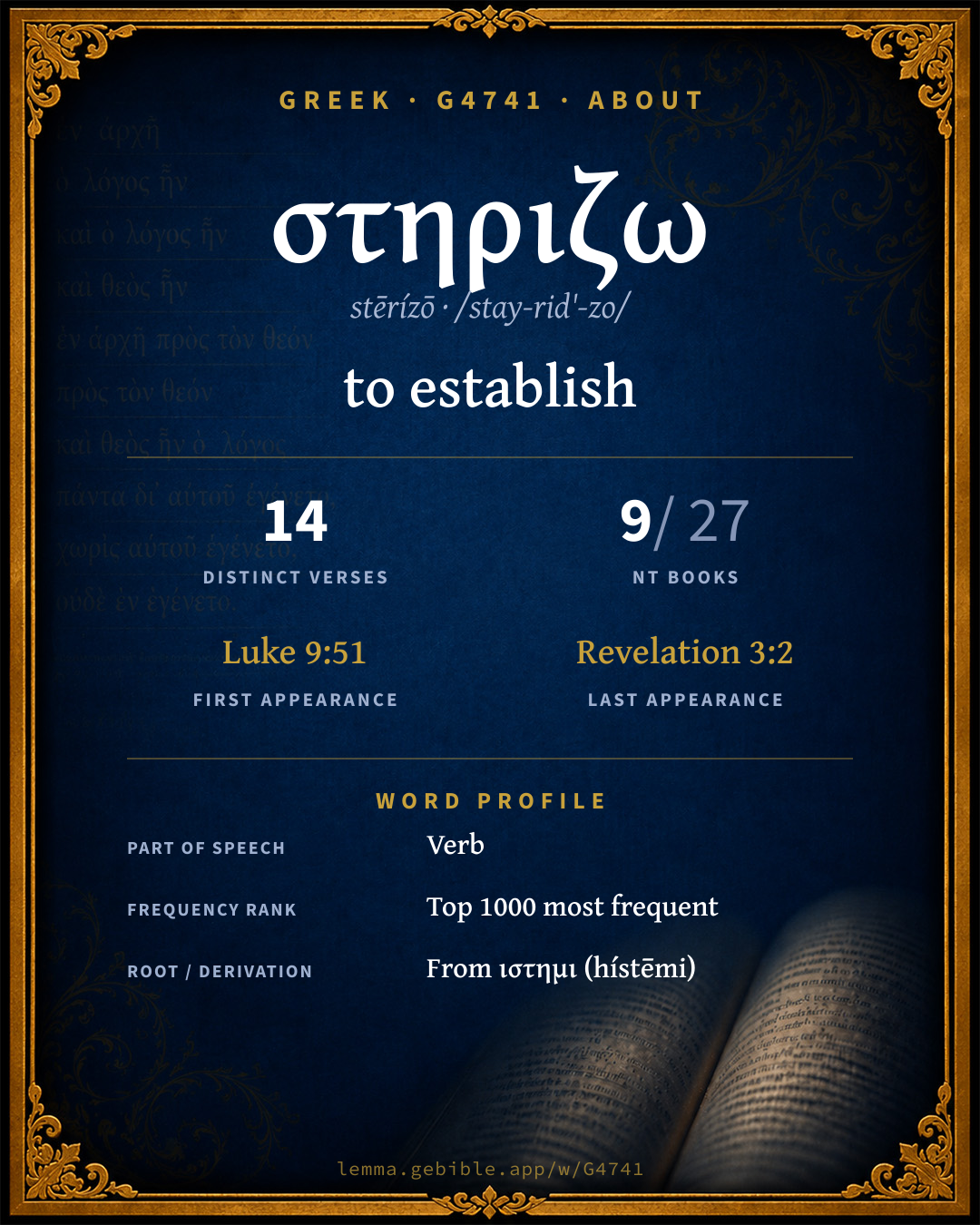
στηρίζω
to establish
‘to establish’ is one of 3 main senses fuller range ↓
Full lexicon entry — Thayer's Greek Lexicon
From Thayer's Greek Lexicon
Where this word appears
See every Aorist-tense verb in the Greek New Testament →
Grammar key — what these labels mean
Part of speech
- Verb
- An action or state-of-being word.
Tense
- Aorist
- Action viewed as a simple whole, without regard to duration — often past (perfective aspect).
- Future
- Action expected in future time.
- Present
- Ongoing or general action in present time (imperfective aspect).
- Perfect
- A completed past action with continuing present results.
Voice
- Active
- The subject performs the action.
- Passive
- The subject receives the action.
Mood
- Infinitive
- A verbal noun (“to write”), unmarked for person or number.
- Imperative
- Expresses a command or request.
- Indicative
- States a fact or asks a factual question (the mood of reality).
- Optative
- Expresses a wish or a remote possibility.
- Participle
- A verbal adjective (“writing,” “having written”).
Case
- Nominative
- The case of the subject (and the predicate nominative).
- Accusative
- The case of the direct object and of extent.
Person
- 2nd person
- The one addressed (“you”).
- 3rd person
- The one spoken about (“he / she / it / they”).
Gender
- Masculine
- Grammatically masculine.
Number
- Singular
- One.
- Plural
- More than one.
1 distinct verse where G4741 appears in the Present tense, across 1 book. Filtered view — show all forms. Click any verse to open its interlinear word-by-word view. Verse text shown in the World English Bible for context — . Each verse’s Greek form is shown with its reference; the English is not keyword-highlighted, since the data carries no word-level English alignment. Use “Compare translations” on any verse to read it across multiple English versions. This concordance covers the Greek New Testament; Septuagint (Greek Old Testament) occurrences of this word are not indexed here.
Acts 1 verse
About this entry
At a glance — auto-summarized from this page’s data, not written by a person. Every figure links to its source below. This summary describes the numbers; it doesn’t interpret them.
στηριζω (stērízō) is a Greek verb most often rendered “to establish.” Scripture first uses it in Luke 9:51. It turns up in 14 verses across 9 books, an uncommon footprint. Ranging over 3 senses, it is not a single-sense word. It clusters with ιστημι, σθενοω and σταδιον under a shared root. The sections below give every sense, occurrence, and version rendering.
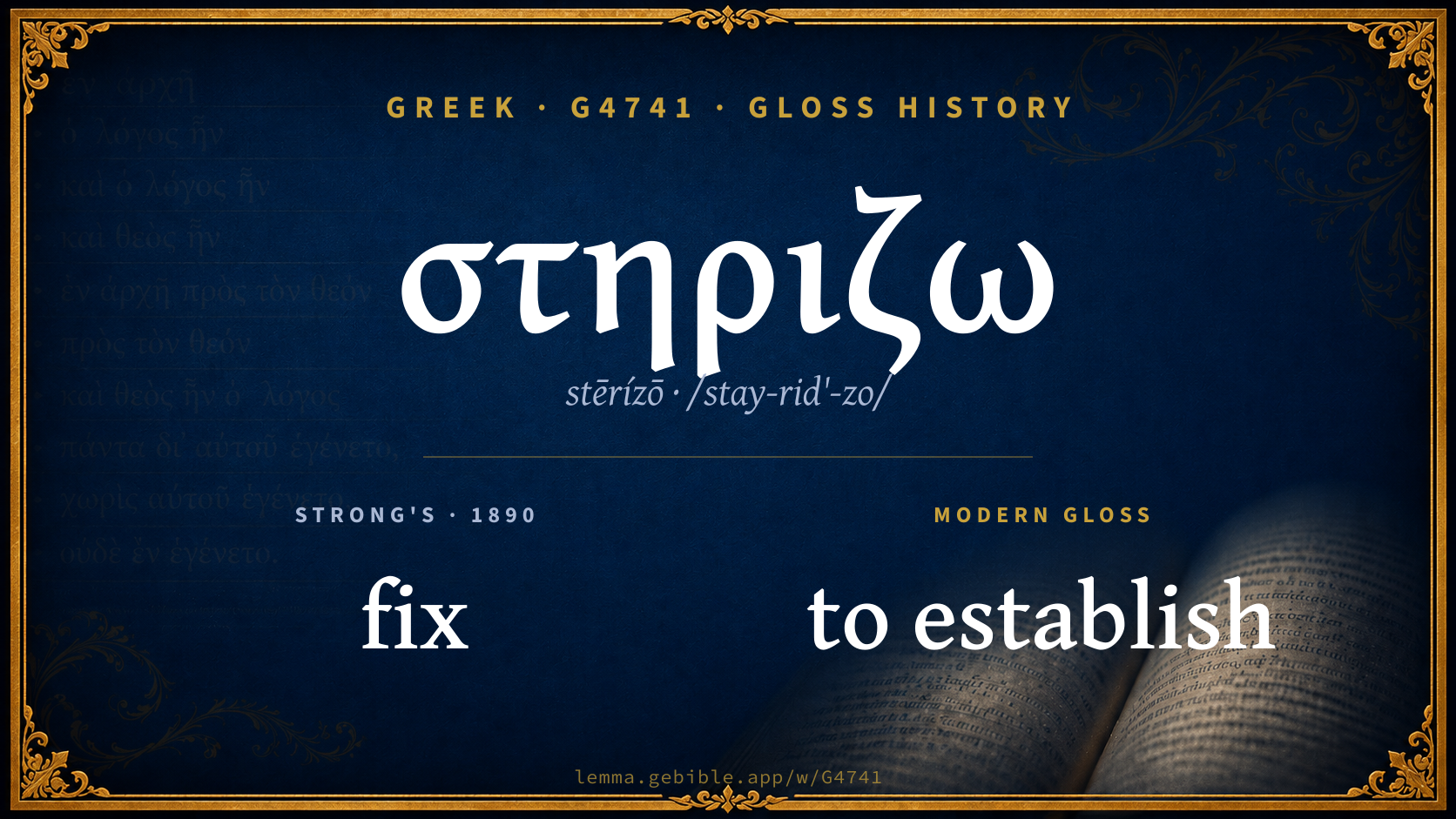
Gloss history
Strong's 1890 vs modern scholarship
About this word
Strong's G4741 catalogs a Greek word from the Greek New Testament.
These counts are not copied from any lexicon or concordance. They are computed here, from the morphology-tagged Greek New Testament. What Lemma adds →
- 14
- distinct verses
- The word appears in 14 distinct verses.
- 9 / 27
- NT books
- The word appears in 9 of 27 New Testament books.
- #814
- by frequency
- Top 1000 most frequent Greek words (rank 814 of 5,347 Greek words by occurrence).
View all 14 occurrences in the concordance →
Most concentrated in
- Luke 3 verses 21%
- Romans 2 verses 14%
- 1 Thessalonians 2 verses 14%
By section of the New Testament
By traditional corpus
Conventional, traditional groupings — biblical authorship is debated, so this is a traditional corpus grouping, not an authorship claim. Some books belong to more than one corpus (Luke is in both the Gospels and the Lukan corpus, and so on), so these shares overlap and need not total 100%. Each figure is a share of the word’s 14 distinct verses.
- Pauline corpus 6 verses · 43%
- Lukan (Luke–Acts) 4 verses · 29%
- Gospels 3 verses · 21%
- General (Catholic) Epistles 3 verses · 21%
- Johannine 1 verse · 7%
- Revelation 1 verse · 7%
How translations render this word
Counts come from each version’s own published word-to-Strong’s tagging or interlinear alignment — an approximate guide to how each version renders this word, not a word-level alignment the data otherwise carries. Because each total is that version’s own tagged count, the per-version totals vary from one another and need not match the appearance or distinct-verse counts above. These counts may also differ from a printed concordance because Lemma counts each distinctly tagged rendering and does not collapse phrase taggings into a single head-word total. This is a fixed set of word-tagged versions (KJV, ASV, BSB, ULT) and does not change with the reading translation you choose elsewhere. Each version’s license is shown beside its name below (and on Sources).
- King James Version: Stablish 4×, Strengthen 2×
- American Standard Version: Establish 7×
- Berean Standard Bible: Strengthen 7×
- unfoldingWord Literal Text: Strengthen 7×
King James Version Public Domain
Renders G4741 across 14 tagged occurrences — most commonly:
Plus 8 renderings that appear only once — usually multi-word phrases or single function words the recovered tagging swept in, not distinct renderings.
American Standard Version Public Domain
Renders G4741 across 13 tagged occurrences — most commonly:
Plus 6 renderings that appear only once — usually multi-word phrases or single function words the recovered tagging swept in, not distinct renderings.
Berean Standard Bible Public Domain
Renders G4741 across 13 tagged occurrences — most commonly:
Plus 6 renderings that appear only once — usually multi-word phrases or single function words the recovered tagging swept in, not distinct renderings.
unfoldingWord Literal Text CC BY-SA 4.0
Renders G4741 across 14 tagged occurrences — most commonly:
Plus 7 renderings that appear only once — usually multi-word phrases or single function words the recovered tagging swept in, not distinct renderings.
Senses in Thayer's
The 3 senses Thayer's distinguishes for this word, in lexicon order (not ranked by frequency or importance). The full entry — with sub-senses — is in the Lexicon Entry tab.
- to make stable, place firmly, set fast, fix
- to strengthen, make firm
- to render constant, confirm, one's mind
Word origin
Derived from ιστημι (hístēmi) (G2476) — to stand.
Forms in the corpus
The 9 distinct written forms G4741 takes in the Greek New Testament, most frequent first — each parse links to that tense’s occurrences in the concordance.
| Form | Parsing | Example | Uses |
|---|---|---|---|
| στηρίξαι stēríxai | Verb, Aorist, Active, Infinitive | Romans 16:25 | 4 |
| στήρισον stḗrison | Verb, Aorist, Active, Imperative, 2nd person, Singular | Luke 22:32 | 2 |
| στηρίξει stēríxei | Verb, Future, Active, Indicative, 3rd person, Singular | 2 Thessalonians 3:3 | 2 |
| στηρίζων stērízōn | Verb, Present, Active, Participle, Nominative, Singular, Masculine | Acts 18:23 | 1 |
| στηρίξατε stēríxate | Verb, Aorist, Active, Imperative, 2nd person, Plural | James 5:8 | 1 |
| στηριχθῆναι stērichthē̂nai | Verb, Aorist, Passive, Infinitive | Romans 1:11 | 1 |
| ἐστήρικται estḗriktai | Verb, Perfect, Passive, Indicative, 3rd person, Singular | Luke 16:26 | 1 |
| ἐστήρισεν estḗrisen | Verb, Aorist, Active, Indicative, 3rd person, Singular | Luke 9:51 | 1 |
| ἐστηριγμένους estērigménous | Verb, Perfect, Passive, Participle, Accusative, Plural, Masculine | 2 Peter 1:12 | 1 |
Same root — word family
Other Thayer's entries built from the same root as G4741, grouped by Strong’s listed origin. These share a root / origin per the lexicon — not necessarily a shared meaning. Each links to that word’s own entry.
Derives from
Shares the same root
- σθενοω sthenóō G4599 to strengthen
- σταδιον stádion G4712 furlong
- σταμνος stámnos G4713 jar
- στασις stásis G4714 insurrection
- σταυρος staurós G4716 cross
- σταχυς stáchys G4719 ear of grain
- στελλω stéllō G4724 to set
- στενος stenós G4728 narrow
- στερεος stereós G4731 strong
- στηθος stēthos G4738 breast
- στηκω stḗkō G4739 to stand firm
- στοα stoá G4745 portico
- στυλος stŷlos G4769 pillar
Derived from this word
Compare all same-root words → Showing 4 of 16 — not the complete family. They share a root, not necessarily a meaning.
Septuagint usage
The same Greek word στηριζω appears 36 times in the Greek Old Testament (Septuagint), across 35 verses in 14 books.
- 36
- LXX occurrences
- Tagged occurrences of this Greek word in the Septuagint.
- 35
- verses
- Distinct Septuagint verses containing this word.
- 14 / 39
- OT books
- The word appears in 14 of the 39 Old Testament books.
Sample Septuagint occurrences
- Genesis 27:37 στηρίζω
- Exodus 17:12 στηρίζω
- Leviticus 13:55 στηρίζω
- Judges 19:5 στηρίζω
- 1 Samuel 26:19 στηρίζω
- 2 Kings 18:16 στηρίζω
- Psalms 50:14 στηρίζω
- Proverbs 15:25 στηρίζω
- Song of Solomon 2:5 στηρίζω
- Isaiah 22:25 στηρίζω
- Jeremiah 3:12 στηρίζω
- Ezekiel 6:2 στηρίζω
Septuagint occurrences (same lexeme)
Every verse where the same Strong’s number (G4741) appears in the Greek Septuagint. Verse text shown in the World English Bible for context; the Greek form is the matched word — the English is not keyword-highlighted.
- Genesis 27:37 στηρίζω Isaac answered Esau, "Behold, I have made him your lord, and all his brothers have I given to him for servants. With grain and new wine have I sustained him. What then will I do for you, my son?"
- Genesis 28:12 στηρίζω He dreamed. Behold, a stairway set up on the earth, and the top of it reached to heaven. Behold, the angels of God ascending and descending on it.
- Exodus 17:12 στηρίζω But Moses' hands were heavy; and they took a stone, and put it under him, and he sat on it. Aaron and Hur held up his hands, the one on the one side, and the other on the other side. His hands were steady until sunset.
- Leviticus 13:55 στηρίζω Then the priest shall examine it, after the plague is washed; and, behold, if the plague hasn't changed its color, and the plague hasn't spread, it is unclean; you shall burn it in the fire. It is a mildewed spot, whether the bareness is inside or outside.
- Judges 19:5 στηρίζω It happened on the fourth day, that they arose early in the morning, and he rose up to depart: and the young lady's father said to his son-in-law, Strengthen your heart with a morsel of bread, and afterward you shall go your way.
- Judges 19:8 στηρίζω He arose early in the morning on the fifth day to depart; and the young lady's father said, Please strengthen your heart and stay until the day declines; and they ate, both of them.
- 1 Samuel 26:19 στηρίζω Now therefore, please let my lord the king hear the words of his servant. If it be Yahweh that has stirred you up against me, let him accept an offering: but if it be the children of men, cursed be they before Yahweh: for they have driven me out this day that I shouldn't cling to Yahweh's inheritance, saying, Go, serve other gods.
- 2 Kings 18:16 στηρίζω At that time did Hezekiah cut off [the gold from] the doors of the temple of Yahweh, and [from] the pillars which Hezekiah king of Judah had overlaid, and gave it to the king of Assyria.
- 2 Kings 18:21 στηρίζω Now, behold, you trust on the staff of this bruised reed, even on Egypt; whereon if a man lean, it will go into his hand, and pierce it: so is Pharaoh king of Egypt to all who trust on him.
- Psalms 50:14 στηρίζω Offer to God the sacrifice of thanksgiving. Pay your vows to the Most High.
- Psalms 103:15 στηρίζω As for man, his days are like grass. As a flower of the field, so he flourishes.
- Psalms 110:8 στηρίζω
- Psalms 111:8 στηρίζω They are established forever and ever. They are done in truth and uprightness.
- Proverbs 15:25 στηρίζω Yahweh will uproot the house of the proud, But he will keep the widow's borders intact.
- Proverbs 16:26 στηρίζω The appetite of the laboring man labors for him; For his mouth urges him on.
- Proverbs 27:20 στηρίζω Sheol and Abaddon are never satisfied; And a man's eyes are never satisfied.
- Song of Solomon 2:5 στηρίζω Strengthen me with raisins, Refresh me with apples; For I am faint with love.
- Isaiah 22:25 στηρίζω In that day, says Yahweh of hosts, shall the nail that was fastened in a sure place give way; and it shall be hewn down, and fall; and the burden that was on it shall be cut off; for Yahweh has spoken it.
- Isaiah 59:16 στηρίζω He saw that there was no man, and wondered that there was no intercessor: therefore his own arm brought salvation to him; and his righteousness, it upheld him.
- Jeremiah 3:12 στηρίζω Go, and proclaim these words toward the north, and say, Return, you backsliding Israel, says Yahweh; I will not look in anger on you; for I am merciful, says Yahweh, I will not keep [anger] forever.
- Jeremiah 17:5 στηρίζω Thus says Yahweh: Cursed is the man who trusts in man, and makes flesh his arm, and whose heart departs from Yahweh.
- Jeremiah 21:10 στηρίζω For I have set my face on this city for evil, and not for good, says Yahweh: it shall be given into the hand of the king of Babylon, and he shall burn it with fire.
- Jeremiah 24:6 στηρίζω For I will set my eyes on them for good, and I will bring them again to this land: and I will build them, and not pull them down; and I will plant them, and not pluck them up.
- Ezekiel 6:2 στηρίζω Son of man, set your face toward the mountains of Israel, and prophesy to them,
- Ezekiel 13:17 στηρίζω You, son of man, set your face against the daughters of your people, who prophesy out of their own heart; and prophesy you against them,
- Ezekiel 14:8 στηρίζω and I will set my face against that man, and will make him an astonishment, for a sign and a proverb, and I will cut him off from the midst of my people; and you shall know that I am Yahweh.
- Ezekiel 15:7 στηρίζω I will set my face against them; they shall go forth from the fire, but the fire shall devour them; and you shall know that I am Yahweh, when I set my face against them.
- Ezekiel 21:2 στηρίζω Son of man, set your face toward Jerusalem, and drop [your word] toward the sanctuaries, and prophesy against the land of Israel;
- Ezekiel 21:7 στηρίζω It shall be, when they tell you, Why do you sigh? that you shall say, Because of the news, for it comes; and every heart shall melt, and all hands shall be feeble, and every spirit shall faint, and all knees shall be weak as water: behold, it comes, and it shall be done, says the Lord Yahweh.
- Ezekiel 25:2 στηρίζω Son of man, set your face toward the children of Ammon, and prophesy against them:
- Ezekiel 28:21 στηρίζω Son of man, set your face toward Sidon, and prophesy against it,
- Ezekiel 29:2 στηρίζω Son of man, set your face against Pharaoh king of Egypt, and prophesy against him, and against all Egypt;
- Ezekiel 38:2 στηρίζω Son of man, set your face toward Gog, of the land of Magog, the prince of Rosh, Meshech, and Tubal, and prophesy against him,
- Daniel 7:28 στηρίζω Here is the end of the matter. As for me, Daniel, my thoughts much troubled me, and my face was changed in me: but I kept the matter in my heart.
- Amos 9:4 στηρίζω Though they go into captivity before their enemies, there I will command the sword, and it will kill them. I will set my eyes on them for evil, and not for good.
These are occurrences of the same Greek lexeme (G4741) in the Septuagint — not a translation of any one Hebrew word. The store carries no word-level Hebrew↔Greek alignment, so no Hebrew original is asserted here. Counts come from the recovered LXX Strong's tagging — high-frequency vocabulary is well covered, while rare or late forms may be untagged — so they reflect tagged occurrences and may slightly undercount.