
Psalms 103:15

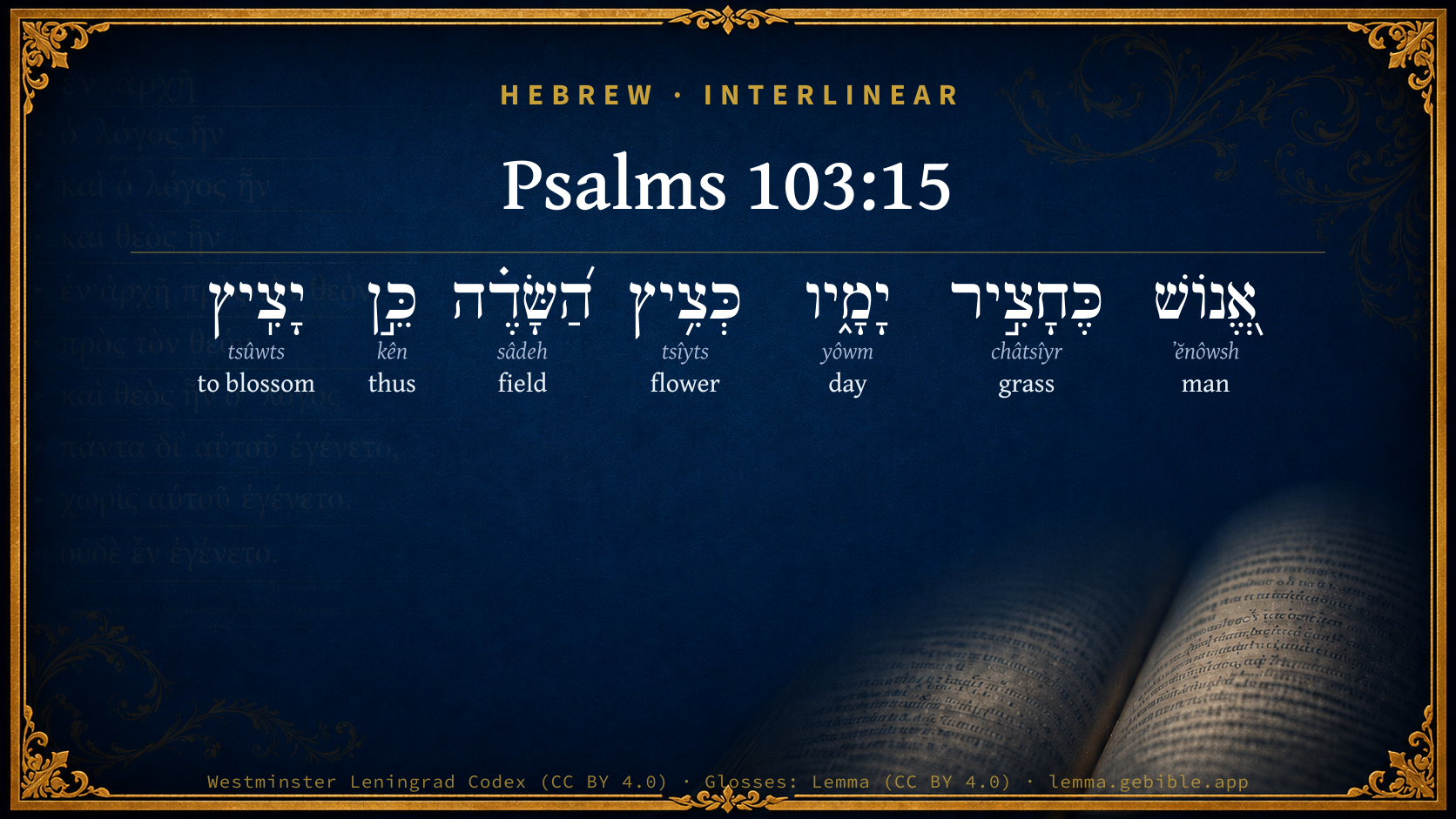
Hebrew (Westminster Leningrad Codex) Psalms 103:15 appears in the Hebrew Old Testament. The text above is from the Westminster Leningrad Codex. Each word links to its Strong’s number, a concise gloss, and parsing drawn from the Open Scriptures Hebrew Bible morphology. Click any word for its full Brown-Driver-Briggs (BDB) entry.
Download image
Cite this verse

Psalms 103:15 (World English Bible). Public Domain. Lemma interlinear Bible study tool, https://lemma.gebible.app/v/psalms/103/15.

Show BibTeX & RIS
BibTeX
RIS
English Translation
As for man, his days are like grass. As a flower of the field, so he flourishes.
World English Bible · Public Domain
Download a study sheet

One document with this verse’s original text, its word-by-word gloss line, the meaning frame, cross-references with their text, attributed commentary, and full source and license credits — printable, and it pastes into notes with its structure intact.

This verse Autodidact and up

Study sheet (.html) Plain text (.txt)

A passage Seminary Student

Up to 50 verses in one chapter. A passage sheet keeps up to 6 commentary sources and 12 cross-references per verse, in the order this page ranks them, and says so on the sheet whenever that leaves anything out. Ask for a single verse and you get the Autodidact verse sheet above.

Everything on this page stays free to read, with no account — the sheet is a download of what is already on screen, not access to it.

Want to remove ads? Support Godless Engineer
Compare translations 3

The same verse in 3 English versions, stacked beneath the original-language interlinear above. Click any original word for its lexicon entry.

Each is an independent rendering of the whole verse — the interlinear is not word-aligned to these translations.

Highlighted words mark where these versions differ — a whole-verse word diff, not a word-by-word alignment.

  • World English Bible Public Domain
    As for man, his days are like grass. As a flower of the field, so he flourishes.
  • King James Version Public Domain
    As for man, his days are as grass: as a flower of the field, so he flourisheth.
  • unfoldingWord Literal Text CC BY-SA 4.0
    A man, his days like grass; like a flower of the field, thus he flourishes.

unfoldingWord Literal Text — © unfoldingWord, licensed CC BY-SA 4.0. Word-aligned USFM3 via Door43 (git.door43.org/unfoldingWord/en_ult).

Versions to compare (up to 4)

3 of 4 selected

Show all 18 translations

Every available English version of this verse, each an independent rendering of the whole verse.

  • World English Bible Public Domain
    As for man, his days are like grass. As a flower of the field, so he flourishes.
  • Berean Standard Bible Public Domain
    As for man, his days are like grass—he blooms like a flower of the field;
  • Majority Standard Bible Public Domain
    As for man, his days are like grass—he blooms like a flower of the field;
  • King James Version Public Domain
    As for man, his days are as grass: as a flower of the field, so he flourisheth.
  • American Standard Version (1901) Public Domain
    As for man, his days are as grass; As a flower of the field, so he flourisheth.
  • Revised Version (1885) Public Domain
    As for man, his days are as grass; as a flower of the field, so he flourisheth.
  • Geneva Bible (1599) Public Domain
    The dayes of man are as grasse: as a flowre of the fielde, so florisheth he.
  • Douay-Rheims (1899) Public Domain
    man's days are as grass, as the flower of the field so shall he flourish.
  • Young's Literal Translation Public Domain
    Mortal man! as grass `are' his days, As a flower of the field so he flourisheth;
  • Literal Standard Version CC BY-SA 4.0
    Mortal man! His days [are] as grass, || He flourishes as a flower of the field;
  • Unlocked Literal Bible CC BY-SA 4.0
    As for man, his days are like grass; he flourishes like a flower in a field.
  • unfoldingWord Literal Text CC BY-SA 4.0
    A man, his days like grass; like a flower of the field, thus he flourishes.
  • Darby Bible Public Domain
    As for man, his days are as grass; as a flower of the field, so he flourisheth:
  • World Messianic Bible Public Domain
    As for man, his days are like grass. As a flower of the field, so he flourishes.
  • Webster's Bible Public Domain
    As for man, his days are as grass: as a flower of the field, so he flourisheth.
  • Free Bible Version CC BY-SA 4.0
    Human lifetimes are like grass: we blossom like flowers in a field,
  • Bible in Basic English Public Domain
    As for man, his days are as grass: his beautiful growth is like the flower of the field.
  • JPS Tanakh (1917) Public Domain
    As for man, his days are as grass; as a flower of the field, so he flourisheth.

Literal Standard Version (2020), Covenant Press — licensed CC BY-SA 4.0. Text via the HelloAO Bible API (eBible.org). Unlocked Literal Bible (unfoldingWord) — licensed CC BY-SA 4.0. Text via the HelloAO Bible API (eBible.org). unfoldingWord Literal Text — © unfoldingWord, licensed CC BY-SA 4.0. Word-aligned USFM3 via Door43 (git.door43.org/unfoldingWord/en_ult). Free Bible Version, Dr. Jonathan Gallagher — licensed CC BY-SA 4.0. Text via the HelloAO Bible API (eBible.org).

Word by word

More ways to search: Search by grammar → Find every occurrence → Compare this word →

Practice this passage: Drill this verse → Learn its vocabulary →

About this verse

These counts appear in no published source. They are computed here, from the morphology-tagged text and Lemma’s own curated glosses. What Lemma adds →

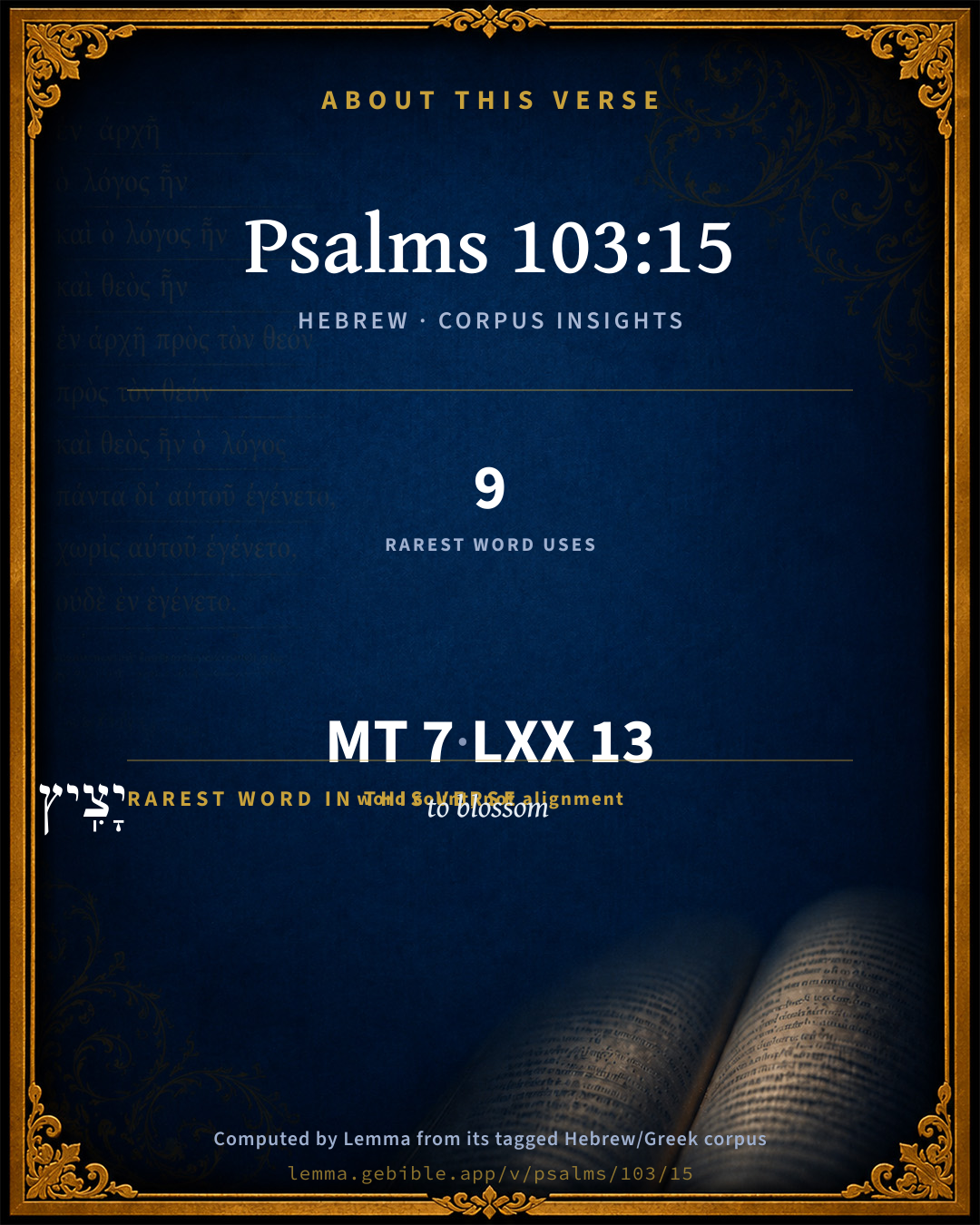
7
words
7
distinct lemmas
Wisdom
section

Notable vocabulary

The rarest word here is יָצִֽיץ to blossom H6692 — appearing just 9 times in the whole Hebrew Bible.

Shared distinctive vocabulary

יָצִֽיץ to blossom H6692 occurs in 9 verses of the Hebrew Bible. Also found in:

Grammatical profile

  • 1 verb
  • 5 nouns
  • 1 particle

Verb forms

  • יָצִֽיץ Hiphil · Imperfect

Hebrew & Septuagint length

In English translation the verse runs 17 words from the Hebrew and 18 from the Septuagint (LXX English) — closely comparable.

A rough comparison of the two English renderings, which tokenize alike — not a word-level alignment.

Word counts can differ between the Hebrew and the Greek without any difference in meaning — e.g. the Hebrew direct-object marker אֵת has no separate Greek word, and Greek often adds the article ὁ.

In the original languages it is 7 Hebrew tokens and 13 Greek tokens — but the two are counted differently (Hebrew bundles its prefixes and suffixes into one token; the Greek is in lemma form), so that isn’t a like-for-like length.

Cross-references

9

Topical passages linked to Psalms 103:15 in the Treasury of Scripture Knowledge — connected by theme and wording, ordered by reader-vote popularity; previews shown in the World English Bible.

  • 1 Peter 1:24 For, "All flesh is like grass, And all of man's glory like the flower in the grass. The grass withers, and its flower falls;
  • James 1:10–11 and the rich, in that he is made humble, because like the flower in the grass, he will pass away.
  • Isaiah 51:12 I, even I, am he who comforts you: who are you, that you are afraid of man who shall die, and of the son of man who shall be made as grass;
  • Isaiah 28:1 Woe to the crown of pride of the drunkards of Ephraim, and to the fading flower of his glorious beauty, which is on the head of the fat valley of those who are overcome with wine!
  • Isaiah 40:6–8 The voice of one saying, Cry. One said, What shall I cry? All flesh is grass, and all the glory of it is as the flower of the field.
  • Job 14:1–3 "Man, who is born of a woman, Is of few days, and full of trouble.
  • Psalms 90:5–6 You sweep them away as they sleep. In the morning they sprout like new grass.
  • Isaiah 28:4 and the fading flower of his glorious beauty, which is on the head of the fat valley, shall be as the first-ripe fig before the summer; which when he who looks on it sees, while it is yet in his hand he eats it up.
  • Nahum 1:4 He rebukes the sea, and makes it dry, and dries up all the rivers. Bashan languishes, and Carmel; and the flower of Lebanon languishes.

Cross-references courtesy of OpenBible.info (CC BY 4.0).

Hebrew and Greek witnesses Masoretic Hebrew ↔ Greek Septuagint

The same verse in the two great witnesses to the Old Testament, shown verse-for-verse.

You’re reading Greek Psalm 102 (Hebrew Psalm 103). The Septuagint counts the superscription, so verse numbers can differ from the Hebrew — chapter-level alignment, not verse-by-verse. Numbering follows Rahlfs.

These are two independent witnesses, not word-aligned to each other, and the Septuagint is shown in lemma (dictionary) form.

Hebrew Psalms 103:15 Masoretic · Westminster Leningrad Codex

אֱ֭נוֹשׁ כֶּחָצִ֣יר יָמָ֑יו כְּצִ֥יץ הַ֝שָּׂדֶ֗ה כֵּ֣ן יָצִֽיץ

As for man, his days are like grass. As a flower of the field, so he flourishes.

World English Bible · Public Domain

Greek LXX Greek Psalm 102:15 Septuagint · lemma form

ἄνθρωπος ὡσεί χόρτος ὁ ἡμέρα αὐτός ὡσεί ἄνθος ὁ ἀγρός οὕτως ἐκ ἀντιἵημι

As for man, his days are as grass; as a flower of the field, so shall he flourish.

LXX2012 (modern English Septuagint) · Public Domain

Hebrew: Westminster Leningrad Codex (CC BY 4.0). Greek: Septuagint (public domain); English from LXX2012 (modern English Septuagint) (Public Domain). How the Septuagint differs from the Hebrew →

Commentary

Notes on Psalms 103:15 from classic Christian and Jewish commentators (each source and its license shown beneath its notes). The classic Christian expositions comment on the surrounding passage and are grouped to its opening verse, so a note may address several verses; the Jewish commentaries on the Tanakh (Rashi and others) are per-verse, so they appear only where the commentator wrote on this verse.

Lemma curates 59 commentaries, every one of them public domain or Creative Commons licensed, each selected and text-cleaned for this edition rather than reprinted as found. About our sources →

Trapp's Complete Commentary

John Trapp

Psa 103:15 [As for] man, his days [are] as grass: as a flower of the field, so he flourisheth.

Ver. 15. As for man, his days are as grass] The frailty of man’s life, intimated in the former verse, is here lively painted out under the similitude of grass, as likewise in many other Scriptures. See Psa 37:2; Psa 90:5-6, &c.

As a flower of the field, so he flourisheth] Take him in all his gaiety, his beauty, and his bravery, he is but as a flower; and that not of the garden, which hath more shelter and better ordering, but of the field, and so more subject to heat, weather, pulling up, or treading down, Isa 40:6-8.

John Trapp, A Commentary or Exposition upon All the Books of the Old and New Testament (1647–1656) — public domain. Text from a community e-Sword module.

The Biblical Illustrator

Joseph S. Exell

Psa_103:15-18

As for man, his days are as grass.

Human life

We have here presented mans existence in relation to--

I. The material and the moral.

1. His relation to the material. Like the flower--

(1) He springs out of the earth.

(2) He is sustained by the earth.

(3) He returns to the earth.

2. His relation to the moral. Inside this flame of organized dust there is a spirit that can reverence the Infinite, that can keep His covenant and attend to His precepts. Herein is the glory of mans nature. The power to do this is His distinction; the willingness to do this is his glory.

II. The temporary and the eternal.

1. The connection of all men with the earth is temporary (verses 15, 16). The wind of mortality is ever breathing through the human world, and men like flowers wither every hour, aye, every minute.

2. The connection of good men with mercy is eternal (verses 17, 18; Isa_54:10). (Homilist.)

The lessons o/autumn

There is a pensiveness in this season, which surely all must feel, and which must dispose all, except the most thoughtless, to some degree of reflection. It would be strange if we could stand amidst the decay, which is now so rapidly advancing, without being led by it into some train of meditation, favourable to religious feeling; and without receiving impressions calculated to make us wiser and better.

I. The frail and fleeting nature of man (verses 15, 16; Psa_90:5-6; Isa_64:6; Isa_40:6-7; Job_14:2; Jam_1:10). The place which we now occupy was once occupied by others, but it knows them no more; and soon it will know nothing of us. Our occupation will be gone--our daily doings will have ceased--our history will have come to its close. To fix our wishes on earth, would be to doom them to certain disappointment; it would be like putting our goods into a dwelling which we knew the next hour would be burned unto the ground--trusting our treasure to a vessel which we knew would go to pieces in the coming storm.

II. The enduring nature of the mercy of God (verses 17, 18; 1Jn_2:17; Joh_6:27; Mat_24:35). Why, then, need we be depressed at the thought, that our days on earth are but as grass, and our joys but as the fading flowers of the field, since we may revive again, and become partakers of an enduring substance in a better world.

III. The character of those to whom this mercy will be shown. Although it is free in its offers, it is not indiscriminate in its gifts: although it is given gratuitously, it is not given unconditionally: although it is offered to all, it is not granted to all. (G. Bellett.)

Mortality

If we consider ourselves as offenders in many things, which we all are, death is a just consequence of our transgressions; for it is fit and reasonable that disobedient creatures should be deprived of the powers which they pervert and abuse.

I. Our present state of mortality is upon many accounts convenient and useful.

1. It is convenient that we should die, because this world is a state of trial.

2. As the consideration of death hath a tendency to deter us from vice, it consequently prevents some disorders, and makes us live together in society better than we else should pass our days.

3. It is also convenient that we should die, because the future recompenses of obedience are of a spiritual nature.

4. Another reason why it is convenient that we should die, is, that our obedience at best being defective, death prepares us for the next state, and excites in the soul thoughts and inclinations which ought to accompany it at its entrance into the world of spirits, and into the presence of its Maker.

5. It is not only convenient, but desirable and profitable, that we should die, if death conducts us to life eternal.

6. If by obedience and perseverance we secure to ourselves an inheritance in the Kingdom of God, when that promised time shall come, and this corruptible shall have put on incorrutption, the remembrance of our former earthly state, and of all its inconveniences, may probably add to our happiness; and then it will be good for us that we once were mortal creatures.

II. The methods which we must use, to allay and restrain those immoderate fears of death, which are blameable, and which also render life itself, with all its conveniences, dull and comfortless.

1. Frequent thoughts of our latter end will assist to produce this good effect.

2. Another way of reconciling ourselves to death is to consider it as unavoidable.

3. Another consideration tending to make us more willing to die, is, that it is common to all.

4. The troubles of life, rightly considered, may help to remove a great dislike of death. (J. Jortin, D. D.)

As a flower of the field.--

What the flowers say

(Flower Service):--Let us listen to the preaching of the flowers today. What do they say to us? One thing they all say is--trust God. God takes care of the flowers, and sends them dew, and rain, and sunshine, and fresh air, and they tell us that the same God who cares for them cares also for us. And next, I think, all the flowers say to us, thank God. See how the daisies in the meadow seem to look up thankfully to God. Some one says that God smiles on the earth, and that the earth smiles back again with its flowers. Next, the flowers say to us, be contented. They are quite satisfied to grow, and smell sweet, and look pretty, in the place where God puts them. Now, just as God plants the flowers in a certain place, some up high on the hills, others down low in the valley; some in the Queens greenhouse, others in the cottagers garden, so He puts you children in your right place. Another thing which all the flowers tell us is this, remember that you must die. When the autumn and winter come we say the flowers are dead because we cannot see them. But the flowers are not really dead. They are sleeping in the earth till the spring comes again. God has put them to bed in the warm ground, and when the proper time comes they will waken up. Just what God does to the flowers He does to us. What else do the flowers say to us? I think they say, keep in the sunshine, be happy. You always find that flowers are on the sunny side of things. So ought we to be. There is another thing which the flowers say to us--Be sweet. There is nothing so delicious as to go into a flower garden after a warm shower, and to smell the sweet scents. Well, God has sent you into the garden of this world to be sweet like the flowers. Some children are regular stinging nettles in a home, or a school. They always make people uncomfortable. They sting with their tongues, and they sting with their looks and their tempers. (H. J. Wilmot-Buxton, M.A.)

The Biblical Illustrator, edited by Joseph S. Exell (c. 1880s–1900s) — public domain. Text from a community e-Sword module.

J. A. Alexander on Psalms

Joseph Addison Alexander

15. (Psa 103:15) (As for) man, his days (are) like the grass; like the blossom of the ield, so he blossoms. As the preceding verse expresses the fragility of man by referring to his origin and end, so this verse does the same by a familiar but beautiful comparison, borrowed from Ps. xc. 6, and repeated in Isa 40:6-8, Job 14:2. The very name here given to the race is one denoting frailty and infirmity. See above, on Psa 8:4.

Joseph Addison Alexander, The Psalms Translated and Explained (1850) — public domain. Text from a community e-Sword module.

Geneva Bible (1599)

Geneva Bible translators

He declareth that man hath nothing in himself to move God to mercy, but only the confession of his infirmity and misery.

Geneva Bible (1599) marginal notes — public domain. Text via Bolls.life.

Adam Clarke's Commentary

Verse 15. His days are as grass] See Clarke on Ps 90:5.

Adam Clarke's Commentary on the Bible (1810–1826) — public domain. Text from a community e-Sword/MySword module.

John Calvin's Commentaries

To the same purpose is the comparison immediately following, (verse 15,) that all the excellency of man withers away like a fading flower at the first blast of the wind. Man is indeed improperly said to flourish. But as it might be alleged that he is, nevertheless, distinguished by some endowment or other, David grants that he flourishes like the grass, instead of saying, as he might justly have done, that he is a vapor or shadow, or a thing of nought. Although, as long as we live in this world, we are adorned with natural gifts, and, to say nothing of other things, “live, and move, and have our being in God,” (Acts 17:28;) yet as we have nothing except what is dependent on the will of another, and which may be taken from us every hour, our life is only a show or phantom that passes away. The subject here treated, is properly the brevity of life, to which God has a regard in so mercifully pardoning us, as it is said in another psalm: “He remembered that they were but flesh, a wind that passeth away, and cometh not again,” (Psalm 78:39.) If it is asked why David, making no mention of the soul, which yet is the principal part of man, declares us to be dust and clay? I answer, that it is enough to induce God mercifully to sustain us, when he sees that nothing surpasses our life in frailty. And although the soul, after it has departed from the prison of the body, remains alive, yet its doing so does not arise from any inherent power of its own. Were God to withdraw his grace, the soul would be nothing more than a puff or blast, even as the body is dust; and thus there would doubtless be found in the whole man nothing but mere vanity.

John Calvin's Commentaries (1540-1563) — public domain. Text from the Calvin Translation Society English edition (1840s-50s) via the Christian Classics Ethereal Library (ccel.org). Calvin's coverage is partial (roughly two-thirds of the Bible); uncommented books and verses are honest gaps, never fabricated. The 19th-century editor's footnotes and remarks are omitted so the notes are faithfully Calvin's own voice.

The Cambridge Bible for Schools and Colleges

gen. ed. J. J. S. Perowne

15. As for man] Mortal man: the Heb. ’enôsh denotes man in his weakness and frailty (Psa_90:3). For the figure of the grass cp. Psa_90:5-6; Isa_51:12; for that of the flower, Job_14:2; for both, Isa_40:6 ff.

15–18. Man passes away, but God’s mercy endures for ever.

The Cambridge Bible for Schools and Colleges (gen. ed. J. J. S. Perowne; Cambridge University Press, 1878–1918) — public domain. Text from a community e-Sword module.

John Gill's Exposition

But the mercy of the Lord is from everlasting to everlasting upon them that fear him,.... In opposition to the frailty of man, the stability and duration of the mercy of God is observed. This reaches from one eternity to another; it is from everlasting in the heart of God: it appeared in the choice of the vessels of mercy; in the covenant of grace, which is founded upon it, and filled with it; every blessing of which flows from it, and therefore are called the "sure mercies of David". And it appears in time in the regeneration of God's elect, which is according to his abundant mercy; in the forgiveness of their sins, which is according to the multitude of his tender mercies; and in their whole salvation, which is by that, and not by works of righteousness; and will endure for ever, for the mercy of our Lord Jesus Christ is unto eternal life. It reaches from the world past to the world to come, as the Targum; and it is so "upon them that fear" the Lord; not with a servile, but a filial fear; a fear of the Lord and his goodness; which only is consistent with the grace and mercy of God, and a sense of it: not that the fear of God is the cause of mercy or grace; but, on the contrary, grace and mercy are the cause of the fear of God; which is a blessing of the covenant of grace, and one of the first things which appear in conversion; but this properly describes the persons who openly and manifestly share in the grace or mercy of God, and to whom he manifests it yet more and more; nor have any reason to believe they are the objects of it, until the true fear of God is wrought in their hearts; and, besides, this character may be given to show that the mercy and grace of God are not limited to the Israelites only, but belong to such of all nations that fear the Lord.

And his righteousness unto children's children; not the essential righteousness of God, but rather his faithfulness in the performance of his promises, which he will not suffer to fail: the justifying righteousness of Christ is here meant; which is an everlasting one, and is unto and upon all them that believe, in all successive generations; which is meant by the phrase of "children's children", even the spiritual seed of Christ, the seed of the church, the seed of Israel; to all and each of which, in every age, the word of God comes, and his promises are fulfilled; and who are justified by and glory in Christ, their righteousness; and who are further described in the next verse, which shows that not the carnal seed of them that fear the Lord are meant.

John Gill's Exposition of the Whole Bible (1746–1763) — public domain (CC PDM 1.0). Text via the HelloAO Bible API.

Albert Barnes' Notes on the Bible

As for man - literally, “Man; like the grass are his days!” The thought is fixed on man: man so frail and weak; man, not only made originally of earth, but man delicate, feeble, soon to pass away like the springing grass, or like the fading flower.

His days are as grass - See the notes at Psa 90:5-6; compare Isa 40:6-8, notes; 1Pe 1:24, note.

As a flower of the field - As a blossom. It opens with beauty and fragrance, but soon fades and perishes.

So he flourisheth - Rather, “So he blossoms.” That is, he is like a flower that is fresh and beautiful, and that soon withers away.

Albert Barnes' Notes on the Bible (1834–1885) — public domain. Text from a community e-Sword/MySword module.

Matthew Poole's English Annotations

A flower of the field; which is more exposed to winds and other violences than the flowers of the garden, which are secured by the art and care of the gardener.

Matthew Poole's English Annotations on the Holy Bible (1683–1685) — public domain. Text from a community e-Sword/MySword module.

The Treasury of David

Charles H. Spurgeon

Ver. 15. As for man, his days are as grass. He lives on the grass, and lives like the grass. Corn is but educated grass, and man, who feeds on it, partakes of its nature. The grass lives, grows, flowers, falls beneath the scythe, dries up, and is removed from the field: read this sentence over again, and you will find it the history of man. If he lives out his little day, he is cut down at last, and it is far more likely that he will wither before he comes to maturity, or be plucked away on a sudden, long before he has fulfilled his time.

As a flower of the field, so he flourisheth. He has a beauty and a comeliness even as the meadows have when they are yellow with the king-cups, but, alas, how short-lived! No sooner come than gone, a flash of loveliness and no more! Man is not even like a flower in the conservatory or in the sheltered garden border, he grows best according to nature, as the field-flower does, and like the unprotected beautifier of the pasture, he runs a thousand risks of coming to a speedy end. A large congregation, in many-coloured attire, always reminds us of a meadow bright with many hues; and the comparison becomes sadly true when we reflect, that as the grass and its goodliness soon pass away, even so will those we gaze upon, and all their visible beauty. Thus, too, must it be with all that comes of the flesh, even its greatest excellencies and natural virtues, for "that which is born of the flesh is flesh, "and therefore is but as grass which withers if but a breath of wind assails it. Happy are they who, born from above, have in them an incorruptible seed which liveth and abideth for ever.

Ver. 15. As for man. The insignificance of man is especially brought out by the use of ENOSH here. Robert Baker Girdlestone.

Ver. 15. Man comes forth, says Job, like a flower, and is cut down; he is sent into the world the fairest and noblest part of God's works, fashioned after the image of his Creator, with respect to reason and the great faculties of the mind; he cometh forth glorious as the flower of the field; as it surpasses the vegetable world in beauty, so does he the animal world in the glory and excellence of his nature. The one, if no untimely accident oppress it, soon arrives at the full period of its perfection, is suffered to triumph for a few moments, and is plucked up by the roots in the very pride and gayest stage of its being; or if it happens to escape the hands of violence, in a few days it necessarily sickens of itself and dies away. Man likewise, though his progress is slower, and his duration somewhat longer, yet the periods of his growth and declension are nearly the same, both in the nature and manner of them. If he escapes the dangers which threaten his tenderer years, he is soon got into the full maturity and strength of life; and if he is so fortunate as not to be hurried out of it then by accidents, by his own folly and intemperanceif he escapes these, he naturally decays of himself, a period comes fast upon him, beyond which he was not made to last. Like flowers or fruits which may be plucked up by force before the time of their maturity, yet cannot be made to outgrow the period when they are to fade and drop of themselves; when that comes, the hand of nature then plucks them both off, and no art of the botanist can uphold the one, or skill of the physician preserve the other, beyond the periods to which their original frames and constitutions were made to extend. As God has appointed and determined the several growths and decays of the vegetable race, so he seems as evidently to have prescribed the same laws to man, as well as all living creatures, in the first rudiments of which there are contained the specific powers of their growth, duration and extinction; and when the evolutions of those animal powers are exhausted and run down, the creature expires and dies of itself, as ripe fruit falls from the tree, or a flower preserved beyond its bloom, drops and perishes upon the stalk. Lawrence Sterne, 1713-1768.

Ver. 15. The Psalmist saith of man, as a flower of the field, so he flourisheth. It is not a flower of the garden, but of the "field." This latter is more subject to decay than the former, because it lies more open to the nipping air and violent winds, and to the browsing mouth of the beast, and is more liable to be trampled upon: by all these ways it decayeth as well as by the scorching sun, and its own fading temper. John Edwards, in "Theologia Reformata."

Ver. 15. As flower of the field.

What is life! like a flower, with the bane in its bosom,

Today full of promisetomorrow it dies!

And healthlike the dew-drop that hangs in its blossom,

Survives but a night, and exhales to the skies!

How oft beneath the bud that is brightest and fairest,

The seeds of the canker in embryo lurk!

How oft at the root of the flower that is rarest

Secure in its ambush the worm is at work? James Beattie, 1735-1803.

Ver. 15. Man's earthly career. His rise, progress, glory, fall, and oblivion.

Ver. 15-18.

1. What man is when left to himself. "As for man, "etc. (a) What here? His days are as grass, his glory as the flower of grass. (b) What hereafter? swept away by a blighting wind, by a blast of divine angerknown no more on the earth, known only in perdition.

2. What the mercy of God does for him. (a) Makes a covenant of grace on his behalf flora everlasting. (b) Makes a covenant of peace with hint in this life. (c) Makes a covenant of promise to him for an eternity to come.

3. Who are the objects of this mercy? (a) Those who fear God. (b) Who walk in the footsteps of pious ancestors. (c) Who rely upon covenant mercy. (d) Who are faithful to their covenant engagements. G. R.

Psalms 103:16*

Charles H. Spurgeon's The Treasury of David (1869–1885) — public domain. Psalms only. Text from a community e-Sword/MySword module.

Whedon's Commentary on the Bible

Daniel D. Whedon

15. As for man—As for the human race, “man” being used collectively of all men, as Deu_32:26; Job_7:17; Psa_8:4-5.

Grass… flower—Emblems of frailty and beauty. Job_14:2; Psa_90:6

Daniel D. Whedon (gen. ed.), Commentary on the Old and New Testaments (1874–1909) — public domain. Text from a community e-Sword module.

The Pulpit Commentary

As for man, his days are as grass. Here is a new departure. From the loving kindness and mercy of God the psalmist passes to the weakness and helplessness of man. Man is like grass. (Psa_37:2 Psa_90:5, 6 102:11 Isa_40:6-8, etc.) His days fleet and fade. He never "continueth in one stay." As a flower of the field. (comp. Job_14:2 Isa_28:1 Isa_40:6 Jam_1:10 1Pe_1:24, etc.) He flourisheth; i.e. he cometh up in full vigour, glorious to look upon, rejoicing in his youth and strength, but within a little time he fadeth, falleth away, or is "cut down, dried up, and withered." There is no strength or stability in him.

The Pulpit Commentary (1880–1919), ed. H.D.M. Spence-Jones & Joseph S. Exell — public domain. Text from a community e-Sword module.

Keil & Delitzsch

C. F. Keil & F. Delitzsch

The figure of the grass recalls Psa 90:5., cf. Isa 40:6-8; Isa 51:12; that of the flower, Job 14:2. אנושׁ is man as a mortal being; his life's duration is likened to that of a blade of grass, and his beauty and glory to a flower of the field, whose fullest bloom is also the beginning of its fading. In Psa 103:16 בּו (the same as in Isa 40:7.) refers to man, who is compared to grass and flowers. כּי is ἐάν with a hypothetical perfect; and the wind that scorches up the plants, referred to man, is an emblem of every form of peril that threatens life: often enough it is really a breath of wind which snaps off a man's life. The bold designation of vanishing away without leaving any trace, "and his place knoweth him no more," is taken from Job 7:10, cf. ibid. Job 8:18; Job 20:9. In the midst of this plant-like, frail destiny, there is, however, one strong ground of comfort. There is an everlasting power, which raises all those who link themselves with it above the transitoriness involved in nature's laws, and makes them eternal like itself. This power is the mercy of God, which spans itself above (על) all those who fear Him like an eternal heaven. This is God's righteousness, which rewards faithful adherence to His covenant and conscientious fulfilment of His precepts in accordance with the order of redemption, and shows itself even to (ל) children's children, according to Exo 20:6; Exo 34:7; Deu 7:9 : on into a thousand generations, i.e., into infinity.

Keil & Delitzsch — Biblical Commentary on the Old Testament (1861–1891) — public domain (CC PDM 1.0). Text via the HelloAO Bible API. (Old Testament only.)

Lesson kit

Teaching starters — assembled from the data on this page, not authored interpretation. Every prompt links to the verse data it draws on. Edit before teaching.

Psalms, in the Wisdom, opens this verse with 7 words (7 distinct Hebrew lemmas). Its most distinctive word is tsûwts (“to blossom”). A historical commentator’s framing appears above. Read the whole chapter for the surrounding context.

Discussion questions

  1. The word tsûwts carries the sense “to blossom.” How does it shape the verse?
  2. Numbers 17:8 shares the word «to blossom» with this verse. How do the two illuminate each other?
  3. These translations render this verse differently; the difference is in the English rendering, not the original. What questions does that raise?
  4. The verb «יָצִֽיץ» is Hiphil Imperfect. How does its form color the action?
  5. Reading how Trapp's Complete Commentary and The Biblical Illustrator read this verse, where do the two commentators agree and where do they part?

Things to notice

Reading settings

Reading text

Shown beneath each verse's original-language words.

Old Testament
Old Testament edition

Read the OT as the Masoretic Hebrew (MT) or the Greek Septuagint (LXX).

English shown for the Greek Septuagint (in the Hebrew ↔ Greek comparison).

Comparing translations? Open the Compare panel on any verse page to stack up to four side by side.