
Ezekiel 15:7

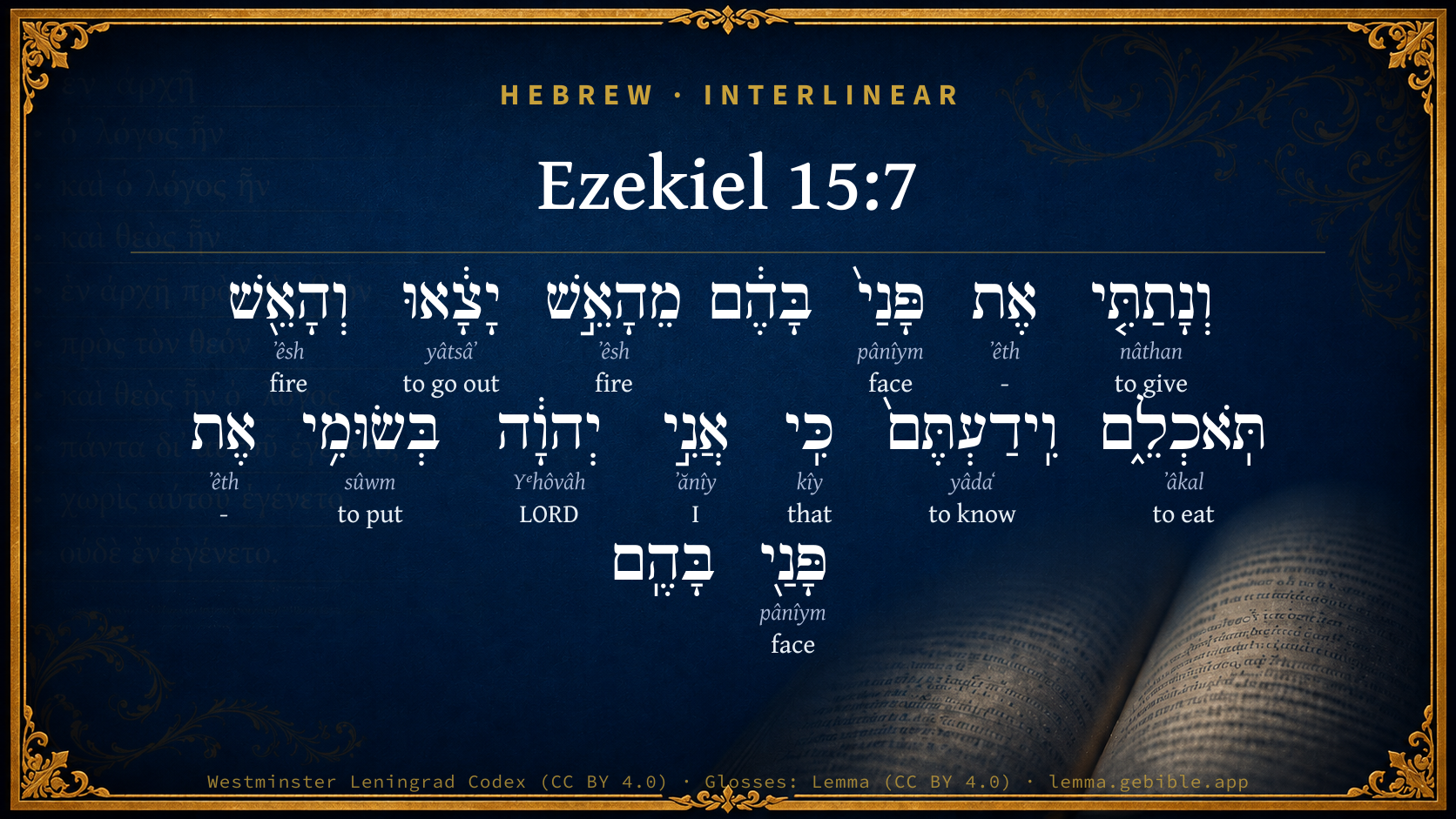
Hebrew (Westminster Leningrad Codex) Ezekiel 15:7 appears in the Hebrew Old Testament. The text above is from the Westminster Leningrad Codex. Each word links to its Strong’s number, a concise gloss, and parsing drawn from the Open Scriptures Hebrew Bible morphology. Click any word for its full Brown-Driver-Briggs (BDB) entry.
Download image
Cite this verse

Ezekiel 15:7 (World English Bible). Public Domain. Lemma interlinear Bible study tool, https://lemma.gebible.app/v/ezekiel/15/7.

Show BibTeX & RIS
BibTeX
RIS
English Translation
I will set my face against them; they shall go forth from the fire, but the fire shall devour them; and you shall know that I am Yahweh, when I set my face against them.
World English Bible · Public Domain
Download a study sheet

One document with this verse’s original text, its word-by-word gloss line, the meaning frame, cross-references with their text, attributed commentary, and full source and license credits — printable, and it pastes into notes with its structure intact.

This verse Autodidact and up

Study sheet (.html) Plain text (.txt)

A passage Seminary Student

Up to 50 verses in one chapter. A passage sheet keeps up to 6 commentary sources and 12 cross-references per verse, in the order this page ranks them, and says so on the sheet whenever that leaves anything out. Ask for a single verse and you get the Autodidact verse sheet above.

Everything on this page stays free to read, with no account — the sheet is a download of what is already on screen, not access to it.

Want to remove ads? Support Godless Engineer
Compare translations 3

The same verse in 3 English versions, stacked beneath the original-language interlinear above. Click any original word for its lexicon entry.

Each is an independent rendering of the whole verse — the interlinear is not word-aligned to these translations.

Highlighted words mark where these versions differ — a whole-verse word diff, not a word-by-word alignment.

  • World English Bible Public Domain
    I will set my face against them; they shall go forth from the fire, but the fire shall devour them; and you shall know that I am Yahweh, when I set my face against them.
  • King James Version Public Domain
    And I will set my face against them; they shall go out from one fire, and another fire shall devour them; and ye shall know that I am the LORD, when I set my face against them.
  • unfoldingWord Literal Text CC BY-SA 4.0
    For I will set my face against them. Though they come out from the fire, yet the fire will consume them; so you will know that I am Yahweh, when I set my face against them.

unfoldingWord Literal Text — © unfoldingWord, licensed CC BY-SA 4.0. Word-aligned USFM3 via Door43 (git.door43.org/unfoldingWord/en_ult).

Versions to compare (up to 4)

3 of 4 selected

Show all 18 translations

Every available English version of this verse, each an independent rendering of the whole verse.

  • World English Bible Public Domain
    I will set my face against them; they shall go forth from the fire, but the fire shall devour them; and you shall know that I am Yahweh, when I set my face against them.
  • Berean Standard Bible Public Domain
    And I will set My face against them. Though they may have escaped the fire, yet another fire will consume them. And when I set My face against them, you will know that I am the LORD.
  • Majority Standard Bible Public Domain
    And I will set My face against them. Though they may have escaped the fire, yet another fire will consume them. And when I set My face against them, you will know that I am the LORD.
  • King James Version Public Domain
    And I will set my face against them; they shall go out from one fire, and another fire shall devour them; and ye shall know that I am the LORD, when I set my face against them.
  • American Standard Version (1901) Public Domain
    And I will set my face against them; they shall go forth from the fire, but the fire shall devour them; and ye shall know that I am Jehovah, when I set my face against them.
  • Revised Version (1885) Public Domain
    And I will set my face against them; they shall go forth from the fire, but the fire shall devour them; and ye shall know that I am the LORD, when I set my face against them.
  • Geneva Bible (1599) Public Domain
    And I will set my face against them: they shall go out from one fire, and another fire shall consume them: and ye shall know, that I am the Lord, when I set my face against them,
  • Douay-Rheims (1899) Public Domain
    And I will set my face against them: they shall go out from fire, and fire shall consume them: and you shall know that I am the Lord, when I shall have set my face against them.
  • Young's Literal Translation Public Domain
    And I have set My face against them, From the fire they have gone forth, And the fire doth consume them, And ye have known that I `am' Jehovah, In My setting My face against them.
  • Literal Standard Version CC BY-SA 4.0
    And I have set My face against them, || They have gone forth from the fire, || And the fire consumes them, || And you have known that I [am] YHWH, || In My setting My face against them.
  • Unlocked Literal Bible CC BY-SA 4.0
    For I will set my face against them. Though they come out from the fire, yet the fire will consume them; so you will know that I am Yahweh, when I set my face against them.
  • unfoldingWord Literal Text CC BY-SA 4.0
    For I will set my face against them. Though they come out from the fire, yet the fire will consume them; so you will know that I am Yahweh, when I set my face against them.
  • Darby Bible Public Domain
    And I will set my face against them: they shall go forth from [one] fire, and [another] fire shall devour them; and ye shall know that I [am] Jehovah when I set my face against them.
  • World Messianic Bible Public Domain
    I will set my face against them. They will go out from the fire, but the fire will still devour them. Then you will know that I am the LORD, when I set my face against them.
  • Webster's Bible Public Domain
    And I will set my face against them; they shall go out from one fire, and another fire shall devour them; and ye shall know that I am the LORD, when I set my face against them.
  • Free Bible Version CC BY-SA 4.0
    I will turn against them. While they might have escaped this fire, another fire is going to burn them up. When I turn against them, then you will know that I am the Lord.
  • Bible in Basic English Public Domain
    And my face will be turned against them; and though they have come out of the fire they will be burned up by it; and it will be clear to you that I am the Lord when my face is turned against them.
  • JPS Tanakh (1917) Public Domain
    And I will set My face against them; out of the fire are they come forth, and the fire shall devour them; and ye shall know that I am the LORD, when I set My face against them.

Literal Standard Version (2020), Covenant Press — licensed CC BY-SA 4.0. Text via the HelloAO Bible API (eBible.org). Unlocked Literal Bible (unfoldingWord) — licensed CC BY-SA 4.0. Text via the HelloAO Bible API (eBible.org). unfoldingWord Literal Text — © unfoldingWord, licensed CC BY-SA 4.0. Word-aligned USFM3 via Door43 (git.door43.org/unfoldingWord/en_ult). Free Bible Version, Dr. Jonathan Gallagher — licensed CC BY-SA 4.0. Text via the HelloAO Bible API (eBible.org).

Word by word

More ways to search: Search by grammar → Find every occurrence → Compare this word →

Practice this passage: Drill this verse → Learn its vocabulary →

מֵהָאֵ֣שׁ
ʼêsh
H784
“from · the · fire”
Preposition + Particle, Definite Article + Noun, Common, Both, Singular, Absolute
Part of Speech
Preposition + Particle + Noun
Type
Common
Gender
Both
Number
Singular
State
Absolute
Full BDB Definition

Origin: a primitive word

TWOT: 172

fire - fire, flames - supernatural fire (accompanying theophany) - fire (for cooking, roasting, parching) - altar-fire - God's anger (figuratively)
  1. וְנָתַתִּ֤י nâthan H5414 “and · to give” Conjunction + Verb, Qal, Sequential Perfect, 1st Person, Common, Singular
  2. אֶת ʼêth H853 “-” Particle, Direct Object
  3. פָּנַי֙ pânîym H6440 “face(s) · my” Noun, Common, Both, Plural, Construct + Suffix, Personal, 1st Person, Common, Singular
  4. יָצָ֔אוּ yâtsâʼ H3318 “to go out” Verb, Qal, Perfect, 3rd Person, Common, Plural
  5. וְהָאֵ֖שׁ ʼêsh H784 “and · the · fire” Conjunction + Particle, Definite Article + Noun, Common, Both, Singular, Absolute
  6. תֹּֽאכְלֵ֑ם ʼâkal H398 “to eat · them” Verb, Qal, Imperfect, 3rd Person, Feminine, Singular + Suffix, Personal, 3rd Person, Masculine, Plural
  7. וִֽידַעְתֶּם֙ yâdaʻ H3045 “and · to know” Conjunction + Verb, Qal, Sequential Perfect, 2nd Person, Masculine, Plural
  8. כִּֽי kîy H3588 “that” Conjunction
  9. אֲנִ֣י ʼănîy H589 “I” Pronoun, Personal, 1st Person, Common, Singular
  10. יְהוָ֔ה Yᵉhôvâh H3068 “LORD” Noun, Proper
  11. בְּשׂוּמִ֥י sûwm H7760 “in/at · to put · me” Preposition + Verb, Qal, Infinitive Construct + Suffix, Personal, 1st Person, Common, Singular
  12. אֶת ʼêth H853 “-” Particle, Direct Object
  13. פָּנַ֖י pânîym H6440 “face(s) · my” Noun, Common, Both, Plural, Construct + Suffix, Personal, 1st Person, Common, Singular

About this verse

These counts appear in no published source. They are computed here, from the morphology-tagged text and Lemma’s own curated glosses. What Lemma adds →

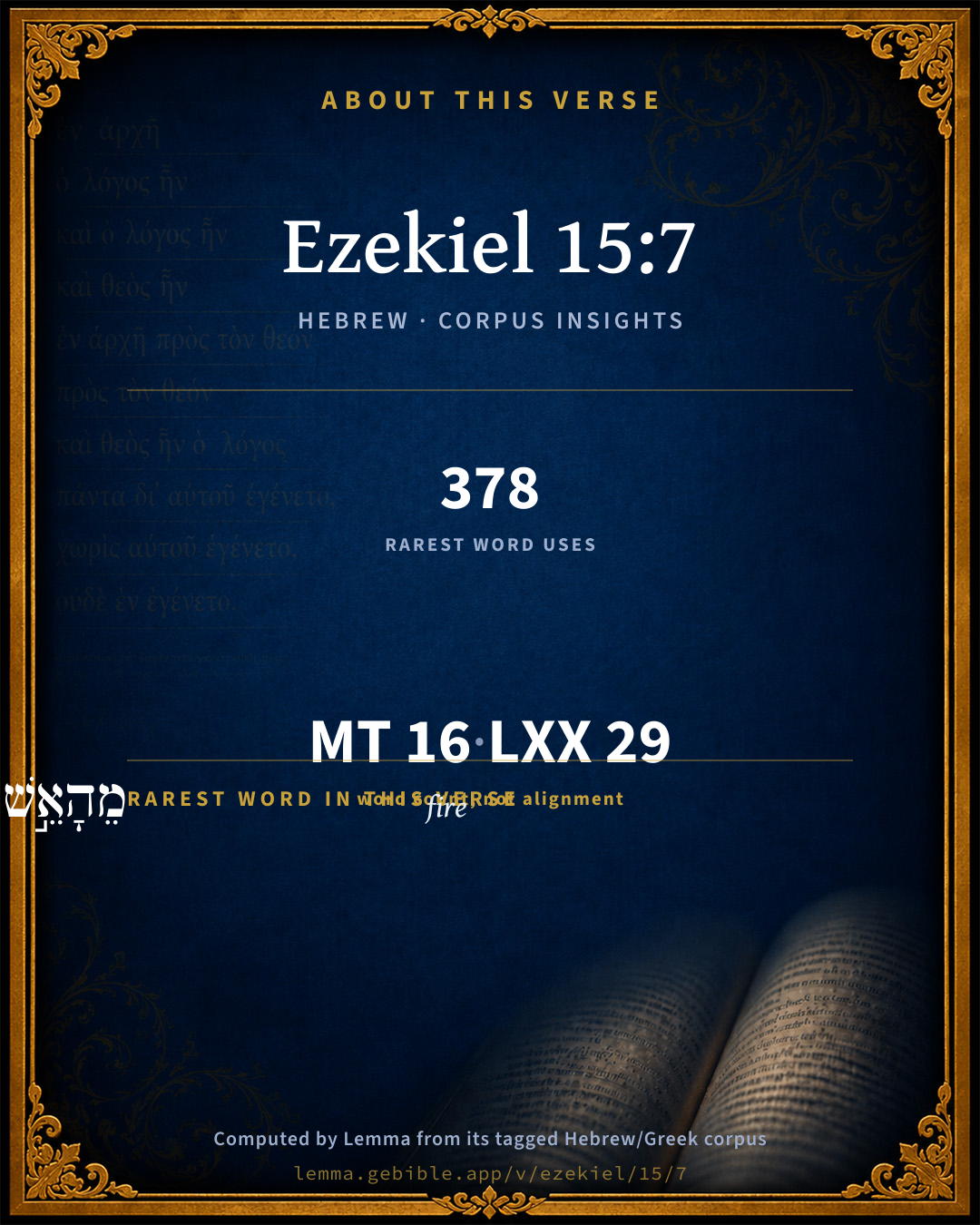
16
words
11
distinct lemmas
Prophets
section

Grammatical profile

  • 5 verbs
  • 5 nouns
  • 1 pronoun
  • 2 prepositions
  • 1 conjunction
  • 2 particles

Verb forms

  • וְנָתַתִּ֤י Qal · Sequential Perfect
  • יָצָ֔אוּ Qal · Perfect
  • תֹּֽאכְלֵ֑ם Qal · Imperfect
  • וִֽידַעְתֶּם֙ Qal · Sequential Perfect
  • בְּשׂוּמִ֥י Qal · Infinitive Construct

Repetition

Words recur within this verse — often emphatic in Hebrew:

  • פָּנַי֙ face H6440 ×2
  • מֵהָאֵ֣שׁ fire H784 ×2

Hebrew & Septuagint length

In English translation the verse runs 35 words from the Hebrew and 38 from the Septuagint (LXX English) — closely comparable.

A rough comparison of the two English renderings, which tokenize alike — not a word-level alignment.

Word counts can differ between the Hebrew and the Greek without any difference in meaning — e.g. the Hebrew direct-object marker אֵת has no separate Greek word, and Greek often adds the article ὁ.

In the original languages it is 16 Hebrew tokens and 29 Greek tokens — but the two are counted differently (Hebrew bundles its prefixes and suffixes into one token; the Greek is in lemma form), so that isn’t a like-for-like length.

Cross-references

18

Topical passages linked to Ezekiel 15:7 in the Treasury of Scripture Knowledge — connected by theme and wording, ordered by reader-vote popularity; previews shown in the World English Bible.

  • Ezekiel 14:8 and I will set my face against that man, and will make him an astonishment, for a sign and a proverb, and I will cut him off from the midst of my people; and you shall know that I am Yahweh.
  • Psalms 34:16 Yahweh's face is against those who do evil, To cut off the memory of them from the earth.
  • Isaiah 24:18 It shall happen, that he who flees from the noise of the fear shall fall into the pit; and he who comes up out of the midst of the pit shall be taken in the snare: for the windows on high are opened, and the foundations of the earth tremble.
  • Amos 9:1–4 I saw the Lord standing beside the altar, and he said, "Strike the tops of the pillars, that the thresholds may shake; and break them in pieces on the head of all of them; and I will kill the last of them with the sword: there shall not one of them flee away, and there shall not one of them escape.
  • Leviticus 26:17 I will set my face against you, and you will be struck before your enemies. Those who hate you will rule over you; and you will flee when no one pursues you.
  • 1 Kings 19:17 It shall happen, that he who escapes from the sword of Hazael shall Jehu kill; and he who escapes from the sword of Jehu shall Elisha kill.
  • Jeremiah 21:10 For I have set my face on this city for evil, and not for good, says Yahweh: it shall be given into the hand of the king of Babylon, and he shall burn it with fire.
  • Ezekiel 6:7 The slain shall fall in the midst of you, and you shall know that I am Yahweh.
  • Leviticus 17:10 "'Any man of the house of Israel, or of the strangers who live as foreigners among them, who eats any kind of blood, I will set my face against that soul who eats blood, and will cut him off from among his people.
  • Leviticus 20:3–6 I also will set my face against that person, and will cut him off from among his people because he has given of his seed to Molech, to defile my sanctuary, and to profane my holy name.
  • Psalms 9:16 Yahweh has made himself known. He has executed judgment. The wicked is snared by the work of his own hands. Meditation. Selah.
  • Jeremiah 48:43–44 Fear, and the pit, and the snare, are on you, inhabitant of Moab, says Yahweh.
  • Ezekiel 11:10 You shall fall by the sword; I will judge you in the border of Israel; and you shall know that I am Yahweh.
  • Ezekiel 20:38 and I will purge out from among you the rebels, and those who disobey against me; I will bring them forth out of the land where they sojourn, but they shall not enter into the land of Israel: and you shall know that I am Yahweh.
  • Ezekiel 20:42 You shall know that I am Yahweh, when I shall bring you into the land of Israel, into the country which I swore to give to your fathers.
  • Ezekiel 20:44 You shall know that I am Yahweh, when I have dealt with you for my name's sake, not according to your evil ways, nor according to your corrupt doings, you house of Israel, says the Lord Yahweh.
  • Amos 5:19 As if a man fled from a lion, And a bear met him; Or he went into the house and leaned his hand on the wall, And a snake bit him.
  • Ezekiel 7:4 My eye shall not spare you, neither will I have pity; but I will bring your ways on you, and your abominations shall be in the midst of you: and you shall know that I am Yahweh.

Cross-references courtesy of OpenBible.info (CC BY 4.0).

Hebrew and Greek witnesses Masoretic Hebrew ↔ Greek Septuagint

The same verse in the two great witnesses to the Old Testament, shown verse-for-verse.

These are two independent witnesses, not word-aligned to each other, and the Septuagint is shown in lemma (dictionary) form.

Hebrew Ezekiel 15:7 Masoretic · Westminster Leningrad Codex

וְנָתַתִּ֤י אֶת פָּנַי֙ בָּהֶ֔ם מֵהָאֵ֣שׁ יָצָ֔אוּ וְהָאֵ֖שׁ תֹּֽאכְלֵ֑ם וִֽידַעְתֶּם֙ כִּֽי אֲנִ֣י יְהוָ֔ה בְּשׂוּמִ֥י אֶת פָּנַ֖י בָּהֶֽם

I will set my face against them; they shall go forth from the fire, but the fire shall devour them; and you shall know that I am Yahweh, when I set my face against them.

World English Bible · Public Domain

Greek LXX Ezekiel 15:7 Septuagint · lemma form

καί δίδωμι ὁ πρόσωπον ἐγώ ἐπί αὐτός ἐκ ὁ πῦρ ἐκἔρχομαι καί πῦρ αὐτός καταἐσθίω καί ἐπιγιγνώσκω ὅτι ἐγώ κύριος ἐν ὁ στηρίζω ἐγώ ὁ πρόσωπον ἐγώ ἐπί αὐτός

And I will set my face against them; they shall go forth of the fire, and yet fire shall devour them; and they shall know that I am the Lord, when I have set my face against them.

LXX2012 (modern English Septuagint) · Public Domain

Hebrew: Westminster Leningrad Codex (CC BY 4.0). Greek: Septuagint (public domain); English from LXX2012 (modern English Septuagint) (Public Domain). How the Septuagint differs from the Hebrew →

Targum (Aramaic paraphrase)

1

The Targum is the ancient Jewish Aramaic paraphrase of the Hebrew Scriptures — an interpretive translation, not the Hebrew text itself. Onkelos (literal) and Pseudo-Jonathan (expansive) render the Torah, and Jonathan the Prophets. Coverage is partial: where no permissively-licensed English translation exists for a verse, only the Aramaic is shown. This is verse-level text, not a word-by-word alignment to the Hebrew.

  1. Targum Jonathan Prophets (Joshua–Malachi)
    וְאֶתֵּן יַת פּוּרְעֲנוּתִי בְּהוֹן עַל פִּתְגָמַי אוֹרַיְתָא דִיהִיבִין מִגוֹ אֶשְׁתָּא עֲבַרוּ וְעַמְמַיָא דִתְקִיפִין כְּאֶשְׁתָּא יְשֵׁיצִינוּן וְתִידְעוּן אֲרֵי אֲנָא יְיָ כַּד יָחוּל רוּגְזִי בְּהוֹן:

    (no public-domain English translation for this verse)

    Targum Jonathan — Aramaic: “Mikraot Gedolot” (public domain). English: “Sefaria Community Translation” (CC0 1.0 (public-domain dedication)); “London "Chaldee Paraphrase," 1871” (public domain). Text via Sefaria.

Commentary

Notes on Ezekiel 15:7 from classic Christian and Jewish commentators (each source and its license shown beneath its notes). The classic Christian expositions comment on the surrounding passage and are grouped to its opening verse, so a note may address several verses; the Jewish commentaries on the Tanakh (Rashi and others) are per-verse, so they appear only where the commentator wrote on this verse.

Lemma curates 59 commentaries, every one of them public domain or Creative Commons licensed, each selected and text-cleaned for this edition rather than reprinted as found. About our sources →

Trapp's Complete Commentary

John Trapp

Eze 15:7 And I will set my face against them; they shall go out from [one] fire, and [another] fire shall devour them; and ye shall know that I [am] the LORD, when I set my face against them.

Ver. 7. And I will set my face aguinst them.] See Eze 14:8 Lev 17:10.

They shall go out from one fire.] And then think themselves safe and happy; but this is but gaucdium lachrymosum; their preservation is but only a reservation; for

Another fire shall devour them.] A man pulleth a brand out of the fire sometimes, and then presently casteth it in again. He gathereth up the stick ends, but it is to cast them into the middle of the fire. So dealeth God often with the wicked; to whom also whatsoever they suffer here is but a typical Tophet. See Amo 5:19 Jer 48:43.

And ye shall know that I am the Lord,] i.e., True of my word, and terrible in mine executions. The prophets could not get you to believe that your sins were so heinous, that my wrath was so hot, that your judgments were so heavy, &c.; but now ye shall surely feel what you would not then believe, and cry out, Nos insensati, &c. Oh we fools, and slow of heart to believe all that the prophets had spoken unto us.

When I set my face against them.] As being fully resolved to have my full blow at them, and to pay them home.

John Trapp, A Commentary or Exposition upon All the Books of the Old and New Testament (1647–1656) — public domain. Text from a community e-Sword module.

Tyndale Open Study Notes

Tyndale Open Resources

15:7 Anyone who escaped from one fire of God’s judgment (probably a reference to the defeat of Judah by Nebuchadnezzar in 597 BC; 2 Kgs 21:1-4) would simply fall into another (the destruction of Jerusalem in 586 BC).

Tyndale Open Study Notes — © Tyndale Open Resources, licensed CC BY-SA 4.0. Text via the HelloAO Bible API.

Geneva Bible (1599)

Geneva Bible translators

Though they escape one danger, yet another will take them.

Geneva Bible (1599) marginal notes — public domain. Text via Bolls.life.

Jamieson, Fausset & Brown

Robert Jamieson, A. R. Fausset & David Brown

And I will set my face against them--(See on Lev 17:10).

from one fire . . . another--(Compare Isa 24:18). "Fire" means here every kind of calamity (Psa 66:12). The Jewish fugitives shall escape from the ruin of Jerusalem, only to fall into some other calamity.

Jamieson, Fausset & Brown — Commentary Critical and Explanatory on the Whole Bible (1871) — public domain (CC PDM 1.0). Text via the HelloAO Bible API.

Adam Clarke's Commentary

Verse 7. They shall go out from one fire, and another fire shall devour them] If they escape the sword, they shall perish by the famine; if they escape the famine, they shall be led away captives. To escape will be impossible. It will be to them according to the proverb: -

Incidit in Scyllam, cupiens vitare Charybdim.

"Out of the scald, into the flame."

Adam Clarke's Commentary on the Bible (1810–1826) — public domain. Text from a community e-Sword/MySword module.

John Calvin's Commentaries

He confirms what had been said in the last verse, and at the same time explains it: as if the citizens of Jerusalem retained some form, because they were not reduced to dust; but the fire had burnt all round them, as if the flame was licking a bundle of twigs. While the royal seat remained to them, the name of a people remained, and hence an opportunity for their obstinacy. For they were not to be subdued, since they were not entirely consumed: and now another madness is added; for as soon as they had escaped from any misfortune, they thought themselves quite safe, — “O now we shall rest,” said they; if the enemy had departed from the city, or if new forces had not arrived against them, or if provisions failed the enemy’s troops, they immediately regained their courage, and not only breathed again, but proudly laughed at God and his prophets, as if they were beyond all danger. For this reason he now says, I have set my face against them. To set, or, if any one prefers it, to establish one’s face, is to persist constantly, so as not only to do anything on passing, but to remain there until we have accomplished our intention; so that those are not bad expounders of the Prophet who say, “I have set my face firmly:” they do not translate verbally, but according to God’s meaning. For he often chastises a whole nation or city, and yet he does not set his face, that is, he does not stay there, but chastises them lightly, and but for a short time, as if passing in another direction. But he means something else here — that he would set his face; that is, never desist until the people’s name, as well as their city, was utterly abolished. For we have said that the prophets speak of the present state of the people when they threaten such destruction. I will set my face, therefore, against them: they shall escape from one fire, and another shall devour them. Here the Prophet strikes down that foolish opinion by which the Jews deceived themselves. For if they escaped from one danger, they thought it the last, and hence their security, and even obstinacy. But the Prophet says here, after they had escaped from one fire, that a new fire to consume them was lighted up: he means, that there were different means in God’s hand by which he destroys and extinguishes a people: as he had previously said, that he was armed with pestilence and the sword, and famine and wild beasts; so now under the name of fire he comprehends various scourges. If, therefore, men have escaped the sword, a new attack shall inter them, since God will press them with famine, or urge them with pestilence, or in other ways: and then, they shall know, says he, that I am Jehovah, when I shall set my face against it. By these words he signifies that his glory could not otherwise remain safe, since impunity blinded the Jews — nay, hardened them till they became like the brutes. If, therefore, God had spared them, his glory would have been as it were buried, and through so long a connivance he had been no longer acknowledged as God. There was a real necessity for so much rigor: since he would never show himself to be God otherwise than by destroying the impious who were so stupefied by their sins as long as he bore with them. At length he adds, I will lay the land waste since they have prevaricated by prevarication. Here, also, God expresses how terrible, yet just, was that judgment, because the Jews were no trifling offenders, but perfidiously departed from his worship, and from the whole teaching of the law, and were obstinate in their ingratitude. Since they were so abandoned, we gather that God was not too severe when he put forth his hand to destroy them utterly.

John Calvin's Commentaries (1540-1563) — public domain. Text from the Calvin Translation Society English edition (1840s-50s) via the Christian Classics Ethereal Library (ccel.org). Calvin's coverage is partial (roughly two-thirds of the Bible); uncommented books and verses are honest gaps, never fabricated. The 19th-century editor's footnotes and remarks are omitted so the notes are faithfully Calvin's own voice.

The Cambridge Bible for Schools and Colleges

gen. ed. J. J. S. Perowne

7. go out from one fire] Rather: they have come out of the fire, but the fire shall devour them. They are in the condition of a brand that has been plucked for a moment from the fire (Eze_15:4-5), but they shall be plunged again into it to be burnt. Only scathed and charred as yet, they shall be wholly consumed.

I am the Lord] The object of these chastisements is that they may know that he who inflicts them is Jehovah, and what Jehovah is; and this shall be the result of them.

The Cambridge Bible for Schools and Colleges (gen. ed. J. J. S. Perowne; Cambridge University Press, 1878–1918) — public domain. Text from a community e-Sword module.

John Gill's Exposition

And I will make the land desolate,.... The land of Judea uncultivated, men and beast being cut off; see Eze 14:15;

because they have committed a trespass, saith the Lord God; acted a treacherous and perfidious part; apostatized from God, having committed idolatry, which was the cause of their ruin; and therefore it was not without a cause that the Lord did what he did, in it; see Eze 14:23.

Next: Ezekiel Chapter 16

John Gill's Exposition of the Whole Bible (1746–1763) — public domain (CC PDM 1.0). Text via the HelloAO Bible API.

Albert Barnes' Notes on the Bible

They shall go out ... - Rather, they have gone forth from the fire, and the fire shall devour them. The condition of the people is here depicted. The people of Israel - as a whole and as separate kingdoms - had become worthless. The branch torn from the living stem had truly been cast into the fire, which had devoured both ends of it; what remained was a brand plucked from the burning. Those who had escaped the general calamity were reserved for a like fate. Compare Joh 15:6.

Albert Barnes' Notes on the Bible (1834–1885) — public domain. Text from a community e-Sword/MySword module.

Haydock's Catholic Bible Commentary

From fire. If they escape one misery they shall fall into another, as the event shewed. (Calmet) --- They shall be thrown back into the fire. (Menochius)

George Leo Haydock (1774–1849), Haydock's Catholic Family Bible and Commentary, 1859 edition — public domain. Excludes Psalms (Douay-Rheims chapter numbering differs from Protestant) and Deuterocanonical books (Catholic canon only).

Matthew Poole's English Annotations

I will look upon them with an angry and displeased countenance, which is enough to destroy them, or to fill them with terrors. This phrase occurs Eze 14:8, which see. My wrath shall kindle a fire among them.

They shall go out from one fire; either shift themselves, and flee from one evil, which as fire consumed them; or else be cast by others, by their enemies, out of one evil into another; from a less which troubled them to a greater which devours them, 1Ki 19:17; Jer 48:43,44; Am 5:19.

Ye shall know; you that are in Babylon, and hear what mischiefs are heaped on Jerusalem one after another, shall know it is my anger and fury poured out upon them.

Matthew Poole's English Annotations on the Holy Bible (1683–1685) — public domain. Text from a community e-Sword/MySword module.

Whedon's Commentary on the Bible

Daniel D. Whedon

7. They shall go out from one fire, etc. — Literally, out of the fire are they come forth, but the fire shall devour them. They have only been “singed” (Eze_15:4-5, A.V., “burned”) heretofore by these fires of punishment; but the fire into which they will now be plunged “shall devour them.”

Daniel D. Whedon (gen. ed.), Commentary on the Old and New Testaments (1874–1909) — public domain. Text from a community e-Sword module.

unfoldingWord translationNotes

Door43 World Missions Community

General Information:

Yahweh speaks to Ezekiel about the people of Israel.

I will set my face against them

Yahweh speaks of being opposed to them as if he were to set his face against them. AT: "I will be against them" or "I will oppose them" (See: Symbolic Action)

set my face

Here "face" is a metonym for attention or gaze, and "set my face" refers to staring. AT: "stare" (See: Metonymy)

know that I am Yahweh

When Yahweh says that people will know that he is Yahweh, he is implying that they will know that he is the one true God who has supreme authority and power. See how you translated this in Ezekiel 6:7. AT: "understand that I am Yahweh, the one true God" or "realize that I, Yahweh, have supreme power and authority" (See: Assumed Knowledge and Implicit Information)

Though they come out from the fire, yet the fire will consume them

Yahweh speaks of the punishment that he will afflict upon the people as if it were a fire that burns them. (See: Metaphor)

the fire will consume them

Yahweh speaks of fire burning things as if the fire consumed them. AT: "the fire will destroy them" (See: Metaphor)

they have committed sin

"the people who live there have committed sin" or "the people who live there have sinned"

this is the Lord Yahweh's declaration

Yahweh speaks of himself by name to express the certainty of what he is declaring. See how you translated this in Ezekiel 5:11. AT: "this is what the Lord Yahweh has declared" or "this is what I, the Lord Yahweh, have declared" (See: First, Second, or Third Person)

translationWords

face

fire

consume

know

Yahweh

waste

sin

Lord Yahweh

declare

unfoldingWord translationNotes — © Distant Shores Media and the Door43 World Missions Community, licensed CC BY-SA 4.0. Source: git.door43.org/Door43/en_tn.

Rashi

Rabbi Shlomo Yitzchaki (Rashi)

From the fire they have emerged They transgressed the words of the Torah, which were given from fire, and nations as strong as fire will destroy them.

Rashi on the Tanakh — English translations: “The Judaica Press complete Tanach with Rashi, translated by A. J. Rosenberg” (CC BY 4.0); “Pentateuch with Rashi's commentary by M. Rosenbaum and A.M. Silbermann, 1929-1934” (public domain); “The Metsudah Tanach series, Lakewood, N.J” (CC BY 4.0); and “The Book of Joshua, Metsudah Publications, 1997” (CC BY 4.0). Text via Sefaria.

Lesson kit

Teaching starters — assembled from the data on this page, not authored interpretation. Every prompt links to the verse data it draws on. Edit before teaching.

Ezekiel, in the Prophets, opens this verse with 16 words (11 distinct Hebrew lemmas). Its most distinctive word is ʼêsh (“fire”). A historical commentator’s framing appears above. Read the whole chapter for the surrounding context.

Discussion questions

  1. The word ʼêsh carries the sense “fire.” How does it shape the verse?
  2. Ezekiel 14:8 shares this passage’s theme. How do the two illuminate each other?
  3. “face” occurs 2× in this one verse. What is the effect of the repetition?
  4. These translations render this verse differently; the difference is in the English rendering, not the original. What questions does that raise?
  5. The verb «וְנָתַתִּ֤י» is Qal Sequential Perfect. How does its form color the action?
  6. Reading how Trapp's Complete Commentary and Tyndale Open Study Notes read this verse, where do the two commentators agree and where do they part?

Things to notice

Reading settings

Reading text

Shown beneath each verse's original-language words.

Old Testament
Old Testament edition

Read the OT as the Masoretic Hebrew (MT) or the Greek Septuagint (LXX).

English shown for the Greek Septuagint (in the Hebrew ↔ Greek comparison).

Comparing translations? Open the Compare panel on any verse page to stack up to four side by side.