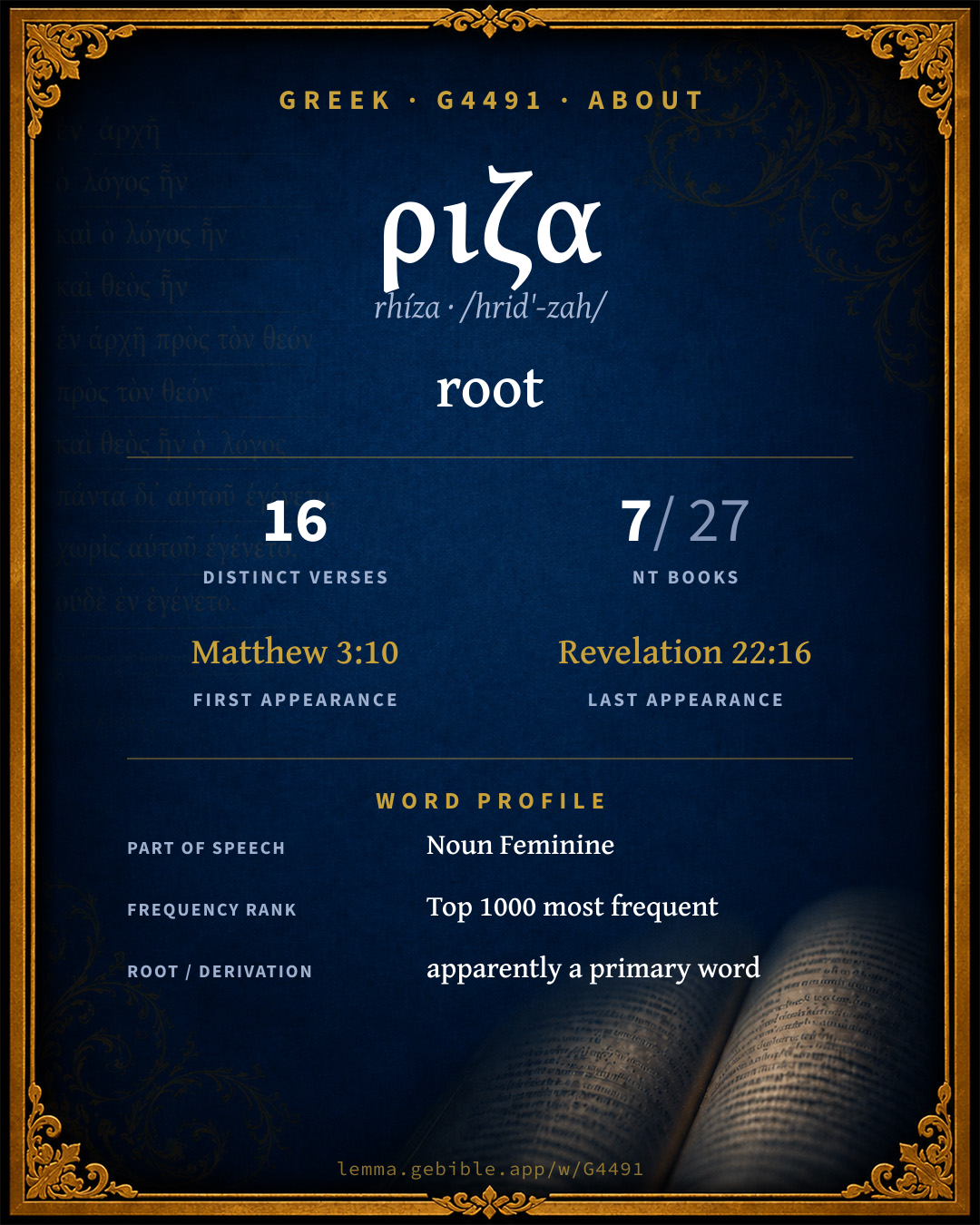
ῥίζα
root
‘root’ is one of 3 main senses fuller range ↓
Full lexicon entry — Thayer's Greek Lexicon
From Thayer's Greek Lexicon
Where this word appears
See every Accusative-case word in the Greek New Testament →
Grammar key — what these labels mean
Part of speech
- Noun
- A naming word — a person, place, thing, or idea.
Case
- Accusative
- The case of the direct object and of extent.
- Nominative
- The case of the subject (and the predicate nominative).
- Genitive
- The case of source, possession, or “of” — answers “whose / from what.”
Gender
- Feminine
- Grammatically feminine.
Number
- Singular
- One.
- Plural
- More than one.
Grammatical forms
- Noun, Accusative, Singular, Feminine 8 times (47%)
- Noun, Nominative, Singular, Feminine 7 times (41%)
- Noun, Genitive, Plural, Feminine 1 time (6%)
- Noun, Genitive, Singular, Feminine 1 time (6%)
Parsed forms decoded from the imported morphology (Robinson–Tischendorf, public domain), counted across 17 parsed occurrences — not distinct verses.
Every verse where G4491 appears — 16 distinct verses across 7 books. Click any verse to open its interlinear word-by-word view. Verse text shown in the World English Bible for context — . Each verse’s Greek form is shown with its reference; the English is not keyword-highlighted, since the data carries no word-level English alignment. Use “Compare translations” on any verse to read it across multiple English versions. This concordance covers the Greek New Testament; Septuagint (Greek Old Testament) occurrences of this word are not indexed here.
Matthew 3 verses
- Matthew 3:10 ῥίζαν n acc sg fem "Even now the axe lies at the root of the trees. Therefore, every tree that doesn't bring forth good fruit is cut down, and cast into the fire.
- Matthew 13:6 ῥίζαν n acc sg fem When the sun had risen, they were scorched. Because they had no root, they withered away.
- Matthew 13:21 ῥίζαν n acc sg fem yet he has no root in himself, but endures for a while. When oppression or persecution arises because of the word, immediately he stumbles.
Mark 3 verses
- Mark 4:6 ῥίζαν n acc sg fem When the sun had risen, it was scorched; and because it had no root, it withered away.
- Mark 4:17 ῥίζαν n acc sg fem They have no root in themselves, but are short-lived. When oppression or persecution arises because of the word, immediately they stumble.
- Mark 11:20 ῥιζῶν n gen pl fem As they passed by in the morning, they saw the fig tree withered away from the roots.
Luke 2 verses
- Luke 3:9 ῥίζαν n acc sg fem Even now the axe also lies at the root of the trees. Every tree therefore that doesn't bring forth good fruit is cut down, and thrown into the fire."
- Luke 8:13 ῥίζαν n acc sg fem Those on the rock are they who, when they hear, receive the word with joy; but these have no root, who believe for a while, then fall away in time of temptation.
Romans 4 verses
- Romans 11:16 ῥίζα n nom sg fem If the first fruit is holy, so is the lump. If the root is holy, so are the branches.
- Romans 11:17 ῥίζης n gen sg fem But if some of the branches were broken off, and you, being a wild olive, were grafted in among them, and became partaker with them of the root and of the richness of the olive tree;
- Romans 11:18 ῥίζαν ῥίζα n acc sg fem n nom sg fem don't boast over the branches. But if you boast, it is not you who support the root, but the root supports you.
- Romans 15:12 ῥίζα n nom sg fem Again, Isaiah says, "There will be the root of Jesse, He who arises to rule over the Gentiles; On him will the Gentiles hope."
1 Timothy 1 verse
Hebrews 1 verse
Revelation 2 verses
- Revelation 5:5 ῥίζα n nom sg fem One of the elders said to me, "Don't weep. Behold, the Lion who is of the tribe of Judah, the Root of David, has overcome; he who opens the book and its seven seals."
- Revelation 22:16 ῥίζα n nom sg fem I, Jesus, have sent my angel to testify these things to you for the assemblies. I am the root and the offspring of David; the Bright and Morning Star."
About this entry
At a glance — auto-summarized from this page’s data, not written by a person. Every figure links to its source below. This summary describes the numbers; it doesn’t interpret them.
At its core, ριζα (rhíza) means “root.” First canonically at Matthew 3:10, it enters the text early. It appears 16 verses across 7 books of the Greek New Testament, among its uncommon vocabulary. The word gravitates to Romans (25%), then Matthew and Mark. Catalogued under 3 senses, its meaning is not single-sense. Each statement above links to its evidence; the full detail follows below.
Gloss history
Strong's 1890 vs modern scholarship
About this word
Strong's G4491 catalogs a Greek word from the Greek New Testament.
These counts are not copied from any lexicon or concordance. They are computed here, from the morphology-tagged Greek New Testament. What Lemma adds →
- 16
- distinct verses
- The word appears in 16 distinct verses.
- 7 / 27
- NT books
- The word appears in 7 of 27 New Testament books.
- #697
- by frequency
- Top 1000 most frequent Greek words (rank 697 of 5,347 Greek words by occurrence).
View all 16 occurrences in the concordance →
By section of the New Testament
By traditional corpus
Conventional, traditional groupings — biblical authorship is debated, so this is a traditional corpus grouping, not an authorship claim. Some books belong to more than one corpus (Luke is in both the Gospels and the Lukan corpus, and so on), so these shares overlap and need not total 100%. Each figure is a share of the word’s 16 distinct verses.
- Gospels 8 verses · 50%
- Pauline corpus 5 verses · 31%
- Lukan (Luke–Acts) 2 verses · 13%
- Johannine 2 verses · 13%
- Revelation 2 verses · 13%
- Hebrews 1 verse · 6%
How translations render this word
Counts come from each version’s own published word-to-Strong’s tagging or interlinear alignment — an approximate guide to how each version renders this word, not a word-level alignment the data otherwise carries. Because each total is that version’s own tagged count, the per-version totals vary from one another and need not match the appearance or distinct-verse counts above. These counts may also differ from a printed concordance because Lemma counts each distinctly tagged rendering and does not collapse phrase taggings into a single head-word total. This is a fixed set of word-tagged versions (KJV, ASV, BSB, ULT) and does not change with the reading translation you choose elsewhere. Each version’s license is shown beside its name below (and on Sources).
- King James Version: Root 16×
- American Standard Version: Root 15×
- Berean Standard Bible: Root 16×
- unfoldingWord Literal Text: Root 16×
King James Version Public Domain
Renders G4491 across 17 tagged occurrences — most commonly:
Plus 1 rendering that appears only once — usually multi-word phrases or single function words the recovered tagging swept in, not distinct renderings.
American Standard Version Public Domain
Renders G4491 across 16 tagged occurrences — most commonly:
Plus 1 rendering that appears only once — usually multi-word phrases or single function words the recovered tagging swept in, not distinct renderings.
Berean Standard Bible Public Domain
Renders G4491 across 17 tagged occurrences — most commonly:
Plus 1 rendering that appears only once — usually multi-word phrases or single function words the recovered tagging swept in, not distinct renderings.
unfoldingWord Literal Text CC BY-SA 4.0
Renders G4491 across 17 tagged occurrences — most commonly:
Plus 1 rendering that appears only once — usually multi-word phrases or single function words the recovered tagging swept in, not distinct renderings.
Senses in Thayer's
The 3 senses Thayer's distinguishes for this word, in lexicon order (not ranked by frequency or importance). The full entry — with sub-senses — is in the Lexicon Entry tab.
- a root
- that which like a root springs from a root, a sprout, shoot
- metaph. offspring, progeny
Word origin
Origin: apparently a primary word
Apparently a primary word; a root (literally or figuratively): - root.
— Strong’s Exhaustive Concordance (1890), public domain.
Forms in the corpus
The 4 distinct written forms G4491 takes in the Greek New Testament, most frequent first — each parse links to that case’s occurrences in the concordance.
| Form | Parsing | Example | Uses |
|---|---|---|---|
| ῥίζαν rhízan | Noun, Accusative, Singular, Feminine | Matthew 3:10 | 8 |
| ῥίζα rhíza | Noun, Nominative, Singular, Feminine | Romans 11:16 | 7 |
| ῥίζης rhízēs | Noun, Genitive, Singular, Feminine | Romans 11:17 | 1 |
| ῥιζῶν rhizō̂n | Noun, Genitive, Plural, Feminine | Mark 11:20 | 1 |
Same root — word family
Other Thayer's entries built from the same root as G4491, grouped by Strong’s listed origin. These share a root / origin per the lexicon — not necessarily a shared meaning. Each links to that word’s own entry.
Derived from this word
Compare all same-root words → They share a root, not necessarily a meaning.
Septuagint usage
The same Greek word ριζα appears 38 times in the Greek Old Testament (Septuagint), across 36 verses in 12 books.
- 38
- LXX occurrences
- Tagged occurrences of this Greek word in the Septuagint.
- 36
- verses
- Distinct Septuagint verses containing this word.
- 12 / 39
- OT books
- The word appears in 12 of the 39 Old Testament books.
Sample Septuagint occurrences
- Deuteronomy 29:17 ῥίζα
- 2 Kings 19:30 ῥίζα
- Job 5:3 ῥίζα
- Psalms 47:3 ῥίζα
- Proverbs 12:3 ῥίζα
- Isaiah 5:24 ῥίζα
- Jeremiah 17:8 ῥίζα
- Ezekiel 16:3 ῥίζα
- Daniel 4:8 ῥίζα
- Hosea 9:16 ῥίζα
- Amos 2:9 ῥίζα
- Malachi 3:19 ῥίζα
Septuagint occurrences (same lexeme)
Every verse where the same Strong’s number (G4491) appears in the Greek Septuagint. Verse text shown in the World English Bible for context; the Greek form is the matched word — the English is not keyword-highlighted.
- Deuteronomy 29:17 ῥίζα and you have seen their abominations, and their idols, wood and stone, silver and gold, which were among them);
- 2 Kings 19:30 ῥίζα The remnant that has escaped of the house of Judah shall again take root downward, and bear fruit upward.
- Job 5:3 ῥίζα I have seen the foolish taking root, But suddenly I cursed his habitation.
- Job 8:12 ῥίζα While it is yet in its greenness, not cut down, It withers before any other reed.
- Job 13:27 ῥίζα You also put my feet in the stocks, And mark all my paths. You set a bound to the soles of my feet:
- Job 14:8 ῥίζα Though the root of it grows old in the earth, And the stock of it dies in the ground;
- Job 18:16 ῥίζα His roots shall be dried up beneath, Above shall his branch be cut off.
- Job 19:28 ῥίζα If you say, 'How we will persecute him!' Because the root of the matter is found in me,
- Job 28:9 ῥίζα He puts forth his hand on the flinty rock, And he overturns the mountains by the roots.
- Job 29:19 ῥίζα My root is spread out to the waters, The dew lies all night on my branch;
- Job 30:4 ῥίζα They pluck salt herbs by the bushes. The roots of the broom are their food.
- Job 31:12 ῥίζα For it is a fire that consumes to destruction, And would root out all my increase.
- Psalms 47:3 ῥίζα He subdues nations under us, And peoples under our feet.
- Psalms 79:10 ῥίζα Why should the nations say, "Where is their God?" Let it be known among the nations, before our eyes, That vengeance for your servants' blood is being poured out.
- Proverbs 12:3 ῥίζα A man shall not be established by wickedness, But the root of the righteous shall not be moved.
- Proverbs 12:12 ῥίζα The wicked desires the plunder of evil men, But the root of the righteous flourishes.
- Isaiah 5:24 ῥίζα Therefore as the tongue of fire devours the stubble, And as the dry grass sinks down in the flame, So their root shall be as rottenness, And their blossom shall go up as dust; Because they have rejected the law of Yahweh of Hosts, And despised the word of the Holy One of Israel.
- Isaiah 11:1 ῥίζα There shall come forth a shoot out of the stock of Jesse, and a branch out of his roots shall bear fruit.
- Isaiah 11:10 ῥίζα It shall happen in that day, that the root of Jesse, who stands for an ensign of the peoples, to him shall the nations seek; and his resting-place shall be glorious.
- Isaiah 37:31 ῥίζα The remnant that is escaped of the house of Judah shall again take root downward, and bear fruit upward.
- Isaiah 40:24 ῥίζα Yes, they have not been planted; yes, they have not been sown; yes, their stock has not taken root in the earth: moreover he blows on them, and they wither, and the whirlwind takes them away as stubble.
- Isaiah 53:2 ῥίζα For he grew up before him as a tender plant, and as a root out of a dry ground: he has no form nor comeliness; and when we see him, there is no beauty that we should desire him.
- Jeremiah 17:8 ῥίζα For he shall be as a tree planted by the waters, who spreads out its roots by the river, and shall not fear when heat comes, but its leaf shall be green; and shall not be careful in the year of drought, neither shall cease from yielding fruit.
- Ezekiel 16:3 ῥίζα and say, Thus says the Lord Yahweh to Jerusalem: Your birth and your birth is of the land of the Canaanite; the Amorite was your father, and your mother was a Hittite.
- Ezekiel 17:6 ῥίζα It grew, and became a spreading vine of low stature, whose branches turned toward him, and the roots of it were under him: so it became a vine, and brought forth branches, and shot forth sprigs.
- Ezekiel 17:7 ῥίζα There was also another great eagle with great wings and many feathers: and, behold, this vine did bend its roots toward him, and shot forth its branches toward him, from the beds of its plantation, that he might water it.
- Ezekiel 17:9 ῥίζα Say you, Thus says the Lord Yahweh: Shall it prosper? shall he not pull up the roots of it, and cut off the fruit of it, that it may wither; that all its fresh springing leaves may wither? and not by a strong arm or much people can it be raised from the roots of it.
- Ezekiel 31:7 ῥίζα Thus was it beautiful in its greatness, in the length of its branches; for its root was by many waters.
- Daniel 4:8 ῥίζα But at the last Daniel came in before me, whose name was Belteshazzar, according to the name of my god, and in whom is the spirit of the holy gods: and I told the dream before him, [saying],
- Daniel 4:19 ῥίζα Then Daniel, whose name was Belteshazzar, was stricken mute for a while, and his thoughts troubled him. The king answered, Belteshazzar, don't let the dream, or the interpretation, trouble you. Belteshazzar answered, My lord, the dream be to those who hate you, and the interpretation of it to your adversaries.
- Daniel 11:7 ῥίζα But out of a shoot from her roots shall one stand up in his place, who shall come to the army, and shall enter into the fortress of the king of the north, and shall deal against them, and shall prevail.
- Daniel 11:20 ῥίζα Then shall stand up in his place one who shall cause a tax collector to pass through the kingdom to maintain its glory; but within few days he shall be destroyed, neither in anger, nor in battle.
- Hosea 9:16 ῥίζα Ephraim is struck. Their root has dried up. They will bear no fruit. Even though they bring forth, yet I will kill the beloved ones of their womb."
- Hosea 14:6 ῥίζα His branches will spread, And his beauty will be like the olive tree, And his fragrance like Lebanon.
- Amos 2:9 ῥίζα Yet I destroyed the Amorite before them, Whose height was like the height of the cedars, And he was strong as the oaks; Yet I destroyed his fruit from above, and his roots from beneath.
- Malachi 3:19 ῥίζα
These are occurrences of the same Greek lexeme (G4491) in the Septuagint — not a translation of any one Hebrew word. The store carries no word-level Hebrew↔Greek alignment, so no Hebrew original is asserted here. Counts come from the recovered LXX Strong's tagging — high-frequency vocabulary is well covered, while rare or late forms may be untagged — so they reflect tagged occurrences and may slightly undercount.