Job 13:27

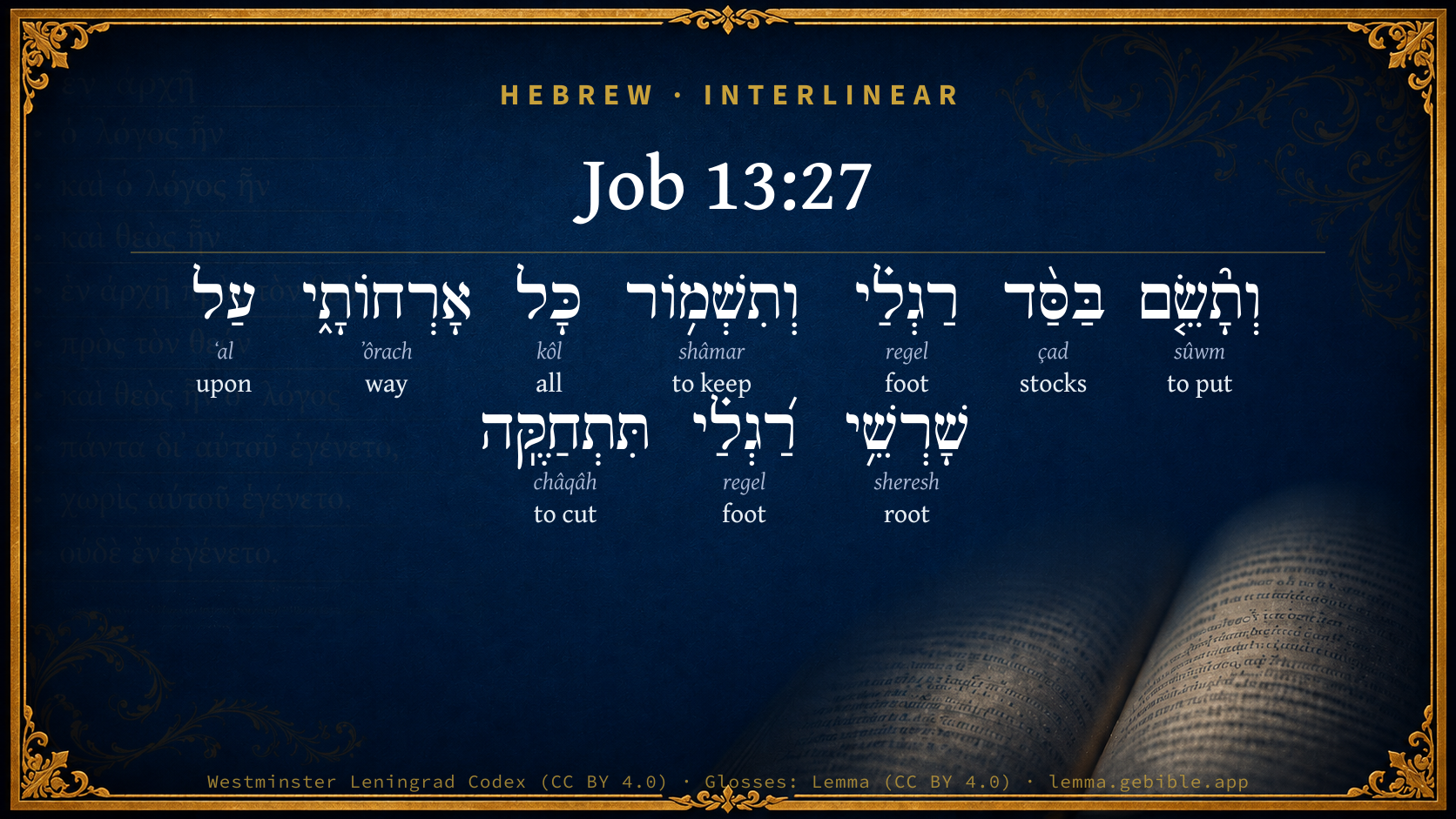
Hebrew (Westminster Leningrad Codex) Job 13:27 appears in the Hebrew Old Testament. The text above is from the Westminster Leningrad Codex. Each word links to its Strong’s number, a concise gloss, and parsing drawn from the Open Scriptures Hebrew Bible morphology. Click any word for its full Brown-Driver-Briggs (BDB) entry.
Download image
Cite this verse

Job 13:27 (World English Bible). Public Domain. Lemma interlinear Bible study tool, https://lemma.gebible.app/v/job/13/27.

Show BibTeX & RIS
BibTeX
RIS
English Translation
You also put my feet in the stocks, And mark all my paths. You set a bound to the soles of my feet:
World English Bible · Public Domain
Highlights
  • 1 first appearance in the Hebrew Bible
Full analysis ↓
Download a study sheet

One document with this verse’s original text, its word-by-word gloss line, the meaning frame, cross-references with their text, attributed commentary, and full source and license credits — printable, and it pastes into notes with its structure intact.

This verse Autodidact and up

Study sheet (.html) Plain text (.txt)

A passage Seminary Student

Up to 50 verses in one chapter. A passage sheet keeps up to 6 commentary sources and 12 cross-references per verse, in the order this page ranks them, and says so on the sheet whenever that leaves anything out. Ask for a single verse and you get the Autodidact verse sheet above.

Everything on this page stays free to read, with no account — the sheet is a download of what is already on screen, not access to it.

Want to remove ads? Support Godless Engineer
Compare translations 3

The same verse in 3 English versions, stacked beneath the original-language interlinear above. Click any original word for its lexicon entry.

Each is an independent rendering of the whole verse — the interlinear is not word-aligned to these translations.

Highlighted words mark where these versions differ — a whole-verse word diff, not a word-by-word alignment.

  • World English Bible Public Domain
    You also put my feet in the stocks, And mark all my paths. You set a bound to the soles of my feet:
  • King James Version Public Domain
    Thou puttest my feet also in the stocks, and lookest narrowly unto all my paths; thou settest a print upon the heels of my feet.
  • unfoldingWord Literal Text CC BY-SA 4.0
    and you put my feet in shackles, and you watch all of my paths; you engrave around the soles of my feet.

unfoldingWord Literal Text — © unfoldingWord, licensed CC BY-SA 4.0. Word-aligned USFM3 via Door43 (git.door43.org/unfoldingWord/en_ult).

Versions to compare (up to 4)

3 of 4 selected

Show all 18 translations

Every available English version of this verse, each an independent rendering of the whole verse.

  • World English Bible Public Domain
    You also put my feet in the stocks, And mark all my paths. You set a bound to the soles of my feet:
  • Berean Standard Bible Public Domain
    You put my feet in the stocks and stand watch over all my paths; You set a limit for the soles of my feet.
  • Majority Standard Bible Public Domain
    You put my feet in the stocks and stand watch over all my paths; You set a limit for the soles of my feet.
  • King James Version Public Domain
    Thou puttest my feet also in the stocks, and lookest narrowly unto all my paths; thou settest a print upon the heels of my feet.
  • American Standard Version (1901) Public Domain
    Thou puttest my feet also in the stocks, And markest all my paths; Thou settest a bound to the soles of my feet:
  • Revised Version (1885) Public Domain
    Thou puttest my feet also in the stocks, and markest all my paths; thou drawest thee a line about the soles of my feet:
  • Geneva Bible (1599) Public Domain
    Thou puttest my feete also in the stocks, and lookest narrowly vnto all my pathes, and makest the print thereof in ye heeles of my feet.
  • Douay-Rheims (1899) Public Domain
    Thou hast put my feet in the stocks, and hast observed all my paths, and hast considered the steps of my feet:
  • Young's Literal Translation Public Domain
    And puttest in the stocks my feet, And observest all my paths, On the roots of my feet Thou settest a print,
  • Literal Standard Version CC BY-SA 4.0
    And you put my feet in the stocks, || And observe all my paths—You set a print on the roots of my feet,
  • Unlocked Literal Bible CC BY-SA 4.0
    You also put my feet in the stocks; you closely watch all my paths; you examine the ground where the soles of my feet have walked
  • unfoldingWord Literal Text CC BY-SA 4.0
    and you put my feet in shackles, and you watch all of my paths; you engrave around the soles of my feet.
  • Darby Bible Public Domain
    And thou puttest my feet in the stocks, and markest all my paths; thou settest a bound about the soles of my feet; --
  • World Messianic Bible Public Domain
    You also put my feet in the stocks, and mark all my paths. You set a bound to the soles of my feet,
  • Webster's Bible Public Domain
    Thou puttest my feet also in the stocks, and lookest narrowly to all my paths; thou settest a print upon the heels of my feet.
  • Free Bible Version CC BY-SA 4.0
    You put my feet in the stocks. You keep an eye on every step I take. You even inspect my footprints!
  • Bible in Basic English Public Domain
    And you put chains on my feet, watching all my ways, and making a limit for my steps;
  • JPS Tanakh (1917) Public Domain
    Thou puttest my feet also in the stocks, and lookest narrowly unto all my paths; Thou drawest Thee a line about the soles of my feet;

Literal Standard Version (2020), Covenant Press — licensed CC BY-SA 4.0. Text via the HelloAO Bible API (eBible.org). Unlocked Literal Bible (unfoldingWord) — licensed CC BY-SA 4.0. Text via the HelloAO Bible API (eBible.org). unfoldingWord Literal Text — © unfoldingWord, licensed CC BY-SA 4.0. Word-aligned USFM3 via Door43 (git.door43.org/unfoldingWord/en_ult). Free Bible Version, Dr. Jonathan Gallagher — licensed CC BY-SA 4.0. Text via the HelloAO Bible API (eBible.org).

Word by word

More ways to search: Search by grammar → Find every occurrence → Compare this word →

Practice this passage: Drill this verse → Learn its vocabulary →

בַּסַּ֨ד
çad
H5465
“in/at the · stocks”
Preposition, Determined + Noun, Common, Masculine, Singular, Absolute
Part of Speech
Preposition + Noun
Type
Common
Gender
Masculine
Number
Singular
State
Absolute
Full BDB Definition

Origin: from an unused root meaning to estop

TWOT: 1464

stocks (for feet)
  1. וְתָ֘שֵׂ֤ם sûwm H7760 “and · to put” Conjunction + Verb, Qal, Imperfect, 2nd Person, Masculine, Singular
  2. רַגְלַ֗י regel H7272 “feet · my” Noun, Common, Feminine, Dual, Construct + Suffix, Personal, 1st Person, Common, Singular
  3. וְתִשְׁמ֥וֹר shâmar H8104 “and · to keep” Conjunction + Verb, Qal, Imperfect, 2nd Person, Masculine, Singular
  4. כָּל kôl H3605 “all of” Noun, Common, Masculine, Singular, Construct
  5. אָרְחוֹתָ֑י ʼôrach H734 “ways · my” Noun, Common, Both, Plural, Construct + Suffix, Personal, 1st Person, Common, Singular
  6. עַל ʻal H5921 “upon” Preposition
  7. שָׁרְשֵׁ֥י sheresh H8328 “roots of” Noun, Common, Masculine, Plural, Construct
  8. רַ֝גְלַ֗י regel H7272 “feet · my” Noun, Common, Feminine, Dual, Construct + Suffix, Personal, 1st Person, Common, Singular
  9. תִּתְחַקֶּֽה châqâh H2707 “to cut” Verb, Hithpael, Imperfect, 2nd Person, Masculine, Singular

About this verse

These counts appear in no published source. They are computed here, from the morphology-tagged text and Lemma’s own curated glosses. What Lemma adds →

10
words
9
distinct lemmas
Wisdom
section

Notable vocabulary

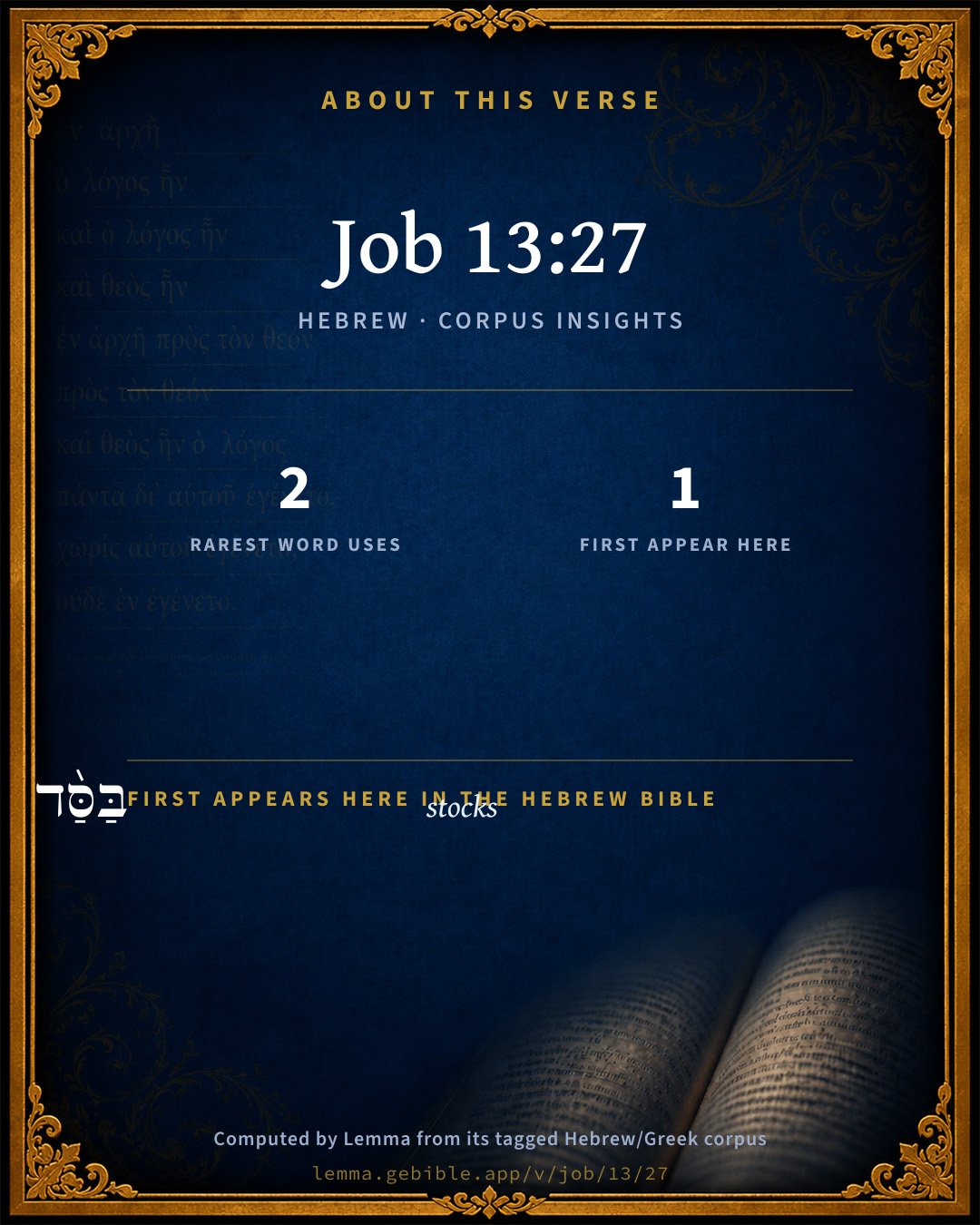
The rarest word here is בַּסַּ֨ד stocks H5465 — appearing just 2 times in the whole Hebrew Bible.

First appearance in Scripture

This word makes its first canonical appearance in the Hebrew Bible here:

  • בַּסַּ֨ד stocks H5465

Shared distinctive vocabulary

בַּסַּ֨ד stocks H5465 occurs in 2 verses of the Hebrew Bible. Also found in:

Grammatical profile

  • 3 verbs
  • 6 nouns
  • 1 preposition

Verb forms

  • וְתָ֘שֵׂ֤ם Qal · Imperfect
  • וְתִשְׁמ֥וֹר Qal · Imperfect
  • תִּתְחַקֶּֽה Hithpael · Imperfect

Repetition

A word recurs within this verse — often emphatic in Hebrew:

  • רַגְלַ֗י foot H7272 ×2

Hebrew & Septuagint length

In English translation the verse runs 23 words from the Hebrew and 21 from the Septuagint (LXX English) — closely comparable.

A rough comparison of the two English renderings, which tokenize alike — not a word-level alignment.

Word counts can differ between the Hebrew and the Greek without any difference in meaning — e.g. the Hebrew direct-object marker אֵת has no separate Greek word, and Greek often adds the article ὁ.

Cross-references

8

Topical passages linked to Job 13:27 in the Treasury of Scripture Knowledge — connected by theme and wording, ordered by reader-vote popularity; previews shown in the World English Bible.

  • Job 33:11 He puts my feet in the stocks, He marks all my paths.'
  • 2 Chronicles 16:10–12 Then Asa was angry with the seer, and put him in the prison-house; for he was in a rage with him because of this thing. Asa oppressed some of the people at the same time.
  • Job 2:7 So Satan went forth from the presence of Yahweh, and struck Job with painful sores from the sole of his foot to his head.
  • Job 10:6 That you inquire after my iniquity, And search after my sin?
  • Job 14:16 But now you number my steps. Don't you watch over my sin?
  • Job 16:9 He has torn me in his wrath, and persecuted me; He has gnashed on me with his teeth: My adversary sharpens his eyes on me.
  • Proverbs 7:22 He followed her immediately, As an ox goes to the slaughter, As a fool stepping into a noose.
  • Acts 16:24 who, having received such a charge, threw them into the inner prison, and secured their feet in the stocks.

Cross-references courtesy of OpenBible.info (CC BY 4.0).

Hebrew and Greek witnesses Masoretic Hebrew ↔ Greek Septuagint

The same verse in the two great witnesses to the Old Testament, shown verse-for-verse.

These are two independent witnesses, not word-aligned to each other, and the Septuagint is shown in lemma (dictionary) form.

Hebrew Job 13:27 Masoretic · Westminster Leningrad Codex

וְתָ֘שֵׂ֤ם בַּסַּ֨ד רַגְלַ֗י וְתִשְׁמ֥וֹר כָּל אָרְחוֹתָ֑י עַל שָׁרְשֵׁ֥י רַ֝גְלַ֗י תִּתְחַקֶּֽה

You also put my feet in the stocks, And mark all my paths. You set a bound to the soles of my feet:

World English Bible · Public Domain

Greek LXX Job 13:27 Septuagint · lemma form

τίθημι δέ ἐγώ ὁ πούς ἐν κώλυμα φυλάσσω δέ ἐγώ πᾶς ὁ ἔργον εἰς δέ ῥίζα ὁ πούς ἐγώ ἀποἱκνέομαι

And you have placed my foot in the stocks; and you have watched all my works, and have penetrated my heels.

LXX2012 (modern English Septuagint) · Public Domain

On this verse, Albert Barnes' Notes on the Bible discusses the Septuagint’s reading. Read the note in Commentary ↓

Hebrew: Westminster Leningrad Codex (CC BY 4.0). Greek: Septuagint (public domain); English from LXX2012 (modern English Septuagint) (Public Domain). How the Septuagint differs from the Hebrew →

Commentary

Notes on Job 13:27 from classic Christian and Jewish commentators (each source and its license shown beneath its notes). The classic Christian expositions comment on the surrounding passage and are grouped to its opening verse, so a note may address several verses; the Jewish commentaries on the Tanakh (Rashi and others) are per-verse, so they appear only where the commentator wrote on this verse.

Lemma curates 59 commentaries, every one of them public domain or Creative Commons licensed, each selected and text-cleaned for this edition rather than reprinted as found. About our sources →

Trapp's Complete Commentary

John Trapp

Job 13:27 Thou puttest my feet also in the stocks, and lookest narrowly unto all my paths; thou settest a print upon the heels of my feet.

Ver. 27. Thou puttest my feet also in the stocks] Mercer here observeth an elegant gradation in God’s proceeding with Job, as himself describeth it, rising higher and higher in his discourse. 1. God hid his face, and denied him his favour. 2. He counted him as his enemy. 3. He broke him like a leaf or stubble. 4. He wrote bitter things against him. 5. He made him possess the sins of his youth. 6. For his young sins he claps him up close prisoner now in his old age, and there keeps him as with a strict guard following him close at heels if he but stir a foot. Was there ever sorrow like unto Job’s sorrow? was ever greater severity and rigour showed upon any godly person? Where, then, shall the ungodly and the sinner appear? &c. God’s wrath is like Elijah’s cloud, little at first, as a man’s hand, but soon after very dismal and dreadful; or as thunder, of which we hear at first a little noise afar off, but soon after a terrible crack. Well might Moses say, "Who knoweth the power of thine anger?" Psa 90:11, Cavebis autem, si pavebis. You will beware if you will be frightened.

And lookest narrowly into all my paths] He saith not ways, but paths. Gregory maketh this difference: ways are larger, paths narrower. God then is said to look into all men’s paths, when he looketh not only at the evil done by them, but at the intention of their mind, which is not so easily discerned but by him, the searcher of all hearts. And for that which followeth,

Thou settest a print upon the heels of my feet] Gregory here observeth, that God looketh at the hurt done to others by examples given by men’s evil doings unto them, leaving a print upon the ground, as it were, whereby others follow them, and so their sin is in this regard made the greater; to which purpose some sense those words, Psa 49:5, "When the iniquity of my heels shall compass me about." Others make Job’s meaning here to be, Thou followest me with continual pursuit, as a prisoner that is dogged at heels by his keeper from place to place, lest he should escape. Thou followest me close, and upon the track, like a hunter, Job 10:16. The footsteps of thy wrath (saith an interpreter) are seen upon the soles of my feet (so that from top to toe I have no free part), like as prisoners’ feet are oft swelled with the weight of their fetters.

John Trapp, A Commentary or Exposition upon All the Books of the Old and New Testament (1647–1656) — public domain. Text from a community e-Sword module.

The Biblical Illustrator

Joseph S. Exell

Job_13:27

Thou settest a print upon the heels of my feet.

Footprints

True religion there cannot be without an abiding sense of our responsibilities. We must discover and realise our moral obligations, or we can never meet and discharge them. What is meant by moral responsibility? It implies that God will call man to account for his whole character and conduct, and will render to every man accordingly. To every man time is a state of probation, and eternity a state of retribution. The doctrine of our responsibility lies within us, graven on our very being by the Spirit of God Himself. We are apt to forget the extent of this responsibility. We look upon it as a mere generality. Note, then, we are responsible for our thoughts and our actions. The responsibility extends to every word of our lips, and to every stepping of our feet. As we walk, we write the history of our movements--write them down forever. Some footprints can outlive ages, as the geologists show us. God will remind you that He put a print into the heel of your foot, that He might bring you into judgment for your movements upon earth. Here is a thought upon a part of our responsibilities we are apt to forget. We cannot move but we carry with us our Christian obligations, and our consequent relationship to the day of judgment necessarily attending those obligations. Every single step has left behind it an eternal footprint which determines in what direction we walk, in what character we move.

1. Wherever we move we carry with us our personal and individual responsibility. In every change of place and contact with man on the travel we act as beings who must give an account to God. Then call to mind the obligations that rest on you.

2. We are all so constituted as to exert a relative influence on each other. There is no member of the human family who does not sustain some relation, either original or acquired, either public or private, either permanent or temporary; nor is there any relation which does not invest the person sustaining it with some degree of interest. Do we think as we ought of this? (J. C. Phipps Eyre, M. A.)

The Biblical Illustrator, edited by Joseph S. Exell (c. 1880s–1900s) — public domain. Text from a community e-Sword module.

Joseph Benson's Commentary

Job 13:27. Thou puttest my feet also in the stocks — Thou encompassest me with thy judgments, so that I have no way or possibility to escape. And lookest narrowly unto all my paths — Makest a strict and diligent search into all the actions of my life, that thou mayest find matter for which to condemn me. Thou settest a print upon the heels of my feet — Thou followest me close at the heels, either to observe my actions, or to pursue me with thy judgments; insomuch, that thou dost often, as it were, tread upon my heels, and leave the prints of thy footsteps upon them. Bishop Patrick’s paraphrase here is, “I can no more escape than a malefactor, whose feet are in the stocks, who is encompassed with a vigilant guard, and cannot stir a foot from the place where he is.” Heath thinks there is an allusion, in these words, to the custom of putting a clog on the feet of fugitive slaves, that they might be tracked and found.

Joseph Benson's Commentary on the Old and New Testaments (1811–1818) — public domain. Text from a community e-Sword module.

Geneva Bible (1599)

Geneva Bible translators

Thou makest me thy prisoner, and dost so press me that I cannot stir hand nor foot.

Hebrew, roots.

Geneva Bible (1599) marginal notes — public domain. Text via Bolls.life.

Jamieson, Fausset & Brown

Robert Jamieson, A. R. Fausset & David Brown

stocks--in which the prisoner's feet were made fast until the time of execution (Jer 20:2).

lookest narrowly--as an overseer would watch a prisoner.

print--Either the stocks, or his disease, marked his soles (Hebrew, "roots") as the bastinado would. Better, thou drawest (or diggest) [GESENIUS] a line (or trench) [GESENIUS] round my soles, beyond which I must not move [UMBREIT].

Jamieson, Fausset & Brown — Commentary Critical and Explanatory on the Whole Bible (1871) — public domain (CC PDM 1.0). Text via the HelloAO Bible API.

Adam Clarke's Commentary

Verse 27. Thou puttest my feet also in the stocks] בסד bassad, "in a clog," such as was tied to the feet of slaves, to prevent them from running away. This is still used in the West Indies, among slave-dealers; and is there called the pudding, being a large collar of iron, locked round the ankle of the unfortunate man. Some have had them twenty pounds' weight; and, having been condemned to carry them for several years, when released could not walk without them! A case of this kind I knew: The slave had learned to walk well with his pudding, but when taken off, if he attempted to walk, he fell down, and was obliged to resume it occasionally, till practice had taught him the proper centre of gravity, which had been so materially altered by wearing so large a weight; the badge at once of his oppression, and of the cruelty of his task-masters!

And lookest narrowly] Thou hast seen all my goings out and comings in; and there is no step I have taken in life with which thou art unacquainted.

Thou settest a print upon the heels of my feet.] Some understand this as the mark left on the foot by the clog; or the owner's mark indented on this clog; or, Thou hast pursued me as a hound does his game, by the scent.

Adam Clarke's Commentary on the Bible (1810–1826) — public domain. Text from a community e-Sword/MySword module.

Ellicott's Commentary for English Readers

(27) Thou puttest my feet also in the stocks.—This is illustrated by the language of the Psalms (Psa_88:8; Psa_142:7, &c.). There is a difficulty in these two verses, arising from the pronouns. Some understand the subject to be the fetter: “Thou puttest my feet in the fetter that watcheth over all my paths, and imprinteth itself upon the roots of my feet, and it (the foot) consumeth like a rotten thing, and like a garment that is moth-eaten.” Others refer the “he” to Job himself; and others to man, the subject of the following chapter. In the Hebrew future tense the third person feminine and the second person masculine are alike, and the word for fetter, which is only found here and at Job_33:11, where Elihu quotes these words, may possibly be feminine in this place, though it is clear that Elihu understood Job to be speaking of God. Probably by the “he” introduced so abruptly is meant the object of all this watching and persecution.

A Bible Commentary for English Readers, edited by Charles John Ellicott (1878–1897) — public domain. Text from a community e-Sword module.

The Cambridge Bible for Schools and Colleges

gen. ed. J. J. S. Perowne

27. Thou puttest] Rather, and puttest my feet in &c. The verse describes his afflictions under three figures, all denoting arrest, impossibility of movement or escape, and chastisement. The first words are brought up by Elihu, ch. Job_33:11, cf. Jer_20:2; Act_16:24.

settest a print upon the heels] Rather, and drawest thee a line around the soles of my feet. The figure means that God rigidly prescribed his movements, drawing bounds, which he must not overstep, around his feet. He is a prisoner under rigid surveillance.

The Cambridge Bible for Schools and Colleges (gen. ed. J. J. S. Perowne; Cambridge University Press, 1878–1918) — public domain. Text from a community e-Sword module.

John Gill's Exposition

Thou puttest my feet also in the stocks,.... Which is one kind of punishment of offenders, and a preservation of them from making their escape; and is a security and reservation of them for further punishment sometimes; and so Job looked upon his afflictions as a punishment for he knew not what, and with which he was so surrounded and enclosed, that there was no getting out of them any more than a man can whose feet are set fast in the stocks; and that he was here kept for greater afflictions still, which he dreaded. Aben Ezra interprets it, "thou puttest my feet in lime"; and this is followed by others (n), suggesting, as a man's steps in lime are marked and easily discerned, so were his by the Lord; but this seems to be foreign from the mind of Job, who would not make such a concession as this, as if his steps taken amiss were so visible:

and lookest narrowly into all my paths; so that there was no possibility of escaping out of his troubles and afflictions; so strict a watch was kept over him; see Job 7:19; according to Ben Gersom, this refers to the stocks, "it keeps all my ways", kept him within from going abroad about the business of life, and so may refer to the disease of his body, his boils and ulcers, which kept him at home, and suffered him not to stir out of doors; but the former sense is best:

thou settest a print upon the heels of my feet; either it, the stocks, made a mark upon his heels, with which they were pressed hard, as Gersom; or rather God set one upon them, afflicting him very sorely and putting him to an excruciating pain, such as is felt by criminals when heavy blows are laid upon the soles of their feet, to which the allusion may be; or else the sense is, that he followed him closely by the heels, that whenever he took a step, it was immediately marked, and observed by the Lord, as if he trod in his steps, and set his own foot in the mark that was left.

(n) "Calce tinxisti pedes meos", Gussetius, p. 550. so some in Ben Melech.

John Gill's Exposition of the Whole Bible (1746–1763) — public domain (CC PDM 1.0). Text via the HelloAO Bible API.

Albert Barnes' Notes on the Bible

Thou puttest my feet also in the stocks - The word rendered “stocks” (סד sad), denotes the wooden frame or block in which the feet of a person were confined for punishment. The whole passage here is designed to describe the feet; as so confined in a clog or clogs, as to preclude the power of motion. Stocks or clogs were used often in ancient times as a mode of punishment. Pro 7:22. Jeremiah was punished by being confined in the stocks. Jer 20:2; Jer 29:2, Jer 29:6. Paul and Silas were in like manner confined in the prison in stocks; Act 16:24. Stocks appear to have been of two kinds. They were either clogs attached to one foot or to both feet, so as to embarrass, but not entirely to prevent walking, or they were fixed frames to which the feet were attached so as entirely to preclude motion. The former were often used with runaway slaves to prevent their escaping again when taken, or were affixed to prisoners to prevent their escape. The fixed kinds - which are probably referred to here - were of different sorts. They consisted of a frame, with holes for the feet only; or for the feet and the hands; or for the feet, the hands, and the neck. At Pompeii, stocks have been found so contrived that ten prisoners might be chained by the leg, each leg separately by the sliding of a bar. “Pict. Bible.” The instrument is still used in India, and is such as to confine the limbs in a very distressing position, though the head is allowed to move freely.

And lookest narrowly unto all my paths - This idea occurs also in Job 33:11, though expressed somewhat differently, “He putteth my feet in the stocks, he marketh all my paths.” Probably the allusion is to the paths by which he might escape. God watched or observed every way - as a sentinel or guard would a prisoner who was hampered or clogged, and who would make an attempt to escape.

Thou settest a print upon the heels of my feet - Margin, “roots.” Such also is the Hebrew - רגלי שׁרשׁי shereshy regely. Vulgate, “vestigia.” Septuagint, “Upon the roots - εἰς δὲ ῥίζας eis de rizas - of my feet thou comest.” The word שׁרשׁ shârash means properly “root;” then the “bottom,” or the lower part of a thing; and hence, the soles of the feet. The word rendered” settest a print,” from חקה châqâh, means to cut in, to hew, to hack; then to engrave, carve, delineate, portray; then to dig. Various interpretations have been given of the passage here. Gesenius supposes it to mean, “Around the roots of my feet thou hast digged,” that is, hast made a trench so that I can get no further. But though this suits the connection, yet it is an improbable interpretation. It is not the way in which one would endeavor to secure a prisoner, to make a ditch over which he could not leap.

Others render it, “Around the soles of my feet thou hast drawn lines,” that is, thou hast made marks how far I may go. Dr. Good supposes that the whole description refers to some method of clogging a wild animal for the purpose of taming him, and that the expression here refers to a mark on the hoof of the animal by which the owner could designate him. Noyes accords with Gesenius. The editor of the Pictorial Bible supposes that it may refer to the manner in which the stocks were made, and that it means that a seal was affixed to the parts of the plank of which they were constructed, when they were joined together. He adds that the Chinese have a portable pillory of this kind, and that offenders are obliged to wear it around their necks for a given period, and that over the place where it is joined together a piece of paper is pasted, that it may not be opened without detection. Rosenmuller supposes that it means, that Job was confined within certain prescribed limits, beyond which he was not allowed to go. This restraint he supposes was effected by binding his feet by a cord to the stocks, so that he was not allowed to go beyond a certain distance. The general sense is clear, that Job was confined within certain limits, and was observed with very marked vigilance. But I doubt whether either of the explanations suggested is the true one. Probably some custom is alluded to of which we have no knowledge now - some mark that was affixed to the feet to prevent a prisoner from escaping without being detected. What that was, I think, we do not know. Perhaps Oriental researches will yet disclose some custom that will explain it.

Albert Barnes' Notes on the Bible (1834–1885) — public domain. Text from a community e-Sword/MySword module.

Haydock's Catholic Bible Commentary

Stocks, in which the person’s legs were sometimes stretched to the sixth hole; (Calmet) at other times, the neck was confined. (Menochius) --- Some translate the Hebrew, "in the mud," which agrees with the other part of the verse. --- Steps. Hebrew and Septuagint, "roots," or ankles, which retain the prints made by the stocks.

George Leo Haydock (1774–1849), Haydock's Catholic Family Bible and Commentary, 1859 edition — public domain. Excludes Psalms (Douay-Rheims chapter numbering differs from Protestant) and Deuterocanonical books (Catholic canon only).

Matthew Poole's English Annotations

Thou encompassest me with thy judgments, that I may have no way or possibility to escape. When thou hast me fast in prison, thou makest a strict and diligent search into all the actions of my life, that thou mayst find matter to condemn me. Thou followest me close at the heels, either to observe my actions, or to pursue me with thy judgments, so that thou dost oft tread upon my heels, and leave the prints of thy footsteps upon them.

Matthew Poole's English Annotations on the Holy Bible (1683–1685) — public domain. Text from a community e-Sword/MySword module.

Whedon's Commentary on the Bible

Daniel D. Whedon

27. The stocks — Some kind of clog for the feet, which the culprit shuffled about with him when he moved, perhaps similar to those in more recent times fastened to the feet of malefactors or fugitive slaves. “At Pompeii stocks have been found so contrived that ten prisoners might be chained by the leg, each leg separately, by the sliding of a bar.” — KITTO, Pictorial Bible.

Thou settest a print — Literally, Around the roots of my feet thou settest a bound. Thus he was imprisoned against any possibility of escape.

Heels — Literally, roots: “that part of the feet through which, standing or going, like a tree through its roots, man is fastened to the earth.” — Stickel. The figures in this verse hinge upon the swollen condition of his feet — a marked feature of the elephantiasis, in the course of which, says WINER, (Rwb., 1:115,) “the feet swell to a horrible extent.” See note Job_2:7.

Daniel D. Whedon (gen. ed.), Commentary on the Old and New Testaments (1874–1909) — public domain. Text from a community e-Sword module.

The Pulpit Commentary

Thou puttest my feet also in the stocks. (comp. Job_33:11) The punishment is said to be still in use among the Bedouin Arabs. It was well known to the Israelites, (Pro_7:22 Jer_20:2 Jer_29:26) to the Greeks (Herod., 9:87), and to the Romans. (Act_16:24) And lookest narrowly unto all my paths. Not allowing me to escape thee. Thou settest a print upon the heels of my feet; rather, upon the soles of my feet. The "print" intended is probably a mark which the stocks were in the habit of making (see Professor Sayee, in Sunday at Home" December, 1890, p. 125).

The Pulpit Commentary (1880–1919), ed. H.D.M. Spence-Jones & Joseph S. Exell — public domain. Text from a community e-Sword module.

Rashi

Rabbi Shlomo Yitzchaki (Rashi)

in the stocks Heb. בסד. In Aramaic (Pesachim 28a), “The one who makes the stocks (סדנא) sits in his own stocks (בסדניה).” [This is] a large [block of] wood in which the prisoners’ feet are inserted, and in Greek it is astock(?).

You engrave Heb. תתחקה. You Yourself engrave my footsteps. So did this one transgress (step—Ed. Furth]), and so he did. Like (Ezek. 43:14), “from the bottom (ומחיק) upon the ground”; [and] (verse 13), “the bottom (וחיק) shall be a cubit.” This is the foundation, affishe in Old French, to affix. (Isa. 49:16): “Behold on [My] hands have I engraved you (חקותיך).”

Rashi on the Tanakh — English translations: “The Judaica Press complete Tanach with Rashi, translated by A. J. Rosenberg” (CC BY 4.0); “Pentateuch with Rashi's commentary by M. Rosenbaum and A.M. Silbermann, 1929-1934” (public domain); “The Metsudah Tanach series, Lakewood, N.J” (CC BY 4.0); and “The Book of Joshua, Metsudah Publications, 1997” (CC BY 4.0). Text via Sefaria.

Lesson kit

Teaching starters — assembled from the data on this page, not authored interpretation. Every prompt links to the verse data it draws on. Edit before teaching.

Job, in the Wisdom, opens this verse with 10 words (9 distinct Hebrew lemmas). Its most distinctive word is çad (“stocks”). A historical commentator’s framing appears above. Read the whole chapter for the surrounding context.

Discussion questions

  1. How does “stocks” (çad) shape what this verse is saying?
  2. The word “stocks” first appears here in Scripture. What is being introduced at this debut?
  3. Job 33:11 shares the word «stocks» with this verse. How do the two illuminate each other?
  4. “foot” occurs 2× in this one verse. What is the effect of the repetition?
  5. These translations render this verse differently; the difference is in the English rendering, not the original. What questions does that raise?
  6. The verb «וְתָ֘שֵׂ֤ם» is Qal Imperfect. How does its form color the action?
  7. Reading how Trapp's Complete Commentary and The Biblical Illustrator read this verse, where do the two commentators agree and where do they part?

Things to notice

  • 1 word makes its first canonical appearance in Scripture here.
  • These translations choose different wording for 19 words in this verse.
  • “foot” occurs 2× in this single verse.
  • 9 distinct Hebrew lemmas span 10 words in this verse.

Reading settings

Reading text

Shown beneath each verse's original-language words.

Old Testament
Old Testament edition

Read the OT as the Masoretic Hebrew (MT) or the Greek Septuagint (LXX).

English shown for the Greek Septuagint (in the Hebrew ↔ Greek comparison).

Comparing translations? Open the Compare panel on any verse page to stack up to four side by side.