
Romans 11:18

Greek (Tischendorf 8th ed.) Romans 11:18 appears in the Greek New Testament. The text above is from the Tischendorf 8th edition. Each word links to its Strong’s number and a concise gloss. Click any word for its full Thayer’s Greek Lexicon entry.

Download image
Cite this verse

Romans 11:18 (World English Bible). Public Domain. Lemma interlinear Bible study tool, https://lemma.gebible.app/v/romans/11/18.

Show BibTeX & RIS
BibTeX
RIS
English Translation
don't boast over the branches. But if you boast, it is not you who support the root, but the root supports you.
World English Bible · Public Domain
Highlights
  • 1 first appearance in the Greek New Testament
Full analysis ↓
Download a study sheet

One document with this verse’s original text, its word-by-word gloss line, the meaning frame, cross-references with their text, attributed commentary, and full source and license credits — printable, and it pastes into notes with its structure intact.

This verse Autodidact and up

Study sheet (.html) Plain text (.txt)

A passage Seminary Student

Up to 50 verses in one chapter. A passage sheet keeps up to 6 commentary sources and 12 cross-references per verse, in the order this page ranks them, and says so on the sheet whenever that leaves anything out. Ask for a single verse and you get the Autodidact verse sheet above.

Everything on this page stays free to read, with no account — the sheet is a download of what is already on screen, not access to it.

Want to remove ads? Support Godless Engineer
Compare translations 3

The same verse in 3 English versions, stacked beneath the original-language interlinear above. Click any original word for its lexicon entry.

Each is an independent rendering of the whole verse — the interlinear is not word-aligned to these translations.

Highlighted words mark where these versions differ — a whole-verse word diff, not a word-by-word alignment.

  • World English Bible Public Domain
    don't boast over the branches. But if you boast, it is not you who support the root, but the root supports you.
  • King James Version Public Domain
    Boast not against the branches. But if thou boast, thou bearest not the root, but the root thee.
  • unfoldingWord Literal Text CC BY-SA 4.0
    do not boast over the branches. But if you boast, you yourself do not support the root, but the root, you.

unfoldingWord Literal Text — © unfoldingWord, licensed CC BY-SA 4.0. Word-aligned USFM3 via Door43 (git.door43.org/unfoldingWord/en_ult).

Versions to compare (up to 4)

3 of 4 selected

Show all 19 translations

Every available English version of this verse, each an independent rendering of the whole verse.

  • World English Bible Public Domain
    don't boast over the branches. But if you boast, it is not you who support the root, but the root supports you.
  • Berean Standard Bible Public Domain
    do not boast over those branches. If you do, remember this: You do not support the root, but the root supports you.
  • Majority Standard Bible Public Domain
    do not boast over those branches. If you do, remember this: You do not support the root, but the root supports you.
  • King James Version Public Domain
    Boast not against the branches. But if thou boast, thou bearest not the root, but the root thee.
  • American Standard Version (1901) Public Domain
    glory not over the branches: but if thou gloriest, it is not thou that bearest the root, but the root thee.
  • Revised Version (1885) Public Domain
    glory not over the branches: but if thou gloriest, it is not thou that bearest the root, but the root thee.
  • Geneva Bible (1599) Public Domain
    Boast not thy selfe against the branches: and if thou boast thy selfe, thou bearest not the roote, but the roote thee.
  • Douay-Rheims (1899) Public Domain
    Boast not against the branches. But if thou boast, thou bearest not the root, but the root thee.
  • Young's Literal Translation Public Domain
    do not boast against the branches; and if thou dost boast, thou dost not bear the root, but the root thee!
  • Literal Standard Version CC BY-SA 4.0
    do not boast against the branches; and if you boast, you do not bear the root, but the root you!
  • Unlocked Literal Bible CC BY-SA 4.0
    do not boast over the branches. But if you do boast, it is not you who supports the root, but the root that supports you.
  • unfoldingWord Literal Text CC BY-SA 4.0
    do not boast over the branches. But if you boast, you yourself do not support the root, but the root, you.
  • Darby Bible Public Domain
    boast not against the branches; but if thou boast, [it is] not *thou* bearest the root, but the root thee.
  • World Messianic Bible Public Domain
    don’t boast over the branches. But if you boast, remember that it is not you who support the root, but the root supports you.
  • Webster's Bible Public Domain
    Boast not against the branches. But if thou boastest, thou bearest not the root, but the root thee.
  • Free Bible Version CC BY-SA 4.0
    then you shouldn't look down on the other branches. If you're tempted to boast, remember it's not you who are supporting the roots, but the roots that are supporting you.
  • Bible in Basic English Public Domain
    Do not be uplifted in pride over the branches: because it is not you who are the support of the root, but it is by the root that you are supported.
  • Text-Critical English NT CC BY 4.0
    do not boast against the branches. But if yoʋ do boast against them, remember that yoʋ do not sustain the root, but the root sustains yoʋ.
  • Tyndale New Testament (1534) Public Domain
    bost not thy selfe agaynst the brauches. For yf thou bost thy selfe remember that thou bearest not the rote but the rote the.

Literal Standard Version (2020), Covenant Press — licensed CC BY-SA 4.0. Text via the HelloAO Bible API (eBible.org). Unlocked Literal Bible (unfoldingWord) — licensed CC BY-SA 4.0. Text via the HelloAO Bible API (eBible.org). unfoldingWord Literal Text — © unfoldingWord, licensed CC BY-SA 4.0. Word-aligned USFM3 via Door43 (git.door43.org/unfoldingWord/en_ult). Free Bible Version, Dr. Jonathan Gallagher — licensed CC BY-SA 4.0. Text via the HelloAO Bible API (eBible.org).

Word by word

More ways to search: Search by grammar → Find every occurrence → Compare this word →

Practice this passage: Drill this verse → Learn its vocabulary →

κατακαυχῶ
katakaucháomai
G2620
“to boast against”
Verb, Present, Middle or Passive deponent, Imperative, 2nd person, Singular
Part of Speech
Verb
Tense
Present
Voice
Middle or Passive deponent
Mood
Imperative
Person
2nd person
Number
Singular
Full Thayer's Definition

Origin: from G2596 and G2744

TDNT: 13:53,4

1. to glory against, to exult over, to boast one's self to the injury (of a person or thing)
  1. μὴ mḗ G3361 “not” Particle, Negative
  2. τῶν ho G3588 “the” Article, Genitive, Plural, Masculine
  3. κλάδων kládos G2798 “young shoot” Noun, Genitive, Plural, Masculine
  4. εἰ ei G1487 “if” Conditional
  5. δὲ dé G1161 “but” Conjunction
  6. κατακαυχᾶσαι katakaucháomai G2620 “to boast against” Verb, Present, Middle or Passive deponent, Indicative, 2nd person, Singular
  7. οὐ ou G3756 “not” Particle, Negative
  8. σὺ sý G4771 “you” Personal pronoun, 2nd person, Nominative, Singular
  9. τὴν ho G3588 “the” Article, Accusative, Singular, Feminine
  10. ῥίζαν rhíza G4491 “root” Noun, Accusative, Singular, Feminine
  11. βαστάζεις bastázō G941 “to take up” Verb, Present, Active, Indicative, 2nd person, Singular
  12. ἀλλὰ allá G235 “but” Conjunction
  13. ἡ ho G3588 “the” Article, Nominative, Singular, Feminine
  14. ῥίζα rhíza G4491 “root” Noun, Nominative, Singular, Feminine
  15. σέ sý G4771 “you” Personal pronoun, 2nd person, Accusative, Singular

About this verse

These counts appear in no published source. They are computed here, from the morphology-tagged text and Lemma’s own curated glosses. What Lemma adds →

16
words
11
distinct lemmas
Pauline Epistles
section

Notable vocabulary

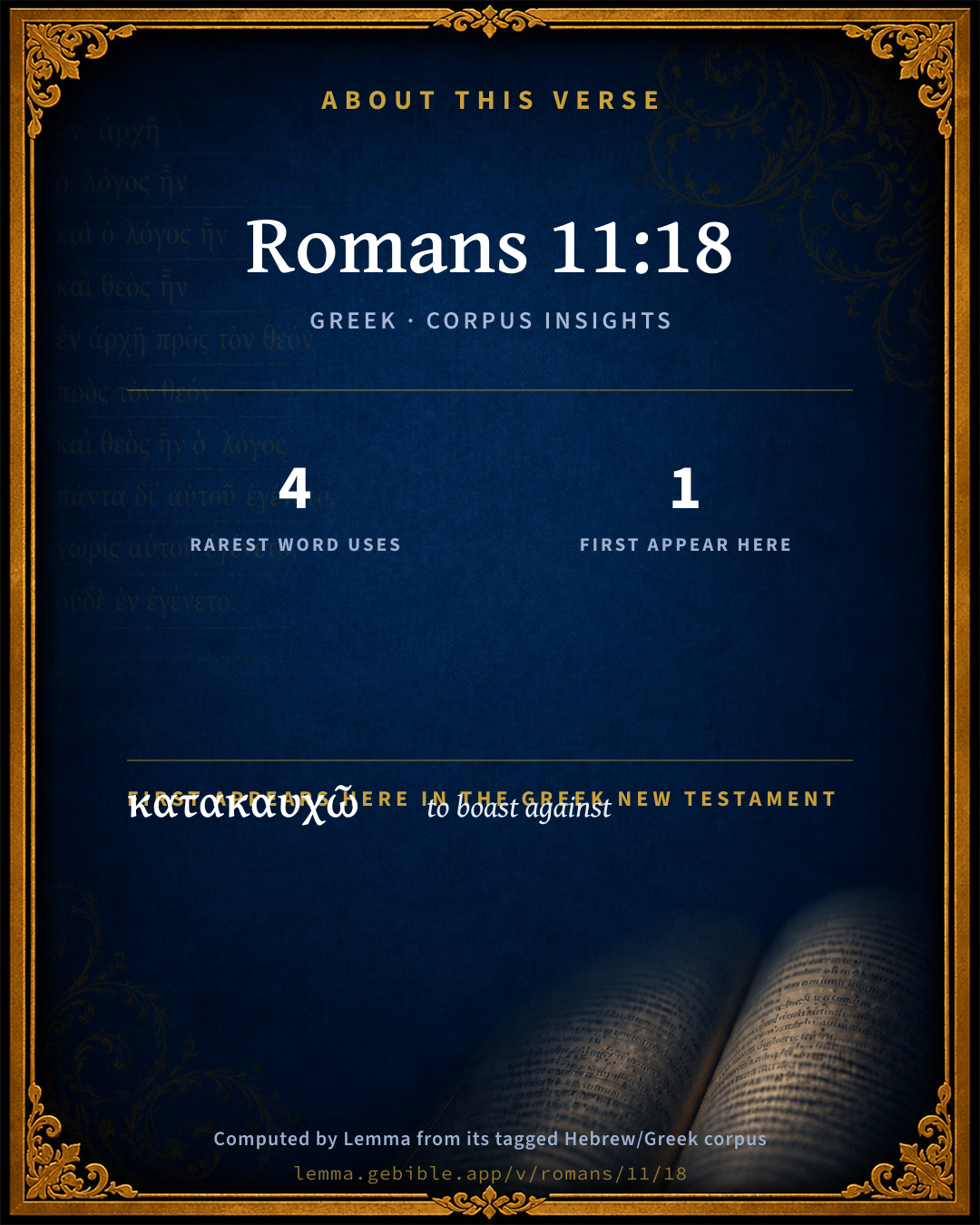
The rarest word here is κατακαυχῶ to boast against G2620 — appearing just 4 times in the whole Greek New Testament.

First appearance in Scripture

This word makes its first canonical appearance in the Greek New Testament here:

  • κατακαυχῶ to boast against G2620

Shared distinctive vocabulary

κατακαυχῶ to boast against G2620 occurs in 3 verses of the Greek New Testament. Also found in:
Repetition

Words recur within this verse:

  • κατακαυχῶ to boast against G2620 ×2
  • ῥίζαν root G4491 ×2
  • τῶν the G3588 ×3
  • σὺ you G4771 ×2

Cross-references

13

Topical passages linked to Romans 11:18 in the Treasury of Scripture Knowledge — connected by theme and wording, ordered by reader-vote popularity; previews shown in the World English Bible.

  • 1 Corinthians 10:12 Therefore let him who thinks he stands be careful that he doesn't fall.
  • Romans 11:20 True; by their unbelief they were broken off, and you stand by your faith. Don't be conceited, but fear;
  • Romans 3:27 Where then is the boasting? It is excluded. By what manner of law? Of works? No, but by a law of faith.
  • Ephesians 2:19–20 So then you are no longer strangers and foreigners, but you are fellow citizens with the saints, and of the household of God,
  • Proverbs 16:18 Pride goes before destruction, And a haughty spirit before a fall.
  • John 10:16 I have other sheep, which are not of this fold. I must bring them also, and they will hear my voice. They will become one flock with one shepherd.
  • 1 Kings 20:11 The king of Israel answered, Tell him, Don't let him who girds on [his armor] boast himself as he who puts it off.
  • Zechariah 8:20–23 Thus says Yahweh of Hosts: "Many peoples, and the inhabitants of many cities will yet come;
  • Matthew 26:33 But Peter answered him, "Even if all will be made to stumble because of you, I will never be made to stumble."
  • Luke 18:9–11 He spoke also this parable to certain people who were convinced of their own righteousness, and who despised all others.
  • Romans 4:16 For this cause it is of faith, that it may be according to grace, to the end that the promise may be sure to all the seed, not to that only which is of the law, but to that also which is of the faith of Abraham, who is the father of us all.
  • Galatians 3:29 If you are Christ's, then you are Abraham's seed and heirs according to promise.
  • John 4:22 You worship that which you don't know. We worship that which we know; for salvation is from the Jews.

Cross-references courtesy of OpenBible.info (CC BY 4.0).

Commentary

Notes on Romans 11:18 from classic Christian and Jewish commentators (each source and its license shown beneath its notes). The classic Christian expositions comment on the surrounding passage and are grouped to its opening verse, so a note may address several verses; the Jewish commentaries on the Tanakh (Rashi and others) are per-verse, so they appear only where the commentator wrote on this verse.

Lemma curates 59 commentaries, every one of them public domain or Creative Commons licensed, each selected and text-cleaned for this edition rather than reprinted as found. About our sources →

Joseph Benson's Commentary

Rom 11:18. Boast not against the branches — Attribute not thy being ingrafted into the good olive to thy own merits, as if thou wert worthy of the blessing. But if thou boast — To humble thy pride, consider, thou bearest not the root, but the root thee — The Jewish church is not ingrafted into the Gentile, but the Gentile into the Jewish; the members thereof being by faith made children of Abraham, who was constituted by God’s covenant the father of all believers, receiving on their behalf the promises. The apostle’s meaning is, that Abraham and his posterity derived no advantage from any covenant which God made with any of the Gentile nations: but the Gentiles have derived many benefits from the covenants which God made with Abraham and the Jews. “Because the converted Gentiles began very early to despise and hate the unbelieving Jews, on account of their opposition to the gospel, and because the apostle foresaw that in after-times the Jews would be treated with great cruelty and contempt by Christians of all denominations, he wrote this passage; in which, by mentioning the great obligations which the Gentiles are under to the Jews, he shows it to be injustice, ingratitude, and impiety, to despise and hate this people; and much more to plunder, persecute, and kill them. They were the original church and people of God. They preserved the knowledge of God when all the world was sunk in idolatry. To them we owe the Scriptures of the New Testament, as well as those of the Old; for the holy and honourable fellowship of the prophets and apostles were Jews. Of them, as concerning the flesh, Christ, the Saviour of the world, came. All the knowledge of religion, therefore, which we enjoy, is derived from them. And surely something of kindness and gratitude is due for such obligations.” — Macknight.

Joseph Benson's Commentary on the Old and New Testaments (1811–1818) — public domain. Text from a community e-Sword module.

Tyndale Open Study Notes

Tyndale Open Resources

11:18 You are just a branch, not the root: By the time Paul wrote to the church in Rome, it was composed mainly of Gentiles, a common situation in the early Christian communities. This dominant role led many Gentile Christians to brag about their status, while treating Jews and their religious heritage with disdain. Paul reminds the Gentile believers that they enjoy God’s blessings only because they have been included in the one people of God, who are rooted in God’s promises to Israel.

Tyndale Open Study Notes — © Tyndale Open Resources, licensed CC BY-SA 4.0. Text via the HelloAO Bible API.

Bengel's Gnomon

Johann Albrecht Bengel

Rom 11:18. Μὴ κατακαυχῶ, Boast not against) Let them, who deny the [possibility of the] conversion of the Jews, take care, that they boast not against them.—οὐ σὺ, it is not thou that) supply know or remember that; know, or remember that it is not thou that bearest the root, but, etc.

Bengel's Gnomon of the New Testament — English translation (T&T Clark, Edinburgh, 1860) — public domain. Text from a community e-Sword module.

Meyer's Critical & Exegetical Commentary

Heinrich August Wilhelm Meyer

Rom_11:18. μὴ κατακ. τῶν κλάδ.] Boast thyself not against (comp. Jam_2:13; Jam_3:14; also in the LXX., not in classical Greek) the branches. These are not the broken-off branches, of which he has just been speaking (Chrysostom, Theodoret, Theophylact, Erasmus, Calovius, and many others, including de Wette, Rückert, Ewald), but, according to Rom_11:16-17, the branches of the olive tree generally (of which some have been broken off); without figure, therefore: the people Israel, but by no means merely those now composing the non-Christian Israel (Hofmann). The latter, because the Christian Israelites also still belonged to the branches of the olive tree, must, as well as the broken-off κλάδοι, have been more precisely designated (against which Hofmann urges subtleties); moreover, the following warning would not be suitable to the broken-off ones, because they no longer stand in any connection with the root. The κλάδοι standing on the root of the patriarchs are the Israelites, whether believing or unbelieving; but under the broken-off ones, which are therefore no longer borne by the root, we are to think not generally of all those Jews who at the time had not yet become believers in Christ (Rom_11:13-14)otherwise the apostolic mission to the Jews would in truth have no meaning (in opposition to Hofmanns denial of this distinction)but only of those who had rejected the Christ preached to them (Act_28:23-24), and therefore were already no longer in living communion with the patriarchal root, excluded in Gods judgment from the theocracy borne by this root (Rom_9:7-8). Hence, too, we are not, with Fritzsche, to think in τῶν κλάδων merely of the converted Jews, as indeed to give a particular warning against pride towards Jewish-Christians was foreign here to the object of the apostle.

εἰ δὲ κατακ. κ.τ.λ.] But if the case occur, that thou boastest against them, then know, reflect: it is not thou who bearest, etc.; without figure: Thy theocratic position is not the original theocratic one, but only a derived one, proceeding from the patriarchs and imparted to thee, conditioned by the relation into which thou hast entered towards them; thou therefore standest likewise only in the relation of a branch to the root, which is borne by the latter, and not the converse, and which may not therefore bear itself proudly towards its fellow-branches, as though it were something better. In these words there lies a warning hint beforehand of the possibility which Paul afterwards, Rom_11:21-22, definitely expresses.

The οὐ σὺ τ. ῥίζ. βαστ κ.τ.λ. is to be taken declaratively. See Winer, p. 575 [E. T. 773]; Buttmann, p. 338. Comp. on 1Co_11:16. The fact itself is quite independent of the case supposed in εἰ κ.τ.λ., but it is brought to mind.

Meyer — Critical and Exegetical Commentary on the New Testament — English translation by Peter Christie, edited by Frederick Crombie (T&T Clark, 1880) — public domain. Text from a community e-Sword module.

Expositor's Greek Testament

ed. W. Robertson Nicoll

Rom 11:18 . μὴ κατακαυχῶ τῶν κλάδων : for the genitive see Buttm., 185. Between “if thou boastest,” and “thou bearest not the root,” there is no formal connection: for such breviloquence, which requires us to supply “consider” or “remember,” see Winer, p. 773. The sense is, You owe all you are proud of to an (artificially formed) relation to the race you would despise.

The Expositor's Greek Testament, edited by W. Robertson Nicoll (1897–1910) — public domain. Text from a community e-Sword module.

Hodge's Commentary on Romans, Ephesians & First Corinthians

Charles Hodge

Rom_11:18

Boast not thyself against the branches; κατακαυχάομαι means, to boast against, in the sense of glorying over any one. But if thou boast, thou bearest not the root, but the root thee. A concise expression, for, If thou boast (i.e., art disposed to do it), consider that thou bearest not the root, etc. The Gentiles had been brought into fellowship with the patriarchs, not the patriarchs with them. Salvation was from the Jews. The truth that the Jews were the channel of blessings to the Gentiles, and not the reverse, was adapted to prevent all ungenerous and self-confident exultation of the latter over the former.

Charles Hodge — Commentary on Romans (1835), First Corinthians (1857), and Ephesians (1856) — public domain. Text from a community e-Sword module.

Geneva Bible (1599)

Geneva Bible translators

We may rejoice in the Lord, but so that we despise not the Jews, whom we ought rather to provoke to that good striving with us.

Geneva Bible (1599) marginal notes — public domain. Text via Bolls.life.

Jamieson, Fausset & Brown

Robert Jamieson, A. R. Fausset & David Brown

Boast not against the--rejected

branches. But if thou--"do"

boast--remember that

thou bearest not--"it is not thou that bearest"

the root, but the root thee--"If the branches may not boast over the root that bears them, then may not the Gentile boast over the seed of Abraham; for what is thy standing, O Gentile, in relation to Israel, but that of a branch in relation to the root? From Israel hath come all that thou art and hast in the family of God; for "salvation is of the Jews" (Joh 4:22).

Jamieson, Fausset & Brown — Commentary Critical and Explanatory on the Whole Bible (1871) — public domain (CC PDM 1.0). Text via the HelloAO Bible API.

Adam Clarke's Commentary

Verse 18. Boast not against the branches.] While you are ready to acknowledge that you were included in the covenant made with Abraham, and are now partakers of the same blessings with him, do not exult over, much less insult, the branches, his present descendants, whose place you now fill up, according to the election of grace: for remember, ye are not the root, nor do ye bear the root, but the root bears you. You have not been the means of deriving any blessing on the Jewish people; but through that very people, which you may be tempted to despise, all the blessing and excellencies which you enjoy have been communicated to you.

Adam Clarke's Commentary on the Bible (1810–1826) — public domain. Text from a community e-Sword/MySword module.

John Calvin's Commentaries

18. But if thou gloriest, thou bearest not the root, etc. The Gentiles could not contend with the Jews respecting the excellency of their race without contending with Abraham himself; which would have been extremely unbecoming, since he was like a root by which they were borne and nourished. As unreasonable as it would be for the branches to boast against the root, so unreasonable would it have been for the Gentiles to glory against the Jews, that is, with respect to the excellency of their race; for Paul would have them ever to consider whence was the origin of their salvation. And we know that after Christ by his coming has pulled down the partition-wall, the whole world partook of the favor which God had previously conferred on the chosen people. It hence follows, that the calling of the Gentiles was like an ingrafting, and that they did not otherwise grow up as God’s people than as they were grafted in the stock of Abraham.

John Calvin's Commentaries (1540-1563) — public domain. Text from the Calvin Translation Society English edition (1840s-50s) via the Christian Classics Ethereal Library (ccel.org). Calvin's coverage is partial (roughly two-thirds of the Bible); uncommented books and verses are honest gaps, never fabricated. The 19th-century editor's footnotes and remarks are omitted so the notes are faithfully Calvin's own voice.

Ellicott's Commentary for English Readers

(18) Thou bearest not the root.—There can be no boasting, for the privileges which the Gentiles possess are derived, and not original.

A Bible Commentary for English Readers, edited by Charles John Ellicott (1878–1897) — public domain. Text from a community e-Sword module.

The Cambridge Bible for Schools and Colleges

gen. ed. J. J. S. Perowne

18. boast not against, &c.] i.e. against the branches that were broken off; as if in a better position than theirs might have been, and as if better in yourself, and so (as regards any virtue of your own) better able to hold your place.—Every insulting thought, word, or act, of professing Christians towards Jews, as Jews, from that day to this, is an illustration of this verse. Too often such slights are also offered, in one form or another, to the re-ingrafted branches—converted Jews.

thou bearest not, &c.] i.e. Divine mercy has reached thee through Abraham and his sons, not them through thee.

The Cambridge Bible for Schools and Colleges (gen. ed. J. J. S. Perowne; Cambridge University Press, 1878–1918) — public domain. Text from a community e-Sword module.

John Gill's Exposition

Boast not against the branches,.... Those that were broken off: the apostle would not have them vaunt it over them, despise them, and trample upon them; but pity them, and pray for and be abundantly thankful and humbled before God, under a sense of Ida sovereign and distinguishing grace, who had settled them in a Gospel church state, who were before comparable to a wild olive tree; and much less should they glory over the believing Jews, among whom they were, there being no difference between them, for they were all one in Christ Jesus:

but if thou boast; but if such a vain temper of mind should prevail, he suggests they would do well to sit down and consider what little reason they had on their side to glory; and if such glorying and boasting, one against another was lawful, the Jews had the greatest reason for it; for, adds the apostle,

thou bearest not the root, but the root thee. The Jews received no advantages from the Gentiles, but on the contrary the Gentiles from the Jews, to whom were committed the oracles of God, and by whom they were faithfully kept and transmitted to the Gentiles; the Gospel itself came out first from among them; the first preachers of it were Jews, who carried it into the Gentile world, where it was greatly succeeded to the conversion of many, who by this means were brought into a Gospel church state, and so enjoyed all the privileges they did: yea, Christ himself, according to the flesh, came of them, was sent unto them, was the minister of them, lived and died among them, and wrought out the great salvation for his people; hence "salvation" itself is said to be "of the Jews", Joh 4:22, so that the root and foundation of all their enjoyments were from the Jews, and not those of the Jews from them; hence there was no room, nor reason, for boasting against them, and vaunting it over them.

John Gill's Exposition of the Whole Bible (1746–1763) — public domain (CC PDM 1.0). Text via the HelloAO Bible API.

Trapp's Complete Commentary

John Trapp

18 Boast not against the branches. But if thou boast, thou bearest not the root, but the root thee.

Ver. 18. Boast not] Gr. throw not up thy neck, in a scornful insulting way, but rather pity and pray for them. (Isidor. Solil.)

John Trapp, A Commentary or Exposition upon All the Books of the Old and New Testament (1647–1656) — public domain. Text from a community e-Sword module.

Albert Barnes' Notes on the Bible

Boast not ... - The tendency of people is to triumph over one that is fallen and rejected. The danger of pride and boasting on account of privileges is not less in the church than elsewhere. Paul saw that some of the Gentiles might be in danger of exultation over the fallen Jews, and therefore cautions them against it. The ingrafted shoot, deriving all its vigor and fruitfulness from the stock of another tree, ought not to boast against the branches.

But if thou boast - If thou art so inconsiderate and wicked, so devoid of humility, and lifted up with pride, as to boast, yet know that there is no occasion for it. If there were occasion for boasting, it would rather be in the root or stock which sustains the branches; least of all can it be in those which were grafted in, having been before wholly unfruitful.

Thou bearest not the root - The source of all your blessings is in the ancient stock. It is clear from this, that the apostle regarded the church as one; and that the Christian economy was only a prolongation of the ancient dispensation. The tree, even with a part of the branches removed. and others ingrafted, retains its identity, and is never regarded as a different tree.

Albert Barnes' Notes on the Bible (1834–1885) — public domain. Text from a community e-Sword/MySword module.

Matthew Poole's English Annotations

Boast not against the branches; i.e. against the Jews, who, because of their unbelief, are broken off; as if by nature thou wert better than they, or more worthy of that grace which is bestowed on thee. The word signifies: Throw not up thy neck, do not carry thyself scornfully and insultingly.

But if thou boast, thou bearest not the root, but the root thee: q.d. If any will needs be so insolent, let them know and consider, that as the root is not beholden to the branches, but the branches to the root; so the good things that the Gentiles have, they received from the Jews, and not the Jews from them: the Gentile church is incorporated into the Jewish, and not the Jewish into the Gentile. Or else the meaning is: Despise not the Jews, for they are the natural branches of the root that bears them. If thou insultest over the branches, thou dost in a manner lift up thyself against the root, that once bore them, and now bears thee; even Abraham, who is the father of all them that believe. Abraham is not the root, simply and absolutely, but relatively, or by way of relation to his posterity and offspring.

Matthew Poole's English Annotations on the Holy Bible (1683–1685) — public domain. Text from a community e-Sword/MySword module.

Whedon's Commentary on the Bible

Daniel D. Whedon

18. Against the branches—Yet Christendom has boasted terribly against the branches! With such a warning from this Jewish apostle of the Gentiles in behalf of his kinsmen according to the flesh, how wonderful it is that the Christian ages have been so cruel and bloody to the Jew. This has been one of our crimes, and doubtless it has brought its penalties.

Daniel D. Whedon (gen. ed.), Commentary on the Old and New Testaments (1874–1909) — public domain. Text from a community e-Sword module.

John Wesley's Explanatory Notes

Boast not against the branches - Do not they do this who despise the Jews? or deny their future conversion?

John Wesley, Explanatory Notes Upon the Whole Bible (1754–1765) — public domain. Text via the GEBible commentary corpus.

McGarvey & Pendleton's Commentaries

J. W. McGarvey

glory not over the branches: but if thou gloriest [remember], it is not thou that bearest the root, but the root thee . ["Pride goeth before destruction, and a haughty spirit before a fall" ( Pro_16:18 ). Religious pride had proved the undoing of the Jews. It made them despise and reject an unregal Messiah; it caused them to spurn a gospel preached to the poor; it moved them to reject a salvation in which the unclean Gentile might freely share. As Paul opens before his Gentile readers the high estate into which they had come, he anticipates the religious pride which the contemplation of their good fortune was so soon to beget in them, hence he at once sounds the timely note of warning. As to the Jew they had no reason to boast, for they were debtor to him, not he to them, for "salvation is from the Jew" ( Joh_4:22 ). As to themselves they could not speak proudly, for the depression of the Jew was due to God's severity, and the exaltation of the Gentile was due to his goodness, The Gentile church was incorporated into a previously existing Jewish church, and their new Theocracy had its root in the old, so that in neither case were these privileges original, but wholly secondary and derived from the Jews. Moreover, "such presumption toward the branches," says Tholuck, "could not be without presumption toward the root." Would that the Gentiles, who to-day boast of their Christianity and despise the Jew from whence it was derived, could comprehend the folly of their course. How great is the sin of Christendom! "In its pride," says Godet, "it tramples underfoot the very nation of that grace which has made it what it is. It moves on, therefore, to a judgment of rejection like that of Israel, but which shall not have to soften it a promise [of final restoration] like that which accompanied the fall of the Jews."]

J. W. McGarvey (with Philip Y. Pendleton), Commentaries on the New Testament (The Fourfold Gospel, 1914; Acts; and the epistles) — public domain. Text from a community e-Sword/MySword module.

The People's New Testament

B. W. Johnson

18. Boast not over the branches. There is too much of this in the prejudice against the Jewish race. The root beareth thee. The riches of grace of the Gentile Christian are due to the fact that he is “grafted in” upon the Abrahamic stock, and becomes his child by faith.

B. W. Johnson's The People's New Testament with Notes (1889–1891) — public domain. Electronic text from the Christian Classics Ethereal Library (CCEL) ThML edition.

Cambridge Greek Testament for Schools and Colleges

18. μὴ κατακαυχῶ. ‘Do not triumph over’ (as you are in danger of doing (cf. Moulton, p. 125)).

Cambridge Greek Testament for Schools and Colleges (Cambridge University Press, 1896; 21 vols, various authors incl. Carr, Maclear, Plummer, Farrar, Lumby, Moule, M. R. James, Simcox) — public domain. Text from a community e-Sword module.

Alford’s Greek Testament

Henry Alford

18.] do not boast against the branches (which were broken off): but if thou boastest against them (know that … or let this consideration humble thee, that … Similarly 1Co 11:16, εἰ δέ τις δοκεῖ φιλόνεικος εἶναι, ἡμεῖς τοιαύτην συνήθειαν οὐκ ἔχομεν, κ.τ.λ. See Winer, edn. 6, § 66.1 a) it is not thou that bearest the root, but the root thee. The ground of humiliation is—“Thou partakest of thy blessings solely by union with God’s spiritual church, which church has for its root that Father of the faithful, from whom they are descended. Regard them not therefore with scorn.” This is expanded further in ver. 20.

Henry Alford, The Greek Testament (1849–1861) — public domain. Text from a community e-Sword module.

International Critical Commentary

18. μὴ κατακαυχῶ τῶν κλάδων. St. Paul seems to be thinking of Gentile Christians who despised the Jews, both such as had become believers and such as had not. The Church of Corinth could furnish many instances of new converts who were carried away by a feeling of excessive confidence, and who, partly on grounds of race, partly because they had understood or thought they had understood the Pauline teaching of ἐλευθερία, were full of contempt for the Jewish Christians and the Jewish race. Incidentally St. Paul takes the opportunity of rebuking such as them.

οὐ σὺ τὴν ῥίζαν κ.τ.λ. ‘All your spiritual strength comes from the stock on which you have been grafted.’ In the ordinary process it may be when a graft of the cultivated olive is set on a wild stock the goodness of the fruit comes from the graft, but in this case it is the reverse; any merit, any virtue, any hope of salvation that the Gentiles may have arises entirely from the fact that they are grafted on a stock whose roots are the Patriarchs and to which the Jews, by virtue of their birth, belong.

International Critical Commentary — older volumes (1896–1929), various authors — public domain. Text from a community e-Sword module.

Vincent's Word Studies in the New Testament

Marvin R. Vincent

The branches, Of the olive - tree generally, Jewish Christians and unbelieving Jews. Not those that are broken off, who are specially indicated in ver. 19.

Marvin R. Vincent, Word Studies in the New Testament (1887–1900) — public domain. Text from a community e-Sword/MySword module.

Godet's Commentaries

Frédéric Louis Godet

Vv. 18. If it is so, Christians of Gentile origin have no cause to indulge pride as against the natural branches. The true translation would perhaps be: “Do not despise the branches. But if, nevertheless, thou despisest”...Must we understand by the branches those broken off? Certainly, for it is on them that the look of disdain might most easily be cast by those who had been called to fill their place. Do we not see Christians at the present day often treating with supreme contempt the members of the Jewish nation who dwell among them? But this contempt might easily extend even to Judeo-Christians; and this, perhaps, is the reason why Paul says simply the branches, without adding the epithet: broken off. It is all that bears the name of Jew which he wished to put under the protection of this warning. As to the idea Fritzsche had of applying this word branches to Christians of Jewish origin solely, it does not deserve refutation.

Yet the apostle supposes that the presumption of the Gentile-Christian continues, in spite of this warning. This is why he adds: “But if, notwithstanding, thou despisest”...We have not to understand a verb such as: know that or think that. The idea understood, if there is one, is to this effect: “Be it! despise! But this, nevertheless, remains the fact.” And what is the fact that nothing can change, and with which such a feeling conflicts? It is, that the salvation enjoyed by this believer has been prepared by a divine history which is one with that of Israel, and that the Christian of Gentile origin enters into possession of a blessing already existing and inherent in this people. As Hodge says: “It is the Jews who are the channel of blessings to the Gentiles, and not inversely.” The Gentiles become God’s people by means of the Jews, not the Jews by the instrumentality of the Gentiles. In view of this fact, the contempt of the latter becomes absurd and even perilous.

Not only, indeed, should Gentile believers not despise the Jews; but if they understand their position rightly, the sight of this rejected people should lead them to tremble for themselves.

Frédéric Louis Godet — Commentaries on Luke, John, Romans, and 1 Corinthians — English translation (T&T Clark, Edinburgh, 1870s–1890s) — public domain. Text from a community e-Sword module.

Lesson kit

Teaching starters — assembled from the data on this page, not authored interpretation. Every prompt links to the verse data it draws on. Edit before teaching.

Romans, in the Pauline Epistles, opens this verse with 16 words (11 distinct Greek lemmas). Its most distinctive word is katakaucháomai (“to boast against”). A historical commentator’s framing appears above. Read the whole chapter for the surrounding context.

Discussion questions

  1. The word katakaucháomai carries the sense “to boast against.” How does it shape the verse?
  2. This is the first place “to boast against” appears in Scripture (first appears here). What does its debut here establish?
  3. How does James 2:13, which shares the word «to boast against», read alongside this verse?
  4. What does the repetition of “to boast against” (2× in this one verse) do in this verse?
  5. These translations render this verse differently. What is at stake in choosing one wording over another?
  6. Compare how Joseph Benson's Commentary and Tyndale Open Study Notes read this verse. Where do they agree or differ?

Things to notice

  • 1 word makes its first canonical appearance in Scripture here.
  • These translations choose different wording for 10 words in this verse.
  • “to boast against” occurs 2× in this single verse.
  • 11 distinct Greek lemmas span 16 words in this verse.

Reading settings

Reading text

Shown beneath each verse's original-language words.

Old Testament
Old Testament edition

Read the OT as the Masoretic Hebrew (MT) or the Greek Septuagint (LXX).

English shown for the Greek Septuagint (in the Hebrew ↔ Greek comparison).

Comparing translations? Open the Compare panel on any verse page to stack up to four side by side.