
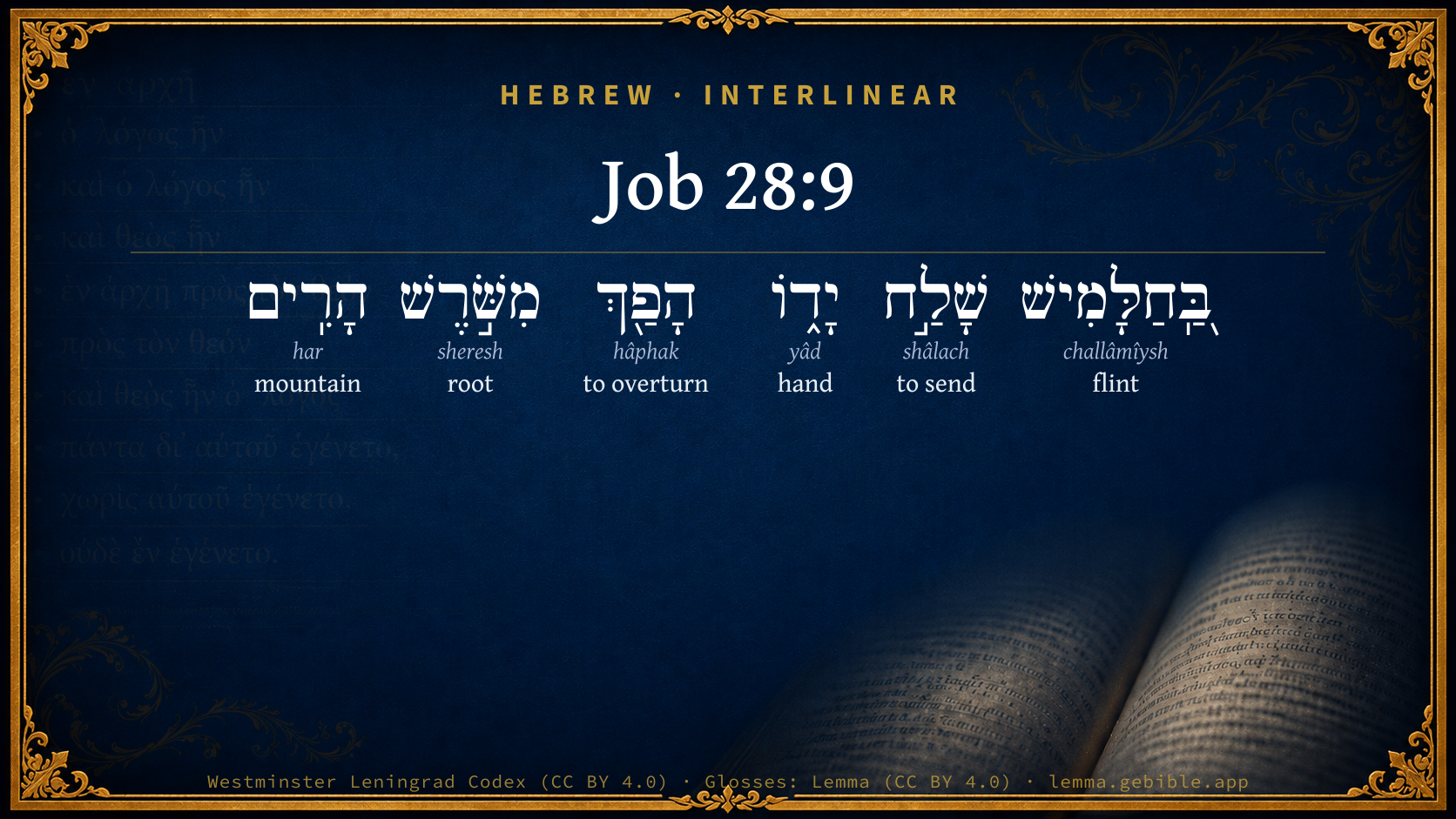
Job 28:9

Hebrew (Westminster Leningrad Codex) Job 28:9 appears in the Hebrew Old Testament. The text above is from the Westminster Leningrad Codex. Each word links to its Strong’s number, a concise gloss, and parsing drawn from the Open Scriptures Hebrew Bible morphology. Click any word for its full Brown-Driver-Briggs (BDB) entry.
Download image
Cite this verse

Job 28:9 (World English Bible). Public Domain. Lemma interlinear Bible study tool, https://lemma.gebible.app/v/job/28/9.

Show BibTeX & RIS
BibTeX
RIS
English Translation
He puts forth his hand on the flinty rock, And he overturns the mountains by the roots.
World English Bible · Public Domain
Download a study sheet

One document with this verse’s original text, its word-by-word gloss line, the meaning frame, cross-references with their text, attributed commentary, and full source and license credits — printable, and it pastes into notes with its structure intact.

This verse Autodidact and up

Study sheet (.html) Plain text (.txt)

A passage Seminary Student

Up to 50 verses in one chapter. A passage sheet keeps up to 6 commentary sources and 12 cross-references per verse, in the order this page ranks them, and says so on the sheet whenever that leaves anything out. Ask for a single verse and you get the Autodidact verse sheet above.

Everything on this page stays free to read, with no account — the sheet is a download of what is already on screen, not access to it.

Want to remove ads? Support Godless Engineer
Compare translations 3

The same verse in 3 English versions, stacked beneath the original-language interlinear above. Click any original word for its lexicon entry.

Each is an independent rendering of the whole verse — the interlinear is not word-aligned to these translations.

Highlighted words mark where these versions differ — a whole-verse word diff, not a word-by-word alignment.

  • World English Bible Public Domain
    He puts forth his hand on the flinty rock, And he overturns the mountains by the roots.
  • King James Version Public Domain
    He putteth forth his hand upon the rock; he overturneth the mountains by the roots.
  • unfoldingWord Literal Text CC BY-SA 4.0
    He stretches out his hand against flinty rock; he overturns mountains from their roots.

unfoldingWord Literal Text — © unfoldingWord, licensed CC BY-SA 4.0. Word-aligned USFM3 via Door43 (git.door43.org/unfoldingWord/en_ult).

Versions to compare (up to 4)

3 of 4 selected

Show all 18 translations

Every available English version of this verse, each an independent rendering of the whole verse.

  • World English Bible Public Domain
    He puts forth his hand on the flinty rock, And he overturns the mountains by the roots.
  • Berean Standard Bible Public Domain
    The miner strikes the flint; he overturns mountains at their base.
  • Majority Standard Bible Public Domain
    The miner strikes the flint; he overturns mountains at their base.
  • King James Version Public Domain
    He putteth forth his hand upon the rock; he overturneth the mountains by the roots.
  • American Standard Version (1901) Public Domain
    He putteth forth his hand upon the flinty rock; He overturneth the mountains by the roots.
  • Revised Version (1885) Public Domain
    He putteth forth his hand upon the flinty rock; he overturneth the mountains by the roots.
  • Geneva Bible (1599) Public Domain
    He putteth his hand vpon the rockes, and ouerthroweth the mountaines by the rootes.
  • Douay-Rheims (1899) Public Domain
    He hath stretched forth his hand to the flint, he hath overturned mountains from the roots.
  • Young's Literal Translation Public Domain
    Against the flint he sent forth his hand, He overturned from the root mountains.
  • Literal Standard Version CC BY-SA 4.0
    He sent forth his hand against the flint, || He overturned mountains from the root.
  • Unlocked Literal Bible CC BY-SA 4.0
    A man lays his hand on the flinty rock; he overturns mountains by their roots.
  • unfoldingWord Literal Text CC BY-SA 4.0
    He stretches out his hand against flinty rock; he overturns mountains from their roots.
  • Darby Bible Public Domain
    [Man] putteth forth his hand upon the flinty rock, he overturneth the mountains by the root.
  • World Messianic Bible Public Domain
    He puts his hand on the flinty rock, and he overturns the mountains by the roots.
  • Webster's Bible Public Domain
    He putteth forth his hand upon the rock; he overturneth the mountains by the roots.
  • Free Bible Version CC BY-SA 4.0
    Miners attack the hard rock; they overturn the roots of mountains.
  • Bible in Basic English Public Domain
    Man puts out his hand on the hard rock, overturning mountains by the roots.
  • JPS Tanakh (1917) Public Domain
    He putteth forth his hand upon the flinty rock; He overturneth the mountains by the roots.

Literal Standard Version (2020), Covenant Press — licensed CC BY-SA 4.0. Text via the HelloAO Bible API (eBible.org). Unlocked Literal Bible (unfoldingWord) — licensed CC BY-SA 4.0. Text via the HelloAO Bible API (eBible.org). unfoldingWord Literal Text — © unfoldingWord, licensed CC BY-SA 4.0. Word-aligned USFM3 via Door43 (git.door43.org/unfoldingWord/en_ult). Free Bible Version, Dr. Jonathan Gallagher — licensed CC BY-SA 4.0. Text via the HelloAO Bible API (eBible.org).

Word by word

More ways to search: Search by grammar → Find every occurrence → Compare this word →

Practice this passage: Drill this verse → Learn its vocabulary →

About this verse

These counts appear in no published source. They are computed here, from the morphology-tagged text and Lemma’s own curated glosses. What Lemma adds →

6
words
6
distinct lemmas
Wisdom
section

Notable vocabulary

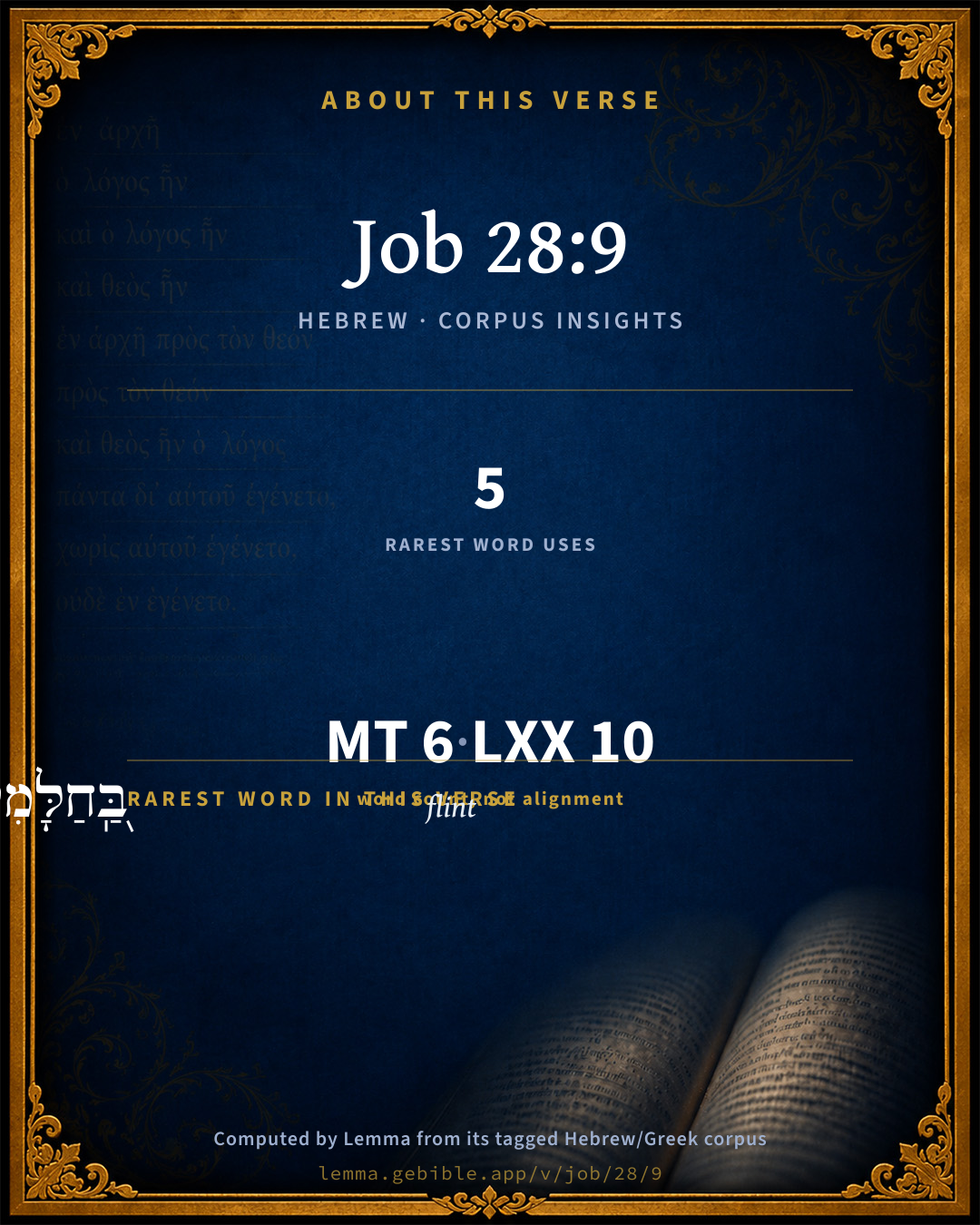
The rarest word here is בַּֽ֭חַלָּמִישׁ flint H2496 — appearing just 5 times in the whole Hebrew Bible.

Shared distinctive vocabulary

בַּֽ֭חַלָּמִישׁ flint H2496 occurs in 5 verses of the Hebrew Bible. Also found in:

Grammatical profile

  • 2 verbs
  • 4 nouns

Verb forms

  • שָׁלַ֣ח Qal · Perfect
  • הָפַ֖ךְ Qal · Perfect

Hebrew & Septuagint length

In English translation the verse runs 17 words from the Hebrew and 17 from the Septuagint (LXX English) — the same length.

A rough comparison of the two English renderings, which tokenize alike — not a word-level alignment.

Word counts can differ between the Hebrew and the Greek without any difference in meaning — e.g. the Hebrew direct-object marker אֵת has no separate Greek word, and Greek often adds the article ὁ.

In the original languages it is 6 Hebrew tokens and 10 Greek tokens — but the two are counted differently (Hebrew bundles its prefixes and suffixes into one token; the Greek is in lemma form), so that isn’t a like-for-like length.

Cross-references

1

Topical passages linked to Job 28:9 in the Treasury of Scripture Knowledge — connected by theme and wording, ordered by reader-vote popularity; previews shown in the World English Bible.

  • Nahum 1:4–6 He rebukes the sea, and makes it dry, and dries up all the rivers. Bashan languishes, and Carmel; and the flower of Lebanon languishes.

Cross-references courtesy of OpenBible.info (CC BY 4.0).

Hebrew and Greek witnesses Masoretic Hebrew ↔ Greek Septuagint

The same verse in the two great witnesses to the Old Testament, shown verse-for-verse.

These are two independent witnesses, not word-aligned to each other, and the Septuagint is shown in lemma (dictionary) form.

Hebrew Job 28:9 Masoretic · Westminster Leningrad Codex

בַּֽ֭חַלָּמִישׁ שָׁלַ֣ח יָד֑וֹ הָפַ֖ךְ מִשֹּׁ֣רֶשׁ הָרִֽים

He puts forth his hand on the flinty rock, And he overturns the mountains by the roots.

World English Bible · Public Domain

Greek LXX Job 28:9 Septuagint · lemma form

ἐν ἀκρότομος ἐκτείνω χείρ αὐτός καταστρέφω δέ ἐκ ῥίζα ὄρος

He has stretched forth his hand on the sharp rock, and turned up mountains by the roots:

LXX2012 (modern English Septuagint) · Public Domain

On this verse, Keil & Delitzsch discusses the Septuagint’s reading. Read the note in Commentary ↓

Hebrew: Westminster Leningrad Codex (CC BY 4.0). Greek: Septuagint (public domain); English from LXX2012 (modern English Septuagint) (Public Domain). How the Septuagint differs from the Hebrew →

Commentary

Notes on Job 28:9 from classic Christian and Jewish commentators (each source and its license shown beneath its notes). The classic Christian expositions comment on the surrounding passage and are grouped to its opening verse, so a note may address several verses; the Jewish commentaries on the Tanakh (Rashi and others) are per-verse, so they appear only where the commentator wrote on this verse.

Lemma curates 59 commentaries, every one of them public domain or Creative Commons licensed, each selected and text-cleaned for this edition rather than reprinted as found. About our sources →

Trapp's Complete Commentary

John Trapp

Job 28:9 He putteth forth his hand upon the rock; he overturneth the mountains by the roots.

Ver. 9. He putteth forth his hand upon the rock] "He," that is, mortal man, the miner, Job 28:4 (not God, as Mercer would have it), "putteth forth his hand"; sc. to dig down these rocks, that he may come at that treasure, and make himself master of that spoil that is hidden in their entrails.

Nil tam difficile est, quod non sollertia vincit.

Alexander the Great being asked, How he so soon overran the universe? answered, I never held anything impossible to be achieved. When he had heard of anything dangerous to be done, or unlikely, he would the rather set upon it, and say, Iam periculum par animo Alexandri, This is an enterprise fit for an Alexander. So of Julius Caesar (who had in his time taken a thousand towns, conquered three hundred nations, taken prisoners a million of men, and slain as many) sings the poet (Lucan),

- Caesar in omnia praeceps,

Nil actum credens, dum quid superesset agendum,

Fertur atrox. -

Difficulty doth but whet on heroic spirits; it wakeneth, but not any way weakeneth, the courageous and industrious. Hannibal made his way through the Alps by breaking down a huge rock putrefied with fire, and vinegar poured thereon. Hence Juvenal,

Opposuit natura Alpemque nivemque

Deduxit scopulos, et montem rupit aceto.

He overturneth the mountains by the roots] Or, he turneth it up at the roots of the mountains; sc. which he mineth, by the obstinace of his labour.

- Labor improbus omnia vincit.

Dεινος και παντολμος της φιλοχρηματιας ερως, saith Isidore, the love of money is daring and desperate.

John Trapp, A Commentary or Exposition upon All the Books of the Old and New Testament (1647–1656) — public domain. Text from a community e-Sword module.

Joseph Benson's Commentary

Job 28:9-11. He putteth forth his hand upon the rock, &c. — He digs through the hardest rocks by his obstinate labour; and undermines mountains, that he may find the treasures hid in their bowels. He cutteth out rivers among the rocks — If he meets with waters in his mining, which hinder his work, he cuts a channel through the rocks to convey them away; or, if he wants water, to wash the ore, he, with incredible industry, cuts channels to bring it into the mines. And his eye seeth every precious thing — Having with great art, and indefatigable industry, broke through all difficulties, he at last arrives at the wished-for object, and finds those precious treasures which he sought for. He bindeth the floods from overflowing — He restraineth them, and, as it were, bindeth them to their good behaviour, that they may not overflow the mine. Or, by his industry and skill he confineth the rivers, so that they cannot overflow. And the thing that is hid bringeth he forth to light — Those metals, or precious stones, which lie hid in the secret parts of the earth, he discovers to himself and others.

Joseph Benson's Commentary on the Old and New Testaments (1811–1818) — public domain. Text from a community e-Sword module.

Geneva Bible (1599)

Geneva Bible translators

After that he hath declared the wisdom of God in the secrets of nature he describeth his power.

Geneva Bible (1599) marginal notes — public domain. Text via Bolls.life.

Jamieson, Fausset & Brown

Robert Jamieson, A. R. Fausset & David Brown

rock--flint. He puts forth his hand to cleave the hardest rock.

by the roots--from their foundations, by undermining them.

Jamieson, Fausset & Brown — Commentary Critical and Explanatory on the Whole Bible (1871) — public domain (CC PDM 1.0). Text via the HelloAO Bible API.

Adam Clarke's Commentary

Verse 9. He putteth forth his hand upon the rock,] Still there appears to be a reference to mining. Man puts his hand upon the rock, he breaks that to pieces, in order to extract the metals which it contains.

He overturneth the mountains] He excavates, undermines, or digs them away, when in search of the metals contained in them: this is not only poetically, but literally, the case in many instances.

Adam Clarke's Commentary on the Bible (1810–1826) — public domain. Text from a community e-Sword/MySword module.

Ellicott's Commentary for English Readers

(9) He putteth forth his hand upon the rock.—The process described is that of tunnelling and excavating, and that of making canals and lining them with stone; and in the course of such works many precious things would be discovered. The canals and cisterns were made so accurately that they retained the water, and did not even weep or trickle.

A Bible Commentary for English Readers, edited by Charles John Ellicott (1878–1897) — public domain. Text from a community e-Sword module.

The Cambridge Bible for Schools and Colleges

gen. ed. J. J. S. Perowne

9. upon the rock] Or, the flinty rock; man puts forth his hand upon the rock either to break it or pierce a way through it. His force makes the hardest obstacle give way before him.

9–11. Some further touches regarding the irresistible force and the skilful ingenuity with which man conducts his operations, with the result at last of bringing that which is hidden forth to light.

The Cambridge Bible for Schools and Colleges (gen. ed. J. J. S. Perowne; Cambridge University Press, 1878–1918) — public domain. Text from a community e-Sword module.

John Gill's Exposition

He putteth forth his hand upon the rock,.... The discourse is carried on concerning the miner, and digger in the earth for metals and precious stones; who meeting with a rock or flint, and a ridge of them, is not discouraged, but goes to work therewith, and with his hammer in his hand lays upon the rock or flint, and beats it to pieces, and with proper instruments cuts through it; and using fire and vinegar, as Pliny (g) observes, makes his way into it, and oftentimes by splitting it discovers gold (h) or silver, or precious stones, in it:

he overturneth the mountains by the roots; or turns them up from the roots; he roots them up, he undermines them; he turns up the earth at the roots of them, to get what is hid at the bottom, or in the bowels of them. Some understand this, and what is said in the following verses, of God, and of wonderful things done by him; so Jarchi, Aben Ezra, and others; and to whom indeed such things are sometimes ascribed in Scripture: he touches the hills, and they smoke, Psa 104:32; lays his hand on the rock, and removes it out of its place, Job 14:18; it was he that smote and opened the rock at Horeb, and the waters gushed out, Exo 17:6; yea, turned the rock into standing water, and the flint into a fountain of water, Psa 114:8, and he, in a figurative sense, has laid his hand on the rock Christ, and smote him with the rod of justice, whereby the blessings of grace come flowing down upon his people; and he it is that puts forth his hand of powerful and efficacious grace upon the rocky hearts of men, and with the hammer of his word breaks them to pieces, Jer 23:29, and takes away the stony heart, and gives an heart of flesh, Eze 11:19, and he also, in a literal sense, overturns hills and mountains by their roots, through storms, and tempests, and earthquakes; and figuratively, kingdoms and states, that lie in the way of his interest; for what are these mountains before the great Zerubbabel? they soon and easily become a plain; and so breaks through all difficulties, which proverbially may be signified by removing mountains, that seem to obstruct and hinder the conversion and salvation of his people; he makes those mountains a way, and his highways are exalted; see Sol 2:8; but the former sense is best, and most agreeable to the context.

(g) Nat. Hist. l. 33. c. 4. "----Montem rumpit aceto", Juvenal. Sat. 10. v. 153. (h) lbid.

John Gill's Exposition of the Whole Bible (1746–1763) — public domain (CC PDM 1.0). Text via the HelloAO Bible API.

Albert Barnes' Notes on the Bible

He putteth forth his hand - That is, the miner in securing the precious metals and gems.

Upon the rock - Margin, “flint.” The word used here (חלמישׁ challâmı̂ysh) occurs also in Psa 104:8. Deu 8:15; Deu 32:13. It means “flint, silex;” and the idea is, that the miner approaches the hardest substances. He penetrates even the flint in searching for precious stones. Dr. Good renders it, “Sparry ore.” Michaelis renders the same word in Deu 7:15, porphyry, or red granite. The idea is that nothing, however difficult, not even cutting down the hardest rocks, deters the miner from pursuing his work.

He overturneth the mountains by the roots - That is, he digs under them, and they fall. The root of a mountain means its base or foundation. The following passage from Pliny (Hist. Nat. xxxiii. c. iv. 21) furnishes an admirable illustration of this passage: Tamen in silice facilior existimatur labor. Est namque terra ex quodam argillae genere glarae mixta, Candidam vocant, prope inexpugnabilis. Cuneis earn ferreis aggrediuntur, et iisdem mallets; nihilque durius putant, nisi quod inter omnia auri lama durissima est. Peracto opere cervices fornicum ab ultimo caedunt, dantque signun ruinrae, eamque solus intelligit in cacumine montis pervigil. Hic voce, ictuque, repente operarios revocari jubet, pariterque ipse devolat. Mons fractus cadit in scse Iongo fragore, qui concipi humana mente non possit, et flatu incredibili. Spectant victores ruinam naturae.

Albert Barnes' Notes on the Bible (1834–1885) — public domain. Text from a community e-Sword/MySword module.

Haydock's Catholic Bible Commentary

Roots, in quest of precious metals. (Menochius) --- "Imus in viscera terræ et in sede Marium opes quærimus." (Pliny, [Natural History?] xxxiii. pref.) Effodiuntur opes, irritamenta malorum. (Ovid, Met. i.)

George Leo Haydock (1774–1849), Haydock's Catholic Family Bible and Commentary, 1859 edition — public domain. Excludes Psalms (Douay-Rheims chapter numbering differs from Protestant) and Deuterocanonical books (Catholic canon only).

Matthew Poole's English Annotations

This and the two next verses are meant either,

1. Of other eminent and considerable works of God, who sometimes overturneth rocks, and produceth new rivers in unlikely places. Or rather,

2. Of the same work of mining and digging for gold, or other precious things of the earth, and of other effects of man’s art and wisdom in that work. The miners resolve to break through all opposition, and by iron tools, or fire, or other ways, dig through the hardest rocks. He undermineth the very mountains to find out the metals lying at the bottom of them.

Matthew Poole's English Annotations on the Holy Bible (1683–1685) — public domain. Text from a community e-Sword/MySword module.

Whedon's Commentary on the Bible

Daniel D. Whedon

9. Upon the rock — Against the flint, (the hardest rock,) as in margin. Pliny’s words furnish a fitting comment. “They attack the flint with iron wedges and hammer’s.… The mountain, fractured, falls off at a great distance.… The victors gaze upon nature’s downfall.”

Daniel D. Whedon (gen. ed.), Commentary on the Old and New Testaments (1874–1909) — public domain. Text from a community e-Sword module.

The Pulpit Commentary

He putteth forth his hand upon the rock. Our Revisers translate, upon the flinty rock; while Canon Cook maintains that "the word used means either granite or quartz." Probably Job meant no more than that man does not shrink from attacking any even the hardest rock; but will subdue it, and cut Iris way through it, if he has occasion so to do. He overturneth the mountains by the roots. Herodotus, in describing what he had seen of the Phoenician mining operations in the island of Thasos, observes, "a huge, mountain has been turned upside down in the search for ores" (Herod., 6:47). Pliny says of the process employed for detaching huge masses from the metalliferous hills in Spain, "They attack the rock with iron wedges and hammers. When this work is complete, they destroy the supports, and notify by signal that the fall is about to take place. A watchman, stationed on the mountain-top, alone understands the signal; and he proceeds at once to have all the workmen called in, and himself makes a hurried retreat. Then the mountain falls m upon itself with a crash that cannot be imagined, and an incredible concussion of the air. The successful engineers contemplate the ruin which they have achieved" ("Hist. Nat.," 33:4.

The Pulpit Commentary (1880–1919), ed. H.D.M. Spence-Jones & Joseph S. Exell — public domain. Text from a community e-Sword module.

John Wesley's Explanatory Notes

He, &c. - This and the two next verses mention other eminent works of God, who overturneth rocks, and produceth new rivers.

John Wesley, Explanatory Notes Upon the Whole Bible (1754–1765) — public domain. Text via the GEBible commentary corpus.

Keil & Delitzsch

C. F. Keil & F. Delitzsch

9 He layeth his hand upon the pebbles;

He turneth up the mountains from the root.

10 He cutteth canals through the rocks;

And his eye seeth all kinds of precious things.

11 That they may not leak, he dammeth up rivers;

And that which is hidden he bringeth to light.

12 But wisdom, whence is it obtained?

And where is the place of understanding?

Beneath, whither no other being of the upper world penetrates, man puts his hand upon the quartz or rock. חלּמישׁ (perhaps from חלם, to be strong, firm: Arabic, with the reduplication resolved, chalnubûs, like עכּבישׁ, Arab. ‛ancabûth, vid., Jesurun, p. 229) signifies here the quartz, and in general the hard stone; שׁלח יד בּ something like our "to take in hand" of an undertaking requiring strong determination and courage, which here consists in blasting and clearing away the rock that contains no ore, as Pliny, h. n. xxxiii. 4, 21, describes it: Occursant ... silices; hos igne et aceto rumpunt, saepius vero, quoniam id cuniculos vapore et fumo strangulat, caedunt fractariis CL libras ferri habentibus egeruntque umeris noctibus ac diebus per tenebras proxumis tradentes; lucem novissimi cernunt. Further: he (man, devoted to mining) overturns (subvertit according to the primary signification of הפך, Arab. 'fk, 'ft, to turn, twist) mountains from the roots. The accentuation הפך with Rebia mugrasch, משׁרשׁ with Mercha, is false; it is, according to Codd. and old editions, to be accented הפך with Tarcha, משׁרשׁ with Munach, and to be translated accordingly: subvertit a radice montes (for Munach is the transformation of a Rebia mugrasch), not a radice montium. Blasting in mining which lays bare the roots (the lowest parts) of the mountains is intended, the conclusion of which - the signal for the flight of the workmen, and the effective crash - is so graphically described by Pliny in the passage cited above: Peracto opere cervices fornicum ab ultumo cadunt; dat signum ruina eamque solus intellegit in cacumine ejus montis vigil. Hic voce, nutu evocari jubet operas pariterque ipse devolat. Mons fractus cadit ab sese longe fragore qui concipi humana mente non possit eque efflatu incredibili spectant victores ruinam naturae.

The meaning of Job 28:10 depends upon the signification of the יארים. It is certainly the most natural that it should signify canals. The word is Egyptian; aur in the language of the hieroglyphs signifies a river, and especially the Nile; wherefore at the close of the Laterculus of Eratosthenes the name of the king, Φρουορῶ (Φουορῶ), is explained by ἤτοι Νεῖλος. If water-canals are intended, they may be either such as go in or come away. In the first case it may mean water let in like a cataract over the ruins of the blasted auriferous rock, the corrugi of Pliny: Alius par labor ac vel majoris impendi: flumina ad lavandam hanc ruinam jugis montium obiter duxere a centesimo plerumque lapide; corrugos vocant, a corrivatione credo; mille et hic labores. But בּקּע is not a suitable word for such an extensive and powerful flooding with water for the purpose of washing the gold. It suits far better to understand the expression of galleries or ways cut horizontally in the rock to carry the water away. Thus von Veltheim explains it: "The miner makes ways through the hard rock into his section in which the perpendicular shaft terminates, guides the water which is found in abundance at that depth through it [i.e., the water as the bottom of the pit that hinders the progress of the work], and is able [thus Job 28:10 naturally is connected with what precedes] to judge of the ore and fragments that are at the bottom, and bring them to the light. This mode of mining by constantly forming one gallery under the other [so that a new gallery is made under the pit that is worked out by extending the shaft, and also freeing this from water by making another outlet below the previous one] is the oldest of all, of which anything certain is known in the history of mining, and the most natural in the days when they had no notion of hydraulics." This explanation is far more satisfactory than that of Herm. Sam. Reimarus, of the "Wolfenbtteler Fragmente" (in his edition of the Neue Erkl. des B. Hiob, by John Ad. Hoffmann, 1734, iv. S. 772): "He breaks open watercourses in the rocks. What the miners call coming upon water, is when they break into a fissure from which strong streams of water gush forth. The miner not only knows how to turn such water to good account, but it is also a sign that there are rich veins of ore near at hand, as there is the most water by these courses and fissures. Hence follows: and then his eye sees all kinds of precious things." But there is no ground for saying that water indicates rich veins of ore, and בקע is much more appropriate to describe the designed formation of courses to carry off the water than an accidental discovery of water in course of the work; moreover, יארים is as appropriate to the former as it is inappropriate to the latter explanation, for it signifies elsewhere the arms of the Nile, into which the Nile is artificially divided; and therefore it may easily be transferred to the horizontal canals of the mine cut through the hard rock (or through the upper earth). Nevertheless, although the water plays an important part in mining operations, by giving rise to the greatest difficulties, as it frequently happens that a pit is deluged with water, and must be abandoned because no one can get down to it: it is improbable that Job 28:10 as well as Job 28:11 refers to this; we therefore prefer to understand יארים as meaning the (horizontal) courses (galleries or drifts) in which the ore is dug, - a rendering which is all the more possible, since, on the one hand, in Coptic jaro (Sahidic jero) signifies the Nile of Egypt (phiaro ente chêmi); on the other, ior (eioor) signifies a ditch, διώρυξ (comp. Isa 33:21, יארים, lxx διώρυχες), vid., Ges. Thes. Thus also Job 28:10 is consistently connected with what precedes, since by cutting these cuniculi the courses of the ore (veins), and any precious stones that may also be embedded there, are laid bare.

Job 28:11

Contrary to the correct indication of the accentuation, Hahn translates: he stops up the droppings of the watercourses; מבּכי has Dech, and is therefore not to be connected with what follows as a genitive. But Reimarus' translation: from the drops he connects the streams, is inadmissible. "The trickling water," he observes, "is carefully caught in channels by the miners for use, and is thus brought together from several parts of the reservoir and the water-wheel. What Pliny calls corrugus, corrivatio,." On the contrary, Schlottm. remarks that חבשׁ cannot signify such a connection, i.e., gathering together of watercourses; it occurs elsewhere only of hunting, i.e., binding up wounds. Nevertheless, although חבשׁ cannot directly signify "to collect," the signification coercere (Job 34:17), which is not far from this idea, - as is evident from the Arab. ḥibs (ḥabs), a dam or sluice for collecting water, and Arab. maḥbas 'l-mâ', a reservoir, cistern, - is easily transferable to water, in the sense of binding = catching up and accumulating. But it is contrary to the form of the expression that מבכי, with this use of חבש, should denote the materia ex qua, and that נהרות should be referred to the miry ditches in which "the crushed ore is washed, for the purpose of separating the good from the worthless." On the contrary, from the form of the expression, it is to be translated: a fletu (not e fletu) flumina obligat, whether it be that a fletu is equivalent to ne flent s. stillent (Simeon Duran: שׁלא יזלו), or obligat equivalent to cohibet (Ralbag: מהזּלה). Thus von Veltheim explains the passage, since he here, as in Job 28:10, understands the channels for carrying off the water. "The miner covers the bottom with mire, and fills up the crevices so exactly i.e., he besmears it, where the channel is broken through, with some water-tight substance, e.g., clay, that it may entirely carry off the water that is caught by it out of the pit in which the shaft terminates, and not let it fall through the fissures crevices to the company of miners below to the vein that lies farther down; then the miner can descend still deeper since the water runs outwards and does not soak through, and bring forth the ore that lies below the channel." This explanation overlooks the fact that יארים is used in Job 28:10, whereas Job 28:11 has נהרות. It is not probable that these are only interchangeable expressions for the channels that carry off the water. יארים is an appropriate expression for it, but not נהרות, which as appropriately describes the conflux of water in the mine itself.

The meaning of Job 28:11 is, that he (the miner) binds or stops the watercourses which his working out of the pit has interfered with and injured, so that they may not leak, i.e., that they may not in the least ooze through, whether by building up a wall or by collecting the water that streams forth in reservoirs (Arab. mahbas) or in the channels which carry it outwards, - all these modes of draining off the water may be included in Job 28:11, only the channel itself is not, with von Veltheim, to be understood by נהרות, but the concourse of the water which, in one way or the other, is rendered harmless to the pit-work, so that he (the miner), as Job 28:11 says, can bring to light (אור = לאור) whatever precious things the bowels of the earth conceals (תּעלמהּ, according to Kimchi and others, with euphonic Mappik, as according to the Masora כבכורהּ Isa 28:4, גשׁמהּ Eze 22:24, and also וגלהּ Zac 4:2, only לתפארת הקריאה ולא לכינוי, i.e., they have Mappik only for euphony, not as the expression of the suff.).

Job 28:12

With the question in Job 28:12 the description of mining attains the end designed: man can search after and find out silver, gold, and others metals and precious stones, by making the foundations of the earth accessible to him; but wisdom, whence shall be obtain it, and which (ואי־זה, according to another reading ואיזה) is the place of understanding? החכמה has the art. to give prominence to its transcendency over the other attainable things. חכמה is the principal name, and בּינה interchanges with it, as תּבוּנה, Pro 8:1, and other synonyms in which the Chokma literature abounds elsewhere in Prov 1-9. בינה is properly the faculty of seeing through that which is distinguishable, consisting of the possession of the right criteria; חכמה, however, is the perception, in general, of things in their true nature and their final causes.

Keil & Delitzsch — Biblical Commentary on the Old Testament (1861–1891) — public domain (CC PDM 1.0). Text via the HelloAO Bible API. (Old Testament only.)

unfoldingWord translationNotes

Door43 World Missions Community

lays his hand on the flinty rock

This represents breaking up the rock. AT: "digs into the flinty rock" (See: Metonymy)

flinty rock

"hard rock"

he overturns mountains by their roots

Digging up the mountains and the ground underneath them is a metaphor from digging out weeds or trees, an exaggeration that represents digging minerals out of the ground. AT: "he turns the mountains upside down by pulling out their roots" (See: Hyperbole and Generalization and Metaphor)

his eye sees

Here "his eye" represents him. AT: "he sees" (See: Synecdoche)

He ties up the streams so they do not run

Here "ties up the streams" means damming or blocking the streams. AT: "He blocks the streams so they do not flow" (See: Metaphor)

what is hidden there

This refers to things that people normally do not see because they are in the ground or underwater.

translationWords

light

unfoldingWord translationNotes — © Distant Shores Media and the Door43 World Missions Community, licensed CC BY-SA 4.0. Source: git.door43.org/Door43/en_tn.

Rashi

Rabbi Shlomo Yitzchaki (Rashi)

upon the flinty rock and turned over the roots of the mountains from top to bottom.

Rashi on the Tanakh — English translations: “The Judaica Press complete Tanach with Rashi, translated by A. J. Rosenberg” (CC BY 4.0); “Pentateuch with Rashi's commentary by M. Rosenbaum and A.M. Silbermann, 1929-1934” (public domain); “The Metsudah Tanach series, Lakewood, N.J” (CC BY 4.0); and “The Book of Joshua, Metsudah Publications, 1997” (CC BY 4.0). Text via Sefaria.

Lesson kit

Teaching starters — assembled from the data on this page, not authored interpretation. Every prompt links to the verse data it draws on. Edit before teaching.

Job, in the Wisdom, opens this verse with 6 words (6 distinct Hebrew lemmas). Its most distinctive word is challâmîysh (“flint”). A historical commentator’s framing appears above. Read the whole chapter for the surrounding context.

Discussion questions

  1. How does “flint” (challâmîysh) shape what this verse is saying?
  2. Deuteronomy 8:15 shares the word «flint» with this verse. How do the two illuminate each other?
  3. These translations render this verse differently. What is at stake in choosing one wording over another?
  4. The verb «שָׁלַ֣ח» is Qal Perfect. How does its form color the action?
  5. Reading how Trapp's Complete Commentary and Joseph Benson's Commentary read this verse, where do the two commentators agree and where do they part?

Things to notice

Reading settings

Reading text

Shown beneath each verse's original-language words.

Old Testament
Old Testament edition

Read the OT as the Masoretic Hebrew (MT) or the Greek Septuagint (LXX).

English shown for the Greek Septuagint (in the Hebrew ↔ Greek comparison).

Comparing translations? Open the Compare panel on any verse page to stack up to four side by side.