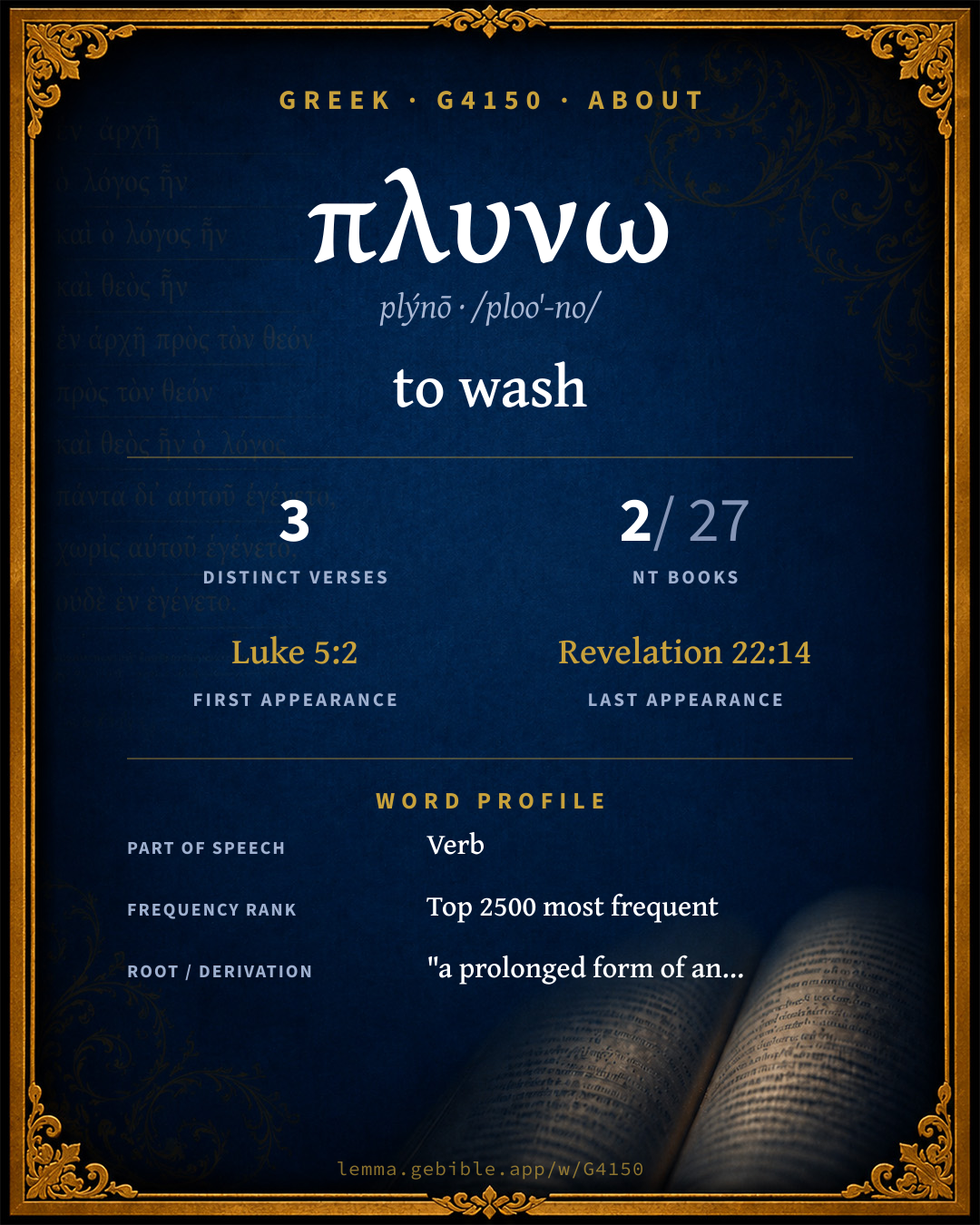
πλύνω
to wash
Full lexicon entry — Thayer's Greek Lexicon
From Thayer's Greek Lexicon
Where this word appears
See every Aorist-tense verb in the Greek New Testament →
Grammar key — what these labels mean
Part of speech
- Verb
- An action or state-of-being word.
Tense
- Aorist
- Action viewed as a simple whole, without regard to duration — often past (perfective aspect).
- Present
- Ongoing or general action in present time (imperfective aspect).
Voice
- Active
- The subject performs the action.
Mood
- Indicative
- States a fact or asks a factual question (the mood of reality).
- Participle
- A verbal adjective (“writing,” “having written”).
Case
- Nominative
- The case of the subject (and the predicate nominative).
Person
- 3rd person
- The one spoken about (“he / she / it / they”).
Gender
- Masculine
- Grammatically masculine.
Number
- Plural
- More than one.
Every verse where G4150 appears in the Book of Revelation — 2 distinct verses. Click any verse to open its interlinear word-by-word view. Verse text shown in the World English Bible for context — . Each verse’s Greek form is shown with its reference; the English is not keyword-highlighted, since the data carries no word-level English alignment. Use “Compare translations” on any verse to read it across multiple English versions. This concordance covers the Greek New Testament; Septuagint (Greek Old Testament) occurrences of this word are not indexed here.
Revelation
- Revelation 7:14 ἔπλυναν aor act ind 3pl I told him, "My lord, you know." He said to me, "These are those who came out of the great tribulation. They washed their robes, and made them white in the Lamb's blood.
- Revelation 22:14 πλύνοντες pres act ptcp nom pl masc Blessed are those who do his commandments, that they may have the right to the tree of life, and may enter in by the gates into the city.
About this entry
At a glance — auto-summarized from this page’s data, not written by a person. Every figure links to its source below. This summary describes the numbers; it doesn’t interpret them.
At its core, πλυνω (plýnō) means “to wash.” It occurs a mere 3 verses across Scripture. The word gravitates to Revelation (67%), then Luke. Scripture first uses it in Luke 5:2. It clusters with πλεω under a shared root. Each statement above links to its evidence; the full detail follows below.
Gloss history
Strong's 1890 vs modern scholarship
About this word
Strong's G4150 catalogs a Greek word from the Greek New Testament.
These counts are not copied from any lexicon or concordance. They are computed here, from the morphology-tagged Greek New Testament. What Lemma adds →
- 3
- distinct verses
- The word appears in 3 distinct verses.
- 2 / 27
- NT books
- The word appears in 2 of 27 New Testament books.
- #2,203
- by frequency
- Top 2500 most frequent Greek words (rank 2,203 of 5,347 Greek words by occurrence).
View all 3 occurrences in the concordance →
Most concentrated in
- Revelation 2 verses 67%
- Luke 1 verse 33%
By section of the New Testament
By traditional corpus
Conventional, traditional groupings — biblical authorship is debated, so this is a traditional corpus grouping, not an authorship claim. Some books belong to more than one corpus (Luke is in both the Gospels and the Lukan corpus, and so on), so these shares overlap and need not total 100%. Each figure is a share of the word’s 3 distinct verses.
- Johannine 2 verses · 67%
- Revelation 2 verses · 67%
- Gospels 1 verse · 33%
- Lukan (Luke–Acts) 1 verse · 33%
How translations render this word
Counts come from each version’s own published word-to-Strong’s tagging or interlinear alignment — an approximate guide to how each version renders this word, not a word-level alignment the data otherwise carries. Because each total is that version’s own tagged count, the per-version totals vary from one another and need not match the appearance or distinct-verse counts above. These counts may also differ from a printed concordance because Lemma counts each distinctly tagged rendering and does not collapse phrase taggings into a single head-word total. This is a fixed set of word-tagged versions (KJV, ASV, BSB, ULT) and does not change with the reading translation you choose elsewhere. Each version’s license is shown beside its name below (and on Sources).
- King James Version: Have washed 1×
- American Standard Version: They washed 1×
- Berean Standard Bible: They have washed 1×, Wash 1×, Were washing 1×
- unfoldingWord Literal Text: Ones washing 1×, They have washed 1×, Were washing 1×
King James Version Public Domain
Renders G4150 across 1 tagged occurrence — most commonly:
American Standard Version Public Domain
Renders G4150 across 1 tagged occurrence — most commonly:
Berean Standard Bible Public Domain
Renders G4150 across 3 tagged occurrences — most commonly:
unfoldingWord Literal Text CC BY-SA 4.0
Renders G4150 across 3 tagged occurrences — most commonly:
Senses in Thayer's
The 1 sense Thayer's distinguishes for this word, in lexicon order (not ranked by frequency or importance). The full entry — with sub-senses — is in the Lexicon Entry tab.
- to wash: with reference to clothing
Word origin
Origin: "a prolonged form of an obsolete pluo (to "flow")"
Forms in the corpus
The 2 distinct written forms G4150 takes in the Greek New Testament, most frequent first — each parse links to that tense’s occurrences in the concordance.
| Form | Parsing | Example | Uses |
|---|---|---|---|
| ἔπλυναν éplynan | Verb, Aorist, Active, Indicative, 3rd person, Plural | Luke 5:2 | 2 |
| πλύνοντες plýnontes | Verb, Present, Active, Participle, Nominative, Plural, Masculine | Revelation 22:14 | 1 |
Same root — word family
Other Thayer's entries built from the same root as G4150, grouped by Strong’s listed origin. These share a root / origin per the lexicon — not necessarily a shared meaning. Each links to that word’s own entry.
Derived from this word
Compare all same-root words → They share a root, not necessarily a meaning.
Septuagint usage
The same Greek word πλυνω appears 52 times in the Greek Old Testament (Septuagint), across 49 verses in 8 books.
- 52
- LXX occurrences
- Tagged occurrences of this Greek word in the Septuagint.
- 49
- verses
- Distinct Septuagint verses containing this word.
- 8 / 39
- OT books
- The word appears in 8 of the 39 Old Testament books.
Sample Septuagint occurrences
- Genesis 49:11 πλύνω
- Exodus 19:10 πλύνω
- Leviticus 1:9 πλύνω
- Numbers 8:7 πλύνω
- 2 Samuel 19:25 πλύνω
- 2 Chronicles 4:6 πλύνω
- Psalms 50:4 πλύνω
- Malachi 3:2 πλύνω
Septuagint occurrences (same lexeme)
Every verse where the same Strong’s number (G4150) appears in the Greek Septuagint. Verse text shown in the World English Bible for context; the Greek form is the matched word — the English is not keyword-highlighted.
- Genesis 49:11 πλύνω Binding his foal to the vine, His donkey's colt to the choice vine; He has washed his garments in wine, His robes in the blood of grapes:
- Exodus 19:10 πλύνω Yahweh said to Moses, "Go to the people, and sanctify them today and tomorrow, and let them wash their garments,
- Exodus 19:14 πλύνω Moses went down from the mountain to the people, and sanctified the people; and they washed their clothes.
- Exodus 29:17 πλύνω You shall cut the ram into its pieces, and wash its innards, and its legs, and put them with its pieces, and with its head.
- Leviticus 1:9 πλύνω but its innards and its legs he shall wash with water. The priest shall burn the whole on the altar, for a burnt offering, an offering made by fire, of a sweet savor to Yahweh.
- Leviticus 1:13 πλύνω but the innards and the legs he shall wash with water. The priest shall offer the whole, and burn it on the altar. It is a burnt offering, an offering made by fire, of a sweet savor to Yahweh.
- Leviticus 6:20 πλύνω "This is the offering of Aaron and of his sons, which they shall offer to Yahweh in the day when he is anointed: the tenth part of an ephah of fine flour for a meal offering perpetually, half of it in the morning, and half of it in the evening.
- Leviticus 8:21 πλύνω He washed the innards and the legs with water; and Moses burned the whole ram on the altar. It was a burnt offering for a sweet savor. It was an offering made by fire to Yahweh; as Yahweh commanded Moses.
- Leviticus 9:14 πλύνω He washed the innards and the legs, and burned them on the burnt offering on the altar.
- Leviticus 11:25 πλύνω Whoever carries any part of their carcass shall wash his clothes, and be unclean until the evening.
- Leviticus 11:28 πλύνω He who carries their carcass shall wash his clothes, and be unclean until the evening. They are unclean to you.
- Leviticus 11:40 πλύνω He who eats of its carcass shall wash his clothes, and be unclean until the evening. He also who carries its carcass shall wash his clothes, and be unclean until the evening.
- Leviticus 13:6 πλύνω The priest shall examine him again on the seventh day; and, behold, if the plague has faded, and the plague hasn't spread in the skin, then the priest shall pronounce him clean. It is a scab. He shall wash his clothes, and be clean.
- Leviticus 13:34 πλύνω On the seventh day, the priest shall examine the itch; and, behold, if the itch hasn't spread in the skin, and its appearance isn't deeper than the skin, then the priest shall pronounce him clean. He shall wash his clothes, and be clean.
- Leviticus 13:54 πλύνω then the priest shall command that they wash the thing in which the plague is, and he shall isolate it seven more days.
- Leviticus 13:55 πλύνω Then the priest shall examine it, after the plague is washed; and, behold, if the plague hasn't changed its color, and the plague hasn't spread, it is unclean; you shall burn it in the fire. It is a mildewed spot, whether the bareness is inside or outside.
- Leviticus 13:56 πλύνω If the priest looks, and, behold, the plague has faded after it is washed, then he shall tear it out of the garment, or out of the skin, or out of the warp, or out of the woof:
- Leviticus 13:58 πλύνω The garment, either the warp, or the woof, or whatever thing of skin it is, which you shall wash, if the plague has departed from them, then it shall be washed the second time, and it will be clean."
- Leviticus 14:8 πλύνω "He who is to be cleansed shall wash his clothes, and shave off all his hair, and bathe himself in water; and he shall be clean. After that he shall come into the camp, but shall dwell outside his tent seven days.
- Leviticus 14:9 πλύνω It shall be on the seventh day, that he shall shave all his hair off his head and his beard and his eyebrows, even all his hair he shall shave off. He shall wash his clothes, and he shall bathe his body in water, then he shall be clean.
- Leviticus 14:47 πλύνω He who lies down in the house shall wash his clothes; and he who eats in the house shall wash his clothes.
- Leviticus 15:5 πλύνω Whoever touches his bed shall wash his clothes, and bathe himself in water, and be unclean until the evening.
- Leviticus 15:6 πλύνω He who sits on anything whereon the man who has the discharge sat shall wash his clothes, and bathe himself in water, and be unclean until the evening.
- Leviticus 15:7 πλύνω "'He who touches the body of him who has the discharge shall wash his clothes, and bathe himself in water, and be unclean until the evening.
- Leviticus 15:8 πλύνω "'If he who has the discharge spits on him who is clean, then he shall wash his clothes, and bathe himself in water, and be unclean until the evening.
- Leviticus 15:10 πλύνω Whoever touches anything that was under him shall be unclean until the evening. He who carries those things shall wash his clothes, and bathe himself in water, and be unclean until the evening.
- Leviticus 15:11 πλύνω "'Whoever he who has the discharge touches, without having rinsed his hands in water, he shall wash his clothes, and bathe himself in water, and be unclean until the evening.
- Leviticus 15:13 πλύνω "'When he who has a discharge is cleansed of his discharge, then he shall count to himself seven days for his cleansing, and wash his clothes; and he shall bathe his flesh in running water, and shall be clean.
- Leviticus 15:17 πλύνω Every garment, and every skin, whereon the semen is, shall be washed with water, and be unclean until the evening.
- Leviticus 15:21 πλύνω Whoever touches her bed shall wash his clothes, and bathe himself in water, and be unclean until the evening.
- Leviticus 15:22 πλύνω Whoever touches anything that she sits on shall wash his clothes, and bathe himself in water, and be unclean until the evening.
- Leviticus 15:27 πλύνω Whoever touches these things shall be unclean, and shall wash his clothes, and bathe himself in water, and be unclean until the evening.
- Leviticus 16:26 πλύνω "He who lets the goat go for the scapegoat shall wash his clothes, and bathe his flesh in water, and afterward he shall come into the camp.
- Leviticus 16:28 πλύνω He who burns them shall wash his clothes, and bathe his flesh in water, and afterward he shall come into the camp.
- Leviticus 17:15 πλύνω "'Every person that eats what dies of itself, or that which is torn by animals, whether he is native-born or a foreigner, he shall wash his clothes, and bathe himself in water, and be unclean until the evening: then he shall be clean.
- Leviticus 17:16 πλύνω But if he doesn't wash them, or bathe his flesh, then he shall bear his iniquity.'"
- Numbers 8:7 πλύνω Thus shall you do to them, to cleanse them: sprinkle the water of cleansing on them, let them shave their whole bodies with a razor, and let them wash their clothes, and cleanse themselves.
- Numbers 8:21 πλύνω The Levites purified themselves from sin, and they washed their clothes; and Aaron offered them for a wave offering before Yahweh; and Aaron made atonement for them to cleanse them.
- Numbers 19:7 πλύνω Then the priest shall wash his clothes, and he shall bathe his flesh in water, and afterward he shall come into the camp, and the priest shall be unclean until the even.
- Numbers 19:8 πλύνω He who burns her shall wash his clothes in water, and bathe his flesh in water, and shall be unclean until the even.
- Numbers 19:10 πλύνω He who gathers the ashes of the heifer shall wash his clothes, and be unclean until the even: and it shall be to the children of Israel, and to the stranger who lives as a foreigner among them, for a statute forever.
- Numbers 19:19 πλύνω and the clean person shall sprinkle on the unclean on the third day, and on the seventh day: and on the seventh day he shall purify him; and he shall wash his clothes, and bathe himself in water, and shall be clean at even.
- Numbers 19:21 πλύνω It shall be a perpetual statute to them: and he who sprinkles the water for impurity shall wash his clothes, and he who touches the water for impurity shall be unclean until even.
- Numbers 31:24 πλύνω You shall wash your clothes on the seventh day, and you shall be clean; and afterward you shall come into the camp.
- 2 Samuel 19:25 πλύνω It happened, when he was come to Jerusalem to meet the king, that the king said to him, Why didn't you go with me, Mephibosheth?
- 2 Chronicles 4:6 πλύνω He made also ten basins, and put five on the right hand, and five on the left, to wash in them; such things as belonged to the burnt-offering they washed in them; but the sea was for the priests to wash in.
- Psalms 50:4 πλύνω He calls to the heavens above, To the earth, that he may judge his people:
- Psalms 50:9 πλύνω I have no need for a bull from your stall, Nor male goats from your pens.
- Malachi 3:2 πλύνω "But who can endure the day of his coming? And who will stand when he appears? For he is like a refiner's fire, and like launderer's soap;
These are occurrences of the same Greek lexeme (G4150) in the Septuagint — not a translation of any one Hebrew word. The store carries no word-level Hebrew↔Greek alignment, so no Hebrew original is asserted here. Counts come from the recovered LXX Strong's tagging — high-frequency vocabulary is well covered, while rare or late forms may be untagged — so they reflect tagged occurrences and may slightly undercount.