
Psalms 50:9

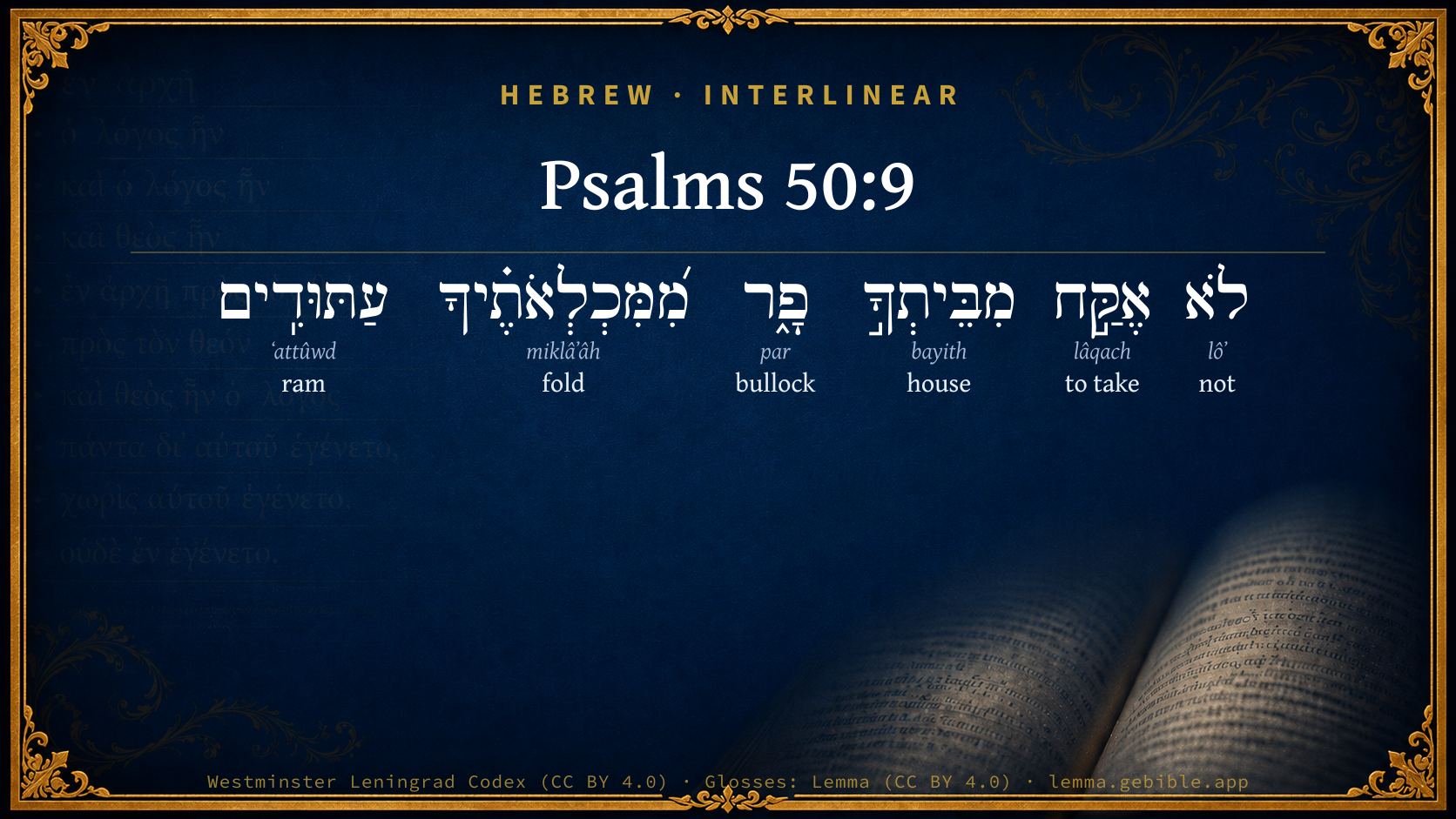
Hebrew (Westminster Leningrad Codex) Psalms 50:9 appears in the Hebrew Old Testament. The text above is from the Westminster Leningrad Codex. Each word links to its Strong’s number, a concise gloss, and parsing drawn from the Open Scriptures Hebrew Bible morphology. Click any word for its full Brown-Driver-Briggs (BDB) entry.
Download image
Cite this verse

Psalms 50:9 (World English Bible). Public Domain. Lemma interlinear Bible study tool, https://lemma.gebible.app/v/psalms/50/9.

Show BibTeX & RIS
BibTeX
RIS
English Translation
I have no need for a bull from your stall, Nor male goats from your pens.
World English Bible · Public Domain
Highlights
  • 1 first appearance in the Hebrew Bible
Full analysis ↓
Download a study sheet

One document with this verse’s original text, its word-by-word gloss line, the meaning frame, cross-references with their text, attributed commentary, and full source and license credits — printable, and it pastes into notes with its structure intact.

This verse Autodidact and up

Study sheet (.html) Plain text (.txt)

A passage Seminary Student

Up to 50 verses in one chapter. A passage sheet keeps up to 6 commentary sources and 12 cross-references per verse, in the order this page ranks them, and says so on the sheet whenever that leaves anything out. Ask for a single verse and you get the Autodidact verse sheet above.

Everything on this page stays free to read, with no account — the sheet is a download of what is already on screen, not access to it.

Want to remove ads? Support Godless Engineer
Compare translations 3

The same verse in 3 English versions, stacked beneath the original-language interlinear above. Click any original word for its lexicon entry.

Each is an independent rendering of the whole verse — the interlinear is not word-aligned to these translations.

Highlighted words mark where these versions differ — a whole-verse word diff, not a word-by-word alignment.

  • World English Bible Public Domain
    I have no need for a bull from your stall, Nor male goats from your pens.
  • King James Version Public Domain
    I will take no bullock out of thy house, nor he goats out of thy folds.
  • unfoldingWord Literal Text CC BY-SA 4.0
    I will not take a bull from your house, goats from your folds.

unfoldingWord Literal Text — © unfoldingWord, licensed CC BY-SA 4.0. Word-aligned USFM3 via Door43 (git.door43.org/unfoldingWord/en_ult).

Versions to compare (up to 4)

3 of 4 selected

Show all 18 translations

Every available English version of this verse, each an independent rendering of the whole verse.

  • World English Bible Public Domain
    I have no need for a bull from your stall, Nor male goats from your pens.
  • Berean Standard Bible Public Domain
    I have no need for a bull from your stall or goats from your pens,
  • Majority Standard Bible Public Domain
    I have no need for a bull from your stall or goats from your pens,
  • King James Version Public Domain
    I will take no bullock out of thy house, nor he goats out of thy folds.
  • American Standard Version (1901) Public Domain
    I will take no bullock out of thy house, Nor he-goats out of thy folds.
  • Revised Version (1885) Public Domain
    I will take no bullock out of thy house, nor he-goats out of thy folds.
  • Geneva Bible (1599) Public Domain
    I will take no bullocke out of thine house, nor goates out of thy foldes.
  • Douay-Rheims (1899) Public Domain
    I will not take calves out of thy house: nor he goats out of thy flocks.
  • Young's Literal Translation Public Domain
    I take not from thy house a bullock, From thy folds he goats.
  • Literal Standard Version CC BY-SA 4.0
    I do not take a bullock from your house, || [Or] male goats from your folds.
  • Unlocked Literal Bible CC BY-SA 4.0
    I will take no bull out of your house, or male goats out of your folds.
  • unfoldingWord Literal Text CC BY-SA 4.0
    I will not take a bull from your house, goats from your folds.
  • Darby Bible Public Domain
    I will take no bullock out of thy house, [nor] he-goats out of thy folds:
  • World Messianic Bible Public Domain
    I have no need for a bull from your stall, nor male goats from your pens.
  • Webster's Bible Public Domain
    I will take no bullock out of thy house, nor he-goats out of thy folds.
  • Free Bible Version CC BY-SA 4.0
    I do not require bulls from your barns or goats from your pens,
  • Bible in Basic English Public Domain
    I will take no ox out of your house, or he-goats from your flocks;
  • JPS Tanakh (1917) Public Domain
    I will take no bullock out of thy house, nor he-goats out of thy folds.

Literal Standard Version (2020), Covenant Press — licensed CC BY-SA 4.0. Text via the HelloAO Bible API (eBible.org). Unlocked Literal Bible (unfoldingWord) — licensed CC BY-SA 4.0. Text via the HelloAO Bible API (eBible.org). unfoldingWord Literal Text — © unfoldingWord, licensed CC BY-SA 4.0. Word-aligned USFM3 via Door43 (git.door43.org/unfoldingWord/en_ult). Free Bible Version, Dr. Jonathan Gallagher — licensed CC BY-SA 4.0. Text via the HelloAO Bible API (eBible.org).

Word by word

More ways to search: Search by grammar → Find every occurrence → Compare this word →

Practice this passage: Drill this verse → Learn its vocabulary →

About this verse

These counts appear in no published source. They are computed here, from the morphology-tagged text and Lemma’s own curated glosses. What Lemma adds →

6
words
6
distinct lemmas
Wisdom
section

Notable vocabulary

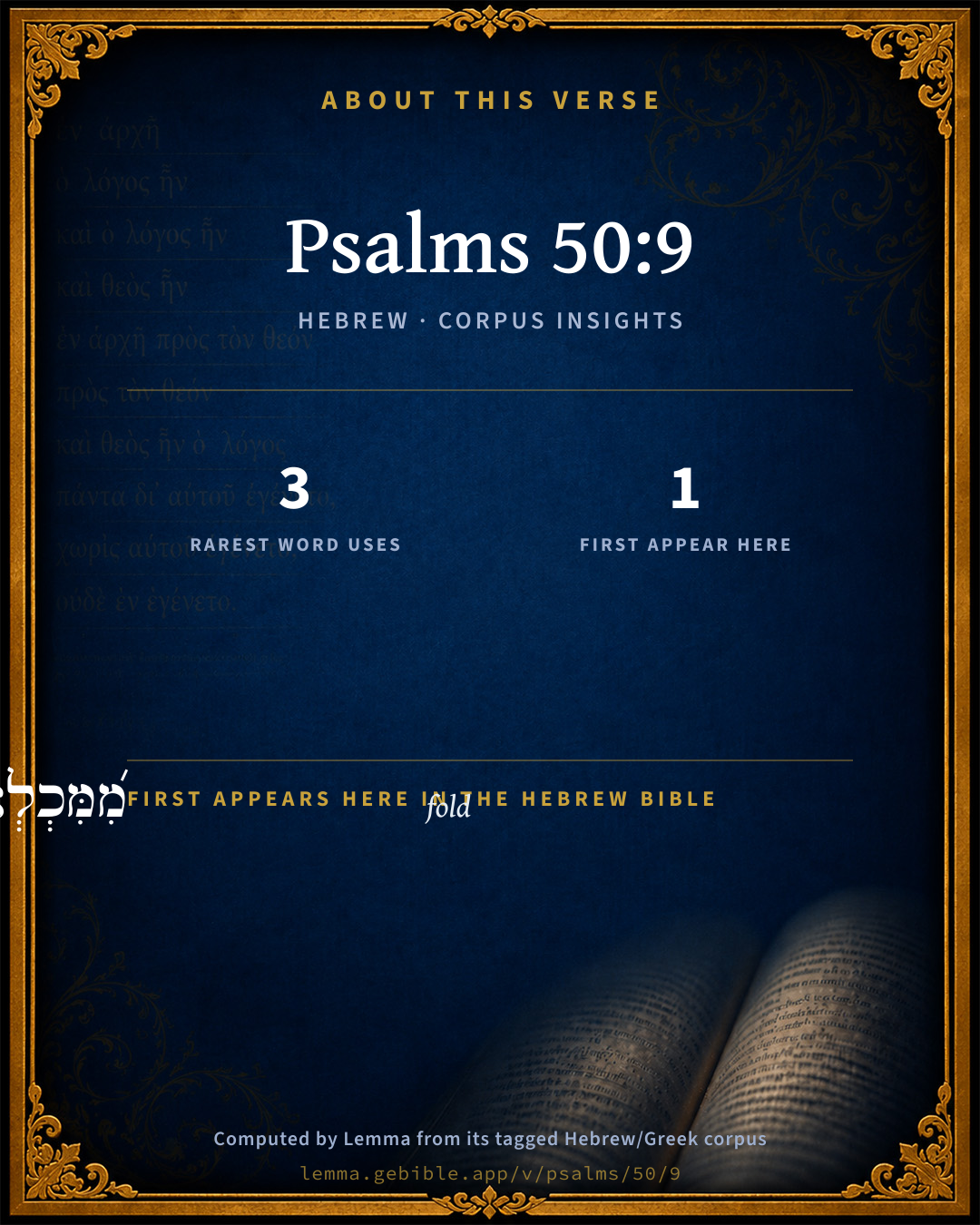
The rarest word here is מִ֝מִּכְלְאֹתֶ֗יךָ fold H4356 — appearing just 3 times in the whole Hebrew Bible.

First appearance in Scripture

This word makes its first canonical appearance in the Hebrew Bible here:

  • מִ֝מִּכְלְאֹתֶ֗יךָ fold H4356

Shared distinctive vocabulary

מִ֝מִּכְלְאֹתֶ֗יךָ fold H4356 occurs in 3 verses of the Hebrew Bible. Also found in:

Grammatical profile

  • 1 verb
  • 4 nouns
  • 1 particle

Verb forms

  • אֶקַּ֣ח Qal · Imperfect

Hebrew & Septuagint length

In English translation the verse runs 16 words from the Hebrew and 15 from the Septuagint (LXX English) — closely comparable.

A rough comparison of the two English renderings, which tokenize alike — not a word-level alignment.

Word counts can differ between the Hebrew and the Greek without any difference in meaning — e.g. the Hebrew direct-object marker אֵת has no separate Greek word, and Greek often adds the article ὁ.

Cross-references

5

Topical passages linked to Psalms 50:9 in the Treasury of Scripture Knowledge — connected by theme and wording, ordered by reader-vote popularity; previews shown in the World English Bible.

  • Micah 6:6–8 How shall I come before Yahweh, And bow myself before the exalted God? Shall I come before him with burnt offerings, With calves a year old?
  • Acts 17:25 neither is he served by men's hands, as though he needed anything, seeing he himself gives to all life and breath, and all things.
  • Hebrews 10:4–6 For it is impossible that the blood of bulls and goats should take away sins.
  • Psalms 69:31 It will please Yahweh better than an ox, Or a bull that has horns and hoofs.
  • Isaiah 43:23–24 You have not brought me of your sheep for burnt offerings; neither have you honored me with your sacrifices. I have not burdened you with offerings, nor wearied you with frankincense.

Cross-references courtesy of OpenBible.info (CC BY 4.0).

Hebrew and Greek witnesses Masoretic Hebrew ↔ Greek Septuagint

The same verse in the two great witnesses to the Old Testament, shown verse-for-verse.

You’re reading Greek Psalm 49 (Hebrew Psalm 50). The Septuagint counts the superscription, so verse numbers can differ from the Hebrew — chapter-level alignment, not verse-by-verse. Numbering follows Rahlfs.

These are two independent witnesses, not word-aligned to each other, and the Septuagint is shown in lemma (dictionary) form.

Hebrew Psalms 50:9 Masoretic · Westminster Leningrad Codex

לֹא אֶקַּ֣ח מִבֵּיתְךָ֣ פָ֑ר מִ֝מִּכְלְאֹתֶ֗יךָ עַתּוּדִֽים

I have no need for a bull from your stall, Nor male goats from your pens.

World English Bible · Public Domain

Greek LXX Greek Psalm 49:9 Septuagint · lemma form

οὐ δέχομαι ἐκ ὁ οἶκος σύ μόσχος οὐδέ ἐκ ὁ ποίμνιον σύ χίμαρος

I will take no bullocks out of your house, nor he-goats out of your flocks.

LXX2012 (modern English Septuagint) · Public Domain

Hebrew: Westminster Leningrad Codex (CC BY 4.0). Greek: Septuagint (public domain); English from LXX2012 (modern English Septuagint) (Public Domain). How the Septuagint differs from the Hebrew →

Commentary

Notes on Psalms 50:9 from classic Christian and Jewish commentators (each source and its license shown beneath its notes). The classic Christian expositions comment on the surrounding passage and are grouped to its opening verse, so a note may address several verses; the Jewish commentaries on the Tanakh (Rashi and others) are per-verse, so they appear only where the commentator wrote on this verse.

Lemma curates 59 commentaries, every one of them public domain or Creative Commons licensed, each selected and text-cleaned for this edition rather than reprinted as found. About our sources →

Trapp's Complete Commentary

John Trapp

Psa 50:9 I will take no bullock out of thy house, [nor] he goats out of thy folds.

Ver. 9. I will take no bullock out of thy house, &c.] q.d. Keep them to thyself, I need them not; thou settest a high price upon them, and thinkest to ingratiate with me by them; I value them not, nay, I loathe them, Sordet in conspectu Iudicis quod fulget in conspectu operantis. "That which is highly esteemed among men is abomination in the sight of God," Luk 16:15. Displeasing service is double dishonour.

John Trapp, A Commentary or Exposition upon All the Books of the Old and New Testament (1647–1656) — public domain. Text from a community e-Sword module.

J. A. Alexander on Psalms

Joseph Addison Alexander

9. (Psa 50:9) I will not take from thy house a bullock, (nor) from thy folds he-goats. Here begins the correction of the false and foolish notion, extensively prevalent among the heathen, and not unknown among the ancient Jews, especially in times of great corruption, that the sacrifices were designed to satisfy some physical necessity on God's part, whether in the way of food or otherwise. In opposition to this impious absurdity, it is argued that, even if God needed such supplies, he would not be dependent on the worshipper, who is here addressed directly as an individual, with great advantage to the liveliness and force of the whole passage. "If I needed bulls and goats, as you imagine, I would not be under the necessity of seeking them at your hands."

Joseph Addison Alexander, The Psalms Translated and Explained (1850) — public domain. Text from a community e-Sword module.

Tyndale Open Study Notes

Tyndale Open Resources

50:9 Unlike pagan gods, God does not need food; instead, he wants his people to serve him with a right heart (50:14-15).

Tyndale Open Study Notes — © Tyndale Open Resources, licensed CC BY-SA 4.0. Text via the HelloAO Bible API.

John Calvin's Commentaries

9 I will take no calf out thy house Two reasons are given in this and the succeeding verses to prove that he cannot set any value upon sacrifices. The first is, that supposing him to depend upon these, he needs not to be indebted for them to man, having all the fullness of the earth at his command; and the second, that he requires neither food nor drink as we do for the support of our infirm natures. Upon the first of these he insists in the ninth and three following verses, where he adverts to his own boundless possessions, that he may show his absolute independence of human offerings. He then points at the wide distinction betwixt himself and man, the latter being dependent for a frail subsistence upon meat and drink, while he is the self-existent One, and communicates life to all beside. There may be nothing new in the truths here laid down by the Psalmist; but, considering the strong propensity we have by nature to form our estimate of God from ourselves, and to degenerate into a carnal worship, they convey a lesson by no means unnecessary, and which contains profound wisdom, that man can never benefit God by any of his services, as we have seen in Psalm 16:2, “My goodness extendeth not unto thee.” In the second place, God says that he does not require any thing for his own us but that, as he is sufficient in his own perfection, he has consulted the good of man in all that he has enjoined. We have a passage in Isaiah to a similar effect,

“The heaven is my throne, and the earth is my footstool: where is the house that ye build unto me, and where is the place of my rest? For all these things hath mine hand made.” — (Isaiah 66:1, 2,)

In these words

God asserts his absolute independence; for while the world had a beginning, he himself was from eternity. From this it follows, that as he subsisted when there was nothing without him which could contribute to his fullness, he must have in himself a glorious all-sufficiency.

John Calvin's Commentaries (1540-1563) — public domain. Text from the Calvin Translation Society English edition (1840s-50s) via the Christian Classics Ethereal Library (ccel.org). Calvin's coverage is partial (roughly two-thirds of the Bible); uncommented books and verses are honest gaps, never fabricated. The 19th-century editor's footnotes and remarks are omitted so the notes are faithfully Calvin's own voice.

Ellicott's Commentary for English Readers

(9-18) Notice the fine tone of irony that pervades this rebuke, the best weapon against ritualistic errors.

A Bible Commentary for English Readers, edited by Charles John Ellicott (1878–1897) — public domain. Text from a community e-Sword module.

John Gill's Exposition

I will take no bullock out of thy house,.... That is, will accept of none; such sacrifices being no more agreeable to the will of God, Heb 10:5; the "bullock" is mentioned, that being a principal creature used in sacrifice; as also the following,

nor he goats out of thy folds; the reasons follow.

John Gill's Exposition of the Whole Bible (1746–1763) — public domain (CC PDM 1.0). Text via the HelloAO Bible API.

Albert Barnes' Notes on the Bible

I will take no bullock out of thy house - Bullocks were offered regularly in the Hebrew service and sacrifice Exo 29:11, Exo 29:36; Lev 4:4; 1Ki 18:23, 1Ki 18:33; and it is with reference to this that the language is used here. In obedience to the law it was right and proper to offer such sacrifices; and the design here is not to express disapprobation of these offerings in themselves considered. On this subject - on the external compliance with the law in this respect - God says Psa 50:8 that he had no cause to complain against them. It was only with respect to the design and the spirit with which they did this, that the language in this verse and the following verses is used. The idea which it is the purpose of these verses to suggest is, that God did not “need” such offerings; that they were not to be made “as if” he needed them; and that if he needed such he was not “dependent” on them, for all the beasts of the earth and all the fowls of the mountains were his, and could be taken for that purpose; and that if he took what was claimed to be theirs - the bullocks and the goats - he did not wrong them, for all were his, and he claimed only his own.

Nor he-goats out of thy folds - Goats were also offered in sacrifice. Lev 3:12; Lev 4:24; Lev 10:16 : Num 15:27.

Albert Barnes' Notes on the Bible (1834–1885) — public domain. Text from a community e-Sword/MySword module.

Matthew Poole's English Annotations

But be not so vain and foolish as to imagine that thou dost lay any obligations upon me by thy sacrifices; or that I required them because I had need of them, or took any pleasure in them for themselves, or for my own satisfaction by them.

Matthew Poole's English Annotations on the Holy Bible (1683–1685) — public domain. Text from a community e-Sword/MySword module.

The Treasury of David

Charles H. Spurgeon

Ver. 9. I will take no bullock out of thy house. Foolishly they dreamed that bullocks with horns and hoofs could please the Lord, when indeed he sought for hearts and souls. Impiously they fancied that Jehovah needed these supplies, and that if they fed his altar with their fat beasts, he would be content. What he intended for their instruction, they made their confidence. They remembered not that "to obey is better than sacrifice, and to hearken than the fat of rams." Nor he goats out of thy folds. He mentions these lesser victims as if to rouse their common sense to see that the great Creator could find not satisfaction in mere animal offerings. If he needed these, he would not appeal to their scanty stalls and folds; in fact, he here refuses to take so much as one, if they brought them under the false and dishonouring view, that they were in themselves pleasing to him. This shows that the sacrifices of the law were symbolical of higher and spiritual things, and were not pleasing to God except under their typical aspect. The believing worshipper looking beyond the outward was accepted, the unspiritual who had no respect to their meaning was wasting his substance, and blaspheming the God of heaven.

Charles H. Spurgeon's The Treasury of David (1869–1885) — public domain. Psalms only. Text from a community e-Sword/MySword module.

The Pulpit Commentary

I will take no bullock out of thy house, nor he goats out of thy folds. The offerings of those who offer amiss will not be accepted. God declines to receive them.

The Pulpit Commentary (1880–1919), ed. H.D.M. Spence-Jones & Joseph S. Exell — public domain. Text from a community e-Sword module.

John Wesley's Explanatory Notes

Bullock - Be not so foolish, as to imagine that thou dost lay any obligations upon me by thy sacrifices.

John Wesley, Explanatory Notes Upon the Whole Bible (1754–1765) — public domain. Text via the GEBible commentary corpus.

unfoldingWord translationNotes

Door43 World Missions Community

folds

areas surrounded by walls in which sheep and goats are kept

the cattle on a thousand hills

The phrase "on a thousand hills" does not represent the total number of cattle that God owns. The number is an exaggeration that emphasizes that God owns all of the cattle in the world. The verb may be supplied from the previous phrase. AT: "all the cattle in the world are mine" (See: Hyperbole and Generalization and Ellipsis)

thousand hills

"1,000 hills" (See: Numbers)

I know all the birds

Here the word "know" implies ownership. AT: "I own all the birds" (See: Idiom and Assumed Knowledge and Implicit Information)

translationWords

cow

house

goat

beast

know

unfoldingWord translationNotes — © Distant Shores Media and the Door43 World Missions Community, licensed CC BY-SA 4.0. Source: git.door43.org/Door43/en_tn.

Rashi

Rabbi Shlomo Yitzchaki (Rashi)

I will not take from your household a bull They are not yours but Mine.

from your pens Heb. ממכלאתיך. That is a sheepfold, as (Habakkuk 3:17): “the flock shall be cut off from the fold (ממכלה).” Parc in French, pen.

Rashi on the Tanakh — English translations: “The Judaica Press complete Tanach with Rashi, translated by A. J. Rosenberg” (CC BY 4.0); “Pentateuch with Rashi's commentary by M. Rosenbaum and A.M. Silbermann, 1929-1934” (public domain); “The Metsudah Tanach series, Lakewood, N.J” (CC BY 4.0); and “The Book of Joshua, Metsudah Publications, 1997” (CC BY 4.0). Text via Sefaria.

Lesson kit

Teaching starters — assembled from the data on this page, not authored interpretation. Every prompt links to the verse data it draws on. Edit before teaching.

Psalms, in the Wisdom, opens this verse with 6 words (6 distinct Hebrew lemmas). Its most distinctive word is miklâʼâh (“fold”). A historical commentator’s framing appears above. Read the whole chapter for the surrounding context.

Discussion questions

  1. How does “fold” (miklâʼâh) shape what this verse is saying?
  2. The word “fold” first appears here in Scripture. What is being introduced at this debut?
  3. Psalms 78:70 shares the word «fold» with this verse. How do the two illuminate each other?
  4. These translations render this verse differently; the difference is in the English rendering, not the original. What questions does that raise?
  5. The verb «אֶקַּ֣ח» is Qal Imperfect. How does its form color the action?
  6. Reading how Trapp's Complete Commentary and J. A. Alexander on Psalms read this verse, where do the two commentators agree and where do they part?

Things to notice

Reading settings

Reading text

Shown beneath each verse's original-language words.

Old Testament
Old Testament edition

Read the OT as the Masoretic Hebrew (MT) or the Greek Septuagint (LXX).

English shown for the Greek Septuagint (in the Hebrew ↔ Greek comparison).

Comparing translations? Open the Compare panel on any verse page to stack up to four side by side.