
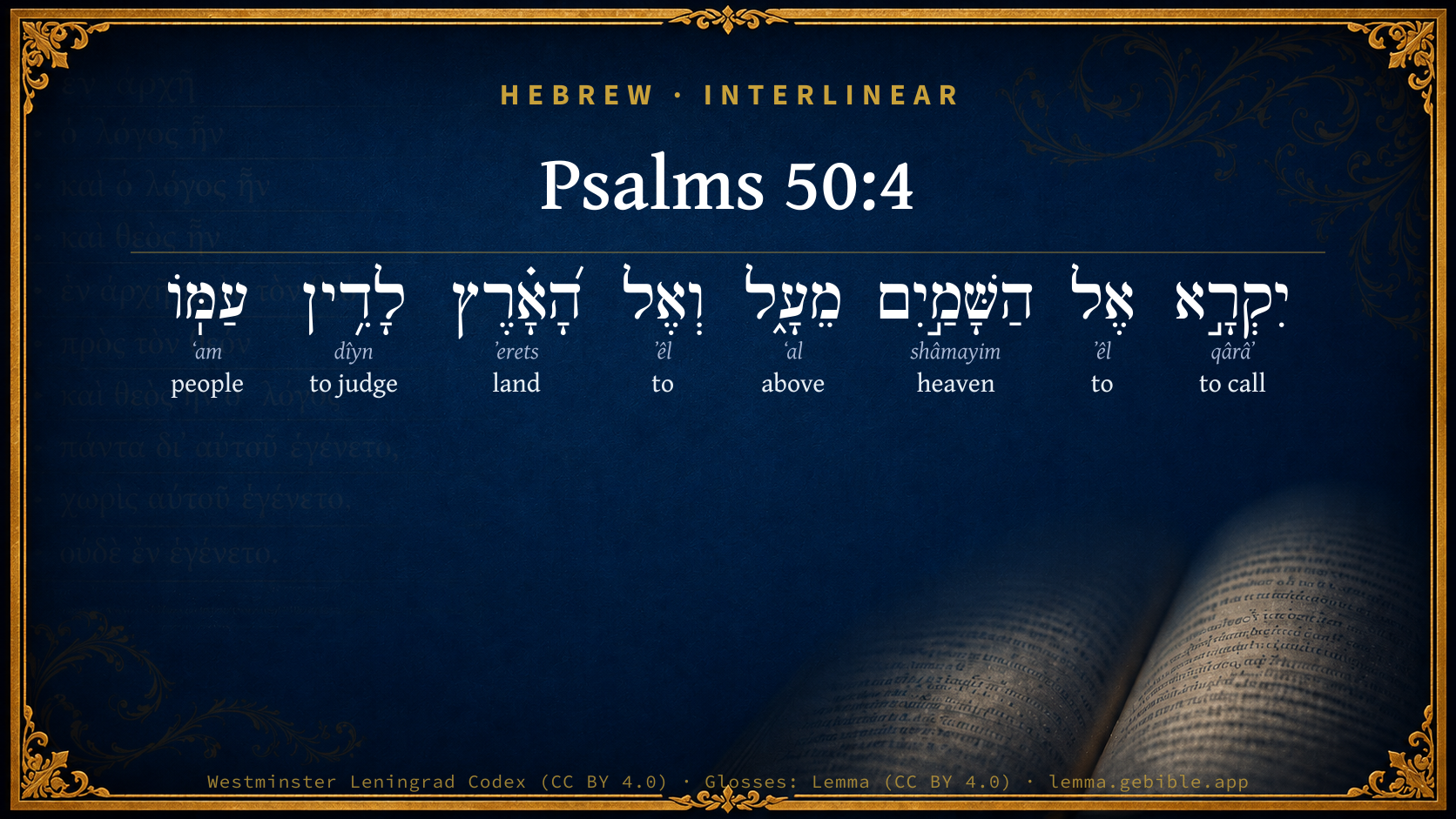
Psalms 50:4

Hebrew (Westminster Leningrad Codex) Psalms 50:4 appears in the Hebrew Old Testament. The text above is from the Westminster Leningrad Codex. Each word links to its Strong’s number, a concise gloss, and parsing drawn from the Open Scriptures Hebrew Bible morphology. Click any word for its full Brown-Driver-Briggs (BDB) entry.
Download image
Cite this verse

Psalms 50:4 (World English Bible). Public Domain. Lemma interlinear Bible study tool, https://lemma.gebible.app/v/psalms/50/4.

Show BibTeX & RIS
BibTeX
RIS
English Translation
He calls to the heavens above, To the earth, that he may judge his people:
World English Bible · Public Domain
Download a study sheet

One document with this verse’s original text, its word-by-word gloss line, the meaning frame, cross-references with their text, attributed commentary, and full source and license credits — printable, and it pastes into notes with its structure intact.

This verse Autodidact and up

Study sheet (.html) Plain text (.txt)

A passage Seminary Student

Up to 50 verses in one chapter. A passage sheet keeps up to 6 commentary sources and 12 cross-references per verse, in the order this page ranks them, and says so on the sheet whenever that leaves anything out. Ask for a single verse and you get the Autodidact verse sheet above.

Everything on this page stays free to read, with no account — the sheet is a download of what is already on screen, not access to it.

Want to remove ads? Support Godless Engineer
Compare translations 3

The same verse in 3 English versions, stacked beneath the original-language interlinear above. Click any original word for its lexicon entry.

Each is an independent rendering of the whole verse — the interlinear is not word-aligned to these translations.

Highlighted words mark where these versions differ — a whole-verse word diff, not a word-by-word alignment.

  • World English Bible Public Domain
    He calls to the heavens above, To the earth, that he may judge his people:
  • King James Version Public Domain
    He shall call to the heavens from above, and to the earth, that he may judge his people.
  • unfoldingWord Literal Text CC BY-SA 4.0
    He calls to the heavens above and to the earth so that he may judge his people.

unfoldingWord Literal Text — © unfoldingWord, licensed CC BY-SA 4.0. Word-aligned USFM3 via Door43 (git.door43.org/unfoldingWord/en_ult).

Versions to compare (up to 4)

3 of 4 selected

Show all 18 translations

Every available English version of this verse, each an independent rendering of the whole verse.

  • World English Bible Public Domain
    He calls to the heavens above, To the earth, that he may judge his people:
  • Berean Standard Bible Public Domain
    He summons the heavens above, and the earth, that He may judge His people:
  • Majority Standard Bible Public Domain
    He summons the heavens above, and the earth, that He may judge His people:
  • King James Version Public Domain
    He shall call to the heavens from above, and to the earth, that he may judge his people.
  • American Standard Version (1901) Public Domain
    He calleth to the heavens above, And to the earth, that he may judge his people:
  • Revised Version (1885) Public Domain
    He shall call to the heavens above, and to the earth, that he may judge his people:
  • Geneva Bible (1599) Public Domain
    Hee shall call the heauen aboue, and the earth to iudge his people.
  • Douay-Rheims (1899) Public Domain
    He shall call heaven from above, and the earth, to judge his people.
  • Young's Literal Translation Public Domain
    He doth call unto the heavens from above, And unto the earth, to judge His people.
  • Literal Standard Version CC BY-SA 4.0
    He calls to the heavens from above, || And to the earth, to judge His people.
  • Unlocked Literal Bible CC BY-SA 4.0
    He calls to the heavens above and to the earth so that he may judge his people:
  • unfoldingWord Literal Text CC BY-SA 4.0
    He calls to the heavens above and to the earth so that he may judge his people.
  • Darby Bible Public Domain
    He will call to the heavens from above, and to the earth, that he may judge his people:
  • World Messianic Bible Public Domain
    He calls to the heavens above, to the earth, that he may judge his people:
  • Webster's Bible Public Domain
    He shall call to the heavens from above, and to the earth, that he may judge his people.
  • Free Bible Version CC BY-SA 4.0
    He summons the heavens above and the earth to witness the judgment of his people.
  • Bible in Basic English Public Domain
    His voice will go out to the heavens and to the earth, for the judging of his people:
  • JPS Tanakh (1917) Public Domain
    He calleth to the heavens above, and to the earth, that He may judge His people:

Literal Standard Version (2020), Covenant Press — licensed CC BY-SA 4.0. Text via the HelloAO Bible API (eBible.org). Unlocked Literal Bible (unfoldingWord) — licensed CC BY-SA 4.0. Text via the HelloAO Bible API (eBible.org). unfoldingWord Literal Text — © unfoldingWord, licensed CC BY-SA 4.0. Word-aligned USFM3 via Door43 (git.door43.org/unfoldingWord/en_ult). Free Bible Version, Dr. Jonathan Gallagher — licensed CC BY-SA 4.0. Text via the HelloAO Bible API (eBible.org).

Word by word

More ways to search: Search by grammar → Find every occurrence → Compare this word →

Practice this passage: Drill this verse → Learn its vocabulary →

About this verse

These counts appear in no published source. They are computed here, from the morphology-tagged text and Lemma’s own curated glosses. What Lemma adds →

8
words
7
distinct lemmas
Wisdom
section

Notable vocabulary

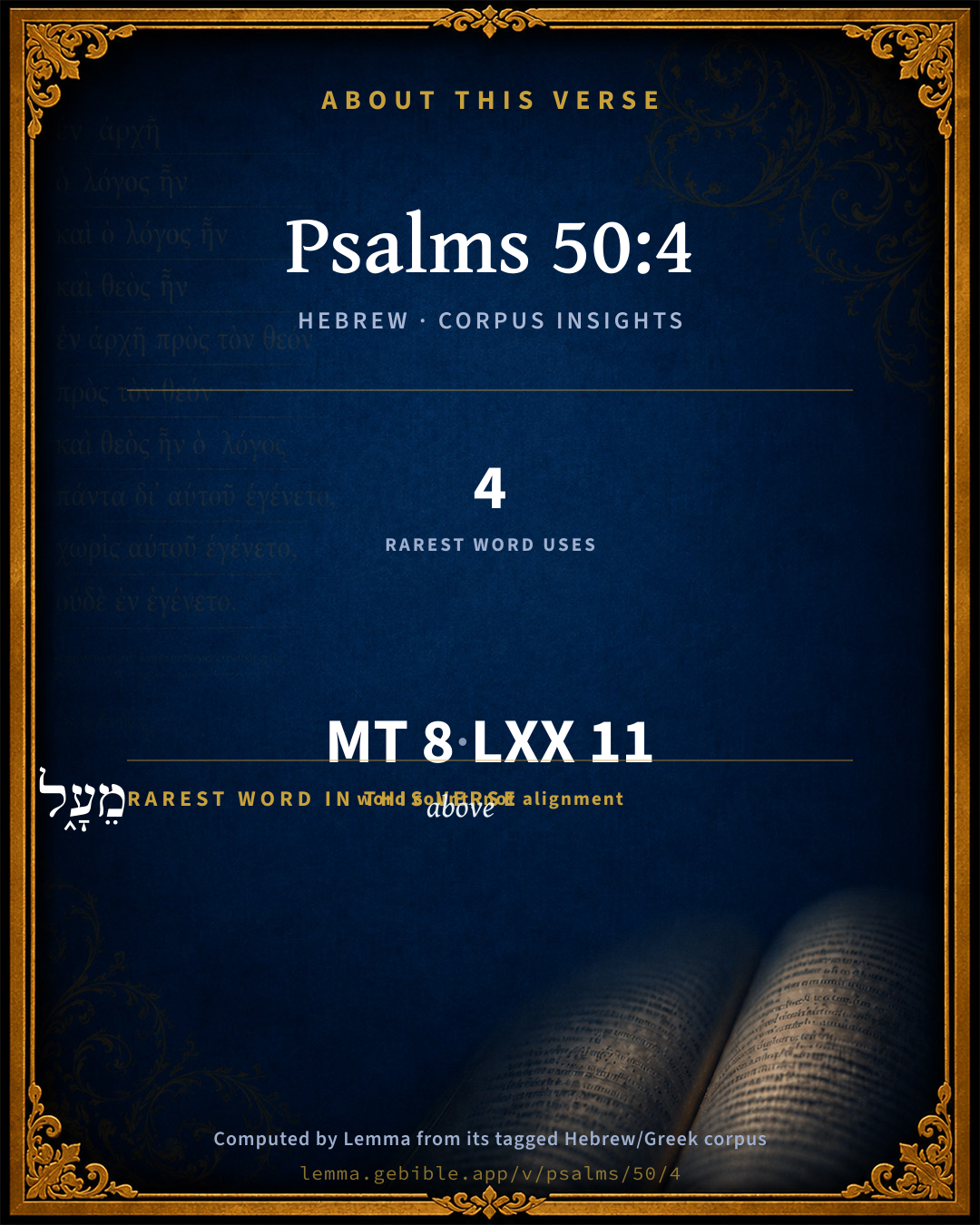
The rarest word here is מֵעָ֑ל above H5920 — appearing just 4 times in the whole Hebrew Bible.

Shared distinctive vocabulary

מֵעָ֑ל above H5920 occurs in 4 verses of the Hebrew Bible. Also found in:

Grammatical profile

  • 2 verbs
  • 4 nouns
  • 2 prepositions

Verb forms

  • יִקְרָ֣א Qal · Imperfect
  • לָדִ֥ין Qal · Infinitive Construct

Repetition

A word recurs within this verse — often emphatic in Hebrew:

  • אֶל to H413 ×2

Hebrew & Septuagint length

In English translation the verse runs 15 words from the Hebrew and 15 from the Septuagint (LXX English) — the same length.

A rough comparison of the two English renderings, which tokenize alike — not a word-level alignment.

Word counts can differ between the Hebrew and the Greek without any difference in meaning — e.g. the Hebrew direct-object marker אֵת has no separate Greek word, and Greek often adds the article ὁ.

In the original languages it is 8 Hebrew tokens and 11 Greek tokens — but the two are counted differently (Hebrew bundles its prefixes and suffixes into one token; the Greek is in lemma form), so that isn’t a like-for-like length.

Cross-references

12

Topical passages linked to Psalms 50:4 in the Treasury of Scripture Knowledge — connected by theme and wording, ordered by reader-vote popularity; previews shown in the World English Bible.

  • Deuteronomy 31:28 Assemble to me all the elders of your tribes, and your officers, that I may speak these words in their ears, and call heaven and earth to witness against them.
  • Deuteronomy 32:1 Give ear, you heavens, and I will speak; Let the earth hear the words of my mouth.
  • Isaiah 1:2 Hear, heavens, And listen, earth; for Yahweh has spoken: I have nourished and brought up children, And they have rebelled against me.
  • Deuteronomy 4:26 I call heaven and earth to witness against you this day, that you shall soon utterly perish from off the land whereunto you go over the Jordan to possess it; you shall not prolong your days on it, but shall utterly be destroyed.
  • Deuteronomy 30:19 I call heaven and earth to witness against you this day, that I have set before you life and death, the blessing and the curse: therefore choose life, that you may live, you and your seed;
  • Micah 6:1–2 Listen now to what Yahweh says: "Arise, plead your case before the mountains, And let the hills hear what you have to say.
  • Psalms 98:9 Let them sing before Yahweh, For he comes to judge the earth. He will judge the world with righteousness, And the peoples with equity.
  • Isaiah 11:3–4 His delight shall be in the fear of Yahweh; and he shall not judge after the sight of his eyes, neither decide after the hearing of his ears;
  • John 5:22–23 For the Father judges no one, but he has given all judgment to the Son,
  • Deuteronomy 4:36 Out of heaven he made you to hear his voice, that he might instruct you: and on earth he made you to see his great fire; and you heard his words out of the midst of the fire.
  • Psalms 50:6 The heavens shall declare his righteousness, For God himself is judge. Selah.
  • Psalms 96:13 Before Yahweh; for he comes, For he comes to judge the earth. He will judge the world with righteousness, The peoples with his truth.

Cross-references courtesy of OpenBible.info (CC BY 4.0).

Hebrew and Greek witnesses Masoretic Hebrew ↔ Greek Septuagint

The same verse in the two great witnesses to the Old Testament, shown verse-for-verse.

You’re reading Greek Psalm 49 (Hebrew Psalm 50). The Septuagint counts the superscription, so verse numbers can differ from the Hebrew — chapter-level alignment, not verse-by-verse. Numbering follows Rahlfs.

These are two independent witnesses, not word-aligned to each other, and the Septuagint is shown in lemma (dictionary) form.

Hebrew Psalms 50:4 Masoretic · Westminster Leningrad Codex

יִקְרָ֣א אֶל הַשָּׁמַ֣יִם מֵעָ֑ל וְאֶל הָ֝אָ֗רֶץ לָדִ֥ין עַמּֽוֹ

He calls to the heavens above, To the earth, that he may judge his people:

World English Bible · Public Domain

Greek LXX Greek Psalm 49:4 Septuagint · lemma form

προςκαλέω ὁ οὐρανός ἄνω καί ὁ γῆ διακρίνω ὁ λαός αὐτός

He shall summon the heaven above, and the earth, that he may judge his people.

LXX2012 (modern English Septuagint) · Public Domain

Hebrew: Westminster Leningrad Codex (CC BY 4.0). Greek: Septuagint (public domain); English from LXX2012 (modern English Septuagint) (Public Domain). How the Septuagint differs from the Hebrew →

Commentary

Notes on Psalms 50:4 from classic Christian and Jewish commentators (each source and its license shown beneath its notes). The classic Christian expositions comment on the surrounding passage and are grouped to its opening verse, so a note may address several verses; the Jewish commentaries on the Tanakh (Rashi and others) are per-verse, so they appear only where the commentator wrote on this verse.

Lemma curates 59 commentaries, every one of them public domain or Creative Commons licensed, each selected and text-cleaned for this edition rather than reprinted as found. About our sources →

Trapp's Complete Commentary

John Trapp

Psa 50:4 He shall call to the heavens from above, and to the earth, that he may judge his people.

Ver. 4. He shall call to the heavens from above, and to the earth] That these dumb creatures may be as so many speaking evidences against an unworthy people, and witnesses of God’s righteous dealings against them. See Deu 32:1 Isa 1:2 Mic 6:2. The Chaldee thus paraphraseth, He will call the high angels from above; and the just of the earth from beneath.

John Trapp, A Commentary or Exposition upon All the Books of the Old and New Testament (1647–1656) — public domain. Text from a community e-Sword module.

The Biblical Illustrator

Joseph S. Exell

Psa_50:4-6

He shall call to the heavens from above, and to the earth, that He may judge His people.

Nature, a witness against the sinner

But she seems, oftentimes, utterly insensible. The most bounteous gifts are bestowed on saint and sinner alike. No matter what outrages on all righteousness and goodness men may be guilty of, she takes no notice. No lightning-bolt leaps forth on the impious head, and the solid earth does not yawn to engulf the perpetrator of iniquity. But, nevertheless, Scripture speaks of Nature as if it were a conscious witness of the moral history of man, as here in our text (cf. also Isa_1:1; Mic_6:1; Deu_31:28). What is the import of this appeal, in which heaven and earth are called upon to bear record?

I. The material world may be thus summoned to witness, as containing the scenes of mans crimes. Nature keeps a silent record of them in the associations of the places where they were committed. Bring the sinner to the scene of his past misdeeds, and he will sometimes feel as if all the objects around were endowed with a voice of reproachful reminiscence. How great is the power of local association, whether the deeds done there have boon noble or the reverse. There are places on which we wish never to look again because of that of which they remind us. Thus the whole earth may become full of such reminders, and so may be a faithful record to the eye that can read them.

II. By its fulfilling, in contrast with man, the end of its existence. All things are judged as they answer to the ends for which they were made. How, then, does the material world witness against us.

III. As affording proof of the unerring certainty and strictness of the divine laws. Their operation is invisible and uniform; slow, oftentimes, but sure. Only the interposition of a higher law, as in the Redemption of Christ, can save the sinful man. (John Caird, D. D.)

The Biblical Illustrator, edited by Joseph S. Exell (c. 1880s–1900s) — public domain. Text from a community e-Sword module.

Tyndale Open Study Notes

Tyndale Open Resources

50:4-6 The Lord is coming to bring righteousness. This hope encourages his faithful people, but those who have been unfaithful will not experience blessing when the heavens above and earth below testify against them (cp. Deut 30:19; 31:28; 32:1; Isa 1:2). The Lord comes to restore order to the world (Pss 5:8; 22:31; 33:5; 40:9; 50:6; 71:16; 97:6).

Tyndale Open Study Notes — © Tyndale Open Resources, licensed CC BY-SA 4.0. Text via the HelloAO Bible API.

Geneva Bible (1599)

Geneva Bible translators

As witnesses against the hypocrites.

Geneva Bible (1599) marginal notes — public domain. Text via Bolls.life.

Jamieson, Fausset & Brown

Robert Jamieson, A. R. Fausset & David Brown

above--literally, "above" (Gen 1:7).

heavens . . . earth--For all creatures are witnesses (Deu 4:26; Deu 30:19; Isa 1:2).

Jamieson, Fausset & Brown — Commentary Critical and Explanatory on the Whole Bible (1871) — public domain (CC PDM 1.0). Text via the HelloAO Bible API.

John Calvin's Commentaries

4. He shall call to the heavens from above It is plain from this verse for what purpose God, as he had already announced, would call upon the earth. This was to witness the settlement of his controversy with his own people the Jews, against whom judgment was to be pronounced, not in the ordinary manner as by his prophets, but with great solemnity before the whole world. The prophet warns the hypocritical that they must prepare to be driven from their hiding-place, that their cause would be decided in the presence of men and angels, and that they would he dragged without excuse before that dreadful assembly. It may be asked, why the prophet represents the true fearers of the Lord as cited to his bar, when it is evident that the remonstrance which follows in the psalm is addressed to the hypocritical and degenerate portion of the Jews? To this I answer, that God here speaks of the whole Church, for though a great part of the race of Abraham had declined from the piety of their ancestors, yet he has a respect to the Jewish Church, as being his own institution. He speaks of them as his meek ones, to remind them of what they ought to be in consistency with their calling, and not as if they were all without exception patterns of godliness. The form of the address conveys a rebuke to those amongst them whose real character was far from corresponding with their profession. Others have suggested a more refined interpretation, as if the meaning were, Separate the small number of my sincere worshippers from the promiscuous multitude by whom my name is profaned, lest they too should afterwards be seduced to a vain religion of outward form. I do not deny that this agrees with the scope of the prophet. But I see no reason why a church, however universally corrupted, provided it contain a few godly members, should not be denominated, in honor of this remnant, the holy people of God. Interpreters have differed upon the last clause of the verse: Those who strike a covenant with me over sacrifices, Some think over is put for besides, or beyond, and that God commends his true servants for this, that they acknowledged something more to be required in his covenant than an observance of outward ceremonies, and were not chargeable with resting in the carnal figures of the Law. Others think that the spiritual and true worship of God is here directly opposed to sacrifices; as if it had been said, Those who, instead of sacrifices, keep my covenant in the right and appointed manner, by yielding to me the sincere homage of their heart. But in my opinion, the prophet is here to be viewed as pointing out with commendation the true and genuine use of the legal worship; for it was of the utmost consequence that it should be known what was the real end for which God appointed sacrifices under the Law. The prophet here declares that sacrifices were of no value whatever except as seals of God’s covenant, an interpretative handwriting of submission to it, or in general as means employed for ratifying it. There is an allusion to the custom then universally prevalent of interposing sacrifices, that covenants might be made more solemn, and be more religiously observed. In like manner, the design with which sacrifices were instituted by God was to bind his people more closely to himself, and to ratify and confirm his covenant. The passage is well worthy of our particular notice, as defining those who are to be considered the true members of the Church. They are such, on the one hand, as are characterised by the spirit of meekness, practising righteousness in their intercourse with the world; and such, on the other, as close in the exercise of a genuine faith with the covenant of adoption which God has proposed to them. This forms the true worship of God, as he has himself delivered it to us from heaven; and those who decline from it, whatever pretensions they may make to be considered a church of God, are excommunicated from it by the Holy Spirit. As to sacrifices or other ceremonies, they are of no value, except in so far as they seal to us the pure truth of God. All such rites, consequently, as have no foundation in the word of God, are unauthorised, and that worship which has not a distinct reference to the word is but a corruption of things sacred.

John Calvin's Commentaries (1540-1563) — public domain. Text from the Calvin Translation Society English edition (1840s-50s) via the Christian Classics Ethereal Library (ccel.org). Calvin's coverage is partial (roughly two-thirds of the Bible); uncommented books and verses are honest gaps, never fabricated. The 19th-century editor's footnotes and remarks are omitted so the notes are faithfully Calvin's own voice.

Ellicott's Commentary for English Readers

(4) He shall call.—Better, He calls. The poet actually hears the summons go forth calling heaven and earth as witnesses, or assessors (comp. Mic_6:2), of the judgment scene. (Comp. Deu_4:26; Deu_32:1; Isa_1:2; Mic_1:2; 1Ma_2:37.)

Israel, politically so insignificant, must have been profoundly conscious of the tremendous issues involved in its religious character to demand a theatre so vast, an audience so august.

A Bible Commentary for English Readers, edited by Charles John Ellicott (1878–1897) — public domain. Text from a community e-Sword module.

The Cambridge Bible for Schools and Colleges

gen. ed. J. J. S. Perowne

4. He shall call to the heavens from above] Better, in continuation of the preceding verse, Let him call to the heavens above. The object of the summons is ‘that he may judge his people.’ Heaven and earth, the whole world of nature, are summoned to be witnesses of the judgement, for they are far older than man, and have watched the whole course of Israel’s history. Cp. Deu_4:26; Deu_4:32; Deu_31:28; Deu_32:1; Isa_1:2; Mic_1:2; Mic_6:1-2. The poetical idea finds a strange equivalent in the conception of modern science that every action is recorded by a corresponding physical change, so that Nature is in truth a witness to the actions of man[25].

[25] See Babbage, Ninth Bridgewater Treatise, ch. 9., “On the Permanent Impression of our Words and Actions on the Globe we inhabit.”

The Cambridge Bible for Schools and Colleges (gen. ed. J. J. S. Perowne; Cambridge University Press, 1878–1918) — public domain. Text from a community e-Sword module.

John Gill's Exposition

He shall call to the heavens from above, and to the earth,.... To hear what he shall say, when he will no longer keep silence; and to be witnesses of the justice of his proceedings; see Isa 1:2. The Targum interprets this of the angels above on high, and of the righteous on the earth below; and so Aben Ezra, Kimchi, and Ben Melech, explain it of the angels of heaven, and of the inhabitants of the earth;

that he may judge his people; not that they, the heavens and the earth, the inhabitants of either, may judge his people; but the Lord himself, as in Psa 50:6; and this designs not the judgment of the whole world, nor that of his own covenant people, whom he judges when he corrects them in love, that they might not be condemned with the world; when he vindicates them, and avenges them on their enemies, and when he protects and saves them; but the judgment of the Jewish nation, his professing people, the same that Peter speaks of, Pe1 4:17.

John Gill's Exposition of the Whole Bible (1746–1763) — public domain (CC PDM 1.0). Text via the HelloAO Bible API.

Albert Barnes' Notes on the Bible

He shall call to the heavens from above - He will call on all the universe; he will summon all worlds. The meaning here is, not that he will gather those who are in heaven to be judged, but that he will call on the inhabitants of all worlds to be his witnesses; to bear their attestation to the justice of his sentence. See Psa 50:6. The phrase “from above” does not, of course, refer to the heavens as being above God, but to the heavens as they appear to human beings to be above themselves.

And to the earth - To all the dwellers upon the earth; “to the whole universe.” He makes this universal appeal with the confident assurance that his final sentence will be approved; that the universe will see and admit that it is just. See Rev 15:3; Rev 19:1-3. There can be no doubt that the universe, as such, will approve the ultimate sentence that will be pronounced on mankind.

That he may judge his people - That is, all these arrangements - this coming with fire and tempest, and this universal appeal - will be prepatory to the judging of his people, or in order that the judgment may be conducted with due solemnity and propriety. The idea is, that an event so momentous should be conducted in a way suited to produce an appropriate impression; so conducted, that there would be a universal conviction of the justice and impartiality of the sentence. The reference here is particularly to his professed “people,” that is, to determine whether they were truly his, for that is the main subject of the psalm, though the “language” is derived from the solemnities appropriate to the universal judgment.

Albert Barnes' Notes on the Bible (1834–1885) — public domain. Text from a community e-Sword/MySword module.

Matthew Poole's English Annotations

Either to heaven and earth themselves, and so it is a figure called prosopopoeia; or to the inhabitants of them, all angels and men, whom he calls in for witnesses and judges of the equity of his present proceedings. Compare Deu 4:26; Deu 31:28; 32:1. That he may judge his people, to wit, in their presence and hearing.

Matthew Poole's English Annotations on the Holy Bible (1683–1685) — public domain. Text from a community e-Sword/MySword module.

The Treasury of David

Charles H. Spurgeon

Ver. 4. He shall call to the heavens from above, and to the earth. Angels and men, the upper and the lower worlds, are called to witness the solemn scene. The whole creation shall stand in court to testify to the solemnity and the truth of the divine pleading. Both earth beneath and heaven above shall unite in condemning sin; the guilty shall have no appeal, though all are summoned that they may appeal if they dare. Both angels and men have seen the guilt of mankind and the goodness of the Lord, they shall therefore confess the justice of the divine utterance, and say "Amen" to the sentence of the supreme Judge. Alas, ye despisers! What will ye do and to whom will ye fly? That he may judge his people. Judgment begins at the house of God. The trial of the visible people of God will be a most awful ceremonial. He will thoroughly purge his floor. He will discern between his nominal and his real people, and that in open court, the whole universe looking on. My soul, when this actually takes place, how will it fare with thee? Canst thou endure the day of his coming?

Ver. 4. He shall call to the heavens from above, and to the earth. That these dumb creatures may be as so many speaking evidences against an unworthy people, and witness of God's righteous dealings against them. See De 32:1 Isa 1:2 Mic 6:2. The Chaldee thus paraphrases: He will call the high angels from above; and the just of the earth from beneath. John Trapp.

Ver. 4.

1. What God will do for his people. He will judge them.

1. Deliver.

2. Defend.

3. Uphold.

2. The means at his disposal for this purpose. "He shall call, "etc. Heaven and earth are subservient to him for the good of his church. G. R.

Ver. 4. The judgment of the visible church. It will be by God himself, public, searchingwith fire and wind, exact, final.

Psalms 50:5*

Charles H. Spurgeon's The Treasury of David (1869–1885) — public domain. Psalms only. Text from a community e-Sword/MySword module.

Whedon's Commentary on the Bible

Daniel D. Whedon

4. The heavens… the earth—These are summoned as witnesses, as Deu_4:26; Deu_30:19

Daniel D. Whedon (gen. ed.), Commentary on the Old and New Testaments (1874–1909) — public domain. Text from a community e-Sword module.

The Pulpit Commentary

He shall call to the heavens from above; rather, to the heavens above; i.e. to the inhabitants of heaven the holy angels. And to the earth (comp. ver. 1). That he may judge his people. Heaven and earth are called upon to come together, and furnish a fit audience before which the judgment may proceed.

The Pulpit Commentary (1880–1919), ed. H.D.M. Spence-Jones & Joseph S. Exell — public domain. Text from a community e-Sword module.

John Wesley's Explanatory Notes

Call - To the inhabitants of them, all angels and men, whom he calls in for witnesses of the equity of his proceedings.

John Wesley, Explanatory Notes Upon the Whole Bible (1754–1765) — public domain. Text via the GEBible commentary corpus.

Keil & Delitzsch

C. F. Keil & F. Delitzsch

The judgment scene. To the heavens above (מעל, elsewhere a preposition, here, as in Gen 27:39; Gen 49:25, an adverb, desuper, superne) and to the earth God calls (קרא אל, as, e.g., Gen 28:1), to both לדין עמּו, in order to sit in judgment upon His people in their presence, and with them as witnesses of His doings. Or is it not that they are summoned to attend, but that the commission, Psa 50:5, is addressed to them (Olshausen, Hitzig)? Certainly not, for the act of gathering is not one that properly belongs to the heavens and the earth, which, however, because they exist from the beginning and will last for ever, are suited to be witnesses (Deu 4:26; Deu 32:1; Isa 1:2, 1 Macc. 2:37). The summons אספוּ is addressed, as in Mat 24:31, and frequently in visions, to the celestial spirits, the servants of the God here appearing. The accused who are to be brought before the divine tribunal are mentioned by names which, without their state of mind and heart corresponding to them, express the relationship to Himself in which God has placed them (cf. Deu 32:15; Isa 42:19). They are called חסידים, as in the Asaph Psa 79:2. This contradiction between their relationship and their conduct makes an undesigned but bitter irony. In a covenant relationship, consecrated and ratified by a covenant sacrifice (עלי־זבח similar to Psa 92:4; Psa 10:10), has God placed Himself towards them (Ex 24); and this covenant relationship is also maintained on their part by offering sacrifices as an expression of their obedience and of their fidelity. The participle כּרתי here implies the constant continuance of that primary covenant-making. Now, while the accused are gathered up, the poet hears the heavens solemnly acknowledge the righteousness of the Judge beforehand. The participial construction שׁפט הוּא, which always, according to the connection, expresses the present (Nah 1:2), or the past (Jdg 4:4), or the future (Jer 25:31), is in this instance an expression of that which is near at hand (fut. instans). הוּא has not the sense of ipse (Ew. 314, a), for it corresponds to the "I" in אני שׁפט or הנני שׁפט; and כּי is not to be translated by nam (Hitzig), for the fact that God intends to judge requires no further announcement. On the contrary, because God is just now in the act of sitting in judgment, the heavens, the witnesses most prominent and nearest to Him, bear witness to His righteousness. The earthly music, as the סלה directs, is here to join in with the celestial praise. Nothing further is now wanting to the completeness of the judgment scene; the action now begins.

Keil & Delitzsch — Biblical Commentary on the Old Testament (1861–1891) — public domain (CC PDM 1.0). Text via the HelloAO Bible API. (Old Testament only.)

Rashi

Rabbi Shlomo Yitzchaki (Rashi)

He shall call to the heavens to visit upon the celestial princes of the peoples.

and to the earth to visit upon the kings of the earth.

to avenge His people Heb. לדין, to avenge the vengeance of His people, as (Deut. 32:36): “For the Lord shall judge His people, and He shall avenge the blood of His servants.”

Rashi on the Tanakh — English translations: “The Judaica Press complete Tanach with Rashi, translated by A. J. Rosenberg” (CC BY 4.0); “Pentateuch with Rashi's commentary by M. Rosenbaum and A.M. Silbermann, 1929-1934” (public domain); “The Metsudah Tanach series, Lakewood, N.J” (CC BY 4.0); and “The Book of Joshua, Metsudah Publications, 1997” (CC BY 4.0). Text via Sefaria.

Lesson kit

Teaching starters — assembled from the data on this page, not authored interpretation. Every prompt links to the verse data it draws on. Edit before teaching.

Psalms, in the Wisdom, opens this verse with 8 words (7 distinct Hebrew lemmas). Its most distinctive word is ʻal (“above”). A historical commentator’s framing appears above. Read the whole chapter for the surrounding context.

Discussion questions

  1. How does “above” (ʻal) shape what this verse is saying?
  2. How does 2 Samuel 23:1, which shares the word «above», read alongside this verse?
  3. What does the repetition of “to” (2× in this one verse) do in this verse?
  4. These translations render this verse differently; the difference is in the English rendering, not the original. What questions does that raise?
  5. «יִקְרָ֣א» is a Qal Imperfect verb. How does that grammatical form shape the action described?
  6. Compare how Trapp's Complete Commentary and The Biblical Illustrator read this verse. Where do they agree or differ?

Things to notice

Reading settings

Reading text

Shown beneath each verse's original-language words.

Old Testament
Old Testament edition

Read the OT as the Masoretic Hebrew (MT) or the Greek Septuagint (LXX).

English shown for the Greek Septuagint (in the Hebrew ↔ Greek comparison).

Comparing translations? Open the Compare panel on any verse page to stack up to four side by side.